Managing a loved one’s trust can feel overwhelming, especially when family members start asking the same hard question. Why did one beneficiary receive more than another? If you’re the trustee, you may worry that every decision will be second-guessed. If you’re a beneficiary, you may wonder whether something unfair, or unlawful, is happening.
That tension is common in Texas families. One child may need help with medical care. Another may be financially stable. A surviving spouse may depend on trust income now, while children from a prior marriage care a great deal about what will remain later. In those moments, fairness can feel personal.
The legal answer to can a trustee favor one beneficiary over another Texas isn't found in one sentence alone. The answer usually lives in two places at once. First, Texas law sets the default rule. Second, the trust document may change how that rule works in a particular family.
That combination is where people get confused. Many readers have heard that a trustee must “treat everyone equally.” That’s not always the right way to think about it. In trust law, impartial doesn’t always mean identical. It often means the trustee must follow the creator’s written instructions while still acting fairly, reasonably, and in good faith.
Navigating Trust Administration with Confidence
A familiar situation goes like this. A parent dies, a trust becomes active, and one sibling learns the trustee approved a distribution for another sibling’s living expenses or tuition. The first reaction is often simple and emotional. “That’s not fair.”
Sometimes that reaction is justified. Sometimes it isn’t. The hard part is that trust administration sits at the intersection of grief, money, family history, and legal duty. People bring old resentments into very technical decisions.
The starting point is this. A trustee doesn’t get to make choices based on personal preference. A trustee must follow the trust and follow Texas fiduciary law. If those two line up clearly, the answer may be straightforward. If the trust uses broad or vague language, things can get complicated quickly.
A trustee’s job is less like being a parent deciding what feels fair and more like being a referee who must apply written rules consistently.
That’s why the exact words your loved one chose matter so much. A trust may require equal shares. It may permit different distributions based on need. It may give discretion, but not unlimited freedom. Those differences can completely change whether unequal treatment is proper.
Families also get tripped up by terminology. “Beneficiary” can mean a current beneficiary receiving support now, or a remainder beneficiary who may inherit later. Their interests can conflict. A trustee often has to balance both.
If you’re serving as trustee, or questioning what a trustee is doing, clarity starts with careful reading and careful records. Texas law provides the framework, but the trust document often supplies the definitive answer.
The Trustee's Core Duty of Impartiality in Texas
Under Texas law, the default rule is clear. A trustee can't favor one beneficiary over another unless the trust itself clearly allows that unequal treatment. Texas recognizes this as the duty of impartiality. The duty requires a trustee to treat beneficiaries and classes of beneficiaries fairly while balancing competing interests, as explained in this discussion of the Texas trustee’s duty of impartiality.

What impartiality really means
Many people hear “impartiality” and think “equal dollars every time.” That’s too simplistic. In practice, impartiality means the trustee must weigh the interests of everyone the trust is supposed to protect.
Think of a trustee like someone holding a set of scales. On one side may be a surviving spouse who needs income now. On the other side may be children who will receive what’s left later. The trustee can’t dump all the weight on one side just because of a personal bond, pressure from one family member, or a desire to avoid conflict.
A trustee also owes related fiduciary duties, including loyalty, prudence, and fair dealing. These duties work together. Loyalty means the trustee must put the trust’s purposes and beneficiary interests ahead of personal motives. Prudence means the trustee must make careful decisions, including investment decisions. Fair dealing means the trustee must act with integrity and consistently.
Why this duty matters in real life
Impartiality becomes most visible when beneficiaries want different things. One beneficiary may want larger current distributions. Another may want the trustee to preserve principal. A trustee must manage that tension without picking favorites.
Here’s a simple example:
| Situation | Improper approach | Proper approach |
|---|---|---|
| Surviving spouse wants more income | Trustee gives repeated extra payments because they feel sympathy, without trust authority | Trustee checks trust terms, reviews the spouse’s needs, and considers the effect on remainder beneficiaries |
| Two children request support | Trustee approves one request because that child is closer personally | Trustee uses the same standards for both requests |
| Trust investments | Trustee favors long-term growth only because one beneficiary will inherit later | Trustee considers both current income needs and future preservation |
Practical rule: If a trustee’s decision can only be explained by personal preference, the trustee is probably off course.
What happens if a trustee ignores the duty
Texas courts take this duty seriously. When a trustee acts with favoritism instead of reasoned judgment, that can amount to a fiduciary breach. Courts may order remedies that can include removal, financial responsibility for losses, or other corrective action.
That matters because trust disputes often begin with small decisions. One unexplained distribution. One ignored request for information. One pattern of silence. Over time, beneficiaries stop assuming the trustee is being fair and start assuming the trustee is protecting someone else.
How the Trust Document Defines a Trustee's Powers
A family often starts with the same question: “Is the trustee being fair?” In Texas, the better first question is narrower and more useful: “What does the trust say the trustee can do?” The answer often turns on a few words your loved one chose, and those words can change the result in a very personal way.

A trust works like a set of instructions left behind for the trustee. Texas law supplies default rules, but the document often fills in the details that matter most. That is why two families with similar disputes can get different answers. The law may be the same, yet the wording in the trust is different.
Start with the verbs.
If the trust says a beneficiary “shall receive” income, principal, or a stated amount once a condition is met, the trustee usually has little room to improvise. “Shall” points toward a duty. If the trust says the trustee “may distribute” funds for health, education, maintenance, or support, the trustee has judgment to exercise. That judgment still has to stay inside the boundaries the settlor wrote.
This is the point many families miss. Broad authority is not personal authority. It is authority tied to the document’s purpose. A trustee deciding whether to approve distribution of trust assets under Texas trust terms should read the distribution clause the way a careful contractor reads a blueprint. If the blueprint allows a window in one wall but not another, preference does not change the plan.
Mandatory terms and discretionary terms
Mandatory language usually creates a direct obligation. Discretionary language gives the trustee room to weigh facts, timing, and need. The difference matters because many conflicts come from treating a discretionary clause as if it were unlimited.
Texas law recognizes that trustees may have broad discretion, yet that discretion still has limits. As discussed in this analysis of distribution requests under Texas trust law, even clauses that sound broad, such as “absolute discretion,” are not a blank check if used unreasonably or in bad faith.
The words that deserve close attention
Certain phrases carry more weight than families expect:
- “Sole discretion” gives the trustee decision-making authority, but it does not erase fiduciary duties.
- “Absolute discretion” sounds sweeping, yet a trustee still must act in good faith and for a proper purpose.
- “Health, education, maintenance, and support” creates a standard to apply, not a license to favor one person for personal reasons.
- “Equal shares” usually means the trustee should divide benefits equally unless another clause clearly changes that result.
- “Unequal distributions” or similar language may allow different treatment, but the permission needs to come from the trust’s wording, not the trustee’s personal view of who deserves more.
Sometimes intent appears indirectly rather than in one dramatic sentence. A trust may create separate shares for a surviving spouse and for children. It may give one beneficiary access to educational support and another beneficiary support tied to a disability or long-term care need. In that setting, different treatment may be exactly what the settlor planned.
Why wording problems lead to family conflict
Unclear drafting puts the trustee in a hard position. If a trust says, “my trustee may make unequal distributions as needed,” but never explains what “needed” means, each beneficiary may hear that phrase differently. One hears medical need. Another hears financial hardship. A third hears favoritism.
That is why trust disputes often come down to interpretation before they ever become accusations. The core question is usually whether the trustee followed the words on the page with a reasonable, documented process. A trustee who can point to the exact clause, the exact standard, and the facts considered is on much firmer ground than a trustee who can only say, “I thought this was best.”
The better question is not whether one beneficiary received more. It is whether the trust authorized that result and the trustee applied the written standard faithfully.
Permissible Reasons for Unequal Trust Distributions
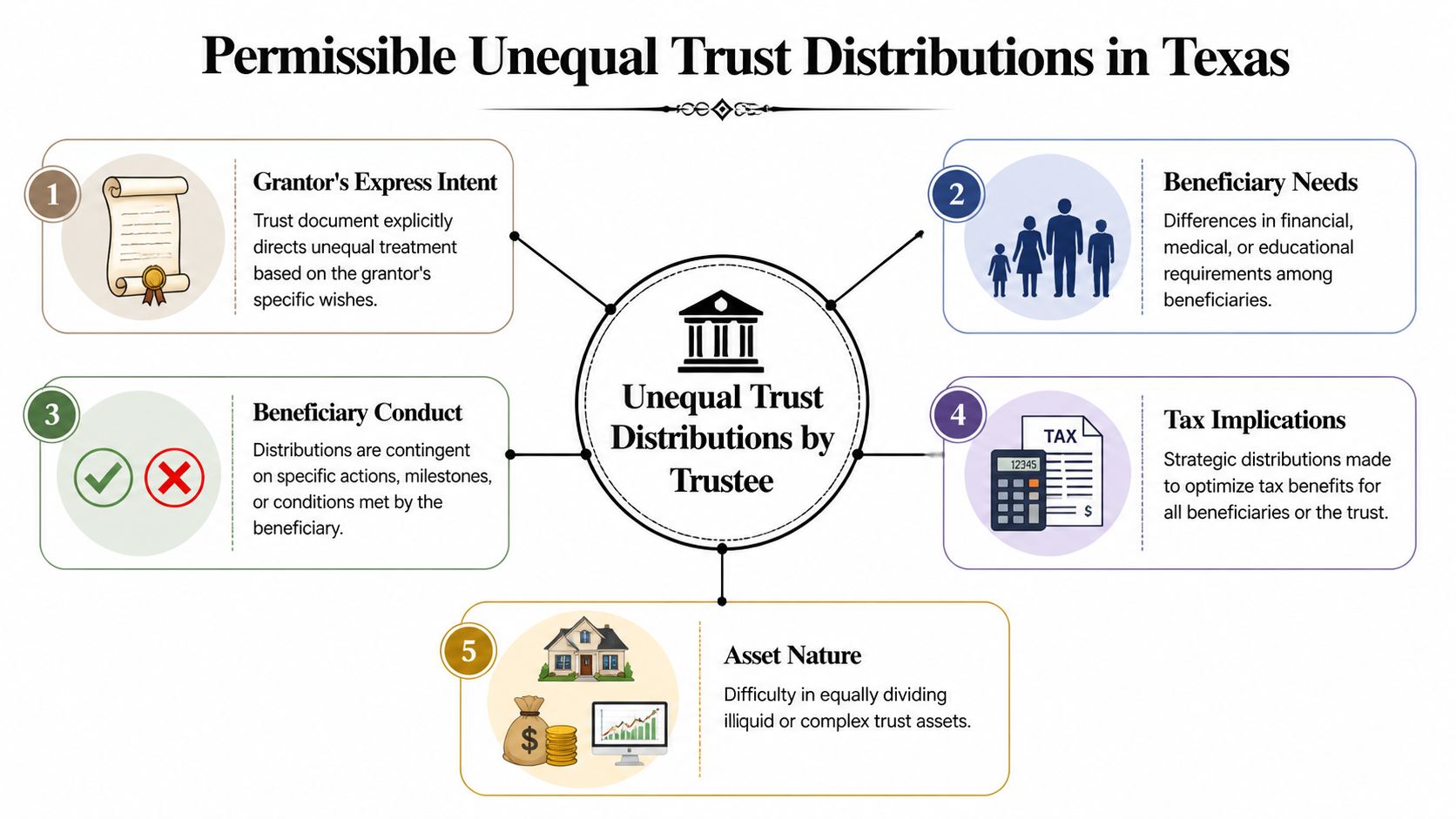
A trustee may be allowed, and sometimes required, to make unequal distributions. That can be lawful when the trust language supports it and the trustee applies the proper standard. The key is that the difference must come from the trust’s purpose or the beneficiaries’ circumstances, not personal favoritism.
A few situations where unequal treatment may be proper
Consider a trust that allows distributions for health, education, maintenance, and support, often called HEMS. If one beneficiary needs surgery or specialized treatment and another doesn’t, the trustee may have a valid reason to distribute more to the first beneficiary. That isn't necessarily favoritism. It may be faithful administration.
The same can be true with education. If one child is in college and the trust allows educational support, paying that child’s tuition doesn't automatically require making an identical payment to a sibling who has no educational expense at that time.
Another example involves the trust creator’s specific intent. A grandparent may have wanted a beneficiary’s share held back until that person reaches a certain age, maintains employment, finishes a program, or meets another condition written into the trust. If the trustee follows those directions, the unequal result may be exactly what the grantor intended.
You also see uneven distributions when the trust holds assets that aren't easy to divide. A family business, ranch interest, or house may require a practical approach instead of simple equal slicing. The trustee still has to act fairly, but fairness may involve timing, valuation, or offsetting assets rather than identical distributions on the same day.
For a closer look at how trustees handle these issues in practice, families often review guidance on the distribution of trust assets in Texas.
Equal isn't always the same as fair
This distinction helps many families calm down enough to analyze the issue properly.
| Scenario | Could unequal treatment be proper | Why |
|---|---|---|
| One beneficiary needs funds for major medical care | Yes | The trust may allow support based on health needs |
| One beneficiary requests vacation money and another requests tuition | Possibly | Educational expenses may fit the trust standard more clearly |
| One beneficiary met a condition in the trust and another did not | Yes | The trustee may be following the document’s conditions |
| Trust owns a single house | Yes | The trustee may need a practical distribution method rather than identical division right away |
What lawful decision-making looks like
A trustee should be able to answer three questions for any unequal distribution.
- What exact language in the trust supports this decision?
- What facts about the beneficiary’s situation matter under that language?
- How did the trustee consider the effect on the other beneficiaries?
If the trustee can’t answer those questions, the decision starts to look arbitrary.
Unequal treatment becomes easier to defend when the trustee can connect the dots between the trust language, the beneficiary’s actual need, and the trust’s overall purpose.
A good trustee also avoids making decisions from memory or family assumptions. If the trust uses a support standard, the trustee should gather real information. Medical bills, school invoices, budgets, or other documentation can matter. Written records protect the trustee and reassure beneficiaries that the process isn't personal.
Red Flags That Indicate a Breach of Fiduciary Duty
Not every unequal distribution is wrongful. Some are proper. But some patterns should put beneficiaries and trustees on alert quickly.

One of the clearest danger zones is when the trustee is also a beneficiary. Texas law allows that setup, but the conflict risk is obvious. According to this discussion of whether a trustee can also be a beneficiary in Texas, dispute risk rises by an estimated 35% in these arrangements. That doesn't mean every dual-role trustee is acting improperly. It does mean everyone should pay closer attention to process, disclosures, and documentation.
Warning signs families shouldn't ignore
A trustee may be crossing the line if you see patterns like these:
- Self-serving distributions that seem to benefit the trustee personally while others are delayed or denied.
- Inconsistent explanations where similar requests receive different answers without a clear reason.
- No documentation supporting why one beneficiary received funds and another didn’t.
- Silence or secrecy when beneficiaries ask for basic information.
- Use of trust property for personal advantage, which can raise serious concerns about trustee self-dealing under Texas law.
Self-dealing is especially serious. If a trustee sells trust property to themselves at a bargain price, borrows from the trust for personal benefit, or manipulates distributions to increase their own advantage, that usually isn't a gray area. It's a fiduciary problem.
Improper favoritism often looks arbitrary
Beneficiaries often ask, “How do I tell the difference between a hard decision and a bad-faith decision?” One useful test is whether the trustee can show a reason anchored in the trust.
If the explanation is, “I know what Mom would have wanted,” that may not be enough. If the explanation is, “Section 4.2 allows support distributions for medical necessity, and I approved this request after reviewing the invoices,” that looks very different.
This short video gives additional context on how trust conflict issues can develop in practice.
Common breach patterns
Warning sign: When one beneficiary gets transparency and another gets excuses, the problem may be process, not just outcome.
A few examples come up often in Texas trust disputes:
| Conduct | Why it raises concern |
|---|---|
| Trustee approves their own request quickly but stalls others | Suggests conflict of interest |
| Trustee refuses to explain standards used | Suggests arbitrary decision-making |
| Trustee treats family closeness as a distribution factor | Personal preference is not a trust standard |
| Trustee mixes trust property with personal interests | May indicate self-dealing |
The law can provide remedies when a breach occurs. A beneficiary may seek information, demand an accounting, ask a court to review conduct, or pursue removal of the trustee. A trustee who has made questionable decisions should take concerns seriously early, before routine mistrust turns into formal litigation.
Guidance for Trustees and Beneficiaries
A family often reaches this point after one hard conversation. One beneficiary says, “Why did she get money for medical bills when I was told no?” The trustee says, “I’m doing my best.” Both sides may feel wronged, but the answer usually turns on something more concrete. The specific words in the trust, the records behind the decision, and whether the trustee followed a fair process.
That is the part many families miss. Texas law sets the ground rules, but the trust document often decides how those rules apply in real life. A trustee may have room to make different decisions for different people. A trustee may also cross the line if those decisions rest on favoritism, poor records, or personal loyalties instead of the written terms.
If you're the trustee
Start with the trust as written. A trustee’s job works a lot like following a set of instructions left by someone who is no longer in the room to clarify what they meant. Your memory of that person matters far less than the words they signed.
A practical checklist can keep you out of trouble:
- Read the distribution standard closely. Focus on words such as “shall,” “may,” “support,” “maintenance,” “health,” “education,” and any conditions tied to age, milestones, or behavior.
- Match the facts to the language. If a beneficiary asks for help with tuition, medical care, or living expenses, note which provision applies and which facts support the request.
- Write down the reason for your decision. A short memo in the file can explain the request, the trust provision you relied on, the documents reviewed, and why you approved or denied it.
- Use one review method for everyone. Different outcomes can be proper. Different standards for similar requests create risk.
- Give beneficiaries the information they are entitled to receive. Clear accountings and timely responses often prevent suspicion from turning into a legal dispute.
- Get professional advice when the wording is unclear. Trustees often consult a CPA, financial advisor, bank trust department, or a Texas trust administration lawyer. The Law Office of Bryan Fagan, PLLC is one Texas-based option for guidance on administration, disputes, estate planning, probate, guardianship, and asset protection.
One practical habit matters more than trustees expect. Keep a file that would make sense to a stranger. If a judge, mediator, or beneficiary reads it later, the file should show that your decision came from the trust document and verified facts, not family pressure.
If you're a beneficiary
Begin with a careful request for information. A trustee’s decision may be lawful even when it feels uneven, especially if the trust allows discretion based on health, support needs, age, or another stated standard.
Try this sequence:
- Ask for the exact trust language that supports the decision. A trustee should be able to point to a section, not just give a general impression.
- Request a written explanation. Ask what facts were considered and how the trustee applied the trust terms.
- Ask for an accounting or supporting records if needed. Paperwork often answers questions that family conversations do not.
- Compare process, not just outcome. If two beneficiaries made similar requests, were they asked for the same documents and judged under the same standard?
- Speak with counsel if responses stay vague. Unclear answers, repeated delays, or shifting explanations can signal a larger problem.
This approach helps in two ways. It gives you a fair chance to see whether the trustee acted properly, and it creates a clear record if stronger action later becomes necessary.
A simple framework for both sides
The strongest trust decisions are the ones a trustee can tie to the trust’s actual words, support with records, and explain in plain English.
That standard keeps everyone focused on the right question. Equal treatment does not always mean identical distributions. Unequal treatment does not always mean misconduct. The main issue is whether the trustee handled the decision in a way the trust permits and Texas fiduciary rules require.
Disputes become expensive, time-consuming, and personal very quickly. Early documentation, clear explanations, and prompt legal advice can prevent a disagreement over one distribution from turning into a much larger fight.
If you’re managing a trust or questioning a trustee’s conduct, outside guidance can help sort out what the trust says, what Texas law requires, and what steps make sense next.
If you’re managing a trust or planning your estate, contact Law Office of Bryan Fagan, PLLC for a free consultation. Our attorneys provide Texas-based guidance for trust administration, disputes, estate planning, probate, guardianship, and asset protection.