Managing a loved one’s trust can feel overwhelming, especially when grief and family tension are happening at the same time. Many people searching for what happens when siblings fight over a trust in Texas aren’t looking for courtroom drama. They want straight answers, a path forward, and some way to protect both their rights and their family if that’s still possible.
A trust is supposed to make things easier. But when one sibling is the trustee, another feels shut out, and no one agrees on what Mom or Dad intended, the trust can become the center of a painful conflict. Texas law gives trustees real power, but it also places strict duties on them. Beneficiaries also have rights, and those rights matter most when communication breaks down.
When Family Trusts Lead to Family Feuds
Most trust disputes don't begin with a lawsuit. They start with a phone call that isn't returned, an accounting that never arrives, or a sibling who says, “Just trust me,” while refusing to share records.
That kind of silence can turn grief into suspicion very quickly. One sibling may think the trustee is being careful. Another may think money is being hidden, delayed, or diverted. Both may carry years of family history into every conversation.

When conflict stops being just about money
Texas cases show how serious these disputes can become. In one Harris County case, a sibling fight over a family trust lasted nearly a decade, and in another Texas dispute involving a 446-acre farm, the conflict escalated into physical assault and felony charges, as described in this discussion of Texas sibling trust conflicts.
Those examples matter because they reflect a truth many families don't expect. A trust dispute is rarely only about the trust. It can become a fight about fairness, loyalty, caregiving, old resentments, and whether one child had more influence over a parent than the others.
A trust conflict can threaten more than assets. It can permanently change sibling relationships, holiday gatherings, and even personal safety in high-conflict families.
Why these disputes grow so fast
A few problems tend to make matters worse:
- Unclear trust language can leave room for competing interpretations.
- Uneven access to information can make one sibling feel powerless.
- Delayed distributions often create fear that money is being mishandled.
- Past family wounds can turn legal disagreement into personal warfare.
Texas law can't erase family history. But it can give structure to a situation that feels chaotic. Once you understand the trustee’s duties, the beneficiary’s rights, and the steps available in court or mediation, the dispute becomes easier to evaluate.
That doesn't make it easy. It does make it navigable.
Understanding Trustee Duties and Beneficiary Rights in Texas
When a sibling serves as trustee, that role isn't informal. It's a legal job governed by the Texas Trust Code and basic fiduciary principles. A trustee doesn't get to manage trust property however they want. They must manage it for the benefit of others.
What fiduciary duty means in plain English
A fiduciary duty is one of the highest duties recognized by law. In simple terms, the trustee must act with honesty, care, and loyalty toward the beneficiaries.
Think of the trustee as someone holding property that belongs in a practical sense to other people. Even if the trustee is also a beneficiary, they can't treat the trust like a personal account.
Key duties usually include:
- Duty of loyalty. The trustee must put the trust’s interests ahead of personal gain.
- Duty of prudence. The trustee must handle property carefully and make reasonable decisions.
- Duty of impartiality. If there are multiple beneficiaries, the trustee can't unfairly favor one over another.
- Duty to inform and account. The trustee must provide required information and keep proper records.
Under Texas law, these duties aren't optional. If co-trustees are involved, Texas law can also impose shared responsibility for failures in oversight.
What beneficiaries are entitled to ask for
Many beneficiaries hesitate because they don't want to seem aggressive. But asking for information is often the most responsible first step.
A beneficiary may need to request:
- A copy of the trust or relevant trust terms
- An accounting
- Bank and transaction records tied to trust activity
- Explanations for delayed distributions or major decisions
If you're unsure what you can request, this guide on rights of trust beneficiaries in Texas is a helpful starting point.
Practical rule: If a trustee keeps saying “everything is fine” but won't produce records, don't assume the delay is harmless. Lack of information is often the issue that pushes a family dispute into formal litigation.
Where readers often get confused
People often mix up these roles:
- Trustee means the person managing the trust.
- Beneficiary means the person who benefits from the trust.
- Settlor or grantor means the person who created the trust.
Another common point of confusion is fairness. Texas law doesn't require equal outcomes unless the trust says so. A sibling may feel hurt by an unequal distribution, but the legal question is whether the trustee followed the trust and fulfilled fiduciary duties.
That distinction is hard emotionally, but it's critical legally.
Common Grounds for Sibling Trust Disputes
Most sibling trust fights fall into a few recurring categories. The facts change, but the legal themes are familiar.

Breach of fiduciary duty
This is one of the most common claims. It usually means the trustee failed to meet the legal duties described above.
Examples may include:
- Using trust property personally
- Failing to keep records
- Delaying distributions without good reason
- Refusing to communicate with beneficiaries
- Favoring one beneficiary over another
Sometimes the issue is outright misconduct. Sometimes it's mismanagement dressed up as “informal family handling.” Courts look at conduct, records, and whether the trustee can justify decisions.
Undue influence and last-minute changes
Another major source of litigation is the claim that one sibling pressured a parent into changing the trust.
In Mayfield v. Peek, a Texas appellate court held that a sister had standing to sue her brother over allegations that he used undue influence to convince their mother to move property out of a family trust into a new trust benefiting only him. The same source notes that approximately 30-40% of contested trusts in Texas involve undue influence claims, according to this discussion of the Mayfield v. Peek decision.
That matters because people often assume only the trustee can go to court. In many situations, a beneficiary with a legally recognized interest has standing to challenge conduct that harms that interest.
Lack of capacity and fraud
A trust or trust amendment may also be challenged if the parent lacked mental capacity when signing it, or if fraud or forgery is involved.
These cases often turn on documents and witness testimony, such as:
- medical records
- emails or text messages
- notes from the drafting attorney
- evidence about the parent’s condition near the signing date
When a trust changes suddenly near the end of life and one sibling benefits heavily, families often focus on fairness first. The court focuses on proof.
Why these cases become so personal
A legal claim like undue influence doesn't just accuse someone of getting more property. It accuses them of interfering with a parent’s free choice. That's why these cases feel so raw.
In practice, many disputes combine several issues at once. A beneficiary may allege undue influence in the creation of an amendment, then also claim the acting trustee later breached fiduciary duties by refusing to disclose records. That's one reason these cases can become layered and difficult quickly.
Navigating the Trust Dispute Resolution Process
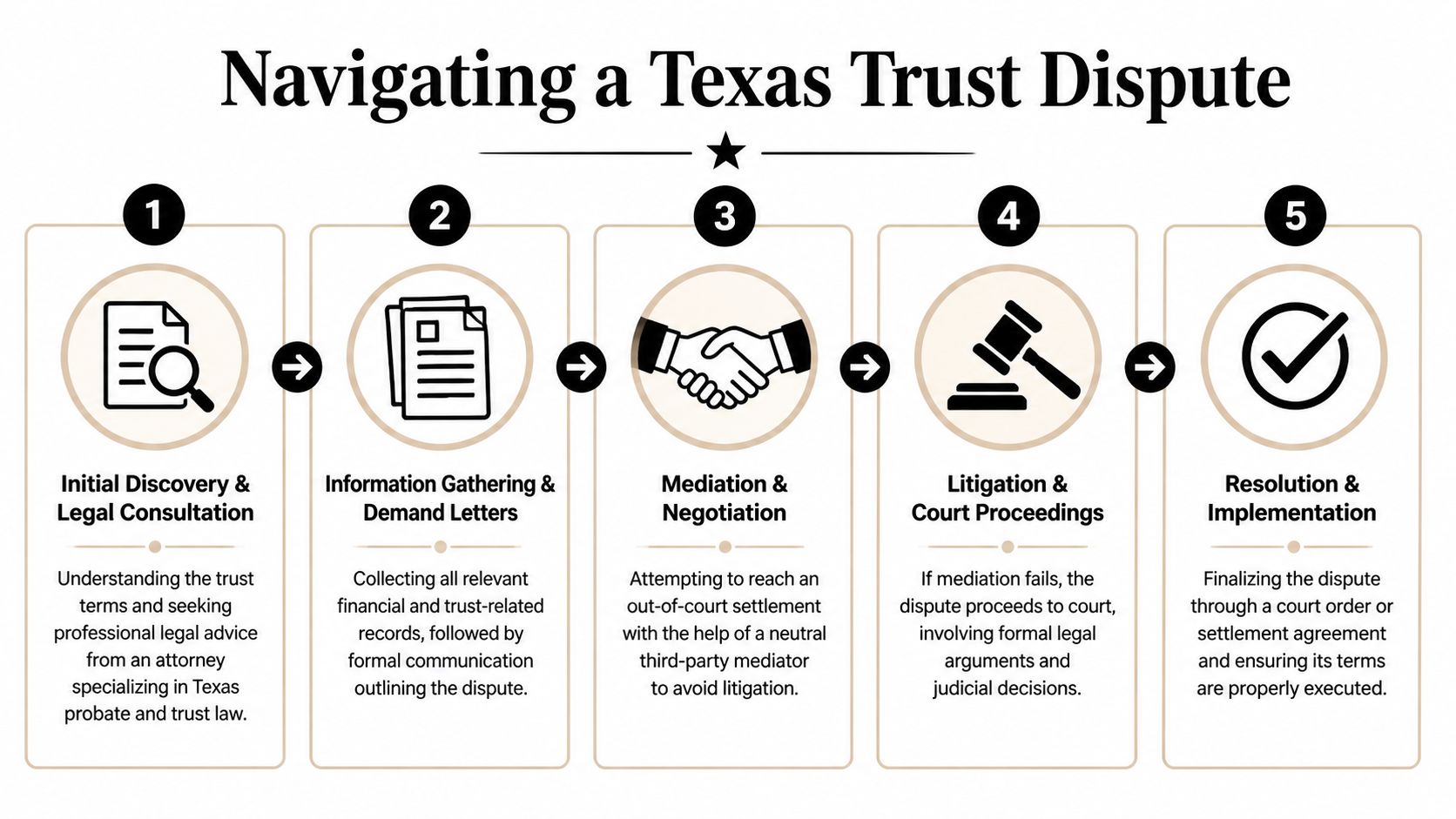
Once a dispute starts, people often jump straight to trial in their minds. That's usually not how the process unfolds. Most cases move through stages, and each stage has a different purpose.
A visual summary can help:
How a dispute usually begins
The first stage is often information gathering. That may include reviewing the trust, tracing transactions, and identifying who has standing to act.
Then an attorney may send a formal demand letter. That letter can request records, an accounting, a correction of trustee conduct, or a specific distribution. Sometimes a dispute resolves at that point because everyone finally understands the legal exposure.
For readers who want a fuller overview, this page on dispute resolution and litigation in Texas trusts explains the process in more detail.
Why mediation matters
Texas courts often expect parties to attempt mediation before trial. Mediation puts the siblings and their lawyers in a structured setting with a neutral third party.
That doesn't mean everyone suddenly agrees. It means there is a controlled space to negotiate practical solutions, such as:
- replacing the trustee
- setting a timeline for distribution
- requiring a formal accounting
- agreeing to sell trust property
- clarifying future administration terms
A short video can make the process easier to picture:
What happens if mediation fails
If no settlement is reached, the dispute moves into litigation. That usually involves:
- Filing pleadings in the proper Texas court
- Discovery, where both sides exchange records and testimony
- Motions, asking the judge to decide certain issues
- Trial or final hearing, where evidence is presented
- Enforcement, if the court orders action and someone resists
Litigation forces disclosure. If a trustee won't explain decisions voluntarily, the court process gives beneficiaries tools to demand records, testimony, and sworn explanations.
This is often the point where families realize a trust fight is no longer just an argument. It has become a legal matter with deadlines, evidentiary rules, and serious consequences.
Legal Remedies and Potential Outcomes for Beneficiaries
A beneficiary’s lawsuit isn't just about proving someone was wrong. The court also needs a remedy. In other words, what should happen now?
Texas courts have several tools available in trust disputes, depending on the facts.
Remedies that can correct the problem
Some remedies focus on transparency. Others focus on replacing the wrongdoer or repairing financial harm.
| Remedy | What It Means | When It's Used |
|---|---|---|
| Accounting | The court orders the trustee to produce financial records and explain trust activity | When beneficiaries suspect missing information, poor recordkeeping, or hidden transactions |
| Trustee removal | The court removes the acting trustee and may appoint a replacement | When the trustee can't perform properly, acts against beneficiary interests, or creates unworkable conflict |
| Surcharge or repayment | The trustee may be ordered to repay losses caused by misconduct or mismanagement | When trust assets were wasted, diverted, or mishandled |
| Disgorgement of profits | The trustee may have to give up personal profit gained through improper conduct | When the trustee benefited from self-dealing |
| Constructive trust | The court can impose control over property that was wrongfully taken or redirected | When assets were transferred improperly |
| Trust modification or reformation | The court can address mistakes, ambiguity, or administration problems in the trust terms | When the written document creates confusion or doesn't reflect lawful administration needs |
If a beneficiary is considering direct action against a trustee, this page on beneficiary suits against trustees in Texas outlines the dispute in practical terms.
Real estate disputes are often the hardest
Trust-held real estate creates a special kind of deadlock. One sibling may want to keep the family house. Another may want cash. A third may be living there.
When those conflicts can't be resolved, Texas law may allow a partition action. That means a court can order the property divided if possible, or sold and the proceeds split. As explained in this discussion of Texas partition actions involving inherited real estate, a forced sale can bring in 10-30% below market value because the sale is distressed.
That is one reason experienced counsel often pushes hard for negotiated buyouts or sale terms before the case reaches that point.
Courts can do more than award money
People sometimes assume the only outcome is “winner takes all” or a damages award. Trust cases are more flexible than that.
A court can:
- require reports going forward
- set administration rules
- unwind improper transactions
- remove decision-making power from one sibling
- force action where delay has become harmful
The right remedy depends on the actual problem. If the issue is secrecy, accounting may be the first goal. If the issue is self-dealing, removal and repayment may be central. If the issue is real estate deadlock, sale or buyout terms may become the focus.
Critical Timelines and Gathering Your Evidence
A common pattern looks like this. One sibling says, “Mom wanted me to handle everything.” Months pass. Questions get brushed off. Then a beneficiary learns a house was transferred, an account was closed, or trust terms were changed, and suddenly the family is arguing about both money and memory.
That is why timing and proof matter so much in Texas trust disputes. The legal question is not only what happened. It is also when you learned about it, what you were told, and what records can prove the difference.
Deadlines can be more complicated than they appear
Texas law often gives a beneficiary several years to bring a breach of trust claim. The harder question is usually when the clock started. In some families, that date is obvious. In others, it is buried under half-truths, missing papers, or repeated assurances that “everything is fine.”
A 2024 Texas appellate decision addressed that problem directly. In this discussion of the Prieto concealment ruling, the court recognized that equitable tolling may extend a filing deadline when a trustee concealed information or misled a beneficiary about the inheritance.
That matters in real life. A trustee should not be able to hide the ball, run out the clock, and then argue that the beneficiary waited too long.
If you suspect deception, do not assume your claim is already gone. The timeline may depend on when you discovered the problem and whether the trustee's conduct delayed that discovery.
Delay still carries risk. Memories fade. Phones get replaced. Bank records become harder to get. A beneficiary who waits too long can end up fighting two battles at once: the underlying misconduct and the deadline.
Start building your file early
Trust litigation often works like assembling a paper trail after a storm. The family story may be loud and emotional, but courts usually focus on documents, dates, and patterns.
Gather and preserve:
- The trust agreement and every amendment
- Emails, texts, letters, and voicemails with the trustee or other family members
- Bank records, statements, and transaction histories you can lawfully access
- Formal accountings, informal summaries, and written requests for information
- Deeds, closing papers, appraisals, and other property records
- Medical records or detailed observations if mental capacity is part of the dispute
- A written timeline listing who said what, and when
Do this sooner than feels comfortable. In high-conflict families, people often delete messages, “clean out” a parent's house, or reframe old conversations once they realize a dispute is coming.
If your sibling controls the records because they serve as trustee, ask for documents in writing. Save the request. Save the response. If there is no response, save that too. Silence can become part of the evidence.
Standing and proof usually rise or fall together
Being hurt is not always the same as having a legal claim. Texas courts usually require a person to show a recognized legal interest in the trust, such as beneficiary status or another legally protected connection to the matter.
This is one of the hardest emotional parts of these cases. A parent may have made verbal promises at holidays or during illness. A sibling may sincerely believe those promises should control. But courts usually give the greatest weight to the written trust and reliable supporting evidence.
A practical first pass looks like this:
- Get the trust and all amendments
- Confirm your legal relationship to the trust
- Write out a timeline of suspicious acts, missing information, or conflicting statements
- Preserve electronic communications and records
- Speak with a Texas trust administration lawyer before the deadline becomes its own dispute
Some families ask firms such as the Law Office of Bryan Fagan, PLLC to review the records, assess standing, and explain what remedies Texas law may allow. That kind of early review can help separate understandable family anger from facts a court can use.
The True Cost of a Trust Dispute and When to Seek Help
A trust fight can drain far more than money. It can consume years, harden family divisions, and turn every conversation into evidence. Even when a person is legally right, the process can still be exhausting.
The financial side is serious too. Verified data tied to Texas trust litigation notes that these cases can take years and may significantly erode what the family hoped to preserve. The emotional cost can be even harder to repair, especially when the conflict involves deception, caregiving resentment, or fear.
Getting legal advice early isn't an act of aggression. It's often the step that prevents a worse outcome. A lawyer can help you separate hurt feelings from legal claims, demand the right records, evaluate deadlines, and push the matter toward settlement when possible.
If you’re managing a trust or planning your estate, contact The Law Office of Bryan Fagan, PLLC for a free consultation. Our attorneys provide trusted, Texas-based guidance for every step of the process.
If you're dealing with a sibling trust dispute, serving as a trustee, or trying to understand your rights as a beneficiary, Law Office of Bryan Fagan, PLLC can help you take the next step with clear, Texas-based guidance. A free consultation can help you understand your options, protect important evidence, and decide whether negotiation, mediation, or court action makes the most sense for your situation.