Skip to content
A parent dies. You open the trust documents expecting to see a plan you recognize, and instead you find a last-minute amendment, a new beneficiary, or terms that don't sound like your loved one at all. That moment is unsettling. It can leave you wondering whether the trust is valid, whether anyone broke the rules, and whether you still have time to act.
If that's where you are, your concern is reasonable. Texas law does allow courts to set aside a trust, or parts of it, when the document wasn't created freely, competently, or lawfully. It also gives beneficiaries ways to challenge a trustee who is mishandling a valid trust.
The hard part is knowing which problem you're dealing with. Some cases involve what invalidates a trust in Texas from the start. Others involve a trust that was valid when signed but later put at risk by poor administration. The difference matters because the evidence, deadlines, and remedies are not the same.
Understanding the Validity of a Loved One's Trust
Most families don't start with legal vocabulary. They start with red flags.
A daughter notices that her father's long-time plan left assets to his children equally, but a newer trust favors a caregiver. A son asks for trust information and gets silence from the trustee. A surviving spouse learns that valuable accounts were never moved into the trust at all. Each of these situations raises a different legal question, and families often lump them together.
A valid Texas trust usually depends on a few basic things. The person creating it must understand what they're signing. Their decision must be voluntary. The document must satisfy Texas law. The trust's purpose must also be lawful and workable.
Practical rule: A trust contest isn't about whether a result feels unfair. It's about whether the trust is legally defective or was created under improper circumstances.
That distinction helps people breathe a little. You don't have to guess. You can sort the problem into categories, gather records, and evaluate your options with a clearer head.
Primary Grounds for Invalidating a Texas Trust
A trust contest usually rises or falls on the reason behind it. In court, families need more than a sense that something felt wrong. They need a legal defect they can identify, investigate, and later prove with records, witnesses, or both.
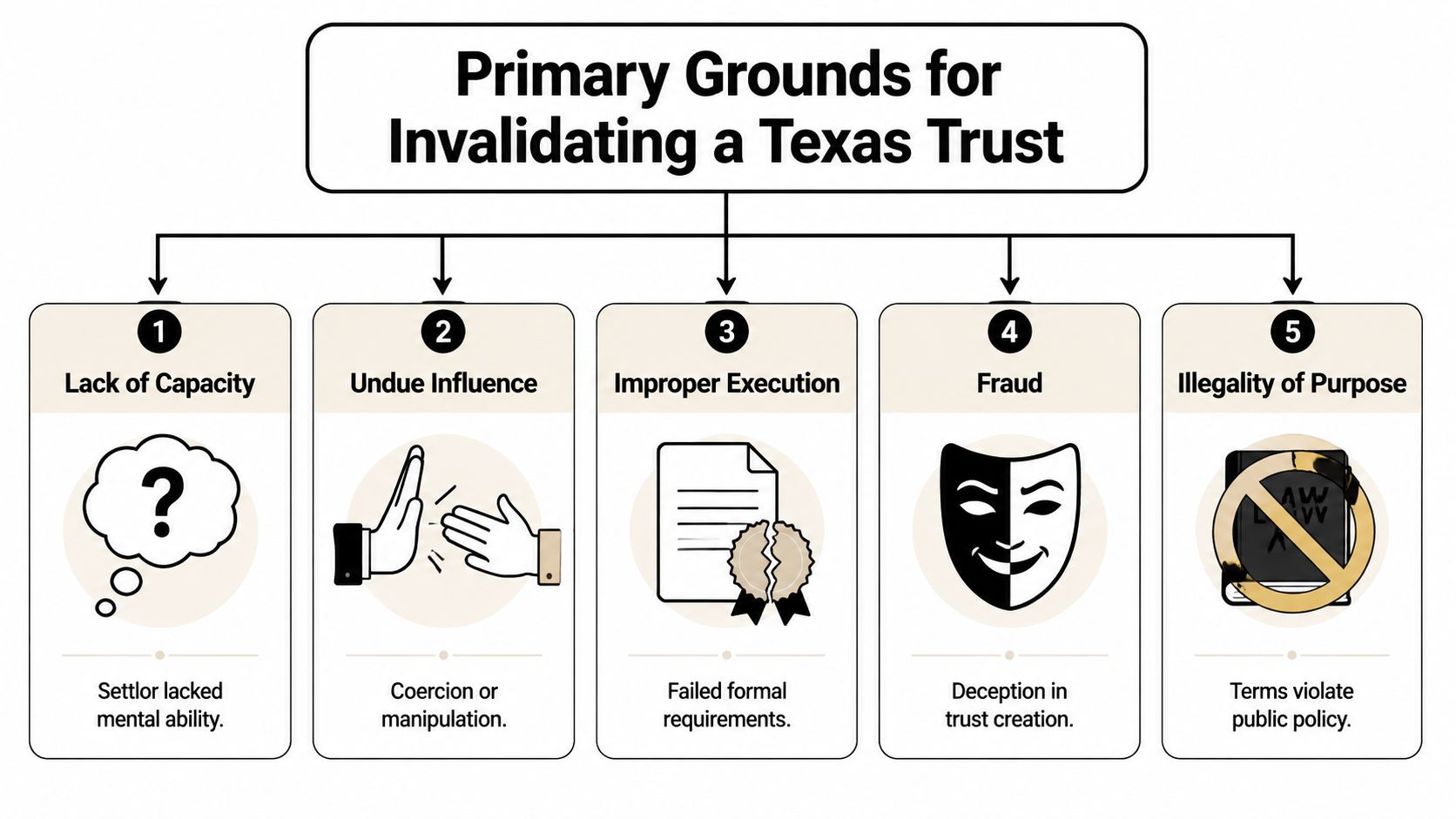
The five grounds below are the ones families raise most often in Texas trust litigation. As you read them, focus on the practical question behind each one: what facts would show this happened?
Lack of capacity
Capacity is about the settlor's mental ability at the moment of signing. A medical label by itself does not answer the question. The court looks closer and asks whether the person understood their property, the family members or other people who would naturally receive it, and what the trust document would do.
That timing matters. A person with dementia may still have a clear period and sign a valid trust. A person with no formal diagnosis may still lack capacity if they were disoriented, heavily medicated, or unable to understand basic facts when they signed. The proof often comes from medical charts, medication records, notes from the drafting attorney, and testimony from people who saw the settlor that day. Texas courts discuss these capacity principles in cases summarized by the Texas Center for Legal Ethics trust and estate materials.
A real-world example helps. Suppose an elderly father could explain that he owned a ranch, several bank accounts, and mineral rights, knew his children by name, and understood that the trust would place one child in charge as trustee. That points toward capacity. If he could not describe what he owned, believed a deceased spouse was still alive, or signed without understanding that the document changed who would inherit, the trust becomes much easier to challenge.
Undue influence
Undue influence means the trust reflects someone else's will, not the settlor's free choice. Persuasion alone is not enough. Adult children can argue with a parent, plead their case, or ask for help without invalidating a trust. The problem starts when pressure becomes control.
Courts often look for a pattern. Did one person isolate the settlor from relatives? Did that person arrange the lawyer, drive to the appointment, stay in the room, and then end up with a much larger share than before? Did the settlor depend on that person for medication, housing, or access to the outside world? Those facts do not prove undue influence by themselves, but they are the kind of facts lawyers build cases around.
It helps to picture the process like a bent steering wheel. The settlor may appear to be driving, but someone else is forcing the direction. If you want a closer explanation of the facts Texas courts examine, this guide on proving undue influence in Texas trusts is a useful next read.
Fraud or forgery
Fraud and forgery attack the trust's authenticity from different angles. Fraud means the settlor signed because someone lied or concealed key facts. Forgery means the signature, initials, or even the document itself is fake or altered.
These cases often begin with small inconsistencies. The settlor supposedly signed on a day they were hospitalized. A page uses a different font or date format. A relative says, "She signed everything," but cannot explain who prepared the packet or where the original is. In more recent disputes, electronic files and digital storage create new problems. Metadata, scanned signatures, cloud-stored drafts, and altered PDFs can all become evidence.
Families should preserve documents early. Save emails, text messages, drafts, file histories, and the devices that may contain them. In a fraud case, those digital breadcrumbs can matter as much as the paper copy in the binder.
Improper execution
A trust can reflect the settlor's true wishes and still face trouble if the signing process was defective. This ground is procedural, which means families need to examine exactly how the trust was created, signed, acknowledged, and funded.
The details vary by document. Was the signature complete? Was the trust amendment executed with the formalities the instrument required? Did the person signing have authority to act? Were notarization problems present? If the dispute involves assets that were supposed to transfer into the trust, title records and beneficiary designations can become part of the execution problem too.
This ground often gets overlooked because the document looks polished. A professionally prepared packet can still fail if a key signature page is missing or a required step never happened.
Illegality or invalid purpose
Texas law does not enforce a trust solely because it was written down. The trust must have a lawful purpose, and its terms must be capable of administration. If a provision requires illegal conduct, violates public policy, or is so unclear that a trustee cannot reasonably carry it out, a court may strike that provision or, in a serious case, question the validity of the arrangement.
This issue appears in family cases more often than people expect. A clause may attempt to control property in a way the settlor no longer had authority to control. A digital asset provision may direct access that conflicts with privacy law, platform rules, or ownership limits. A business-related trust may be structured around a transfer the settlor never had legal power to make.
A Texas trust usually fails for reasons that are specific and provable. Loss of mental capacity. Pressure that overbears free choice. Deception. Defective signing. An unlawful or unworkable purpose.
The Legal Pathway to Challenging a Trust in Texas
Once you suspect a trust is invalid, the next question is practical. What do you do?

Start with standing and deadlines
Not everyone can file a trust contest. Usually, the person challenging the trust must have a real financial stake in the outcome, such as a current beneficiary, someone who benefited under an earlier version, or an heir who would inherit if the trust failed.
Time is just as important. Under Texas Estates Code § 256.204, a trust contest must typically be filed within two years of the trust becoming irrevocable, often at the settlor's death. Missing that deadline is a frequent reason cases get thrown out, and over 30% of trust disputes are dismissed for being untimely, according to Texas trust dispute guidance discussing the filing deadline.
That deadline catches families off guard because grief slows everything down. People spend months trying to get answers informally, only to learn the legal clock kept running.
File in the proper court
A contest usually begins with a petition filed in the appropriate probate court. That filing identifies the trust, the challenger's interest, the legal grounds, and the relief requested.
For many families, this is the point where the issue becomes real. Before filing, it feels like a private suspicion. After filing, it becomes a formal legal dispute with deadlines, evidence requests, and court oversight.
A practical overview of that process appears in this resource on how to contest a trust in Texas.
Expect discovery, not instant answers
Many people think a judge will quickly read the document and decide whether it's valid. That almost never happens.
Most trust contests move into discovery, where both sides exchange documents and testimony. That can include medical records, bank statements, drafting files, emails, text messages, and depositions from witnesses such as caregivers, family members, and the attorney who prepared the trust.
This video gives a helpful overview of the dispute process:
Many cases resolve before trial
A filed case doesn't always end in a courtroom trial. Once documents come out and testimony is taken, weaknesses become clearer. Some disputes narrow to one amendment. Others settle after mediation.
That matters for families because a trust contest isn't only about winning or losing the entire case. Sometimes the practical goal is smaller: restore a prior version, remove one improper change, or force proper disclosure so everyone can evaluate the situation accurately.
Proving Your Case Evidence and Burdens in Trust Litigation
A trust contest is a proof problem. Family members may feel certain something went wrong, but a Texas court will ask a narrower question: what evidence shows that a legal ground existed at the time the trust or amendment was signed?
That question shapes everything. It tells you what records to request, which witnesses matter, how to build a timeline, and what to preserve before phones are replaced or accounts are closed.
What courts usually look for
For a capacity challenge, the strongest evidence usually comes from the days and weeks around the signing. The court wants to know whether the settlor understood three basic things: what they owned, who their natural beneficiaries were, and what the trust would do with their property.
Proof often comes from several sources working together, much like fitting pieces into the same puzzle. One medical note by itself may not decide the case. One odd text message may not either. But medical records, attorney notes, medication changes, and witness testimony that all point in the same direction can become persuasive.
A practical explanation of how Texas courts evaluate capacity and related proof appears in this discussion from the Texas State Law Library on wills and estate planning resources.
Courts often focus on evidence such as:
- Medical records: doctor visits, hospital charts, neurology notes, memory care evaluations, and medication logs near the signing date
- Drafting history: prior trust versions, handwritten markups, intake notes, and emails about who requested changes
- Neutral witnesses: neighbors, bankers, advisors, or office staff who observed the settlor without having money at stake
- Financial activity: sudden account changes, new joint access, unusual gifts, or transfers that match the disputed trust terms
- Communication records: texts, call logs, calendars, visitor records, and emails showing who controlled access to the settlor
- Digital asset evidence: password resets, changes to online account ownership, crypto wallet access, or cloud documents edited by someone other than the settlor
Digital evidence matters more than many families expect. If a disputed amendment changed control of online brokerage accounts, cryptocurrency, or revenue-producing digital property, the login history and device records may matter almost as much as the signed paper.
Burden of proof, in plain English
"Burden of proof" means the person making the claim must bring enough evidence to support it. The court does not start from scratch and investigate for you.
That matters early.
If you claim undue influence, you need evidence showing more than a close relationship or a child helping an aging parent. Texas courts usually look for a pattern. Who isolated the settlor? Who contacted the drafting lawyer? Who drove the process? Who benefited from the last-minute change? When those facts line up, the other side has a harder time presenting the trust as a free, informed choice.
The same practical rule applies to fraud, forgery, or improper execution. The court needs proof tied to the exact theory you are asserting. General family conflict will not carry the claim.
Courts decide legal defects, not family disappointment.
Build the case by timeline, not by stack of paper
Families often gather documents in grocery bags, banker boxes, and screenshot folders. That is understandable. It is also hard to use.
A timeline works better than a pile.
Start with the signing date. Then work outward. Add medical appointments, medication changes, calls with the drafting attorney, large transfers, caregiver shifts, text messages, and any change in who controlled transportation or communication. If there are digital assets, add account recovery emails, device access alerts, and online ownership changes.
Here is a simple way to organize proof:
| Lane | What it helps prove | Examples |
|---|---|---|
| Mental state | Did the settlor understand the decision? | physician notes, evaluations, medication records, confusion reports |
| Influence and control | Was someone directing the process? | caregiver texts, ride logs, attorney contact history, visitor restrictions |
| Document integrity | Does the paperwork and account activity match the story? | drafts, signature pages, notarization details, funding records, login history |
This method keeps the case focused. It also helps your lawyer spot gaps early, such as needing a subpoena for clinic records or a deposition from the notary.
Evidence has deadlines attached to it
Families sometimes wait because they hope emotions will cool down. Delay can cost proof.
Phones are wiped. Security footage disappears. Care facilities change vendors. Online platforms overwrite login history. Witnesses forget dates and conversations. If digital assets are involved, access trails can become much harder to reconstruct once credentials are changed or multi-factor devices are replaced.
Preserve first. Sort later.
Save emails, screenshots, voicemails, letters, account statements, cloud files, and device records in original form if possible. Avoid editing file names or forwarding documents repeatedly if that could strip metadata. If you have the original envelope, keep it. If you have a text thread, capture the full thread, not just one message that looks suspicious.
Small procedural steps often make a large difference in trust litigation. A well-kept timeline with clean records gives the court something concrete to evaluate. That is how a concern becomes a case.
When a Trustee's Actions Jeopardize the Trust
Not every trust problem means the trust was invalid from day one. Sometimes the trust is perfectly valid, but the trustee is the problem.

A valid trust can still be badly managed
Texas trustees owe fiduciary duties. In plain language, that means they must act loyally, carefully, and in the beneficiaries' interests. They must follow the trust terms, avoid self-dealing, keep proper records, and provide accountings when required.
Breach of fiduciary duty is a leading cause of Texas trust litigation. Under the Texas Trust Code, a trustee can be liable even for an honest mistake if it was negligent, and once a beneficiary shows basic evidence of misconduct, the burden shifts to the trustee to prove the conduct was fair and proper, as outlined in this explanation of breach of trust under Texas law.
What breach looks like in real life
Some breaches are dramatic. A trustee transfers trust money to their own business, sells trust property to a friend on favorable terms, or refuses to explain where funds went.
Others look ordinary at first:
- Failure to account: Beneficiaries keep asking for records and receive vague answers.
- Negligent investing: Assets sit unmanaged or are handled carelessly.
- Favoritism: One beneficiary gets special treatment outside the trust terms.
- Commingling: Trust funds and personal funds blur together.
If your concern centers on trustee conduct rather than the trust's creation, this guide to trustee breach of fiduciary duty in Texas may be more relevant than a full invalidity challenge.
The remedy may be removal, not invalidation
Many families struggle with this misconception. They think, "If I can't void the trust, I have no case." That's not true.
A court may order an accounting, award damages, remove the trustee, recover assets, or appoint a receiver. Those remedies focus on fixing administration rather than wiping out the trust itself.
A trust contest asks whether the document should exist. A fiduciary-duty case asks whether the trustee should stay in control.
That difference matters in property cases too. If trust-owned real estate is being mishandled, families sometimes need to understand sale procedures, title issues, and default-related processes. For background on how trustee sales work in a different but related property context, BatchData's trustee's sale overview gives a practical explanation of the terminology people often hear when trust property and forced sale issues intersect.
Drafting an Ironclad Trust Proactive Prevention Strategies
The best trust disputes are the ones that never start. Careful drafting and disciplined administration can reduce confusion, strengthen evidence of intent, and make challenges harder to sustain.
Build a clean signing record
If capacity could later become an issue, create a record while the settlor is clearly able to speak for themselves. That may include a contemporaneous physician evaluation, attorney notes confirming independent discussion, and a signing process without interested beneficiaries in the room.
For families with conflict already brewing, video execution and written certifications can help show autonomy. The point isn't drama. It's documentation.
Fund the trust correctly
A beautifully drafted trust can still fail in practice if key assets never get transferred into it. That is especially important for brokerage accounts, business interests, real estate, and modern digital property.
Digital assets now create a newer risk. Improperly transferring cryptocurrency or NFTs to a trust can leave the trust effectively empty and push those assets back toward probate. Texas adopted the Revised Uniform Fiduciary Access to Digital Assets Act in 2024, creating a framework, but specialized drafting is still needed, as discussed in this overview of digital-asset trust planning risks.
Use prevention tools that fit the family
Some protective steps are legal. Others are practical.
Consider a mix like this:
- Independent counsel: The settlor should meet privately with the drafting lawyer so no one can later claim the instructions came from a beneficiary.
- Clear explanations: Plain-language summaries reduce later claims that the settlor didn't understand the trust's effect.
- No-contest clauses: These may discourage weak challenges, though they need to be drafted carefully under Texas law.
- Successor trustee planning: Choose someone organized, even-tempered, and willing to communicate.
- Periodic reviews: Update the trust after deaths, marriages, divorces, sales of major property, or changes in digital holdings.
Prevention also means trustee education
A solid trust document isn't enough if the trustee doesn't know what to do next. Trustees need to understand recordkeeping, distributions, beneficiary communication, tax coordination, and the limits of their authority.
That's why many families benefit from treating trust administration like a process, not a stack of papers in a safe. A knowledgeable Texas estate planning attorney or Texas trust administration lawyer can help create both the document and the operating plan that keeps it defensible later.
Secure Your Legacy with Trusted Legal Guidance
A son opens his father's email account after the funeral and finds missing password records, unusual transfers, and a trustee who will not answer basic questions. That is often how these cases start. The family is not asking for a lawsuit at first. They want to know what happened, what records to request, and how long they have before options start to close.
Texas trust disputes are rarely solved by naming a legal theory alone. A trust contest works more like assembling a file for the court. You need the right claim, filed on time, supported by records, witness testimony, medical evidence, and a clear explanation of the relief you want. In some cases, that means asking the court to declare the trust invalid because of incapacity, undue influence, fraud, improper execution, or an unlawful purpose. In others, the trust itself may remain valid, while the main problem is a trustee who failed to follow the document or breached fiduciary duties.
Procedure matters.
A delayed response can make bank records harder to obtain, device data easier to lose, and family memories less reliable. Digital assets add another layer. Online accounts, cryptocurrency, cloud storage, and electronically delivered statements may hold the best proof of who controlled property, when changes were made, and whether trust assets were ever properly transferred into the trust.
Good legal guidance helps a family choose the next step with care. That may mean sending a targeted request for information, preserving electronic evidence, preparing for a trust contest, seeking an accounting, asking for trustee removal, or focusing on a practical fix that protects the estate without full invalidation. The goal is not just to react. The goal is to build a case, or a solution, that fits the facts and can stand up under Texas court procedures.
If you are planning ahead, strong drafting is only part of the job. The trust also needs clear funding instructions, updated asset titles, and a plan for digital access so a successor trustee is not left guessing. If conflict has already started, early action can protect both legal rights and family clarity during a stressful season.
If you're managing a trust or planning your estate, contact Law Office of Bryan Fagan, PLLC for a free consultation. Our attorneys provide trusted, Texas-based guidance for each stage of trust planning, administration, and litigation.