A parent dies. The family gathers, expecting the trust to follow the plan everyone had heard about for years. Then the amendment appears. A caregiver is suddenly the main beneficiary. One child who handled appointments and medications receives nearly everything. Longtime family members are cut out with no warning and no explanation that fits the person you knew.
That kind of discovery can leave people angry, confused, and guilty all at once. Many families ask the same question: “Was this really their decision?” In some cases, the answer is yes, even if the outcome feels unfair. In others, the document may reflect pressure, manipulation, or control that crossed the line into undue influence.
Texas law does give families a path to challenge a trust that wasn’t the product of a person’s free will. But suspicion alone won’t carry a case. Courts want proof. And in these disputes, proof usually isn’t a single dramatic moment. It’s a pattern built from records, witness accounts, timing, and inconsistencies.
If you’re facing that situation now, it helps to approach it with both urgency and discipline. Emotions matter, but evidence decides cases.
When a Loved One’s Trust Feels Wrong
A suspicious trust amendment rarely arrives with a confession attached. More often, families notice a string of unsettling facts after the person is gone. The trusted advisor changed. Calls stopped being returned. Visits became harder. The person who benefited most was the same person controlling access, transportation, medication, or information.
Those facts don’t automatically prove wrongdoing. But they are the kind of details that should prompt a careful legal review.
One common example is the older parent who had a stable estate plan for years, then signed a late amendment after a hospitalization or period of declining health. Another is the widowed settlor who became dependent on one adult child, then changed the trust in a way that sharply favored that child while excluding everyone else. A third involves a nonfamily caregiver who became involved in daily life, finances, and appointments, then appeared in the trust documents with a major benefit.
What families often feel first is not certainty. It’s disorientation. The plan doesn’t match the person they knew. The explanation offered by the favored beneficiary sounds rehearsed or incomplete. Documents are slow to surface. Questions are treated as hostility.
That feeling of something being off deserves to be taken seriously, but it also needs to be tested against Texas law. The right first step is usually not confrontation at the kitchen table. It’s document preservation, timeline building, and early legal advice about whether there are grounds to proceed. If you’re trying to understand the process for challenging a suspicious amendment, this guide on how to challenge a trust amendment in Texas is a useful starting point.
Families often think they need a “smoking gun.” Most undue influence cases are built from smaller facts that fit together.
Understanding Undue Influence Under Texas Law
Undue influence is not the same as persuasion, caregiving, or even strong family pressure. Texas courts know that people talk to parents, help with paperwork, drive them to lawyers, and discuss inheritance. None of that is automatically wrongful.
The line is crossed when someone’s influence overrides the settlor’s free will so the trust reflects the influencer’s wishes rather than the settlor’s own decision. A simple way to think about it is this: advice can guide a choice, but undue influence replaces the choice.

Where the rule comes from
Texas undue influence law has been shaped over decades. The doctrine has deep roots, and the 1963 Texas Supreme Court case Rothermel v. Duncan established a foundational 10-factor test that courts still use today to analyze the circumstances surrounding a contested will or trust, as discussed in this review of the doctrine of undue influence in Texas probate cases.
Those factors help courts evaluate questions such as:
- Vulnerability of the settlor based on age, illness, dependence, or cognitive weakness
- Opportunity for influence when one person controls access, transportation, care, or information
- Active involvement in the planning process, especially if the beneficiary arranged the lawyer or drove the drafting
- Unnatural changes that sharply depart from prior plans without a believable explanation
What courts are not looking for
Courts are not there to correct every family disappointment. A parent can favor one child. A settlor can reward a caregiver. A trust can be changed late in life. Those facts may be unfair in a family sense and still be valid legally.
That’s why trust contests are so fact-sensitive. The issue isn’t whether the result looks odd in isolation. The issue is whether the result was produced by improper pressure that overpowered the settlor’s judgment.
A trustee, beneficiary, or family member trying to sort this out should also understand that trust contests arise under a broader framework of fiduciary duties in Texas and trust administration rules. If you’re weighing whether the document itself can be attacked, this overview of whether a trust can be contested helps frame the issue.
A suspicious result matters. But the court still wants to know how that result happened.
The Three-Prong Test for Proving Your Claim
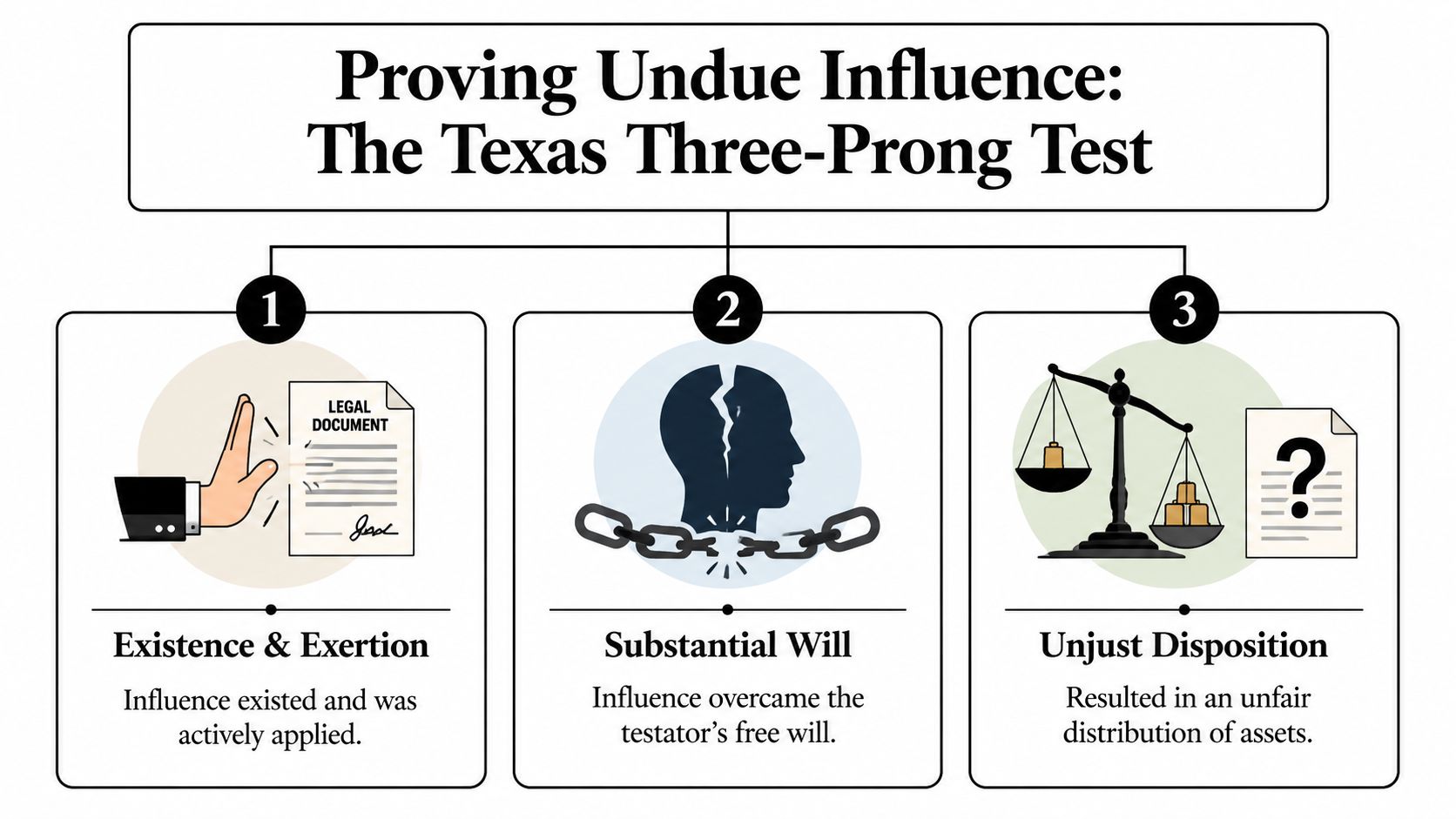
Texas courts apply a specific legal test. To succeed in an undue influence claim, a contestant must prove three elements by a preponderance of the evidence: the existence and exertion of an influence; the effective operation of that influence to subvert the settlor's mind at the time of execution; and the execution of a trust that the settlor would not have made but for the influence, as explained in this discussion of a Texas appellate ruling on setting aside an instrument for undue influence.
That legal standard can sound abstract. In practice, each prong asks a very concrete question.
Existence and exertion of influence
This first prong asks whether influence was present and used. Not just available. Used.
A daughter who lived nearby and helped with groceries had opportunity. That alone isn’t enough. A son who controlled appointments, screened calls, chose the lawyer, and stayed in the room during key conversations may have done much more than help. That starts to look like influence being exerted.
Useful proof for this prong often includes:
- Communication records showing one person controlled access to the settlor
- Appointment logs revealing who arranged legal or medical meetings
- Email or text chains where the beneficiary pushed for changes
- Witness testimony from friends, neighbors, staff, or relatives who saw isolation or control
The strongest cases don’t stop at “they were around a lot.” They show actions.
Subversion of the settlor’s mind
This is usually the hardest part. The court wants evidence that the influence overpowered the settlor’s independent judgment when the document was signed.
That does not require proving the settlor had no mind of their own. It requires showing that, at the relevant time, the person’s will was overcome.
A practical way to think about this prong is to compare two people. One elderly parent is physically weak but still decisive, understands the family, asks sharp questions, and rejects suggestions they dislike. Another is confused, dependent, eager to avoid conflict, fearful of abandonment, or unable to track the consequences of a sudden legal change. The second person is much more susceptible to manipulation.
Evidence here often comes from a combination of records and testimony:
| Type of proof | What it can show |
|---|---|
| Medical records | Cognitive decline, memory problems, confusion, medication effects |
| Care notes | Dependence, fear, agitation, or unusual reliance on one person |
| Attorney file materials | Whether the settlor spoke independently or only through the beneficiary |
| Witness accounts | Changes in personality, hesitation, or repeated talking points |
Practical rule: The closer the evidence is to the date of signing, the more useful it usually becomes.
But-for causation
The last prong asks whether the trust, or the amendment in dispute, would have been executed but for the influence. In plain English, would this document exist in this form if the manipulation had not happened?
Prior estate plans matter. If the settlor had followed one pattern for years and then abruptly adopted a radically different plan when one person gained control, that timing may help prove causation. So can evidence that the change served no stated goal, contradicted longstanding relationships, or made no sense given the settlor’s history.
What doesn’t work well is a case built only on family hurt. A child may sincerely believe, “Mom would never have done this.” Courts need facts that support that belief.
A disciplined case ties each prong to evidence. Not assumptions. Not outrage. Evidence.
Common Red Flags and Real-World Scenarios
Undue influence rarely looks dramatic while it’s happening. It often looks like “help.” Then, when you line up the facts, the pattern becomes hard to ignore.

The isolated parent
A widowed father begins relying on one child for rides, medications, and bill paying. Over time, siblings can’t reach him directly. Calls go unanswered. Visits must be “approved.” Then a trust amendment appears leaving nearly everything to the caregiving child.
That fact pattern raises concern because isolation can increase dependence and reduce outside reality checks. But the winning point usually isn’t “the caregiving child benefited.” It’s the combination of restricted access, dependency, and active control around the time of the trust change.
The caregiver who became indispensable
An elderly woman hires in-home help. Over time, the caregiver becomes the gatekeeper for meals, appointments, and communication. Friends stop visiting because the caregiver says she’s tired. A lawyer is contacted, and the caregiver receives a substantial trust benefit.
This scenario doesn’t prove misconduct on its own. Some caregivers are genuinely beloved and properly remembered in estate plans. What matters is whether the caregiver inserted themselves into the drafting process, discouraged independent advice, or exploited physical and mental frailty.
The new spouse or partner
A late-in-life relationship changes family dynamics quickly. Adult children are portrayed as greedy or absent. The new partner accompanies every appointment and pushes for “cleaning up the estate.” Soon, earlier beneficiaries are removed.
This kind of dispute often turns on context. If the settlor had long discussed wanting to provide for a spouse, the change may be legitimate. If the shift came with alienation, secrecy, and a break from everything the settlor had said before, the concern grows.
The child who “handled everything”
One adult child has a power of attorney, controls transportation, manages passwords, and communicates with financial institutions. The parent seems to repeat that child’s views word for word. A trust amendment then favors that same child in a way that no one had heard discussed before.
That pattern can be especially troubling because authority and access may look ordinary from the outside. Families often assume the child was being responsible. In litigation, the details matter more. Who contacted the drafting attorney? Who was in the room? Who paid the invoice? Who kept the original?
A case often becomes stronger when several modest red flags point in the same direction.
What usually does not move a case forward
Some facts feel suspicious but don’t carry much weight by themselves:
- Mere opportunity because a person lived nearby or visited often
- Family conflict that existed long before the trust was changed
- An unequal gift without proof of manipulation
- Speculation about motives unsupported by documents or witness testimony
That’s why the practical work in undue influence in Texas trusts: how to prove it always comes back to specifics, not labels. Courts don’t invalidate trust instruments because someone was unlikeable or controlling in general. They do it when the evidence shows that control produced the document.
How to Gather Evidence for Your Case
Most families begin with a story. The legal system needs a file.
Because direct proof is rare, undue influence cases usually depend on circumstantial evidence. Medical expert affidavits and forensic accounting can be especially important, and some analyses described in this discussion of Texas undue influence claims note that success rates in litigated trust contests can be low. That’s one reason early, organized evidence gathering matters so much.

Start with a timeline
Before subpoenas and depositions, build a working chronology. Put dates next to every major event you know:
- Health events such as hospitalizations, diagnoses, falls, medication changes
- Relationship shifts including new caregivers, new partners, or one child moving in
- Document activity like trust amendments, powers of attorney, account changes, deed transfers
- Access changes when family contact narrowed or suddenly became supervised
A clean timeline does two things. It helps you see patterns, and it helps your lawyer spot what records to request first.
Medical records that matter
Don’t ask only whether your loved one “had dementia.” That question is too blunt. What matters is functioning near the time the trust was signed.
Useful medical material may include:
- Physician notes describing memory issues, confusion, orientation, or impaired judgment
- Medication lists that may explain sedation or mental changes
- Neurology or geriatric evaluations if they exist
- Hospital discharge paperwork close to the execution date
- Home health records documenting dependence or cognitive concerns
Ask practical questions when reviewing them. Did the person understand conversations? Were they missing appointments unless one person managed everything? Did providers note agitation, paranoia, or inability to manage finances?
Financial and trust records
The money trail often tells a quieter version of the same story. A Texas trust administration lawyer can use requests for production, subpoenas, and other discovery tools to gather records families often can’t get on their own.
Look for:
- Bank statements showing unusual withdrawals, transfers, or new joint access
- Trust account activity that changed sharply around the amendment date
- Checks or invoices showing who paid the drafting attorney
- Title or beneficiary changes made in the same window
- Prior trust versions that reveal a long-settled plan before the disputed change
A forensic accountant can be helpful when transactions are layered or spread across multiple accounts.
What works: matching legal documents, bank activity, and care records to the same time period.
What doesn’t: accusing someone of manipulation without tracing what changed and when.
A short explainer on the investigation process can also help families understand what formal case-building looks like in practice:
Messages, devices, and recordings
Texts, emails, voicemails, and calendar entries can reveal isolation tactics, pressure campaigns, or efforts to script the settlor’s explanation. Deleted material may sometimes be recoverable through proper legal process.
Families also ask about recording conversations. That area can be risky if handled casually, especially when multiple states are involved or one person is gathering evidence without legal advice. Before anyone hits record, it’s wise to understand state laws on recording calls and discuss strategy with counsel.
Witnesses to prioritize
Not all witnesses carry the same weight. The best witnesses are often people with no financial stake who observed real changes.
Consider speaking with:
- Longtime friends who knew the settlor’s consistent wishes
- Former caregivers or aides who saw who controlled access
- Doctors or staff who can describe functioning and dependence
- The drafting attorney and office staff who can explain who gave instructions and who attended meetings
When interviewing witnesses, don’t ask, “Do you think there was undue influence?” Ask narrower questions. Who scheduled the appointment? Was anyone answering for the settlor? Did the settlor seem fearful, confused, or unusually passive? Those answers are more useful than conclusions.
Navigating the Legal Process Step by Step
Once the facts suggest a real claim, the case moves from suspicion to procedure. That shift matters. Courts expect deadlines to be met, documents to be preserved, and allegations to be backed by admissible evidence.
Step one is preserving the case
Start by gathering the trust instruments, amendments, correspondence, and any records already available to the family. Avoid altering devices, deleting messages, or confronting the suspected influencer in a way that could trigger further concealment.
Texas timing rules can be strict. One verified discussion of Texas trust and probate procedure notes filing within 2 years in certain probate-linked contexts under the Estates Code, tied to the trust becoming irrevocable or the settlor’s death. Timing depends on the claim and the posture of the matter, so families should get case-specific advice quickly rather than relying on assumptions.
Filing and discovery
After review, counsel may send a demand, request records informally, or file suit. Litigation then usually turns to discovery. That is where depositions, interrogatories, subpoenas, and requests for production become central.
A good discovery plan is targeted. It asks for the drafting file, communications with the beneficiary, medical records near execution, financial records showing changes in control, and testimony from the people closest to the process. If you want a broader look at the court process, this page on dispute resolution and litigation in Texas trusts gives helpful context.
Some families also use technology to organize the growing volume of records and case law. Tools that automate legal research with AI can help review large document sets more efficiently, though they should support, not replace, attorney analysis.
Remedies and practical realities
If the claim succeeds, the court can set aside the tainted trust provision or invalidate the instrument at issue, with the estate or trust then administered under an earlier valid document or, in some situations, under default succession rules. The exact remedy depends on the document history and the claims pled.
Texas trust disputes are also becoming more complex. One discussion of emerging Texas developments notes proposed safe harbor affidavits aimed at documenting a trust creator’s capacity, which could affect burden issues and make proactive defense strategy more important in future cases, as described in this article on undue influence and recent Texas legislative trends.
The strongest move is often the earliest one. Once records disappear and memories fade, even a valid claim becomes harder to prove.
If you’re managing a trust or planning your estate, contact Law Office of Bryan Fagan, PLLC for a free consultation. Our attorneys provide trusted, Texas-based guidance for every step of the process.