Planning for a time when you or a loved one might need help managing personal or financial affairs can feel overwhelming. It's an act of profound care, but the legal complexities can seem daunting. Understanding the difference between a guardianship and a Power of Attorney (POA) is the first step toward clarity and peace of mind.
The core difference boils down to this: a Power of Attorney is a choice you make for yourself while you are fully capable. In contrast, a guardianship is a court-ordered solution implemented after someone can no longer make decisions for themselves. With a POA, you choose your trusted decision-maker. With a guardianship, a judge makes that choice for you.
Clarifying Your Legal Options In Texas
The two most common paths for managing another's affairs, a Power of Attorney and a guardianship, aim for similar goals but get there in vastly different ways. Knowing how they work under Texas law is crucial for protecting your family and preserving your wishes.

A Power of Attorney is a cornerstone of proactive estate planning. It’s a private legal document you create while you have full mental capacity, giving a trusted person—your "agent"—the authority to act on your behalf. This approach keeps you in control and your family out of the courtroom.
Guardianship is the opposite—it’s a public court proceeding. When a person becomes incapacitated without a valid POA, a judge must intervene to appoint a guardian. While this provides a necessary safety net, the process is often expensive, time-consuming, and strips the individual (now called a "ward") of significant personal freedom.
| Attribute | Power of Attorney (POA) | Guardianship |
|---|---|---|
| Initiation | Created voluntarily by an individual (the principal) while they have capacity. | Started with a court filing after an individual (the ward) is already deemed incapacitated. |
| Decision-Maker | The principal hand-picks a trusted agent to act for them. | A judge appoints a guardian to make decisions for the ward. |
| Court Involvement | Minimal to none. It’s a private document designed to avoid court oversight. | Extensive. The entire process is supervised by the court, requiring legal filings and annual reports. |
| Cost & Time | Relatively low-cost and quick to set up as part of a good estate plan. | Significantly more expensive and time-consuming due to legal fees, court costs, and ongoing processes. |
| Autonomy | Preserves the principal's autonomy by letting them set the terms and choose their agent. | Removes the ward's legal rights to make their own personal and financial decisions. |
Understanding Guardianship Under Texas Law
When a loved one can no longer make safe decisions and has no advance directives, the Texas legal system provides a protective measure: a guardianship. This is not a private family agreement but a formal, public legal process overseen by a court to protect a vulnerable person.

Unlike a Power of Attorney created in advance, a guardianship begins only when someone files an application with the court concerning a "proposed ward."
The Legal Standard for Incapacity in Texas
A Texas court will not grant a guardianship simply because someone is aging or making occasional poor choices. The legal standard is much higher.
Under the Texas Estates Code, the applicant must prove with clear and convincing evidence that the proposed ward is legally "incapacitated." This means the individual is substantially unable to provide for their own food, clothing, or shelter, care for their physical health, or manage their financial affairs. This determination nearly always requires a recent medical examination and a formal letter from a physician detailing the person’s condition and specific limitations.
Furthermore, the court must determine that a guardianship is the least restrictive alternative to keep the person safe. If other supports could work, a judge will favor that less drastic solution.
Types of Guardianship
Texas law recognizes that an individual may need help with finances but be perfectly capable of making medical decisions, or vice versa. To address this, courts can establish different types of guardianships tailored to the ward's specific needs.
- Guardian of the Person: This guardian makes decisions about personal and medical well-being, such as where the ward lives, consenting to medical care, and ensuring their day-to-day safety.
- Guardian of the Estate: This guardian acts as a financial manager, responsible for managing the ward’s assets—paying bills, handling investments, protecting property, and filing a detailed annual accounting with the court that tracks every transaction.
A judge may appoint one person for both roles or split the duties between two people, always prioritizing the ward's best interests. For a more detailed walkthrough, see our guide on how to get legal guardianship of a parent.
The Impact of a Guardianship
The most significant consequence of a guardianship is the ward's loss of civil liberties. A court-appointed guardian means the ward can lose fundamental rights, such as the right to vote, marry, drive, or decide where to live.
A guardianship is a protective measure, but it is also the most restrictive one. It effectively transfers a person's legal right to make their own decisions to someone else under a judge's watchful eye.
Because the impact is so profound, courts treat guardianship as a last resort. It is the path taken when an individual is already incapacitated and lacks a valid Power of Attorney. The court's ongoing supervision, including mandatory annual reports, is designed to prevent abuse and ensure the guardian fulfills their strict fiduciary duties—acting solely in the ward’s best interests.
The Role and Power of a Texas Power of Attorney
If guardianship is the court-ordered safety net, a Power of Attorney (POA) is your proactive, self-designed plan. As a key part of any Texas estate plan, it allows you to choose a trusted person—your "agent"—to handle your affairs, keeping your family out of the courtroom. It is your private declaration of who you want in your corner if you cannot speak for yourself.
Guardianship is a public, court-imposed process that currently impacts an estimated 1.3 million adults nationwide, overseeing $50 billion in assets. A POA is the opposite: a private document you sign while fully capable, designed specifically to avoid court intervention. This research on guardianship and POA trends highlights the profound differences between these two legal paths.
The Power of a Durable POA
For incapacity planning, the Durable Power of Attorney is essential. The word "durable" is key; it means the document remains effective even if you become incapacitated, activating right when it's needed most. A standard POA without this provision becomes useless at the worst possible time.
With a Durable POA, your agent can seamlessly:
- Pay your mortgage and utility bills
- Manage your bank and investment accounts
- File your taxes
- Handle real estate transactions
It is the tool that keeps your financial life in order, protecting your assets from the disruption of unpaid bills and missed deadlines.
Appointing a Medical Decision-Maker
Just as a Durable POA manages your finances, a Medical Power of Attorney protects your health. This separate but equally vital document lets you appoint an agent to make healthcare decisions if you are unable to.
Your medical agent becomes your voice, speaking with doctors, reviewing medical records, and consenting to or refusing treatments on your behalf. By choosing this person in advance, you ensure your medical care aligns with your values, lifting an immense burden from your family. Learn more in our guide on planning for incapacity with power of attorney essentials.
A Power of Attorney is a profound expression of trust. You are granting someone immense authority over your life, which is why your agent is held to the high legal standard of a fiduciary.
Under the Texas Estates Code, your agent has a strict fiduciary duty to act with complete loyalty and always in your best interests. They must manage your property carefully, keep meticulous records, and avoid any self-dealing or conflicts of interest. This legally enforceable obligation gives your trust real power and helps your family avoid the time, expense, and emotional toll of a public guardianship proceeding.
Guardianship vs. POA: A Side-by-Side Comparison
Choosing between a guardianship and a Power of Attorney requires understanding the practical differences in Texas. This isn't a simple list of pros and cons; it’s about recognizing how each path functions in the real world so you can make an informed decision for your family.
This section breaks down how each option works across the most critical factors you will face.

Whether you are planning ahead or facing an unexpected crisis, this is your practical guide.
Authority and Decision-Making Scope
A Power of Attorney is a highly flexible tool. As the principal, you define its scope. You can grant your agent broad authority to manage all your finances or limit their power to a specific task, like a single real estate transaction. A Medical POA is similarly focused, pertaining strictly to healthcare decisions.
In a guardianship, authority comes directly from a judge. A court order specifies exactly what the guardian can do for the ward, based on evidence of the person's needs. The powers can be broad or limited, but the court—not the individual—makes the final determination.
The core difference lies in who holds the pen. With a POA, you write the rules for your agent. In a guardianship, a judge writes the rules for the guardian.
Timing and Initiation
The timing of these two legal tools is perhaps their biggest distinction. A Power of Attorney is established before it's needed as a proactive step while you have full mental capacity. It is a private document, signed and notarized without court involvement, ready to be activated when necessary.
A guardianship, in contrast, is reactive. The process can only begin after a person has been legally declared incapacitated by a court. It starts with a formal application, launching a public and often lengthy legal proceeding.
Court Involvement and Oversight
A Power of Attorney is designed to keep you out of court. It is a private contract that operates outside the judicial system. While an agent who misuses their authority can be challenged in court, there is no routine judicial oversight.
Guardianship is defined by constant court supervision. A judge oversees every step, from the initial appointment to the final termination. In Texas, guardians must file detailed annual reports and accountings with the court. This provides critical protection but also adds layers of complexity, time, and expense. For more on related legal tools, you can learn about unraveling the mysteries of POAs and advance directives.
Revocation and Duration
If you are mentally competent, you can revoke a Power of Attorney at any time by giving written notice to your agent. The power remains entirely in your hands. A durable POA is designed to remain in effect if you become incapacitated and typically terminates upon your death.
A guardianship can only be modified or terminated by a judge. The ward cannot simply "fire" their guardian. While this structure provides stability, it means the ward has no direct control, even if their health improves. They would need to petition the court and prove their capacity has been restored.
Guardianship vs. Power of Attorney Key Differences in Texas
| Attribute | Power of Attorney (POA) | Guardianship |
|---|---|---|
| Initiation | Voluntarily by an individual with capacity. | By court order after incapacity is proven. |
| Decision-Maker | The individual (principal) chooses their agent. | A judge appoints a guardian for the ward. |
| Court Involvement | None required for creation or management. | Extensive and ongoing court supervision. |
| Cost & Time | Lower cost; quick to establish. | Higher cost; lengthy court process. |
| Flexibility | Highly flexible; powers defined by the principal. | Less flexible; powers defined by the court. |
| Revocation | Can be revoked by the principal at any time (if competent). | Can only be terminated by a court order. |
| Autonomy | Preserves individual autonomy and choice. | Removes the ward's legal right to make decisions. |
As you can see, these two legal tools serve different purposes and operate in entirely different ways. The right choice depends entirely on the specific circumstances, timing, and needs of the individual involved.
When Guardianship Becomes the Only Path Forward
While a Power of Attorney is the ideal scenario, reflecting thoughtful, proactive planning, life doesn't always follow a script. In some difficult situations, the court's protective oversight is not just an option—it's a necessity. Knowing when to pursue guardianship can bring clarity during a crisis.
For example, if a loved one has already lost cognitive capacity and has no POA, the family is in a legal bind. They cannot pay bills, manage investments, or consent to medical care. In this common scenario, guardianship is the only way to obtain the legal authority needed to step in and help.
When an Existing POA Goes Wrong
Even with a Power of Attorney, problems can arise. The chosen agent may abuse their power, using funds for personal gain or making harmful decisions. This is a severe breach of their fiduciary duties.
Red flags of agent abuse include:
- Unusual withdrawals or large fund transfers from the principal’s accounts.
- Sudden, unexplained changes to wills, trusts, or beneficiary designations.
- Isolation of the principal from family and friends.
- Unpaid bills, leading to foreclosure risks or lapsed insurance policies.
If you suspect financial exploitation or neglect, family members can take legal action. A guardianship proceeding can remove an abusive agent and appoint a court-supervised guardian, providing a vital shield for the vulnerable person.
A guardianship is the ultimate safety net. When a private agreement like a POA collapses because of abuse or conflict, the court steps in to enforce the highest possible standard of care and accountability.
When Family Conflict Creates Chaos
Sometimes, the greatest threat is not a rogue agent but a family in conflict. When siblings are locked in a bitter dispute over a parent’s care or finances, the incapacitated person suffers. One child may want to move a parent to a nursing home while another insists on in-home care, creating a stalemate that jeopardizes the parent’s health.
In these high-conflict situations, appointing a neutral, professional guardian may be the only path forward. A court-appointed guardian is an impartial third party whose sole legal duty is to the ward, removing family drama from the equation. This is where the difference between guardianship and POA becomes clear. A POA relies on private trust, whereas a guardianship imposes public order. This reliance on the court system is significant—in the U.S., an estimated 1.3 million adults are under guardianship, with courts managing over $50 billion of their assets. You can discover more insights about these guardianship trends here. It is a major step, but it provides a structured, legally sound solution when all other options have failed.
Making The Right Decision For Your Texas Family
Deciding between proactive planning with a Power of Attorney and reacting with a guardianship is one of the most significant choices a family can make. This is where legal principles meet real life, affecting finances, relationships, and daily care. Understanding how these choices play out can make a complex topic much clearer.
The right path often emerges from asking a few key questions. This decision chart illustrates when a guardianship might become the necessary next step for a Texas family.
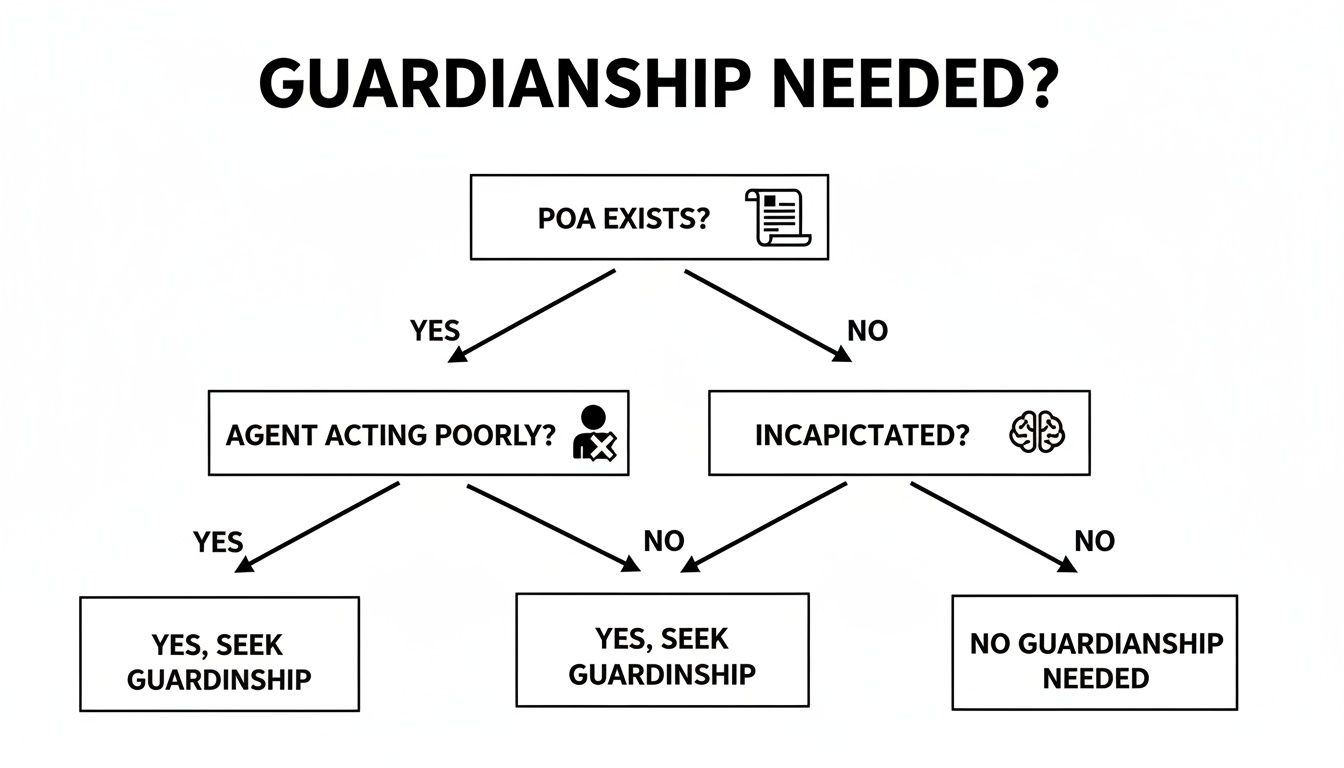
As the chart shows, the road to guardianship often begins where planning ends. When proactive tools like a POA are missing or fail, the court must step in to protect a vulnerable individual.
Real-World Scenarios: The Power Of Planning
To truly grasp the difference between guardianship and a POA, let’s consider two Texas families facing similar challenges with vastly different outcomes. These examples show how a single document can change everything.
Scenario 1: The Seamless Transition With A Durable POA
Meet the Garcia family. Maria, a retired teacher in Austin, worked with an estate planning attorney to create a comprehensive plan. It included a Durable Power of Attorney and a Medical Power of Attorney, naming her son, David, as her agent.
Years later, Maria suffered a severe stroke that left her unable to communicate or manage her affairs. David immediately activated the POA. He accessed her bank accounts to pay her mortgage and medical bills. Using the Medical POA, he coordinated with her doctors, ensuring her care aligned with her previously documented wishes. There was no court, no legal battle, and no interruption in Maria’s care. The family could focus on her recovery, not a stressful legal process.
Scenario 2: The Difficult Journey Through Guardianship
Now, consider the Smith family. John, a widower in Houston, began showing signs of advanced dementia but had never created a Power of Attorney. His daughter, Sarah, watched as he forgot to pay bills, made poor financial decisions, and neglected his health.
Without legal authority, Sarah couldn't access his bank accounts to protect his savings or even discuss his care with doctors. She had no choice but to petition the court for guardianship. The process took months and cost thousands in legal fees. It was a public proceeding that exposed her father’s private struggles and caused friction among her siblings. While the court ultimately appointed her as guardian, the emotional and financial cost was immense—a burden a simple POA could have prevented.
The lesson is clear: A Power of Attorney is an investment in your family’s future peace of mind. It keeps control within the family and avoids the cost, delay, and public nature of a court-supervised guardianship.
Complementary Tools For A Complete Plan
A comprehensive plan doesn't stop with a POA. Advance Directives work alongside your POA to provide a complete picture of your wishes. A Living Will (also called a Directive to Physicians) is a critical component. This document informs doctors of your preferences for life-sustaining treatment if you have a terminal or irreversible condition.
Together, these documents create a powerful framework for asset protection and personal autonomy. They ensure your choices are honored and empower your loved ones to act on your behalf with confidence and legal clarity.
Answering Your Lingering Questions
When navigating the complexities of estate planning, a few key questions often arise. Here are answers to some of the most common concerns we hear from Texas families weighing guardianship against a Power of Attorney.
Can a Power of Attorney Stop a Guardianship in Texas?
Yes, a well-drafted Durable Power of Attorney is one of the most effective tools for preventing a guardianship. Because you have already designated someone to make decisions for you, there is typically no need for a court to intervene and appoint a guardian.
However, it is not an absolute shield. A court can still initiate a guardianship proceeding if there is evidence that your chosen agent is abusing their power, not acting in your best interest, or if the POA document is invalid. This is why working with an experienced estate planning attorney is so critical—it ensures your documents are legally sound.
What Happens If Family Disagrees with the POA Agent’s Decisions?
If family members have credible evidence that an agent is failing their fiduciary duties—such as mismanaging funds, neglecting the principal's care, or making harmful choices—they have legal recourse. They can petition the court to have the agent removed and require them to account for their actions.
This could also lead them to request a formal guardianship to bring in the protection of court supervision. A judge will carefully review the evidence to determine if the agent has violated their legal responsibilities. It all comes back to one thing: choosing an agent you trust implicitly is the most important decision in this process.
How Much Does a Guardianship Cost Compared to a Power of Attorney?
The cost difference is significant. Creating a Power of Attorney is typically a straightforward, one-time expense, often included as part of a comprehensive estate plan. It is a proactive investment in your future and your family's peace of mind.
A guardianship, however, is a full court proceeding with accumulating costs, which can include:
- Court filing fees
- Your attorney's fees
- Fees for the attorney ad litem (a court-appointed lawyer for the proposed ward)
- Ongoing costs for filing annual reports and accountings
If the guardianship is contested by family members, the costs can easily escalate into the tens of thousands of dollars, depleting the very assets the process is meant to protect.
If you’re managing a trust or planning your estate, contact The Law Office of Bryan Fagan, PLLC for a free consultation. Our attorneys provide trusted, Texas-based guidance for every step of the process. You can learn more at https://texastrustadministration.com.