Managing a loved one’s trust can feel overwhelming, but with the right legal guidance, it doesn’t have to be. One of the first questions families ask is simple and urgent: how long does trustee have to distribute assets texas?
That question usually comes at a hard moment. A parent has died. A sibling has been named trustee. Another family member is waiting for an inheritance and wondering why nothing has happened yet. The trustee feels pressure from every direction. The beneficiaries feel shut out. Everyone wants a date on the calendar.
Texas law rarely gives that kind of neat answer.
Instead, trustees and beneficiaries have to work through a practical process shaped by the trust document, the assets involved, debts, taxes, and the trustee’s fiduciary duties. If you’re new to trusts, a plain-English primer like What Is a Trust Fund and How Does It Work can help frame the basics before you dig into Texas-specific timing rules.
This guide is written the way I’d explain it to a concerned family member sitting across the desk. You need to know what Texas law expects, what usually causes delay, when patience is wise, and when action makes sense. Once you understand the moving parts, the timeline starts to feel less mysterious and much more manageable.
Your Guide to Navigating Trust Distributions in Texas
A trustee’s job isn’t just to hand over property after a death. The trustee has to gather the assets, protect them, pay valid debts and expenses, handle required notices and accountings, and only then distribute what the trust says each beneficiary should receive.
The process resembles closing out a household after a move. You can’t just toss the keys to the next person and walk away. First, you find every account, settle every bill, make sure nothing is missing, and confirm who gets what. A trust administration works the same way, except the trustee is also under legal duties imposed by the Texas Trust Code.
That’s why families often get confused by timing. A beneficiary may think, “The trust says I inherit one-third, so why haven’t I been paid?” The trustee may think, “If I distribute too soon and a tax issue appears later, I could be personally liable.”
Both concerns are real.
A good trustee balances speed with caution. Moving too slowly creates mistrust. Moving too fast can create legal exposure.
The practical answer is that some trusts wrap up quickly, while others take much longer. The legal answer is more nuanced. Texas focuses less on a hard calendar deadline and more on whether the trustee acted in a reasonable time under the circumstances. That gray area is what causes most of the stress, and it’s also where informed guidance matters most.
The 'Reasonable Time' Rule Texas Law Follows
Many individuals expect a deadline. They want Texas law to say something like, “The trustee must distribute all assets within X months.” That isn’t how this area of law works.
Texas follows a reasonable time standard. That means the trustee must administer the trust in a timely way and according to the trust’s terms, but the law doesn’t impose a single hard deadline for every case. As one Texas discussion of the issue explains, Texas has no specific legal deadline for trustee distributions, unlike some states with statutory timelines, and the commonly discussed 12 to 18 month period is not a hard legal deadline. The focus is timely action and compliance with the trust document, not a fixed countdown (estateplanningdfw.law discussion of Texas timing ambiguity).

Why Texas uses a flexible standard
A trust that holds one checking account and a homestead is not the same as a trust that owns rental property, mineral interests, or a closely held business. Texas law leaves room for those differences.
That flexibility helps trustees do the job properly. It also creates uncertainty. A beneficiary may think the trustee is dragging their feet. The trustee may believe the delay is necessary. A court then looks at the full context.
The trust document comes first. Under the Texas Trust Code, the trustee’s core duty is to administer the trust according to its terms. If the trust calls for an outright distribution after the settlor’s death, that points toward a quicker administration. If the trust requires continuing management, staggered payments, or discretion, the timeline naturally changes.
What “reasonable” often means in real life
A useful analogy is a chef preparing dinner. If the meal is soup and sandwiches, it should be ready soon. If it’s a large holiday meal with multiple courses, the cook needs more time. The law doesn’t ask whether dinner was served instantly. It asks whether the cook moved with appropriate care for the meal being prepared.
Texas courts view trust administration in a similar way. They may look at issues such as:
- Asset complexity: Real estate, business interests, or hard-to-value assets usually slow things down.
- Debt resolution: The trustee needs time to identify and address claims before making final distributions.
- Tax work: Final filings and related accounting can delay closing.
- Trust instructions: Some trusts require conditions to be met before funds are released.
- Disputes: Family conflict, contests, or unclear ownership can stop a distribution in its tracks.
Why trustees should care about the gray area
The lack of a hard deadline doesn’t mean a trustee can wait. It means the trustee has to be able to explain the timeline.
That’s the practical framework I give trustees:
- Read the trust first. The document may answer more timing questions than the statute does.
- Create a written administration plan. Even a simple checklist helps show diligence.
- Communicate early with beneficiaries. Silence often creates more problems than delay itself.
- Document every reason for waiting. Appraisals, tax questions, debt issues, and litigation should be recorded.
- Revisit the timeline regularly. A delay that made sense three months ago may not make sense now.
Practical rule: In Texas, “reasonable” usually looks like a trustee who is actively doing the work, keeping records, and communicating why distribution hasn’t happened yet.
The biggest misunderstanding families have
Families often hear that “trusts usually settle in about a year” and treat that like a commandment. It isn’t. It’s a rough benchmark that may be helpful for planning, but it doesn’t replace legal analysis.
For trustees, that means the safest path is not speed alone. It’s reasonable, documented progress.
For beneficiaries, it means the right question usually isn’t “Why haven’t I been paid yet?” The better question is, “What has the trustee done so far, what remains to be done, and is the delay justified?”
That shift in perspective often lowers tension right away.
A Practical Timeline for Trust Asset Distribution
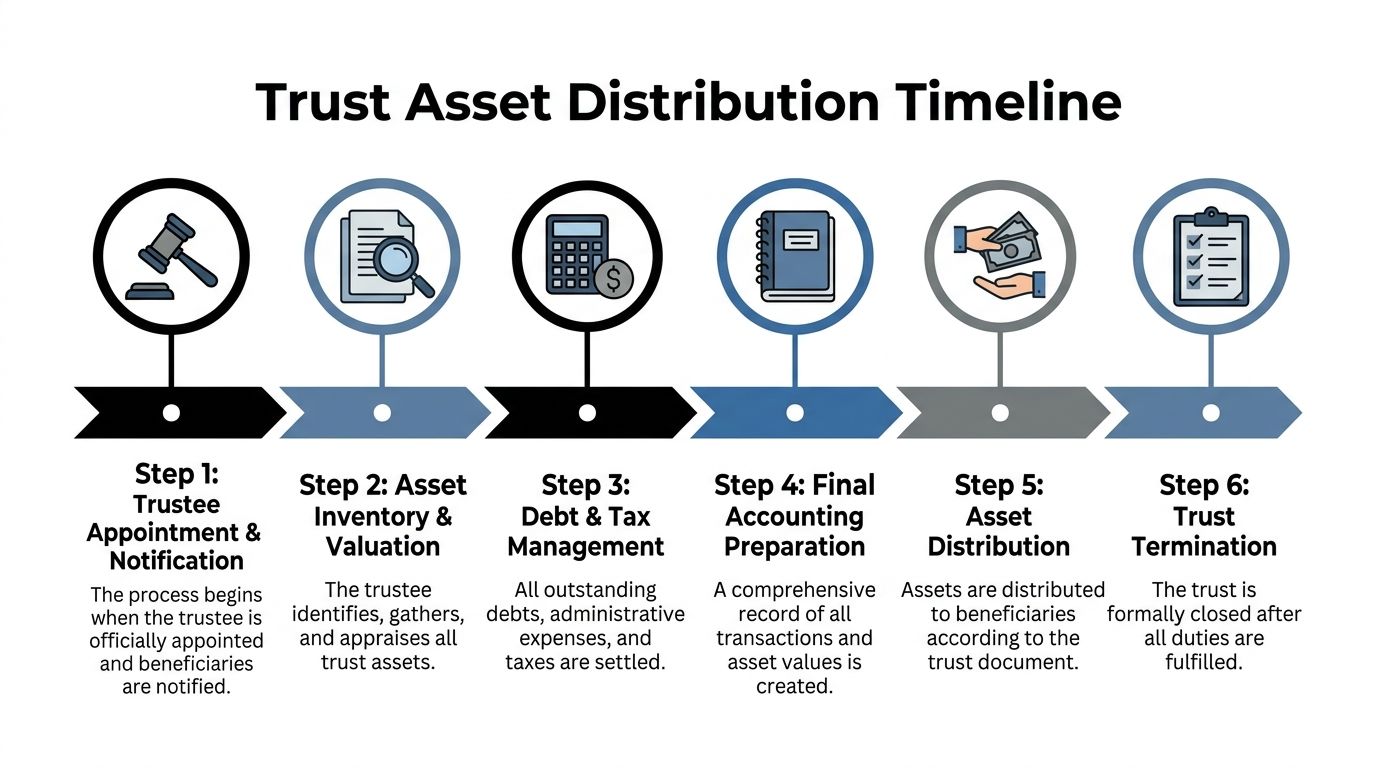
Families still need a working timeline, even if Texas doesn’t provide a hard deadline. In practice, legal guidance commonly points to 12 to 18 months from the trust becoming irrevocable for many Texas trust administrations, while a straightforward trust can sometimes finish in 4 to 5 months. Creditors may also have a 4-month window after notification to file claims, which is one reason many trustees don’t distribute everything immediately (Texas trust distribution guidance).
That gives you a planning range, not a guarantee.
The timeline at a glance
| Phase | Key Activities | Estimated Duration |
|---|---|---|
| Trustee appointment and setup | Confirm authority, review trust terms, identify beneficiaries, begin notices | Varies by trust and assets |
| Asset inventory and valuation | Gather statements, retitle assets as needed, obtain appraisals, locate records | Varies by complexity |
| Debt and tax review | Identify claims, pay expenses, evaluate tax filings, hold reserves | Often shaped by the creditor claims period |
| Accounting and distribution planning | Prepare records, evaluate what can be distributed now versus later | Varies |
| Final distribution | Transfer funds or title according to trust terms | Often after debts, expenses, and tax issues are addressed |
| Trust termination or ongoing administration | Close the trust if complete, or continue management if the trust requires it | Depends on trust language |
For a more process-focused overview, this timeline for trust administration in Texas can help trustees match the legal tasks to the calendar.
Phase one: securing control and calming the chaos
The first stage is often less visible than beneficiaries expect. The trustee has to get organized before anyone receives property.
That usually means locating the signed trust, reading any amendments, identifying successor trustees, finding the death certificate if the trust became irrevocable at death, and making sure the trustee has access to the accounts and property involved.
A beneficiary may see no outward progress. The trustee may be spending hours just identifying what exists.
A common example is a parent who had several bank accounts, a brokerage account, a house, and an interest in a family LLC. Before distribution starts, the trustee has to confirm which assets are in the trust and which are not. That takes legwork.
Phase two: inventory and valuation
This phase is where many delays begin.
A trustee has to determine what the trust owns and what each asset is worth. Cash is easy. Real estate is slower. Mineral rights, business interests, collectibles, and partnership stakes can be much slower.
Beneficiaries often underestimate this step because they know the family assets in a general sense. The trustee needs legal and financial precision, not family memory.
Phase three: debts, expenses, and taxes
This is the phase that most often explains why a trustee can’t distribute everything at once.
The trustee may need to pay funeral-related expenses tied to administration, legal and accounting fees, property maintenance costs, and valid debts. If notice to creditors is given, creditors may have a 4-month period to present claims under the guidance cited above. Trustees who ignore that risk may pay beneficiaries first and then discover there isn’t enough left to cover obligations.
That’s how trustees create personal liability.
If a trustee has a choice between making a fast distribution and making a safe distribution, Texas law expects the trustee to choose the safe one.
Phase four: accounting and decision-making
Before final distribution, the trustee should be able to explain what came in, what went out, what remains, and why. That accounting function is often where trustees realize they need help from a CPA, attorney, or both.
This is also when partial distributions may be considered. If the trust has plenty of liquidity and the remaining issues are limited, the trustee may decide an interim distribution makes sense while holding back a reserve.
That’s not required in every case. But when done carefully, it can reduce tension.
Phase five: final distribution
This is the part everyone notices, but it comes near the end for a reason.
The trustee signs deeds, transfers funds, assigns interests, obtains receipts, and closes the administrative file if the trust ends here. If the trust creates ongoing subtrusts or continuing management, the trustee may distribute some assets while retaining others for later administration.
What tends to move a case from short to long
The same trust can feel fast or slow depending on a few practical issues.
- Simple asset mix: Cash and marketable accounts usually move faster.
- Illiquid property: Real estate or business interests can require patience.
- Cooperative beneficiaries: Prompt responses help.
- Incomplete records: Missing tax documents or account statements cause lag.
- Unclear title: Problems with deeds, beneficiary designations, or entity records can add work.
A family should think of trust administration less like flipping a switch and more like clearing a runway. The plane can’t take off until the runway is clear.
Key Fiduciary Duties That Impact Distribution Timing
A trustee can feel pressure from every side once it is time to distribute assets. One beneficiary wants a check now. Another wants more information. The trustee may also know that one wrong move can create tax problems, title problems, or claims of unfair treatment later.
That tension is why Texas timing questions rarely have a clean calendar answer. Instead, the rule is reasonableness, and reasonableness is judged through fiduciary duties. A trustee who moves too slowly without explanation can create trouble. A trustee who moves too fast without doing the legal work can create a different kind of trouble.
A helpful starting point is this overview of fiduciary duties of trustees. It explains the standards trustees must meet while deciding when assets can be distributed safely.
Prudence affects the clock
The duty of prudence often adds time, but not for the sake of delay. It adds time because the trustee has to make informed decisions.
Guidance on Texas distribution requests explains that illiquid assets, including family businesses, can slow administration, and that even broad discretion still operates within the prudent investor rule in Tex. Prop. Code § 116.001.
Suppose the trust owns a closely held company. A beneficiary asks for an immediate payout. Before distributing, the trustee may need a valuation, a review of governing company documents, and an analysis of whether a sale would harm the trust or other beneficiaries. In that setting, waiting is not foot-dragging. Waiting may be the careful choice the law expects.
This is the practical framework. Ask one question at a time. What information is missing? Why does it matter? How long should it reasonably take to get it?
Impartiality can prevent a quick payout
A trustee also has a duty to act impartially among beneficiaries according to the trust terms.
That does not mean every person gets the same thing on the same day. It means the trustee must consider how one distribution affects everyone else. If an early payment to one beneficiary would leave too little cash for taxes, expenses, or a later equalization, the trustee may need to pause.
Families often misunderstand this point. Silence can feel personal. Delay can feel hostile. In many cases, the trustee is trying to avoid favoring the loudest person in the room.
That matters under the Texas reasonable-time standard. A court usually asks whether the trustee had a fair basis for waiting, not whether the most impatient beneficiary wanted action sooner.
Communication is part of the job
Many disputes about timing start long before anyone files anything in court. They start when beneficiaries hear nothing and begin filling in the blanks themselves.
A careful trustee should be able to explain, in plain language:
- Which assets are ready for distribution
- Which assets or issues still need review
- Why any reserve is being held back
- Whether a partial distribution is realistic
- What decision or document comes next
Good records matter too.
Courts often focus on whether the trustee acted carefully, consistently, and with documentation to support each decision. A trustee who can show the work usually stands in a much better position than one who says, “Trust me, I was handling it.”
A practical way trustees should make timing decisions
The better question is not, “How fast can I distribute?” The better question is, “What can I distribute now without exposing the trust or beneficiaries to avoidable harm?”
That approach gives the reasonable-time standard some shape. For trustees, it helps turn a gray legal standard into a series of manageable decisions:
- Separate assets that are ready from assets that still need review
- Estimate taxes, debts, expenses, and any likely reserve
- Decide whether a partial distribution can be made safely
- Write down the reason for each holdback
- Update beneficiaries before frustration turns into suspicion
- Get legal or accounting help when the trust terms, valuations, or family conflict create real risk
Professional help often becomes part of prudent administration, not a sign that something has gone wrong. A Texas trust administration lawyer, CPA, appraiser, or business valuation professional may each have a role depending on the assets involved. In more involved matters, firms such as the Law Office of Bryan Fagan, PLLC assist trustees with administration, accountings, and beneficiary communication so the process stays documented and legally grounded.
Common Delays in Trust Administration and How to Handle Them
A family may hear, “We just need a little more time,” and have no idea whether that means a normal administrative pause or the start of a serious problem. That uncertainty is common in Texas because the law usually asks whether the trustee acted within a reasonable time, and that standard leaves room for judgment.
The better way to evaluate delay is to ask a practical question. What, exactly, is holding up distribution, and is that reason tied to protecting the trust or avoiding action? A trustee is often sorting two piles at once. Assets that are ready to go, and assets that still need work. Families get less anxious when they can see which pile their inheritance is in.
The ranch that will not sell
A parent leaves a ranch in trust for three adult children. One wants to keep it. One wants it sold. One lives out of state and does not respond.
Land does not distribute like cash. The trustee may need a title review, an appraisal, insurance coverage, maintenance arrangements, and a decision about whether the property should be sold, transferred, or held for a period of time. If the trust allows one child to buy out the others, the trustee may also need a fair valuation and signed agreements before any distribution happens.
In that setting, delay may be reasonable for a while. Silence is not. A careful trustee should explain the steps, give target dates where possible, and say what has to happen before the ranch can be distributed.
The family business problem
A trust that owns an interest in a closely held company often moves even more slowly. Transfer restrictions in the company documents may block a quick handoff. The business may need a valuation. The trustee may need to decide whether a sale now would hurt all beneficiaries by forcing a discount.
That is why broad advice like “trusts usually wrap up in 12 to 18 months” can mislead families. A business interest may justify a longer timeline. What matters is whether the trustee is doing the work, getting the right advice, and keeping records that show why the asset is still being held.
The sibling conflict that freezes progress
Family conflict can turn an ordinary administration into a standstill. One beneficiary accuses the trustee of favoritism. Another threatens court. The trustee, tired of being attacked, stops answering calls.
That reaction is human. It is also dangerous.
A better response is to put the process on rails:
- Send regular written updates: Short, factual summaries lower the temperature.
- Name the unresolved items: Appraisals, tax questions, debt review, missing signatures, or sale decisions.
- Request information in writing: Written requests create a record and reduce “you never told me” arguments.
- Use neutral professionals when needed: An attorney, CPA, appraiser, or mediator can help separate legal decisions from family emotion.
Sometimes the conflict also exposes problems in the trust document itself. If the trust is still revocable or otherwise subject to change, families may need legal advice about amendments and administration options rather than continuing with a document that keeps producing the same dispute.
The tax and paperwork bottleneck
Many delays have nothing to do with bad behavior. They come from missing information.
A trustee may be trying to confirm date-of-death values, locate old account statements, determine tax basis, identify debts, or prepare returns that should be filed before final distribution. Those jobs are not dramatic, but they matter. Distributing too early can leave the trustee scrambling to recover money later if taxes, expenses, or claims were underestimated.
A simple system helps:
- List every missing document or open issue
- Assign who is getting it
- Set a target date for each item
- Tell beneficiaries what remains outstanding
- Revisit whether a partial distribution is safe while the rest is being finished
That last point gets missed often. A delay affecting one asset does not always justify holding everything back.
When delay starts to look unreasonable
The warning sign is usually not the calendar by itself. It is the lack of a credible explanation.
Beneficiaries should pay closer attention if they see problems like these:
- No updates for long stretches
- No accounting or records after repeated written requests
- No clear explanation for why simple assets remain undistributed
- No visible progress on appraisals, tax filings, or sales
- Trust property being used personally by the trustee
- Excuses that keep changing
At that stage, the issue may no longer be ordinary delay. It may be a fiduciary problem. Families who need to assess whether stronger action makes sense can review what is involved in suing a trustee in Texas and then decide, with counsel, whether a demand letter, accounting request, mediation, or court petition fits the situation.
The key is to judge delay by cause, documentation, and communication. That gives the Texas “reasonable time” standard some real shape, and it helps both trustees and beneficiaries tell the difference between a slow administration and one that has gone off course.
When Beneficiaries Can and Should Take Action
A beneficiary doesn’t have to sit forever. Texas law gives beneficiaries rights, but using those rights well matters. Calm, methodical action usually gets better results than angry demands.

Under the Texas Trust Code, a beneficiary’s primary right is to have the trust administered according to its terms. Guidance on this issue also notes that if a delay appears unreasonable, a beneficiary can demand an accounting, and delays beyond 24 months without clear justification often push courts to intervene and order at least partial distributions, especially for certain beneficiaries entitled to fuller information under the statute (Trustee Alliance discussion of beneficiary rights and delay).
Start with information, not accusations
The first step is usually a written request for information.
Ask for:
- A copy of the trust or the relevant provisions
- A status update on administration
- A list of trust assets
- An explanation of unresolved issues
- An accounting if appropriate
This approach does two things. It gives the trustee a fair chance to respond, and it creates a record if the trustee does not.
Know when silence becomes a legal issue
A trustee doesn’t have to satisfy every beneficiary demand instantly. But the trustee does have to act consistently with the trust and fiduciary law.
If months pass with no meaningful response, the issue may no longer be “the process takes time.” It may be “the trustee is failing to administer the trust properly.”
That’s often the point where beneficiaries benefit from legal advice about possible next steps, including this overview of beneficiary suing trustee in Texas.
A beneficiary who asks for records and a timeline is not being difficult. That beneficiary is asking the trustee to do the job transparently.
Escalate in stages
Most beneficiaries should think in levels, not leaps.
Level one is a polite written request.
Level two is a formal demand through counsel.
Level three is asking the court to compel action, require an accounting, order a distribution, or in serious cases remove the trustee.
That middle step matters. A lawyer’s letter often changes a stagnant case because it tells the trustee that someone is now evaluating the delay through a legal lens.
Here’s a helpful video if you want more context on trust disputes and beneficiary concerns.
What beneficiaries should avoid
Beneficiaries can hurt their own position by making assumptions too early.
Try not to:
- Assume every delay is misconduct
- Threaten litigation before asking for records
- Ignore the trust’s actual terms
- Confuse probate rules with trust administration rules
- Rely only on family gossip about what the trustee “should” do
A beneficiary is strongest when the complaint is specific. “The trustee has not provided an accounting despite written requests” is far more useful than “I feel like this is taking too long.”
Secure Your Legacy with Trusted Texas Guidance
A family can do everything right on paper and still feel stuck once the trustee starts administering the trust. Weeks pass. Then months. One beneficiary thinks the delay is normal. Another thinks something is wrong. In Texas, that tension often comes from one phrase: reasonable time.
That phrase gives trustees room to do the job carefully. It also leaves families without a clean date they can circle on the calendar. The better question is not, “Has enough time passed?” The better question is, “What has the trustee done during that time?”
A trust administration that is on track usually leaves a trail. Assets are identified. Values are confirmed. Debts, taxes, and title issues are addressed. Beneficiaries receive updates that explain what has been completed, what is still pending, and what is holding up distribution. A trust administration that is drifting looks different. Records are hard to get. Questions go unanswered. No one can explain why the next step has not happened.
Reasonable time works a lot like the standard of reasonable care in everyday life. It depends on the facts. A trust holding one bank account can often be wrapped up far faster than a trust holding real estate, business interests, mineral rights, or assets with tax complications. The law leaves room for those differences. It does not give a trustee permission to wait without explanation.
That is where families often find clarity. Trustees should be able to show progress, not just ask for patience. Beneficiaries should be able to ask for information without being treated as a problem. If you focus on documented action, communication, and the actual complexity of the assets, the gray area becomes easier to judge.
Trust disputes also tend to expose older planning problems. A delayed distribution may point to unclear trust terms, outdated beneficiary designations, family conflict, missing records, or property that was never transferred into the trust correctly. Good planning does more than pass assets along. It gives the trustee a usable map and gives the family fewer chances to get lost.
If you are serving as trustee, careful records and consistent communication can protect both the trust and you. If you are a beneficiary, you do not have to accept silence as the price of waiting. Texas law gives both sides a framework, even though it does not give every case a fixed deadline.
If you’re managing a trust or planning your estate, contact Law Office of Bryan Fagan, PLLC for a free consultation. Our attorneys provide Texas-based guidance for each stage of the process.