Managing a loved one’s trust can feel overwhelming, especially when something seems off and no one is giving you a straight answer. Many beneficiaries come to this issue with the same mix of emotions: concern, confusion, and the fear that waiting too long could make the problem worse.
Texas law does give beneficiaries meaningful rights. It also imposes real duties on trustees. If you are researching beneficiary suing trustee texas, the key question is usually not just whether the trustee made a mistake. It is whether the trustee crossed the line from difficult administration into a breach of fiduciary duty.
That distinction matters. So does timing. So does how you ask for records, how you frame your claim, and what remedy you seek. A calm, organized approach usually works better than a rushed accusation.
Understanding a Trustee’s Core Responsibilities in Texas
A trustee is not the owner of trust property in the ordinary sense. The trustee controls the assets, but only to carry out the trust’s terms and protect the beneficiaries’ interests. Under the Texas Trust Code, that job is fiduciary in nature. In plain English, the trustee must act with a high level of honesty, care, and loyalty.
A helpful way to think about it is this. A trustee is more like a steward than a free agent. The trust property is not there for the trustee to use as a personal checking account, a family bargaining chip, or a business opportunity.

If you need a practical overview of the job itself, this guide on what a trustee does in Texas is a useful starting point.
Loyalty comes first
The duty of loyalty is the backbone of trust administration. A trustee must put the trust’s interests ahead of personal interests. That means the trustee should not use trust property to benefit himself, herself, or a favored relative unless the trust instrument or Texas law clearly allows it.
Families often spot loyalty problems before they know the legal term for them. A trustee moves into trust property without paying fair value. A trustee channels trust business to a company he owns. A trustee treats one beneficiary as an insider and another as a problem to be managed.
Those facts do not prove liability by themselves. But they are common warning signs.
Practical takeaway: If a trustee benefits personally from a trust decision, do not assume it is automatically allowed because the trustee says it is “for the family.”
Prudence means careful management
A trustee also owes a duty of prudence. That means handling trust assets with care, judgment, and attention to risk. The trustee does not have to guarantee perfect results. Trustees are not insurers against every market change or business setback.
What they must do is make thoughtful decisions and stay within the authority granted by the trust.
A prudent trustee generally does the following:
- Keeps records: The trustee maintains organized financial records, backup documents, and a clear explanation for major decisions.
- Protects assets: Real property, investment accounts, business interests, and personal property should be monitored, maintained, and preserved.
- Separates funds: Trust assets should stay separate from personal assets.
- Follows the trust document: The trustee cannot rewrite distribution standards or invent new rules.
A well-drafted trust from the beginning often reduces later conflict. That is one reason families often address risk early through coordinated estate planning, beneficiary design, and asset management choices instead of leaving unclear authority for later generations to fight over.
Impartiality matters in family trusts
Many Texas trusts involve multiple beneficiaries with different interests. One person may receive income now, while another receives property later. One sibling may need distributions for health or education, while another expects an equal share at termination.
The trustee cannot pick a favorite because that beneficiary calls more often, lives nearby, or agrees with the trustee’s decisions. The duty of impartiality requires the trustee to take each beneficiary’s position seriously and administer the trust fairly under its terms.
That does not always mean identical treatment. It means legally justified treatment.
A trustee can make different decisions for different beneficiaries if the trust authorizes it. The problem arises when the trustee acts from bias, pressure, or self-interest instead of the language of the trust.
Disclosure and transparency are part of the job
A beneficiary does not have to accept “trust me” as an accounting system. Trustees are expected to communicate and, when required, provide information about trust administration.
Here is where many disputes begin. The trustee delays. Records arrive late. Statements are incomplete. Questions get brushed off. The beneficiary starts to suspect that the lack of transparency is not accidental.
A trustee who communicates clearly often prevents litigation. A trustee who refuses basic transparency often invites it.
What good administration looks like
Trust disputes become clearer when you compare the trustee’s conduct to a practical baseline.
| Trustee conduct | Healthy administration | Concerning administration |
|---|---|---|
| Communication | Responds to reasonable questions | Ignores or stonewalls |
| Recordkeeping | Maintains organized documentation | Produces scattered or missing records |
| Distributions | Follows trust standards | Makes ad hoc or unexplained decisions |
| Asset handling | Separates and protects trust property | Mixes trust property with personal interests |
| Family dynamics | Applies the trust neutrally | Rewards allies and freezes out others |
A beneficiary does not need to know every statute before asking whether the trustee is acting like a fiduciary. Start with the basics. Is the trustee being loyal, careful, fair, and transparent? If the answer is no, the concern may be legal, not just personal.
Common Grounds for a Lawsuit Against a Texas Trustee
Trust cases rarely begin with one dramatic event. More often, a beneficiary notices a pattern. A distribution never arrives. Property is sold under suspicious circumstances. The trustee gives excuses instead of records. Over time, those facts can point to a breach of trust.
Texas law recognizes that beneficiaries need a way to challenge improper conduct. Significantly, that right is broader than many families realize. In Texas, even some beneficiaries whose interests have not fully vested can still bring claims. The 2017 case Mayfield v. Peek confirmed that contingent beneficiaries have standing under Texas Property Code § 115.011(a) to sue for breach of fiduciary duty. That ruling is discussed in this summary of contingent trust beneficiary standing in Texas.

That matters in real life. If a trustee is draining value from a trust now, the law does not necessarily require a contingent beneficiary to sit back and wait for years while the damage grows.
Self-dealing and conflicts of interest
Self-dealing is one of the clearest grounds for a lawsuit. It happens when the trustee uses trust authority to benefit personally.
Common examples include:
- Below-market transfers: The trustee sells trust property to himself or to a close relative on favorable terms.
- Insider arrangements: The trustee hires his own company, or a family business, to manage trust assets without proper authority or fair terms.
- Personal use of assets: The trustee treats trust property as if it were personal property.
Families often describe these facts informally. “He always said the ranch was basically his.” “She used the trust account to cover things and promised to sort it out later.” Those facts deserve closer review.
Failure to make proper distributions
Some lawsuits arise from what the trustee did not do. A trust may require mandatory distributions at a certain age, after a triggering event, or according to a fixed formula. Other trusts allow discretionary distributions for health, education, maintenance, or support.
Discretion does not mean unlimited power. A trustee cannot deny distributions for improper reasons, invent conditions that do not appear in the trust, or use distributions to gain advantage in a family dispute.
A common example is the trustee who says, “I will not release funds unless you agree not to question me.” That is not trust administration. That is pressure.
Poor investment or property management
Not every bad outcome is a breach. But repeated neglect can be.
Consider a trust that holds rental property. The trustee does not maintain insurance, ignores taxes, leaves the property vacant for long periods, and fails to document income. Or a trust holds a concentrated investment position and the trustee never reviews risk, never consults qualified professionals, and cannot explain why the position was left untouched.
Those facts may support a claim that the trustee failed to act prudently.
Refusing to provide information
A trustee who hides the ball creates legal exposure. Beneficiaries often ask simple questions at first:
- What assets are in the trust?
- Has trust property been sold?
- Why was a distribution denied?
- Where are the account statements?
- What expenses have been paid?
When the answers never come, the lack of disclosure becomes part of the case. In many disputes, the refusal to provide an accounting is what forces the beneficiary to move from concern to action.
Red flag: A trustee who says “you have no right to see anything” is often overstating the law or avoiding scrutiny.
Trying to do the trustee’s job for the trustee
Another recurring problem is misunderstanding what claim a beneficiary has. A beneficiary can sue the trustee for breach of fiduciary duty. That is different from stepping into the trustee’s shoes to bring the trust’s own claims against outsiders.
That distinction becomes important when a trustee refuses to pursue a claim against a third party. The beneficiary may be tempted to file directly against that third party “for the trust.” Texas law is much more cautious about that route, and the pleading posture matters.
Family pressure and informal administration
Some breaches grow out of informality, not open theft. A parent names one child as trustee because that child is “good with money.” Years later, that child runs the trust casually, keeps poor records, advances money without documentation, or makes deals based on family understandings rather than trust language.
That kind of administration can feel normal inside the family. In court, it can look very different.
A beneficiary evaluating a possible claim should ask a simple question. Is the trustee acting under the trust document and fiduciary standards, or under personal assumptions and family politics? That answer often points to whether litigation is justified.
Your Pre-Lawsuit Action Plan for Documenting a Breach
Most strong trust cases are built before a petition is filed. Good documentation does two things. It helps your lawyer evaluate the claim, and it gives the trustee fewer opportunities to hide behind confusion.
Start by slowing down. Do not fire off a late-night family text accusing the trustee of theft. Do not post about the dispute online. Do not assume every frustration is a lawsuit. Organize first.

Ask for the records in a usable way
A formal written request often works better than repeated phone calls. If you are a beneficiary, one of the first practical steps is requesting an accounting and supporting documents. This overview of trust accounting in Texas explains why that process matters.
When requesting information, keep the tone direct and professional. Ask for specific categories rather than demanding “everything.”
Useful categories often include:
- The trust instrument and amendments
- Bank and brokerage statements
- Closing documents for any sale of trust property
- Tax returns filed for the trust
- Invoices, receipts, and expense ledgers
- Distribution records
- Communications explaining major decisions
A focused request is harder to ignore and easier for a court to evaluate later.
Build a chronology before you build a case
Beneficiaries often know something is wrong but cannot explain it in sequence. Courts and lawyers need sequence.
Create a working timeline that includes:
- Key trust events: creation of the trust, death of the settlor, trustee changes, major distributions.
- Your requests for information: dates, method of communication, and response.
- Suspicious transactions: sales, transfers, unexplained withdrawals, denied distributions.
- Family context: only if it affects administration, such as pressure, incapacity concerns, or isolation of the settlor.
This timeline does not need to be polished. It does need to be accurate.
Separate proof from assumption
A beneficiary may strongly believe the trustee's conduct was dishonest. That belief may turn out to be right. But before litigation, it helps to sort facts into three folders.
| Category | What goes there |
|---|---|
| Documents you have | Statements, deeds, emails, letters, tax forms |
| Facts you observed | Meetings, conversations, denied requests, property condition |
| Questions you still need answered | Missing funds, unexplained transfers, valuation issues |
That approach keeps you from overstating the case too early. It also helps your attorney identify what can be proven now and what must be obtained through formal discovery.
Practical tip: Keep original emails, letters, and attachments in the form you received them. Forwarding or screenshotting without preserving the original context can create problems later.
Know who you are suing and for what
One of the most common mistakes in a trust dispute is framing the claim the wrong way. Beneficiaries generally cannot sue on behalf of the trust to pursue claims against a third party, because that is usually the trustee’s role. But beneficiaries can sue the trustee directly for breach of fiduciary duty, including a failure to pursue a valid claim. That distinction is discussed in this analysis of In re XTO Energy and beneficiary claims against trustees.
This is not just technical pleading. It shapes the whole lawsuit.
If the primary complaint is that the trustee refused to protect the trust, the beneficiary usually needs to focus on the trustee’s conduct, not attempt to replace the trustee as litigation manager from day one.
Use a demand letter carefully
A demand letter can be useful when it is precise. It can be harmful when it reads like a threat written in anger.
A strong pre-suit letter usually does the following:
- Identifies the sender’s beneficiary status
- Lists the records requested
- Describes the conduct at issue in plain terms
- Sets a reasonable deadline to respond
- Reserves rights without making reckless accusations
Later in the process, many families also benefit from hearing a plain-language discussion of what trust litigation looks like in practice:
Decide whether the case needs legal intervention now
Not every dispute needs immediate filing. Some need fast court action. Others need document review, accounting analysis, or a targeted demand first.
When beneficiaries seek counsel at this stage, they often work with a Texas trust administration lawyer to assess records, identify fiduciary issues, and determine whether emergency relief, mediation, or formal suit makes the most sense. Law Office of Bryan Fagan, PLLC is one Texas firm that handles trust administration and trust dispute matters.
The strongest next step is usually the one that preserves evidence, protects deadlines, and keeps your claim framed correctly from the start.
Navigating the Trust Litigation Process in Texas
Once a lawsuit becomes necessary, most beneficiaries want to know two things. How long will this take, and what happens next?
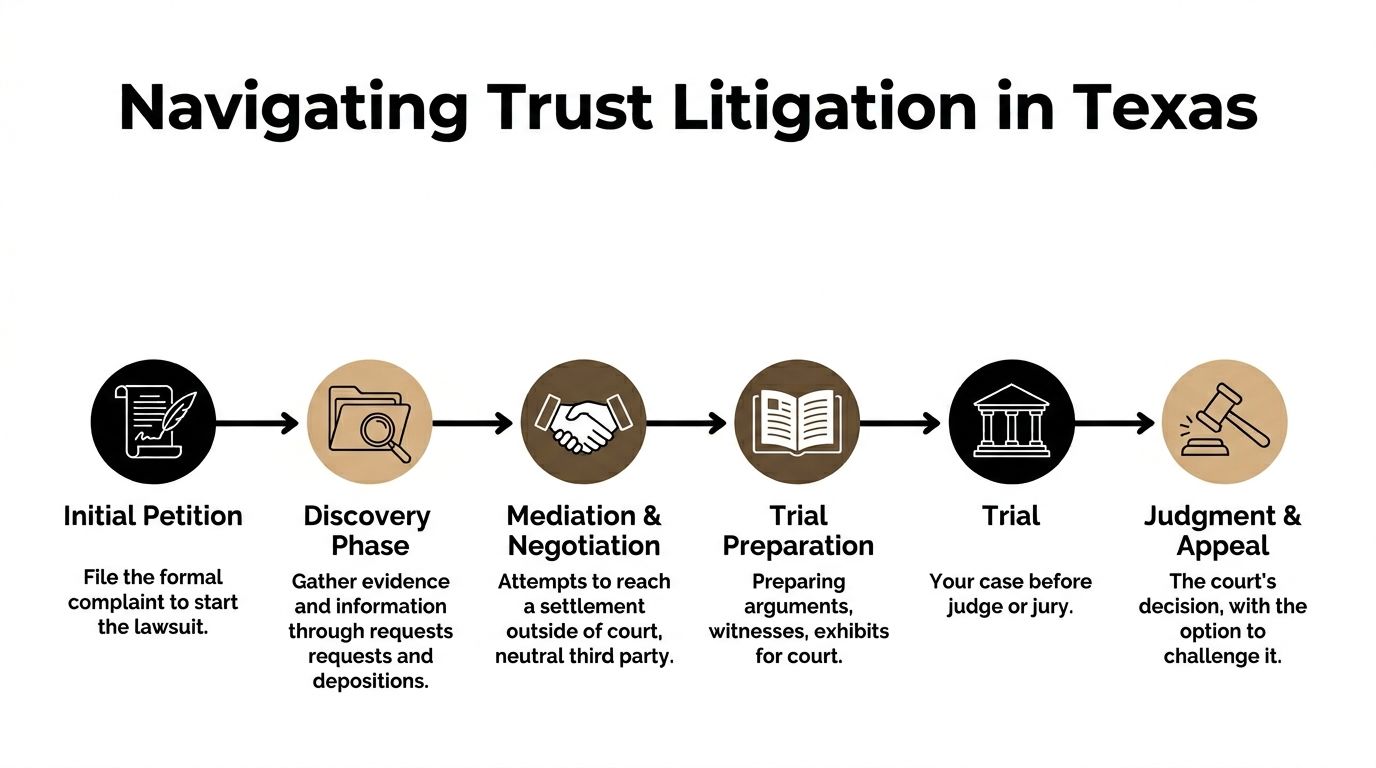
Trust litigation follows a sequence, but it rarely moves in a straight line. Courts may address standing, limitations, accountings, temporary relief, and settlement efforts at different stages. A beneficiary who understands the basic rhythm of the case is in a better position to make decisions without panic.
The first filing shapes the case
The lawsuit begins with a petition. That filing identifies the parties, the trust relationship, the alleged misconduct, and the relief requested. In a trust dispute, the wording matters more than many people expect.
A petition that is too vague invites attack. A petition that confuses personal claims against the trustee with claims that belong to the trust can create avoidable problems. So can a filing that fails to describe why the plaintiff qualifies as an interested person under Texas law.
The opening stage is also when lawyers decide whether to seek urgent relief. If assets may be transferred, records destroyed, or trust property dissipated, early court involvement may be necessary.
Discovery is where the paper trail gets tested
After filing, the case usually enters discovery. This is the evidence-gathering phase. Each side requests documents, serves written questions, and may take depositions.
For beneficiaries, discovery often reveals whether the initial suspicion was too narrow or not nearly broad enough. Records may show simple neglect. They may also show a long pattern of transfers, informal loans, insider dealings, or missing documentation.
Common discovery targets include:
- Trust account records
- Real estate transaction files
- Tax returns and supporting work papers
- Communications with brokers, accountants, and family members
- Calendars, notes, and internal trustee records
Depositions matter because they force witnesses to commit to explanations under oath. A trustee who sounds confident in a family meeting may struggle when asked to identify documents, dates, and authority for a transaction.
Key point: Trust cases often turn less on dramatic testimony and more on whether the trustee can produce consistent records that match the story being told.
Mediation is often part of the path
Texas trust disputes frequently go through mediation before trial. That process gives the parties a structured chance to resolve the case privately with a neutral third party.
Mediation can work well when both sides finally have enough information to evaluate risk. It is less effective when the trustee still has not produced meaningful records or one side is using the process only to delay.
That said, many cases settle after discovery clarifies the facts. A beneficiary who prepared carefully before filing usually negotiates from a stronger position.
The statute of limitations can decide the case
One of the most important issues in beneficiary suing trustee texas cases is timing. Under Texas law, beneficiaries generally must sue within four years of when the breach was discovered or reasonably should have been discovered. The Texas Supreme Court enforced that rule in a 2022 case where claims involving conduct from 2000 to 2007 were dismissed because suit was not filed until 2016, as explained in this discussion of the Texas Supreme Court’s limitations ruling in a trust dispute.
That does not mean every case is simple to time. The phrase “discovered or reasonably should have been discovered” is intensely fact-sensitive. Trustees do not always provide full accountings when they should. Records may be incomplete. Family members may suspect misconduct long before they can prove it.
Still, waiting is dangerous. The law does not reward indefinite delay once a reasonable person would have investigated further.
What trial preparation really looks like
By the time a case approaches trial, the focus narrows. The court wants to know what duties existed, what acts or omissions breached those duties, what harm resulted, and what remedy is legally available.
Trial preparation often includes:
- refining the timeline
- selecting witnesses
- organizing exhibits
- preparing objections
- addressing expert issues if accounting, valuation, or asset tracing is disputed
Many beneficiaries are surprised by how document-heavy this phase becomes. Trial is not just about telling the judge your side of the story. It is about proving it in a way that fits the trust document, the Texas Trust Code, and the rules of evidence.
Related disputes often overlap
Trust litigation does not always stay inside a neat box. A beneficiary suit may intersect with probate issues, elder exploitation concerns, or guardianship disputes involving incapacity and control over assets. When a trust was amended late in life, or when one family member isolated a parent before major transfers, the trust case may overlap with broader estate litigation.
That overlap can change strategy. The right next step may involve parallel record review, probate filings, or a challenge to related transactions outside the trust itself.
A realistic view of the process
Here is a simple way to think about the path:
| Stage | What usually matters most |
|---|---|
| Filing | Framing the legal theory correctly |
| Early motions | Standing, pleading defects, urgent relief |
| Discovery | Documents, accountings, sworn testimony |
| Mediation | Whether facts are clear enough to value risk |
| Trial | Proof of breach, causation, and remedy |
| Appeal | Legal errors, preservation, and final scope of relief |
Litigation can protect a trust, but it also demands discipline. The beneficiaries who do best are usually the ones who stay organized, act promptly, and keep the case focused on provable fiduciary misconduct instead of family grievances alone.
Potential Remedies and Paths to Resolution
A lawsuit is not only about proving the trustee did something wrong. It is about fixing the damage in a legally workable way. That is where many beneficiaries need the most clarity.
Texas courts have broad tools in trust cases. The best remedy depends on the nature of the breach, the current condition of the trust, and whether the relationship between trustee and beneficiaries can still function.
Removal is sometimes the primary goal
In some disputes, money is not the first concern. The immediate problem is that the wrong person remains in control.
A court may remove a trustee when the facts justify it. That often becomes the central remedy when the trustee refuses transparency, has a material conflict, mishandles assets, or has lost the confidence required to carry out the role responsibly. If removal is the likely path, this overview of a petition to remove a trustee in Texas helps explain the process at a practical level.
Removal can protect the trust going forward even before every dollar issue is fully resolved.
Accounting, reimbursement, and restoration
Other cases focus on forcing the trustee to open the books and restore what was lost. Courts can require accountings, order repayment, unwind improper conduct in some circumstances, and impose remedies aimed at making the trust whole.
That “make the trust whole” point matters. Beneficiaries often assume that if they win, the court will write a check directly to them. Texas law is usually more careful than that.
As noted in the Fetter case, a $2 million award was reversed because it was awarded directly to the beneficiary instead of to the trust. The award included $1.3 million in actual damages and $0.7 million in punitive damages, but the proper approach was to restore the trust, not bypass it, as discussed in the fiduciary litigation update handout.
That does not make the lawsuit pointless. It changes expectations. If trust assets are restored, the beneficiary may receive the benefit later through the normal distribution process rather than immediate personal payment.
Important expectation: In many Texas trust cases, the court’s remedy runs to the trust first and the beneficiary benefits through the trust.
Settlement can be a strong result
Many people hear “settlement” and think “compromise because the case is weak.” In trust litigation, settlement often reflects the opposite. Once records are exchanged and the risks are clear, resolution may protect the trust faster, with less expense and less family damage than a full trial.
Strong settlements often include combinations of the following:
- resignation or replacement of the trustee
- a full accounting
- revised administration procedures
- repayment or reallocation of disputed funds
- release terms tied to disclosure and corrective action
Settlement is especially useful when the trust must continue operating after the dispute. A business interest, family ranch, or income-producing property may suffer if litigation drags on without a practical plan.
Mediation works best when the facts are mature
Early mediation can be productive if the trustee has already produced meaningful information. If not, mediation may expose how far apart the parties still are.
Beneficiaries should be careful not to confuse speed with progress. Quick resolution is good only when the beneficiary understands the assets, the alleged breach, and the likely remedies. Otherwise, the beneficiary may sign away claims without knowing what was lost.
What works and what usually does not
Beneficiaries often ask for the practical version, not just the legal version. Here it is.
What tends to work:
- A disciplined paper trail
- Focused claims tied to specific fiduciary duties
- Early attention to limitations
- A clear remedy request
- Willingness to mediate once the facts are developed
What tends not to work:
- General accusations without documents
- Using the lawsuit to relitigate family history
- Waiting too long because the trustee is a relative
- Demanding remedies Texas courts do not usually award directly to beneficiaries
- Filing before identifying whether the claim belongs against the trustee personally or relates to trust-owned claims
A practical decision point for beneficiaries
If you suspect wrongdoing, the immediate goal is not to “win the whole case” in your head. The goal is to identify the next right move.
Sometimes that next move is a records request. Sometimes it is a formal accounting demand. Sometimes it is a filing for removal or damages. Sometimes it is preparing for mediation from a position of strength.
What matters is acting with enough urgency to protect your rights, and enough care to avoid turning a valid concern into a weakly framed case.
If you’re dealing with a trustee who will not answer questions, a denied distribution, missing trust records, or suspected self-dealing, specific legal advice can make the situation much clearer. The Law Office of Bryan Fagan, PLLC works with Texas beneficiaries, trustees, and families on trust disputes, estate planning, probate, guardianship matters, and asset protection issues. If you’re managing a trust or planning your estate, contact The Law Office of Bryan Fagan, PLLC for a free consultation. Our attorneys provide trusted, Texas-based guidance for every step of the process.