Managing a loved one’s trust can feel overwhelming, especially when you’re grieving and people start asking you practical questions right away. Who pays the bills? Can you access the bank account? Do you need to go to court? If you’ve been named successor trustee, you may feel pressure to get everything right while still trying to absorb a loss.
That’s a very common place to be. Many trustees are spouses, adult children, siblings, or close friends. They were chosen because the person who created the trust trusted them, not because they had legal or tax training. The good news is that post-death trust administration follows a workable path when you understand the order of steps and the duties involved.
A revocable living trust is often used in Texas to keep asset management organized during life and to make the transfer process smoother after death. If you need a plain-English refresher on the basic structure, this overview of what a revocable trust is in Texas is a helpful starting point.
If you’re searching for answers about revocable trust after death texas, the key point is this. Your job is no longer to guess what your loved one would have wanted. Your job is to carry out the written trust terms carefully, fairly, and in line with Texas fiduciary law. That can feel like a heavy responsibility, but it’s also a clear one.
The trustee’s role is part manager, part recordkeeper, and part protector of the beneficiaries’ interests.
Introduction Navigating a Loved One’s Trust
The first few days after a death are often a blur. Someone is planning services, someone else is gathering financial papers, and then the question lands on you: “You’re the trustee. What happens now?rdquo; For many families, that’s the moment the legal side of grief becomes real.
A revocable living trust often operated in the background while your loved one was alive. They may have served as their own trustee, used the trust to hold a home or accounts, and changed the terms when life changed. After death, that flexibility ends, and the trust shifts into an administration phase.
That shift matters because your authority as successor trustee comes from the trust document itself. In many cases, you can act without opening a full probate case for the assets that were properly placed in the trust. That usually means less delay, more privacy, and a more direct path to carrying out your loved one’s instructions.
Why trustees often feel stuck at the start
It's common to be unsure whether to begin with the bank, the lawyer, the accountant, or the funeral home. They’re also worried about making a mistake. That anxiety makes sense because trustees owe legal duties to beneficiaries, and those duties are real.
A calm first step is to gather the core documents and slow the process down enough to read them. You’ll want the trust agreement, any amendments, certified death certificates, and a rough list of assets. Once you have those in one place, the process becomes far easier to manage.
What this role really asks of you
You’re not expected to do everything in a single week. You are expected to act carefully, keep good records, follow the trust terms, and avoid using trust property as if it were your own. If a question is unclear, get legal or tax guidance before acting.
That mindset protects both the trust and you personally.
The Critical Transition From Revocable to Irrevocable
At the moment the grantor dies, the trust changes in a very important way. What was once flexible becomes fixed. The trust no longer belongs to the personal decision-making of the person who created it, because that person is no longer here to amend it.
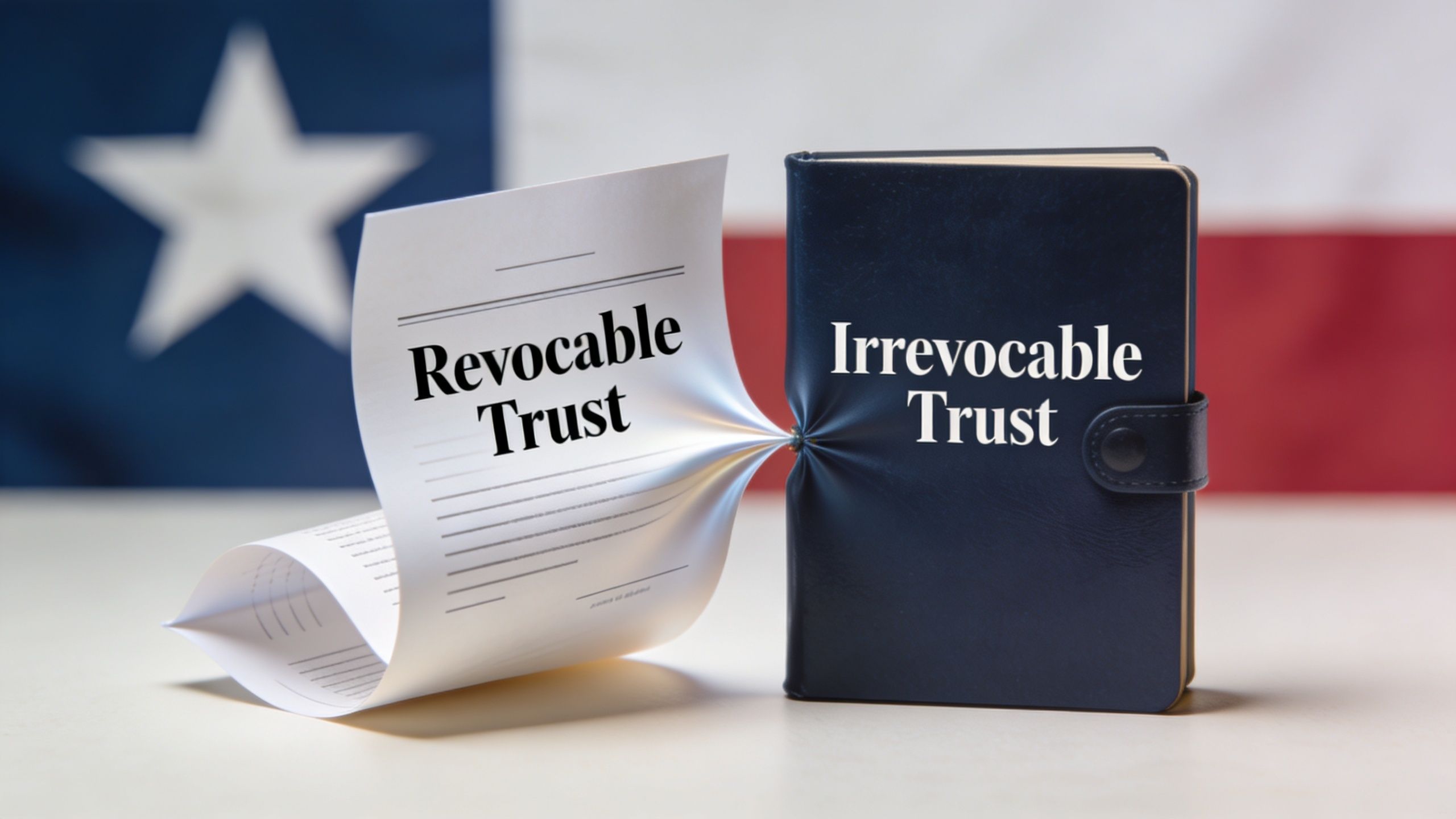
Under Texas trust practice, upon the grantor's death, a revocable living trust undergoes an immediate legal transformation. The trust becomes irrevocable, meaning no party can subsequently modify its terms. This conversion is automatic and requires no court intervention. Simultaneously, fiduciary authority transfers from the grantor to the successor trustee named in the trust document, who gains full legal authority to manage trust property and execute the distribution process without probate court oversight, as explained in this discussion of what happens to a revocable living trust after death.
What irrevocable means in plain English
Think of the trust like a set of written instructions in a sealed binder. While the grantor was alive, they could open the binder, rewrite pages, remove beneficiaries, add assets, or revoke the trust completely. At death, that binder closes.
From that point on, the trustee doesn’t get to rewrite the plan just because one beneficiary wants something different or because the family agrees informally to change direction. In most situations, the trustee must follow the trust as written.
For a trustee, that’s helpful. It narrows your role. You’re not deciding who deserves what. You’re administering a legal document.
What changes for your authority
Before death, the grantor may have been the acting trustee. After death, your authority begins because the trust says it does. Financial institutions often want proof of both the death and your appointment. In practice, trustees usually gather:
- The signed trust agreement so they can confirm the exact terms
- Any amendments because later amendments may control over earlier language
- Certified death certificates because banks, title companies, and government offices often require them
- A certification of trust when a third party needs basic trust information without seeing the full private document
Texas trustees dealing with an irrevocable trust after death often benefit from reviewing guidance on Texas irrevocable trust administration because the rules and practical concerns are different from those during the grantor’s lifetime.
Practical rule: Don’t assume you can “fix” an unclear trust by family agreement. Read the document first, then get legal advice if any provision seems uncertain.
What doesn’t happen automatically
Beneficiaries don’t automatically receive checks the day after death. Assets don’t instantly retitle themselves. Debts don’t disappear. The trust may avoid probate for trust-owned property, but administration still takes work.
The trust can hold a house, investment accounts, business interests, or personal property. Each asset type may require a different process to secure, value, manage, and eventually distribute. That’s why successor trustees need to move carefully rather than quickly.
The phrase revocable trust after death texas often causes confusion because people hear “avoid probate” and think “no legal process at all.” A more accurate understanding reveals a nuanced process. There may be no probate for trust assets, but there is still trust administration, and that administration carries legal duties.
Your Role and Fiduciary Duties as Successor Trustee
A common Texas trustee scenario looks like this. You have the death certificates, family members are calling, and someone asks, “So when do we get our share?rdquo; At that moment, your job is not to act like the owner of the trust property. Your job is to act like the person responsible for protecting, accounting for, and carrying out someone else’s written instructions.
That shift matters because a successor trustee wears two hats at once. You may be a grieving spouse, child, or sibling. You are also a fiduciary under Texas law. The second role comes with rules, deadlines, and potential personal liability if trust property is mishandled or beneficiaries are kept in the dark.

The trust document tells you what powers you have. The Texas Trust Code and general fiduciary law set the rules for how you must use those powers. A trustee can have full authority to sign, sell, invest, or distribute, and still breach a duty by acting carelessly, favoring one beneficiary, mixing trust funds with personal funds, or failing to give required information.
In plain terms, fiduciary duty means this: the trust is not your money, even if you are also a beneficiary. The records are not yours to hide. The timing is not yours to control for convenience. Each decision should be tied to the trust terms, the interests of the beneficiaries, and a written record showing why you acted.
Texas law also places real communication duties on trustees. Beneficiaries are often entitled to notice and trust information, and trustees may have to provide an accounting or inventory depending on the circumstances and the terms of the trust. As noted in this discussion of how a trust works after someone dies, post-death disputes often grow out of silence, delay, and poor documentation rather than a single dramatic mistake.
Loyalty means avoiding self-dealing
This is the duty trustees understand in theory and violate in ordinary ways.
If you are trustee and also one of three beneficiaries, you cannot pay yourself first because you have easier access to the checkbook. If the trust owns a house, you cannot move into it rent-free unless the trust clearly allows that arrangement. If you want to buy trust property yourself, you should stop and get legal advice before doing anything. Transactions that benefit the trustee personally receive close scrutiny.
Common loyalty problems include:
- Using trust funds for personal expenses
- Selling trust property to yourself or an ally without a fair process
- Withholding information from certain beneficiaries
- Delaying distributions to pressure family members during a dispute
A good test is simple. If you had to explain the transaction line by line to all beneficiaries and a judge, would it look fair and authorized?
Prudence means acting like a careful manager
A trustee does not have to know everything. A trustee does have to slow down, gather facts, and make reasonable decisions.
Prudence works a lot like being the temporary manager of a family business you did not build. You protect the assets first. You avoid careless decisions. You bring in help when the work goes beyond your skill set. For a vacant home, that may mean changing locks, confirming insurance, arranging maintenance, and documenting contents. For investments, it may mean reviewing the trust terms, avoiding speculative trades, and getting advice before making major changes.
This is also where personal liability becomes very real. Under Texas law, a trustee who breaches a duty can face surcharge, repayment, removal, attorney fee exposure, or other remedies. A trustee usually gets into trouble through patterns, not one isolated typo. Poor records, unexplained delays, missed notices, and casual use of trust assets can build a case against you.
Communication is part of the job
Many trustees stay quiet because they hope silence will keep the peace. In practice, silence usually creates suspicion.
Beneficiaries do not need daily updates. They do need timely, understandable information about what you are doing, what is causing delay, and what documents or valuations are still pending. If Texas law requires notice or an accounting in your situation, treat that as a legal task, not a family courtesy. Keep copies of what you sent, when you sent it, and who received it.
If you are unsure whether a beneficiary must receive formal notice, an accounting, or specific trust information under the Texas Trust Code, get advice early. That is one of the legal nuances many trustees overlook, and it is one of the easiest ways to create avoidable exposure.
Impartiality matters, especially in difficult families
If there is more than one beneficiary, your duty is usually to act impartially unless the trust itself directs different treatment. Impartial does not always mean identical in every moment. It means your decisions must be grounded in the trust, not in old family alliances.
For example, one child may live near the trust property and help coordinate repairs. That may be practical. Giving that child special access to information, allowing them to remove property, or letting them influence sale terms for personal reasons is a different matter. Your role is to keep process fair and documented.
A practical checklist for staying out of trouble
Use this as a working standard during administration:
- Read the trust and every amendment before taking major action
- Open a clear recordkeeping system from day one
- Keep trust money and personal money completely separate
- Track expenses, deposits, conversations, and decisions in writing
- Respond to beneficiary questions professionally and consistently
- Do not make early distributions until debts, taxes, and administration costs are reviewed
- Get legal or tax advice before any unusual sale, disclaimer, settlement, or beneficiary dispute
The safest mindset is simple. You are not just carrying out wishes. You are administering a legal relationship with duties that can be enforced against you personally. Handled carefully, the role is manageable. Handled casually, it can become expensive very quickly.
A Step-by-Step Guide to Post-Death Trust Administration
Most trustees do better when they stop thinking of trust administration as one giant legal problem and start treating it as a sequence of tasks. The order matters. When you do the early steps carefully, the later steps usually become more manageable.
Here is the checklist many trustees wish they had on day one.
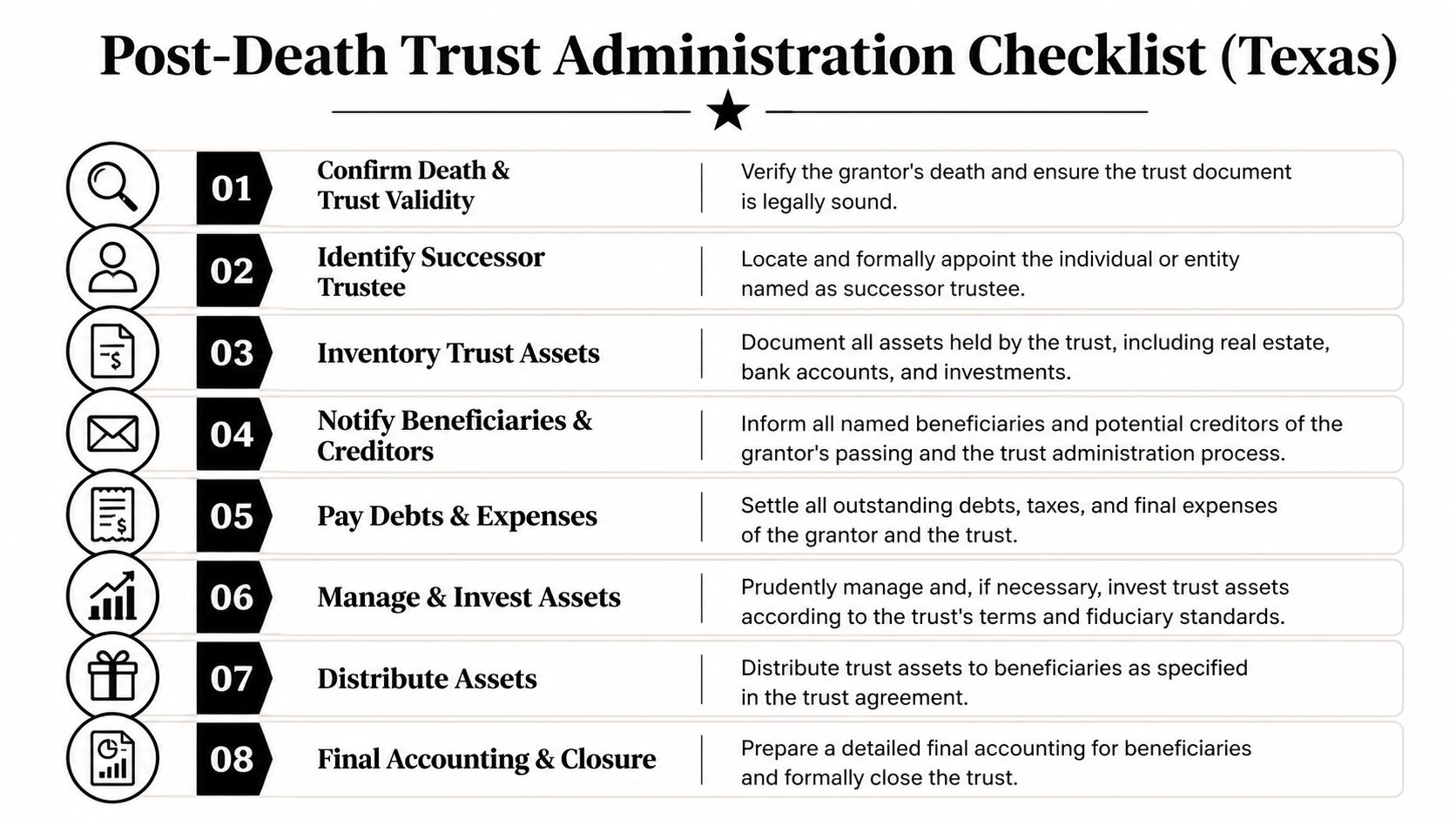
Upon the death of the grantor in Texas, a revocable living trust becomes irrevocable, locking in its terms and allowing the successor trustee to manage assets without probate court involvement. This transition allows the successor trustee to settle debts, pay taxes, and distribute assets to beneficiaries, often enabling distribution in weeks rather than the months or years required by probate, according to this explanation of revocable trusts after death in Texas.
Step one gather authority documents
Start with the trust agreement, amendments, and certified death certificates. If the grantor had a pour-over will, collect that too, along with any deeds, account statements, insurance information, and recent tax returns.
You can’t administer what you can’t identify. A missing amendment or overlooked account can create serious problems later.
Step two secure property and information
The trustee’s first practical responsibility is protection. Make sure homes are locked, valuables are safe, insurance is in place, and online financial access is preserved where lawful and appropriate.
If there are rental properties or business operations, address anything time-sensitive. Utilities, payroll, security, and vendor relationships may require immediate attention.
A short visual summary can help you keep the order straight.
Step three identify which assets are actually in the trust
Many trustees stumble on this point. Just because an asset appears on a handwritten list doesn’t mean the trust owns it. Confirm title and beneficiary designations.
Look at:
- Real estate deeds to see whether title was transferred to the trust
- Bank and brokerage accounts to confirm ownership or trust registration
- Business interests to check operating agreements, stock records, or assignment documents
- Vehicles and personal property because ownership and transfer rules can differ
If an asset was left outside the trust, it may require separate handling, sometimes through probate.
Step four notify beneficiaries and handle required disclosures
Communication should begin early. Beneficiaries need to know the trust is being administered and what to expect. Texas law may also require specific information, including inventory obligations in appropriate situations.
Keep your tone factual and steady. You don’t need to promise exact distribution dates before you know the debt, tax, and asset picture.
Important point: Early transparency often prevents later accusations that the trustee acted in secret.
Step five collect values and assess debts
Administration depends on knowing what the trust owns and what the estate or trust owes. That usually means gathering date-of-death values, appraisals when needed, mortgage balances, credit obligations, and final expenses.
A trustee should also look for recurring expenses that continue after death, such as insurance premiums, property taxes, association dues, and maintenance costs. If no one is watching these items, preventable losses can happen.
Step six manage taxes and claims before distributing
Don’t rush distributions because a beneficiary is impatient. Creditors, tax filings, and administration expenses need attention first. A trustee who distributes too early can create personal problems if money is later needed to pay valid obligations.
This phase often involves coordination with a CPA for income tax reporting and with counsel if there are disputed claims or uncertain legal questions.
Step seven distribute according to the trust terms
Once the trust is ready, follow the document exactly. Some trusts call for outright distribution. Others create continuing shares, sub-trusts, or staged distributions.
If the trust says the home goes to one child and investment accounts are divided among three children, document how values are handled and how expenses are allocated. Beneficiaries are far less likely to object when the trustee can show the math and the authority behind each choice.
Step eight prepare final records and close administration
Before closing out your work, prepare a full accounting of receipts, expenses, income, distributions, and remaining balances. Get consents or receipts when appropriate and confirm that title transfers, account closures, and tax matters have been completed.
At that point, the administration is not just “basically done.” It is documented as done.
Comparing Trust Administration and Texas Probate
You open the trust binder, then discover one surprise. The house is in the trust, but a bank account is still in your loved one’s individual name. As successor trustee, you may be handling two systems at once. Trust administration governs trust-owned assets. Probate handles assets that were still owned individually at death, unless a beneficiary designation, survivorship feature, or another transfer method applies.
That split is the starting point. It also explains why a family can have a trust and still need a probate case.
The biggest difference is ownership at death
The question is simple: who held legal title when the person died?
If the trust owned the asset, the successor trustee usually handles it under the trust terms. If the deceased person owned the asset individually, a probate proceeding may be needed to move title to the right person. The trust document does not automatically pull every asset under its control just because it exists.
A revocable trust works like a container. Only the property placed into that container during life avoids probate through trust administration. Property left outside the container follows its own transfer rules.
That is why lawyers focus so much on trust funding. Signing the trust is only one step. Retitling the house, accounts, and other property is what gives the plan practical effect after death.
A pour-over will can help. It often directs individually owned property into the trust through probate. That safety net is useful, but it still means the court process may be part of the administration.
Trust Administration vs. Texas Probate At a Glance
| Feature | Trust Administration | Texas Probate |
|---|---|---|
| Main trigger | Assets titled in the trust | Assets owned individually at death |
| Who is in charge | Successor trustee under the trust terms | Executor or administrator under court authority |
| Court involvement | Often handled without ongoing probate court oversight for trust assets | Court process is usually required |
| Privacy | Trust administration is generally private | A will filed for probate becomes part of the public record |
| Process focus | Collect, manage, and distribute trust property under the trust | Prove the will, appoint a personal representative, and transfer individually owned property |
| Risk point for the person in charge | Trustee can face personal liability for mishandling notice, distributions, or trust property | Executor can face liability for errors in estate administration |
The practical difference for a trustee is control and exposure. In many trust administrations, no judge is supervising each step, which gives the trustee more room to act. It also means more responsibility to get the details right, especially with recordkeeping, communications, and any notice duties that may apply under the Texas Trust Code.
As noted in this discussion of revocable living trust pros and cons in Texas, a properly funded revocable trust can avoid probate for the assets titled in the trust, preserve privacy, and often allow distributions sooner than a probate case. The same source discusses general cost and timing differences, but those figures depend heavily on the estate, the county, whether assets were properly funded, and whether disputes arise.
Why probate does not mean the plan failed
Families often hear “probate” and assume something went wrong. Sometimes nothing went wrong at all. A trust may administer the home, brokerage account, and other funded assets, while probate is used for one overlooked account, a vehicle, or a mineral interest that stayed in an individual name.
That is not unusual in Texas.
For a successor trustee, the better question is not “Did we avoid probate entirely?rdquo; The better question is “Which assets belong in which process, and what do I need to do for each one?rdquo; That approach keeps you from making one of the most common mistakes. Treating all property as if the trust controls it.
A common Texas example
A parent creates a revocable trust and properly transfers the home and investment account into it. Years later, that parent opens a new bank account in an individual name and never retitles it. After death, the trustee may be able to manage and distribute the home and investment account under the trust. The bank account may require probate, or it may pass another way if a payable-on-death designation was added.
The lesson is practical. Review each asset one by one, confirm how title was held, and match the asset to the correct transfer process. That careful inventory protects the beneficiaries, and it protects you as trustee.
Managing Tax Filings and Final Accounting
Taxes and accounting are where many trustees slow down, and that’s wise. This phase deserves care. A trustee who keeps excellent records and gets the filings right is usually in a much stronger position if beneficiaries later ask questions.

One practical privacy tool in Texas trust administration is the certification of trust. Texas law allows trustees to provide essential trust information, such as trustee identity and powers, without publicly disclosing beneficiary names or asset values, as outlined in this explanation of Texas trust administration privacy protections.
The tax side of the trustee’s job
After death, tax reporting may involve more than one return. The deceased person may need a final personal income tax return. The trust may also need its own fiduciary income tax return, commonly Form 1041, depending on income and administration details.
Because tax treatment can vary by asset and timing, trustees often work with a CPA rather than guessing. That’s especially true when there are investment accounts, rental property, business income, or distributions made during the administration period.
Why accounting protects you
A final accounting is more than a spreadsheet. It is your written explanation of what came in, what went out, what remains, and why. Beneficiaries may not love every decision, but they are far more likely to accept a well-documented administration than a vague one.
A useful accounting usually includes:
- Beginning asset values based on statements or appraisals
- Income received such as rent, dividends, or interest
- Expenses paid including taxes, maintenance, professional fees, and debts
- Distributions made to each beneficiary
- Ending balances and any reserve still being held
Trustees who want a clearer sense of reporting expectations can review this explanation of trust accounting in Texas.
Clean records don’t just help beneficiaries understand the administration. They help the trustee prove the administration was proper.
Use privacy tools correctly
Unlike probate, trust administration usually doesn’t require a public asset inventory filing. That privacy is one reason many Texas families use living trusts. But privacy doesn’t mean informality.
Third parties may still need proof of your authority. A certification of trust can often provide enough information without exposing the full document. That helps with banks, title work, and other transactions while preserving the private nature of the trust arrangement.
Common Complications and When to Contact an Attorney
Some trust administrations are smooth. Others develop problems that aren’t obvious at first. The trustee’s job is not to solve every legal conflict alone. It’s to recognize when the issue has moved beyond routine administration.
The trust language isn’t clear
A father’s trust says one child may receive “the ranch operations” and the rest of the estate is divided equally. The trust doesn’t define whether that includes equipment, livestock contracts, mineral income, or only the land. The trustee shouldn’t improvise. Ambiguous wording can trigger claims that the trustee favored one side.
A beneficiary thinks the trustee is hiding something
An adult daughter keeps asking for updates. The trustee, her brother, believes she’s being difficult and stops responding. That silence turns a manageable relationship problem into a legal one. Counsel can help structure proper disclosures, prepare accountings, and lower the chance of escalation.
The trust owns hard-to-manage property
A trust may hold rental homes, a family business, or property in more than one state. Those assets often require legal review, tax coordination, and careful operational decisions. A trustee who waits too long to ask for help can create unnecessary loss.
Debts or claims surface late
Sometimes a creditor appears after the family thought everything was nearly complete. Sometimes tax records don’t match what the trustee expected. Sometimes someone challenges whether an asset belonged to the trust at all.
Those are strong moments to call a Texas estate planning attorney or trust litigation counsel. You should also reach out if:
- A beneficiary threatens suit
- You discover missing or mis-titled assets
- You’re asked to make uneven distributions
- You suspect self-dealing by a prior trustee
- You don’t know whether you can safely close the trust
If a related issue involves probate administration, guardianship concerns, or asset preservation, legal advice may need to cover more than just the trust document. Post-death administration often overlaps with broader estate planning, probate, guardianship, and asset protection work.
Conclusion Your Path Forward with Confidence
You may be reading this with a trust document on the table, a death certificate beside it, and family members already asking what happens next. That is a heavy position to be in. It is also a role you can handle if you treat it like a series of careful, documented steps.
After death, a revocable trust no longer changes at the creator’s whim. It operates more like a set of written instructions that you, as successor trustee, must carry out with care. Your job is practical and legal at the same time. Protect trust property. Follow the trust terms. Give required notices when Texas law calls for them. Keep clean records. Pause before making distributions if debts, taxes, or beneficiary questions are still unresolved.
Many new trustees worry they are already behind because they do not know everything on day one. That is not the standard. The standard is whether you act prudently, stay organized, and avoid shortcuts that could expose you to personal liability.
Start there.
If you have been searching for answers about revocable trust after death texas, the safest path is usually the same. Gather the trust papers and related estate documents. Identify what is titled in the trust. Separate trust property from non-trust property. Create a record of every action you take, every expense you pay, and every notice you send.
A careful trustee protects two things at once. The beneficiaries’ interests, and the trustee personally.
Some administrations are straightforward. Others involve real estate, business interests, late creditor issues, tax filings, or conflict between beneficiaries. In those cases, early legal advice often prevents expensive mistakes later, especially where the Texas Trust Code imposes duties that are easy to overlook.
If you need help handling a trust after a death or want to plan ahead, contact Law Office of Bryan Fagan, PLLC for a free consultation. Our attorneys advise Texas families and trustees on trust administration, fiduciary duties, and related estate matters.