Losing a loved one is hard enough. Then the paperwork starts, the questions pile up, and someone in the family has to figure out what happens to the house, the bank accounts, and the plan your loved one thought was clear.
In Texas, two legal tools often come up in that moment. One is muniment of title, a probate shortcut that applies only in narrow situations. The other is a trust, which works very differently and can solve problems that probate shortcuts can’t touch. If you’re searching for muniment of title vs trust texas, you’re probably not looking for theory. You want to know which option fits your family, your property, and the risks you may not see yet.
That’s where many families get stuck. A muniment of title can be fast and efficient, but it has strict limits. A trust can offer privacy, continuity, and stronger control, but it takes planning and proper funding. The right choice depends less on labels and more on the facts on the ground. Are there debts? Is there a blended family? Did Medicaid benefits create possible recovery issues? Do you need someone to manage assets over time, not just transfer title once?
Managing a Loved One’s Estate Can Feel Overwhelming
When a parent or spouse dies, families often discover that “simple” isn’t always simple. A house may be paid for except for a mortgage. One child may live nearby and handle paperwork while another lives out of state. Someone may assume the will alone transfers title, only to learn that Texas still requires a legal process to make records clear.
That confusion is understandable. Texas estate law includes both the Texas Estates Code and the Texas Trust Code, and each set of rules serves a different purpose. The Estates Code governs probate procedures, including special tools like muniment of title. The Trust Code governs trustees, asset management, beneficiary rights, and the fiduciary duties that come with holding property for someone else.
Families also tend to focus on speed first. Speed matters, but it shouldn’t be the only question. The better question is this: what legal tool matches the estate you have?
Consider the difference between these situations:
- A straightforward home transfer: A parent leaves a valid will, owns a house in Texas, and has no unpaid unsecured debts.
- A complex family structure: A surviving spouse wants to stay in the home, but children from a prior marriage also have inheritance rights.
- A caregiver concern: An elderly parent received Medicaid benefits and the family worries that a transfer after death may not protect the property from estate recovery issues.
- An incapacity risk: Someone wants a plan that works during life if they can’t manage finances, not only after death.
Those aren’t small details. They often decide whether a probate shortcut is enough or whether a trust-based plan makes more sense.
The strongest estate plan usually isn’t the one with the fewest documents. It’s the one that still works when family stress, debt questions, or health care costs enter the picture.
What is Muniment of Title in Texas
Muniment of title is one of the most Texas-specific probate tools you’ll find. Texas is the only state in the United States that permits probate of a will as a muniment of title under Texas Estates Code §257.001, allowing direct transfer of real property without full estate administration when there are no unpaid unsecured debts, only debts secured by liens like mortgages, as described in this Texas probate explanation of muniment of title.
The phrase comes from the Latin munimentum, meaning a defense or written proof of title. In practical terms, that tells you what this process does. It proves the will and clears title, especially for real estate. It does not create a full estate administration.
What muniment of title actually does
A muniment proceeding asks a Texas probate court to admit a will to probate for one limited purpose. The court confirms the will is valid and issues an order that can be recorded in the county deed records along with the will. That recorded order helps establish the chain of title for real property.
This matters most when a family needs to:
- Transfer a homestead or other Texas real estate
- Sell property after a death
- Refinance or otherwise document ownership clearly
- Avoid appointing an executor when there’s no real need for one
For a closer look at the process, many families start with this overview of muniment of title in Texas.
What has to be true before it works
Muniment of title is efficient, but it is also strict. The estate must fit the tool.
A family generally needs these conditions:
- A valid will: The will must have been properly executed and capable of being admitted to probate.
- No unpaid unsecured debts: Mortgages and other secured liens may be allowed, but unsecured obligations disqualify the estate.
- No need for full administration: If assets need active collection, management, or transfer through formal authority, muniment usually isn’t enough.
One point confuses families all the time. A will admitted as a muniment of title can help with real property, but it usually won’t solve every transfer problem. Assets such as brokerage accounts or other property that require formal authority may still need a different probate path.
Practical rule: Muniment of title works best when the estate is real-estate heavy, the debt picture is clean, and nobody needs an executor to keep managing property after the hearing.
What it is not
Muniment of title is not a trust. It is not private estate planning. It is not a tool for managing conflict. It does not create a fiduciary structure for long-term oversight. It is a limited court process that validates a will and helps transfer title.
That’s why families often hear that muniment is “simple” and assume it fits every modest estate. Sometimes it does. Sometimes it doesn’t. The difference usually turns on debt, asset type, and whether the family needs management or only transfer.
Understanding How a Trust Works for Estate Planning
A trust works differently from probate because it is not mainly a court procedure. It is a legal arrangement for holding and managing property. In Texas, trust administration is governed by Trust Code §§ 113.001-113.022, and one Texas estate planning analysis states that trusts reduce post-death administration time by 80-90% compared to probate processes, with zero court filings required after funding, while trustees must follow the prudent investor rule under §113.056 and provide annual accountings under §113.151 in many circumstances, as discussed in this Texas trust administration resource from Baylor Law.

The three people every trust involves
Most families understand trusts more easily when they break them into roles.
- Grantor: The person who creates the trust and places assets into it.
- Trustee: The person or institution that manages the trust property.
- Beneficiary: The person who benefits from the trust assets now or later.
In a revocable living trust, the grantor often serves as the initial trustee during life. If the grantor becomes incapacitated or dies, a successor trustee steps in under the terms of the trust. That continuity is one reason trusts are so useful in long-term planning.
Families who want a practical starting point often review how living trusts work in Texas.
Why fiduciary duties matter
A trustee doesn’t just “help out.” A trustee has fiduciary duties in Texas. That means the trustee must act for the benefit of the beneficiaries, follow the trust terms, manage assets prudently, keep records, and communicate as the law requires.
That structure gives a trust a major advantage over a one-time title transfer. If a house needs to be held for a surviving spouse, if investment accounts need oversight, or if a child shouldn’t receive assets outright at once, the trustee has ongoing authority to manage the situation.
A muniment proceeding doesn’t do that. Once title is transferred, the court’s role is generally over. A trust, by contrast, can continue operating according to the written instructions.
What a trust can handle that probate shortcuts often can’t
A trust can be used to address issues that aren’t really about probate at all.
For example:
- Incapacity planning: If the grantor can’t manage finances, the successor trustee can act without waiting for a death.
- Private administration: The trust document and trust assets generally aren’t handled through public probate filings in the same way a probated will is.
- Ongoing control: Assets can be distributed over time, held for a beneficiary, or managed under conditions set by the grantor.
- Complex assets and debts: Trust administration can involve broader management than a simple court order transferring title.
A trust is less about proving who inherits a house and more about deciding who manages property, under what rules, and for how long.
A plain-English example
Suppose a widowed father owns a home, a brokerage account, and rental property. He wants one child to receive support over time because that child struggles with money, while another child is ready for an outright distribution. A trust allows him to say exactly how that should work and who will manage it.
That flexibility is why many people searching for a Texas trust administration lawyer or Texas estate planning attorney are really asking a deeper question. They don’t just want to transfer assets. They want a plan that keeps working after the funeral, during conflict, and through changing family needs.
Muniment of Title vs Trust A Detailed Comparison
The choice between these tools becomes clearer when you compare how they behave under pressure. The chart below gives a quick view before we dig into the details.
| Feature | Muniment of Title | Living Trust |
|---|---|---|
| Primary purpose | Proves a will and transfers title, mainly for real property | Holds and manages assets during life and after death |
| Court involvement | Court proceeding required | Private administration after funding |
| Privacy | Court order and will are recorded publicly | Generally private |
| Debt limits | Not suitable if unpaid unsecured debts exist | Can manage more complex debt situations |
| Ongoing management | No ongoing manager created by the process | Trustee manages assets under fiduciary duties |
| Family conflict | Best when beneficiaries agree | Better suited for structured management when tension exists |
| Incapacity planning | No | Yes |
| Best fit | Simple, clean estate with a valid will | Broader estate planning and administration needs |
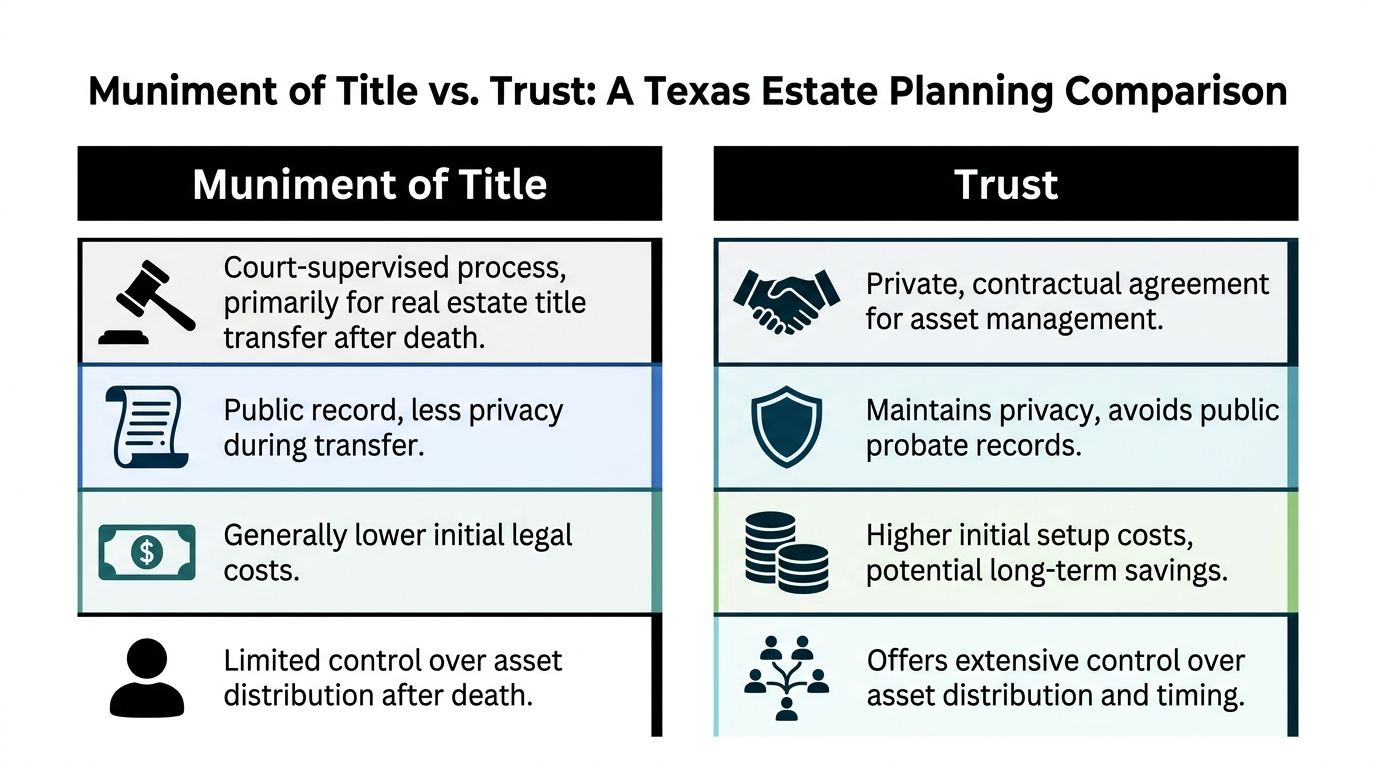
One Texas probate resource states that muniment of title typically takes 1-3 months and costs 50-70% less than full probate, while trusts offer private administration and can handle complex debts, with their major advantage being asset protection and tax planning that can preserve an additional 15-20% of net wealth for high-net-worth estates, according to this Texas muniment of title and trust comparison.
Court involvement and public process
Muniment of title is still a probate case. It may be limited, but it requires filing in court, obtaining a hearing, and securing an order that supports title transfer. That’s often manageable for a simple estate.
A living trust usually avoids that kind of post-death court process for funded assets. The trustee follows the trust terms privately.
This difference matters more than many families expect. Public filings can expose family relationships and property details in a way some people would rather avoid.
If privacy is one of your main goals, a trust usually gives you more control than a probate shortcut.
Timeline and cost
For the right estate, muniment can be appealing because it is narrow. It usually involves one hearing and fewer filings than full probate. That can reduce cost and stress.
A trust is different. It often requires more planning up front because the document must be drafted and assets must be funded into it. But after death, administration can be smoother because the trustee already has authority under the trust terms.
People sometimes compare the wrong things. Muniment is usually compared to full probate after death. A trust should be compared to a broader planning system that can operate during life, at incapacity, and after death.
Debt handling and creditor issues
This is one of the biggest practical divides in any muniment of title vs trust texas analysis.
Muniment of title is available only when there are no unpaid unsecured debts. The process tolerates certain secured liens, such as a mortgage, but unsecured obligations can knock the estate out of eligibility.
A trust does not erase debts, of course. But it provides a management structure through a trustee who can deal with complex assets and liabilities under the trust terms and applicable law.
That’s especially important when families are unsure whether all liabilities have surfaced yet. Medical bills, unresolved claims, or questions about final expenses can make a supposedly “simple” estate less simple.
Medicaid recovery risk
This point is often overlooked in basic guides. A simplified probate transfer does not provide planning against Medicaid estate recovery. If Medicaid benefits create a possible claim, the fact that title passes through a muniment order doesn’t itself shield the asset.
The primary protection question usually has to be addressed earlier, through planning rather than after-death procedure. Certain trust structures may be used as part of that planning, while muniment of title is only a transfer mechanism after death.
For families caring for aging parents, this issue deserves careful attention. The wrong assumption here can turn a hoped-for shortcut into a costly surprise.
Asset management and flexibility
Muniment of title does one main job. It validates the will for title purposes. That can be exactly enough in the right estate.
But if someone needs to manage property over time, collect rent, supervise investments, make discretionary distributions, hold funds for a young adult, or protect assets for a vulnerable beneficiary, muniment has no built-in manager. A trust does.
That distinction goes to the heart of fiduciary design. Under the Texas Trust Code, the trustee serves as an ongoing decision-maker with legal duties. Under muniment, beneficiaries generally receive property according to the will and then must sort out what comes next.
Privacy and family stress
Privacy is not only about avoiding curiosity from outsiders. It’s also about reducing friction. In families with old resentments or uncertainty about who gets what and when, public filings can make a tense situation worse.
A trust typically keeps administration more contained. The trustee still owes duties and must communicate appropriately, but the process is not centered on a public probate record.
That makes trusts especially useful for:
- Blended families
- Second marriages
- Estranged siblings
- Beneficiaries who need staggered distributions
- Families who value discretion
A family that agrees today may not agree once a house needs to be sold, an account needs to be divided, or a caregiver believes promises were made informally.
Real-World Scenarios Choosing the Right Path
Legal definitions help, but families usually understand these choices best through situations that feel familiar.

One Texas probate discussion notes that muniment of title works best when beneficiaries are in agreement, while trusts provide better tools for managing disputes without court intervention. That difference becomes especially important in blended families, second marriages, or estates involving estranged beneficiaries, as explained in this discussion of muniment of title and family agreement issues.
The simple house transfer
A mother dies with a valid will. Her main asset is her Texas home. She has no unpaid unsecured debts, and her two adult children agree that the home should pass exactly as the will says.
This is the kind of case where muniment of title may fit well. The family’s main need is clear title, not long-term asset management. They don’t need an executor collecting scattered property or managing a difficult administration. They need a clean legal path to record ownership.
In that setting, a full trust plan may not have been necessary to solve the immediate post-death issue.
The blended family problem
A husband in a second marriage wants his wife to live in the home for life, then wants the property to pass to children from his first marriage. Everyone gets along at Thanksgiving. That doesn’t mean they’ll agree after his death.
A muniment transfer can become awkward here because title may pass without any built-in structure for balancing competing interests over time. A trust can name a trustee, define who pays expenses, explain whether the home can be sold, and state what happens if the surviving spouse moves out or needs support.
Trusts often prevent future conflict rather than merely reacting to it.
A trust can separate love from logistics. Family members don’t have to negotiate from scratch when the document already answers the hard questions.
The business owner
A Texas business owner dies owning an interest in a closely held company, along with real estate and personal accounts. The family may need someone with authority to manage income, coordinate distributions, and protect operations while decisions are made.
Muniment of title is too narrow for that kind of ongoing administration. Even if there is a valid will, the family’s real challenge is continuity and management. A trust can work alongside business succession planning and give a trustee authority to act under written terms.
That can be especially valuable if one child works in the business and another does not. Equal inheritance and equal control are not always the same thing.
The incapacity concern
A widow wants to make things easier for her children. She worries less about death than about the years before it. If she becomes unable to handle bills, rental income, or investment decisions, she wants a smooth handoff.
Muniment of title can’t help with that because it only comes into play after death and only through probate of a will. A living trust, by contrast, can provide continuity if a successor trustee needs to step in during incapacity.
That difference is often the deciding factor for families dealing with aging parents, memory loss concerns, or long-term care planning.
The caregiver facing Medicaid questions
An adult child has been caring for a parent who received Medicaid benefits. The parent owns a home and has a will. The family wonders whether a muniment of title will keep the home safe after death.
That question is understandable, but the primary issue isn't speed. It's exposure. If Medicaid recovery is in the background, a simple title transfer may do nothing to solve the underlying risk. Planning may need to happen before death, and trusts are often part of those conversations.
For caregivers, the legal question is rarely limited to “how do we transfer this?” More often it is “what happens if the state has a claim, and what planning should have been done earlier?”
A Checklist for Your Decision
A family often reaches this point wanting a simple answer. They want someone to say, "Use muniment," or "Set up a trust." Texas law rarely works that neatly. The better question is what could go wrong later if you choose the simpler path now.
A good checklist should test more than paperwork. It should test whether the estate needs a one-time transfer, ongoing management, protection from conflict, or planning around creditor and Medicaid concerns that standard summaries often leave out.
Consider muniment of title if
Muniment of title works best in a narrow lane. It is a title-clearing tool, not an estate management system.
- There is a valid will: If there is no will, this option is unavailable.
- The estate is simple and the main job is transferring title: This often fits a home or other Texas real property that needs to pass under the will.
- There are no unpaid unsecured debts, other than debt secured by real estate: If creditors may have claims, the estate may need a different probate process. This Texas probate path comparison gives a helpful overview of why that matters.
- The beneficiaries are getting along: A muniment proceeding is not built to absorb serious family conflict.
- No one needs a trustee or other decision-maker after the transfer: Once title is confirmed, the court is not setting up ongoing supervision or asset management.
- There is no larger concern about post-death claims against the estate: If Medicaid estate recovery or similar issues may be in the background, speed alone does not solve the problem.
A trust is often the better fit if
A trust starts to make more sense when the family needs control, structure, or privacy over time.
- You want someone to manage assets, not just transfer them: Rental property, brokerage accounts, and business interests often need continued oversight.
- You want privacy: Trust administration usually keeps more family and financial details out of the public court file than probate does.
- You are planning for incapacity as well as death: A successor trustee can step in under the terms of the trust.
- The family has stress points: Blended families, unequal distributions, a child with financial problems, or concern about future disputes often call for clearer guardrails.
- You are worried about a beneficiary handling money poorly: A trust can stagger distributions or place them under a trustee's control.
- You need planning that takes Medicaid or creditor exposure seriously: In some families, the central issue is not how fast title passes. It is whether the chosen structure leaves assets exposed.
Questions to ask before choosing
Use these questions the way a doctor uses a checklist before treatment. Each answer points toward risk, and the pattern matters more than any single item.
- What assets are in the estate? A house alone raises different issues than a house plus accounts, mineral interests, or a closely held business.
- Are there unpaid debts, possible creditor claims, or Medicaid recovery concerns?
- Would a title transfer solve the problem, or would someone still need to manage property or money afterward?
- Is there anyone in the family who is likely to object, delay, or challenge decisions?
- Would public probate filings create privacy concerns or fuel family tension?
- Is incapacity planning part of the goal, especially for an aging parent or vulnerable spouse?
- Do the beneficiaries need protection from themselves, from creditors, or from outside pressure such as a divorce?
If your answers point in both directions, that usually means the family needs advice suited to the actual facts.
That is especially true for caregivers. Families helping an older parent often face estate questions and long-term care questions at the same time. This guide for caregiver legal needs gives useful context for those overlapping concerns. If you are comparing counsel before making a decision, this resource on how to choose an estate planning attorney can help you ask better questions in that first meeting.
When to Consult a Texas Trust and Estate Attorney
Families often wait too long to get legal guidance because they assume the estate is simple. Then a title company asks for clearer documents, a bank refuses to release funds, or a sibling raises concerns that no one expected.
An experienced Texas estate planning attorney or Texas trust administration lawyer can spot issues that don’t show up on the first read of a will. That includes hidden debt concerns, assets that won’t transfer cleanly through a muniment proceeding, and situations where a trust would better protect the family from conflict or administrative mistakes.
This is especially important for seniors and caregivers. If you’re helping an aging parent and want a broader resource on planning challenges, this guide for caregiver legal needs offers useful context on the legal issues families often face alongside estate questions.
It also helps to know what to look for in counsel. Families comparing lawyers often benefit from reading about how to choose an estate planning attorney, especially if the case involves trusts, fiduciary duties in Texas, guardianship concerns, or possible disputes.
Choosing between muniment of title and a trust is not only a paperwork decision. It’s a decision about control, protection, privacy, and whether the plan will still work when life gets harder.
If you’re managing a trust or planning your estate, contact Law Office of Bryan Fagan, PLLC for a free consultation. Our attorneys provide trusted, Texas-based guidance for every step of the process.