Skip to content
A child's trust is supposed to create safety. It's meant to hold money for school, medical care, housing, or a more stable future. When the person in charge of that trust starts acting secretive, careless, or self-interested, families often feel trapped between anger and uncertainty.
That uncertainty is common. A grandparent may have created a trust with good intentions, only for another relative to serve as trustee and become hard to reach. A surviving parent may notice delayed payments, missing explanations, or records that never seem to arrive. Sometimes the problem is serious misconduct. Sometimes it's poor administration that slowly puts a child's inheritance at risk.
When family stress and child welfare concerns overlap, emotional support matters too. Families dealing with instability often benefit from practical mental health resources like this guide to healing from trauma, especially when financial conflict is affecting a child's sense of security.
Securing a Child's Future When a Trust Is at Risk
The first thing to understand is simple. Concern alone doesn't fix a trust problem, but informed action often does.
In Texas, protecting children from a bad trustee starts with seeing the full life cycle of the issue. Some families need to respond to a current problem. Others are still in the planning stage and want to prevent one. Both situations matter because a trust can protect a child only if the document is well designed and the trustee follows it.
A child beneficiary is especially vulnerable. The child usually can't review statements, challenge decisions, or push for accountability on their own. That leaves parents, guardians, co-trustees, and adult beneficiaries in the position of watching closely and acting carefully.
When a trust is for a child, delay can be costly. Lost records, vague explanations, and missed distributions tend to become harder to unwind with time.
The legal system does provide tools, but it expects evidence and patience. Courts usually want to see what the trust says, what the trustee did, what records were requested, and what harm followed. Families who move methodically usually put themselves in a stronger position than families who begin with accusations and no paper trail.
A Trustee's Sacred Duties Under the Texas Trust Code
A trustee doesn't own the trust property in the ordinary sense. The trustee controls it for someone else's benefit and under someone else's instructions. That role carries fiduciary duties in Texas, which means the trustee must act with loyalty, care, and discipline.
For families trying to judge whether a trustee is doing the job correctly, the legal baseline matters more than personality. A trustee can be unpleasant and still comply with the law. A trustee can also sound reassuring while violating basic duties. For a fuller overview of those standards, this page on Texas Trust Code trustee duties is a useful starting point.
Loyalty means the child comes first
The duty of loyalty is the core rule. A trustee must act in the beneficiaries' interests, not the trustee's own.
If a trust exists for a minor child, the trustee shouldn't treat the account like a personal reserve, a family loan source, or a convenience fund. The trustee also shouldn't favor personal relationships over the trust terms. If the child's education, support, or health is the stated purpose, decisions should reflect that purpose.
A common problem appears when a trustee says, “I know what's best,” but can't connect that judgment to the actual trust language. That's not enough.
Prudence means careful management, not guesswork
A trustee also has a duty to manage assets prudently. In plain English, that means making thoughtful decisions, keeping records, and avoiding careless handling of money.
For a child's trust, prudence often affects practical issues such as:
- Investment choices that fit the trust's purpose and time horizon.
- Cash management so money is available when tuition, therapy, housing, or medical costs arise.
- Administrative follow-through like tax filings, record retention, and proper distribution procedures.
A trustee doesn't have to guarantee perfect results. Markets rise and fall, and reasonable people can disagree. What matters is whether the trustee used a responsible process and stayed within the authority granted by the trust.
Practical rule: A trustee is judged more by the quality of decision-making than by whether every decision turned out well.
Accountability is not optional
Beneficiaries and those acting for them often focus on communication because that's where problems first become visible. Silence by itself isn't always misconduct, but refusal to account is a serious warning sign.
Texas law gives beneficiaries meaningful ways to hold trustees accountable. Under Texas Property Code Chapter 114, courts can compel a trustee to perform duties, order an accounting, and remove a trustee when necessary. Beneficiaries generally have 4 years to bring a breach-of-trust claim, and Texas law limits liability for trustees who act in good faith but not for bad-faith or intentional misconduct, as explained in this discussion of breach-of-trust remedies under Texas law.
Impartiality matters in family trusts
Many child-focused trusts are part of larger family plans. One child may receive support from a trust while another child receives assets later or under different terms. In those settings, the trustee may owe duties to multiple beneficiaries.
That doesn't always require equal treatment. It does require fair treatment under the trust terms. If the trustee gives one branch of the family detailed updates and leaves another in the dark, that imbalance can become part of a larger fiduciary problem.
A sound trustee stays organized, communicates clearly, documents decisions, and treats the office as a legal responsibility rather than a family favor.
Red Flags That May Signal Trustee Misconduct
Most families don't start with proof. They start with discomfort. Something feels off. A reimbursement takes too long. A tuition payment gets delayed. Questions are met with vagueness. Bank records don't match explanations.
Those concerns deserve attention, but they also need sorting. Texas law usually requires evidence of an actual breach, not just frustration with a trustee's judgment. That distinction is often overlooked, and it matters. A beneficiary generally needs proof of misconduct, failure to perform fiduciary duties, or harm to the trust before relief is likely, as noted in this discussion of how beneficiaries can protect their interests when a trustee acts improperly.

What usually points to a real problem
Some warning signs are more serious because they tie directly to fiduciary duties.
- Unexplained financial activity. Missing funds, transfers without backup, or transactions that don't match the trust's purpose deserve immediate review.
- Refusal to share records. A trustee who won't produce statements, ledgers, receipts, or explanations may be hiding poor administration or worse.
- Chronic delay. A trustee doesn't have to approve every request, but repeated delay without a documented reason can signal neglect.
- Self-dealing. If the trustee uses trust property for personal benefit, arranges favorable loans, or pays excessive compensation, the issue can quickly become a breach.
- Disorganized administration. Incomplete files, missing tax paperwork, and inconsistent statements often show that the trustee isn't treating the role seriously.
What may be frustrating but still lawful
Families sometimes assume any disliked decision is proof of a bad trustee. That's not always true.
A trust may give the trustee discretion to delay distributions, pay providers directly instead of handing cash to a beneficiary, or preserve principal for later needs. A trustee may also deny a request that falls outside the trust's standard, even when the family strongly disagrees. That can feel harsh without being improper.
Here's a useful way to frame the issue:
| Situation | Likely concern |
|---|---|
| Trustee explains a denial by pointing to a trust term and documented reasoning | May be valid discretion |
| Trustee ignores requests, gives shifting explanations, or cannot show records | Possible breach issue |
| Trustee invests or spends with no clear connection to the child's interests | Possible fiduciary problem |
| Trustee delays all action but still keeps proper files and communicates reasons | Concerning, but fact-specific |
A trustee doesn't become “bad” because a beneficiary is disappointed. The stronger question is whether the trustee can show lawful authority, a sound process, and records to support the decision.
Families often improve their position at this stage. Instead of arguing over motives, they begin identifying conduct, dates, missing documents, and specific trust terms.
Preventive Measures How to Draft a Child-Safe Trust
The strongest protection often happens before any dispute begins. If you're creating a trust now, the goal isn't just passing assets down. It's building a structure that can still protect a child if the trustee later becomes inattentive, biased, or irresponsible.
For many families, a discretionary lifetime trust with spendthrift-style protections is the safer model. This structure keeps inherited assets out of the child's direct ownership, helps prevent commingling with marital property or creditor claims, and allows distributions to be limited when a beneficiary has poor judgment, addiction concerns, or financial vulnerability, as discussed in this article on setting up a trust for a child.
Trustee selection is the most important choice
Families spend a great deal of time choosing beneficiaries and distribution ages. They often spend too little time choosing the fiduciary.
For protecting children from an unreliable trustee, careful trustee selection matters at least as much as the wording of the trust. A major failure point is naming a relative or friend who lacks neutrality or administrative discipline. In many cases, a professional trustee is the safer option, as noted in this discussion of lifetime trusts and spendthrift-style protection for children.
A family member may know the child well. That can help. It can also create pressure, favoritism, weak bookkeeping, and conflict with other relatives.
Design features that reduce damage
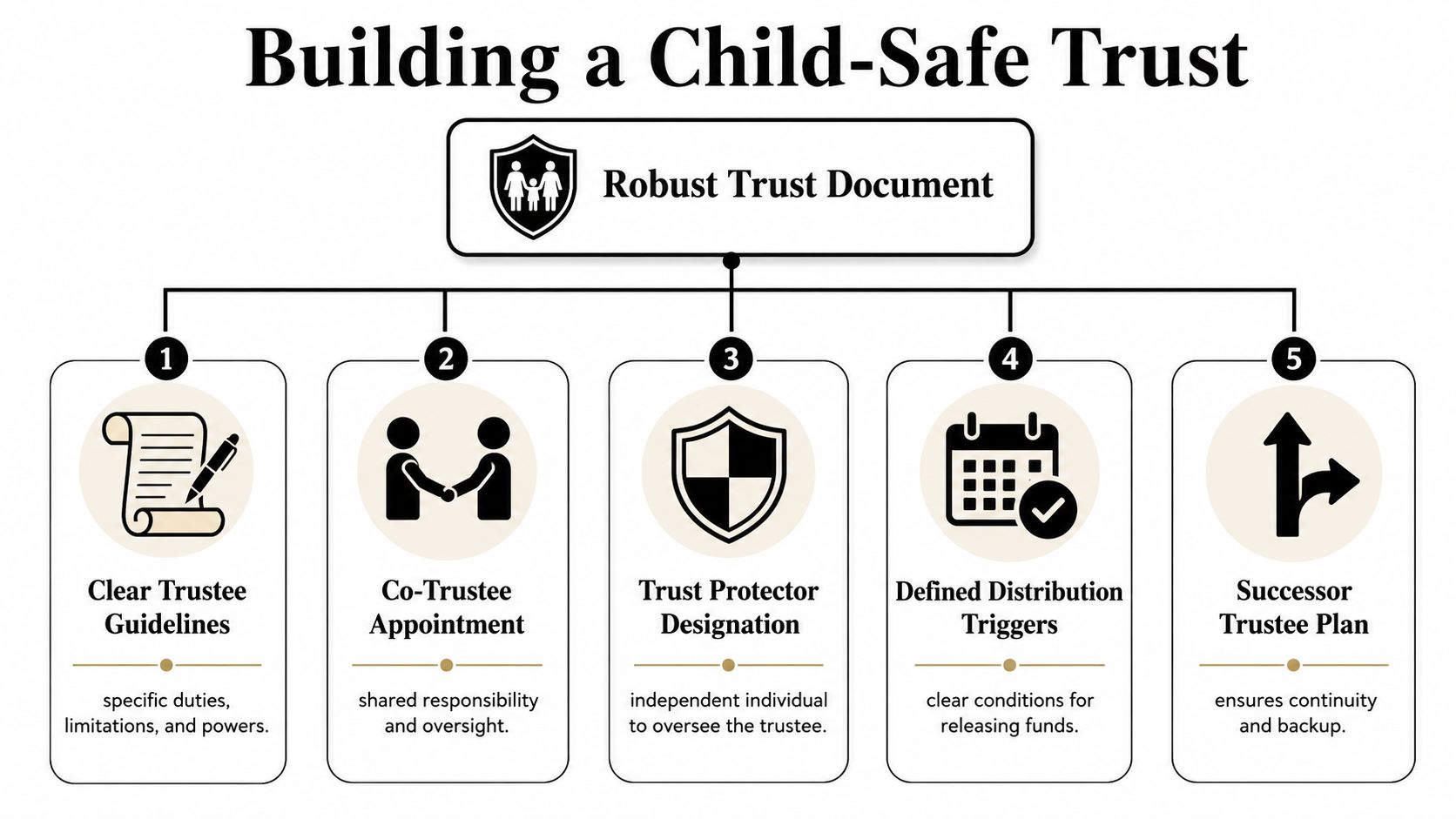
A child-safe trust usually includes layers of protection rather than a single fix.
- Clear distribution standards so the trustee knows when support is expected and when discretion applies.
- A successor trustee plan in case the original trustee dies, resigns, or becomes unsuitable.
- Removal and replacement mechanisms that let the family change trustees without waiting for a crisis.
- Guardrails on discretion so the trustee has flexibility, but not unlimited freedom.
Some families also coordinate the trust with broader estate planning services and asset protection planning, especially when minors, blended families, disability concerns, or family conflict are part of the picture.
A well-drafted trust can't guarantee perfect behavior, but it can make bad behavior easier to detect and easier to stop.
What works and what often fails
What works is specificity. If you want the trustee to prioritize education, health, and stable housing, say so. If you want direct payment to schools or providers, build that in. If you want a neutral fiduciary, appoint one from the start.
What often fails is vague drafting combined with an informal trustee choice. Families sometimes assume “they'll do the right thing” because the trustee is close to the child. That hope can collapse once money, resentment, or changing family circumstances enter the picture.
A Step-by-Step Guide to Confronting a Bad Trustee
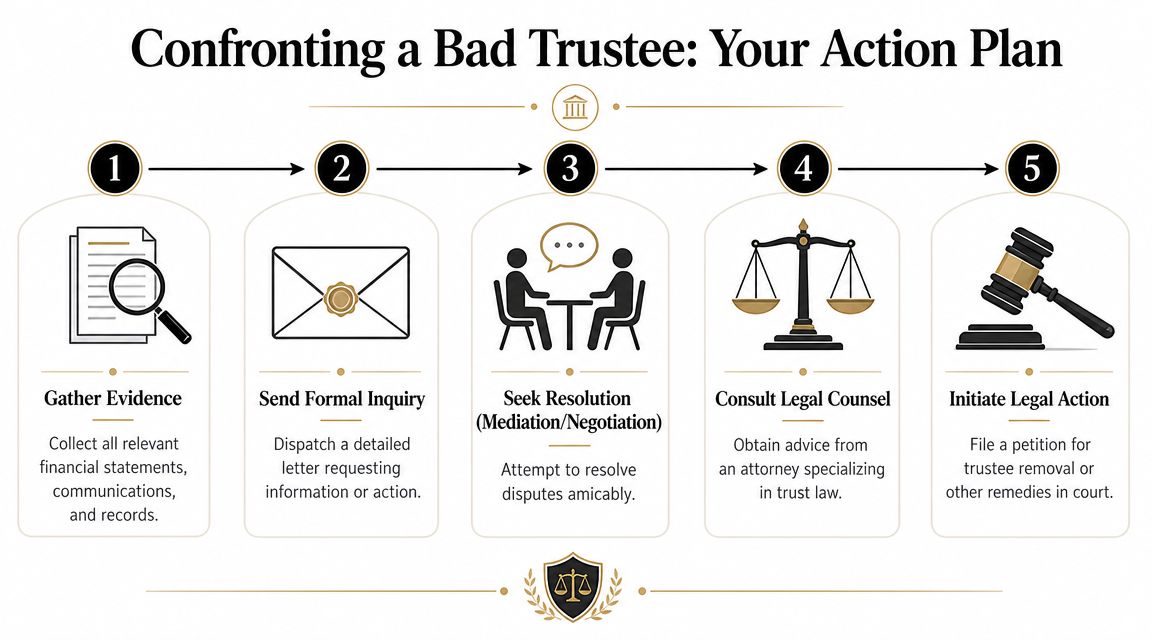
When concerns are real, structure matters. Families usually do better when they respond in stages instead of jumping straight into litigation. A written record, tied to the trust terms and the transactions in question, often becomes the foundation of any later remedy.
This visual gives a practical overview of the sequence.
Start with the trust instrument
Read the trust before you confront the trustee. That sounds obvious, but families often skip it.
The trust tells you what powers the trustee has, what standards control distributions, who can request information, and whether there are built-in mechanisms for dispute resolution or replacement. Without that document, it's easy to accuse the trustee of misconduct when the trustee may be exercising discretion the settlor intentionally granted.
Make a written request and be specific
A practical response begins with a formal written request for an accounting or explanation. That step creates a record and gives the trustee a fair chance to respond.
Your request should identify the issue precisely. Ask about the missed distribution, the unclear transaction, the absent statement, or the unexplained fee. Vague complaints often produce vague answers. Specific requests are harder to dodge.
Include points such as:
- The trust provision at issue if you can identify it.
- The transaction or time period you want explained.
- The records requested, such as statements, receipts, ledgers, or a written accounting.
- A deadline for response that is reasonable and clear.
Keep emotion out of the letter. Precision helps more than outrage.
A measured workflow matters here. Review the trust first, send a written request for an accounting or explanation, document every missed deadline or questionable transaction, and escalate only if the trustee refuses to correct the conduct. Under Texas law, beneficiaries may seek an accounting, removal of the trustee, injunctions, or damages for losses caused by fiduciary misconduct, as explained in this article on handling a trustee who is not acting in the beneficiaries' best interest.
Build the file as if someone else will read it later
After the letter goes out, preserve everything.
That includes emails, texts, statements, payment requests, responses, delays, and any contradictory explanations. Make a timeline. Note dates when distributions should have been made, dates when information was requested, and dates when the trustee failed to answer.
This matters because trust disputes often turn on records, not memory.
A practical file might include:
- Communications between the trustee and family members
- Financial documents showing balances, transfers, or missing support
- Third-party bills for tuition, therapy, care, or housing that should have been considered
- Notes of conversations made close in time to the event
The next resource may help if you want a general overview of trust disputes before speaking with counsel.
Escalate in the right order
If the trustee responds, the matter may still be fixable. If the trustee ignores the request, provides incomplete records, or continues suspicious conduct, the issue usually moves to counsel.
At that point, a Texas trust administration lawyer can compare the trust terms to the trustee's conduct, evaluate whether the evidence shows a breach, and advise on options. Those may include negotiation, mediation, or filing in court. The Law Office of Bryan Fagan, PLLC is one Texas-based option for families who need help with trust administration, fiduciary disputes, or beneficiary rights.
Mediation can be useful when communication has broken down but the trustee may still be willing to step back, provide information, or agree to a transition. Court becomes more likely when the trustee refuses transparency or the risk to the child's inheritance is ongoing.
The Legal Process for Removing a Trustee in Texas
Removing a trustee is serious. Courts usually want a clear record showing more than family tension or disagreement. The strength of a removal case often depends on whether the facts show a material breach, failure to perform duties, conflict of interest, incapacity, or another condition that makes continued service unsafe for the trust.
For a closer look at that remedy, see this discussion of removing a trustee in Texas.

What the court will look for
Judges generally focus on evidence, not family narratives. They want to see the trust document, the disputed transactions, the requests for information, and the trustee's response or refusal.
The most persuasive cases usually include:
- A documented pattern of noncompliance, secrecy, self-dealing, or neglect
- Clear harm or risk to the trust or the child beneficiary
- Specific trust terms that the trustee failed to follow
- Proof that lesser efforts failed, such as written demands or attempted resolution
What removal can involve
A court petition may request more than removal. Depending on the facts, a beneficiary may also ask for an accounting, an injunction to stop harmful conduct, or damages tied to losses caused by fiduciary misconduct. In some cases, replacing the trustee is only part of the work. The records may need reconstruction, distributions may need review, and a successor fiduciary may need authority to stabilize administration.
This is why families should approach protecting children from a bad trustee in Texas as an evidence problem as much as a legal problem. Good facts, good records, and careful timing usually matter as much as strong legal arguments.
If you're managing a trust or planning your estate, contact Law Office of Bryan Fagan, PLLC for a free consultation. Our attorneys provide trusted, Texas-based guidance for every step of the process, including estate planning, probate, guardianship, asset protection, trustee compliance, and trust dispute resolution suited to your family's needs.