Skip to content
A lot of Texas families arrive at this question the same way. A business owner has spent years building a company, a physician worries about liability exposure, or parents with growing investments want to make sure their children inherit in a protected and orderly way. Then someone mentions an offshore trust. Someone else says a Texas trust should be enough. Suddenly, a practical estate-planning discussion starts to feel intimidating.
That confusion is understandable. Both structures can play an important role in protecting wealth, guiding distributions, and helping families plan for the future. But they are not interchangeable. The main difference is not just where the trust is formed. It's how much control you keep, how much complexity you accept, and how hard it would be for a creditor to reach the assets.
For many readers searching Offshore vs Texas trusts: what's the difference, the better question is this: Which tool fits my family's goals, risk level, and tolerance for administration? That is the lens a careful Texas estate planning attorney should use.
Before getting into the details, this side-by-side view helps frame the conversation:
| Feature | Texas Trust | Offshore Trust |
|---|---|---|
| Governing law | Texas law and U.S. law | Foreign jurisdiction law |
| Trustee location | Typically in Texas or the U.S. | Typically a foreign trustee |
| Court authority | Texas and U.S. courts | Foreign courts govern the trust |
| Asset protection posture | Useful in many planning contexts, but still within U.S. jurisdiction | Generally stronger against creditors because of foreign jurisdictional separation |
| Control | Often allows more practical day-to-day involvement within domestic rules | Usually involves reduced direct control |
| Administration | More familiar for Texas families and advisors | More complex and often more expensive |
| Best fit | Families focused on estate planning, fiduciary management, and practical administration | Clients with elevated liability concerns who accept more complexity |
An Introduction to Protecting Your Texas Legacy
A Houston business owner once described this choice in a simple way. He said, “I'm not trying to hide anything. I just want to make sure one lawsuit or one bad year doesn't undo what I built for my kids.” That's the heart of this issue for most families. It isn't about secrecy. It's about planning.
In Texas, trust planning often starts with familiar goals. Parents want to avoid unnecessary probate delays. Grandparents want structured distributions instead of a lump-sum inheritance. A trustee wants clear instructions and a roadmap that follows the Texas Trust Code, the Texas Estates Code, and core fiduciary duties in Texas. Those are ordinary, responsible concerns.
But some families have a second layer of concern. They may own a medical practice, operate a real estate business, sign personal guarantees, or have enough liquid wealth that creditor exposure feels real. That's where offshore trusts enter the conversation.
Practical rule: The right trust depends on the problem you're trying to solve. Estate management, probate avoidance, and beneficiary protection are not always the same problem as high-level creditor defense.
A Texas trust can be an excellent vehicle for administration, family governance, and long-term planning. It can also include spendthrift provisions, trustee controls, and customized distribution standards. An offshore trust serves a different purpose. It is built around legal distance from U.S. courts.
That difference matters because many people hear “asset protection” and assume the stronger option is always the better one. Often, it isn't. A trust that is harder to maintain, more expensive to operate, and more restrictive in practice may not fit a family that mostly wants clarity, continuity, and manageable administration.
Understanding the Two Worlds of Trust Planning
A Texas trust is a domestic trust. In plain English, that means it is created under U.S. law and administered within a domestic legal system. For Texas families, that usually means a trust drafted and managed with the Texas Trust Code in mind, with trustee conduct shaped by fiduciary principles like loyalty, prudence, accounting, and fair treatment of beneficiaries.
What a Texas trust usually does well
A Texas trust is often the workhorse of estate planning. It can hold investments, real estate, business interests, or family wealth for children and grandchildren. It can also help trustees follow a clear legal framework if questions arise about distributions, recordkeeping, or conflicts.
In many families, that predictability is the point.
A domestic trust can help with:
- Trust administration: giving a trustee written powers and duties under Texas law
- Beneficiary protection: using spendthrift language and discretionary distribution terms
- Incapacity planning: letting a successor trustee step in without court intervention
- Estate coordination: working alongside wills, beneficiary designations, and probate planning
This is why a Texas trust administration lawyer often starts with domestic options first. They are familiar, flexible, and easier to integrate with the rest of a Texas-based estate plan.
What makes an offshore trust different
An offshore trust is a foreign trust formed in another jurisdiction, often places such as the Cook Islands, Nevis, or the Bahamas. The core idea is simple. The trust is intentionally placed under foreign law and administered by a foreign trustee.
That doesn't just change the mailing address. It changes the legal environment.
Instead of asking, “What would a Texas court do with this trust?” the question becomes, “What power does a Texas court really have over a trustee and assets governed elsewhere?” That is why offshore trusts are usually discussed in the asset-protection context, not just in standard family estate planning.
A domestic trust is usually designed for orderly management and succession. An offshore trust is usually designed for legal separation.
Why people mix them up
Readers often confuse offshore trusts with offshore companies, or they assume all trusts protect assets in the same way. They don't.
The planning goals can overlap, but the structure changes the result. A Texas settlor may retain a practical level of involvement in a domestic plan, subject to Texas fiduciary and trust-law limits. Offshore planning often asks the client to accept less direct control in exchange for stronger separation from domestic enforcement.
That tradeoff becomes much clearer once you look at jurisdiction.
Comparing Legal Frameworks and Jurisdiction
The biggest difference between these structures is jurisdiction. That word sounds technical, but the concept is straightforward. It means which court system and which body of law control the trust.

Texas trusts stay inside the domestic court system
A Texas trust lives in the legal world most families already know. It is governed by Texas trust rules, interpreted through Texas and U.S. law, and overseen by courts that can issue orders affecting the trustee, beneficiaries, and trust assets. That familiarity is a benefit when the main goal is administration, distribution, modification, or dispute resolution.
It is also a limitation if the main concern is resisting creditor enforcement.
One asset-protection comparison notes that Texas is primarily a domestic trust jurisdiction, while offshore trusts are commonly formed in places such as the Cook Islands, Nevis, or the Bahamas. The same comparison explains that Texas has no DAPT statute, while also offering an unlimited homestead exemption but no comparable protection for liquid assets beyond retirement accounts. It further explains that offshore trusts are designed to place assets under foreign law and under a foreign trustee, which can make enforcement of a U.S. judgment much harder. You can read that comparison in this discussion of asset protection by state and offshore trust jurisdiction.
Offshore trusts are built around legal distance
An offshore trust is not just a Texas trust with an international flavor. It is a deliberate move into another legal system. If a settlor transfers assets to a foreign trustee under foreign law, a U.S. court does not automatically control that trustee the way it controls a domestic fiduciary.
That's why jurisdiction drives the analysis. A Texas judge can enter an order against a Texas trustee. That same judge cannot command a foreign trustee in a foreign jurisdiction to act as if Texas law governs the trust.
For families with property or heirs across borders, broader planning issues can also arise. This overview of international estate planning and considerations for assets abroad is useful when trust design intersects with cross-border ownership.
Why this matters in practice
If your priority is smooth administration, domestic jurisdiction is often a feature, not a flaw. Texas judges, Texas statutes, and Texas fiduciary standards provide a known system for trustees and beneficiaries.
If your priority is resisting collection pressure after a major claim, that same domestic connection can become the weakness. The closer the assets remain to U.S. legal authority, the easier domestic enforcement tools may be to use.
That is why the offshore vs Texas trusts question is really a jurisdiction question first and an asset-protection question second.
Asset Protection Strength and Limitations
If you look only at creditor resistance, offshore trusts generally have the stronger posture. But most Texas families should not stop the analysis there. A trust can be legally strong and still be a poor fit for the family using it.
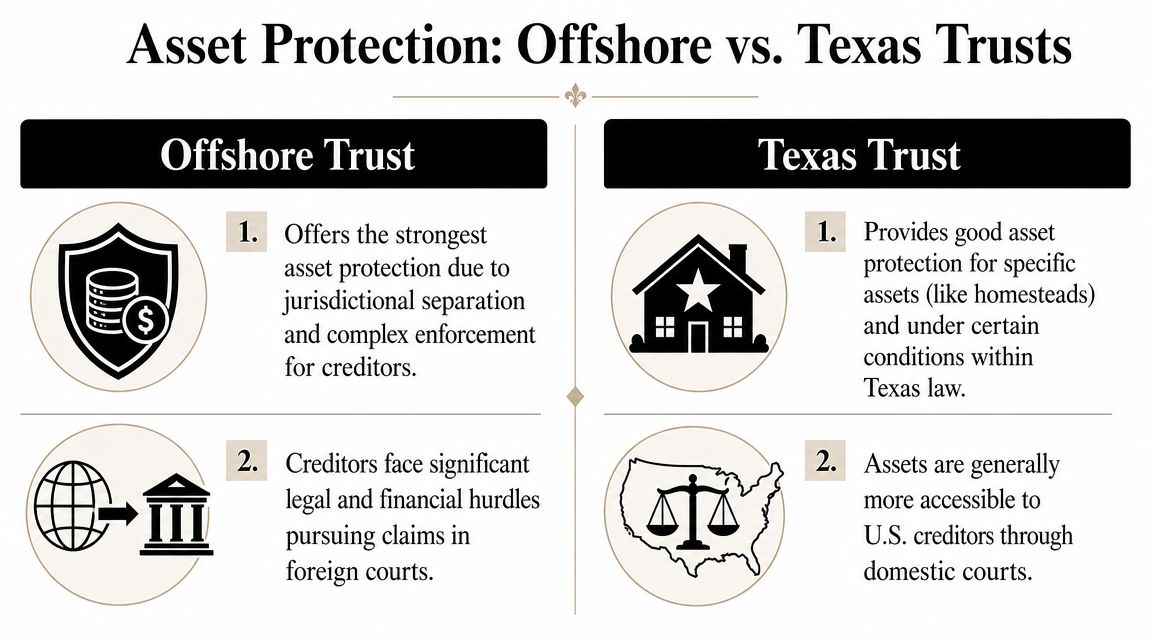
Why offshore protection is usually stronger
Offshore asset-protection trusts generally create a stronger creditor-defense posture because the assets are transferred to a foreign trustee and governed by foreign law. One legal comparison explains that in some jurisdictions this can create an impossibility defense against U.S. repatriation orders. In practical terms, a U.S. court may order a settlor to bring assets back, but the foreign trustee is not bound to comply with that order. That same comparison notes that Texas and other domestic trusts remain within U.S. jurisdiction and are therefore more exposed to domestic creditor tools, even when they use spendthrift or discretionary provisions. See the discussion of offshore trust vs offshore LLC and creditor enforcement posture.
That doesn't mean an offshore trust is untouchable. It means enforcement is harder, slower, and more uncertain for the creditor.
A short explanation of domestic asset-protection planning can help frame that contrast. This article on asset protection trusts in Texas and how they work is a helpful companion for readers comparing domestic strategies.
What Texas trusts can still protect
A Texas trust is not useless just because it isn't offshore. It protects in a different way.
For example, a well-drafted trust may:
- Protect a beneficiary from personal creditors: Spendthrift terms can limit a beneficiary's ability to assign or pledge trust interests.
- Slow down reckless distributions: A discretionary trustee can withhold or stage distributions when a beneficiary faces divorce, debt, or poor judgment.
- Create fiduciary oversight: Trustees must act under duties of loyalty, prudence, and proper administration rather than handing over assets outright.
- Support family continuity: Trust terms can preserve business interests or investment assets for multiple generations.
These are meaningful protections. They just do not remove the trust from domestic legal reach.
Here is a practical summary:
| Asset protection question | Texas trust | Offshore trust |
|---|---|---|
| Can it help shield a beneficiary's inheritance from that beneficiary's own creditors? | Often, with careful drafting | Often, yes |
| Does it remain subject to U.S. court authority? | Yes | Less directly |
| Is creditor enforcement usually easier domestically? | Yes | Generally harder |
| Is it mainly an estate-planning and administration tool? | Often | Not usually the primary reason |
The video below gives additional context on trust-based protection planning:
Stronger creditor resistance doesn't always mean better overall planning. Families still have to live with the structure they choose.
Where clients often get tripped up
People often hear “asset protection trust” and assume a Texas domestic trust works like an offshore fortress. It doesn't. Under the Texas Trust Code, the drafting may be intricate and the fiduciary controls may be excellent, but the legal environment is still domestic.
That's why a prudent attorney focuses on the client's real exposure. A surgeon facing catastrophic professional-liability concerns may evaluate this very differently from a retired couple who mostly wants probate avoidance and responsible inheritances for adult children.
The Practical Realities of Tax Reporting and Administration
A trust can look excellent on paper and still feel hard to live with once real administration begins. For a Texas family, that day-to-day experience often becomes the deciding factor.
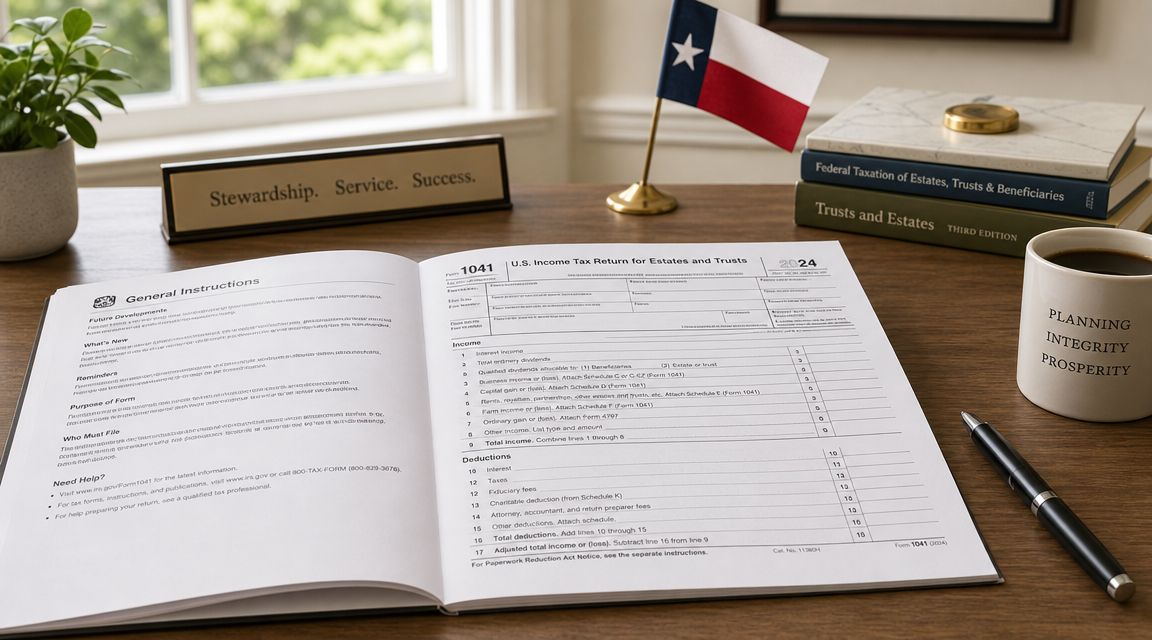
Texas trusts are usually easier to administer
A Texas trust usually fits the systems your family and advisors already use. The trustee still has real work to do: keeping records, answering beneficiary questions, preparing accountings, coordinating distributions, and filing tax returns. But those tasks usually happen with Texas attorneys, Texas CPAs, domestic banks, and a legal framework that feels familiar.
That familiarity matters more than many families expect.
If a child needs a distribution for graduate school, or a trustee needs guidance on fiduciary income reporting, the answer is often close at hand. The professionals are easier to reach. The documents are easier to review. The timing is often more predictable. For many clients, that practical ease is part of the value.
If you want a clearer picture of the filing side, this overview of trust taxation in Texas is a helpful starting point.
Offshore trusts often ask more of the family
Offshore planning usually brings a heavier administrative load. A foreign trustee may control key decisions. A trust protector may also be part of the structure. The family may need accountants and counsel who are comfortable handling foreign trust reporting and cross-border coordination.
A simple way to picture the difference is this: a Texas trust often works like banking at your local branch, while an offshore trust can feel more like managing an important account in another time zone, under another set of procedures, with more people involved in approvals.
That does not make offshore planning wrong. It means the family should go in with clear eyes. The question is not only, "Will this protect assets?" The better question is, "Can we operate this structure confidently for years?"
The tax and administration burden reaches beyond the trust document
Many Texas estates include rental houses, family LLC interests, mineral interests, brokerage accounts, or a closely held business. Once those assets sit inside a trust, administration touches many moving parts at once. Trustee decisions, tax reporting, property oversight, and entity records all have to stay aligned.
Real estate is a good example. If a trust owns Texas property, the trustee may need to monitor valuations and tax bills just as carefully as distributions and accounting records. For fiduciaries handling trust-owned or estate-owned real property, guidance on appealing Texas property assessments can be useful.
Questions that usually decide the issue
Families often get more clarity by focusing on operations instead of labels.
- Who approves distributions and other decisions? Offshore structures often place more authority in an independent foreign trustee.
- Who will prepare the reporting each year? Foreign trust compliance often requires more specialized tax support.
- How quickly can routine matters be handled? Domestic administration is often more straightforward for ordinary requests and time-sensitive decisions.
- How much complexity will the family realistically tolerate? A plan that feels too cumbersome often gets neglected, misunderstood, or second-guessed.
The right trust is not just the one with the strongest theory of protection. It is the one your family can administer correctly, afford comfortably, and trust in real life.
Real-World Scenarios for Texas Residents
The best way to understand this choice is to put it into everyday Texas situations.
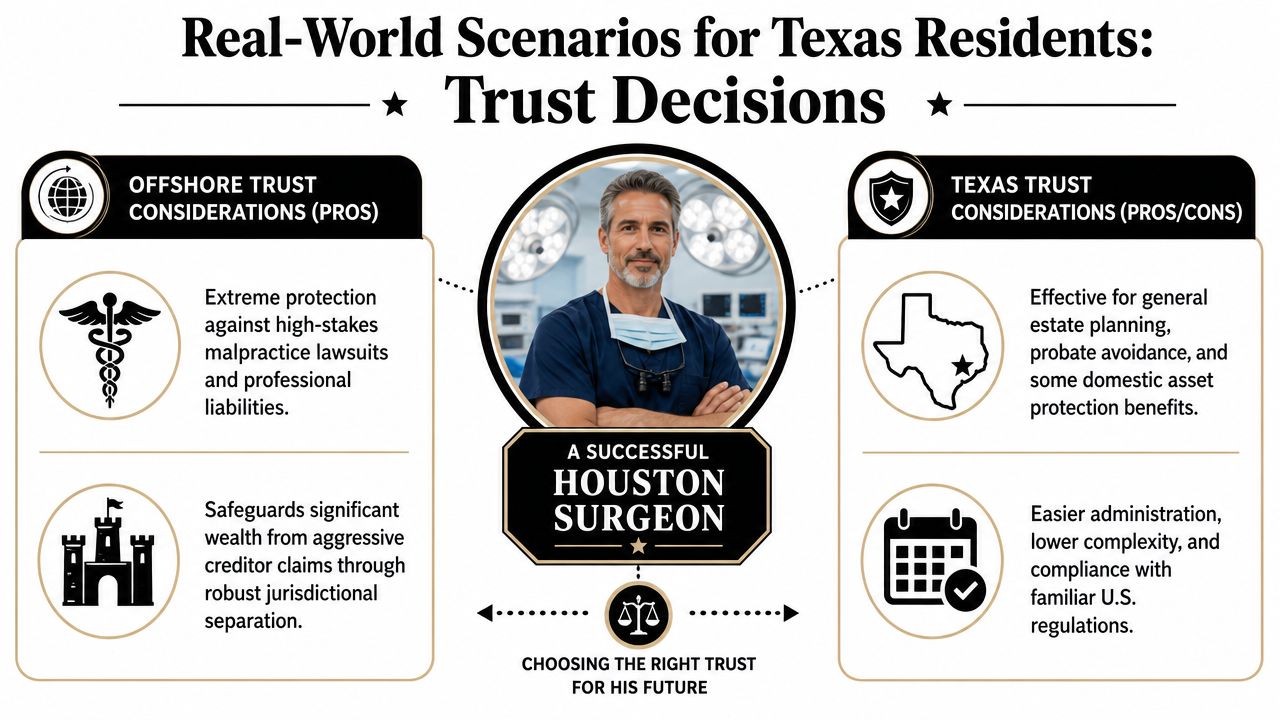
The Houston surgeon
A surgeon in Houston has substantial savings outside retirement accounts, owns part of a practice, and worries about a major malpractice verdict. She is not looking for a simple inheritance plan. She is focused on high-severity liability risk.
In that situation, an offshore trust may deserve serious consideration. The reason is not fashion or status. It is that her planning problem centers on creditor enforcement risk, and offshore planning is designed around legal separation from domestic courts.
Still, she would need to accept the tradeoffs. A foreign trustee means less direct control. Administration may feel slower and less intuitive. The structure may also require more ongoing coordination with professional advisors.
The Dallas real estate family
A Dallas couple owns rental property, investment accounts, and interests in family LLCs. Their main goals are orderly succession, probate avoidance, and making sure their children do not receive wealth outright at a vulnerable age.
A Texas trust is often the more natural fit here. The family can use domestic fiduciary structures, spendthrift protections, and staged distributions while keeping administration practical. A trustee can operate under familiar standards of loyalty, prudence, and recordkeeping, which matters when beneficiaries want transparency and the trustee needs to show compliance with Texas law.
For this type of planning, a Texas estate planning attorney may also coordinate probate strategy, business succession documents, and, if needed, related services involving estate planning, probate, guardianship, or asset protection.
The Austin founder with mixed goals
An Austin founder may sit somewhere in the middle. He has liquidity from a business sale, young children, and concern about future claims connected to past ventures. He wants protection, but he also wants flexibility for education planning, family support, and investment decisions.
That client usually needs a more nuanced answer. Sometimes a domestic structure, combined with disciplined ownership planning and strong trustee controls, is enough. Sometimes the risk profile is high enough that offshore planning becomes part of the conversation. The right answer turns on the specific risk environment, not on marketing language.
Families rarely need the most extreme structure available. They need the structure that fits their actual risks and that their trustees can administer well.
Choosing the Right Path for Your Texas Estate
A Houston couple in their sixties may hear two very different messages at once. One advisor says offshore planning offers the strongest wall against creditors. Another says to keep everything in Texas so the family can understand it, afford it, and live with it for years. Both statements can be true, which is why the actual decision is more practical than dramatic.
For a Texas family, the better question is fit. An offshore trust may make sense if the family faces unusually serious liability exposure and is prepared for a structure that usually costs more, requires foreign administration, and places more day-to-day authority in other hands. A Texas trust often makes more sense when the goal is to protect beneficiaries, keep administration workable, and preserve a level of oversight the family is comfortable with.
A helpful way to view the choice is this. Offshore planning works like putting assets in a more distant legal system to make creditor collection harder. Domestic planning works more like building strong locks on a house you can still visit, inspect, and maintain without crossing borders. One is not automatically the right answer. The better tool depends on the kind of risk you are trying to address and how much complexity your family can realistically manage over time.
That is why families should decide with three plain questions in mind:
- What specific risk are we trying to solve for
- What ongoing cost and administrative burden can we comfortably carry
- How much direct control are we willing to surrender to gain added separation
Those questions usually produce a better answer than broad claims that one structure is always "stronger." In real life, the best plan is the one your family can understand, maintain, and trust to work when pressure arrives.
If you're managing a trust or planning your estate, contact Law Office of Bryan Fagan, PLLC for a free consultation. Our attorneys provide Texas-based guidance for each step of the process.