A child's trust is supposed to create safety. When the numbers don't make sense, the trustee won't answer questions, or distributions seem to benefit everyone except the child, families often feel trapped between fear and uncertainty. They don't want to overreact, but they also don't want to wait while more damage is done.
That instinct to act matters. In Texas child-safety cases, nearly half of children who exited DFPS custody were later named in another investigation within 5 years, according to TexProtects' review of Texas child protection trends. Financial harm inside a trust isn't the same as a CPS case, but the lesson is similar. When a child depends on adults to protect their well-being, delayed action can let a bad situation continue.
If you're worried about protecting children from a bad trustee in Texas, the good news is that Texas law gives beneficiaries and the adults around them real tools. A trustee is not untouchable. A trustee has legal duties, and courts can enforce them. The practical challenge is knowing what to do first, what evidence to gather, when to push for answers, and when it's time to seek court intervention.
Your Guide to Protecting a Child's Inheritance in Texas
A common situation looks like this. A grandparent created a trust for a child. An uncle, family friend, or surviving parent became trustee. At first, everyone assumed things were fine. Then tuition payments were delayed. Requests for records were ignored. The trustee said, “Trust me, I'm handling it,” but wouldn't show where the money was going.
That kind of concern is not paranoia. It's often the first sign that a trustee may be treating a child's inheritance like a private account instead of a protected fund.
Why fast action matters
A trust for a minor exists because the child cannot manage the property personally. That creates a serious imbalance of power. The trustee controls information, controls access, and often controls the timing of distributions. If no one steps in, a child can lose opportunities for education, housing, medical support, or long-term stability.
Practical rule: If a trustee's conduct would worry you in a business relationship, it deserves attention in a child's trust too.
Texas law doesn't expect families to accept blind trust. It expects trustees to act as fiduciaries. In plain English, that means they must put the beneficiary's interests first, follow the trust terms, handle assets carefully, and stay accountable.
What this article focuses on right now
Most articles about trusts focus on setup. They explain how lifetime trusts can shield assets from divorce, creditors, or careless spending. That planning is important. But families in crisis usually need a different answer. They need to know what to do this week.
This guide is built for that moment. It addresses:
- What warning signs deserve immediate attention
- What a trustee legally owes a child beneficiary under Texas law
- How to document concerns without making avoidable mistakes
- When a written demand may be enough
- When court action becomes necessary
If you're a parent, guardian, co-beneficiary, or close family member, your role is not to win an argument with the trustee. Your role is to protect the child and preserve the evidence.
Recognizing the Red Flags of a Bad Trustee
A bad trustee doesn't always look dramatic. Sometimes the conduct is loud and obvious, like taking money for personal use. More often, the problem begins with smaller patterns. Delay. Vagueness. Missing paperwork. Excuses that keep changing.
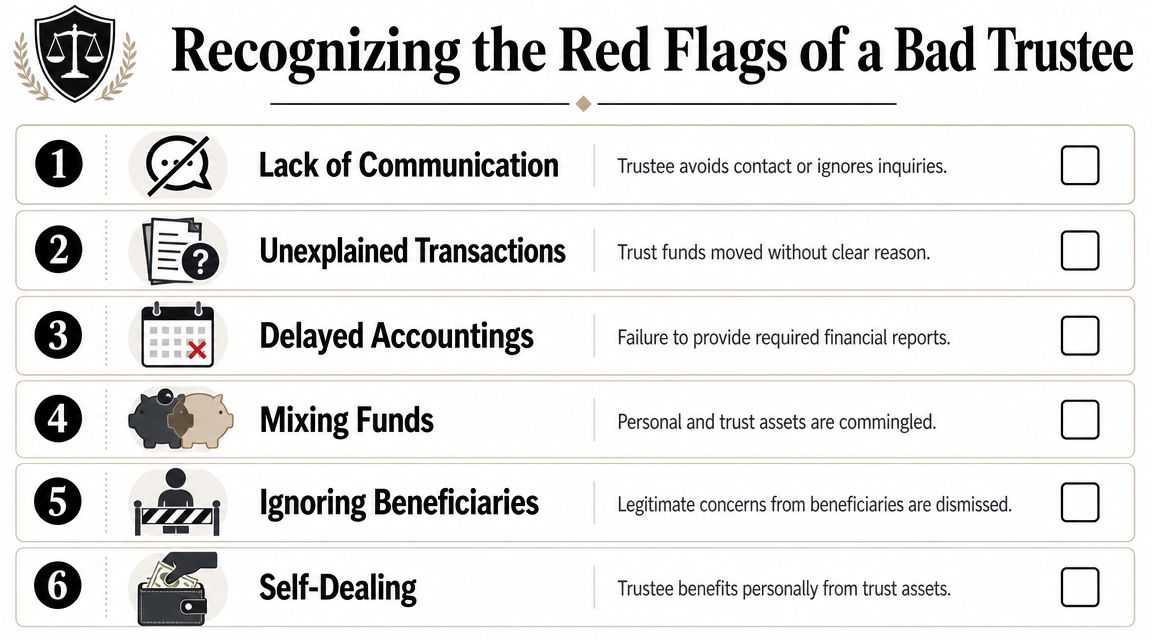
Financial secrecy is a major warning sign
If a trustee refuses to provide basic information, that should get your attention quickly.
Common examples include:
- No accounting: The trustee won't provide a record of trust income, expenses, or distributions.
- Unclear transactions: Money leaves the trust, but no one can explain why.
- Moving targets: The trustee gives one explanation in January and a different one in March.
A responsible trustee may need time to gather records. A responsible trustee does not treat the trust like a secret.
Self-dealing often hides behind “helpful” decisions
Self-dealing means the trustee uses trust property in a way that benefits the trustee or someone close to the trustee, instead of the child.
That can look like:
- Related-party deals: The trustee invests trust money in a business owned by a relative.
- Cheap use of trust property: The trustee lets a friend stay in trust real estate without fair payment.
- Personal reimbursements: The trustee pays themself back from the trust without clear authority or support.
A trustee can't use their position as a shortcut to personal advantage.
Delay can be just as harmful as theft
Not every harmful trustee steals. Some fail to act. That can still damage a child.
Consider these examples:
| Red flag | Why it matters |
|---|---|
| Repeated delay in paying school or medical expenses | The child loses the benefit the trust was meant to provide |
| Failure to respond to urgent requests | Time-sensitive needs go unmet |
| No plan for taxes, records, or asset management | Administrative neglect can reduce trust value and create conflict |
Favoritism and family politics can break a trust
A trustee must follow the trust terms, not personal loyalties. Trouble often appears when the trustee starts treating one beneficiary or one branch of the family differently without legal support.
A trustee who says, “I know what your parent would have wanted,” but won't point to the trust language, is asking for deference instead of earning it.
Commingling is never a small issue
If trust money is mixed with personal money, the risk goes up immediately. Families often discover this through blurred bank statements, informal transfers, or explanations like “I paid it first and sorted it out later.”
When funds are mixed, it becomes harder to trace what belongs to the child. That alone can complicate repair efforts later.
A Trustee's Legal Duties Under the Texas Trust Code
The legal standard for a trustee is higher than “trying their best.” A trustee is a fiduciary. That means Texas law imposes duties that are enforceable, not optional. If you want a broader plain-English explanation of how fiduciary obligations work in financial settings, this overview of fiduciary duty for investors gives useful background.
Duty of loyalty
The duty of loyalty means the trustee must act for the beneficiary's benefit, not their own. A child's trust is not a family slush fund. It is not a convenience account for an adult who thinks they deserve flexibility because they're “doing everyone a favor.”
If the trustee makes decisions to protect their own image, preserve control, benefit a relative, or avoid scrutiny, that can violate this duty.
Duty of prudence
Prudence means careful, sensible management. The trustee doesn't have to guarantee perfect results. The trustee does have to make informed decisions, monitor assets, and avoid careless handling.
That matters especially when the trust holds money intended for education, support, housing, or long-term stability. A trustee who ignores records, leaves assets unmanaged, or takes reckless positions can defeat the purpose of the trust even without obvious theft.
Duty of impartiality and the duty to inform
When a trust involves more than one beneficiary or competing interests, the trustee cannot pick favorites. The trustee must follow the trust terms fairly. The trustee also has a duty to keep beneficiaries appropriately informed and to account for management of the trust.
Families often miss this point. Silence itself can be part of the breach.
Why trustee selection matters so much
One of the most common failures in trust protection is choosing the wrong trustee in the first place. As noted in guidance on protecting children's inheritance through trustee selection and oversight, a trustee who won't follow instructions or exercise sound judgment can undermine the trust's safeguards.
That is why “he's family” is never enough by itself.
A better trustee is someone who can do three things under pressure:
- Follow instructions: They respect the written trust terms.
- Handle conflict: They don't freeze when beneficiaries ask hard questions.
- Use judgment: They know the difference between discretion and personal preference.
Bottom line: Broad authority in a trust does not excuse poor judgment. Discretion still has limits.
Your First Steps When You Suspect a Problem
When families suspect trustee misconduct, they often make one of two mistakes. They either do nothing for too long, or they confront the trustee in anger before gathering records. Neither approach protects the child well.
The better approach is calm, documented, and deliberate.
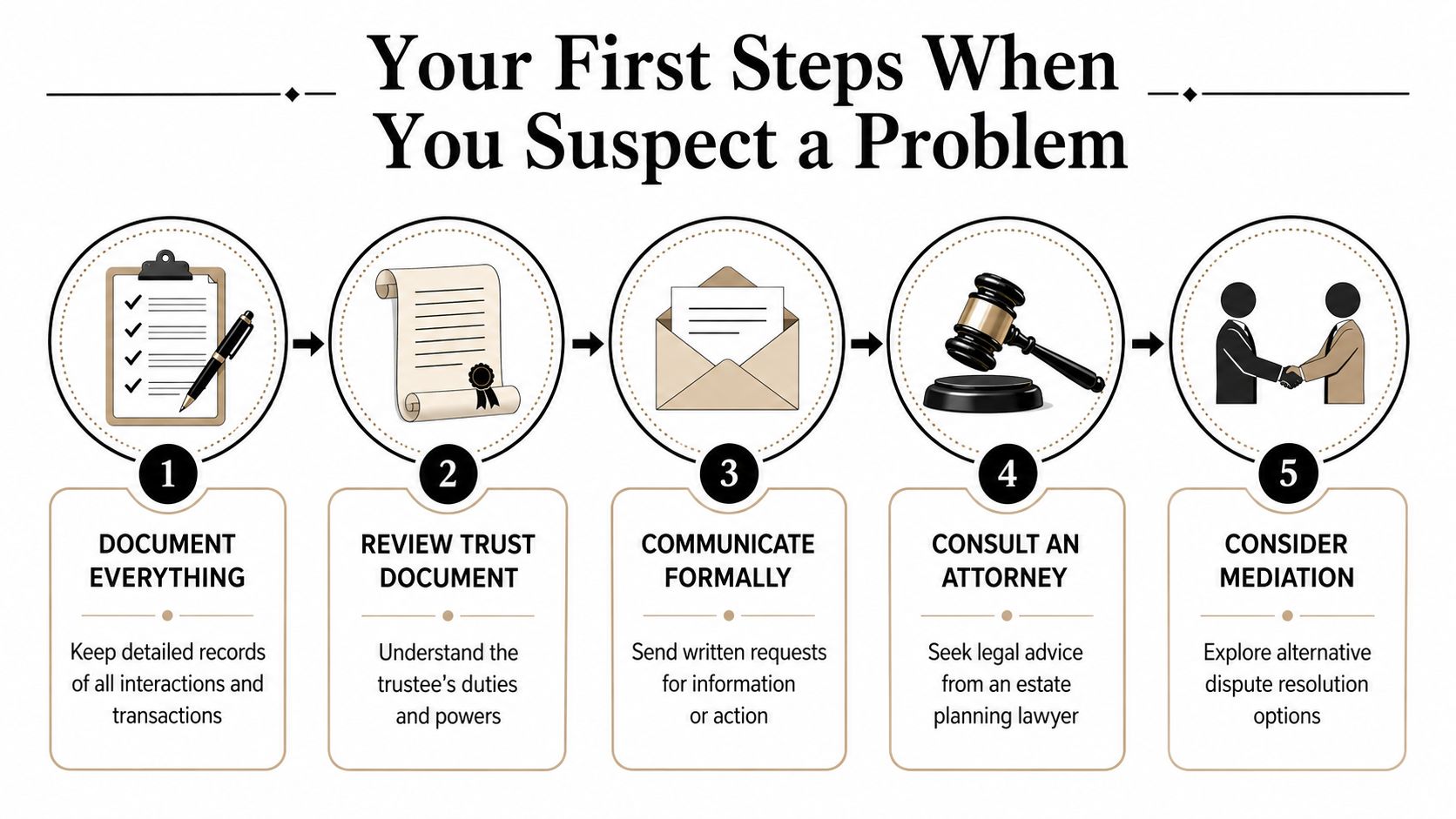
Start building a written record
Write down what you noticed, when you noticed it, and who said what. Use dates where you can. Save emails, text messages, letters, bank notices, tuition invoices, reimbursement requests, and screenshots of beneficiary portal information if available.
Don't edit old messages or “clean up” the timeline. Preserve it as it exists.
A useful log usually includes:
- Date and event: “Requested accounting by email”
- Response or non-response: “No reply after follow-up”
- Child impact: “School payment remained unpaid”
- Supporting document: “Invoice attached”
Get the trust document and review the terms
If you don't have a complete copy of the trust, request it in writing. You need the actual language governing distributions, trustee powers, accounting duties, successor trustee provisions, and any standards for the child's health, education, maintenance, or support.
Without the document, families often argue about fairness when the core issue is authority. The trust text tells you whether the trustee is violating a clear instruction, abusing discretion, or failing to communicate.
For a practical overview of beneficiary entitlements, review these rights of trust beneficiaries in Texas.
Make a formal written request
A written request does two jobs. It asks for information, and it creates a paper trail. Keep the tone professional. Avoid accusations unless you already have solid proof.
You might ask for:
- A current accounting
- Copies of recent statements
- An explanation of specific transactions
- A timeline for pending distributions
- Confirmation of where trust assets are held
A simple format works well:
“I am requesting a copy of the trust document, a current accounting, and supporting records for recent trust transactions affecting the minor beneficiary. Please provide these records by a reasonable date and preserve all trust-related documents and communications.”
That kind of letter is often more effective than a heated call.
Here's a helpful overview if you want more context before speaking with counsel:
Talk with a Texas trust administration lawyer before escalating
A lawyer can compare the trust language, your documents, and the trustee's conduct. That helps you avoid weak accusations and focus on provable issues.
Families can save time and trouble through various approaches. Sometimes the right next step is a stronger demand letter. Sometimes it's negotiation with evidence preservation. Sometimes it's immediate court action. Firms that handle these matters, including a Texas trust administration lawyer at the Law Office of Bryan Fagan, PLLC, can review whether the facts support informal resolution or formal litigation.
Consider negotiation, but don't lose leverage
Negotiation can work when the trustee is disorganized, defensive, or overwhelmed, but not actively concealing misconduct. It is less effective when records are disappearing, self-dealing is involved, or urgent child needs are being ignored.
If you negotiate, keep doing three things at once:
- Preserve evidence
- Set written deadlines
- Prepare for court if the trustee stalls
Using Texas Law to Remove a Bad Trustee
At some point, evidence moves the matter out of the “family disagreement” category and into legal enforcement. Texas law allows courts to intervene when a trustee is failing in their duties.
What the court can do
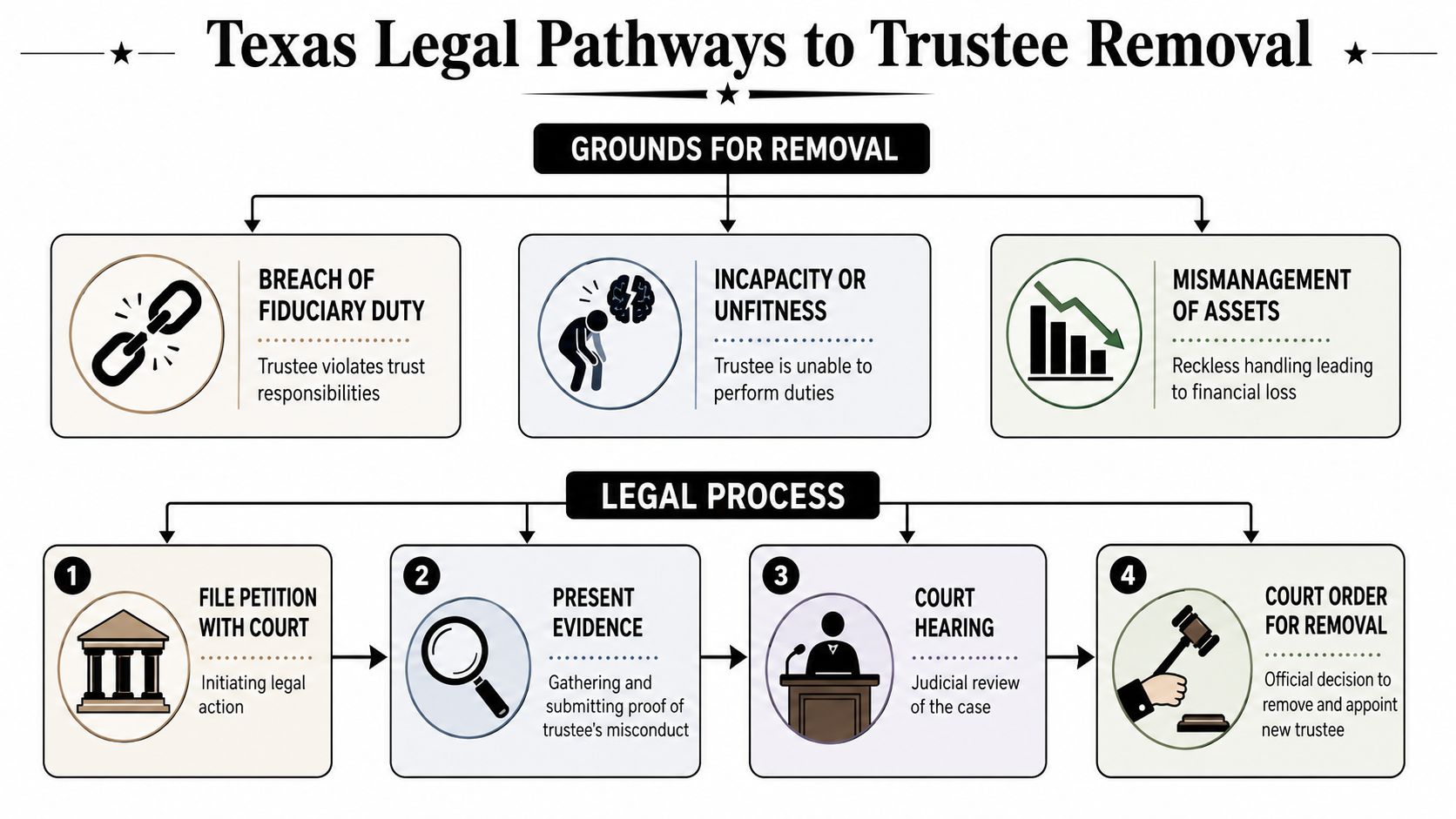
Under Texas law, courts can order a trustee to perform their duties and, in more serious situations, remove the trustee. Beneficiaries generally have four years to bring a breach-of-trust claim, which makes timing critical when a child's trust is being mishandled, as explained in this discussion of Texas breach-of-trust remedies and timing.
That time limit matters for two reasons. First, delay can weaken evidence. Second, waiting can let the trustee keep control longer than necessary.
What usually justifies stronger action
Courts don't remove trustees because beneficiaries are annoyed. They look for conduct that shows the trust is not being properly administered.
Examples often include:
- Breach of fiduciary duty
- Self-dealing or conflict of interest
- Failure to account
- Mismanagement of trust assets
- Conduct showing unfitness to continue serving
A child-focused case often becomes more urgent when the trustee's conduct affects support, housing, education, or essential care.
What the legal process tends to look like
Most trustee removal cases follow a pattern, even though each trust is different.
| Stage | What happens |
|---|---|
| Investigation | Counsel reviews the trust, communications, and financial records |
| Petition filed | The court is asked to order relief |
| Evidence presented | Records, timelines, and witness testimony support the claims |
| Court decision | The judge may order compliance, surcharge losses, or remove the trustee |
If you want a more detailed overview of that remedy, this resource on removing a trustee in Texas is a useful starting point.
What outcomes families should realistically expect
The goal is not to punish a trustee for being difficult. The goal is to protect the trust and the child.
Possible outcomes can include:
- Court-ordered performance: The trustee must provide records or make required decisions.
- Removal: A successor trustee takes over.
- Recovery efforts: The trust may seek restoration of property or losses tied to misconduct.
- Restrictions or supervision: In some matters, the court may impose practical controls short of immediate removal.
Courts respond best to organized proof, not generalized suspicion.
That is why documentation from the early stage matters so much. When families can show missing records, inconsistent explanations, delayed payments, and unauthorized transactions, the case becomes concrete.
Proactive Planning to Prevent Trustee Issues
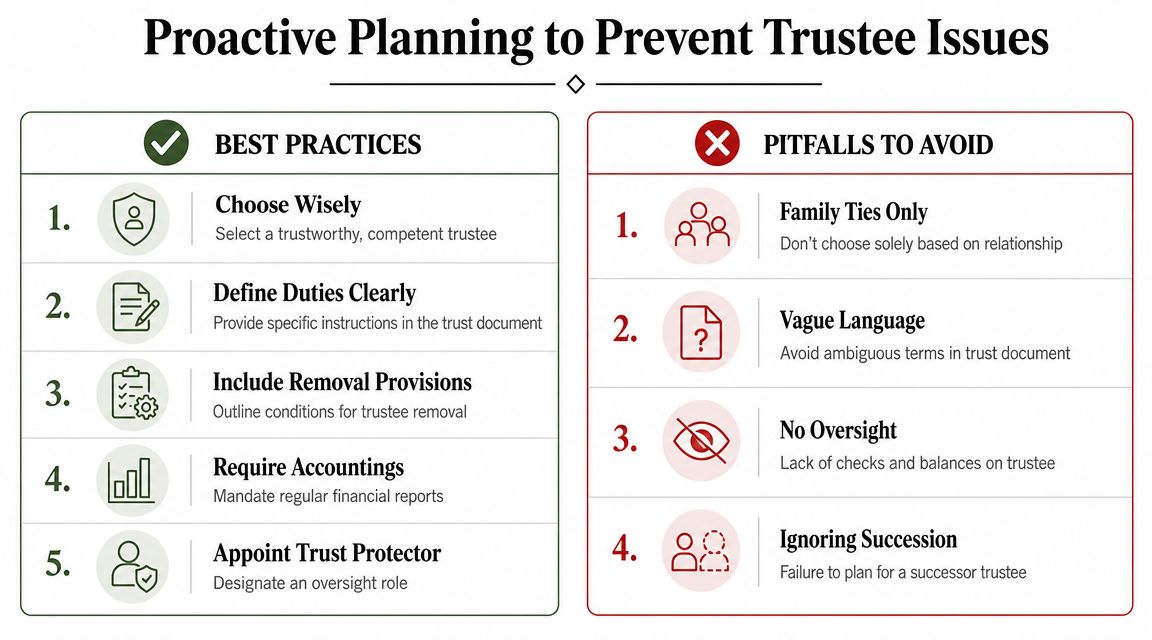
The most effective way to protect a child from a bad trustee is to make it harder for one person to operate without oversight. Good drafting does not eliminate human problems, but it can reduce the space where those problems grow.
Broad discretion is not always safer
Families often hear that a fully discretionary lifetime trust offers strong protection because the trustee controls distributions and keeps inherited property separate from the beneficiary's own assets, reducing exposure to creditors, lawsuits, divorce claims, and poor financial decisions, as described in this article on using lifetime trusts to protect children and inherited assets.
That protection can be valuable. But there is a trade-off. The more power concentrated in one trustee, the harder it can be for a beneficiary to detect harmful delay, poor judgment, or low-grade conflict that technically falls within broad discretion.
Draft for accountability, not just asset protection
A stronger child-focused trust usually includes more than a simple statement that the trustee may distribute money “in their sole discretion.”
Better design choices often include:
- Clear distribution standards: Spell out whether the trust should pay for education, housing, medical care, therapy, activities, or other support.
- Mandatory reporting: Require regular accountings to a parent, guardian, co-trustee, or another named adult.
- Successor trustee triggers: Allow replacement if the trustee refuses to communicate, becomes unable to serve, or creates a documented conflict.
- Named backup decision-makers: Avoid gaps if the first trustee resigns, dies, or becomes unreliable.
As noted in guidance on drafting trusts for children with clearer controls and oversight, broad discretion can concentrate power and reduce oversight. Clear standards, reporting duties, and successor triggers help counter that problem.
Choose the right trustee, not the easiest one
Families often default to a sibling, adult child, or close friend because it feels personal and inexpensive. That choice can work. It can also fail badly when the trustee lacks organization, maturity, or the ability to separate family emotions from legal duties.
A useful comparison looks like this:
| Trustee option | Strengths | Risks |
|---|---|---|
| Individual trustee | Personal knowledge of the child and family | Bias, informality, poor records, conflict |
| Corporate trustee or bank trust department | Process, continuity, accounting structure | Less personal, may be slower or more formal |
| Co-trustee arrangement | Shared oversight and checks | Can create deadlock if roles are unclear |
Simple implementation mistakes can undo good planning
Even a well-drafted trust loses protective value if the assets are handled carelessly after funding.
Pay close attention to these basics:
- Keep inherited funds separate: Don't move trust assets into joint or personal accounts.
- Avoid commingling: Mixing trust funds with marital or personal property makes tracing harder.
- Use the trust structure as intended: If the trust is supposed to own and distribute assets, don't bypass it with informal outright transfers.
For families creating a plan now, these details matter just as much as the signature page. If you're starting from scratch, this overview on setting up a trust for a child can help frame the right questions before drafting.
Protecting children from a bad trustee in Texas starts long before a dispute. It starts when the trust document names the right fiduciary, defines the rules clearly, requires transparency, and gives someone the power to step in before a child's inheritance is wasted.
If you're worried that a trustee is mishandling a child's inheritance, or you want to build stronger protections into your estate plan, contact Law Office of Bryan Fagan, PLLC for a free consultation. Our attorneys provide trusted, Texas-based guidance for every step of the process, from trust administration and dispute resolution to estate planning, guardianship, probate, and asset protection.