Managing a loved one's trust can feel overwhelming, especially when the very document meant to bring order starts creating tension instead. One sibling says the trustee is hiding information. Another thinks the trust was changed under pressure. Someone wants to “just mediate,” while someone else worries that talking too soon could make things worse.
That kind of uncertainty is common in Texas families. Trust disputes often arrive at the same time as grief, long-standing family strain, and urgent financial questions. It's hard to know whether you're dealing with a misunderstanding, a legal violation, or both.
There is a path forward. If you're trying to understand family trust disputes and mediation options in Texas, the first step is getting clear on what kind of dispute you have, what Texas law expects from trustees, and when mediation helps versus when court action may be necessary.
When a Family Trust Becomes a Source of Conflict
After a parent dies, families often expect the trust to provide a roadmap. Instead, the first meeting with the trustee can raise more questions than answers. Maybe your brother, now acting as trustee, says he'll “handle everything” but won't share statements. Maybe your stepmother says the trust amendment was exactly what your father wanted, but the timing feels wrong. Maybe everyone agrees on one thing only. Something doesn't feel right.
In many families, the conflict starts small. A delayed distribution. A vague explanation. A missing document. Then emotions build. Old resentments return. People stop trusting each other, and every decision starts to look suspicious.
Texas trust disputes usually involve more than money. They often involve grief, family roles, and competing ideas about fairness. A child who provided care may expect a different outcome than a child who lived out of state. A trustee may think they're protecting the trust by moving slowly, while beneficiaries see silence as concealment.
Sometimes the legal issue is clear. More often, the emotional issue is loudest first, and the legal issue takes time to identify.
Mediation can be a useful option because it gives families a structured place to talk through the dispute with a neutral third party. But mediation isn't always the right first move. In some cases, the priority is preserving relationships. In others, the priority is protecting records, assets, or both.
That's why a calm, step-by-step approach matters. Once you know what triggered the dispute, what duties the trustee owes, and what remedies Texas courts can provide, the next decision becomes much easier.
Common Causes of Family Trust Disputes in Texas
Most trust conflicts fall into a few recognizable categories. The legal labels can sound intimidating, but the underlying problems are usually familiar. Someone thinks the trustee acted unfairly. Someone questions what the trust means. Someone believes the person who created the trust was pressured or wasn't thinking clearly.
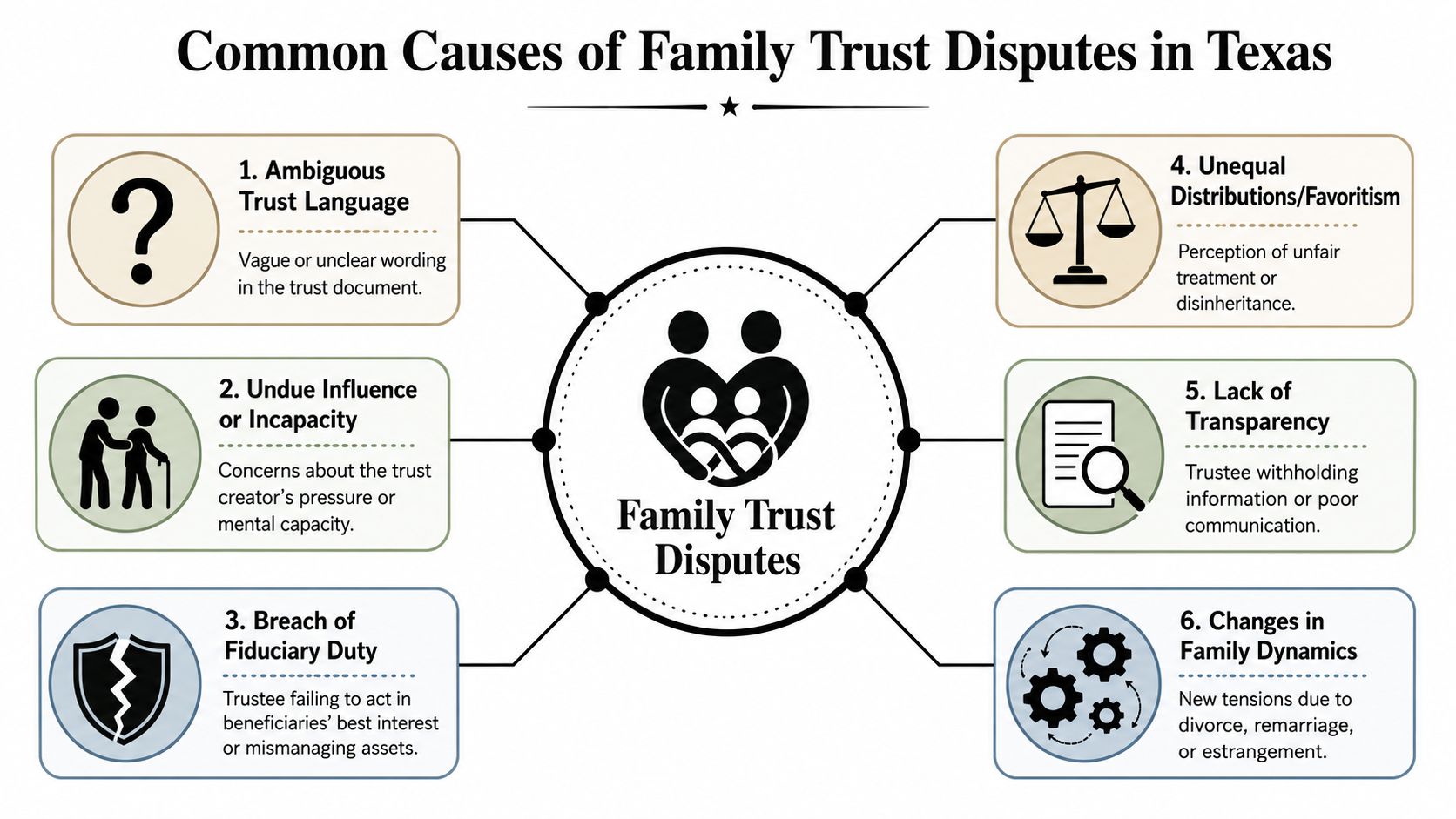
Breach of fiduciary duty
A trustee has fiduciary duties in Texas. That means the trustee must act for the benefit of the beneficiaries, follow the trust terms, manage assets responsibly, and avoid improper self-interest. Disputes often begin when beneficiaries believe the trustee did the opposite.
Examples include:
- Failure to provide information: The trustee ignores requests for records, updates, or an accounting.
- Self-dealing concerns: The trustee uses trust property for personal benefit or enters transactions that seem to favor themselves.
- Mismanagement: Assets aren't handled carefully, bills go unpaid, or investments and distributions don't match the trust's terms.
Disputes over the trust document itself
Some cases don't begin with misconduct. They begin with uncertainty. A trust may contain vague wording about distributions, property use, reimbursement, or who gets a particular asset.
That ambiguity can create real conflict. One beneficiary may read a clause narrowly. Another may read it broadly. A trustee may believe they have discretion, while beneficiaries may believe the trustee is overreaching.
Undue influence or lack of capacity
These are among the most painful allegations because they usually involve the trust creator's final years. A child or caregiver may have had unusual control over access, appointments, or paperwork. A last-minute amendment can trigger immediate suspicion.
A commonly cited backdrop to these disputes is that about 70% of adult Americans do not have a will, which estate litigator Cory Krueger says contributes to inheritance conflict and increases disputes over capacity, undue influence, missing language, or improper procedure, as discussed in this interview with Cory Krueger.
Family dynamics that intensify legal problems
Not every dispute starts with a statute. Divorce, remarriage, estrangement, blended families, and unequal lifetime gifts can all shape how a trust is perceived. Even where the trust is legally valid, poor communication can make people assume the worst.
Practical rule: If the conflict involves missing information, unclear authority, or sudden trust changes, treat it as both a family problem and a legal problem until proven otherwise.
When people can name the problem clearly, they're in a much better position to decide whether they need negotiation, mediation, or immediate court involvement.
Trustee Responsibilities and Beneficiary Rights Under Texas Law
Texas trust disputes make more sense once you understand the legal relationship at the center of them. A trustee doesn't merely “manage the money.” The trustee holds a position of confidence and must carry out the trust according to Texas fiduciary principles, the Texas Trust Code, and the terms of the trust itself.
What trustees are expected to do
A trustee's core job is to administer the trust faithfully. In plain English, that usually means the trustee should:
- Follow the trust terms: Distributions, management decisions, and timing should match the document.
- Act loyally: The trustee should put beneficiary interests and trust purposes ahead of personal advantage.
- Manage assets prudently: Trust property should be handled carefully, not casually or impulsively.
- Keep appropriate records: Good administration requires organized financial and administrative documentation.
- Communicate when required: Beneficiaries often need enough information to understand what the trustee is doing and why.
Trustees who want a practical overview of these obligations can review these fiduciary duties of trustees in Texas.
What beneficiaries can reasonably expect
Beneficiaries don't control the trust solely by virtue of being named in it. But they aren't powerless either. They generally have the right to expect honest administration, adherence to the trust instrument, and access to information that allows them to protect their interests.
That often includes concerns such as whether the trustee has explained delays, produced records, handled property fairly, and respected the distribution scheme laid out by the trust creator.
Here's where many people get confused. They think they are “suing the trust.” In Texas, that usually isn't the proper frame. In trust litigation, the actionable defendant is generally the trustee in a representative capacity, because the trust itself is not typically treated as a separate legal entity that sues or gets sued. That procedural point shapes how claims are investigated and presented, as explained in this discussion of whether a trust can be sued in Texas.
Why this matters before mediation
If you don't know what the trustee was legally required to do, it's hard to evaluate a settlement proposal. A beneficiary may accept too little because they mistake a legal right for a courtesy. A trustee may dig in unnecessarily because they confuse discretion with unlimited authority.
A productive mediation usually starts with a clear map of duties, rights, records, and decision points. Without that map, families often argue about fairness while the legal issues stay unresolved.
This is also where the Texas Estates Code can enter the picture. Trust disputes frequently overlap with probate administration, incapacity questions, beneficiary designations, and estate transfers. When that happens, the legal strategy has to account for more than the trust alone. A Texas estate planning attorney or Texas trust administration lawyer can help sort out which body of law controls which part of the dispute.
Resolving Disputes Through Mediation in Texas
Mediation is a structured settlement process, not a private trial. No judge decides the case in that room. Instead, a neutral mediator helps the parties identify issues, exchange proposals, test assumptions, and work toward an agreement they can live with.
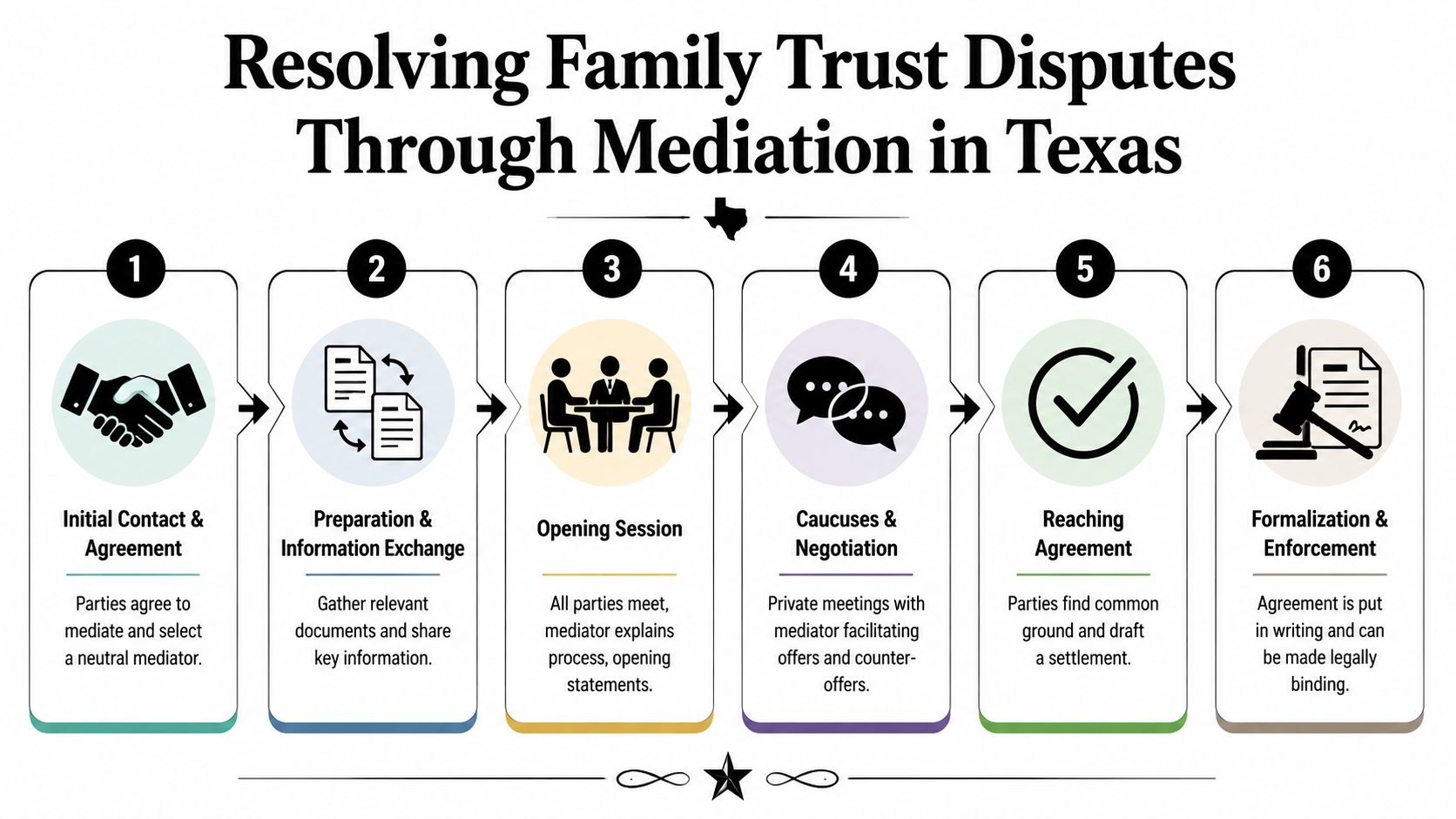
A visual overview helps many families understand the flow.
What mediation usually looks like
Most Texas trust mediations move through a series of practical stages:
Selection of the mediator
The parties choose a neutral person, often someone with probate, trust, or estate dispute experience.Pre-mediation preparation
Each side gathers documents, outlines concerns, and clarifies what outcomes are acceptable.Opening session
The mediator explains the rules, including confidentiality and the mediator's neutral role.Private caucuses
The mediator usually meets with each side separately to explore settlement options, risks, and sticking points.Negotiation
Offers and counteroffers move back and forth. Sometimes the focus is money. Sometimes it's control, timing, records, a resignation, or future communication rules.Settlement drafting
If the parties reach agreement, the terms are reduced to writing before everyone leaves.
For a broader overview of trust conflict pathways, this page on dispute resolution and litigation in Texas trusts is a useful companion.
Here is a short video that gives additional context on dispute resolution in this area:
Why families often prefer mediation
Mediation appeals to many families because it can lower the emotional temperature. People get more control over the outcome than they would in a courtroom, and the discussion can address both legal and practical concerns.
It also gives room for solutions a court may not design on its own. A mediated outcome might include a resignation timeline for the trustee, a process for sharing heirlooms, a schedule for accountings, a neutral third party to help with administration, or an agreed sale process for family property.
Mediation works best when the parties need a solution they can implement, not just a ruling they can cite.
What mediation is not
Mediation is not forced forgiveness. It is not a substitute for evidence review. It is not a guarantee that everyone is telling the truth. And it is not always the right first step.
That matters in family trust disputes and mediation options Texas because many online explanations stop at “mediation is cheaper and faster.” That can be true, but it's only part of the story. If the underlying issue is fiduciary breach, hidden records, or risk to trust assets, timing matters as much as tone.
Common points of confusion
Families often ask whether mediation means filing a lawsuit first. Sometimes yes, sometimes no. Mediation can happen before suit, during a pending case, or after certain court motions narrow the issues.
They also ask whether lawyers are still needed in mediation. In most meaningful trust disputes, legal guidance matters. The settlement may affect real estate, tax treatment, accounting allocations, releases, future claims, and trustee authority. A mediator helps facilitate. The mediator does not become your advocate.
How to Prepare for a Successful Trust Mediation
Preparation often determines whether mediation becomes a real opportunity or just an expensive conversation. Families do better when they arrive with organized records, a clear sense of priorities, and a realistic understanding of what they can prove.
Gather the documents that tell the story
Trust disputes are document-driven. Emotions explain why the conflict feels urgent, but documents usually explain how the conflict can be resolved.
Start by collecting:
- The trust and all amendments: Make sure you have the full version, not just selected pages.
- Letters, emails, and texts: Save communication with the trustee, beneficiaries, financial institutions, and advisors.
- Financial records: Statements, inventories, property records, tax-related paperwork, and records of distributions can all matter.
- Prior accountings or summaries: Even incomplete accountings may reveal patterns or missing information.
- Timeline notes: Write down key events while memory is still fresh, including deaths, amendments, meetings, transfers, and refusals to provide information.
If you suspect breach of fiduciary duty, don't wait too long to get advice. Texas sources commonly state that beneficiaries generally have 4 years to sue a trustee for breach of fiduciary duty, and that the clock often begins when the breach was discovered or reasonably should have been discovered under the discovery rule, as explained in this discussion of Texas trust claims and timing.
Know your goals before you sit down
Mediation gets harder when someone says, “I just want what's fair,” but can't define what that means. A better approach is to separate your goals into categories.
- Non-negotiables: Removal of a trustee, access to records, repayment of a disputed transfer, or a pause on asset sales.
- Strong preferences: Faster distributions, a neutral co-trustee, sale of real property, or family heirloom arrangements.
- Tradeoffs you could accept: Different payment timing, narrower releases, or phased implementation.
A Texas trust administration lawyer can help you test whether your goals line up with the trust terms, the available evidence, and likely court remedies. If the dispute overlaps with probate or incapacity issues, a Texas estate planning attorney may also need to evaluate related estate and beneficiary questions. The Law Office of Bryan Fagan, PLLC handles trust administration, estate planning, probate, guardianship, and asset protection matters in Texas, which can be relevant when a trust dispute crosses into those areas.
Compare mediation and litigation realistically
The choice isn't always either-or. Sometimes mediation comes first. Sometimes litigation comes first and mediation follows after records are produced.
| Factor | Mediation | Litigation |
|---|---|---|
| Decision-maker | The parties control whether a deal is reached | A judge or court process can impose outcomes |
| Privacy | Discussions are generally private and confidential | Court filings and hearings are often more public |
| Flexibility | Solutions can address family logistics and administration details | Remedies are tied more closely to formal legal relief |
| Information access | Depends heavily on voluntary exchange and preparation | Formal procedures can compel records and testimony |
| Speed | Can move quickly if everyone is prepared | Often slower and more structured |
| Relationship impact | Can reduce conflict if people negotiate in good faith | Often increases strain because the process is adversarial |
| Best fit | Communication problems, interpretation disputes, settlement-focused cases | Fraud concerns, missing assets, urgent court orders, severe noncooperation |
Bring two outlines to mediation. One should explain your legal position. The other should explain the practical outcome you can accept.
That simple step helps people stay focused when emotions rise and proposals start moving quickly.
When Litigation Is the Necessary Path
Mediation is valuable, but it isn't a cure-all. In some trust disputes, the first job is not compromise. It's protection. If a trustee may be stealing, hiding records, or moving assets, a family can undermine their capacity to protect assets by waiting too long for informal talks to work.
Red flags that can justify court action first
Some situations call for immediate evaluation of litigation options:
- Suspected fraud or self-dealing: You believe the trustee is using trust assets for personal benefit.
- Refusal to provide records: Requests for financial information are ignored or blocked.
- Urgent risk to assets: Property may be sold, transferred, or depleted before facts are known.
- Serious capacity or undue influence issues: Key trust changes may have occurred under suspicious circumstances.
- Need for enforceable orders: You need the court to require an accounting, restrain conduct, remove a trustee, or appoint another fiduciary.

Texas trust practitioners often note an important strategic tension. Mediation can preserve relationships and reduce cost, but it may also delay discovery, weaken bargaining power, or blur accountability when the underlying dispute is fiduciary misconduct. That concern is discussed in this overview of Texas family trust disputes and mediation strategy.
Litigation and mediation are not opposites
A common mistake is thinking that filing in court means the family has “given up” on settlement. Often, the opposite is true. Filing can create structure. It can force deadlines, preserve evidence, and make the other side take the dispute seriously.
In Texas, courts can order remedies such as trustee removal, an accounting, asset recovery, or appointment of a receiver in appropriate cases. If you need that type of relief, a petition may need to come before any serious settlement discussion.
Beneficiaries considering formal action can review the mechanics of how to sue a trustee in Texas.
If trust assets may disappear before the next conversation, a lawsuit may be the conversation that protects them.
That doesn't mean mediation is off the table. It means the timing of mediation should serve the case, not undermine it.
Life After the Dispute The Path to Lasting Resolution
The end of the argument is not always the end of the work. Whether your case resolves in mediation or through the court, the outcome still has to be carried out properly. That implementation stage is where many families either gain real closure or fall back into conflict.
Turning an agreement into action
A settlement on paper often requires several follow-up steps:
- Signing the right documents: Releases, settlement agreements, trustee resignations, and consents may all be needed.
- Retitling property: If real estate or accounts are changing hands, deeds and transfer paperwork may be required.
- Updating the accounting: The trust records should reflect reimbursements, reallocations, distributions, and any administrative changes.
- Handling ongoing authority: If a new trustee takes over, the transition should be documented clearly so banks, advisors, and beneficiaries know who has authority.
Texas-oriented guidance on estate mediation often notes that successful implementation may require orders, deeds, releases, and asset transfers, which is why the post-settlement workflow matters just as much as the negotiation itself. That practical issue is highlighted in this discussion of Texas estate dispute mediation and enforcement steps.
Preventing the next dispute
The best resolutions don't just settle the immediate complaint. They reduce the chance of a second fight. That may mean creating clear reporting rules, setting distribution dates, documenting future decision-making, or coordinating related probate, guardianship, or asset protection issues so the family isn't dealing with loose ends later.
Families often feel a huge sense of relief once there is a signed agreement or court order. Relief is justified. But accuracy still matters. A poorly implemented resolution can reopen old wounds very quickly.
If you're managing a trust or facing a family conflict over one, legal guidance can help you protect both your rights and your options. A careful review of the trust, the records, and the family dynamics can clarify whether mediation, litigation, or a combination of both makes the most sense. For specialized Texas-based guidance on trust administration, probate, guardianship, estate planning, and asset protection, contact Law Office of Bryan Fagan, PLLC for a free consultation.