Managing a loved one’s trust can feel overwhelming, but with the right legal guidance, it doesn’t have to be.
If you’ve just been named trustee of a special needs trust, you may be staring at a binder, a court order, or a stack of financial papers and wondering what happens next. You want to help. You also don’t want to make a mistake that affects benefits, creates family conflict, or puts you in legal trouble.
That reaction is normal. A trustee’s job in special needs trust administration texas is serious, but it becomes much more manageable when you break it into clear duties and practical decisions. You’re not just handling money. You’re protecting a person’s stability, care, and day-to-day quality of life.
Your Guide to Managing a Special Needs Trust in Texas
Many trustees come into this role during an emotional season. A parent has died. A child has inherited money. A family member has become unable to manage finances alone. In those moments, being told “you’re the trustee now” can sound less like an honor and more like a burden.

A Texas special needs trust exists to hold and manage assets for a person with disabilities in a way that supports that person without carelessly interfering with public benefits. That sounds simple at first. In practice, trustees have to make judgment calls about distributions, records, communication, and compliance.
The good news is that the role is learnable. You do not need to become an expert in every part of trust law overnight. You do need to understand the trust document, respect your fiduciary duties, and pause before making decisions that seem generous but could create problems.
Practical rule: If you’re unsure whether a payment helps the beneficiary or harms benefits, slow down and check before sending money.
Trustees often get tripped up in the same places. They pay a bill in the wrong way. They mix trust funds with personal funds. They assume “family agreement” is enough without legal paperwork. They forget that Texas law adds issues that people in other states may never face, especially with community property.
This guide is written the way I’d explain it to a family member sitting across the desk from me. We’ll keep the language plain. We’ll talk about what matters most under Texas law, what daily administration looks like, and where hidden risks tend to appear.
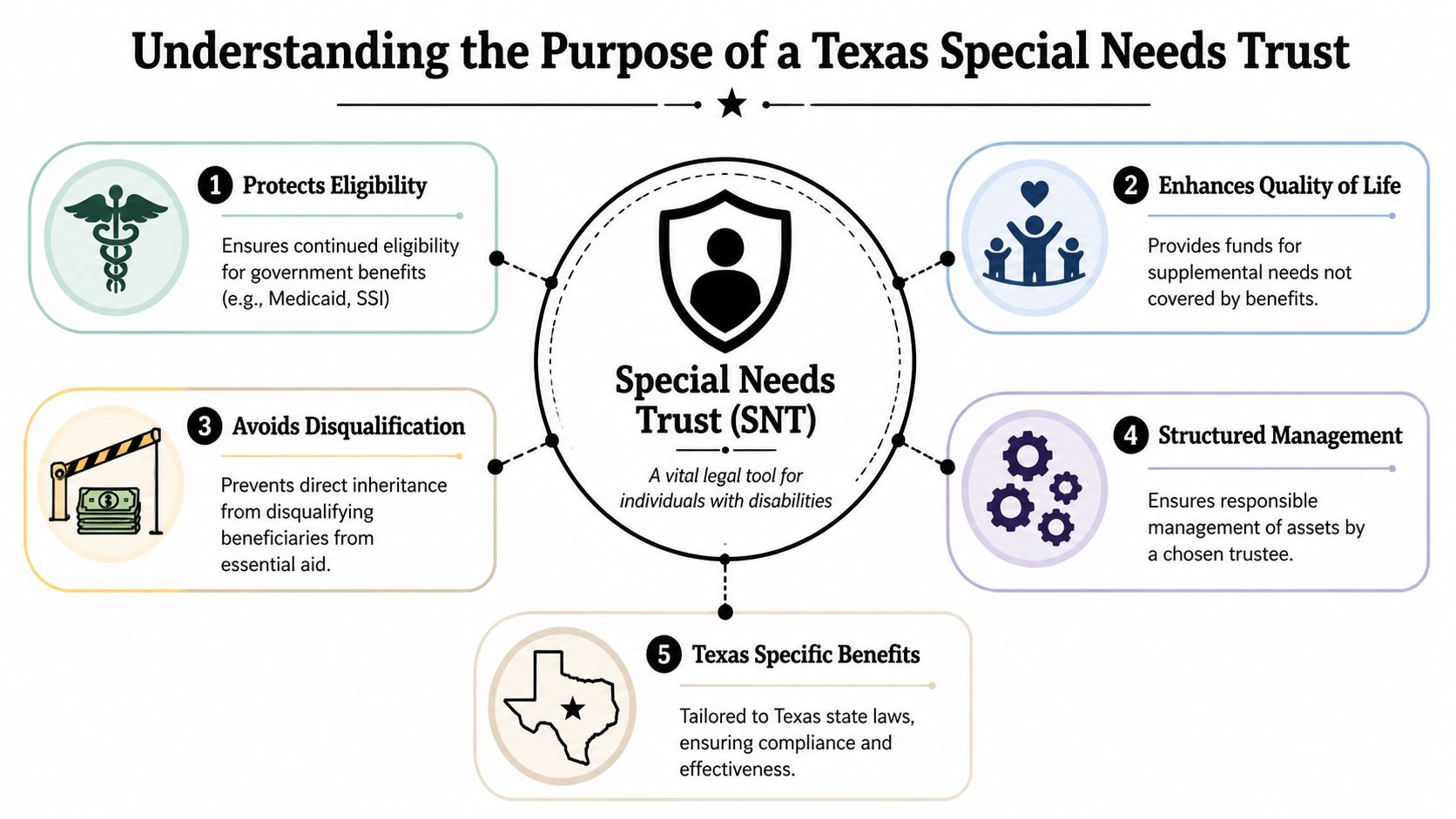
Understanding the Purpose of a Texas Special Needs Trust
A special needs trust works like a protective financial shield. The trust holds assets for the beneficiary, but those assets are structured so they aren’t treated the same way as money the beneficiary owns directly for benefit eligibility purposes.
That distinction matters because a person who needs means-tested benefits in Texas can’t receive money outright and keep those programs untouched. For SSI and Medicaid eligibility in Texas, countable assets are limited to $2,000, and a properly structured special needs trust can make trust assets “invisible” for those eligibility determinations, which is especially important for the state’s estimated 1.2 million residents with disabilities according to Texas special needs trust guidance.
The three people every trustee should know
Every special needs trust involves three core roles.
Settlor or grantor
This is the person who creates the trust or whose planning creates it. In some families, that’s a parent or grandparent.Trustee
This is you, if you’ve been appointed. The trustee manages trust property, follows the trust terms, and makes decisions in the beneficiary’s best interest.Beneficiary
This is the person the trust is designed to help. The trust exists for that person’s benefit, not for the convenience of relatives or caregivers.
The trust’s purpose is not to replace public benefits. It’s to supplement them. That means the trust can often improve the beneficiary’s life by paying for things public programs don’t fully cover, while still protecting the larger safety net.
What “supplement, not replace” really means
Families sometimes assume a trust is just a private account to spend on anything that helps the beneficiary. That’s where confusion starts. A special needs trust must be administered with restraint and planning.
A better way to think about it is this. Public benefits often cover the basics under their own rules. The trust fills gaps. It can support comfort, education, experiences, and services that make life more stable and more meaningful.
For many families, that may include therapies, adaptive items, personal support, transportation-related needs, hobbies, or opportunities that encourage growth. Resources focused on supporting independence through life skills can also help trustees think more broadly about what “quality of life” means for a beneficiary beyond monthly bills.
A well-run special needs trust does more than preserve benefits. It helps the beneficiary live with greater dignity, choice, and support.
Why structure matters so much
If a parent leaves money outright to a child with disabilities, the gift can create immediate problems. If that same parent leaves funds to a properly drafted and properly managed trust, the financial support can remain available without creating the same kind of eligibility issue.
That’s why trustees can’t treat the trust like an ordinary family account. The legal structure is the protection. Your administration preserves that protection over time.
When trustees understand the trust’s purpose from the beginning, later decisions become easier. You stop asking, “Can I use trust money to be helpful?” and start asking, “Does this distribution fit the trust’s purpose and protect the beneficiary’s long-term stability?”
A Trustee’s Fiduciary Duties Under the Texas Trust Code
Being a trustee isn’t just an administrative role. Under Texas law, it’s a fiduciary role. That means you must act with a high level of care, loyalty, and honesty when handling trust matters.
For many family trustees, this is the hardest mindset shift. You may be a parent, sibling, or close relative. But when you act as trustee, you’re not acting based on emotion alone. You’re acting under legal duties.
Duty of loyalty
The duty of loyalty means the trust’s interests and the beneficiary’s interests come first. You can’t use trust funds for yourself. You also can’t make decisions because they make things easier for the family if those decisions don’t serve the trust’s purpose.
A common example is reimbursement. If you pay for something personally and later want repayment from the trust, you need documentation and a clear reason the expense was proper under the trust. “I was helping out” isn’t enough by itself.
Another loyalty issue comes up when family members pressure the trustee. A sibling may ask you to use trust money in a way the trust doesn’t allow. A caregiver may insist a cash payment would be simpler. Your answer still has to be based on the trust and your fiduciary duty.
Duty of prudence
Texas trustees must also act prudently. In plain English, that means handling trust assets carefully, thoughtfully, and with attention to risk.
Prudence affects investing, spending, record-keeping, and timing. If the trust holds funds for long-term support, the trustee can’t act casually. You should understand what assets the trust owns, where cash is held, and what decisions need legal or financial review before action.
The practical side of prudence also includes learning the rules before making distributions. That matters because trustee liability is a significant concern, and trustees can face personal financial exposure for mistakes, including situations where a distribution disqualifies the beneficiary from benefits and causes financial damage, as discussed in Texas special needs trust guidance on trustee risk.
Why this matters: “Good intentions” won’t protect a trustee from the consequences of a bad distribution decision.
A trustee who wants a clearer legal framework for these obligations should review Texas trustee duties under the Texas Trust Code, especially when trying to separate family emotion from fiduciary decision-making.
Duty of impartiality
Some trusts have one current beneficiary and other people who may receive what remains later. In those cases, the trustee may owe a duty of impartiality. That doesn’t mean treating everyone the same. It means making balanced decisions under the trust terms instead of favoring one interested person unfairly.
Here’s how that can look in real life. Suppose the current beneficiary needs a substantial expense that clearly improves health, care, or functioning. A remainder beneficiary might prefer the trustee spend less so more money stays in the trust. Your job is not to preserve the maximum inheritance for someone else. Your job is to follow the trust terms fairly and responsibly.
What fiduciary conduct looks like day to day
Good fiduciary practice is often quiet and repetitive.
- Keep trust money separate from your own accounts and from anyone else’s.
- Save records for every deposit, expense, invoice, and trustee decision.
- Communicate clearly with the beneficiary and appropriate family members without promising distributions too early.
- Ask before acting when the trust language or benefit rules are unclear.
Trust administration often feels personal because it involves someone you care about. But the legal standard is professional. That’s why many trustees benefit from guidance from a Texas trust administration lawyer, an accountant, or both.
Managing Distributions for SSI and Medicaid Compliance
Most trustee anxiety centers on one question. “What can I pay for without hurting benefits?”
That concern is justified. Distribution mistakes can undo the very protection the trust was created to provide. The biggest trouble spots often involve giving the beneficiary cash or paying for food, shelter, or utilities in a way that benefit programs treat as support.
Why discretion matters
One of the strongest protections in a special needs trust is a trustee’s discretionary authority. Under Texas Trust Code Section 113.056, a trustee’s discretionary power can help prevent improper distributions that create in-kind support or maintenance, often called ISM.
According to planning guidance on special needs trusts in Texas, when a trustee properly uses that discretion to avoid paying for food or shelter, the trustee can avoid ISM violations that may reduce the beneficiary’s monthly SSI check by an average of $300 to $400. That same guidance explains that direct payments for shelter can create measurable benefit reductions, while careful discretionary administration helps preserve eligibility.
What ISM means in plain language
ISM is support the government treats as helping with basic living costs. If the trust pays for those items in the wrong way, SSI may be reduced.
Trustees often become confused. They assume paying rent directly, buying groceries, or handing over spending money is obviously helpful. It may be helpful in an everyday sense, but it can still be risky in a benefits sense.
If you need a basic refresher on how SSI differs from other disability programs, a plain-English Social Security disability benefits guide can help frame why means-tested rules are so strict.
Permissible vs. Impermissible SNT Distributions in Texas
| Expenditure Category | Generally Permissible (Does Not Reduce Benefits) | Generally Impermissible or Risky (May Reduce Benefits) |
|---|---|---|
| Medical and therapeutic needs | Uncovered medical care, therapies, adaptive support, and similar supplemental care may be appropriate if allowed by the trust | Cash given to the beneficiary to pay those costs personally can create problems |
| Education and personal development | Tuition, classes, training, books, and other approved educational support are often consistent with supplemental needs planning | Unstructured payments without records or a clear trust purpose are risky |
| Recreation and quality of life | Recreation, hobbies, travel support, and activities that improve quality of life may be proper if documented | Gift cards or cash equivalents are risky because they can be treated like cash |
| Food | Extreme caution is needed. Trustees should get advice before paying for food-related expenses | Direct payment for food can trigger SSI reduction concerns |
| Shelter and housing costs | Housing-related decisions should be reviewed carefully before payment | Rent, mortgage, utilities, and other shelter costs can trigger ISM issues |
| Direct payments to beneficiary | Structured payment to vendors is generally safer than cash to the beneficiary | Cash payments are one of the clearest danger areas |
If a distribution feels ordinary in family life, that doesn’t mean it’s safe in special needs trust administration texas.
A safer way to think through requests
When the beneficiary asks for something, or a parent or caregiver asks on the beneficiary’s behalf, pause and work through a short checklist:
What is the item or service?
Name it specifically. “Support” is too vague. “Dental bill,” “computer for classes,” or “transportation service” is better.Who will receive the payment?
Paying a provider directly is usually easier to evaluate than handing money to the beneficiary.Does it touch food, shelter, utilities, or cash?
If yes, treat it as high risk and get advice before proceeding.What does the trust document say?
Some trusts allow broad supplemental support. Others include narrower standards or approval procedures.Have you documented the reason?
Write down why the distribution serves the beneficiary and why you concluded it was consistent with the trust.
Trustees also need to think ahead. If there’s a pattern of repeated requests in a risky category, don’t solve each one in isolation. Build a policy and discuss it with counsel. For broader planning concerns tied to public benefits and post-death recovery issues, some trustees also review Texas guidance on avoiding Medicaid estate recovery as part of a larger administration strategy.
A common example
Suppose a beneficiary wants help with a laptop for online classes, transportation to appointments, and monthly grocery money.
The laptop may fit educational support. Transportation may fit supplemental care. Grocery money is the danger point. A careful trustee won’t lump all three requests together and approve them as “helpful expenses.” Each one needs its own analysis.
That’s how good administration works. Not by saying yes or no quickly, but by separating safe support from risky support and documenting each decision.
Core Administrative Tasks and Timelines for Texas Trustees
The legal rules matter, but daily administration is where trustees either stay organized or fall behind. A special needs trust usually runs better when you treat it like a system, not a pile of urgent requests.

Your first set of tasks
When you first take over as trustee, your job is to identify the trust, secure control of the assets, and create clean financial boundaries.
That often includes reading the trust document from beginning to end, confirming whether the trust is already funded, and gathering records tied to bank accounts, brokerage accounts, life insurance proceeds, or other assets. If the trust needs its own taxpayer identification number, that should be handled promptly. The same is true for opening a dedicated trust account.
Never use your personal checking account as a temporary stopgap. Even short-term mixing of funds can create confusion, accounting issues, and distrust later.
Build an administration file early
A simple filing system can save you later. You don’t need anything fancy, but you do need consistency.
Trust formation documents
Keep the signed trust, amendments, court orders, and acceptance of trusteeship together.Asset records
Save account statements, transfer confirmations, beneficiary designation paperwork, and appraisals if relevant.Distribution records
Keep invoices, receipts, written requests, approval notes, and proof of payment.Communication log
Save emails and notes of important calls with the beneficiary, family members, agencies, and professionals.
A trustee who builds a dependable record trail is in a much better position if questions arise later.
The ongoing rhythm of administration
Most trusts settle into a repeating cycle. Money comes in. Bills or requests come up. The trustee reviews the request, checks the trust terms, decides whether to approve it, pays the correct party, and saves the record.
That sounds routine, but it requires discipline. Trustees should reconcile accounts, monitor investments when applicable, and keep an eye on whether the trust’s use still matches the beneficiary’s needs. Needs change over time. So should your administration habits.
If you want a broader framework for handling these moving parts, Texas trust administration strategies can help trustees create a more structured process.
This short video is also a useful way to think about the practical side of trust administration.
Tasks trustees often forget
Some trustee duties aren’t urgent, so people put them off. Then those tasks become problems.
Accounting
Beneficiaries or other interested parties may need a clear record of trust activity. Even if no one is demanding it today, good accountings reduce conflict.Tax filings
Trust tax obligations don’t disappear because the trustee is a family member. Coordinate with a qualified tax professional when needed.Professional coordination
Some trustees need help from a lawyer, CPA, care manager, or financial institution. The Law Office of Bryan Fagan, PLLC assists with trust administration, trustee guidance, and related planning matters in Texas when families need legal direction on these steps.Related legal issues
If the beneficiary also has guardianship concerns or the family is doing broader planning, those issues should be coordinated rather than handled in isolation.
Keep the trust organized as if someone else may need to review every decision later. Sometimes they will.
A trustee who follows a repeatable process usually feels less stress. The work doesn’t become small, but it does become clearer.
Avoiding Common Pitfalls and Navigating Disputes
The biggest mistakes in special needs trust administration usually don’t start with bad motives. They start with assumptions. A trustee assumes a family agreement is enough. A spouse assumes community funds can be transferred without extra paperwork. A family assumes end-of-life issues can wait.
Texas law makes those assumptions dangerous.
Community property problems in trust funding
Texas is a community property state. That matters when a married couple funds a special needs trust using assets acquired during marriage.
According to Texas special needs trust planning guidance, if spouses transfer community property into a special needs trust without a marital property partition agreement, the assets may later be challenged as community property in a divorce. That source gives a concrete example. If $200,000 from joint savings goes into the trust and the couple divorces later, an ex-spouse may argue that $100,000 remains subject to division. The same source also notes this is a measurable compliance gap in approximately 40% of self-drafted or improperly advised SNT arrangements.
That’s a hidden risk many families never see coming. The problem isn’t the trust itself. The problem is failing to recharacterize the property before funding.
Improper distributions and family pressure
Another common pitfall is saying yes too quickly.
A beneficiary may ask for direct cash because it’s easier. A parent may insist the trust should cover living expenses because “that’s what the money is for.” A sibling may accuse the trustee of being cold or overly legalistic when the trustee refuses. Those situations are painful, especially in close families.
The trustee still has to hold the line. If the request is risky, document the request, explain the concern respectfully, and seek legal advice if the family challenges your decision. Good communication won’t eliminate every dispute, but poor communication almost always makes disputes worse.
Personal liability is real
Some trustees assume that because they aren’t being paid much, or at all, they won’t be held to a strict standard. That’s not how fiduciary law works.
The concern is not abstract. As noted earlier, trustees can face personal financial exposure if mistakes harm the beneficiary. If a distribution causes a loss of benefits, the trustee may be blamed for the resulting damage. That risk is one reason careful records matter so much. A written decision trail can show that you acted thoughtfully, sought advice, and tried to comply with the trust.
When conflict starts building, the trustee’s best protection is often documentation made before the disagreement became a dispute.
Medicaid reimbursement after the beneficiary’s death
Families also tend to avoid one of the hardest topics. What happens when the beneficiary dies and Medicaid reimbursement issues arise?
The available guidance identifies this as a major planning blind spot. Trustees and families often know there may be a state reimbursement claim, but they don’t know how to approach spend-down decisions, timing questions, or claim procedures. The research also suggests Texas may have favorable conditions because Medicaid estate recovery is limited to probate assets, yet the practical strategy remains unclear in the available materials. That uncertainty is exactly why trustees should not improvise late-stage decisions.
What to do when a dispute is taking shape
Trust disputes rarely begin with a lawsuit. They usually begin with silence, suspicion, or repeated arguments over money. Watch for these signs:
Requests without paperwork
If people resist providing invoices or details, that’s often a warning sign.Complaints about fairness
Family members may frame legal compliance as favoritism or lack of compassion.Informal side agreements
A trustee should never rely on “we all agreed” if the trust or benefit rules point another way.End-of-life panic decisions
Rushed spending or transfers when health declines can create avoidable problems.
When those signs appear, slow the process down. Confirm the trust terms. Gather the records. Ask for requests in writing. Consult a Texas estate planning attorney if needed. In some cases, the issue may involve trust modification, court guidance, or a change in trusteeship.
The trustee’s job is not to keep everyone happy. It is to protect the beneficiary and administer the trust lawfully.
Partnering with a Texas Trust Attorney for Peace of Mind
Serving as trustee is an act of care, but it’s also a legal job. You’re expected to manage assets prudently, honor fiduciary duties in Texas, and make distribution decisions that protect the beneficiary over time. That’s a lot for one person to carry alone.
Most family trustees don’t need more pressure. They need a reliable process, honest answers, and help before small issues turn into expensive ones. A Texas trust administration lawyer can review the trust terms, help with distribution questions, address disputes, and coordinate with tax and benefits professionals when the situation calls for it.
Families sometimes also look at how other regions approach similar planning issues. For example, guidance on Northern California special needs trusts can be useful for general comparison, even though Texas trustees must follow Texas-specific rules on administration, property characterization, and fiduciary conduct.
A careful trustee doesn’t try to know everything. A careful trustee knows when to ask.
If you’re managing a trust or planning your estate, contact The Law Office of Bryan Fagan, PLLC for a free consultation. Our attorneys provide trusted, Texas-based guidance for every step of the process.
If you need help with special needs trust administration texas, fiduciary duties in Texas, or questions about how to modify a trust in Texas, contact Law Office of Bryan Fagan, PLLC. We help trustees, beneficiaries, and families understand their options, avoid costly mistakes, and move forward with clarity through a free consultation.