Divorce already forces people to sort through a home, finances, parenting schedules, and a long list of legal documents. Then someone remembers the trust. That's usually when the anxiety spikes.
A common Texas scenario goes like this. A married couple created a living trust years ago to avoid probate, hold certain assets, and make things easier for their children. Now the marriage is ending, and one or both spouses are asking the same question: what happens to a trust after divorce in Texas, and does the trust still control anything?
The short answer is that the answer depends on a few legal facts, not just on what the trust is called. The most important questions are whether the trust is revocable or irrevocable, whether it was funded with community property or separate property, and whether the divorce decree requires either spouse to take additional action. That combination usually determines whether the trust is easy to change, difficult to change, or left largely untouched.
If you're dealing with this right now, your confusion is understandable. Trusts sit at the intersection of family law, fiduciary duties in Texas, estate planning, and property classification. Those are complicated areas even on their own. When divorce brings them together, families often need a calm, practical way to think through the next step.
Navigating Divorce and Trusts in Texas
Many people assume divorce automatically cancels everything involving an ex-spouse. That assumption can create trouble. Some estate planning provisions may be affected by divorce, but a trust often requires a more careful review.
Take a simple example. Spouses create a joint revocable trust during the marriage and transfer marital assets into it. They later divorce and rely on the decree alone, believing the trust will sort itself out. Years later, one former spouse dies without formally updating the trust, and the old paperwork still names the ex-spouse in a fiduciary role. That's the kind of preventable problem that leads to court fights, delayed distributions, and confusion for children or other beneficiaries.
Why readers get tripped up
There's often a focus on the word trust as if every trust works the same way. In Texas, that's not how the analysis works. Lawyers and judges usually start with a more practical question: what property is inside the trust, who controls it, and when did it get there?
That means a trust created during marriage isn't automatically marital property, and a trust created before marriage isn't automatically safe from all scrutiny either. The legal result usually turns on the source of the assets and the rights each spouse had over them.
A trust is not a magic shield in divorce. In Texas, the court usually looks through the label and asks who owned the property, who controlled it, and whether the assets can be traced.
A useful mental model
If you're trying to understand what happens to a trust after divorce in Texas, it helps to think in three layers:
- The trust type: Can it still be changed, or is it largely locked in place?
- The property character: Was it funded with community funds, separate funds, or a mix?
- The cleanup work: Did anyone amend, revoke, re-title, or re-fund documents after the divorce?
Once you see those three layers, the issue becomes easier to manage. You don't need to memorize statutes to make smart decisions. You need a clear framework and careful review of the documents and asset history.
Revocable vs Irrevocable Trusts The First Critical Distinction
The first thing I'd want a client to identify is the trust's type. That one fact changes the whole conversation.
A revocable trust is flexible. The person who created it usually keeps the power to amend it, revoke it, and often control the assets inside it. An irrevocable trust is much harder to change. In many cases, the person who created it has given up meaningful control, which is why Texas courts often treat it differently.
Think draft versus final
A revocable trust is like a document still sitting on your desk. You can revise it, tear it up, or rewrite key terms. An irrevocable trust is closer to a signed agreement that has already gone into effect. Once it's in place, changing it often takes more than just deciding you want a different result.

If you're not sure which type you have, reviewing the trust instrument is essential. A helpful starting point is this explanation of a revocable trust in Texas.
How divorce affects each type
Texas-focused legal guidance explains that the effect of divorce on a trust depends heavily on whether it is revocable or irrevocable. An ex-spouse's role in a revocable trust may be automatically removed by law or easily revised, but an irrevocable trust generally continues unchanged and can still pass assets to a former spouse unless legally modified or terminated, as discussed in this Texas divorce and estate planning overview.
That difference matters because people often rely on divorce itself to clean up old planning documents. With revocable trusts, there may be more room to fix things quickly. With irrevocable trusts, the document may keep operating under its original terms unless someone takes the proper legal steps.
What this means in plain language
Here's a simple comparison:
| Trust type | Control during marriage | Typical post-divorce issue |
|---|---|---|
| Revocable trust | Creator usually keeps control | Must review who remains beneficiary, trustee, or successor trustee |
| Irrevocable trust | Creator usually gives up significant control | Terms may continue even after divorce unless legally changed |
Practical rule: If your trust is revocable, assume it needs immediate review. If it's irrevocable, assume it needs a legal analysis before anyone promises it can or can't be changed.
That's why the first phone call in these cases is often less about “winning the trust” and more about identifying what kind of instrument you're dealing with.
Community Property and Trusts The Texas-Specific Factor
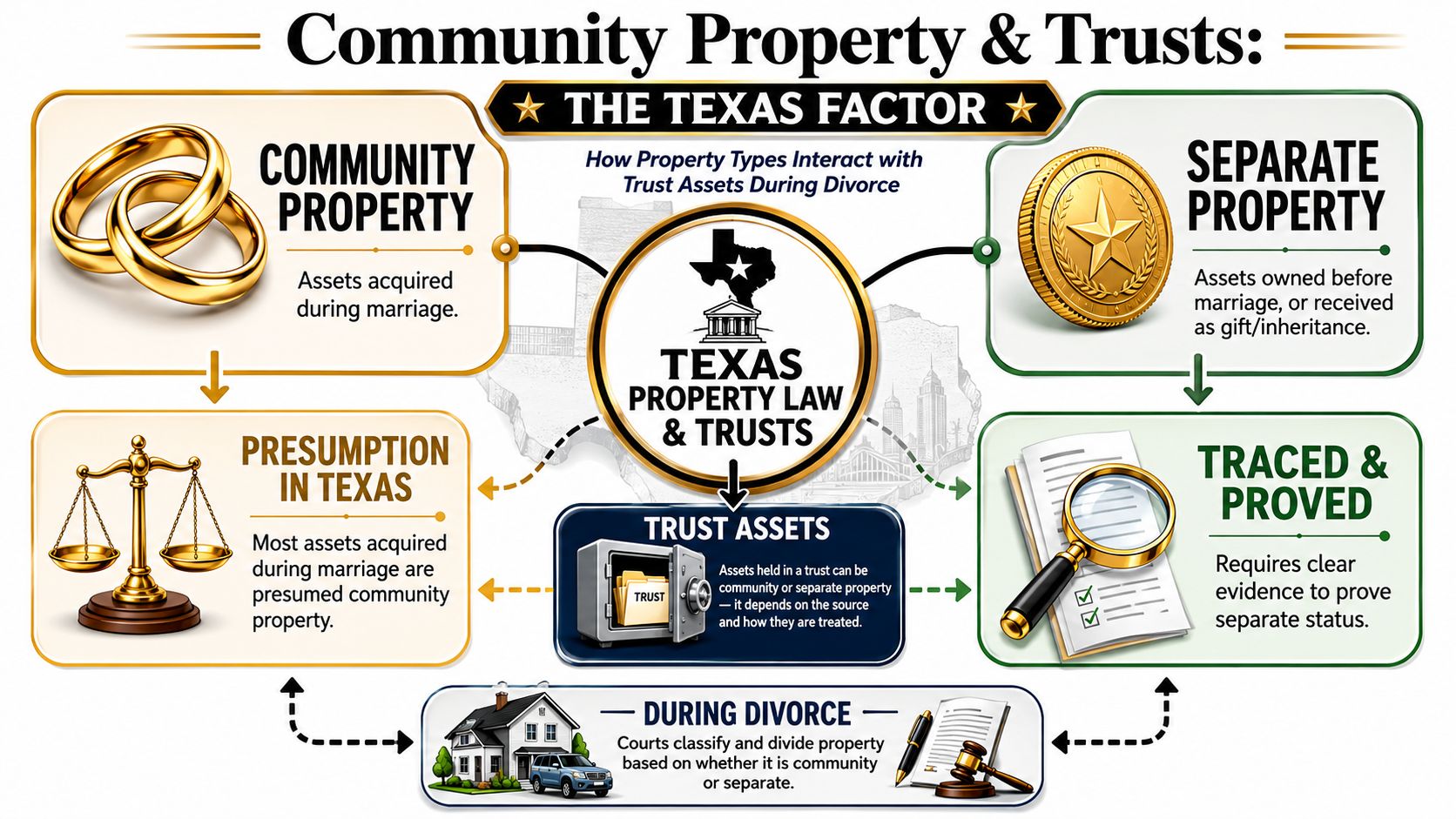
Texas adds a layer that many people don't expect. It's a community property state, so the trust analysis often begins with property classification, not with the trust title.
Think of property as going into one of two buckets. One bucket holds community property, which generally includes assets acquired during the marriage. The other holds separate property, such as property owned before marriage, inheritances, and certain gifts. If money from those buckets goes into a trust, the source still matters.
The source of the money often controls the outcome
Texas legal guidance consistently notes that trust disputes after divorce often turn on property classification. A trust funded with an inheritance is generally insulated as separate property, but income from that trust or appreciation due to community effort can sometimes be argued as community property, which is why tracing matters so much, as explained in this discussion of trusts and divorce property classification.
That means two trusts can look identical on paper and still be treated very differently in divorce court.
One spouse may say, “This trust was always mine.” But if marital earnings were added to it, if trust income was handled in a way that changed its character, or if records are incomplete, the court may have to sort out competing claims. That process is called tracing, and it often becomes the central issue.
A few practical examples
Consider these common patterns:
- Inheritance funded trust: A spouse receives an inheritance and places it into trust. If the inheritance can still be traced, the trust corpus is more likely to remain separate property.
- Marital earnings placed in trust: Spouses transfer earnings from the marriage into a trust. Those assets are far more vulnerable in the divorce process.
- Mixed funding history: A trust begins with separate property, then receives community funds later. That creates a more complicated tracing problem.
For many people, the most difficult part isn't the trust language. It's proving where the assets came from.
People also worry that the other spouse may have moved money without full disclosure. In cases where records seem incomplete or accounts appear to be missing, learning how to find hidden financial accounts can help someone understand what documents to request and what warning signs to discuss with counsel.
For a closer look at one of the most common separate-property questions, this resource on protecting inheritance from divorce in Texas is useful.
A short video can also help frame the issue:
When Texas courts review a trust in divorce, they often care less about the trust's label and more about the path the money took into it.
Your Role After Divorce As a Beneficiary or Trustee
After divorce, people often ask more personal questions. Am I still in the trust? Is my ex still in charge? Do we need to change the children's trust?
Those questions matter because trusts don't just hold property. They assign authority. They name who manages assets, who receives distributions, and who steps in later if the original trustee can't serve.

If you were named as a beneficiary
Suppose a husband created a revocable trust during marriage and named his wife as primary beneficiary. After divorce, he assumes she's automatically out. That may be true in some revocable-estate-planning contexts, but assuming is risky. The trust and related documents still need review to confirm who remains entitled to what.
Now change the facts. The ex-spouse is named in an irrevocable trust. That can be much harder to fix because the trust may continue under its original terms unless there is a valid legal basis to modify or terminate it.
If you were named as trustee or successor trustee
This catches families off guard. An ex-spouse may no longer be the person you'd choose to manage assets for you or your children, but the trust paperwork may still put that person in charge.
Here are a few roles that deserve immediate review:
- Current trustee: This person may still have active control over trust administration.
- Successor trustee: This person may take over later, even if everyone assumes the role ended with the divorce.
- Trustee for a child's trust share: Parents often overlook this appointment during divorce negotiations.
Why fiduciary roles matter so much
Trustees owe fiduciary duties in Texas. That means they must follow the trust terms, act loyally, protect trust property, and keep proper records. If the wrong person remains in that role after divorce, conflict is almost predictable.
A similar review often needs to happen for related planning documents involving minors, incapacity planning, and family oversight. That's one reason families sometimes need coordinated help not only with estate planning, but also with probate, guardianship, and fiduciary appointments.
If your ex-spouse is still named anywhere in a trust, don't assume the divorce decree alone fixed it. Confirm the actual document language and the title of each asset.
How a Divorce Decree Can Shape a Trust's Future
A divorce decree is powerful, but it doesn't wave a wand over every trust document. It can assign property, order transfers, and require one or both spouses to take certain actions. But if nobody completes those actions, old trust language can still create problems.
That distinction matters in practice. Many former spouses leave mediation believing the trust issue was resolved, when what really happened is that the decree ordered future cleanup that still needs to be done.
What a decree can do
For a revocable trust funded with marital assets, Texas family courts can pull the trust property into the property-division analysis because the settlor retains the power to amend or revoke it. With an irrevocable trust, the assets are generally outside the marital estate unless the transfer was made to defraud a spouse, as discussed in this explanation of trusts in Texas divorce proceedings.
So the decree may do things like:
- order a spouse to revoke or amend a revocable trust
- direct the re-titling of assets held by the trust
- require one spouse to sign documents needed to complete division
- address whether a spouse has any continuing claim to trust-related property
For people worried about whether a former spouse may still benefit from trust property, this guide on ex-spouse rights to a trust in Texas is a useful companion read.
What a decree usually does not do by itself
A decree usually doesn't rewrite every trust provision line by line. It may tell the parties what must happen, but someone still has to amend the trust, prepare transfer documents, update beneficiary designations, and confirm the trustee's authority going forward.
That is why the marital settlement agreement can be so important. A well-drafted agreement can address trust assets with much more clarity than a vague promise to “divide property equally” or “remove the other spouse from estate planning documents.”
A practical way to think about it
If the trust is part of the divorce picture, the decree should answer at least these questions:
- Who gets the underlying assets?
- Who must sign what documents?
- Who remains trustee, if anyone?
- Does a new trust need to be created for children or separate property?
The cleaner those answers are at divorce, the less likely the family is to face trust litigation later.
Modifying Terminating or Creating a New Trust After Divorce
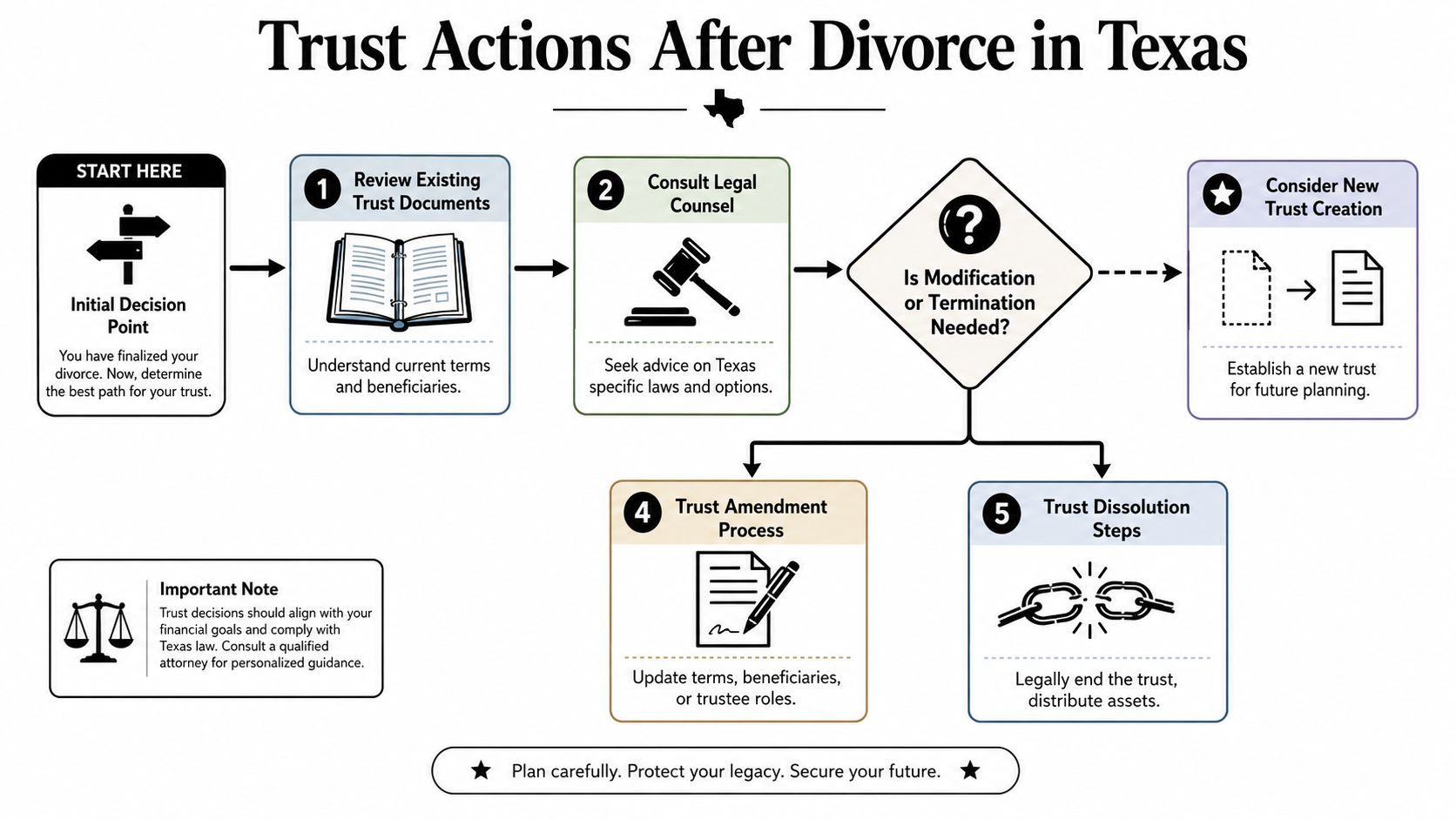
A common post-divorce scene looks like this. The decree is signed, life is starting to settle, and then someone opens a trust binder and realizes the old plan still names the former spouse in multiple roles. At that point, the real question is not just what changed in the marriage. It is what changed, or did not change, in the trust paperwork and the title to the property.
That distinction matters because trust planning after divorce is really a property-characterization exercise. If an asset is separate property, the goal is often to preserve that separate character and place it under terms that fit your new circumstances. If an asset was community property or was mixed with community funds, the next steps may look very different. The trust is the container. The character of the property inside it often drives the decision.
A practical post-divorce cleanup checklist
Consumer guidance on post-divorce estate planning warns that relying on the decree alone can leave outdated trustee and beneficiary designations in place, creating confusion later, as noted in this discussion of post-divorce estate plan updates.
A useful review usually includes these steps:
Collect the full trust file
Gather the trust agreement, every amendment, schedules of property, deeds, account records, and any documents naming or removing trustees.Separate assets by character first
Before changing language in the trust, identify which assets are separate property, which were community property, and which may need tracing because separate and community funds were mixed. This step works like sorting boxes before a move. You need to know what belongs where before you decide what stays, what transfers, and what should go into a new trust.Compare the trust documents to the divorce decree
Check whether the decree requires an amendment, revocation, transfer, division, or new funding. Paperwork often lags behind the court order.Review who still has authority
Confirm the current trustee, successor trustee, beneficiaries, and anyone holding a power of appointment or discretion over distributions.Choose the right path for this trust
A revocable trust may be amended or revoked by the person who holds that power. An irrevocable trust may call for beneficiary consent, court approval, or another Texas-law method of modification or termination.Retitle and fund assets correctly
The trust only controls property that is legally titled to it. If a deed, brokerage account, LLC interest, or bank account was supposed to change hands but never did, the plan on paper may not match reality.
When a new trust makes more sense
Sometimes amending an old trust creates more confusion than clarity. This often happens when the original trust was designed around a married couple's shared plan, but the post-divorce reality is very different.
For example, one spouse may leave the marriage with clearly separate property and want a fresh trust focused on children from a prior relationship, a new trustee choice, or tighter distribution terms. Another person may need a trust that receives assets awarded in the divorce and keeps them clearly segregated going forward. In those cases, starting clean can be simpler than revising a document built for a family structure that no longer exists.
Don't overlook related documents
Trust work after divorce rarely stops with the trust itself. The related documents often determine whether the plan functions.
Review these items at the same time:
- Powers of attorney
- Transfer documents and deeds
- Beneficiary designations
- Guardianship nominations for children
- Any asset protection planning tied to the trust
The goal is alignment. Your trust terms, title documents, and beneficiary designations should all point in the same direction so your separate property stays protected, your divided assets go where the decree intended, and your family is not left sorting out conflicting instructions later.
Secure Your Legacy with a Texas Trust Attorney
By the time a trust issue shows up in divorce, individuals are already emotionally and financially stretched. That's why it helps to return to the core rule. In Texas, the answer usually turns on what kind of trust you have and how the property inside it is characterized.
If the trust is revocable, review and action are often needed quickly. If the trust is irrevocable, the analysis usually becomes more technical and document-driven. If the trust was funded with separate property, tracing may preserve that protection. If marital assets went into the trust, the court may treat the issue very differently. And if no one completes the post-divorce cleanup, old terms can stay alive long after everyone thought the matter was settled.
Why legal guidance matters here
Trust issues after divorce rarely fit into one clean category. They can involve Texas Trust Code principles, Texas Estates Code rules, fiduciary duties in Texas, property tracing, deed transfers, and beneficiary disputes all at once.
That's why families often benefit from legal help that looks at the whole picture instead of just one document. A Texas trust administration lawyer can help identify what the trust still controls, whether any modification is possible, what duties a trustee owes, and what needs to be updated to protect your children and your long-term goals.
The goal is clarity and control
You don't need to stay stuck in uncertainty. With the right review, you can determine whether the trust should remain in place, be modified, be terminated, or be replaced with a better plan.
That kind of work does more than fix paperwork. It restores control. It protects beneficiaries. It reduces the chance of future conflict. And it helps ensure your estate plan reflects your current life, not a marriage that has already ended.
If you're managing a trust or planning your estate, contact Law Office of Bryan Fagan, PLLC for a free consultation. Our attorneys provide trusted, Texas-based guidance for every step of the process.