Divorce changes more than your relationship status. It can leave old estate planning documents pointing in the wrong direction at the worst possible time.
Many Texans come to this question after a hard season. They're sorting out bank accounts, retirement plans, the house, and parenting schedules. Then one more worry surfaces: Can my ex still benefit from my trust, control it, or gain access through our children?
That concern is valid. The short answer is that Texas law does offer protection after divorce, but it doesn't create a clean, universal reset. Some trust rights are revoked automatically. Some are not. Some issues have less to do with who inherits the trust itself and more to do with who receives trust income, who serves in a fiduciary role, or who may manage a child's inheritance later.
Navigating Your Finances and Future After a Divorce
If you were divorced recently, you may be looking at estate documents you signed years ago under very different circumstances. A revocable living trust may still name your former spouse. An irrevocable trust may contain language that seems harder to change. A child-focused trust may not leave property to your ex directly, yet your ex may still have influence over how money reaches your children.
Many people become confused. They hear that “divorce cancels everything,” then assume the problem is solved. In Texas, that's too simple.
The better way to think about ex-spouse rights to a trust in Texas is to ask a series of practical questions:
- What kind of trust is involved? Revocable and irrevocable trusts are treated differently in real life.
- What right are we talking about? Beneficiary rights, trustee powers, trust income, and control over a child's inheritance are not the same.
- When was the interest created? Timing matters in trust law and in property classification.
- Was any trust income received during the marriage? That can change the divorce analysis.
- Have all related documents been updated? Wills, powers of attorney, and beneficiary forms often create the biggest surprises.
Practical rule: If a divorce judgment is final but your estate plan still reflects your marriage, treat that as unfinished legal work.
Texas estate planning works best when every moving part matches your current life. That includes your trust, your will, your nonprobate designations, and the people named to make decisions if something happens to you.
How Divorce Automatically Affects Trusts in Texas
A common post-divorce moment looks like this: you pull out your trust, see your former spouse still named, and assume the document must still control. In Texas, that assumption is often wrong. State law can cancel certain trust-related benefits for an ex-spouse automatically, even if the paperwork was never updated.
Under Texas Estates Code § 123.001 as explained in this Texas divorce and estate planning discussion, divorce generally operates as an automatic revocation of any trust provision that benefits a former spouse, including beneficiary status and trustee nominations, unless the instrument expressly provides otherwise or a post-divorce redesignation is made.
In plain English, Texas often treats the former spouse as though that person no longer has the role the trust gave during the marriage. If your revocable trust says, “my spouse receives everything if living,” a completed divorce will often cut off that gift without forcing your family into a separate lawsuit over outdated language.
This visual shows the basic idea:
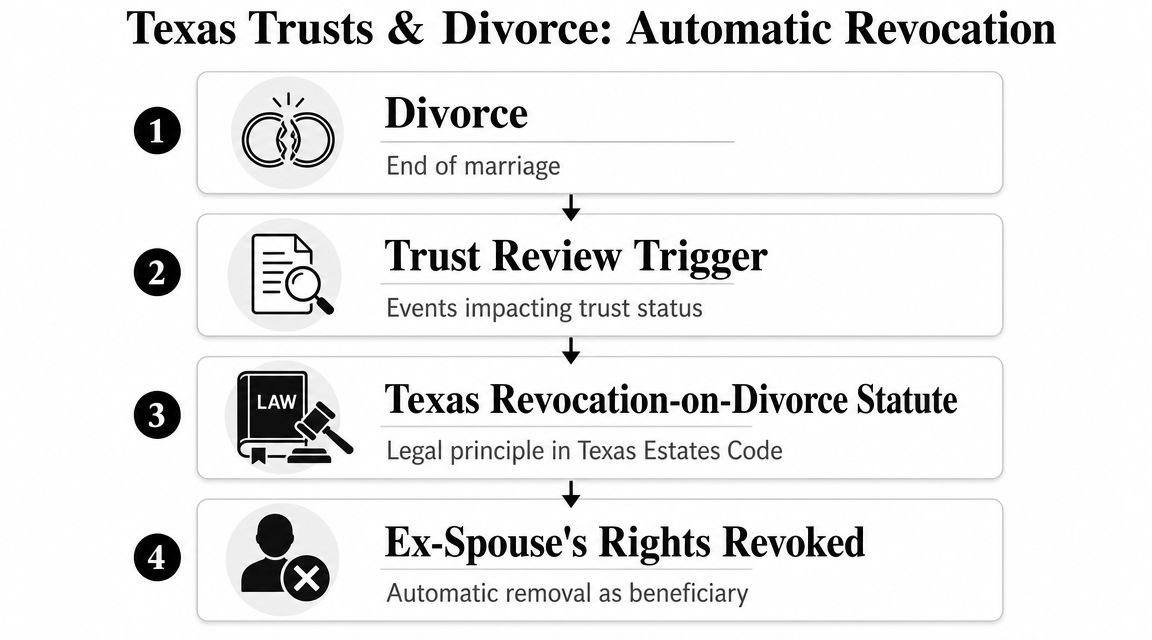
What the automatic revocation rule usually does
For many families, the statute removes a former spouse from roles such as:
- Direct beneficiary status if the trust gave that spouse property at death
- Trustee nominations if the document named the spouse to serve
- Powers of appointment or similar rights if the trust gave the spouse authority to redirect assets
That is why people often hear that divorce “revokes” an ex-spouse's rights. For a standard revocable living trust, that shorthand is often close enough to be useful.
The legal detail still matters. A beneficiary right is different from management authority. A trustee role is different from a right to receive money. If you want a clearer picture of those distinctions, this guide on rights of trust beneficiaries in Texas helps explain what kind of interest a person may hold.
Why automatic revocation does not solve every trust problem
This is the part many articles skip. Divorce can cut off direct benefits, but it does not erase every connection between your former spouse and a trust.
The first reason is simple. Trusts are not all built the same way. A revocable trust is usually easier to amend or revoke because the trustmaker kept control. An irrevocable trust is different. If someone else created it, or if the ex-spouse's interest was fixed under the trust terms, divorce may not give you the power to rewrite that arrangement.
| Trust type | Common post-divorce reality |
|---|---|
| Revocable trust | Usually easier to amend, restate, or revoke after divorce |
| Irrevocable trust | Often harder to change, and a former spouse's interest may survive if the instrument expressly names that person or the interest vested earlier |
A short example shows why this distinction matters.
Suppose David signed a revocable living trust during the marriage and named Maria as both primary beneficiary and successor trustee. After the divorce, David never changes the document. In many cases, Texas law will treat Maria's beneficial interest and trustee nomination as revoked.
Now change the facts. Suppose Maria was named years earlier in an irrevocable family trust created by David's parents. David may have no authority to change that trust at all. Her position would depend on the trust language, how the interest was created, and whether divorce affects that particular right.
That is why the automatic rule helps, but only up to a point.
Later disputes often arise because people confuse “removed as beneficiary” with “fully removed from every trust issue.” Those are not the same thing. An ex-spouse may lose a direct gift and still remain tied to the trust through child-related roles, past distributions, trustee accountings, or powers created in a document that divorce does not automatically rewrite.
For readers who prefer video, this overview may help frame the issue before you review your own documents:
The first question to ask after divorce
Start here: Was the trust revocable or irrevocable on the date of divorce?
That one question usually tells you whether Texas automatic revocation is likely to do most of the cleanup work, or whether you need a close reading of the trust itself. If the trust was revocable, the path is often more direct. If it was irrevocable, the answer usually depends on the exact language and the type of interest involved.
The practical takeaway is steady and realistic. Divorce often removes an ex-spouse from many trust benefits automatically. It does not mean every trust issue disappears on its own.
Untangling Trust Assets and Community Property
The hardest issue usually isn't whether your ex is still named in the trust. It's whether money connected to the trust became part of the marital estate.
Texas law presumes property acquired during marriage is community property. And as explained in this discussion of Texas community property laws in estate planning, while a beneficiary's interest in a trust may be separate property, distributions of income from that trust received during the marriage can be treated as community property unless the trust instrument specifies otherwise.
That single distinction causes a lot of confusion.
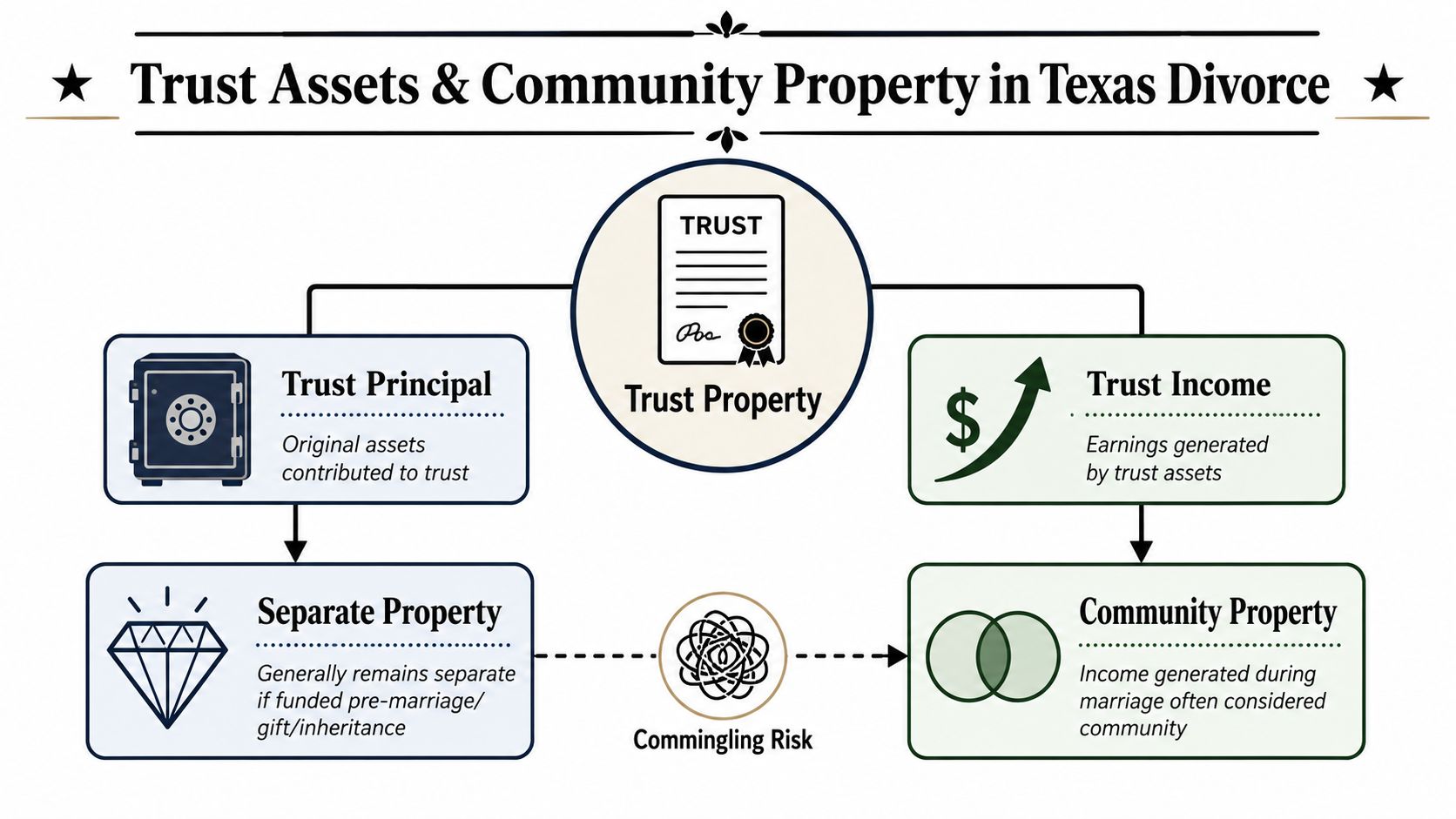
Trust principal and trust income are not the same thing
Think of a trust like a fruit tree.
The principal or corpus is the tree itself. The income or distributions are the fruit it produces. In many cases, Texas may treat the tree one way and the fruit another way.
If a spouse has an underlying beneficial interest in a family trust, that interest may remain separate property. But if the trust distributes income during the marriage and that money is received and used during the marriage, the analysis can shift. The ex-spouse may not have a right to the trust principal itself, yet there may still be a dispute about payments that came out of the trust.
That's the part many articles skip. They focus only on the former spouse as a named beneficiary. They don't explain that trust income can matter in divorce even when the trust corpus stays separate.
A realistic example of where claims arise
Suppose Elena is the beneficiary of a trust created by her parents before marriage. The trust itself is separate from the marital estate. During the marriage, though, the trust makes regular distributions, and Elena and her spouse use that money for household expenses, tuition, travel, and mortgage payments.
In that situation, the trust's principal may still be protected from division. But the stream of money paid out during the marriage may be analyzed differently. That is why a trust doesn't always function as a complete divorce shield.
Another Texas-oriented discussion makes this point from the asset protection side. It explains that for divorce-property analysis, courts focus on whether the trust interest is separate or community property, and that classification turns on funding source, timing, and control retained by the settlor, as discussed in this article on trusts and divorce asset protection in Texas.
What tends to weaken protection
The legal outcome always depends on the document and facts, but these issues often create trouble:
- Commingling. If trust-related funds are mixed with marital accounts and used broadly for family expenses, tracing becomes harder.
- Control retained by the settlor. A revocable trust often offers less insulation because the grantor kept control.
- Funding source. Assets placed into a trust with community funds can invite a very different analysis than assets tied clearly to separate property.
- Use during marriage. Money used to support the marital household may become the center of the dispute.
The most important question may not be “Can my ex get the trust?” It may be “How did trust money flow during the marriage?”
A quick comparison readers often need
| Issue | Why it matters in divorce |
|---|---|
| Beneficial interest in the trust | May stay separate depending on source and terms |
| Income distributed during marriage | May be treated differently from the underlying interest |
| Revocable structure | Can give a court more reason to view assets as reachable |
| Irrevocable structure | Often provides stronger separation, but not if facts undermine it |
A related Texas family law discussion highlights an underserved angle: when a spouse is already receiving trust distributions, the fight may center on the payment stream rather than ownership of the trust itself, as noted in this article about trusts in divorce.
Where the Texas Trust Code still matters
Even after divorce, trust administration doesn't freeze. Circumstances change. Trustees still owe fiduciary duties in Texas, and families sometimes need to modify administration when old assumptions no longer work.
Texas Trust Code § 112.054 allows judicial modification when circumstances changed in ways the settlor did not anticipate, and § 111.0045 allows nonjudicial settlement agreements among interested parties. Those tools don't give a former spouse a simple right to invade trust assets. They do show that Texas courts and interested parties may have options when divorce exposes a mismatch between the trust's purpose and the family's current reality.
For a trustee or beneficiary, that means the answer is often administrative as much as legal. The trust may need better accounting, clearer distribution rules, or a formal modification path.
Beyond Beneficiary Rights Other Ways an Ex-Spouse Stays Connected
A former spouse can be removed as a beneficiary and still remain tied to the trust in ways that surprise families later.
That usually happens because divorce changes the family, but nobody updates the surrounding paperwork. The trust still names the ex in an older role. A will still points to a child's inheritance plan that gives the ex practical influence. A related document still hands authority to the wrong person.
The ex who is no longer a beneficiary but still has power
One of the most overlooked risks is the old fiduciary appointment. As explained in this discussion of estate planning after divorce in Texas, a frequently missed issue is whether an ex-spouse can still affect a trust by serving in an older fiduciary role, like a trustee, or by managing a minor child's inheritance. Revocation-by-divorce rules do not cover every estate-planning instrument, leaving stale documents as a live source of disputes.
That can play out in several ways.
Scenario one
A trust for adult children names the former spouse as successor trustee. Nobody notices because the ex no longer inherits directly. Years later, the trustmaker dies, and the ex steps into an administrative role over trust assets.
Scenario two
A divorced parent leaves property for a minor child. The ex doesn't receive the property personally, but the ex may still end up involved in managing the child's financial affairs unless planning documents were drafted carefully.
Scenario three
A power of attorney, beneficiary designation, or side agreement still interacts with the trust structure. The trust itself may look clean, while the related documents are not.
Old fiduciary appointments create practical control problems even when beneficial rights have changed.
Families in this position sometimes need dispute guidance as much as drafting guidance, especially if one side believes a former spouse is overreaching. In those cases, understanding how to contest a trust can help frame the options.
Why children often complicate the answer
Children are where legal rights and family realities intersect. A trust can be written for a child's benefit, but a divorced co-parent may still influence how requests are made, how expenses are presented, and how money reaches the child.
That doesn't mean the ex automatically controls the trust. It means the parent who created the plan should think several steps ahead:
- Who serves as trustee if you die while the children are minors?
- How are distributions made for school, medical care, or support?
- Should the trustee pay providers directly instead of routing funds through a parent?
- Do related estate documents match the trust plan so there isn't a back door for control?
A careful Texas estate planning attorney will look at the trust and the surrounding ecosystem, not just the beneficiary clause.
Your Post-Divorce Action Plan for Trusts and Estates
A divorce decree is signed, and life starts to settle down. Then you open a binder or a folder on your computer and realize your former spouse is still named in half your estate documents. That is a common moment of panic, but it is also a fixable one.
The key is to treat your trust plan like a house after a storm. You do not just check the front door. You walk room by room and look for hidden damage. In trust and estate planning, that means reviewing every document that can still give an ex-spouse money, authority, or indirect influence.
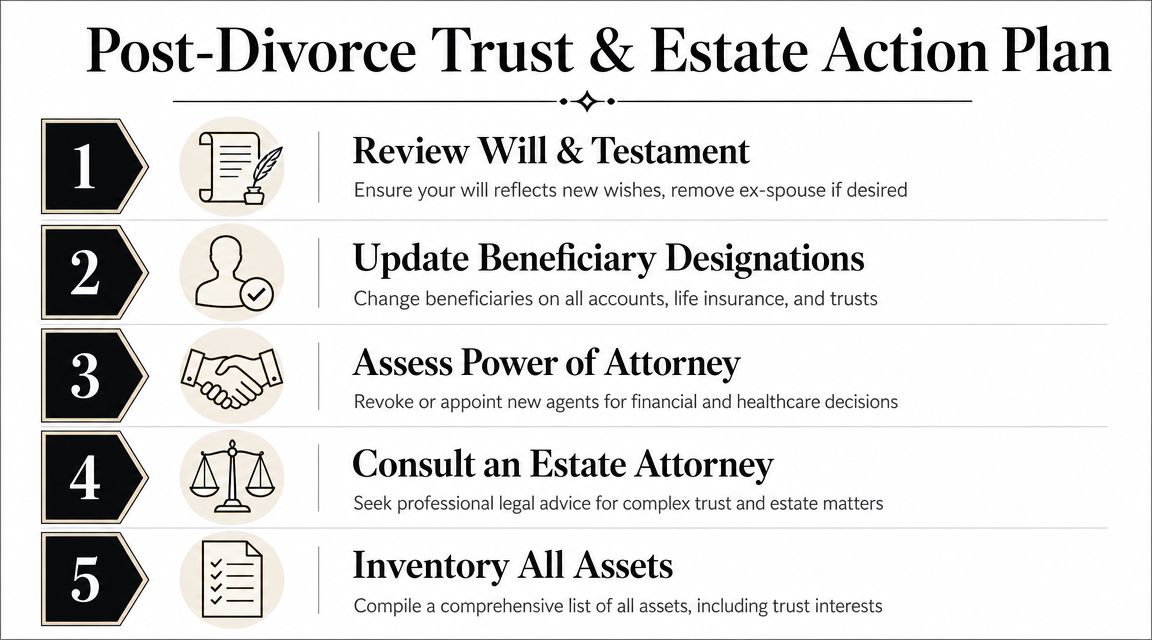
Five steps that protect you now
Gather every estate planning document
Start with the full file, not just the trust. Pull your will, trust amendments, certification of trust, powers of attorney, medical directives, life insurance beneficiary forms, retirement account designations, transfer on death instructions, and any divorce orders that touch property or support. If you are serving as trustee for someone else, gather those trust records too.
Mark every place your former spouse still appears
Look for more than beneficiary language. An ex-spouse may still be listed as trustee, executor, agent under a power of attorney, guardian for a minor child's estate, or contact person for financial institutions. Those roles matter because a person does not need to inherit trust property to still affect how money is handled.
Build a timeline for trust distributions and account transfers
This step helps separate emotion from facts. If trust money was distributed during the marriage, note when it came in, where it was deposited, and whether it stayed separate or was mixed with joint funds. That timeline gives your lawyer a clearer way to analyze community property questions, reimbursement claims, and tracing problems.
Review what can be changed
A revocable trust can often be updated directly by the person who created it. An irrevocable trust is different. It may require a narrower fix, trustee action, beneficiary consent, a nonjudicial settlement agreement, or court involvement. The right method depends on the trust language and the family situation, not just your preference on paper.
Match the trust plan to your next chapter
Removing an ex-spouse's name is only the first layer of protection. You may also need a different successor trustee, more precise instructions for distributions to children, or a new structure that keeps inherited property from being pulled into a future divorce. For many families, it helps to review strategies on how to protect inheritance from divorce while updating the rest of the plan.
A practical review list for trustees and families
If you are the trustee, your job is a little different. You are not just updating documents. You are reducing the risk of mistakes and later disputes.
- Confirm current authority. Verify who is serving now and who takes over next under the trust terms.
- Apply the distribution standard carefully. Health, education, maintenance, and support language should be followed as written, especially when a former spouse is still involved in a child's day to day care.
- Keep clean records. Good documentation helps if someone later questions why money was paid, to whom, and for what purpose.
- Check for conflicts with divorce orders or related documents. The trust may say one thing while an older beneficiary form or fiduciary appointment says another.
- Use a general estate administration checklist if probate is also involved. Many families find the DIYAuctions estate duties checklist helpful as a planning aid.
One step people often miss
Have a Texas lawyer review the whole system together. The trust, the will, beneficiary designations, powers of attorney, and divorce paperwork should tell the same story. If they do not, the gaps are where former spouses, trustees, and adult children end up in conflict.
The Law Office of Bryan Fagan, PLLC handles Texas-based trust administration, estate planning, guardianship, and asset protection matters that often overlap after divorce. A careful review can show what changed automatically, what did not, and what still needs direct action.
Secure Your Legacy with Trusted Texas Guidance
The legal answer to ex-spouse rights to a trust in Texas is rarely a simple yes or no. A divorce may revoke many trust benefits automatically, but that doesn't resolve every issue. Income received during marriage may still raise community property questions. Old fiduciary appointments may leave a former spouse with influence you never intended. Child-centered inheritance plans can create indirect control problems if they aren't drafted carefully.
That's why DIY fixes often fall short. Changing one clause in a trust won't necessarily update your will, your beneficiary forms, your powers of attorney, or the way a child's inheritance will be managed. Trustees face their own risks if they administer a post-divorce trust without understanding fiduciary duties in Texas and the limits of their authority.
A thoughtful review brings order back to a situation that often feels unsettled. It can clarify who has rights, who has duties, what can be changed, and what needs court involvement or a negotiated solution. It also helps prevent the kind of family conflict that starts years later, after memories fade and documents are harder to interpret.
If you're managing a trust or planning your estate, contact The Law Office of Bryan Fagan, PLLC for a free consultation. Our attorneys provide trusted, Texas-based guidance for every step of the process.
If you're concerned about an ex-spouse's role in a trust, updating your estate plan after divorce, or resolving a dispute over trust administration, contact Law Office of Bryan Fagan, PLLC for a free consultation. Our team helps Texas families, trustees, executors, and beneficiaries address estate planning, probate, guardianship, fiduciary duties, and asset protection with clear, practical guidance.