Managing a loved one's trust can feel overwhelming, but with the right legal guidance, it doesn't have to be.
A lot of Texas families are in the same position right now. Two siblings are named co-trustees. One wants to hold property longer, the other wants to sell. One thinks a beneficiary needs support now, the other worries about treating everyone fairly. What started as a job rooted in trust turns into stress, silence, and second-guessing.
That's where many co-trustee disputes in Texas begin. The disagreement usually isn't just about money. It's about responsibility, family history, risk, and fear of getting blamed. The good news is that Texas law gives a framework for handling these disputes, and there are practical steps that can protect both the trust and the people serving it.
When Co-Trustees Disagree in Texas
A common pattern looks like this. A parent names two adult children as co-trustees because that feels fair. After the parent dies, one child takes the lead on bills, bank accounts, and beneficiary calls. The other reviews transactions later and sees distributions they wouldn't have approved. By then, both feel the other has crossed a line.

Disputes also arise when co-trustees read the same trust document differently. One may focus on preserving assets for the long term. Another may focus on making current distributions to a surviving spouse, child, or disabled beneficiary. Both may believe they're honoring the settlor's wishes.
The disagreement is legal and personal
Co-trustee conflict has two layers. The first is legal. Trustees must follow the trust, Texas fiduciary law, and court rules if litigation begins. The second is personal. Co-trustees are often relatives who already have a long history together, and that history shapes every decision.
Practical rule: Early disagreement doesn't always mean anyone has acted in bad faith. But delay can turn a manageable issue into a breach claim, a removal request, or a full trust contest.
What usually helps at the start
When tensions first appear, the most useful move is often simple documentation and structure.
- Name the issue clearly: Is the dispute about an investment, a distribution, a sale, reimbursement, or missing records?
- Pull the governing documents: Review the trust first, then any amendments, related powers, and prior accountings.
- Pause informal assumptions: Many trustees act based on what “seems fair” instead of what the trust states.
Texas trust administration works best when co-trustees stop arguing from memory and start working from the document. That shift alone often changes the tone of the dispute.
Understanding Your Fiduciary Duties as a Co-Trustee
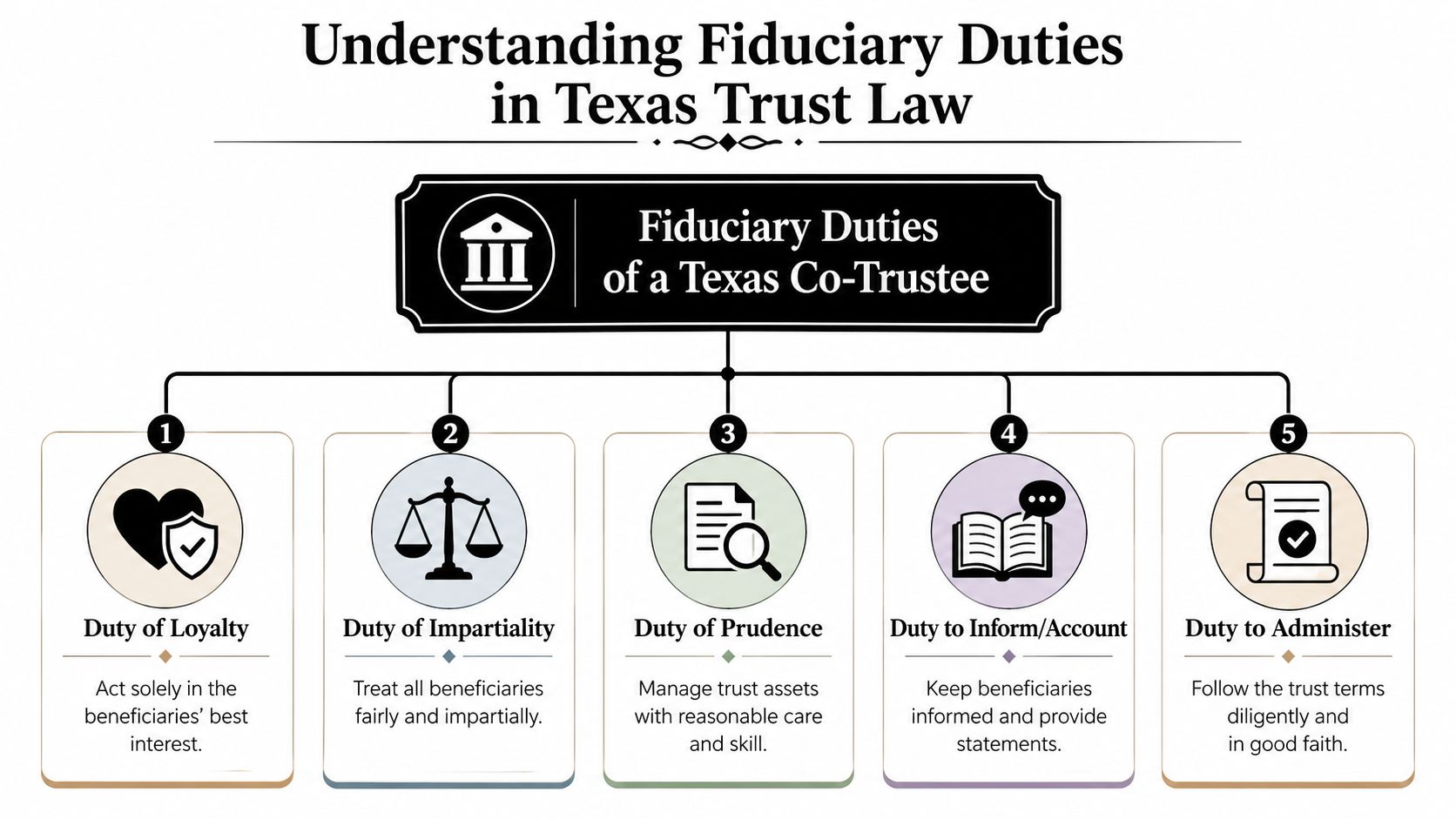
A co-trustee isn't just a helper. A co-trustee is a fiduciary, which means the role carries legal duties of loyalty, care, honesty, and proper administration under Texas trust law. Those duties exist whether the trustee is a professional, a spouse, an adult child, or a close family friend.
The core duties that shape every decision
The main fiduciary duties in Texas include loyalty, prudence, and impartiality. Loyalty means the trustee must act for the beneficiaries and the trust, not for personal advantage. Prudence means the trustee must handle property with reasonable care and skill. Impartiality means the trustee must treat beneficiaries fairly based on the trust's terms, not family pressure or personal preference.
Trust administration also includes practical duties. A trustee has to follow the trust document, keep records, communicate when required, and administer assets carefully. If you want a straightforward overview of those baseline rules, The Fiduciary Duties of a Texas Trustee summarizes the core duties of loyalty, prudence, and impartiality under the Trust Code.
Passive trustees can still face liability
One of the most misunderstood parts of fiduciary duties in Texas is that silence can be dangerous. Under Texas Property Code §114.006 as discussed here, co-trustees have a legal duty to exercise reasonable care to prevent breaches and take action to fix them. A passive co-trustee can be held personally liable for negligently enabling a breach.
That matters in real life. If one trustee moves trust funds improperly, makes self-interested decisions, or ignores the trust's distribution standards, the other trustee cannot merely say, “I stayed out of it.” In many situations, staying out of it is the problem.
A co-trustee doesn't avoid risk by doing less. A co-trustee lowers risk by participating carefully, asking questions, and creating a record.
What active oversight looks like
Good oversight doesn't require hostility. It requires habits.
- Review transactions regularly: Look at account statements, transfers, reimbursements, and proposed distributions before they become old news.
- Object in writing when needed: If a decision appears improper, say so clearly and keep a copy.
- Ask for backup: Request appraisals, invoices, tax records, closing statements, or professional advice when a decision needs support.
- Push for process: Set meeting dates, circulate agendas, and record decisions.
These habits protect beneficiaries, but they also protect the trustee. That's especially important for anyone working with a sibling, blended family member, or business associate where trust existed before the legal role began.
Why Co-Trustee Disputes Arise
Most co-trustee disputes in Texas don't start with a dramatic act. They build through repeated friction. One trustee responds quickly, the other disappears for weeks. One wants to preserve cash, the other wants to invest. One sees discretion, the other sees favoritism.
The most common triggers
Some disagreements are operational. Who pays expenses. When to sell a house. Whether to lease mineral interests. How much documentation a beneficiary should receive. Those issues can be managed if both trustees share information and use a consistent process.
Other disputes cut deeper because they suggest misconduct.
| Trigger | How it shows up |
|---|---|
| Investment disagreements | One trustee favors caution, the other wants more growth or concentration |
| Distribution conflict | Trustees disagree about whether the trust permits a requested payment |
| Uneven workload | One trustee does the work and resents it, while the other still expects equal authority |
| Conflict of interest concerns | A trustee appears to benefit personally from a trust decision |
| Recordkeeping failures | No one can explain where funds went or why a choice was made |
The trust document and Texas default rules
Some conflict comes from structure, not personality. Under Texas Property Code § 113.085(a) and the Texas Supreme Court ruling discussed here, co-trustees in Texas generally act by majority decision unless the trust requires unanimity. That rule catches many families off guard.
In practice, trustees often assume equal appointment means equal veto power. It usually doesn't. If the trust is silent, one trustee can find themselves repeatedly outvoted. That can create resentment fast, especially when the minority trustee believes the majority is making a serious mistake.
Family dynamics usually make the legal issue harder
The law may define authority, but family dynamics shape the conflict.
- Old roles return: The sibling who always managed money may dominate trust administration too.
- Grief affects judgment: A recent death often makes routine decisions feel loaded.
- Beneficiary pressure changes behavior: Trustees may feel pushed by spouses, children, or other relatives.
That's why a Texas trust administration lawyer often looks at both the document and the decision-making pattern. The legal answer matters, but so does the process that led there. In many cases, what fails first isn't the trust. It's communication.
What a Single Dissenting Trustee Can and Cannot Do
Many trustees believe that if they see a problem, they can file suit immediately in the name of the trust. In Texas, that assumption can be wrong.
What standing means in plain English
Standing is the legal right to bring a claim. A person may feel strongly that something improper happened, but courts still ask whether that person has the authority to sue over it.
For a dissenting co-trustee, this becomes a major procedural issue. According to the Texas Supreme Court clarification discussed in this Fiduciary Litigator analysis, a single disagreeing co-trustee in Texas generally lacks the legal authority to sue on behalf of the trust unless the trust document explicitly grants minority power. Only majority co-trustees have standing to assert claims on behalf of the trust.
That surprises people. A trustee may believe they are trying to stop a breach, yet the court may still say they can't pursue that claim in that posture.
A dissenting trustee's power often isn't direct. The first question isn't “Was the decision wrong?” The first question is “Who has authority to challenge it?”
What a dissenting trustee can still do
Limited standing doesn't mean no options exist. It means the path is narrower and has to be handled carefully.
A dissenting trustee can usually take steps such as:
- Reviewing the trust instrument closely: Some trusts change the default rule and give different decision-making power.
- Creating a written record: Document objections, concerns, and the factual basis for them.
- Seeking procedural relief: In the right case, the trustee may need to pursue removal-related relief, resignation, or court guidance rather than trying to sue in the trust's name outright.
- Protecting against personal exposure: Written objections and prompt action can matter when later questions arise about participation or acquiescence.
What usually does not work
What often fails is acting alone based on instinct. A dissenting trustee who freezes accounts without authority, blocks routine administration, or files the wrong kind of case can make the problem worse. The trustee may spend time and money only to be told the claim can't proceed as filed.
This is one reason co-trustee disputes in Texas need Texas-specific analysis. General articles often say “a trustee can sue.” The harder answer is that authority depends on the trust document, the claim, and the trustee's position within the decision-making structure.
Dispute Resolution Pathways from Negotiation to Litigation
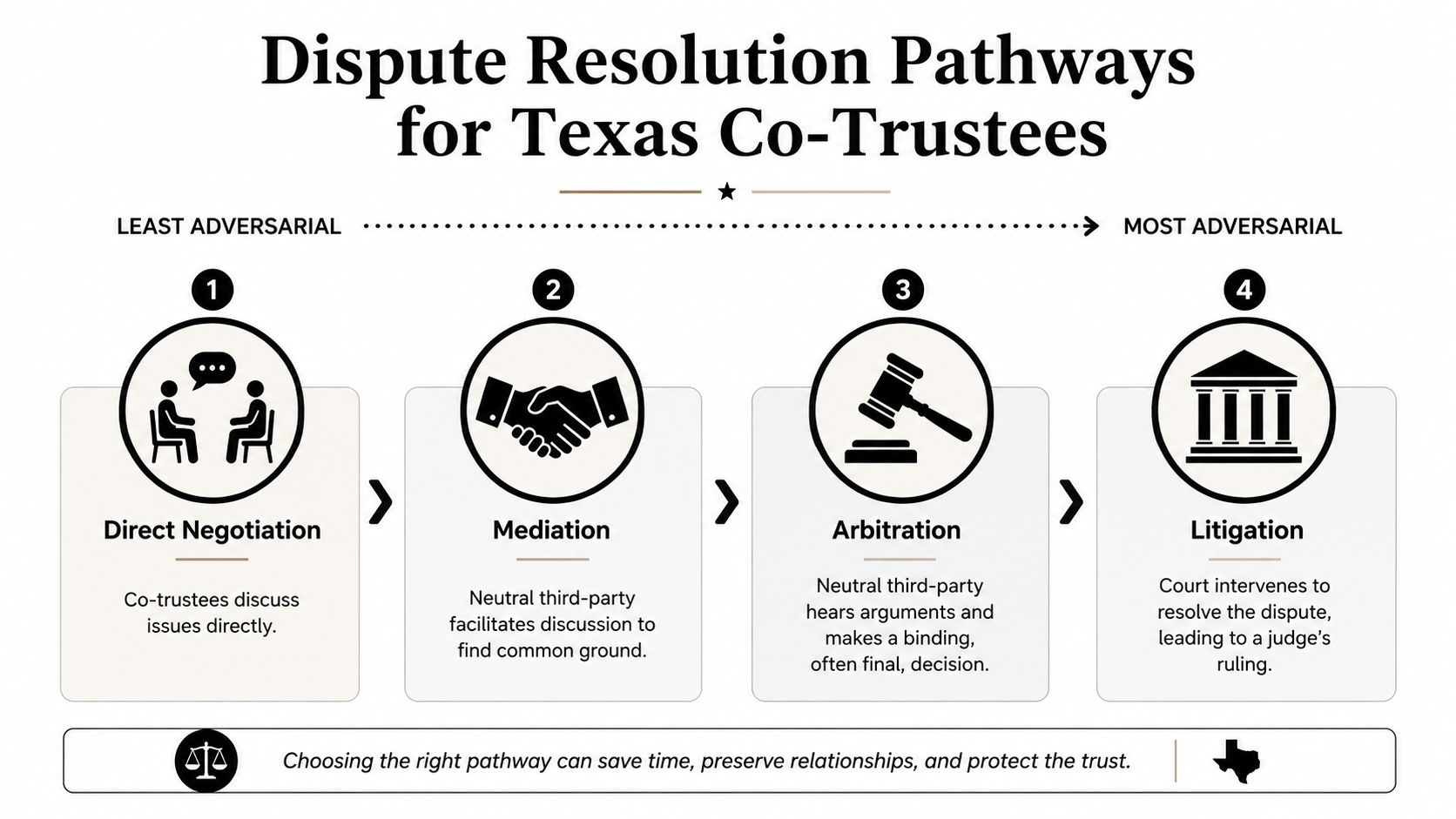
Not every trust dispute belongs in court. In fact, some of the best outcomes come from structured problem-solving before anyone files a petition.
A side-by-side look at the main options
Different disputes call for different tools. A missed reimbursement issue is not the same as a suspected self-dealing claim.
| Path | What it looks like | Main advantage | Main drawback |
|---|---|---|---|
| Direct negotiation | Trustees and counsel discuss the problem and proposed fix | Lowest disruption | Requires both sides to engage honestly |
| Mediation | A neutral helps the parties work toward agreement | Preserves more control and privacy | No guaranteed resolution |
| Arbitration | A neutral hears the dispute and issues a decision if the trust or agreement allows it | More streamlined than court in some matters | Less flexibility once submitted |
| Litigation | The court decides the dispute | Strongest formal remedies | Public, expensive, and often slow |
What tends to work first
Direct negotiation works best when the issue is defined and the records exist. For example, if the dispute is about whether a distribution fits the trust standard, counsel can often narrow the problem by reviewing the actual language, the beneficiary request, and any past pattern of distributions.
Mediation is often useful when both trustees still need a working relationship. The mediator doesn't decide who's morally right. The mediator helps the parties test risk, identify shared concerns, and structure a result. That may include revised communication rules, a distribution protocol, a sale timeline, or agreement on a neutral accountant.
For trustees who need clearer financial information before settlement talks go anywhere, a request for records and a formal accounting often changes the conversation. This guide on how to get an accounting of a trust in Texas explains why accounting issues often sit at the center of the dispute.
Here is a short discussion of dispute dynamics in practice:
When litigation becomes necessary
Litigation usually becomes the realistic option when one or more of these are true:
- Records are missing: You can't evaluate the trust without bank statements, ledgers, or transaction support.
- Assets are at risk: Property may be transferred, dissipated, or mishandled if no court order is sought.
- Communication has collapsed: One side won't respond, participate, or follow interim agreements.
- The requested remedy needs court power: Removal, surcharge, formal instruction, and some other remedies generally require judicial involvement.
A practical strategy starts with the least destructive tool that still protects the trust. Sometimes that's a demand letter. Sometimes it's mediation. Sometimes a petition needs to be filed quickly.
Seeking Legal Remedies Through Texas Courts
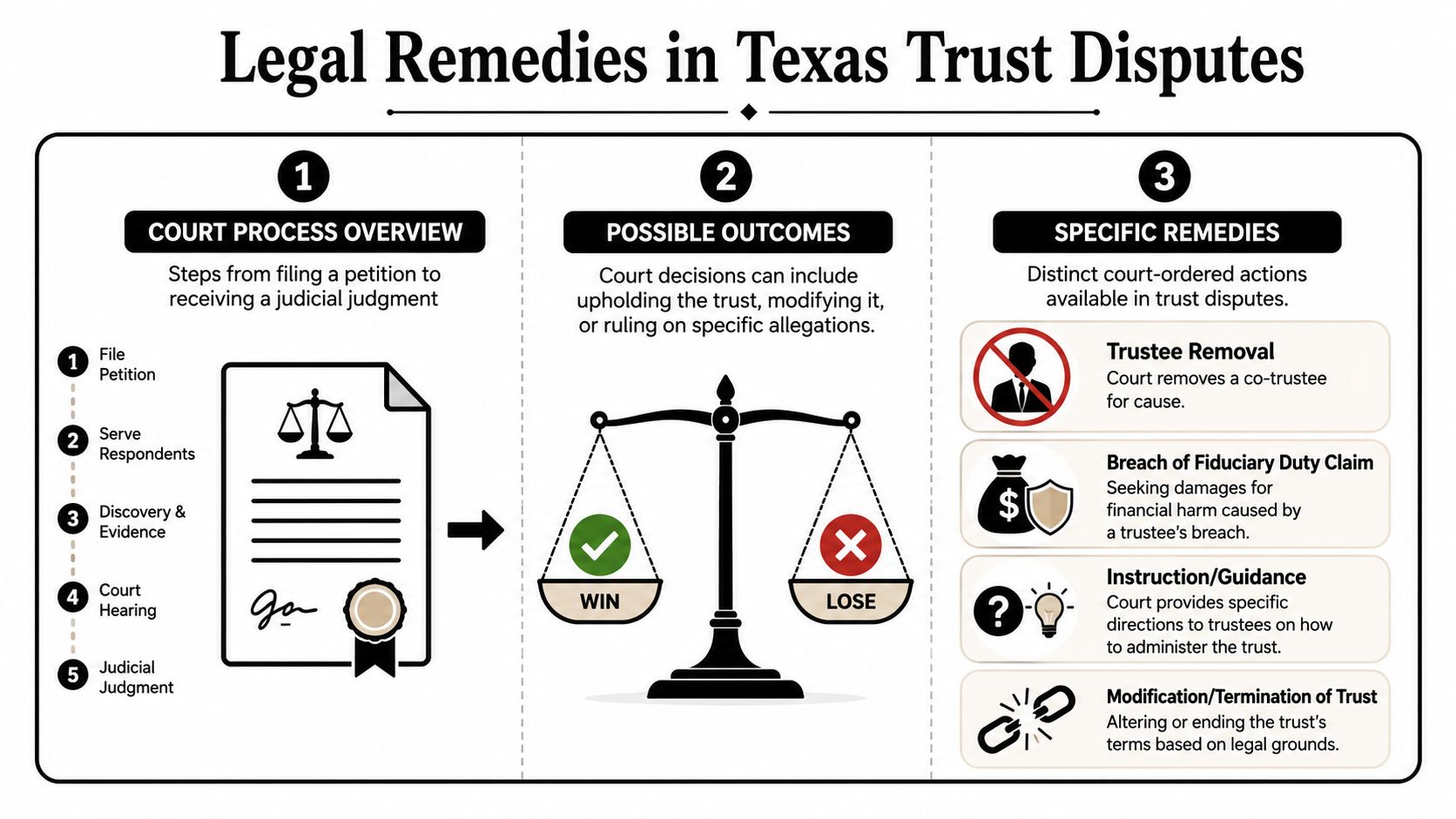
A common Texas court filing starts like this: one co-trustee says the other is acting without consent, records are incomplete, and a decision cannot wait. At that point, the court's job is not just to assign fault. A judge can keep the trust functioning, force disclosure, and decide who has authority to act while the dispute is pending.
Texas procedure matters here. A dissenting co-trustee often has less practical control than people assume unless that trustee asks the court for specific relief. Objection alone may preserve a position, but it does not always stop the other trustee from acting if the trust instrument or Texas law allows majority action, delegated action, or action by a remaining trustee in a particular setting. That misunderstanding is one reason these cases escalate.
Remedies a court can consider
The remedy depends on the problem the court is being asked to solve.
- Accounting: A judge can order a formal accounting so the parties can see receipts, disbursements, asset values, and transactions.
- Instructions: A trustee can ask the court to interpret disputed trust language or approve a proposed course of action before taking it.
- Injunctive relief: If money or property is at immediate risk, the court may restrain transfers, require assets to be preserved, or freeze a disputed step until a hearing.
- Removal: A trustee who is unfit, persistently refuses to administer the trust properly, or creates material risk to the trust can be removed.
- Surcharge and repayment: If a breach caused loss, the court can require the responsible trustee to restore what the trust lost.
- Other trust administration orders: Some cases also involve modification, termination, appointment of a successor trustee, or approval of a transaction.
The right request is often procedural as much as substantive. If the concern is an imminent sale, the first priority may be stopping the sale. If the concern is years of unexplained transactions, the first priority is usually records, accounting, and preservation of evidence.
Timing affects both leverage and available claims
Delay creates problems fast. Records disappear. Recollections change. A trustee who wants court help also has to think about limitation periods and whether a claim has accrued under the facts.
Texas trust claims are fact specific, and the filing deadline may differ depending on the remedy and the theory asserted, as explained in this Texas trust litigation overview. The safe approach is to evaluate deadlines early, especially where a co-trustee has already objected in writing or discovered a questionable transfer.
Waiting can also create a practical problem that clients do not always expect. If one trustee has been acting for months while the other trustee only objects informally, the acting trustee may later argue that the course of administration was accepted, necessary, or already completed. Courts look closely at documents, timing, and whether anyone sought relief when it still mattered.
Joint liability is a serious risk for co-trustees
Texas law can expose more than the trustee who took the lead. If co-trustees participate in a breach together, or one trustee knowingly joins or permits improper conduct, liability may not divide neatly between them. As discussed in this Texas trust law materials reference, that exposure can be joint and several.
That is the practical reality check many co-trustees need. Staying quiet is not always neutral. Signing the paperwork, approving the transfer, or consciously ignoring obvious problems can become part of the claim.
For a closer look at claims, defenses, and what court action usually involves, see this guide on suing a co-trustee in Texas and what you need to know.
How to Prevent Disputes and When to Call an Attorney
A common Texas trust problem starts subtly. One co-trustee believes a proposed distribution is improper, says so by email, and assumes that objection stops the deal. It often does not. Under many Texas trusts, and depending on the trust terms and the issue at hand, a dissent alone may not block action in the way families expect. That misunderstanding is one of the fastest ways a manageable disagreement turns into a liability problem.
Good process prevents a surprising number of these fights.
The co-trustees who stay out of court usually create a routine early and follow it even when everyone gets along. They calendar regular review meetings, keep a shared file for statements and trust records, and confirm important decisions in writing. They also separate day-to-day tasks from final authority. One trustee may handle communications with a property manager or accountant, but major distributions, asset sales, and unusual transfers should be documented and reviewed under the trust's decision rules.
Texas-specific procedure matters here. A co-trustee who disagrees should do more than complain informally. The objection should be clear, dated, and tied to the trust terms or the fiduciary concern. If the issue is serious, such as a questionable distribution, a self-interested transaction, missing records, or pressure from a beneficiary, the dissenting trustee needs to decide quickly whether to demand information, request a pause, seek court instructions, or consider resignation. Waiting while someone else continues to act can create avoidable problems.
A practical prevention plan usually includes:
- Regular decision points: Set monthly or quarterly meetings so issues are addressed before they become emergencies.
- Written records: Use agendas, consent notes, and follow-up emails to confirm what was decided and what was still disputed.
- Shared access to information: Bank records, tax documents, appraisals, invoices, and beneficiary communications should be available to each acting trustee.
- Defined roles: Assign administrative tasks, but do not confuse task-sharing with unilateral authority.
- Early use of outside advisors: Accountants, appraisers, investment advisors, and trust counsel can help before a disputed act is taken.
There is also a point where prevention ends and legal advice should start.
Call a Texas trust attorney when a co-trustee refuses to produce records, ignores written objections, pushes through unusual transfers, mixes trust business with personal interests, or creates pressure around beneficiary distributions. At that stage, the question is no longer just how to keep the peace. The question is how to protect the trust, the beneficiaries, and your own position as trustee.
Law Office of Bryan Fagan, PLLC handles Texas trust administration, estate planning, and related dispute matters. Counsel can review the trust instrument, identify what authority each co-trustee has under Texas law and the trust terms, preserve the paper trail, and help choose the next step. Sometimes that means a lawyer-led negotiation or mediation. Sometimes it means a formal demand, a petition for instructions, or planning an orderly resignation before more damage is done.
If the dispute exposed drafting problems, families should also revisit the estate plan itself. Many co-trustee conflicts trace back to vague distribution standards, unclear tie-breaking rules, or poor successor trustee planning. Fixing those issues now can prevent the same fight from repeating in the next administration.