Skip to content
A parent or grandparent dies. You know there's a trust. Someone else is acting as trustee. Months pass, and you still don't have a clear answer about what the trust owns, what has been spent, or whether distributions are being handled fairly.
That situation is common, and it's stressful for obvious reasons. Most beneficiaries don't want a fight. They want clarity. They want to know whether the trustee is doing the job the trust requires and whether the family member who created the trust would approve of what's happening.
Texas law gives beneficiaries a path to that clarity. If you're trying to learn how to get an accounting of a trust in Texas, the process is more structured than many people realize. You don't have to rely on vague updates, informal conversations, or promises that records will come later. A formal trust accounting is a legal tool for transparency, and when used at the right time, it can tell you a great deal about how the trust is being managed.
Feeling in the Dark About a Texas Trust
Many trust disputes don't begin with open conflict. They begin with silence.
A beneficiary asks a simple question. What assets are in the trust? Has the house been sold? Why did one beneficiary receive money while another did not? The trustee says things are under control, but no records follow. After a while, the uncertainty becomes the main problem.
That uncertainty often carries emotional weight. The trust may hold a family home, long-term investments, or money that was meant to support children, surviving spouses, or grandchildren. When information is missing, people don't just worry about dollars. They worry about fairness, loyalty, and whether someone is honoring a loved one's wishes.
A familiar Texas scenario
One common situation looks like this. A sibling becomes trustee after a parent's death. Another sibling is a beneficiary. At first, the trustee says administration takes time, which is true. But later, basic questions still go unanswered. The beneficiary hears that bills were paid, property was transferred, and professionals were hired, yet no one can see the records.
That doesn't automatically mean misconduct. Trustees often feel overwhelmed, especially if they're balancing grief, family pressure, and unfamiliar legal duties. Trust administration can overlap with probate issues, tax filings, asset management, and even guardianship concerns if a vulnerable beneficiary is involved. Still, confusion doesn't erase the trustee's duty to account.
Trust accountings aren't only for lawsuits. In many cases, they prevent lawsuits by replacing suspicion with records.
Why an accounting matters
A proper accounting turns vague explanations into verifiable information. It lets a beneficiary review what came into the trust, what went out, what the trustee paid themselves, what was distributed, and what remains. It also gives trustees a chance to show they handled the trust carefully and in line with fiduciary duties in Texas.
That matters whether the issue is simple or complex. A modest family trust may raise the same transparency questions as a high-value trust with business interests or real estate. The right to information exists because trust law assumes beneficiaries shouldn't be left guessing.
If you're carrying that uncertainty right now, you're not powerless. Texas law gives you a direct, usable process for getting answers.
Your Legal Right to Information Under the Texas Trust Code
A beneficiary often reaches this point after months of half-answers. The trustee says the trust is being handled. Money has gone out. Property may have been sold. Fees may have been paid. But no one will show the records.
Texas law does not require you to accept that.
A trustee serves in a fiduciary role. That means the trustee must act in the beneficiaries' interest and keep records that can be reviewed when a qualified person asks for them. Information is part of proper trust administration, not a courtesy the trustee may give or withhold depending on family dynamics.
The statute that creates the right
The starting point is Texas Property Code § 113.151. Under that section, a trustee who receives a proper written demand from an interested person can be required to provide a written accounting. Texas law also limits how often that demand can be made. In practical terms, timing matters. If you send a weak request too early, or send a demand before you are ready, you may trigger a waiting period before you can demand another accounting.
That timing issue gets missed all the time. Beneficiaries often focus on whether they have the right to ask. The better question is when to ask, and how to do it in a way that counts.
If you want a practical explanation of how Texas beneficiaries make that request and what to include, this guide on a written demand for a trust accounting in Texas is a helpful companion.
Who is allowed to ask
The statute refers to an interested person. That usually includes a current beneficiary, but not every family member has standing. A person who expects an inheritance someday is not automatically entitled to an accounting today. Rights can depend on the trust language, whether your interest is current or contingent, and whether another event must happen first.
That is why status matters before strategy. If there is any doubt about where you stand, read the trust carefully. Look at how beneficiaries are defined, whether distributions are mandatory or discretionary, and whether your interest exists now or only in the future.
A useful starting point is Beneficiary Rights in a Texas Trust, which explains how beneficiary status affects rights to information and administration.
Why the law gives you this right
An accounting lets a beneficiary test the trustee's decisions against actual records. It should show what the trustee received, what the trustee spent, what distributions were made, and what remains in the trust. Without that information, a beneficiary cannot tell whether the trustee is following the trust terms, favoring one beneficiary over another, charging improper fees, or making avoidable mistakes.
This right also protects careful trustees. A solid accounting often resolves suspicion before it turns into a court fight.
Some trust matters overlap with probate, especially when assets are still moving from an estate into a trust. That does not erase the trustee's duty to account once trust administration is underway.
Practical point: If you are entitled to information, do not treat timing as an afterthought. A well-timed written demand can get answers. A poorly timed one can start the clock on a waiting period and leave you stuck without another formal request for months.
How to Formally Demand a Trust Accounting
Informal texts, phone calls, and family meetings usually don't create the paper trail you need. If you want a trust accounting, make the request in writing and make it clear.
Early in the process, it helps to think in checklist form:
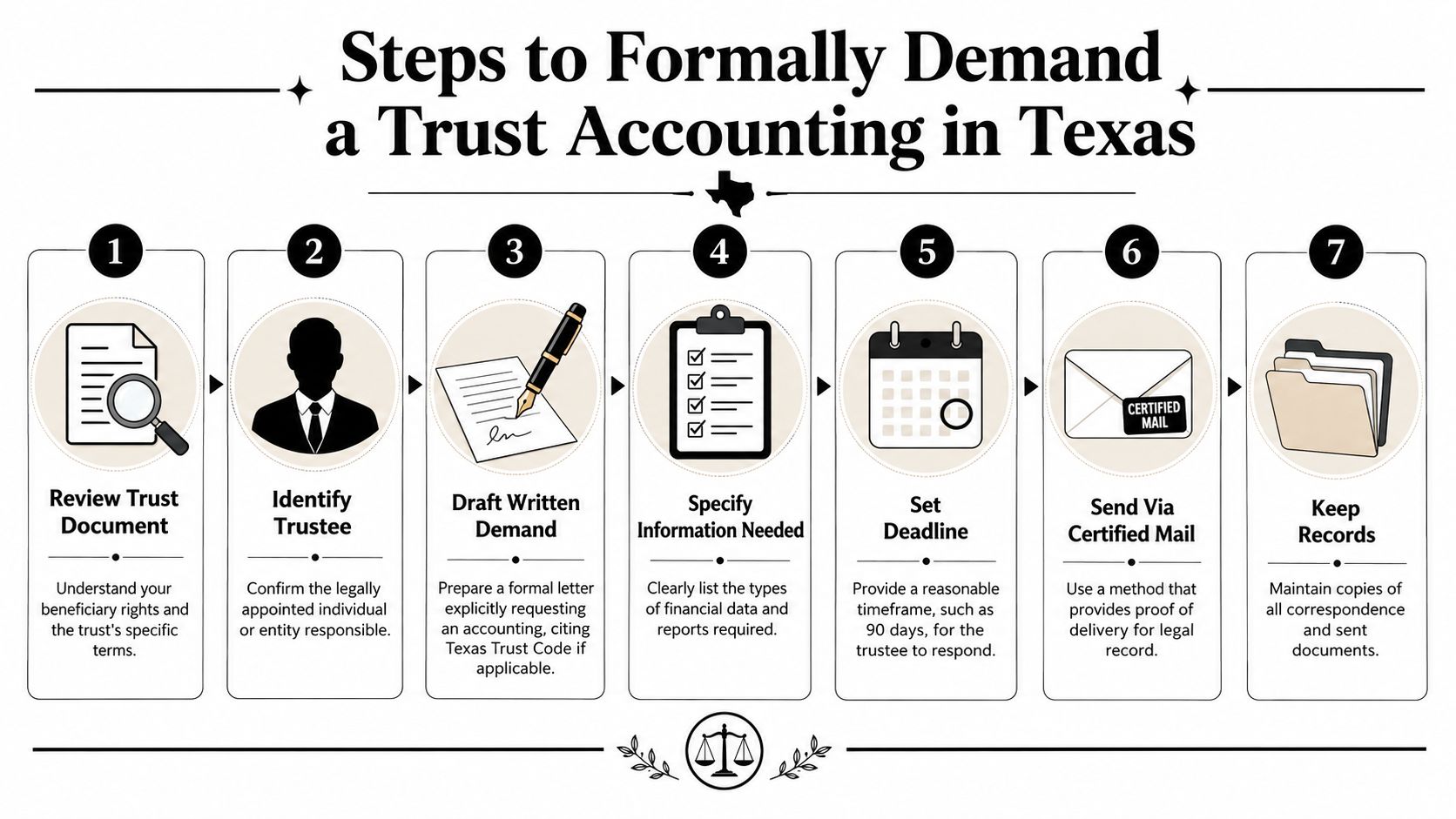
The basic steps that work
Confirm the trustee's identity. Make sure you're writing to the legally serving trustee, not just the family member who has been communicating the most.
Review the trust if you have it. Some trusts contain notice provisions, administrative language, or beneficiary definitions that matter.
State your status clearly. Identify yourself as an interested person or beneficiary and name the trust.
Ask for a formal written accounting. Use that phrase. Don't ask only for “information” or “an update.”
Send it in a trackable way. Certified mail is common because it creates proof of delivery.
Keep copies. Save the signed letter, mailing receipt, and any response.
For readers who want a practical model, this discussion of a demand for trust accounting in Texas is a useful companion resource.
Sample language you can adapt
Re: Demand for Formal Trust Accounting
I am an interested person and beneficiary of the trust known as [name of trust]. I request a formal written accounting of the trust's administration under Texas Property Code § 113.151. Please provide a complete accounting for the relevant period, including trust property received, receipts and disbursements, compensation, fees, distributions, property on hand, and other material matters, together with sufficient supporting records to evaluate the accounting.
Please send the accounting to me at the address below.
The letter doesn't need threats, accusations, or emotional language. In fact, those things usually make the process worse. Precision works better than outrage.
The timing issue most people miss
Many articles explain the demand process but miss the strategic question of when to make the demand. That can be a serious mistake.
While guides explain how to demand an accounting, they often miss a key strategic risk: a trustee's delivery of a compliant report triggers a 12-month bar on future demands. An improperly timed request can prevent a beneficiary from getting updated information for a full year, a critical nuance for strategic planning.
That means a rushed demand can backfire. If the trustee sends a technically compliant accounting at a moment that's not especially useful to you, you may be locked out of another demand for a year. In practice, timing matters when:
- An asset sale is about to close. You may want records after the sale, not before.
- Tax filings or major distributions are pending. A later accounting may reveal more.
- You suspect a pattern, not a single transaction. Waiting can produce a fuller picture.
Legal judgment matters. The best time to demand an accounting isn't always the first moment you're frustrated.
A short video can also help frame the process:
What doesn't work
Some approaches usually waste time:
- Repeated verbal requests: They create confusion about what was asked and when.
- Broad accusations of theft: They harden positions before you have records.
- Accepting partial summaries: A spreadsheet without backup may not tell you much.
If your goal is to learn how to get an accounting of a trust in Texas, the most effective first move is often the simplest one. A well-timed written demand, delivered properly, with careful records of your own.
What a Proper Trust Accounting Should Include
A thick packet can still be a bad accounting.
What matters is whether you can trace the trust from one point in time to the next. A proper accounting should show what the trustee received, what the trustee spent, what the trustee paid to himself or others, what distributions went to beneficiaries, and what assets remain. If you cannot follow that trail, you do not have much to evaluate.
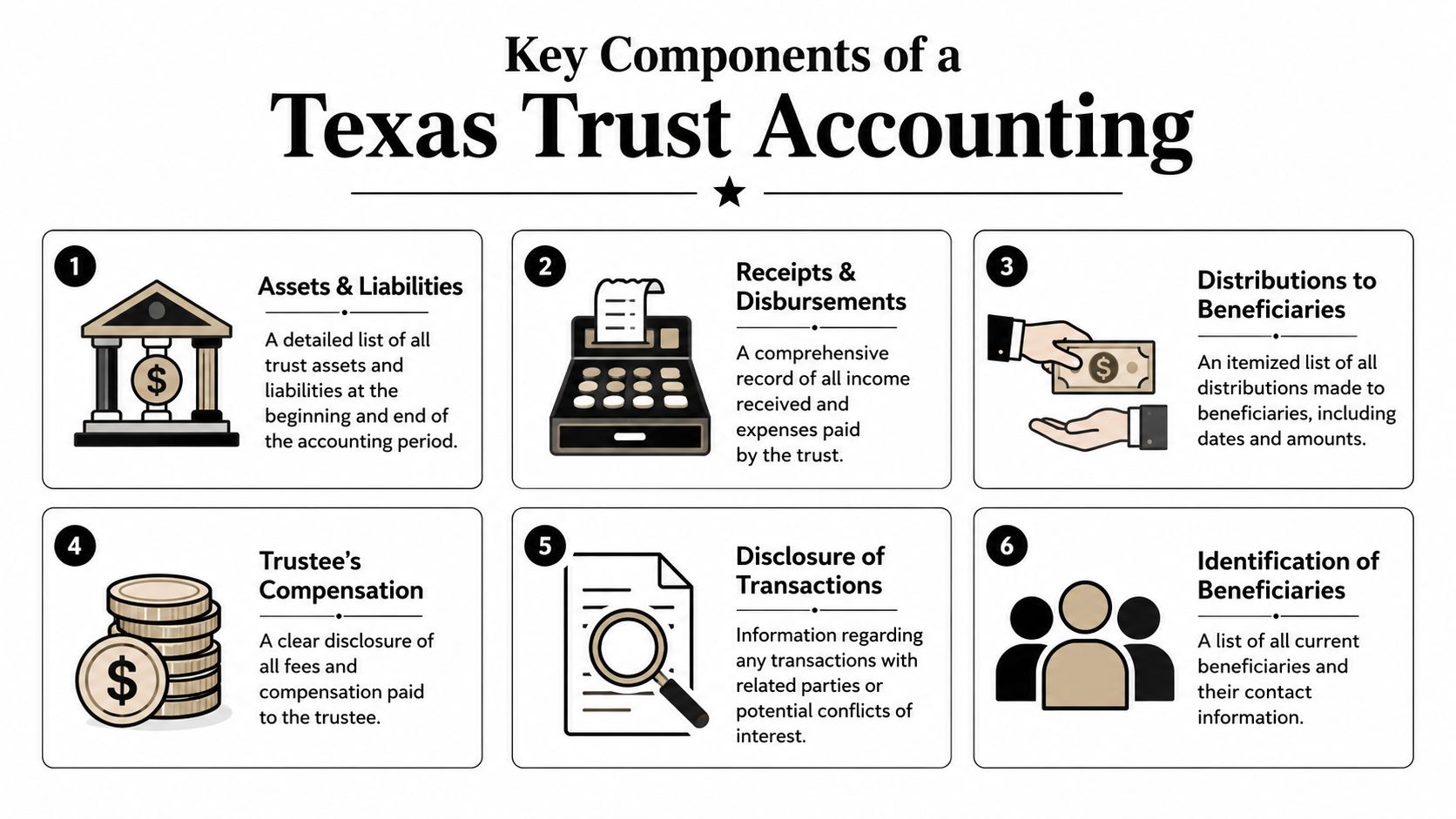
The required categories
Under Texas law, a trust accounting should cover the core categories that let a beneficiary test the trustee's work: property received, receipts, disbursements, trustee compensation, fees paid to agents, distributions to beneficiaries, property still on hand, and other material facts affecting the trust.
That list gives you a practical checklist. If a category is missing, or included only in vague summary form, press on that point. A trustee cannot cure a deficient accounting by sending more pages that still do not answer the question.
What those categories look like in real life
Beneficiaries often expect a clean report that reads like a bank statement. Trust accountings are rarely that neat, especially when the trust owns real estate, a closely held business, mineral interests, or investment accounts with frequent movement. Even so, the accounting should still be organized enough that an outside reader can verify it.
A useful accounting usually includes or ties back to documents such as bank statements, brokerage statements, invoices, tax returns, HUD statements or closing papers from sales, appraisals, and deposit records. The purpose is proof, not paper volume.
Here is a practical way to review what you received:
| Review area | What you should look for |
|---|---|
| Property received | A clear identification of each asset that came into the trust |
| Receipts and disbursements | Itemized transactions with dates, amounts, and enough detail to understand the purpose |
| Trustee compensation | Fees shown plainly, with dates or calculation method, not buried in general expenses |
| Agent fees | Payments to lawyers, accountants, property managers, or advisors listed separately |
| Distributions | Who received money or property, when, and in what amount |
| Property on hand | A readable ending list of what remains in the trust |
| Other material matters | Explanations for unusual transactions, losses, related-party dealings, or major changes in value |
Supporting documents matter
An accounting can be technically polished and still leave out the records that let you check it. That is a common problem. A trustee may provide a summary that looks formal but does not reconcile cash, does not identify where sale proceeds went, or does not connect line items to actual statements.
A helpful reference is an analysis from Trust but Verify, which discusses the kinds of ledger detail, reconciliations, and backup documents that make an accounting useful rather than cosmetic.
If entries cannot be matched to underlying records, the accounting may satisfy appearance more than substance.
I often tell beneficiaries to ask a simple question: could a neutral accountant, lawyer, or judge trace this money without guessing? If the answer is no, the gaps matter.
Red flags beneficiaries often miss
Some defects are easy to spot. Others are subtle.
Watch for round-number entries, unexplained transfers between accounts, missing beginning or ending balances, vague descriptions like "miscellaneous expense," and fee payments grouped into broad categories. Pay close attention to related-party transactions. If trust money went to a business owned by the trustee, a relative, or someone close to them, that deserves a closer look.
Timing also matters here. Because a beneficiary may have to wait before demanding another formal accounting, this is the stage to review carefully and decide whether the accounting you received gives you a real picture or only a partial snapshot. For more detail on reviewing records in a fiduciary accounting in Texas, legal analysis can be especially useful when the trust holds hard-to-value assets or years of transactions.
When a Trustee Refuses or Provides an Inadequate Accounting
You send a proper written demand, wait, and then receive silence, a stack of incomplete papers, or a vague summary that raises more questions than it answers. That is usually the point where beneficiaries start wondering whether the trustee is disorganized or hiding something.
The distinction matters, but the immediate problem is the same. You still do not have a usable accounting, and timing starts to matter in a very practical way. If a trustee gives you just enough paper to argue they complied, but not enough to show what really happened, you need to decide quickly whether to challenge that response. A weak accounting can still create delay, and delay can affect when you are able to force the next one.

Common trustee excuses and why they often fail
Trustees often say they are still gathering records, waiting on valuations, or too busy administering the trust to prepare a formal accounting. Sometimes that explanation is partly true. Real estate can take time to value. Business interests and mineral holdings are harder to summarize than a basic brokerage account.
Even so, inconvenience does not suspend fiduciary duties.
Another common response is more subtle. The trustee sends informal updates, selected bank statements, or a homemade summary and says that should be enough for a family member. It usually is not. A trustee does not get looser standards because the parties are siblings, because everyone has known each other for years, or because the trustee believes no one should be asking hard questions.
Court intervention is often what changes the case
If the trustee does not provide a proper accounting after a valid demand, a beneficiary can ask a Texas court to compel one. That usually means filing a petition and showing three things: you have standing as an interested person, you made the written demand required by the Trust Code, and the trustee did not comply within the required time.
That filing often changes the trustee's posture. Deadlines become real. Explanations have to be stated clearly. Records that were supposedly too hard to gather often appear once a court is involved.
For a practical look at what happens when a trustee refuses to provide an accounting in Texas, it helps to study the dispute pattern before deciding whether another letter will accomplish anything.
Fee exposure can put real pressure on a trustee
Beneficiaries often overlook one of the strongest pressure points. If the trustee failed to provide a proper accounting after the statutory deadline, the court may require the trustee to personally pay the beneficiary's attorney's fees and costs. That possibility changes the economics of the dispute.
See a Texas court can order the trustee to personally pay for a fuller discussion of that risk.
In practice, this matters because some trustees treat delay as harmless. It is not harmless once the trustee may have to pay out of pocket for forcing the beneficiary into court.
Inadequate accountings often point to a larger problem
A bad accounting is sometimes just bad bookkeeping. I have also seen it used as cover for conduct the trustee does not want examined closely.
Once records are pressed for and reviewed carefully, the actual dispute may turn out to involve self-dealing, excessive fees, undisclosed conflicts, missing distributions, or transactions that do not match the trust terms. At that point, the accounting issue is no longer just about getting information. It becomes the doorway to larger claims, including removal of the trustee, a surcharge for losses, or court instructions about how the trust should be administered.
That is why timing matters so much here. If you suspect a major sale, distribution, or transfer is coming, waiting too long can be a mistake. A strategically timed demand may give you a clearer snapshot of the trust's activity, while a poorly timed one can leave you dealing with an incomplete picture and a waiting period before you can force another formal accounting.
Your Next Steps and When to Hire a Trust Attorney
At this point, the path is usually clearer. You have a legal right to seek transparency. You need to use a written demand, not informal requests. You should think carefully about timing because a compliant response can affect your ability to demand another accounting later. And if the trustee refuses or stalls, court enforcement is available.
A simple action plan
If you're deciding what to do next, this sequence is usually sensible:
- Gather what you already have: Trust excerpts, prior emails, bank notices, distribution letters, and names of professionals involved.
- Decide whether the timing is right: If a major transaction is about to happen, you may want to time the demand strategically.
- Send a focused written demand: Keep it professional and track delivery.
- Review the response critically: Look for completeness, backup records, and unexplained entries.
- Escalate when necessary: If the trustee won't cooperate, the issue may move from administration into litigation.
When self-help stops being enough
Some beneficiaries can handle the demand letter stage on their own. Others should involve counsel earlier.
Consider calling a Texas trust administration lawyer when any of these are true:
- The trust holds real estate, a family business, mineral interests, or layered investment accounts.
- The trustee is hostile, evasive, or represented by counsel.
- The accounting you received is dense, confusing, or internally inconsistent.
- You suspect self-dealing or improper compensation.
- The matter overlaps with probate, a will contest, guardianship, or questions about capacity.
- The trustee has died, resigned, or been replaced, which can create a chain-of-records problem and raise issues like what happens when a trustee dies in Texas.
Families often discover that trust administration problems don't stay isolated. They spill into estate planning, probate, asset protection, and family conflict. A Texas estate planning attorney may be needed not just to force disclosure, but to coordinate the bigger picture if the trust terms themselves need attention or if related planning documents are inconsistent. In some situations, the dispute also raises questions about how to modify a trust in Texas, especially if changed family or financial circumstances are adding pressure.
For readers looking at broader planning or dispute options, that may include trust administration guidance, probate counsel, guardianship support, or asset protection planning. One factual option in that category is Law Office of Bryan Fagan, PLLC, which handles trust administration, estate planning, asset protection, and probate-related matters in Texas.
The main point is simple. If the trustee is transparent and organized, a formal accounting can bring clarity quickly. If the trustee is not, a lawyer can help you turn a vague problem into a precise legal claim.
If you're managing a trust or planning your estate, contact The Law Office of Bryan Fagan, PLLC for a free consultation. Our attorneys provide trusted, Texas-based guidance for every step of the process.