Managing a loved one's trust can feel overwhelming, but with the right legal guidance, it doesn't have to be.
A beneficiary usually reaches this point after the same pattern repeats for months. Calls go unanswered. Emails get a vague reply. The trustee says administration is still underway, but never explains what that means. Meanwhile, the distribution you were told to expect never arrives, and the trust starts to feel less like a plan and more like a locked box.
That frustration is real. It's also common in trust disputes. In many Texas cases, the problem isn't that the beneficiary has no rights. The problem is that the beneficiary hasn't yet built a record strong enough to force action. If you want to know how to force a trustee to distribute assets, the answer usually starts before a lawsuit is ever filed.
Texas law gives beneficiaries real tools. The Texas Trust Code and related fiduciary principles require trustees to follow the trust terms, act reasonably, and keep beneficiaries informed. The Texas Estates Code often overlaps with trust administration when probate, estate debts, guardianship concerns, or family disputes affect the timing of distribution. Used properly, those rules can move a case from excuses to enforceable orders.
Waiting for a Trust Distribution That Never Arrives
A familiar example looks like this. A parent dies. The family knows a revocable living trust became irrevocable at death. One child is serving as trustee. Another child is supposed to receive money or property once administration is complete. At first, the delay sounds understandable. There are bills to pay, paperwork to gather, and property to value.
Then the tone changes.
Weeks become months. The trustee says, “I'm working on it,” but never sends the trust document, never provides an accounting, and never gives a clear distribution timeline. If the trust owns a house, the trustee may keep saying the property issue has to be resolved first. If the trust holds cash, the trustee may still insist more time is needed without identifying any actual debt, tax matter, or dispute.
A delay is not automatically wrongful. An unexplained delay usually is.
Many beneficiaries make a costly mistake. They stay in the informal stage too long. They keep asking politely, hoping the trustee will finally do the right thing. Sometimes that works. Often it doesn't. A trustee who wants more control, more time, or an advantage will use the lack of a paper trail as cover.
Trust disputes also carry family pressure. Many beneficiaries hesitate because the trustee is a sibling, stepparent, or family friend. They don't want to escalate. That instinct is understandable, but it can backfire. The longer the delay continues without a formal record, the easier it becomes for the trustee to argue that administration was still “ongoing” and that no one made a clear demand.
The good news is that Texas law gives you a path forward. You can move from frustration to documentation, from documentation to legal advantage, and from that advantage to court intervention if needed.
Your Fundamental Rights as a Trust Beneficiary in Texas
Texas law gives beneficiaries more than the right to wait and hope. It gives enforceable rights that help you test whether a trustee's delay is legitimate or whether the trustee is stalling without a proper basis.
That distinction matters before suit is ever filed. A beneficiary with a dated record of requests for trust information, accountings, and explanations is in a much stronger position than a beneficiary who only has a string of unanswered calls and vague assurances.
Your right to information creates the paper trail you need
A trustee in Texas generally must provide the information a beneficiary reasonably needs to protect his or her interest. That usually starts with the trust document itself and, when appropriate, an accounting that shows assets, receipts, disbursements, liabilities, and distributions.
For a fuller discussion of those rights, see rights of trust beneficiaries in Texas.
This is not a technical point. It is how delay gets measured. If the trustee says administration is still ongoing, the records should show why. If the trustee claims debts, taxes, or liquidity problems justify waiting, the accounting and supporting documents should line up with that explanation.
In practice, I look for specifics. What assets are on hand? What debts remain unpaid? Has the trustee sold property, listed it for sale, or obtained valuations? Has money gone out to professionals or other beneficiaries? A trustee who is acting reasonably can usually answer those questions in writing.
A trustee owes duties that limit delay and discretion
A trustee is a fiduciary. The trustee must follow the trust terms, act in good faith, keep beneficiaries reasonably informed, and administer the trust with the care required by Texas law.
Discretion does not erase those duties.
Some trusts give the trustee broad authority over timing or amount of distributions. Beneficiaries often assume that means the trustee can delay forever. That is usually wrong. Broad discretion still has to be exercised in good faith, consistently with the trust's purposes, and for actual administrative reasons. A trustee cannot hide behind discretionary language to avoid explaining what is happening.
Beneficiaries often gain traction before litigation through this approach. Instead of arguing about bad motive at the start, they ask a simpler set of questions the trustee should be able to answer:
| Issue | What to document |
|---|---|
| Trustee says more time is needed | Ask for the specific reason, the documents supporting it, and the expected completion date |
| Trustee claims debts or taxes block distribution | Request the amount, status, and whether reserves have been calculated |
| Trustee says assets are illiquid | Ask what has been done to sell, transfer, or value the asset |
| Trustee refuses to give the trust or accounting | Preserve that refusal in writing because it often becomes a central issue |
Reasonable delay has facts behind it
Some delays are proper. A trustee may need to collect assets, pay taxes, resolve creditor issues, review the trust terms, or deal with a title problem on real property. Texas law does not require reckless, immediate distribution.
But a proper delay leaves tracks.
There should be correspondence, invoices, tax filings, listing agreements, appraisals, closing documents, or at least a clear written explanation tied to a real task. If months pass and the trustee still cannot identify what remains to be done, that is often the beginning of a strong beneficiary claim.
A trustee's silence also matters. Silence makes it harder for the trustee later to say there was a concrete reason for the delay all along. That is why beneficiaries should document every request for information and every incomplete response.
Start with the rights that are easiest to prove
Beneficiaries sometimes want to open with accusations of theft, self-dealing, or hostility. Sometimes those claims are true. Early in a case, though, the stronger move is often narrower and more disciplined.
Request the trust. Request the accounting. Request the written reason for the delay. Request the expected distribution timeline.
Those requests do two things at once. They give the trustee a fair chance to explain legitimate administration issues, and they build the record you will need if the trustee does not comply. That pre-lawsuit record often decides whether a court sees the dispute as a genuine administration problem or an unreasonable refusal to distribute.
The First Action Documenting Your Formal Demand
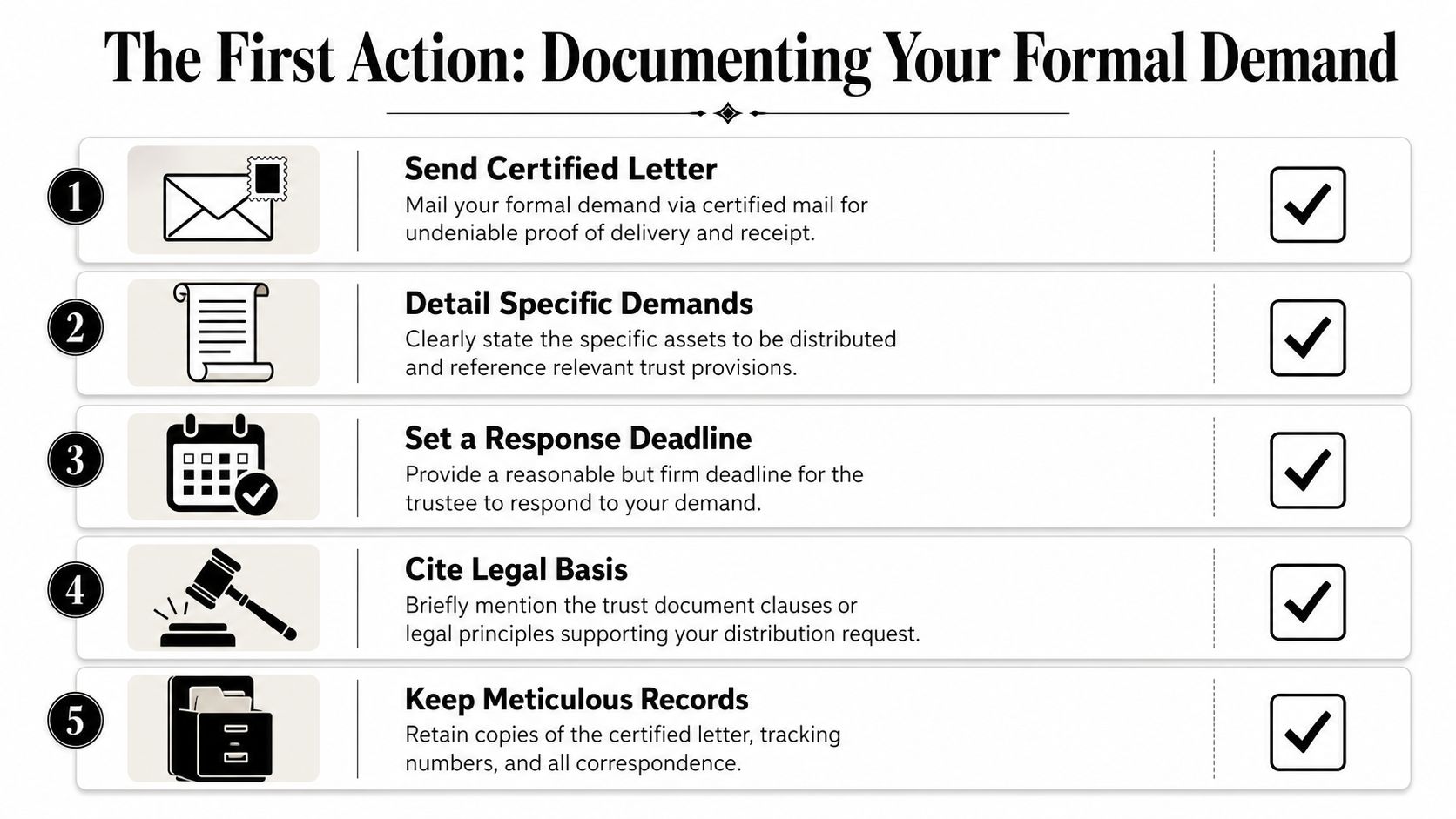
The first serious move is simple. Stop relying on phone calls and scattered texts. Send a formal written demand.
This is the step that changes the case. Informal requests are easy for a trustee to minimize. A formal demand creates a date, a clear request, a deadline, and proof that the trustee received it.
A practical visual can help you organize this step.
What the letter should include
Your demand letter doesn't need dramatic language. It needs precision.
Include these items:
- Your identity as a beneficiary. State your name and relationship to the trust.
- The trust's name. Identify the trust clearly so there's no confusion.
- Your request. Ask for the distribution, the accounting, or both.
- The trust basis. Refer to the trust language, if known, that supports the request.
- A deadline. State a firm response deadline.
Texas practitioners often treat a period of about nine months as a practical benchmark for reasonable administration after trust termination, absent real complications, and beneficiaries are advised to shift to a formal written demand with a specific deadline when informal efforts fail, as discussed in this article on failure to properly terminate a trust and distribute the assets.
If you need to demand records specifically, this guide on a demand for trust accounting in Texas is directly relevant.
Send it in a way you can prove
Mail matters. Send the demand in a form that creates proof of delivery. Keep a complete copy of what you sent, along with delivery confirmation and any response.
That record often becomes an exhibit later.
Trustees can explain a delay. It's much harder for them to explain silence after a documented demand.
Here's what usually works best in practice:
- Use one clean packet that includes the letter and any supporting pages.
- Stick to concrete requests instead of emotional grievances.
- Preserve every response from the trustee, even if it seems unhelpful.
- Create a running timeline with dates of calls, letters, emails, and deadlines.
What a strong demand actually does
A demand letter serves two jobs at once.
First, it gives the trustee one fair chance to comply without court involvement. That can save time, legal fees, and family strain.
Second, it builds your pre-suit record. If the trustee replies with vague statements, shifting explanations, or no documents, that response may help prove the delay is unreasonable.
Later, if you need to seek relief in court, the judge will want to know whether the trustee had notice of the request and whether the trustee had a fair opportunity to respond.
This video gives helpful background on the trust dispute process and why early documentation matters.
A short example of what works and what fails
Compare these two approaches:
| Approach | Likely result |
|---|---|
| “Can you let me know what's going on?” by text | Easy to ignore or reinterpret |
| Formal written demand for accounting and distribution with deadline | Creates evidence and forces a position |
The beneficiaries who make progress are usually the ones who stop asking generally and start asking specifically.
That's the heart of pre-litigation strategy in a trust case.
Escalating Your Claim When a Trustee Does Not Comply
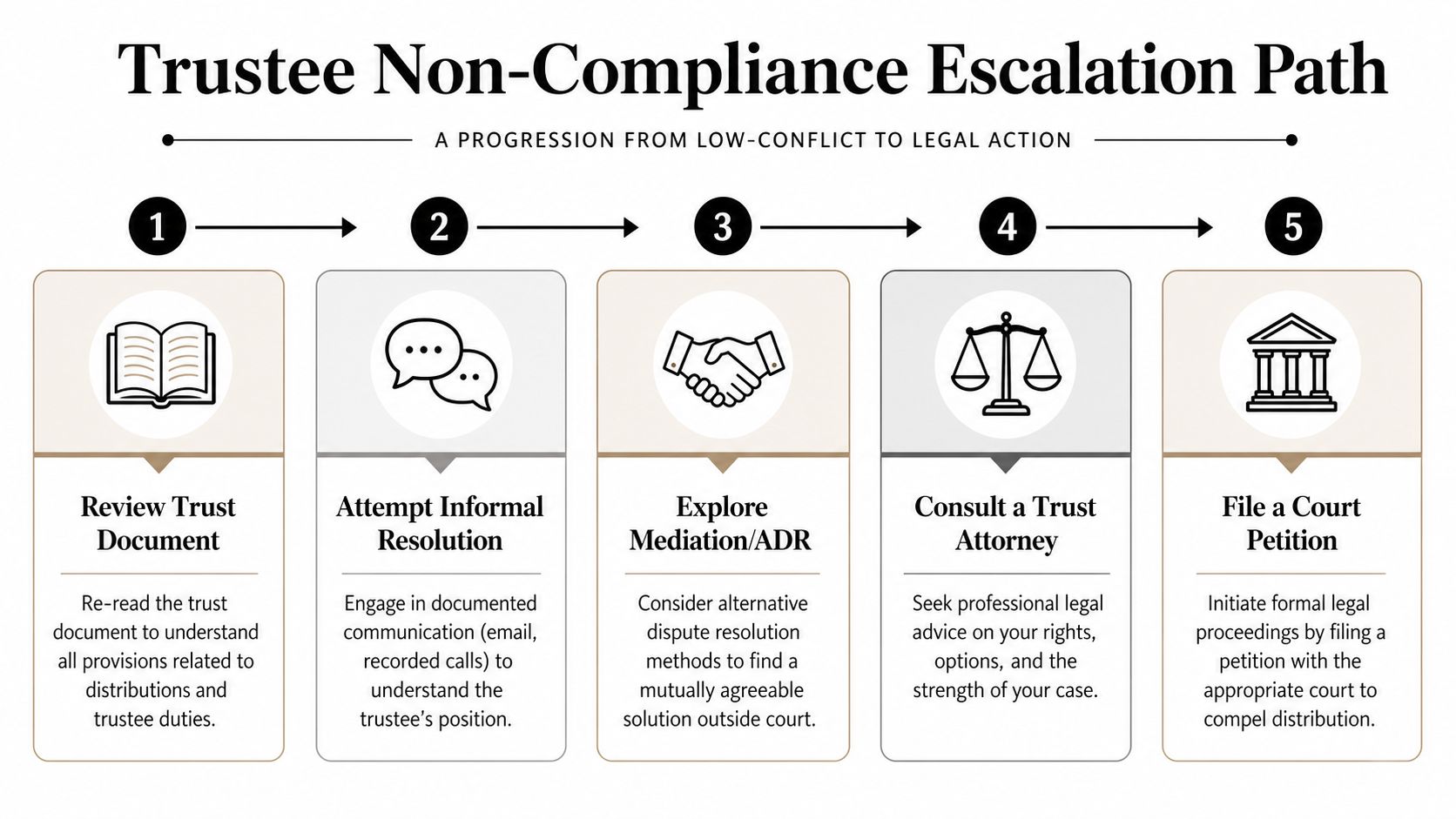
If the trustee ignores your demand or responds with evasive language, you have to decide whether to escalate. This stage is where many cases turn. The goal is not to “sue because you're upset.” The goal is to seek the right remedy for the right problem.
This process usually starts with a sober review of the trust document and the trustee's written position.
Start with lower-conflict options if they can produce records fast
Not every case should go straight to a courthouse. If the trustee is communicating, even poorly, a lawyer-led negotiation or formal mediation may resolve the problem faster.
That works best when the dispute is about timing, reserve amounts, or confusion over administrative tasks. It works poorly when the trustee won't disclose records or is using delay to gain an advantage.
A useful middle step is documented attorney communication. Once counsel gets involved, the trustee often realizes the case now has structure, deadlines, and consequences.
If the trustee's conduct may justify removal, this resource on a petition to remove trustee in Texas helps frame the issue.
The court can order specific relief
Texas courts have broad authority in trust disputes. Under Texas Property Code § 115.011, courts have broad authority to resolve trust disputes. They can issue orders compelling distribution, removing the trustee, and surcharging them for any losses caused by their breach of fiduciary duty, holding them personally liable, as summarized in this Texas trust administration discussion of trustee non-distribution.
That's important because many beneficiaries think “filing suit” means one vague lawsuit. In trust litigation, you usually ask for targeted remedies.
The main petitions beneficiaries use
Petition to compel an accounting
Use this when the trustee has not provided the financial information needed to evaluate the administration.
This petition is often the smart first filing because the accounting can expose whether the trustee's delay is real or pretextual. It may reveal liquid assets sitting untouched, unexplained expenses, distributions to others, or use of trust property that benefits the trustee.
Petition to compel distribution
This is the core tool when the trust terms create a non-discretionary duty and the trustee still refuses to release assets.
Texas trust practice recognizes a petition for a mandatory distribution order as the primary mechanism when the trustee is refusing a distribution required by the trust. Beneficiaries usually strengthen this petition when they can point to trust language that says the trustee “shall distribute” or to a triggering event that has already occurred, according to this trust distribution article from Winstead.
Petition to remove trustee and seek surcharge
This becomes appropriate when the problem isn't just delay, but misconduct. Examples include refusal to account, self-dealing, misuse of assets, favoritism, or continued noncompliance after formal demand.
If a trustee breached fiduciary duty by mismanaging assets or using them personally, Texas law can allow personal liability for resulting losses. In serious cases, the court can remove the trustee and appoint someone else to finish the job.
Court intervention is strongest when your evidence shows a pattern, not just frustration.
Distribution issues involving real estate or illiquid property
Cash disputes are often easier than property disputes. If the trust holds a house, ranch, or business interest, the trustee may claim a liquidity problem.
Texas law does give trustees room to distribute specific property in kind rather than liquidating everything. A trustee may make non-pro rata distributions in kind so long as no beneficiary receives less than the fair market value share they would have received under a pro-rata distribution, as discussed in this Texas materials collection on executor and trustee powers.
That means a beneficiary may be entitled to receive a specific asset in some situations, but the analysis is fact-sensitive. If the trust terms are silent and the asset is illiquid, courts often move carefully. A demand for immediate cash from an unsold illiquid asset is harder than a demand for liquid funds already in the trust.
A realistic view of discretion
Beneficiaries often hear, “The trustee has discretion, so there's nothing you can do.” That is usually too simplistic.
A trustee's discretion is not immunity. If the trustee acts arbitrarily, unreasonably, or in bad faith, courts can intervene. The strongest pre-suit cases are the ones where the beneficiary can show the trustee was asked for records, asked for a timeline, and still failed to justify the refusal with facts.
Building Your Case Evidence Timelines and Costs
A strong trust case is usually won before filing. By the time a judge sees the dispute, the beneficiary who has a clean paper trail, a dated timeline, and organized records is in a far better position than the beneficiary who only shows frustration.
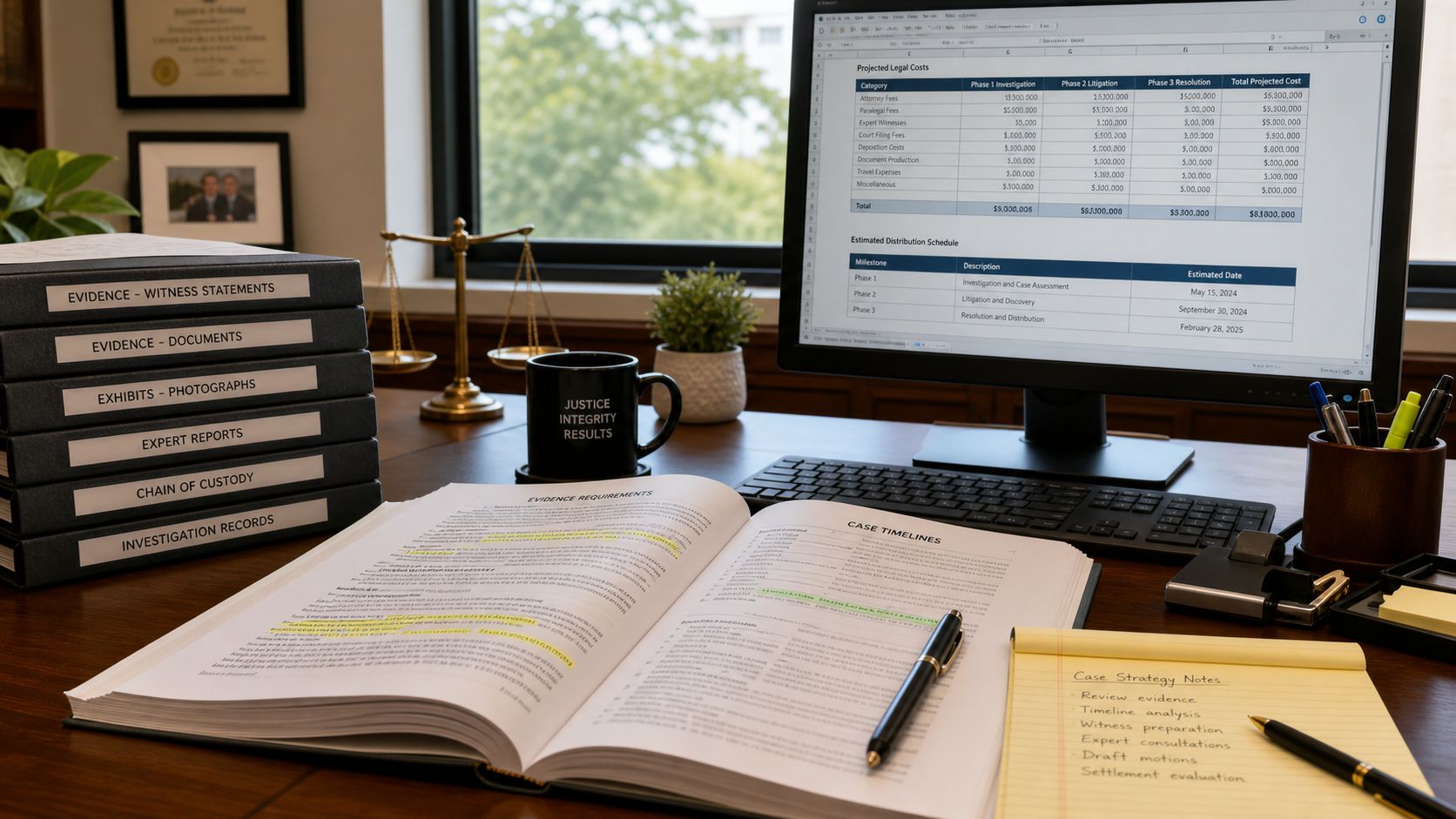
The question is rarely whether you asked for a distribution. The question is whether you can prove the trustee had enough information to act, had enough time to act, and still failed to give a reasonable explanation for the delay. That is how you undercut the defenses trustees raise most often. Pending administration, liquidity concerns, tax issues, and discretionary authority can all be legitimate in the right case. They are much less persuasive when the trustee ignored written requests, missed self-imposed deadlines, or gave explanations that changed from month to month.
What to collect before filing
The best evidence is usually ordinary business paper.
Gather and organize:
- The trust agreement and all amendments that control when and how distributions must be made.
- Your written demand and follow-up letters with certified mail receipts, email delivery confirmations, or other proof of receipt.
- Every trustee response including texts, emails, letters, and voicemail summaries.
- A dated chronology showing key events such as the settlor's death, asset sales, tax filings, requests for information, promised distribution dates, and unexplained periods of silence.
- Accountings, inventories, and statements that show what the trust owns, what has been paid out, and what remains undistributed.
- Documents that test the trustee's excuses such as closing documents if property was sold, brokerage statements showing cash on hand, or correspondence showing taxes were already resolved.
A timeline matters more than many beneficiaries realize. I often find that the turning point in a case is not a dramatic document. It is a simple chronology that shows six months of delay, then a new excuse, then another missed deadline, then no accounting.
How to document unreasonable delay
Courts usually look for facts, not labels. Saying the trustee acted in bad faith is less useful than showing exactly what happened and when.
Start with dates. When did the trust become distributable under its terms. When did you first request payment or an accounting. What did the trustee say was preventing distribution. Did that reason expire, change, or prove false. If the trustee claimed the house had to sell first, note the closing date. If the trustee claimed taxes had to be filed first, note when returns were completed. If the trustee claimed discretion, compare that position to the actual trust language and the trustee's past conduct with other beneficiaries.
This kind of record helps answer the defense before it is raised.
What courts and lawyers look at
Once suit is filed, the case usually turns on a few practical questions:
- Is the distribution mandatory or discretionary under the trust language?
- Has the trustee identified a real administrative reason for delay, or just repeated conclusions?
- Did the trustee communicate promptly and provide records when asked?
- Do the financial records support the trustee's explanation?
- Has the delay harmed the beneficiary or favored someone else?
A beneficiary does not need perfect evidence to start. But the case gets stronger when the documents show a pattern. Silence. Vague answers. Shifting explanations. Missing records. Those facts give the court something concrete to evaluate.
Timelines and costs
Trust litigation takes time. Even a focused case may involve pleadings, service, document requests, account review, hearings, and settlement efforts before a judge orders a distribution, accounting, or other relief. A contested matter involving real estate, valuation disputes, or multiple beneficiaries usually takes longer.
Costs need an honest review at the start. Filing fees are only the beginning. Cases may also require attorney time, accountant review, appraisals, deposition costs, and hearing preparation. Sometimes those expenses are justified because the trustee's conduct left no reasonable alternative. Sometimes a narrowly focused demand, backed by a strong record, gets results without paying for a full court fight.
That is the trade-off. Better pre-suit documentation often reduces later expense because it narrows the issues and makes weak defenses easier to challenge.
Why counsel changes the case
A seasoned Texas trust administration lawyer or Texas estate planning attorney does more than prepare a petition. Counsel can identify what evidence is still missing, frame the timeline around the trustee's duties, and avoid asking the court for relief the facts do not support. That matters because overreaching can damage credibility.
For some families, the dispute also overlaps with related issues involving probate, estate planning, or questions about how to modify a trust in Texas when the trust terms are contributing to repeated conflict. The Law Office of Bryan Fagan, PLLC handles trust administration, estate planning, and trust dispute matters in Texas, including issues involving fiduciary accounting and beneficiary communication.
Take Control of Your Inheritance with Trusted Guidance
A beneficiary in Texas is not powerless. If a trustee won't distribute assets, the path forward is usually clear even if it isn't easy. Know the trust terms. Demand the records you are entitled to see. Put your requests in writing. Set a deadline. Preserve every response. If the trustee still won't act, seek targeted court relief.
That sequence matters because it turns emotion into evidence.
The most effective cases usually aren't the loudest ones. They're the best documented. A trustee can defend a reasonable delay tied to real administration work. A trustee has a much harder time defending silence, missing accountings, evasive answers, or a refusal to carry out a required distribution after formal notice.
Families should also understand the human side of these disputes. Trust conflict often sits on top of grief, sibling tension, blended family concerns, prior caregiving resentment, or disputes about a home or business. Those emotions are real, but they shouldn't control the legal strategy. Calm documentation usually beats angry confrontation.
For trustees, the lesson is just as important. Fiduciary duties in Texas require communication, recordkeeping, fair administration, and reasonable decision-making. Trustees who stay organized and transparent are far less likely to face removal petitions, surcharge claims, or expensive litigation.
If you're a beneficiary, executor, trustee, or family member trying to sort through one of these problems, don't wait for the confusion to fix itself. Early guidance often prevents avoidable mistakes. It also helps you decide whether the trustee is dealing with a valid administrative issue or withholding what should already be distributed.
Whether the issue involves a trust distribution, probate administration, a guardianship-related concern, long-term estate planning, or asset protection, the key is to act with purpose and to document each step carefully.
If you're managing a trust or planning your estate, contact The Law Office of Bryan Fagan, PLLC for a free consultation. Our attorneys provide trusted, Texas-based guidance for every step of the process.