Skip to content
Managing a loved one's trust can feel overwhelming, especially when the person who should be helping manage it is making the process harder. You may be a beneficiary who senses something is off. You may be a co-trustee who keeps getting shut out, ignored, or pressured to approve decisions that don't seem right.
That kind of conflict is exhausting because trust disputes are rarely just about money. In many Texas families, they also involve grief, old resentments, sibling tension, and the fear that speaking up will make things worse. Still, staying silent can create bigger problems.
Texas law gives beneficiaries and co-trustees real tools to protect a trust when another trustee isn't doing the job properly. If you're researching suing a co-trustee in Texas: what you need to know, the good news is that there is a path forward. The key is understanding when a lawsuit makes sense, who can bring it, what proof matters, and what a court can do.
When Trust Breaks Down Between Co-Trustees
A trust works only when the people managing it act like fiduciaries. Under Texas law, a trustee owes duties of loyalty, care, good faith, and proper administration. If there are co-trustees, each person is supposed to help protect the trust and the beneficiaries, not turn the role into a power struggle.
Problems often start subtly. One trustee stops sharing records. Another starts making decisions without real discussion. A family member uses trust property as if it were personal property. At first, it may look like a disagreement over style. Later, it becomes clear that the dispute is affecting distributions, investments, tax reporting, or basic communication.
Why these cases feel so personal
Trust fights often happen after a death, during a parent's incapacity, or in the middle of a larger estate dispute. That emotional pressure matters. A trustee may tell you that asking questions is disloyal or unnecessary. In reality, careful oversight is part of proper trust administration.
Practical rule: If a trustee's conduct is interfering with the trust's operation, your concern is not overreacting. It may be the beginning of a fiduciary dispute.
Texas trust law recognizes that not every disagreement justifies a lawsuit. Trustees can disagree in good faith. They can have different views about distributions, investments, or how quickly to sell property. But once misconduct, secrecy, self-interest, or operational deadlock starts harming the trust, the issue changes.
What readers usually get confused about
Many people assume they have to wait until money is gone before acting. That isn't always true. In some cases, delay itself is dangerous. A trust can be damaged by missed opportunities, unpaid taxes, broken records, or a complete standstill in decision-making.
Others assume only beneficiaries can sue. That also isn't always true. A co-trustee may have both the right and the duty to act when another trustee's conduct threatens the trust.
If you're in that position, the first step is not panic. It's clarity. You need to identify the legal problem, gather the right records, and decide whether the matter can be fixed through a demand, mediation, or court action.
Valid Reasons to Sue a Co-Trustee in Texas
Not every frustrating trustee is a legally removable trustee. Texas courts look for conduct that violates fiduciary duties or interferes with proper administration.

Common legal grounds
A lawsuit against a co-trustee often centers on breach of fiduciary duty. In plain English, that means the trustee failed to act the way Texas law requires. That could involve loyalty problems, carelessness, secrecy, or improper use of trust property. For a deeper discussion of these claims, see this guide on breach of fiduciary duty by a Texas trustee.
Here are some common examples:
- Self-dealing means the trustee uses trust assets for personal benefit. For example, a co-trustee arranges for the trust to sell property to a business they control.
- Failure to account means the trustee doesn't provide records or meaningful financial information when required.
- Misappropriation means trust money is taken, diverted, or spent for unauthorized purposes.
- Improper unilateral action means one co-trustee acts alone when the trust or Texas law requires joint or majority action.
- Hostility that harms administration means the conflict is no longer just personal tension. It is now blocking trust operations.
Hostility can become a legal issue
Texas courts have recognized that trustee hostility can justify removal in the right case. In Ramirez v. Rodriguez, a Texas appeals court affirmed that co-trustees can sue to remove another co-trustee under Texas Property Code § 113.082(a)(4) when hostility and friction actively impede the trust's administration. The court clarified that mere ill will is not enough, but documented hostility that compromises trust performance can support removal.
That distinction matters. A family trust may survive tense conversations and difficult personalities. It may not survive a trustee who refuses to cooperate, blocks decisions, or turns every administrative task into a fight.
How to think about valid claims
A helpful way to evaluate the problem is to ask three questions:
| Question | Why it matters |
|---|---|
| Is the trustee violating a duty? | Texas fiduciary law focuses on duties, not just bad behavior |
| Is the trust being harmed or stalled? | Courts look closely at practical impact |
| Can the problem be documented? | Proof often matters more than suspicion |
The strongest trust claims usually involve both conduct and consequences. A judge wants to know what the trustee did and how that conduct affected the trust.
If your co-trustee is making hidden transactions, refusing to share records, or creating a deadlock that stops administration, those facts may support a claim. If the issue is a difference of opinion handled openly and in good faith, litigation may be harder to justify.
Who Has the Right to File a Lawsuit
The legal term for the right to sue is standing. In trust disputes, the two most common groups with standing are beneficiaries and co-trustees.
Beneficiaries can enforce trustee duties
A beneficiary has a direct interest in the trust. If a trustee mismanages assets, withholds information, favors one beneficiary unfairly, or ignores the trust's terms, the beneficiary may ask a Texas court for relief. That can include an accounting, instructions to the trustee, damages, or removal.
Beneficiaries often worry that they need proof of theft before speaking with a lawyer. They usually don't. A pattern of missing information, unexplained decisions, or refusal to follow the trust may be enough to justify legal review.
Co-trustees may have both rights and obligations
A passive co-trustee cannot sit back and hope the problem goes away. Under Texas law, a co-trustee can avoid liability for another trustee's breach only if they exercised reasonable care to prevent it and acted to compel a remedy. As explained in this discussion of joint liability for co-trustees, proactive steps may include formal objections or demands for mediation, and inaction can lead to joint liability.
That point surprises many families. A co-trustee who says, “I disagreed, but I didn't want conflict,” may still face exposure if they failed to act.
What proactive action can look like
Reasonable care depends on the facts, but these steps are often important:
- Request records in writing so there is a clear paper trail.
- State objections clearly if you believe a proposed action violates the trust or fiduciary duties.
- Ask for correction if a breach has already happened.
- Propose mediation or counsel involvement when cooperation breaks down.
- Go to court if needed when the trust is at risk and informal efforts fail.
A co-trustee's silence can be treated as participation if that silence allows the breach to continue.
Watch the timing
Texas trust claims are also affected by limitations periods. The verified data states that the four-year statute of limitations runs from breach discovery under Texas law. That does not mean every case should wait. Delay can make documents harder to obtain and family narratives harder to untangle.
If you are a beneficiary, an executor, or a trustee trying to protect yourself, early legal advice often matters more than people expect. The issue may involve trust administration, probate, or even related guardianship concerns depending on the family's situation.
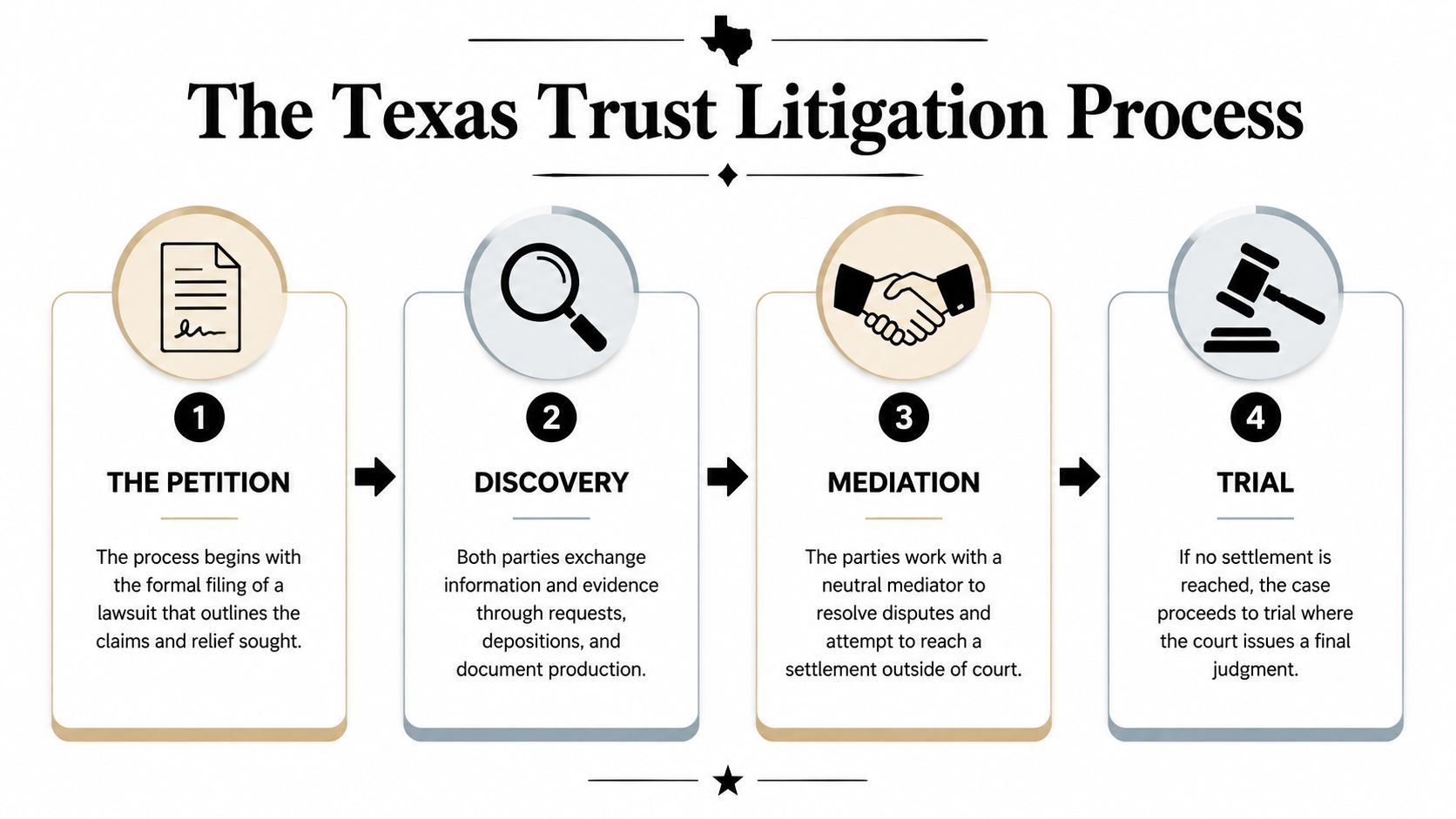
The Texas Trust Litigation Process Step-by-Step
Trust litigation feels less intimidating when you break it into stages. Most cases don't begin in a courtroom showdown. They start with records, strategy, and a decision about what result matters.
Step 1 begins before the lawsuit
Many disputes start with a formal letter. That letter may demand an accounting, object to a proposed transaction, request records, or ask the co-trustee to stop harmful conduct. Sometimes a carefully written demand resolves the matter. Sometimes it helps frame the issues for court.
Before filing, your lawyer will usually review:
- The trust document and any amendments
- Financial records already available
- Emails or texts showing requests, refusals, or admissions
- Property records if trust real estate is involved
- Related probate filings if the trust dispute overlaps with an estate matter
For broader context on these cases, this resource on Texas trust dispute resolution and litigation is a useful reference.
A short video can also help clarify the process in plain language.
Step 2 is filing the petition
The lawsuit formally begins when the plaintiff files a petition in the appropriate Texas court. The petition identifies the parties, explains the trust relationship, states what the defendant did wrong, and asks for remedies.
This part is more than paperwork. The claims you include shape the entire case. If removal is the goal, the facts should support removal. If the focus is repayment or an accounting, that needs to be framed carefully from the start.
Step 3 is discovery
Discovery is the evidence-gathering phase. Both sides request documents, submit written questions, and take depositions. In trust cases, discovery often reveals whether the problem is poor judgment, poor recordkeeping, or something more serious.
Common discovery targets include:
| Evidence source | What it may show |
|---|---|
| Bank and brokerage records | Transfers, withdrawals, investment activity |
| Trustee communications | Intent, concealment, or conflict |
| Tax returns and accounting records | Reporting problems or unexplained discrepancies |
| Meeting notes and approvals | Whether proper consent happened |
Step 4 is mediation or trial
Texas courts often encourage mediation before trial. That can be useful in family disputes because it allows a structured negotiation without putting every grievance into public testimony. A mediated result might include resignation, a neutral successor trustee, accounting terms, or revised procedures for future administration.
If the case doesn't settle, it goes to trial. The judge then decides whether the trustee breached duties and what remedy is appropriate. Some cases also involve temporary requests before trial, such as emergency orders to freeze transactions or preserve records.
Gathering Evidence and Proving Your Case
Trust cases rise or fall on evidence. Strong feelings are understandable, but judges decide these disputes based on documents, testimony, and a clear record of what happened.

Start with the paper trail
In many cases, the most important documents are not dramatic. They are routine records that should have been maintained all along.
Useful evidence often includes:
- Trust account statements showing transfers and balances
- Emails and text messages reflecting requests, refusals, or inconsistent explanations
- Distribution records showing who received what and when
- Real estate records if trust property was sold, leased, or transferred
- Prior accountings and tax information
- Written objections from a concerned co-trustee
If the records are extensive, organizing them matters. Some lawyers and litigation support teams use tools such as software for legal professionals to compare drafts, track edits, and spot meaningful differences across accountings, trustee reports, and trust amendments.
An accounting can be a turning point
A formal accounting often becomes one of the most important requests in a trust dispute. It can force the trustee to explain transactions, identify assets, and provide a clearer picture of administration. If you need that kind of relief, this guide to a petition for accounting in a Texas trust case explains how that request fits into litigation.
A trustee's failure to provide a proper accounting can also shape how the court views the case. Missing records do not automatically prove wrongdoing, but they often increase scrutiny.
Keep every written request you've made for records or explanations. In trust litigation, a calm email sent months earlier can become a powerful exhibit.
Burden-shifting can change the case
Texas trust litigation gives plaintiffs an important strategic tool. According to this explanation of suing a trustee in Texas, once a beneficiary or co-trustee presents credible evidence suggesting improper conduct, the burden shifts to the accused trustee to prove the actions were fair and permissible.
That matters in real life. Trustees usually control the records. They know where the money moved and why decisions were made. Burden-shifting helps prevent a secretive or uncooperative trustee from benefiting because they hold the information.
What counts as credible evidence
Credible evidence may include documents, testimony, suspicious transaction patterns, or inconsistent explanations. It does not have to look like a movie scene with a single smoking gun.
Think in terms of patterns:
- unexplained withdrawals
- one-sided decision-making
- refusal to share records
- conflicting financial statements
- transfers that benefit the trustee personally
When those facts line up, the trustee may have to justify the conduct in detail.
Potential Remedies and Outcomes of a Lawsuit
People often ask the same practical question. If I sue, what can the court do? The answer depends on the misconduct, the harm to the trust, and the proof available.

Removal is only one possible remedy
Removing the co-trustee may be the main goal, but it is not the only option. Texas courts can tailor remedies to the problem. Depending on the case, the court may order the trustee to provide an accounting, repay losses, stop certain conduct, undo an improper transaction, or step aside so another fiduciary can serve.
Some remedies focus on correcting administration. Others focus on compensation.
Here is a simple breakdown:
| Remedy | What it means in practice |
|---|---|
| Removal | The trustee is taken out of the role |
| Damages or surcharge | The trustee may have to personally repay losses |
| Accounting | The trustee must formally disclose financial activity |
| Injunctive relief | The court orders the trustee to stop or avoid certain acts |
| Receiver or replacement fiduciary | Another person is appointed to protect administration |
What the available data suggests
A verified 2024 analysis of Texas fiduciary cases found that 62% of claims against co-trustees resulted in removal or damages, with average awards around $450,000, and trustee removal had a 51% success rate when pursued, according to this Texas breach of trust analysis. Those figures show that litigation can produce meaningful results, but they also show why preparation matters.
A weak case may still be expensive and disruptive. A well-documented case carries more weight in negotiation and in court.
Good trust litigation is not just about proving someone behaved badly. It is about tying that conduct to a remedy a judge can actually order.
What outcome makes sense for your family
Not every case should aim for the maximum conflict. In one family, the right result may be a clean trustee resignation and appointment of a neutral replacement. In another, the primary issue is recovering money and rebuilding records. In a high-asset trust, the dispute may overlap with tax planning, asset protection, or business succession concerns.
That is why legal strategy should match the actual problem. If your co-trustee is careless but cooperative, a structured settlement may work. If the co-trustee is hiding transactions or refusing every request for transparency, stronger remedies may be necessary.
Litigation can also protect the future
A lawsuit is not only about fixing past misconduct. It can also prevent further damage. That is especially important when the trust will continue for years, support a surviving spouse, provide for a child with special needs, or hold business interests that require competent management.
In that setting, prompt action may preserve both assets and family stability.
Considering Alternatives and Finding the Right Attorney
You may be staring at two problems at once. The trust needs protection, and the family relationship may already be fraying.
A lawsuit is one tool, not the only tool. In some Texas co-trustee disputes, mediation, a formal demand letter, or a negotiated resignation can solve the immediate problem with less cost and less strain on the people involved. That approach tends to work best when both co-trustees are still sharing records, responding to questions, and arguing about judgment rather than hiding conduct.
Trust litigation works a lot like calling in a referee after repeated fouls. If the other co-trustee is withholding account statements, making transfers without authority, or refusing to explain decisions, private discussions may no longer protect the trust. In that setting, preparing to sue can change the conversation because it shows you are ready to ask a court for orders, deadlines, and consequences.
What to look for in counsel
The right lawyer should be able to do two things at the same time. First, explain the Texas Trust Code in plain English. Second, turn that law into a practical plan with steps, timing, and likely costs.
Trust disputes are different from ordinary business lawsuits. The court may need to interpret trust language, review accountings, examine fiduciary duties, and sort through family history that has been building for years. Some cases also overlap with probate, estate planning, guardianship, tax questions, or control of a family business.
When you compare attorneys, ask practical questions like these:
- How often do they handle Texas trust litigation
- How do they analyze a trustee's fiduciary duties under Texas law
- Can they press for records, accountings, temporary relief, and final court remedies
- Are they comfortable negotiating a settlement if that protects the trust
- Do they also advise families on the estate and trust structure that may need repair after the dispute
That last point matters more than many families expect. A co-trustee fight often exposes an underlying design problem. The trust may have unclear tie-breaking authority, weak succession language, or no useful process for sharing information. Resolving the lawsuit is one job. Reducing the chance of the next dispute is another.
Firms like the Law Office of Bryan Fagan, PLLC advise Texas families and fiduciaries on trust administration, trust disputes, probate, guardianship, estate planning, and asset protection matters.
Look for a lawyer who provides a calm assessment. You want someone who can explain, in order, whether the next step should be a records demand, mediation, an application for court relief, or full litigation. That kind of guidance lowers anxiety because it turns a family crisis into a sequence of decisions you can make.