Managing a loved one's trust can feel overwhelming, especially when the person in charge won't answer questions, the numbers don't add up, or promised distributions keep getting delayed. Many beneficiaries in Texas reach the same uneasy point. They don't know whether they're seeing ordinary delay, poor recordkeeping, or outright theft.
That uncertainty is real. So is the anger that comes with it.
If you suspect trustee stealing from beneficiaries in Texas, you are not powerless. Texas law gives beneficiaries tools to demand information, force an accounting, seek removal of the trustee, and pursue recovery of trust property. In serious cases, the conduct may also cross into criminal territory. The key is acting carefully, preserving evidence, and not waiting so long that a deadline closes your case.
Protecting Your Inheritance from a Dishonest Trustee
A common situation often has an inconspicuous start. A parent dies. A sibling, family friend, or professional trustee takes control of the trust. At first, the delays sound harmless. There's a tax issue. A bank transfer is pending. Records are being organized. Then months pass. Statements stop coming. Questions get brushed aside. The trust's value seems lower, but no one gives a straight answer.
That pattern often leaves beneficiaries second-guessing themselves. They don't want to accuse someone unfairly. They also don't want to ignore a problem until the money is gone.
Texas trust law doesn't expect beneficiaries to sit still while a trustee hides the ball. A trustee owes fiduciary duties in Texas, including loyalty, prudent administration, and fair treatment of beneficiaries. In plain English, that means the trustee must manage trust property for the beneficiaries' benefit, not for personal convenience or personal gain.
When that duty breaks down, the law provides practical remedies. A beneficiary may be able to demand records, require a full accounting, ask the court to remove the trustee, and recover money or property taken from the trust. In some disputes, families can resolve the problem through disclosure and correction. In others, a fast court filing is the only move that protects what remains.
A beneficiary's first job isn't proving every detail on day one. It's recognizing that secrecy, evasiveness, and missing records are legal warning signs, not just family drama.
A calm plan is essential. Not every trustee who makes mistakes is stealing. But theft and self-dealing often hide behind vague explanations, incomplete accountings, and emotional pressure to “just trust me.” A sound response focuses on documents, deadlines, and the trust's actual terms.
Families dealing with trustee stealing from beneficiaries in Texas usually need two things at once. They need clear legal analysis, and they need reassurance that there is still a path forward.
Identifying the Red Flags of Trustee Misconduct
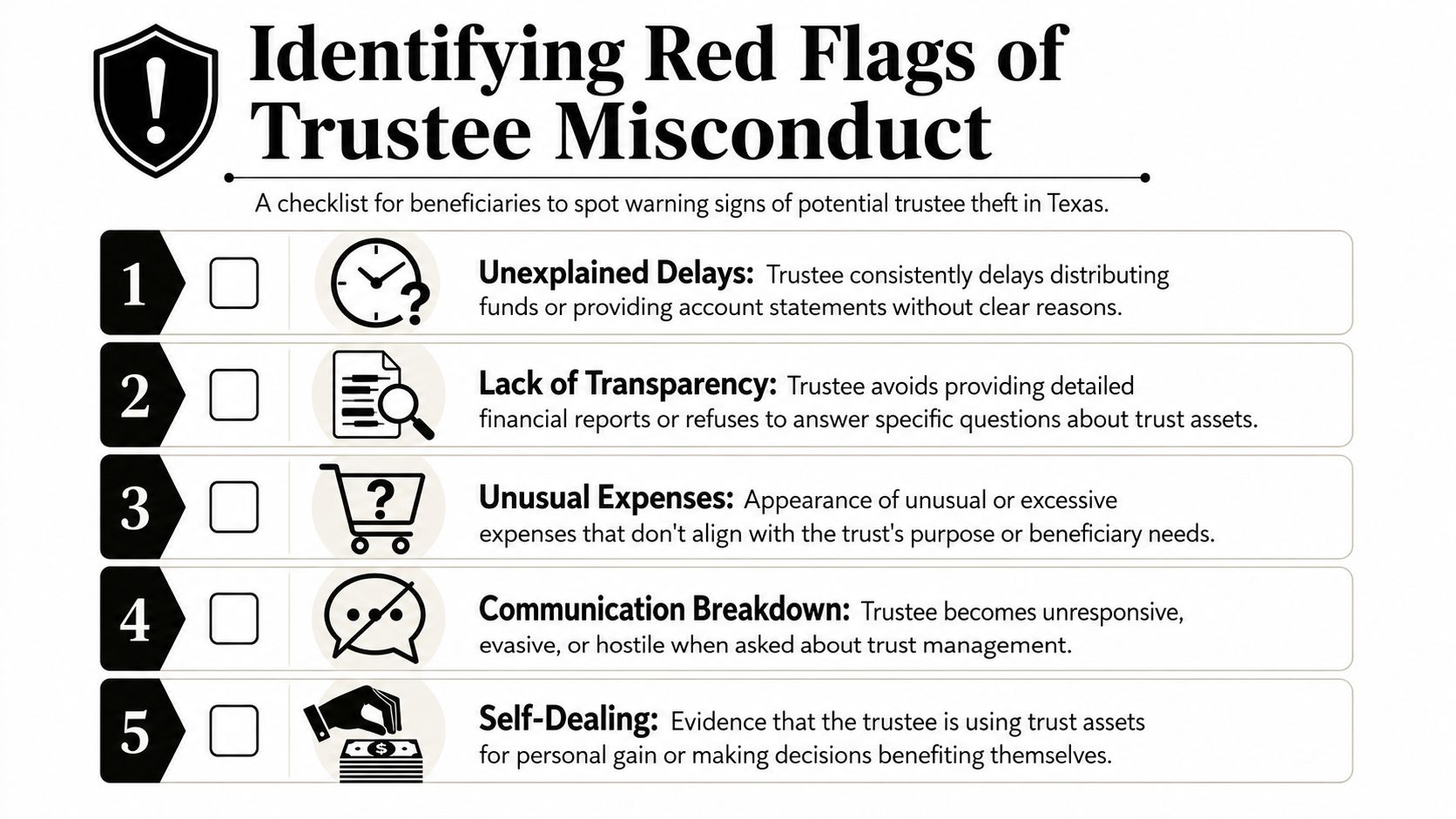
Suspicion alone won't win a case, but specific warning signs often point to a breach of trust. Beneficiaries usually notice problems in patterns, not dramatic confessions. One missing statement may be an oversight. A long string of missing statements, evasive answers, and unexplained spending is different.
Silence and delay usually mean something
A trustee who repeatedly delays distributions or avoids giving basic financial information creates a serious problem. Beneficiaries are entitled to understand how trust property is being managed. When calls go unanswered and written questions get ignored, the issue isn't just bad manners. It may be a breach of the duty to keep beneficiaries reasonably informed.
Consider a simple example. A beneficiary asks for an explanation about a drop in trust account value. The trustee responds with broad comments about “market conditions” but won't provide statements, invoices, or a transaction history. That kind of vagueness often keeps beneficiaries from spotting unauthorized withdrawals or transfers.
Vague records and confusing accountings
Some trustees don't refuse disclosure outright. Instead, they provide documents that say almost nothing. Expenses are lumped together. Transfers are described as “administrative.” Supporting records are missing.
That matters because trustees are supposed to maintain clear records. If a trustee mixes trust assets with personal funds, that violates the duty of segregation under Texas Property Code §117.010, and beneficiaries can demand an immediate full accounting under Texas Estates Code §404.001 as explained at Texas Probate Attorney on breach of trust in Texas. The same discussion also explains the broader discovery rule for trust claims in Texas.
A short checklist can help you evaluate what you're seeing:
- Repeated excuses: The trustee always has a reason the records aren't ready.
- Incomplete statements: Pages are missing, categories are vague, or backup records never appear.
- Unclear transfers: Money leaves the trust with no obvious trust purpose.
- Defensive behavior: Ordinary questions trigger anger or accusations.
- Personal benefit: The trustee appears to be living better while the trust appears to be shrinking.
Self-dealing and favoritism
A trustee can't treat trust property like a personal reserve fund. If the trustee uses trust money for a personal business, pays personal expenses from trust accounts, or directs trust opportunities to themselves, that can violate the duty of loyalty. Favoring one beneficiary without support in the trust terms can also raise a duty-of-impartiality issue.
The resource on The Fiduciary Duties of a Texas Trustee gives a useful plain-English overview of the core duties of loyalty, prudence, and impartiality under the Trust Code.
A real-world example helps. Suppose a trustee says the trust had to “loan” money to a company the trustee owns. The beneficiaries never approved it. The trust document doesn't authorize it. Payments aren't documented. That isn't creative management. It's a conflict of interest with real litigation consequences.
Practical rule: If you can't tell where the trust money went, a judge may want to know too.
A quick red-flag comparison
| Situation | Why it matters |
|---|---|
| Trustee won't provide statements | Possible failure to inform and account |
| Trust money appears mixed with personal funds | Possible commingling and tracing problem |
| Unusual expenses appear without backup | Possible self-dealing or misuse |
| One beneficiary gets favored treatment | Possible breach of impartiality |
| Trustee becomes hostile when asked basic questions | Often a warning sign that transparency is missing |
Your First Steps Preserving Evidence and Demanding Answers
The first days after suspicion matter more than is often understood. Beneficiaries often make one of two mistakes. They either confront the trustee emotionally and alert them to clean up records, or they wait and hope the issue resolves itself.
A better approach is disciplined and documented.
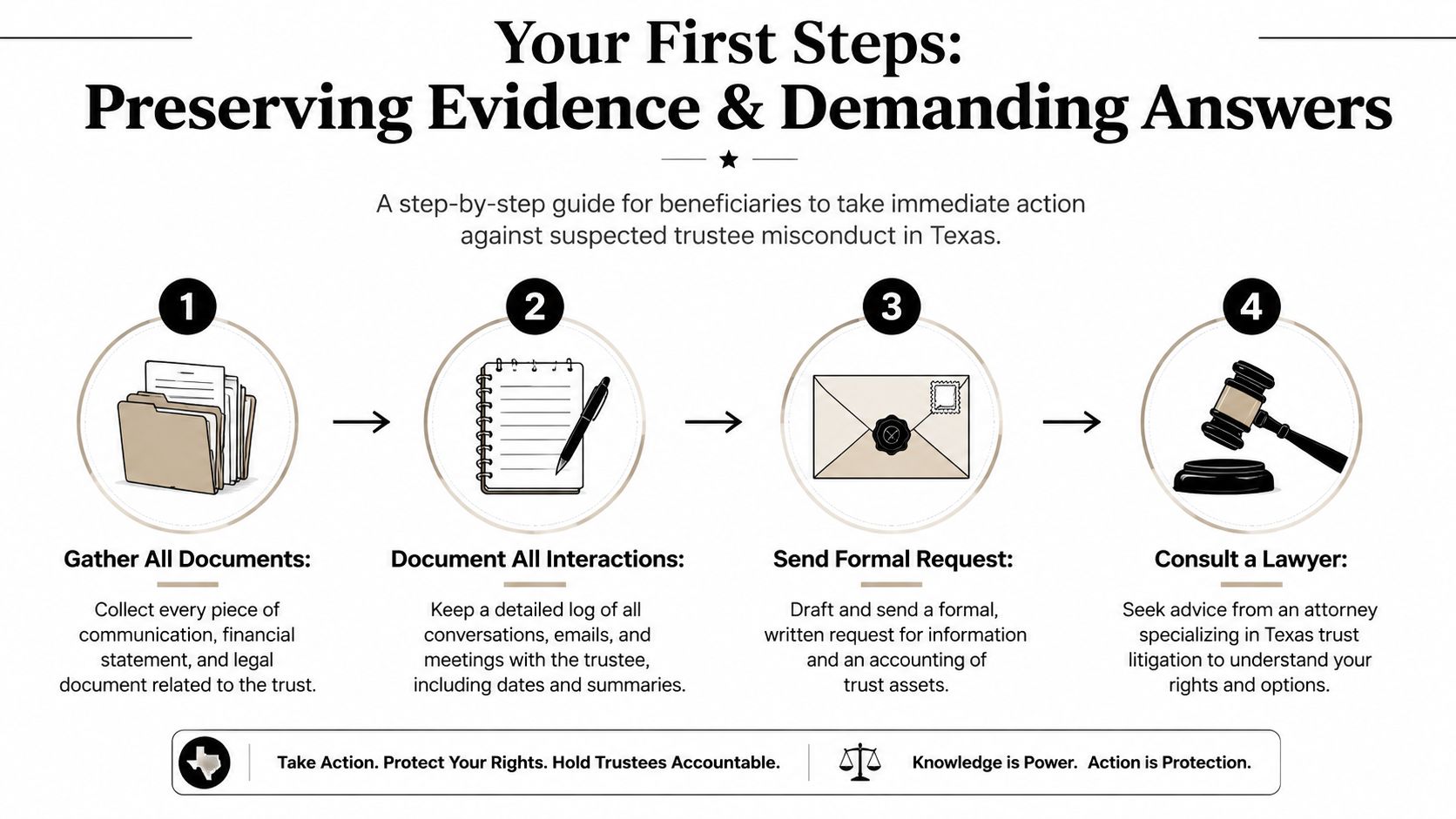
Start with preservation, not accusation
Gather every trust-related document you already have. That includes trust summaries, prior account statements, distribution notices, emails, text messages, letters, tax forms, and notes from calls or meetings. Save them in the form you received them. Don't edit screenshots, combine files, or rewrite old notes in a way that changes dates or wording.
Create a simple chronology. List what you asked for, when you asked, what the trustee said, and what still hasn't been produced. That timeline helps your lawyer identify patterns and can later support court filings.
This is also a good time to review guidance on how to track missing trust money in Texas, especially if the problem appears to involve unexplained withdrawals or missing assets.
Use a formal written demand
Phone calls are easy to deny. Casual emails often drift into side arguments. A formal written demand creates a clean record and puts the trustee on notice that beneficiaries are requesting information in a legally meaningful way.
Under Texas law, recovery efforts commonly begin with a formal written demand for a full accounting under Texas Estates Code § 404.001, followed by a Petition for Removal under Texas Property Code § 113.082 if the trustee refuses transparency, as described by Texas Probate Lawyer on recovering assets from a stealing fiduciary.
Your written demand should usually include:
- Identification of the trust and your status as a beneficiary.
- A request for a full accounting and supporting records.
- A deadline for response that is reasonable and clear.
- Specific categories of documents you want produced, such as bank statements, brokerage records, ledgers, and receipts.
- A written preservation request telling the trustee not to destroy or alter records.
Later in the process, a forensic accountant may become important. Bank statements, accounting summaries, and transaction trails often matter more than personal suspicion.
The video below gives additional context on handling trust disputes and administration issues in Texas.
What works and what usually doesn't
Some approaches move a case forward. Others create delay.
What works
- Documented requests: Written demands with specific categories of records.
- Organized files: A clean record of statements, emails, and timelines.
- Early legal review: An experienced Texas trust administration lawyer can spot removal issues, accounting issues, and tracing issues quickly.
- Focused questions: Asking for exact records instead of broad accusations.
What usually doesn't
- Family group-text fights: They create heat, not evidence.
- Threats without action: An evasive trustee rarely becomes more cooperative because of emotional pressure.
- Waiting for “certainty”: By the time certainty arrives, assets may be harder to trace.
- Accepting partial answers: A vague spreadsheet is not the same as a true accounting.
Keep your communications measured. Judges tend to respond better to a beneficiary who asked for records clearly and repeatedly than to one who escalated first and documented later.
If you're comparing legal options, The Law Office of Bryan Fagan, PLLC handles Texas trust administration, fiduciary disputes, probate, guardianship, and related asset protection matters, which can be relevant when trust theft overlaps with estate administration or vulnerable-family-member concerns.
Civil Remedies to Recover Stolen Assets and Remove the Trustee
Once misconduct moves from suspicion to proof, Texas courts have several civil tools that matter in practical terms. These remedies aren't abstract legal labels. Each one targets a different part of the damage.
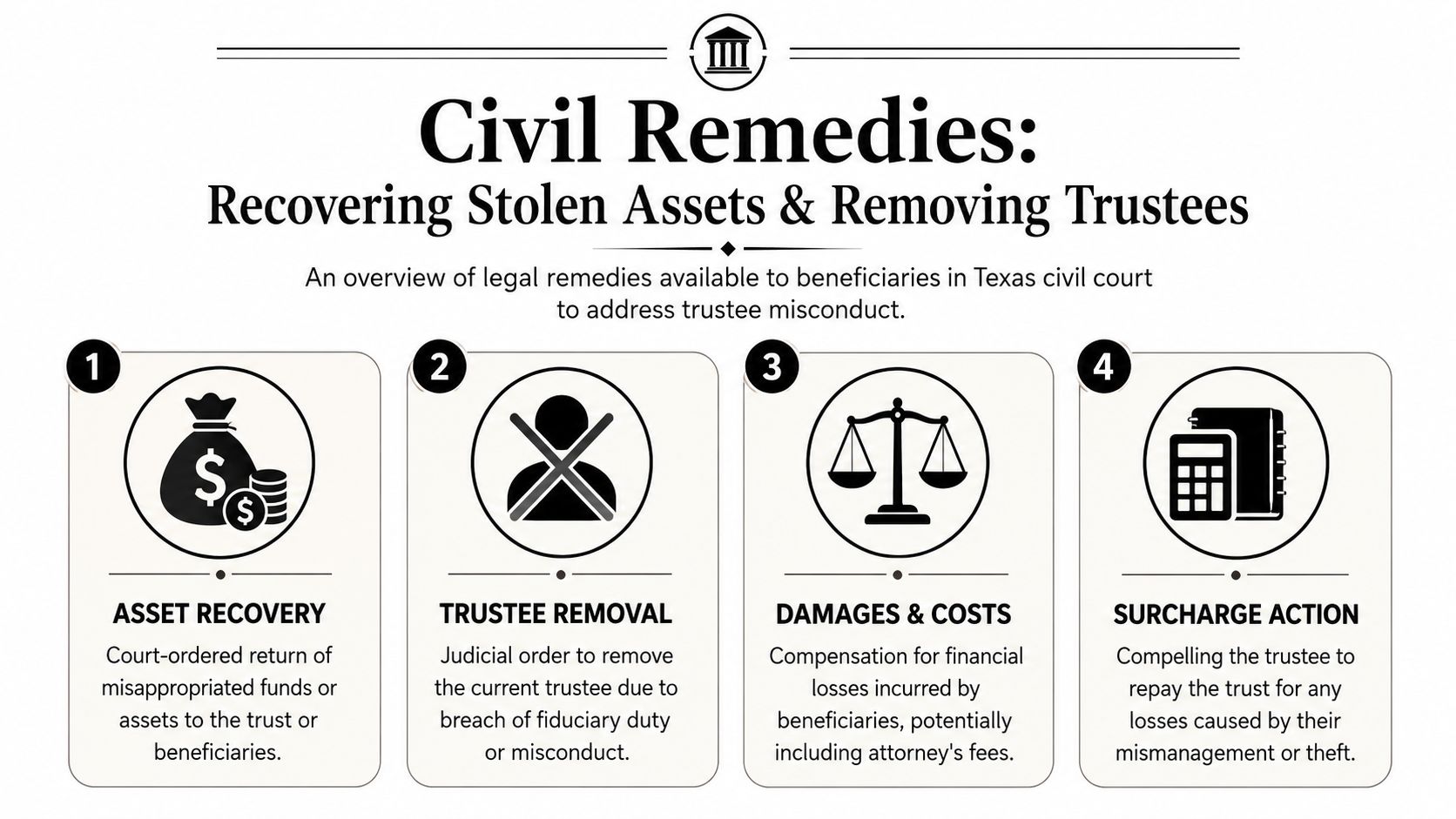
Surcharge puts the loss on the trustee personally
One of the strongest remedies is surcharge liability. When a Texas trustee is proven to have stolen trust assets, a court can require that trustee to personally compensate the trust for 100% of the lost value, and beneficiaries may seek immediate removal if the violation caused material financial loss under Texas Property Code § 113.082, as reflected in the Texas statutory discussion on trustee remedies.
That matters because some trustees wrongly assume they only need to “put back” whatever can still be found. Surcharge focuses on the trust's actual loss, not the trustee's convenience.
A useful example is the trustee who “borrows” trust money for a private business deal that collapses. Even if the money is gone, the court can still place the repayment obligation on the trustee personally.
Disgorgement and fee forfeiture strip away benefit
Texas courts can also order disgorgement, which means the trustee must give up profits obtained through administration of the trust. In appropriate cases, the court may also order fee forfeiture, stripping the trustee of compensation they earned while violating fiduciary duties. A beneficiary may also seek attorney's fees, and punitive damages may be available in cases involving fraud or malice, as discussed by Robbins Estate Law on breach of fiduciary duty in Texas.
This changes the settlement dynamic. A trustee who hoped to keep fees, side profits, or indirect financial advantages can lose those benefits entirely.
Removal protects what's left
Sometimes recovery isn't the only urgent goal. The bigger issue is stopping additional damage. In those cases, removal becomes the central remedy.
If you're evaluating that step, petition to remove a trustee in Texas is often the key procedural path. Removal matters when confidence is gone, records are missing, or the trustee's continued control puts trust assets at risk.
A short comparison helps:
| Remedy | What it does for the beneficiary |
|---|---|
| Surcharge | Forces personal repayment for trust losses |
| Disgorgement | Forces return of profits gained through misconduct |
| Fee forfeiture | Prevents the trustee from keeping compensation |
| Removal | Stops the trustee from causing further harm |
Receivers, freezes, and proof
In severe cases, a court may appoint a receiver to take control of trust assets and help facilitate recovery. That remedy is especially important when the trustee is uncooperative or there is a risk assets will be moved again.
Proof matters here. Cases supported by bank records, accounting trails, and forensic review tend to stand on firmer ground than cases built only on hunches. A practical problem in Texas litigation is waiting too long to seek temporary restraints or an asset freeze. If the trustee keeps moving money during the case, recovery can become harder, as noted by Will Probate Attorneys on breach of fiduciary duty by an executor or trustee in Texas.
The court can punish misconduct after the fact. It's better to stop the bleeding while the case is still unfolding.
What happens after removal
Families sometimes focus so heavily on removing the bad trustee that they forget the trust still needs administration. A successor trustee may need to collect records, secure accounts, re-title assets, and rebuild communication with beneficiaries.
That transition can be technical. It also overlaps with broader estate concerns, including coordination with a Texas estate planning attorney, probate obligations, and in some families, asset protection planning for what remains.
When Trustee Theft Becomes a Criminal Offense
Many beneficiaries assume a stealing trustee creates only a civil case. That assumption is risky. Some trustee misconduct in Texas isn't just a breach of fiduciary duty. It can be a felony.

Texas law classifies financial exploitation by trustees as a Third-Degree Felony punishable by 2–10 years in prison and up to $10,000 in fines, a point summarized at criminal liability of trustees in Texas. That's a major distinction from ordinary theft discussions that focus only on civil recovery.
Civil court and criminal court do different jobs
A civil case is mainly about restoring the trust, recovering property, and changing control. A criminal case is about punishment and public enforcement. One doesn't automatically replace the other.
That means a beneficiary may need to pursue both paths depending on the facts. If the trustee forged documents, diverted funds, concealed transactions, or exploited a position of trust for personal gain, a law-enforcement referral may be appropriate alongside a probate or trust action.
For many families, that idea feels uncomfortable. They worry it will look too aggressive or “tear the family apart.” But in the right case, involving law enforcement can preserve evidence, increase pressure on the wrongdoer, and make clear that this wasn't a private misunderstanding.
When a criminal referral can help
A criminal path can be strategically useful when:
- Records suggest intentional diversion: Not just sloppy bookkeeping, but deliberate transfers or concealment.
- The trustee won't cooperate: Refusal to produce records may require stronger pressure.
- There's a risk of ongoing exploitation: The trustee still controls property and may continue taking it.
- The misconduct affects a vulnerable person or estate: Trust disputes often overlap with elder exploitation concerns.
The article on criminal liability for trustees in Texas, rare but real is a useful internal resource if you're trying to understand how that issue fits into a broader trust dispute.
Trade-offs families should understand
A criminal complaint can provide a strong position for negotiation, but it also changes the tone of the matter quickly. The trustee may stop speaking directly. Their lawyer may advise silence. Parallel civil and criminal issues can complicate timing and negotiations.
Still, pretending a felony-level act is “just a family disagreement” rarely protects beneficiaries. If the evidence points to exploitation, beneficiaries should ask counsel to evaluate both tracks.
Some disputes need an accounting. Others need a courtroom order. A smaller number need both of those and a criminal referral.
This is one of the least understood parts of trustee stealing from beneficiaries in Texas. Families often hear about removal and repayment. They hear much less about the point where fiduciary abuse becomes criminal conduct.
Understanding the Strict Deadlines for Taking Legal Action
A beneficiary opens a trustee report, sees pages of dense financial entries, and sets it aside for the weekend. That delay can be expensive. In Texas trust litigation, a claim can be lost on timing long before a judge decides whether the trustee stole from the trust.
Texas law often gives beneficiaries up to four years to sue for breach of fiduciary duty, misappropriation, or related trust claims, and the clock may turn on when the misconduct was discovered or should have been discovered through reasonable diligence, as described by Josh Curtis Law on trustee misconduct signs and legal remedies. That sounds generous. It often is not.
The hidden danger is the one-year trap.
If the trustee sends a report or accounting that adequately discloses the complained-of conduct and includes the required warning language, the limitations period may shrink to one year. Families miss this point all the time because the document does not look dramatic. It looks technical. It may even appear routine. A beneficiary reads enough to feel uneasy, plans to ask questions later, and learns too late that the shorter deadline has already expired.
Whether that one-year bar applies is rarely a simple calendar exercise. The answer depends on the trust instrument, the content of the report, whether the disclosure was legally sufficient, when it was received, and whether the trustee's conduct was concealed in a way that affects accrual. Those details matter. So does the difference between suspicion and legally adequate notice.
This timing issue also has a criminal-law angle that many civil guides ignore. A criminal investigation does not stop a civil limitations deadline from running. If a beneficiary waits for law enforcement to act, or assumes an indictment will preserve the right to recover trust assets, that beneficiary can lose civil claims while the criminal side goes nowhere or moves slowly. Civil recovery and criminal exposure are related, but they do not run on the same schedule.
That is why early case review matters. A lawyer should examine the trust, all accountings, emails, tax records, distributions, and any report the trustee claims started the one-year period. In many cases, the first legal job is not filing suit. It is figuring out which claims are still alive, which deadline controls, and whether immediate court action is needed to prevent more loss.
Waiting for perfect proof can cost a beneficiary the right to recover anything at all.
If you are dealing with possible trustee stealing from beneficiaries in Texas, treat deadline analysis as urgent, not administrative. The Law Office of Bryan Fagan, PLLC advises Texas families on trust disputes, trustee duties, probate conflicts, guardianship concerns, and related estate matters. Specific legal advice can clarify whether you still have time to act and what step makes sense first.