Managing a loved one's trust can feel overwhelming, especially when something seems off. You may be waiting on a distribution, asking for records you haven't received, or wondering whether a trustee is making fair decisions. Those concerns are common, and they matter.
In Texas, a trustee doesn't just manage money or property. A trustee takes on fiduciary duties in Texas, which means the law expects that person to act carefully and in the beneficiaries' interests. When that doesn't happen, beneficiaries may have legal options. At the same time, not every unpopular decision is a breach. Some trustees have real discretion, and that difference is where many families get stuck.
If you're trying to understand what happens if a trustee does not follow the trust, the first step is to separate poor communication from legal misconduct, and legal misconduct from a trustee's permitted judgment. That clarity can save time, protect the trust, and help you choose the right next step.
Understanding the Trustee's Fundamental Duties in Texas
A common problem starts like this. The trustee says, “I have discretion,” and the beneficiary hears, “I can do whatever I want.” Texas law does not treat those as the same thing.
A trustee has authority, but that authority is fenced in by the trust document and fiduciary law. The trustee must carry out the settlor's instructions, protect trust property, and act for the beneficiaries rather than for personal convenience or gain. If you want a closer look at a trustee's legal duties under Texas law, that resource can help frame the issue.
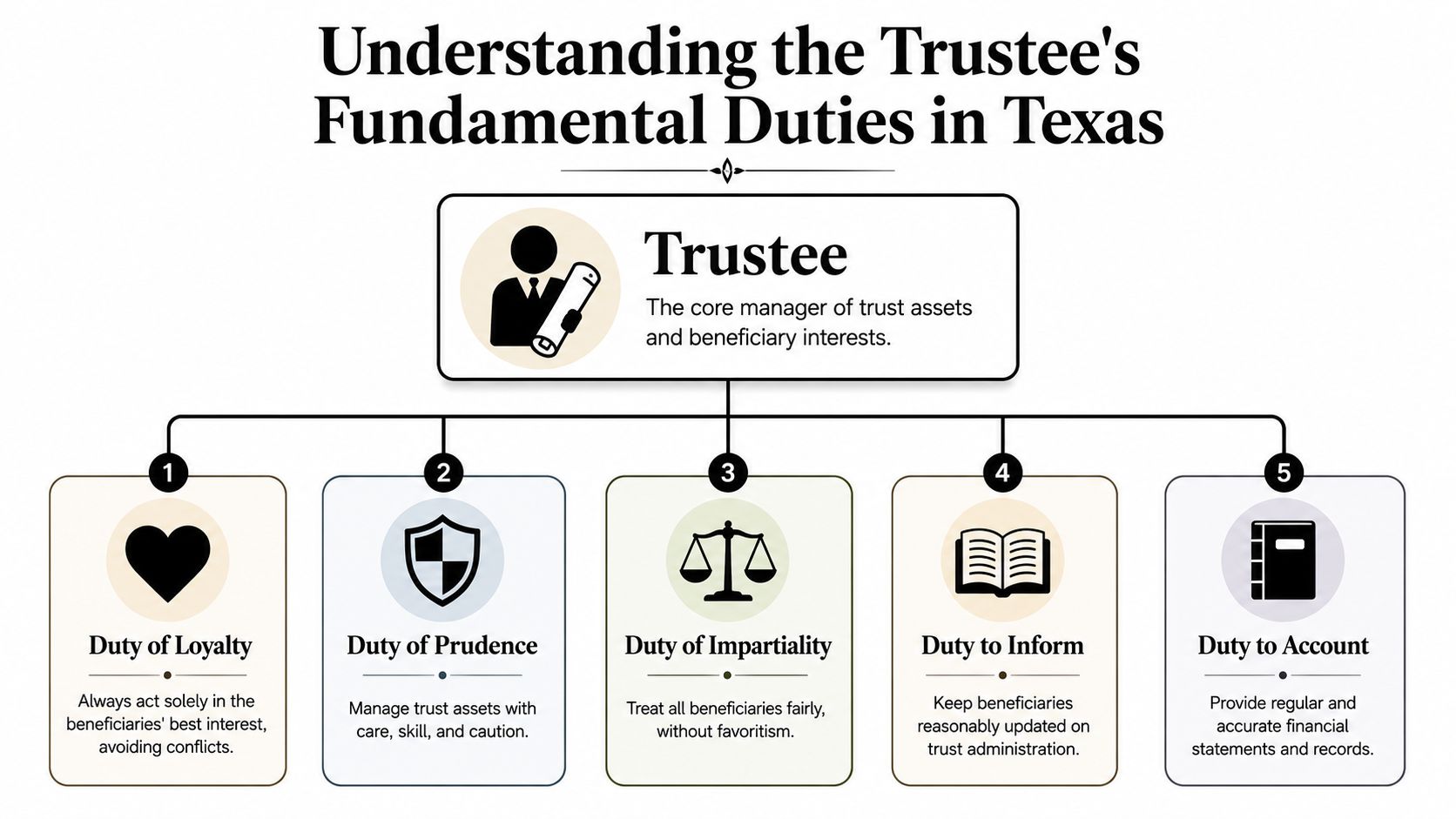
The core duties beneficiaries should know
Several duties come up again and again in Texas trust administration, and each one answers a different question a beneficiary may be asking.
- Duty of loyalty. The trustee must put the beneficiaries' interests first. Using trust property for personal benefit, steering business to themselves, or making decisions shaped by a personal conflict can violate this duty.
- Duty of prudence. The trustee must act with care, skill, and reasonable judgment. That usually includes paying attention to investments, expenses, taxes, insurance, and the condition of trust property.
- Duty of impartiality. If there is more than one beneficiary, the trustee must treat them fairly based on the terms of the trust. Fair does not always mean equal. It means the trustee cannot favor one person without support in the trust language.
- Duty to inform. Beneficiaries are often entitled to meaningful information about the trust and its administration. Silence can become a legal problem when it keeps beneficiaries from understanding what the trustee is doing.
- Duty to account. The trustee must keep accurate records and, when required, provide an accounting that shows receipts, disbursements, assets, and transactions.
A trust works much like a set of written instructions given to a manager. The manager may have room to choose how to carry out the job, but cannot ignore the instructions, hide the books, or use the property as if it were personal property.
Practical rule: A trustee may have discretion over some decisions, but discretion is not a blank check.
How to tell discretion from a breach
This is the point that often causes the most confusion. A trust may give the trustee discretion to decide whether a beneficiary should receive money for health, education, maintenance, or support. If the trustee reviews the request, considers the trust language, looks at the beneficiary's circumstances, and makes a good faith decision, a court may treat that as proper discretion even if the beneficiary disagrees.
The answer changes if the trustee never reviews the request, applies a rule that is not in the trust, refuses distributions to pressure a beneficiary, or benefits personally from the decision. That starts to look less like judgment and more like a breach of duty.
A simple way to assess the situation is to ask three questions:
- What does the trust say?
- What choice did the trustee make?
- Did the trustee act in good faith, carefully, and for the beneficiaries' benefit while making that choice?
If the trust gave the trustee a choice and the trustee used a fair process, the issue may be discretion. If the trust required a certain action, or the trustee acted in self-interest, ignored the terms, or failed to keep records, the issue may be misconduct.
Why these duties matter in real life
Most trust disputes turn on these duties. A delayed distribution, an unexplained property sale, missing records, or a risky financial decision usually leads back to the same legal question. Did the trustee stay within the authority granted by the trust, or step outside it?
That difference matters because it helps beneficiaries choose a measured response. Sometimes the next step is a request for information or a formal accounting, not a lawsuit. Sometimes the facts point to a serious breach that needs quick legal action. Knowing the rulebook helps you tell the difference before spending time and money on the wrong fight.
Common Ways a Trustee Might Not Follow a Trust
Most trust disputes don't start with dramatic fraud. They start with confusion. A beneficiary notices that payments have stopped, a property sale doesn't look right, or months go by without records. The trustee may insist everything is fine. The beneficiary may feel shut out.
That tension often comes from one question. Is the trustee making a hard but permitted decision, or has the trustee crossed the line into breach of fiduciary duty?
Conduct that may signal a breach
Some examples are fairly direct. If a trustee sells trust property to themselves without authority, that may be self-dealing. If the trust requires a distribution at a certain time and the trustee refuses without a valid reason, that may be a failure to follow the trust. If the trustee ignores trust assets, makes careless decisions, or favors one beneficiary without legal support in the trust language, that can also raise serious concerns.
Communication problems matter too. Beneficiaries often don't need constant updates, but they usually are entitled to meaningful information. Questions about A Trustee's Duty to Account to Beneficiaries often arise when a trustee won't provide the formal accounting Texas law may require.
When discretion is real and when it isn't
Many people find this aspect confusing. Some trusts give the trustee discretion to delay or limit distributions. For example, a trust might allow distributions for health, education, maintenance, or support, or allow the trustee to withhold money if the trustee believes a distribution would harm the beneficiary.
That doesn't mean the trustee can act on personal bias.
A trustee may be within their authority if the trust allows discretion and the trustee delays a distribution because a beneficiary is in a financial crisis, struggling with addiction, or needs funds paid directly to a provider instead of in cash. A trustee may be breaching the trust if they delay the same distribution because they dislike the beneficiary's spouse, want to gain an advantage in a family argument, or deliberately ignore the trust terms.
As discussed in this analysis of trustee breach and discretion, many people don't get a clear framework for evaluating whether a trustee's subjective judgment falls within the discretion granted by the trust. That gap often leads to unnecessary litigation.
Recognizing the difference
| Action | Potential Breach Example | Legitimate Discretion Example |
|---|---|---|
| Withholding a distribution | Trustee refuses payment out of spite or favoritism | Trustee delays payment because the trust gives discretion and the facts support the decision |
| Selling trust property | Trustee arranges a sale to themselves without authority | Trustee sells property at fair value because the trust permits sale and administration requires it |
| Investment decisions | Trustee makes reckless or uninformed choices | Trustee makes a reasoned decision after reviewing the trust's purpose and beneficiaries' needs |
| Communication with beneficiaries | Trustee ignores repeated reasonable requests for information | Trustee limits unnecessary back-and-forth but still provides required information |
| Treating multiple beneficiaries | Trustee favors one child for personal reasons | Trustee treats beneficiaries differently when the trust itself requires different timing or conditions |
A trustee's discretion is not unlimited. The trust language, the facts, and the trustee's motives all matter.
Your Legal Toolkit for Holding a Trustee Accountable
A beneficiary often reaches a hard moment like this: the trustee says, "I have discretion," and you are left wondering whether that is a lawful judgment call or a misuse of power. That question matters because the right legal tool depends on the nature of the problem. A trustee who made a difficult but permitted decision should be treated differently from a trustee who hid records, favored themselves, or ignored the trust's terms.
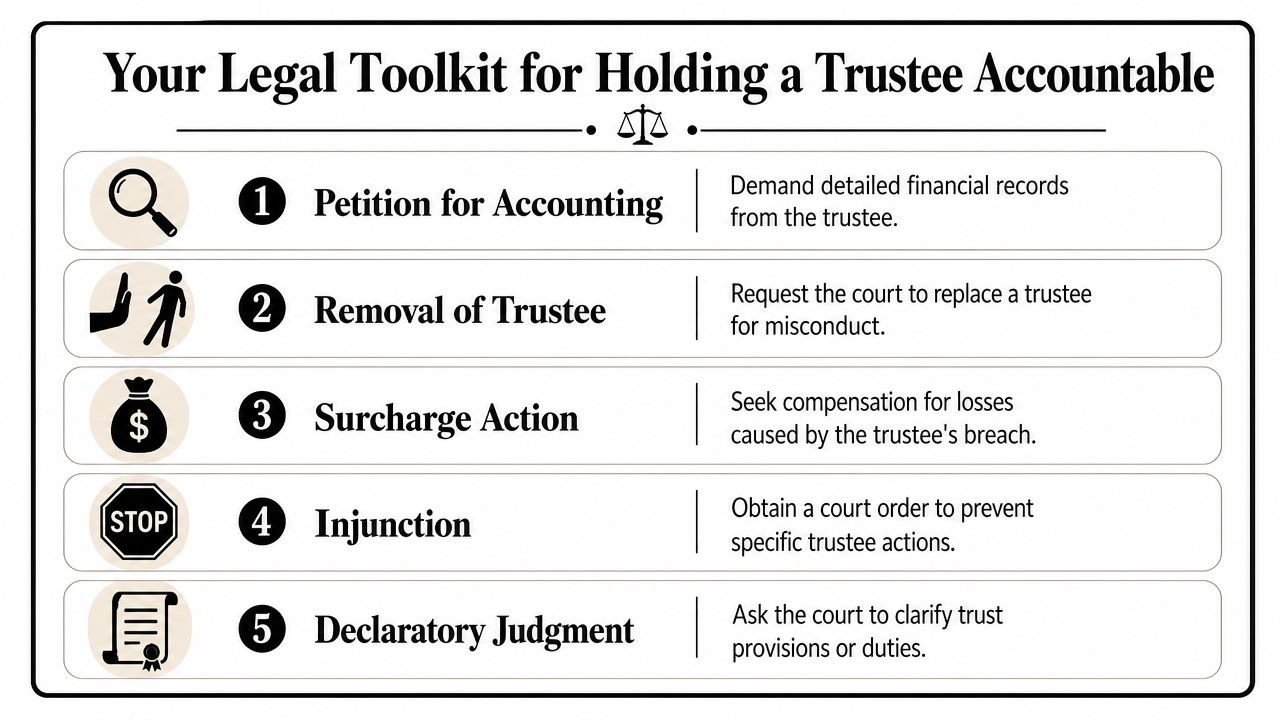
A good way to assess the situation is to ask three questions. What does the trust authorize? What facts did the trustee rely on? Can the trustee show a fair, good-faith reason for the decision? If the answers are unclear, your first goal is often to get information before asking a court for the harshest remedy.
Tool one asks the court for information
A request for an accounting is often the starting point. It works like asking to see the scorecard before accusing the referee of cheating. The records may show a simple communication problem, careless bookkeeping, or a serious breach.
An accounting can bring bank statements, sales records, distributions, expenses, and trustee compensation into view. Once those documents are produced, beneficiaries and their lawyers can compare what happened against what the trust required.
Tool two seeks repayment for losses
If the trustee's conduct caused financial harm, the court can require the trustee to make the trust whole. Under Texas Trust Code Section 114.008, that may include reducing or denying trustee compensation and ordering repayment for losses tied to breach, self-dealing, or mismanagement.
This remedy is often called a surcharge. In plain English, it means the trustee may have to pay back what their misconduct cost the trust. Resigning does not erase that exposure.
Tool three targets improper transactions
Some disputes are not mainly about money damages. They are about undoing a bad act.
If a trustee transferred trust property to themselves, sold an asset for an unfair price, or completed a transaction that violated their duties, a court may be able to set that deal aside. The goal is to restore the trust property, or its value, to where it should have been.
Tool four removes a trustee when necessary
Removal is serious, but sometimes it is the only practical answer. A court may remove a trustee whose conduct shows ongoing risk to the trust, especially where there has been a material violation, financial harm, refusal to account, or conduct that makes proper administration unlikely.
Courts can also put temporary protections in place while the dispute is pending. In the right case, that may include a receiver or other measures to protect trust assets from further loss.
Tool five uses a focused court request
Many trust disputes do not begin with an all-out fight over every issue. A narrower petition may ask the court to interpret a disputed trust provision, order the trustee to perform a specific duty, stop a threatened transaction, or direct the trustee to follow the trust going forward.
That approach can save time, preserve trust assets, and separate a genuine breach from a disagreement about how discretion should be exercised. If you want a clearer picture of procedure, this guide on how to sue a trustee in Texas explains the litigation process in more detail. The Law Office of Bryan Fagan, PLLC also handles trust administration, dispute resolution, probate matters, and related planning issues for Texas families who need guidance on either side of a trustee dispute.
Important point: Courts usually want proof of the trustee's duty, the specific act or omission that violated that duty, and a clear link between the breach and the harm claimed.
The Clock Is Ticking Texas Deadlines for Legal Action
A strong claim can still fail if it's filed too late. That's one of the hardest parts of trust litigation for families to hear, especially when the trustee's conduct seems clearly wrong.

The four-year deadline
In Texas, beneficiaries generally have a four-year statute of limitations to sue for breach of fiduciary duty, and the clock starts when the beneficiary knew, or reasonably should have known, about the trustee's misconduct under the discovery rule, as explained in this discussion of trustee negligence and Texas deadlines.
That rule is important because the deadline doesn't always begin on the day the trustee made the bad decision. It begins when the misconduct was discovered, or when a beneficiary should have discovered it through reasonable diligence.
How the discovery rule works in plain English
Suppose a trustee improperly sold trust property years ago but never shared records with the beneficiaries. The beneficiaries might not learn what happened until they finally receive documents or uncover the transaction another way. In that kind of situation, the legal deadline may begin when the beneficiaries learned enough facts to recognize a possible breach.
But the discovery rule isn't a license to wait. If a beneficiary had enough warning signs and failed to act, a court may decide the claim should have been discovered earlier.
The safest approach is simple. Once you have reason to believe a trustee may have breached a duty, start gathering information and get legal advice quickly.
Why timing affects strategy
Deadlines shape more than lawsuits. They affect the ability to negotiate favorable settlements, document preservation, and whether a court will even hear the case. Families who are still sorting out whether they're dealing with a trust dispute, a probate issue, or a post-death contest often need a timeline review. This guide on contesting a trust after death in Texas can help clarify how timing issues arise in related disputes.
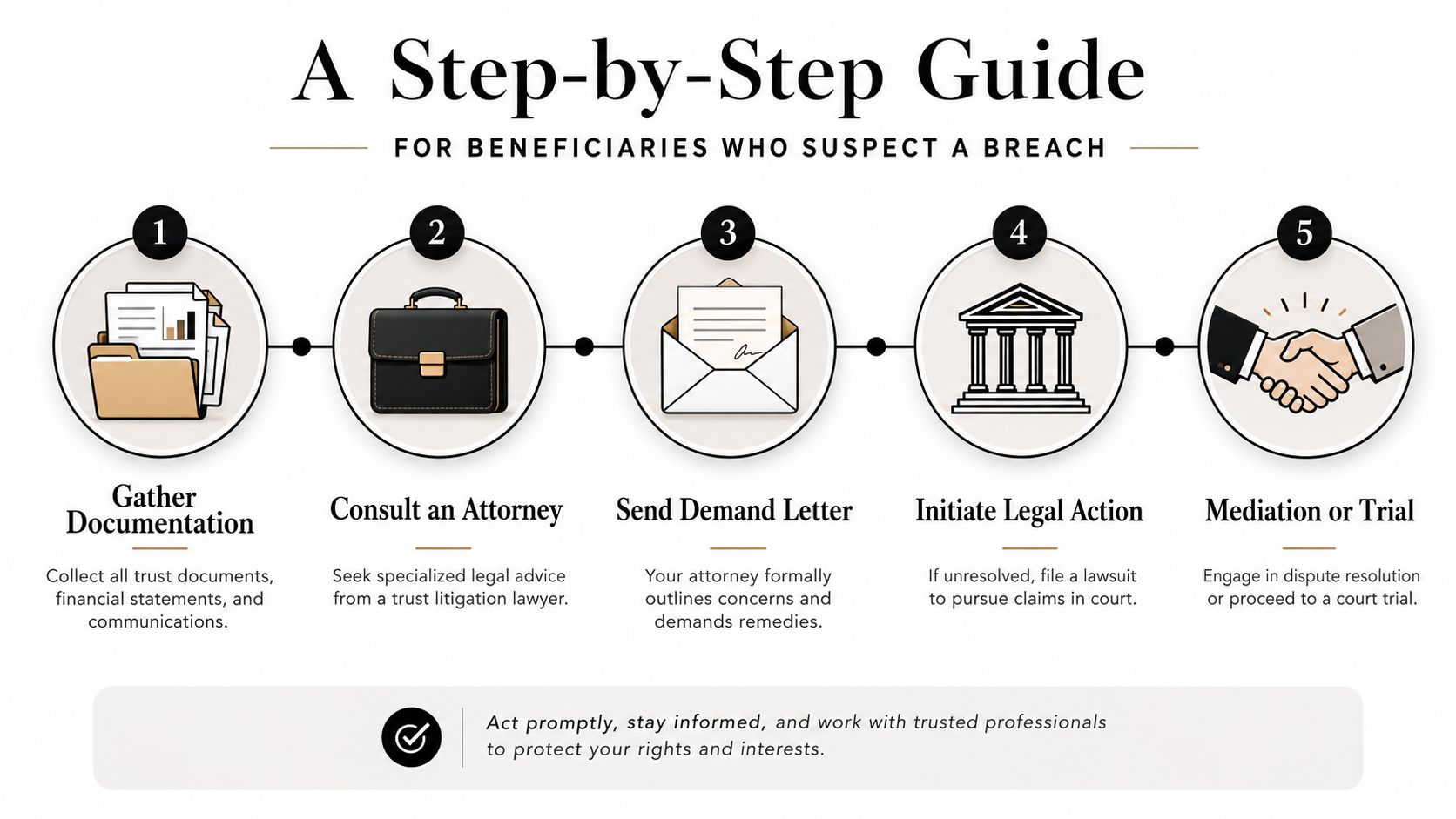
A Step-by-Step Guide for Beneficiaries Who Suspect a Breach
When you suspect a trustee isn't following the trust, it helps to slow down and get organized. Acting too aggressively too soon can create unnecessary expense. Waiting too long can make the problem worse. A careful process usually puts you in the strongest position.
A visual summary can help as you think through the sequence.
Start with the trust document
Read the trust carefully. Look for distribution standards, trustee powers, accounting obligations, investment authority, and any language that gives the trustee discretion. If you don't have a copy, ask for one in writing.
This step matters because a trustee may have broader authority than you expect, or less. The document is the starting point for deciding whether you're dealing with a disagreement over judgment or a true failure to follow the trust.
Build a clean record
Gather what you already have. That may include emails, letters, text messages, tax documents, bank statements, notices, prior accountings, and records of missed distributions.
Create a simple timeline. Note dates of requests, responses, and decisions that concern you. If property was sold or money was moved, write down when you learned about it and what documents support that understanding.
Make a written request
A written request is often more effective than a phone call. Ask for the specific information you need. That may be a copy of the trust, an explanation for a delayed distribution, or a formal accounting.
Keep your request professional and precise. Broad accusations usually don't help. Specific questions do.
Here's a helpful overview before you send that request.
Track the response carefully
If the trustee answers, review what was provided and what was omitted. If the trustee ignores the request, that silence can become important evidence.
Under this discussion of Texas trust litigation and accounting duties, if a Texas trustee fails to provide a required accounting within 90 days of a beneficiary's written request, the beneficiary can petition the court to compel it, and the court may order the trustee to personally pay the beneficiary's attorney's fees.
A practical next step: Save the written request, proof it was sent, and any reply. Courts care about paper trails.
Get legal advice before positions harden
Once you have the trust document, your timeline, and the trustee's response, speak with a Texas trust administration lawyer. A lawyer can help you assess whether the facts support a petition for accounting, a request for corrective action, or a larger breach claim.
That review can also help you connect trust issues with related concerns under the Texas Estates Code, family probate proceedings, guardianship matters, tax planning, or how to modify a trust in Texas when the family's goals have changed. Sometimes the best answer isn't immediate litigation. It may be a negotiated correction that protects the trust and avoids deeper damage.
A Word of Advice for Trustees on Following a Trust
If you're serving as trustee, the job may feel personal because the family is personal. Still, your role is legal. You're carrying out the trust creator's instructions under Texas law, not trying to solve every family tension through instinct alone.
The safest trustees treat administration like a disciplined process.
Good records protect everyone
Keep organized records of receipts, disbursements, investment decisions, property expenses, tax filings, and communications with beneficiaries. If you make a difficult distribution decision, write down why you made it and what trust language supported it.
That record can help beneficiaries understand your reasoning. It can also protect you if someone later claims you acted unfairly.
Communication often prevents disputes
Silence creates suspicion. You don't have to respond emotionally to every complaint, but you should communicate clearly about timing, required documents, and the reason for major decisions. Many trust disputes grow because beneficiaries feel ignored long before they feel harmed.
A short, respectful update often does more to calm a family than a defensive argument after trust has already broken down.
Ask for help before a small issue becomes a legal problem
Trustees should get professional guidance when the trust holds unusual assets, when beneficiaries disagree sharply, when tax questions arise, or when the trust language is hard to interpret. A Texas estate planning attorney can help with administration questions. Financial advisors and CPAs may help with investment and tax concerns. Probate counsel may be needed if trust assets overlap with estate administration.
Families also often need coordinated planning around probate, incapacity, guardianship, and asset protection. Trustees who ask for help early are usually in a better position than trustees who wait until someone accuses them of misconduct.
A careful trustee doesn't look weak for asking questions. A careful trustee looks responsible.
When to Contact a Texas Trust Administration Lawyer
Some situations call for legal help sooner rather than later. For beneficiaries, that includes a trustee who refuses to communicate, won't provide records, appears to be self-dealing, or keeps delaying distributions without a clear legal basis. It also includes cases where an accounting reveals missing information, unexplained transfers, or decisions that don't match the trust terms.
For trustees, legal guidance matters when you're accused of breach, when beneficiaries are fighting over your decisions, or when the trust language leaves real room for doubt. It also matters when trust administration overlaps with probate, guardianship, tax planning, or questions about how to modify a trust in Texas.
A good legal review can do two things at once. It can lower the temperature in a family conflict, and it can protect everyone's rights under the Texas Trust Code, the Texas Estates Code, and long-standing fiduciary principles.
If you're managing a trust or planning your estate, contact Law Office of Bryan Fagan, PLLC for a free consultation. Our attorneys provide trusted, Texas-based guidance for every step of the process.