No, a trustee can't delay distributions indefinitely in Texas. Texas courts apply a reasonable time standard that is typically understood as about 9 to 18 months after trust termination, depending on the work that still must be completed.
If you're waiting for a distribution and getting silence instead of answers, that uncertainty can feel worse than the delay itself. Many beneficiaries assume the trustee has broad control and that nothing can be done until the trustee decides to act. Texas law gives trustees room to finish legitimate administration, but it also gives beneficiaries enforceable rights when a delay stops being reasonable.
Waiting for Your Inheritance? Understanding Trust Distributions in Texas
A common situation looks like this. A parent dies, the family trust becomes active, and one sibling is serving as trustee. Months pass. You ask when distributions will happen, and the answer is vague, delayed, or missing entirely.
That doesn't automatically mean the trustee is doing something wrong. Trust administration takes time. Assets have to be identified, debts reviewed, tax issues handled, and sometimes property has to be sold before cash can be distributed. But Texas law doesn't allow a trustee to hold beneficiaries in limbo forever.
What matters is whether the trustee is acting within a reasonable time and whether the trustee can explain the delay with real facts and records. In practice, Texas courts look at the trust itself, the type of assets involved, the need for tax and creditor work, and whether any disputes are holding things up.
A trustee is not just a gatekeeper with the power to say "wait." The trustee has a duty to move the administration forward.
If you're a beneficiary, your rights usually include getting information, requesting an accounting, and asking the court to step in when the trustee won't act. If you're a trustee, your job isn't just to protect the assets. It's to administer and distribute them according to the trust terms and Texas fiduciary law.
The question isn't whether a delay exists. The question is whether the delay is justified, documented, and handled in good faith. That's where most disputes are won or lost.
The Trustee's Core Responsibilities Under the Texas Trust Code
A trustee holds legal control over trust property, but that control is limited by fiduciary duties in Texas. In plain English, a fiduciary duty means the trustee must act for the beneficiaries' benefit, not for personal convenience, advantage, or self-interest.
The trustee's role is closer to a ship captain than a vault keeper. The captain doesn't just sit with the cargo. The captain has to get it safely to its destination, follow the route, respond to real hazards, and keep the people with an interest in the voyage informed when delays arise.
Loyalty, prudence, and prompt administration
Texas trust law expects a trustee to follow the trust document, protect trust assets, keep proper records, and make distributions when they become due. Courts don't permit indefinite delay. According to Ford + Bergner's discussion of trust termination and distribution duties, Texas courts enforce a reasonable time standard, typically 9 to 18 months after termination, and a delay of over 13 years led to successful claims of mismanagement.
That fits the broader framework of trustee obligations under the Texas Trust Code. If you want a practical overview of those duties, this guide on Texas Trust Code trustee duties is a helpful starting point.
Practical rule: A trustee should be able to explain what has been done, what still needs to be done, and when distributions are expected.
A trustee who can't answer those questions may have an administration problem. A trustee who refuses to answer them may have a legal problem.
What the law expects in real life
The law doesn't require instant distribution. It requires responsible administration. That includes tasks like these:
- Following the trust terms: The trustee must read the instrument carefully and carry out the distribution plan it contains.
- Protecting assets: If the trust owns a house, business interest, or investment account, the trustee has to preserve value while administration continues.
- Keeping beneficiaries informed: Beneficiaries don't have to accept silence as normal.
- Avoiding favoritism: A trustee can't help one beneficiary at the expense of another unless the trust expressly allows that treatment.
- Documenting decisions: Good trustees create a paper trail. Bad trustees create excuses.
Why delay disputes become fiduciary cases
Many people think the issue is only timing. Often, timing is just the symptom. The deeper issue is whether the trustee is loyal, organized, and acting with care.
A delayed distribution can point to several breaches at once. The trustee may be failing to account, using trust property for personal benefit, ignoring written requests, or postponing action because delay benefits the trustee. That's why these cases often turn into broader breach of fiduciary duty claims instead of simple scheduling disputes.
Legitimate Reasons a Trustee Can Delay Trust Distributions
A beneficiary may be ready for a check within weeks. The trustee may still be waiting on a house closing, a business valuation, or final tax numbers. In Texas, those delays can be proper if they are tied to real administration work and the trustee can show why the holdback protects the trust.
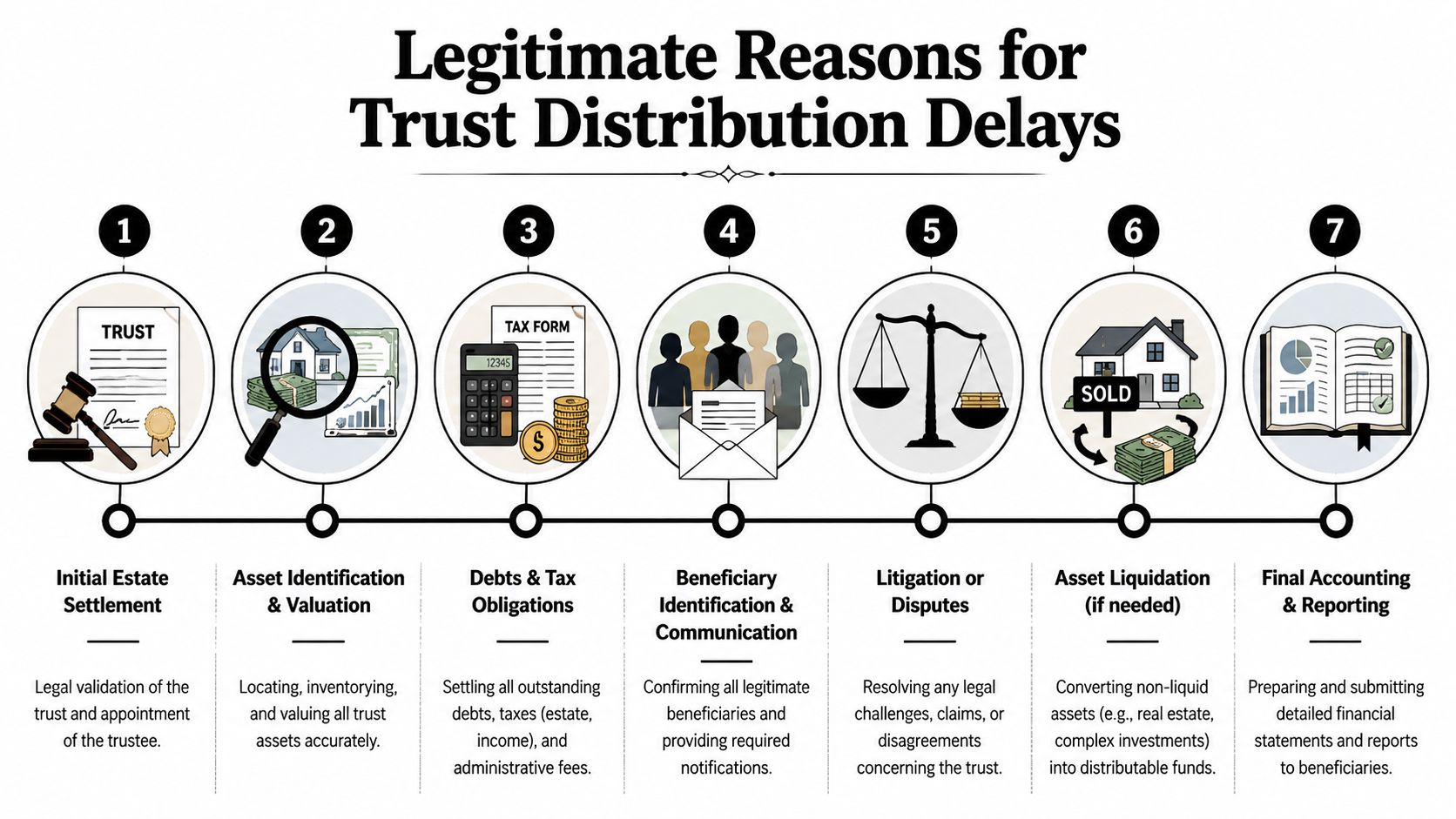
Texas law does not impose a single deadline for every trust. The better question is whether the trustee is acting promptly, carefully, and for the benefit of the beneficiaries rather than for personal convenience. A short explanation with records usually resolves concern. Silence usually does the opposite.
Some delays are routine. Others are justified only for a limited period. For a focused look at Texas trust distribution timing benchmarks, it helps to compare the reason for the delay with the actual work left to do.
Delays that are usually legitimate
Real estate is a common example. If the trust owns a home, the trustee may need time to secure insurance, clean out the property, get an appraisal, make sale decisions, and close the transaction before dividing proceeds. Rushing that process can reduce value for everyone.
Closely held assets also take longer. A family business interest, mineral rights, or a hard-to-value investment may require an appraisal or legal review before a fair distribution can happen. A trustee who distributes too early can create unequal treatment or force a discounted sale.
Taxes and debts are another valid reason to wait. A careful trustee may hold back funds until returns are prepared, liabilities are known, and reasonable reserves are set aside. That is often prudent administration, not foot-dragging.
Disputes among beneficiaries can slow things down too. If one beneficiary contests valuations, ownership, or interpretation of the trust, the trustee may need to pause final distributions until that issue is addressed. In some cases, partial distributions still make sense while the contested amount stays in reserve.
What a proper delay looks like in practice
A legitimate delay has details.
The trustee should be able to identify the asset or issue causing the delay, explain what has already been done, and give a realistic estimate of what remains. That does not require perfect predictions. It does require an honest, specific update.
Beneficiaries should expect information such as:
- The reason for the holdback: sale pending, tax work in progress, valuation not complete, creditor issue under review
- The tasks still open: appraisal, listing, return filing, debt resolution, document collection
- The expected sequence: what happens first, what follows, and what must occur before funds can be released
- Whether a partial distribution is possible: some trusts can distribute a portion now and hold a reserve for the rest
When I review these disputes, the practical difference is usually clear. A trustee with a legitimate reason can produce emails with the CPA, listing documents, payoff statements, appraisals, or closing timelines. A trustee who is stalling usually offers general statements and no paper trail.
The real trade-off trustees face
Trustees do have to be careful. If they distribute everything and later discover taxes, expenses, or claims, they may be personally exposed. That risk is real.
But caution has limits. A trustee cannot keep assets tied up indefinitely just by saying administration is ongoing. The delay has to match the job. If the only remaining tasks are minor and the trustee is also benefiting from holding the assets, the legal risk rises quickly.
Red Flags When a Delay Becomes a Breach of Fiduciary Duty
A beneficiary usually feels the shift before seeing it on paper. At first, the trustee says distribution is coming after one more appraisal, one more tax return, or one more sale. Months later, nothing has closed, no accounting has arrived, and the explanation keeps changing. At that point, the issue is no longer patience. It is whether the trustee is violating fiduciary duties.

Texas law uses a reasonableness standard, but in practice courts look at specifics, not slogans. A delay that may be defensible at six months often becomes hard to justify at eighteen or twenty four months if the trustee cannot show real progress, written updates, and a concrete reason funds still must be held back. In contested cases, judges tend to focus on documents, dates, and conflicts of interest.
One fact pattern gets attention fast. The trustee is also a beneficiary and personally benefits from waiting.
That arrangement is common in Texas family trusts, and it is not improper by itself. The problem starts when the trustee's personal interest affects timing. I see this most often when a trustee-beneficiary continues living in trust real estate, controls trust cash that should be divided, or delays a sale because distribution would reduce that trustee's practical control over the assets. Courts do not assume bad faith from the family relationship alone, but they scrutinize these cases closely because the duty of loyalty still applies in full.
Warning signs that deserve attention
A delay is more likely to cross into breach territory when the trustee's conduct looks like self-protection or concealment rather than administration:
- Repeated silence after written requests: emails and letters go unanswered, or the trustee responds only with general statements.
- No meaningful accounting: the trustee will not show what the trust owns, what has been spent, and what remains available for distribution.
- No target date or sequence: there is no clear explanation of what must happen before money can be released.
- Shifting explanations: taxes are blamed one month, title issues the next, then market conditions after that.
- Unequal access to trust benefits: one beneficiary receives information, use of property, or indirect financial benefit while others wait.
- Personal use of trust assets: the trustee occupies trust property, uses trust funds, or keeps assets invested in a way that favors the trustee's own interests.
- Refusal to produce records that should exist: no CPA correspondence, no closing documents, no appraisals, no payoff statements, and no written timeline.
In real disputes, the paper trail usually decides the tone of the case early. A careful trustee can show what has been done and why more time is needed. A trustee who is stalling usually has very little to produce.
The self-interested trustee problem
Self-interested delay creates the strongest breach claims because motive and conduct start to line up. If a trustee-beneficiary postpones selling a house while living there rent-free, the delay is no longer neutral. If the trustee keeps cash in the trust but cannot explain any pending tax, debt, or reserve need, a court may view that as using control for personal advantage.
Texas judges also look at whether the trustee considered partial distribution. That issue matters. If only one asset is tied up, but cash or marketable securities could have been distributed earlier, a blanket freeze on everything can look unreasonable.
Beneficiaries dealing with that kind of delay often need records before they can prove much. A petition for a trust accounting in Texas is often the turning point because it forces the trustee to either document the delay or expose the lack of documentation.
This video gives a practical overview of trustee disputes and timing concerns in Texas.
What usually fails as a defense
Several trustee explanations tend to fall apart quickly once a beneficiary asks for records or a court gets involved:
| Situation | Why it usually fails |
|---|---|
| "I'm still deciding the best time to distribute." | Discretion has limits. The trustee still must act in good faith, follow the trust terms, and make decisions within a reasonable period. |
| "The beneficiaries are difficult." | Family tension does not excuse withholding distributions that are otherwise due. |
| "I do not have to answer every question." | A trustee may reject harassment, but cannot refuse basic information, accountings, and status updates tied to administration. |
| "Doing nothing protects the trust." | Inaction can be a breach when the trustee should be selling, valuing, accounting, reserving, or distributing. |
Courts look for reasons, records, and forward movement. If those are missing, delay starts to look like breach.
A Beneficiary's Toolkit How to Enforce Your Rights in Texas
A common Texas trust dispute starts the same way. The trustee says distribution is coming soon, months pass, and the beneficiary still has no accounting, no firm timeline, and no explanation that matches the trust terms. At that point, patience stops being a strategy.
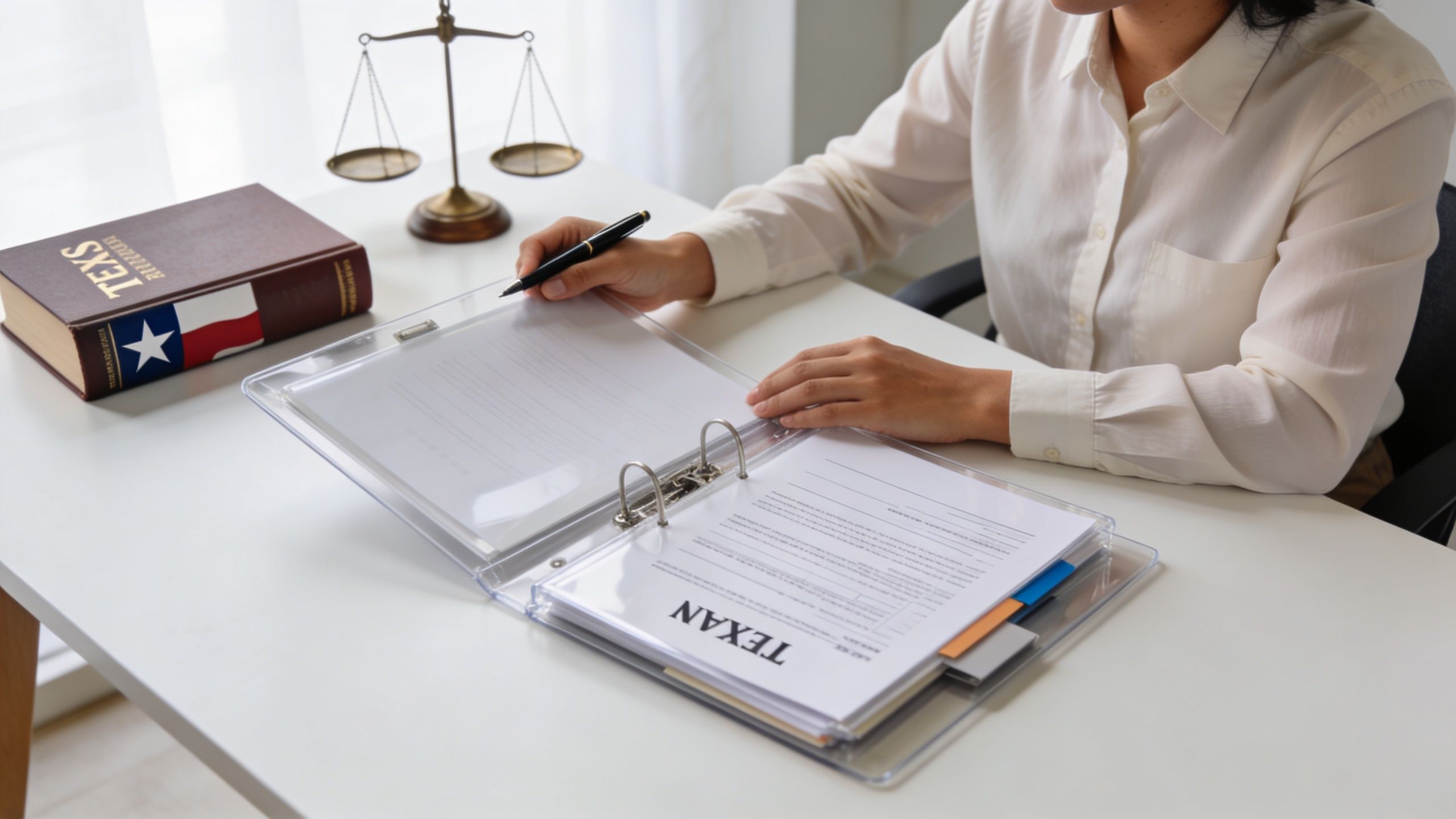
Texas law gives beneficiaries tools to force movement, and the order matters. In practice, the strongest cases usually begin with a measured written demand, followed by a formal accounting request, then a court petition designed for the specific problem. That sequence builds a record. It also puts pressure on a trustee who has been vague for too long, especially if the trustee is also a beneficiary and benefits personally from holding the money back.
Start with a written demand
A phone call rarely helps later in court. A short letter or email does.
Ask for specific items: the reason for the delay, the current list of trust assets, what administration tasks remain, whether any reserve is being held back, and the trustee's expected distribution date. If the trustee claims more time is needed, ask what exactly is still pending and when it will be completed.
Keep the tone professional. The goal is to pin down the trustee's position and create a timeline you can prove.
Request an accounting
An accounting often changes the posture of the dispute because it forces detail. The trustee has to show what came into the trust, what went out, what remains, and why distribution has not occurred. In my experience, delays become much harder to defend once those questions must be answered in writing.
Texas beneficiaries may have the right to seek an accounting under the Trust Code, and a petition for a trust accounting in Texas is often the cleanest first court filing. It is especially useful where the trustee keeps saying the delay is temporary but cannot produce records showing real work, real expenses, or a real plan.
Two patterns matter here. First, the absence of a timely accounting often pushes courts to compel disclosure and administration activity. Second, if a trustee's delay caused measurable financial harm, Texas courts can award surcharge, attorney's fees, or both. The amount depends on the facts, but the remedy is real.
Use the court's enforcement tools that fit the problem
A good petition asks for targeted relief, not every remedy imaginable. Courts respond better when the request matches the misconduct.
Compel an accounting
This is often the best opening move when the beneficiary lacks records and the trustee controls all information.Compel distribution
If administration is effectively complete and the trustee still refuses to pay, the court can order the trustee to distribute under the trust terms.Seek partial or interim distribution
This can make sense when one asset or tax issue is still pending, but enough cash or liquid property exists to make a fair partial payment now.Remove the trustee
Removal becomes a serious option when delay is part of self-dealing, favoritism, hostility between beneficiaries, or repeated refusal to provide basic information.Seek surcharge, fees, and other relief
If the delay caused losses, such as missed investment opportunity, unnecessary tax cost, property deterioration, or legal expense, the trustee may be ordered to reimburse the trust or the beneficiaries.
Pay close attention when the trustee is also a beneficiary
Delay cases become more complicated and more important in these instances. A trustee-beneficiary may have a financial incentive to postpone someone else's share while continuing to control trust assets, occupy trust property, collect income, or defer a reckoning over prior transactions.
Courts do not treat that conflict as an automatic breach, but they do look closely at motive, documentation, and unequal treatment. If one beneficiary receives informal benefits while another gets only excuses, that fact pattern deserves immediate attention.
Build a record that shows breach, not just frustration
Strong beneficiary cases usually include:
- Written requests with dates
- Trustee responses, or proof there were none
- The trust instrument and any amendments
- A timeline of missed deadlines and shifting explanations
- Bank records, property records, or messages suggesting self-dealing or preferential treatment
- Evidence of actual harm caused by the delay
The practical question is simple. Can the trustee explain the delay with records, or only with general statements?
That answer often decides whether the case ends with a clear distribution plan, a court order, or a change in trustee.
Proactive Guidance for Trustees and Beneficiaries
Most trust disputes can be reduced, and some can be avoided, if both sides handle communication better at the start. That's true whether the trust is simple or tied up with real estate, tax planning, probate overlap, or family conflict.
For trustees
Set expectations early. Tell beneficiaries what assets exist in general terms, what tasks must be completed, and what rough timeline you expect. If something changes, update them before they have to ask.
Keep records as you go, not months later. Save appraisals, closing updates, tax correspondence, bank statements, and notes about decisions. In real administration, memory is not a system. Documentation is.
A trustee should also know when to bring in help. An accountant, appraiser, realtor, or Texas estate planning attorney can prevent mistakes that become expensive litigation later. Trustees sometimes think hiring counsel looks defensive. Often it does the opposite. It shows the trustee is taking the job seriously.
For beneficiaries
Ask focused questions. Broad accusations usually escalate conflict. Specific requests often get better results. Asking, "Please provide the current asset list and expected distribution date," is more productive than, "Why are you hiding everything?"
Stay respectful, but don't stay passive. If months pass and the trustee still won't explain the delay, put the request in writing and preserve the record. If the trust is tied to wider family planning concerns, related legal support in estate planning, probate, guardianship, and asset protection can also matter because these issues often overlap.
What usually works
A short comparison helps:
| Approach | Likely result |
|---|---|
| Clear written updates from trustee | Lower chance of suspicion and dispute |
| Detailed records supporting delay | Stronger defense if challenged |
| Vague verbal promises | More beneficiary frustration |
| Ignoring accounting requests | Faster escalation to court |
| Early legal advice | Better decisions and fewer avoidable mistakes |
Preventing a trust fight is usually cheaper than winning one.
Contact a Texas Trust Attorney for Clear Guidance
If you're asking can a trustee delay distributions indefinitely in Texas, the answer is no. Trustees have duties, beneficiaries have rights, and Texas law gives courts the power to compel action when a delay becomes unreasonable.
If you're managing a trust, waiting on a distribution, or trying to avoid a dispute before it starts, legal guidance can bring clarity quickly. A careful review of the trust terms, the timeline, and the trustee's documentation often reveals the next best step.
If you're managing a trust or planning your estate, contact Law Office of Bryan Fagan, PLLC for a free consultation. Our attorneys provide trusted, Texas-based guidance for every step of the process.