Skip to content
Yes, a trustee can be removed for family conflict in Texas, but only when that conflict becomes so serious that it harms the trust or prevents the trustee from doing the job properly. Simple disagreement, hurt feelings, or a personality clash usually isn't enough.
If you're dealing with a family trust dispute, you're probably carrying more than legal stress. You're also dealing with grief, old family dynamics, and the fear that trust property may be mishandled while everyone argues. Texas law does give beneficiaries and co-trustees a path to ask the court for help, but the key question isn't whether the family gets along. The question is whether the conflict is now interfering with trust administration.
That distinction matters. Many people search for can a trustee be removed for family conflict Texas because they already know something feels wrong, but they aren't sure whether the problem is legally serious or just emotionally painful. A Texas trust administration lawyer will usually start by separating those two things. Once you do that, the path forward becomes much clearer.
Understanding the Legal Grounds for Removal in Texas
A trustee doesn't just hold property. A trustee owes fiduciary duties in Texas. In plain English, that means the trustee must act for the benefit of the trust and its beneficiaries, not for personal convenience, resentment, or favoritism.
The core fiduciary duties usually include loyalty, prudence, and accountability. Loyalty means the trustee must put the trust first. Prudence means making careful decisions with trust property. Accountability means keeping records, giving required information, and being prepared to explain decisions.
Texas courts look at trustee removal through that fiduciary lens. Under Texas Property Code § 113.082 guidance on trustee removal, courts recognize that family conflict alone is insufficient grounds for trustee removal, and that "you cannot remove a trustee because of a personality clash or a minor disagreement over a decision."
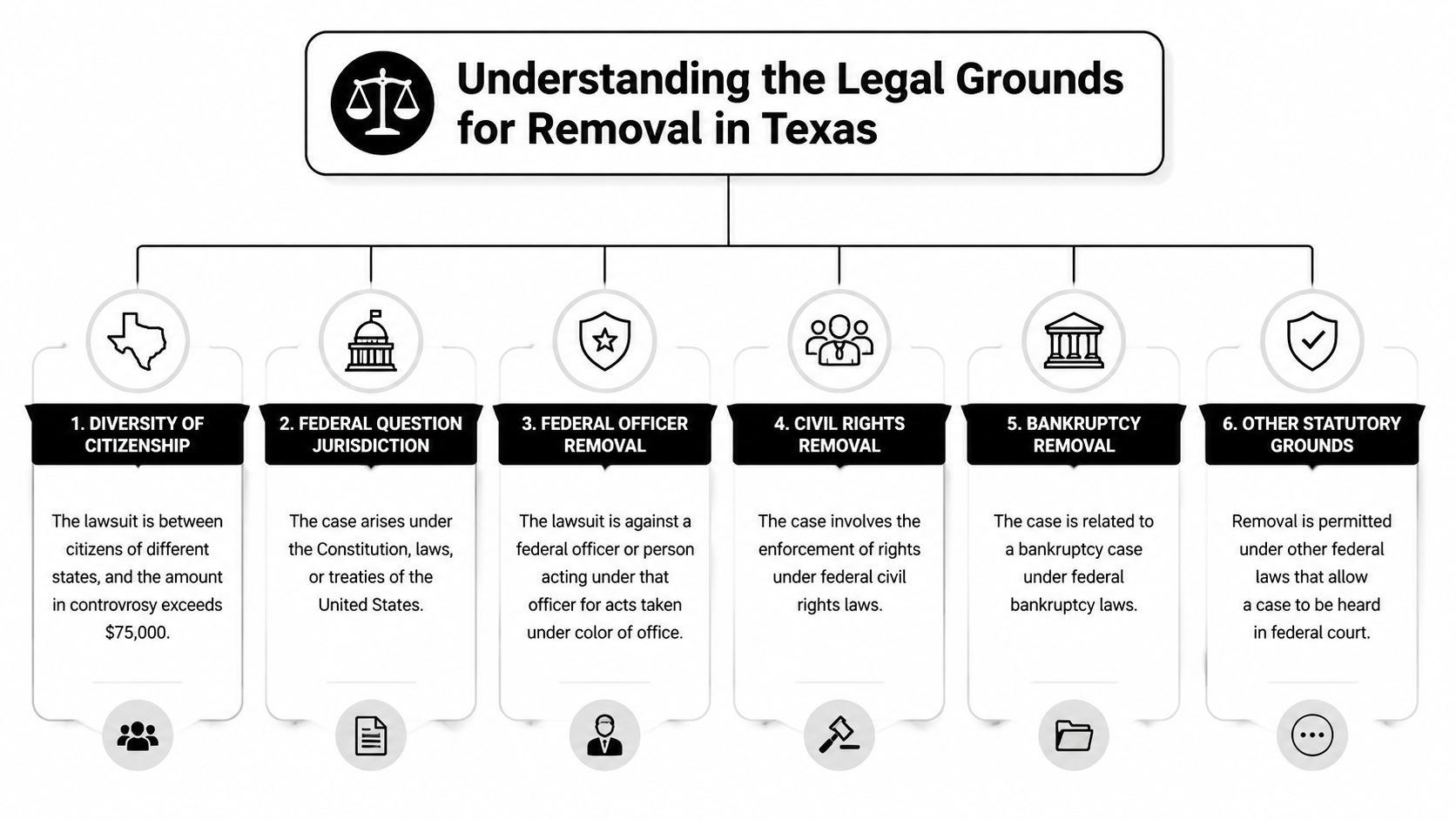
What the court is really looking for
Texas law protects trustee stability, but it also protects beneficiaries when a trustee can't or won't administer the trust properly. The statute includes a flexible "for other cause" provision, which gives a court room to act when keeping the trustee in place would be detrimental to the trust.
That doesn't mean every tense family situation qualifies. It means the judge asks whether the conflict has crossed the line into real dysfunction. For example, Texas courts have recognized that severe hostility may support removal when there is a complete breakdown in the relationship and the parties can no longer work together in a way that allows the trust to function.
Practical rule: A judge usually won't remove a trustee because family members are upset. A judge may remove a trustee when the conflict blocks communication, delays administration, or causes a breach of fiduciary duty.
Common legal grounds in plain English
Texas practitioners commonly describe the main removal categories this way:
- Violation of trust terms: The trustee isn't following the trust document.
- Illegal or improper transactions: The trustee engages in transactions that aren't allowed.
- Friction that disrupts administration: The conflict has become serious enough to impair trust management.
- Incapacity: The trustee can't carry out the job.
These grounds overlap more than people expect. Family conflict often shows up inside another legal problem. A trustee may stop responding to beneficiaries, refuse to share information, or make one-sided decisions out of hostility. At that point, the issue isn't just family drama. It's a trust administration problem that can become a breach of fiduciary duty by a Texas trustee.
Why this legal threshold exists
Families often disagree over investments, distributions, or sales of trust property. If every disagreement justified removal, trusts would become impossible to manage. Texas law tries to avoid that.
At the same time, the law doesn't force beneficiaries to tolerate a trustee whose hostility makes administration unworkable. The trust's well-being comes first. If conflict is damaging the trust's operation or the beneficiaries' interests, the court can step in.
Distinguishing Family Friction from Actionable Harm
A common Texas trust dispute starts like this. One sibling is trustee. Another sibling believes the trustee is secretive, rude, and impossible to deal with. Holidays are tense. Emails feel hostile. Everyone is upset.
Those facts explain why the family is struggling. They do not, by themselves, show grounds for removal.
The court usually looks for something more concrete. The question is whether the conflict is spilling into the trustee's actual job. A trustee can be difficult and still be performing the role properly. A trustee can also be polite on the surface while failing to give accountings, delaying distributions, or blocking decisions the trust needs. That practical difference matters.
A useful way to picture the rule is this. Family friction is smoke. Actionable harm is fire affecting the house. Texas courts are focused on whether the trust itself is being harmed.
Family Friction vs. Actionable Harm to the Trust
| Behavior (Mere Family Friction) | Behavior (Potential Actionable Harm) |
|---|---|
| A beneficiary disagrees with an investment choice | The trustee refuses to provide required accounting or financial records |
| Family members argue over whether to sell a house | The trustee refuses to communicate or respond to reasonable requests for information |
| One sibling thinks the trustee is too cautious | The trustee withholds distributions without a trust-based reason |
| Beneficiaries don't like the trustee's tone | The trustee's hostility prevents decisions from being made |
| Relatives are upset about old personal issues | Co-trustees are so hostile they can't administer the trust effectively |
Scenario one that likely is not enough
A parent dies and leaves a trust for three children. One child becomes trustee. The trust gives that trustee discretion to keep or sell a rental property. Two beneficiaries want the property sold right away because they want cash now. The trustee decides to wait for better market conditions and explains the reasons in writing.
That disagreement may feel unfair to the beneficiaries, especially if they never trusted the trustee in the first place. Still, removal is less likely if the trustee is acting within the trust's terms, sharing information, and making a decision that a reasonable trustee could make.
Courts do not remove trustees merely because beneficiaries would have made a different call.
Scenario two that may support removal
Now change a few facts. The trustee stops answering repeated requests for updates. No accounting is provided. Bank statements and tax information are withheld. A distribution request sits for months with no explanation, and the trustee says family members will get answers only when they start showing "respect."
At that point, the problem is no longer hurt feelings alone. The conflict is interfering with administration. Beneficiaries cannot evaluate what the trustee is doing. Decisions are delayed. The trustee's personal hostility may be driving trust decisions.
That is the kind of pattern that can support removal.
Scenario three involving co-trustees
Co-trusteeship often sounds fair in a family. In practice, it can work like a car with two steering wheels. If both people cooperate, the trust moves forward. If each person blocks the other, the car stalls in the middle of the road.
Suppose two siblings are named co-trustees. One will not attend meetings, will not sign sale documents, and rejects ordinary expenses out of spite rather than judgment. Bills go unpaid. Property management suffers. Tax filings are delayed because the co-trustees cannot act together.
That kind of conflict may cross the legal line because the trust is no longer being administered effectively.
A related issue sometimes appears when family pressure affects trust decisions behind the scenes. If you suspect manipulation, coercion, or pressure is shaping how the trustee acts, this guide on how to prove undue influence in Texas trusts can help you identify a separate legal problem.
Questions to ask before seeking removal
If you are trying to decide whether your situation is ordinary family conflict or something the court may treat more seriously, ask yourself:
- Is the trustee still doing the core work? Look for accountings, tax filings, asset management, responses to reasonable questions, and timely decisions.
- Can you identify a trust-related injury? Delayed distributions, missing records, unpaid bills, unmanaged property, or one-sided transactions are stronger facts than resentment alone.
- Is there a pattern instead of one bad exchange? A single rude email usually carries less weight than months of silence or repeated refusals.
- Would the same conduct worry someone outside the family? That question helps separate old family wounds from a present administration problem.
That last question is often the most helpful. Judges know families argue. What they want to know is whether the argument is damaging the trust.
How to Build a Case for Trustee Removal
Your brother is the trustee. He says the trust is "fine," but months go by with no accounting, no clear answers, and no distribution decisions. Family members are angry, but anger alone will not carry a removal case. What matters is whether you can show, with records and dates, that the conflict is interfering with the trustee's job and hurting the trust or the beneficiaries.
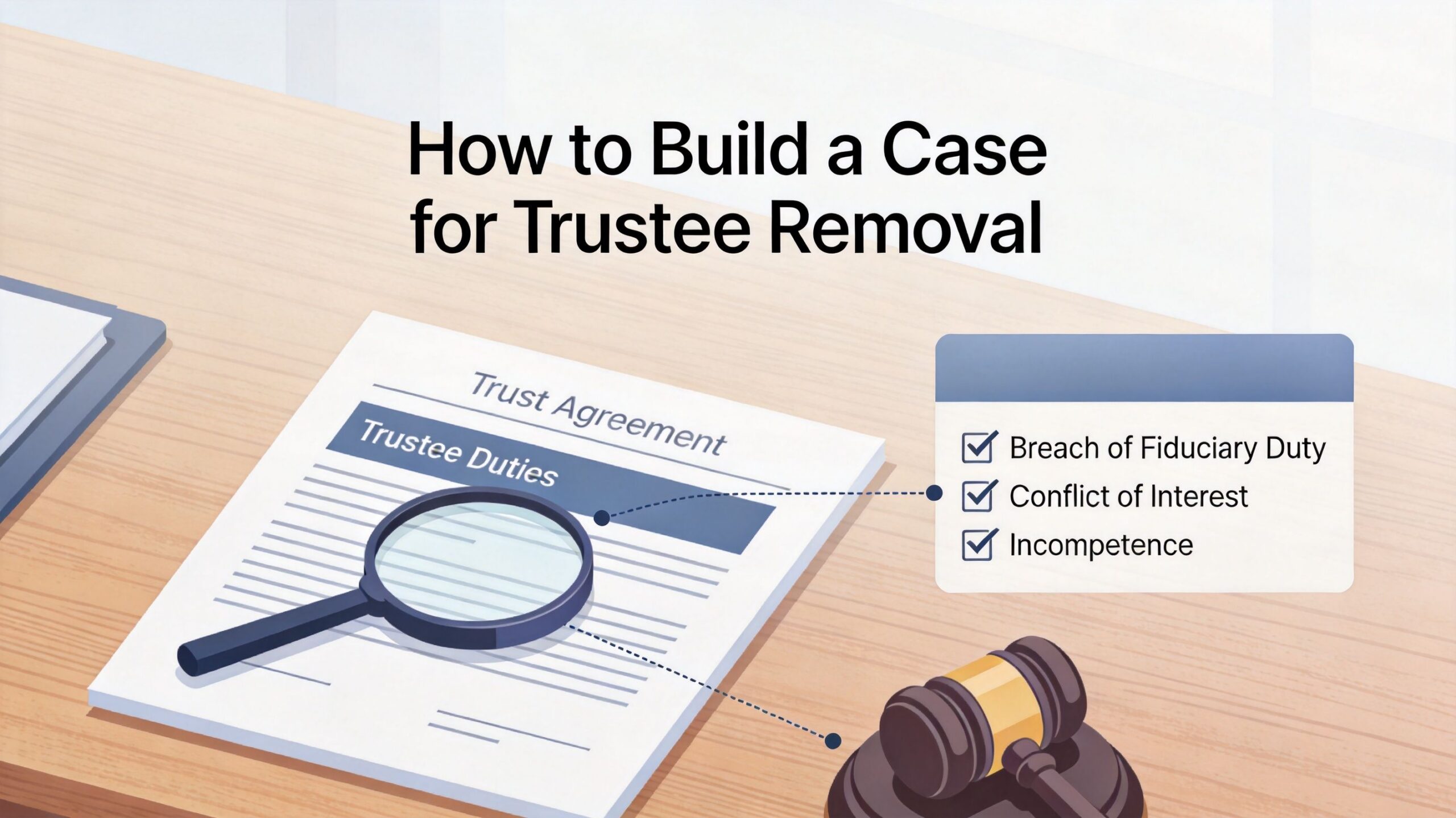
A good case is built the same way you would build any serious claim. You match duties to facts. The trust document states what the trustee is supposed to do. Your evidence shows what the trustee did or failed to do. The court then looks at whether that gap is serious enough to justify removal.
That distinction matters. A trustee does not get removed because family members dislike each other or because holiday dinners have become impossible. Removal becomes more realistic when the breakdown shows up in trust administration. Missing records, ignored requests, delayed distributions, unpaid taxes, unmanaged property, or deadlocked decisions are the kinds of facts that move a case from family tension to legal harm.
What evidence usually matters most
Start with the papers closest to the trust itself, then work outward.
Useful evidence often includes:
- The trust agreement and amendments: These show the trustee's duties, any limits on discretion, and any special procedures built into the trust.
- Written requests for information: Emails, letters, and text messages asking for accountings, records, explanations, or decisions.
- Responses, nonresponses, or refusals: Messages showing delay, stonewalling, or outright refusal to provide information.
- Trust financial records: Bank statements, transaction histories, tax documents, property records, and distribution records, if you can access them.
- A dated timeline: List requests, deadlines, missed follow-ups, canceled meetings, and trust decisions that stalled.
- Co-trustee or advisor communications: Notes showing that administration broke down because people with authority could not act together or could not get needed information.
A timeline is often more persuasive than a stack of loose emails. Judges need to see the pattern quickly. If your file shows that you asked for an accounting in January, followed up in February and March, and still had no records by May while bills went unpaid, the practical harm becomes much easier to understand.
What a lawyer is trying to prove
A Texas trust administration lawyer usually looks for three connected points.
First, the trustee had a duty. Second, the trustee failed to meet that duty or became unable to carry it out responsibly. Third, that failure caused a real trust problem, not just hurt feelings.
That is why specific examples matter so much. "She is unfair" is hard to prove. "She refused repeated written requests for an accounting, did not explain trust expenditures, and delayed a required distribution for months" gives the court something concrete to evaluate.
If accounting information is missing, beneficiaries may need to force the issue before asking for removal. A petition for accounting in a Texas trust matter can help turn suspicion into records the court can use.
In some cases, removal is part of a larger dispute involving damages, instructions to the trustee, or other fiduciary claims. This overview of lawsuits targeting a trustee gives useful context for how these disputes can develop.
A practical checklist before filing
Try to gather the following before you meet with counsel:
- The trust agreement and every amendment
- Names and contact information for trustees, co-trustees, and beneficiaries
- Copies of requests for records, accountings, or action
- Messages showing delay, refusal, or inconsistent explanations
- Proof of missed, reduced, or delayed distributions
- Records of financial harm, administrative delay, or property neglect
- Notes from meetings or calls where trust business stalled
You do not need a perfect file to ask for legal advice. You do need enough information to show a pattern. Even a well-organized folder with emails, letters, and a clean timeline can help a lawyer assess whether the family conflict has crossed the line into a trust administration problem the court may act on.
If you're looking at broader support options, firms like the Law Office of Bryan Fagan, PLLC handle trust administration, fiduciary disputes, probate, guardianship, estate planning, and asset protection matters, which can be important when a trustee conflict overlaps with incapacity or other family legal issues.
The Step-by-Step Process to Petition the Court
For many families, the court process feels intimidating because it's unfamiliar, not because it's impossible. Once you break it into stages, it becomes easier to understand what happens.

Under Texas guidance on removing a trustee from a family trust, courts treat removal based on family conflict under the same fiduciary-duty framework used for economic mismanagement. Practitioners connect the conflict to duties of loyalty, prudence, and accountability, and they attach hard indicators to show causation.
Step one through step three
- Hire counsel and review the trust
A lawyer reviews the trust terms, the family history, and the paper trail. The legal theory is built upon this review. The question is whether the facts support removal, another remedy, or a less adversarial option.
File the petition
The petition tells the court what relief you're requesting and why. It should identify the trustee, describe the trust, state the legal grounds for removal, and attach or reference the facts that support those grounds.
Serve notice on the interested parties
The trustee and other required parties must receive formal notice. That gives everyone a chance to respond.
Step four and step five
Exchange information through discovery
Discovery is the evidence-gathering stage. Parties may request documents, written answers, and testimony. This is often where hidden issues surface, especially if records were not being shared voluntarily.
Attend hearing, mediation, or trial
The court may encourage or require settlement efforts before making a final ruling. If the case isn't resolved, the judge hears the evidence and decides whether removal is warranted.
Courts want to see causation. It isn't enough to prove conflict exists. You need to show that the conflict threatens trust property, delays administration, or impairs the trust's purpose.
What outcomes are possible
A trustee removal case doesn't always end with a dramatic courtroom order. Sometimes the trustee resigns. Sometimes the court orders an accounting first. Sometimes the judge appoints an independent replacement or allows another structural solution.
If you're trying to understand the broader litigation context, this overview of lawsuits targeting a trustee can help frame how trust disputes may expand beyond a simple request for removal.
A Texas estate planning attorney or trust litigation lawyer can also help you decide whether filing now makes sense or whether more evidence should be gathered first.
Exploring Alternatives to Litigation
Going to court isn't always the smartest first move. In many families, litigation deepens the conflict, drains trust assets, and makes future administration harder. Even when a beneficiary has a strong position, a negotiated solution may produce a better result.
Texas practice materials note that courts often look at whether conflict might be resolved by mediation, co-trustee appointment, or another alternative before ordering removal. That makes practical sense. If the trust can be protected without a full court fight, everyone usually benefits.
Mediation can reset communication
Mediation puts the parties in a structured setting with a neutral third party. The goal isn't to force everyone to become friends. The goal is to solve a legal and administrative problem.
In a mediation, parties may agree to:
- Set communication rules: Monthly reports, response deadlines, or shared access to records.
- Define distribution procedures: Clear timing and documentation for payments.
- Limit trustee discretion in practice: Not by rewriting the trust informally, but by creating agreed reporting and review habits.
- Create a transition plan: The trustee may step down voluntarily under agreed terms.
Families who want to understand the format of a neutral facilitated process may find this explanation of SMB Law PC family mediation useful as a general reference point for how mediation can reduce conflict.
Other practical options
Not every case needs immediate removal. Depending on the trust terms and the people involved, these alternatives may work:
- Voluntary resignation: A trustee may agree to step down if the transition is handled respectfully and clearly.
- Appointment of a co-trustee: A second trustee can create balance when one person shouldn't act alone.
- Independent professional trustee: When family friction is chronic, a neutral fiduciary may be the cleanest fix.
- Targeted court relief short of removal: Sometimes the better first request is an accounting, instructions, or limits on specific conduct.
A practical settlement often protects the trust better than a righteous fight. The best outcome is the one that restores proper administration.
When litigation is still necessary
Alternatives are valuable, but they aren't always enough. If the trustee is hiding records, acting out of self-interest, refusing all cooperation, or causing ongoing harm, waiting can make things worse.
That's especially true when trust administration overlaps with aging, incapacity, probate disputes, or the need for coordinated planning. In those situations, families may need help not only with trust litigation, but also with estate planning, probate, guardianship, or asset protection concerns tied to the same conflict.
Frequently Asked Questions About Texas Trustee Removal
Can co-trustees who are in conflict be removed
Yes, they can. Conflict between co-trustees becomes a legal issue when the hostility or lack of cooperation prevents effective administration. If co-trustees can't make required decisions, won't communicate, or repeatedly block basic trust actions, the court may consider removal or another structural fix.
Sometimes the cleaner solution is to remove one co-trustee. In other cases, the court may favor appointing an independent trustee to break the deadlock.
What happens after a trustee is removed
That depends first on the trust document. Some trusts name a successor trustee in advance. If the trust doesn't provide a workable replacement process, the court may appoint one.
The immediate goal is continuity. Someone must be able to gather records, secure trust property, communicate with beneficiaries, and keep the trust functioning. The outgoing trustee may also be required to turn over files, account for prior actions, and transfer control of trust assets.
How much does it cost to remove a trustee in Texas
There's no single answer. Cost depends on how contested the case is, how much evidence must be gathered, whether experts are needed, whether mediation works, and how long the dispute lasts.
A narrow case focused on missing accountings may look very different from a family battle involving multiple beneficiaries, incapacity concerns, and disputed distributions. That's why an early case evaluation matters. It helps you compare the likely cost of litigation with the likely benefit of removal or another remedy.
Do I need proof of stolen money to ask for removal
No. Theft or self-dealing can support removal, but they aren't the only grounds. In Texas, the problem may also be incapacity, refusal to communicate, failure to account, or severe friction that impairs trust administration.
That point often reassures beneficiaries who know something is wrong but don't yet have evidence of outright financial misconduct. The law recognizes that a trust can be harmed by administrative breakdown, not just by missing funds.
What should I do first if I think family conflict is harming the trust
Start by organizing your information. Gather the trust document, save all communications, make a timeline, and write down the practical problems you're seeing. Focus on trust-related issues, not every family grievance.
Then speak with counsel. A lawyer can help you decide whether the better first step is requesting records, seeking an accounting, pursuing mediation, or filing a petition for removal.
If you're managing a trust or facing a dispute over one, Law Office of Bryan Fagan, PLLC can help you understand your options under Texas law. Our attorneys assist trustees, beneficiaries, and families with trust administration, fiduciary disputes, probate, guardianship, estate planning, and asset protection. If you need specific guidance on whether a trustee can be removed for family conflict in Texas, contact us for a free consultation.