Skip to content
A standard, uncontested guardianship in Texas typically costs between $3,000 and $10,000. If the case becomes contested, the price can rise sharply, which is why families often feel anxious about both the legal process and the financial strain.
Managing a loved one's affairs can feel overwhelming, but with the right legal guidance, it doesn't have to be. Many families reach this point slowly. A parent starts missing bills, a hospital asks who has legal authority to consent to care, or siblings gather around a kitchen table and realize that “we'll figure it out later” isn't really a plan.
That moment carries two kinds of pressure. One is emotional. You're trying to protect someone you love without taking away more independence than necessary. The other is financial. You need clear answers about guardianship costs before you can decide whether to move forward, explore alternatives, or prepare for a longer court process.
In Texas, guardianship sits inside a broader framework of Texas Estates Code procedures and fiduciary duties in Texas. If a court appoints a guardian, that person doesn't just “help out.” The guardian takes on legal duties to act in the ward's best interest, manage money carefully, keep records, and report to the court. Those same fiduciary principles also show up in trust and estate work under the Texas Trust Code, which is why families often benefit from looking at guardianship, estate planning, probate, and asset protection as connected issues rather than separate ones.
Navigating the Financials of Guardianship in Texas
One family conversation often starts this process. A daughter notices her father has been giving money to strangers over the phone. Her brother says Dad is “just forgetful.” The hospital social worker asks who can approve discharge plans. No one wants to argue, but no one wants to wait either.
That's where guardianship costs become more than a legal line item. They become part of a larger decision about safety, dignity, and timing.

A delayed decision can carry a price of its own. A national analysis discussed in this medical and legal review of guardianship delays found that medically unnecessary hospital “hoteling” days while patients waited for a guardian cost the U.S. healthcare system an average of $1,093.51 per day. That helps explain why families often feel urgency even when they're still sorting through the legal and emotional questions.
Why families feel stuck
People often assume there are only two choices. Either do nothing and hope things improve, or file for guardianship immediately. Real life is messier than that.
A family may be asking questions like these:
- Can Mom still make some decisions? If so, a full guardianship may not be the right first move.
- Who pays the legal bills? The answer depends on the case and the available estate.
- Will siblings fight about it? Even a manageable legal issue can become expensive when family members disagree.
- Is there another planning tool available? Sometimes there is, especially if incapacity planning was done early.
Practical rule: Guardianship is often necessary when no less restrictive option will protect the person, but cost planning matters just as much as legal planning.
Texas courts take guardianship seriously because it affects personal rights and financial control. That's why the process can feel formal and expensive. Still, when families understand the moving parts, the process becomes easier to budget for and less intimidating to discuss.
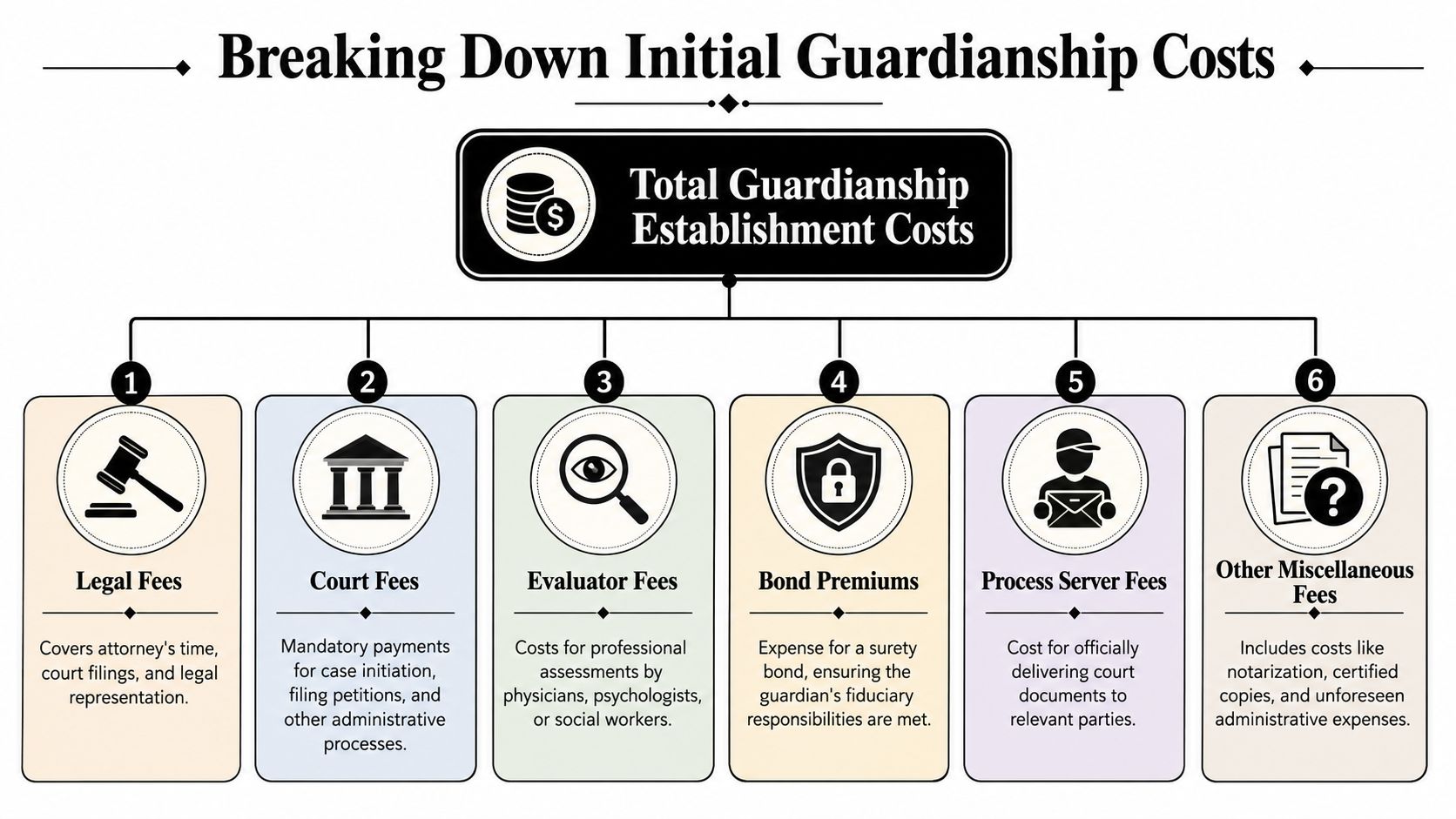
Breaking Down Initial Guardianship Costs
The biggest mistake I see is treating guardianship as one flat fee. It isn't. Most families are really looking at a bundle of one-time startup expenses, and each one has a different purpose.
In Texas, the total cost to establish guardianship typically ranges from $3,000 to $10,000 for standard cases, driven primarily by attorney fees of $2,000 to $5,000, court filing fees of $250 to $400, and mandatory medical evaluations of $500 to $2,000, as outlined in this Texas guardianship cost guide.
The main startup expenses
Here's how those costs usually break down in plain English.
Attorney fees
These often make up the largest part of the bill. Your lawyer prepares the application, coordinates required filings, helps gather evidence, appears in court, and guides you through Texas Estates Code requirements.Court filing fees
These are the fees paid to open the case with the court. They vary by county.Medical evaluation costs
The court typically needs evidence about the proposed ward's capacity. That usually means a physician or another qualified professional must evaluate the person and provide documentation.Possible ad litem or related court-appointed roles
In many cases, the court appoints someone to protect the proposed ward's interests. Those costs can become part of the overall budget.Bond-related expenses
If the guardian will manage money or property, the court may require a bond. That cost depends on the circumstances of the estate and the court's order.
Why each line item exists
Families sometimes get frustrated when they see multiple charges and think the process is duplicative. Usually, each cost connects to a different legal safeguard.
The attorney handles procedure and advocacy. The court filing fee opens the case. The medical evaluation gives the judge evidence. A bond protects the ward's assets when a guardian of the estate is involved. These are all part of the court's effort to balance protection with accountability.
A good starting point is learning the filing process itself. This step-by-step overview on how to apply for guardianship in Texas helps families see where the expenses usually appear. If your family is also juggling trust issues at the same time, First Steps for a Successor Trustee in Texas can help clarify what to do immediately after stepping into the trustee role.
One of the fastest ways to lower stress is to gather records before the first legal meeting. Medical notes, a medication list, insurance information, and a basic asset list can save time and reduce confusion.
Capacity evidence can be a sticking point
Many families struggle most with the evaluation piece. They know something is wrong, but they don't know what documentation the court will require. While Texas procedures control in a Texas case, a plain-language resource like Orange Neurosciences' guide can still help families understand what capacity assessors do and why courts rely on professional evaluations.
That understanding matters. Guardianship cases often turn on whether the evidence clearly shows the person needs help, what kind of help is needed, and whether a less restrictive option would work instead.
Planning for Long-Term Guardianship Costs
The initial filing is only the opening chapter. Once the court appoints a guardian, ongoing work begins. That's where many families need a realistic budget, especially if the guardianship may last for years.
Under Texas law, a guardian is a fiduciary. That means the guardian must act in the ward's best interest, keep money separate, maintain records, and report to the court. Those fiduciary duties in Texas overlap with the same care-and-loyalty principles people see in trust administration under the Texas Trust Code. Different legal roles, same core idea. If you control someone else's money or rights, the law expects careful, documented decision-making.
Recurring expenses to expect
Ongoing guardianship costs in Texas can include annual accounting and reporting fees of $500 to $2,000 for professional preparation, annual court filing fees for reports of $50 to $150, court bond premiums, and continuing legal consultations at $100 to $400 per hour, according to this overview of continuing guardianship expenses in Texas.
That list matters because annual costs can sneak up on families. A guardian of the person may deal mainly with care decisions and required reports. A guardian of the estate usually faces heavier bookkeeping and more court oversight because money is involved.
A simple way to think about annual obligations
| Ongoing duty | Why it matters |
|---|---|
| Annual reports | The court wants current information about the ward's condition and circumstances |
| Annual accountings | The court reviews how money was received, spent, and protected |
| Bond premiums | The bond may remain in place to protect the estate |
| Legal advice | Questions arise about spending, sales, court approval, and compliance |
For many families, long-term planning and asset protection become part of the conversation. If nursing home care, Medicaid planning, or ongoing residential expenses are involved, families may also need to think about preserving resources while still meeting immediate care needs. This guide on protecting assets from nursing home costs is often useful when guardianship and long-term care planning overlap.
Can the guardian be paid
Yes, sometimes. But compensation isn't unlimited.
For a guardian of the person serving in Texas, statutory compensation is capped at the greater of $3,000 per year or five percent of the ward's gross income, subject to the applicable legal framework and court approval, as discussed in this explanation of Texas guardian compensation limits.
That cap can surprise people. A family member may spend substantial time coordinating care, attending appointments, managing paperwork, and responding to emergencies, yet still have limited compensation available. That's one reason detailed records matter so much. Courts want to see what was done, why it was necessary, and how the ward's interests were protected.
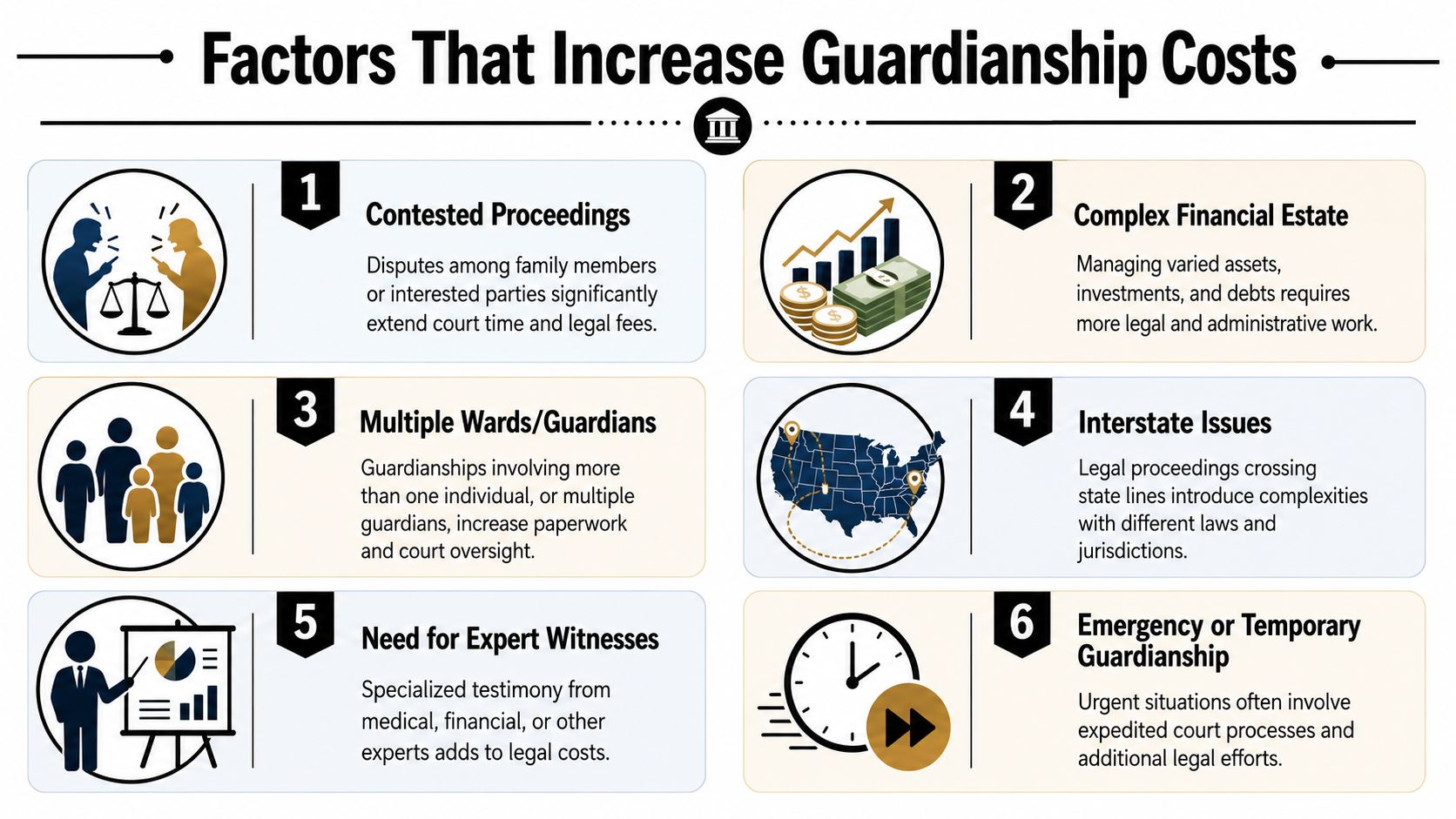
Factors That Increase Guardianship Costs
Some guardianship cases stay focused and orderly. Others grow expensive because the facts, family dynamics, or asset issues make the court process more complicated.
The biggest cost driver is conflict. When people disagree about capacity, accuse each other of bad motives, or fight over who should serve, attorney time expands quickly, hearings multiply, and the court may need more evidence before making a decision.
Contested cases change the math
When a guardianship case becomes contested or involves intense conflict, total legal fees frequently range between $20,000 and $50,000, as noted in this discussion of contested and emergency guardianship expenses.
That kind of increase usually doesn't happen because one form costs more. It happens because the case requires more lawyer time, more court appearances, more investigation, and sometimes more professionals in the middle.
If one sibling believes a guardianship is necessary and another claims it's a power grab, the legal issue stops being purely medical. It becomes an evidence problem, a family dispute, and a court management problem all at once.
Common reasons costs climb
Family disagreement
Disputes about capacity, choice of guardian, or money almost always increase fees.A guardianship of the estate
Managing investments, accounts, real property, or business interests tends to require more detailed accounting and tighter court supervision.Emergency timing
Urgent facts can compress deadlines and force lawyers and families to move quickly.Messy records
Missing account statements, unclear ownership, and undocumented transfers create more work.Related trust or probate issues
If a will contest, trust administration issue, or beneficiary dispute is happening at the same time, the legal picture gets more crowded.
Person versus estate
Families often ask why one guardianship costs more than another even when the hearing looks similar from the outside. The answer is usually the difference between managing a person's care and managing that person's money.
A guardian of the person focuses on living arrangements, medical needs, and daily welfare. A guardian of the estate must handle finances under strict fiduciary rules. That means records, approvals, accountings, and more court attention. The court's goal is to protect the ward from neglect, but also from financial misuse.
This is where the Texas Estates Code and fiduciary principles matter in everyday terms. If you touch someone else's money, you need a paper trail. If you ask the court to approve a transaction, you need records that support it. That discipline keeps many cases manageable and keeps some from turning into disputes.
Smart Strategies for Managing Guardianship Expenses
Families can't control everything in a guardianship case, but they can control a surprising amount. Good preparation won't erase the legal requirements, but it often reduces wasted attorney time, prevents repeat filings, and lowers the chances of a preventable fight.
The most effective cost strategy is simple. Be organized early and communicate clearly.
What helps keep costs under control
Gather the basic documents first
Bring identification, medical records, medication lists, benefit information, recent bank statements, property records, and any existing powers of attorney or trust papers. Lawyers bill less time when they don't have to chase missing basics.Decide who will speak for the family
One point person can coordinate records, answer questions, and keep relatives informed. That reduces duplicate calls and mixed messages.Use careful record-keeping from day one
Save receipts, note every major decision, and document why money was spent. Those habits matter later when annual reporting begins or when someone questions a decision.
Communication can save money
Many contested cases don't start with bad facts. They start with poor communication. One sibling files without telling the others. Another hears half the story and assumes the worst. Resentment grows before the legal process even begins.
A short family meeting, a written summary from counsel, or a clear explanation of the medical concerns can sometimes keep disagreement from turning into litigation. It won't solve every conflict, but it often narrows the issues.
Bottom line: The less time your lawyer spends sorting out family confusion, the more time your lawyer can spend moving the case forward.
Think beyond the court filing
Guardianship sometimes leads to related decisions about the home, personal property, and long-term care transitions. If a residence may need to be emptied or sold, it helps to understand practical costs outside the courtroom too. Families often appreciate a consumer-focused breakdown of true estate sale costs because those expenses can affect cash flow during a guardianship.
A knowledgeable Texas estate planning attorney or guardianship lawyer can also help spot issues that belong in other legal lanes. Some families need probate guidance. Others need trust administration help, tax planning, or advice about preserving assets for future care. The Law Office of Bryan Fagan, PLLC handles matters involving estate planning, probate, guardianship, and asset protection, which can be useful when one family problem touches several areas of Texas trust and estate law.
Practical habits that pay off later
- Use one ledger for all ward-related spending.
- Keep personal funds separate from ward funds at all times.
- Ask before acting if you're unsure whether court approval is needed.
- Review old planning documents so you don't duplicate authority that already exists.
- Meet early with counsel when a dispute seems likely.
Those steps may sound modest, but in fiduciary work, modest habits prevent expensive problems.
Exploring Cost-Effective Alternatives to Guardianship
Guardianship is sometimes necessary, but it's often a reactive solution. A family discovers incapacity after the fact and has to ask the court for authority that could have been granted privately years earlier.
That's why proactive planning matters so much.

A frequently overlooked point is the cost gap between reactive and proactive planning. This comparison of guardianship and advance planning tools notes that the average uncontested guardianship costs $1,800 to $3,000 in Texas, while a durable financial power of attorney and advanced medical directive cost only approximately $500.
Side-by-side thinking
Here's the practical difference:
Guardianship
Court involvement, judicial oversight, ongoing reporting, and the possible loss of personal decision-making rights.Durable Power of Attorney
Lets a trusted agent handle financial matters without a court guardianship, if the document is valid and the situation fits.Medical Power of Attorney and advance directives
Let a person name who can make health decisions and communicate treatment wishes.Revocable living trust
Can help manage assets during incapacity and may reduce the need for a guardianship of the estate, depending on how it is drafted and funded.
If you want a plain-language primer on authority over medical and personal decisions, this article on POA for end-of-life planning gives a helpful overview.
Here's a related video many families find useful as they compare these tools:
Why this matters emotionally as well as financially
Families often focus on dollars first, but the emotional side is just as important. Estate planning lets a person choose who will help them. Guardianship asks a judge to decide after a crisis has already developed.
That difference changes the feel of the whole process. Planning early usually means more privacy, less conflict, and fewer emergencies. It also fits the broader goals of trust administration and incapacity planning under Texas law. A Texas trust administration lawyer or Texas estate planning attorney can help families coordinate trusts, powers of attorney, directives, and beneficiary planning so the documents work together.
If you're weighing court involvement against private planning tools, this guide on the difference between guardian and power of attorney can help clarify when each option makes sense.
Trusts and modification questions
Families also ask how to modify a trust in Texas when incapacity planning needs updating. That question often comes up when parents created an older plan that no longer fits current health or asset realities. The right answer depends on the trust terms, the person's current capacity, and whether a trustee or successor trustee is already serving. That's where a careful review under the Texas Trust Code becomes important.
Common Questions About Guardianship Costs in Texas
Who usually pays guardianship costs
Often, the proposed ward's estate may bear approved costs, but payment issues depend on the facts, available assets, and what the court approves. Families shouldn't assume the applicant personally pays every expense, and they also shouldn't assume every expense will automatically come from the ward's funds.
Are guardianship costs tax-deductible
That depends on the nature of the expense, the ward's financial situation, and the advice of a qualified tax professional. Legal fees, medical costs, fiduciary expenses, and estate-related administration don't all get treated the same way. Guardians should coordinate with a CPA when tax filing and fiduciary reporting overlap.
Can a guardian use Social Security funds to pay fees
This is an area where people can get into trouble by guessing. Under SSA guidelines, guardianship fees are included as part of a state's support obligation, and misusing funds can violate federal regulations, as explained in the SSA policy guidance on use of benefits and guardianship-related obligations.
That means a guardian or representative payee should be very careful before using Social Security benefits for guardianship-related expenses. If there's any doubt, get legal guidance first.
What's the most practical way to reduce future guardianship costs
Early planning usually helps the most. Durable powers of attorney, medical directives, trusts, and clear incapacity planning can reduce the chance that your family will need a full court-supervised guardianship later. They also make it easier for trustees, executors, beneficiaries, and caregivers to understand their responsibilities when a health crisis happens.
For families already in a guardianship, the best cost control usually comes from three habits. Keep records, follow court orders closely, and ask for advice before making a questionable financial move.
If you're managing a trust, facing a possible guardianship, or trying to protect a loved one's finances before a crisis gets worse, contact Law Office of Bryan Fagan, PLLC for a free consultation. Our attorneys provide trusted, Texas-based guidance on estate planning, probate, guardianship, trust administration, fiduciary duties in Texas, tax planning, dispute resolution, and how to modify a trust in Texas so your family can move forward with clarity and confidence.