You've done the hard part. You created a trust, chose the people you trust to carry out your wishes, and started organizing your affairs. Then a very normal question appears: what happens to the things that never made it into the trust?
That question comes up more often than most families expect. A bank account opened years ago. A vehicle title still in your individual name. A refund, inheritance, or final payment that arrives later. In Texas, a pour over will is the backup document designed for that exact problem.
A lot of people also hear one misleading idea: that a pour over will lets everything avoid probate. It doesn't. It helps, but in a very specific way. If you understand that distinction, your estate plan becomes much clearer and much safer.
Your Texas Estate Plan a Safety Net for Your Legacy
A common Texas estate planning story goes like this. A married couple signs a revocable living trust. They transfer their home, some investment accounts, and key savings into the trust. They feel relief because they've created a plan that can keep those assets organized and, for trust-owned property, outside the probate process.
Then life keeps moving.
They buy a replacement car. One spouse opens a small checking account for household expenses. An old certificate of deposit gets renewed in an individual name. None of that means they failed. It means they're human.
That's where a pour over will fits. It works like a safety net under the trust. If something was left outside the trust at death, the will directs that property into the trust so one set of instructions governs the final distribution.
Why families need a backup
Even careful people miss details when titles, beneficiary designations, and account ownership are involved. Estate planning isn't just about signing documents. It's also about keeping ownership aligned with the plan over time.
Practical rule: Your trust does the main work. Your pour over will catches what slips through.
For families trying to understand how different assets affect an estate, resources like Coveredly for comprehensive estate planning can help clarify how property may or may not pass through an estate.
A good plan gives your loved ones both direction and flexibility. The trust provides the roadmap. The pour over will helps make sure an overlooked asset still gets where it was supposed to go.
What Is a Pour Over Will Under Texas Law
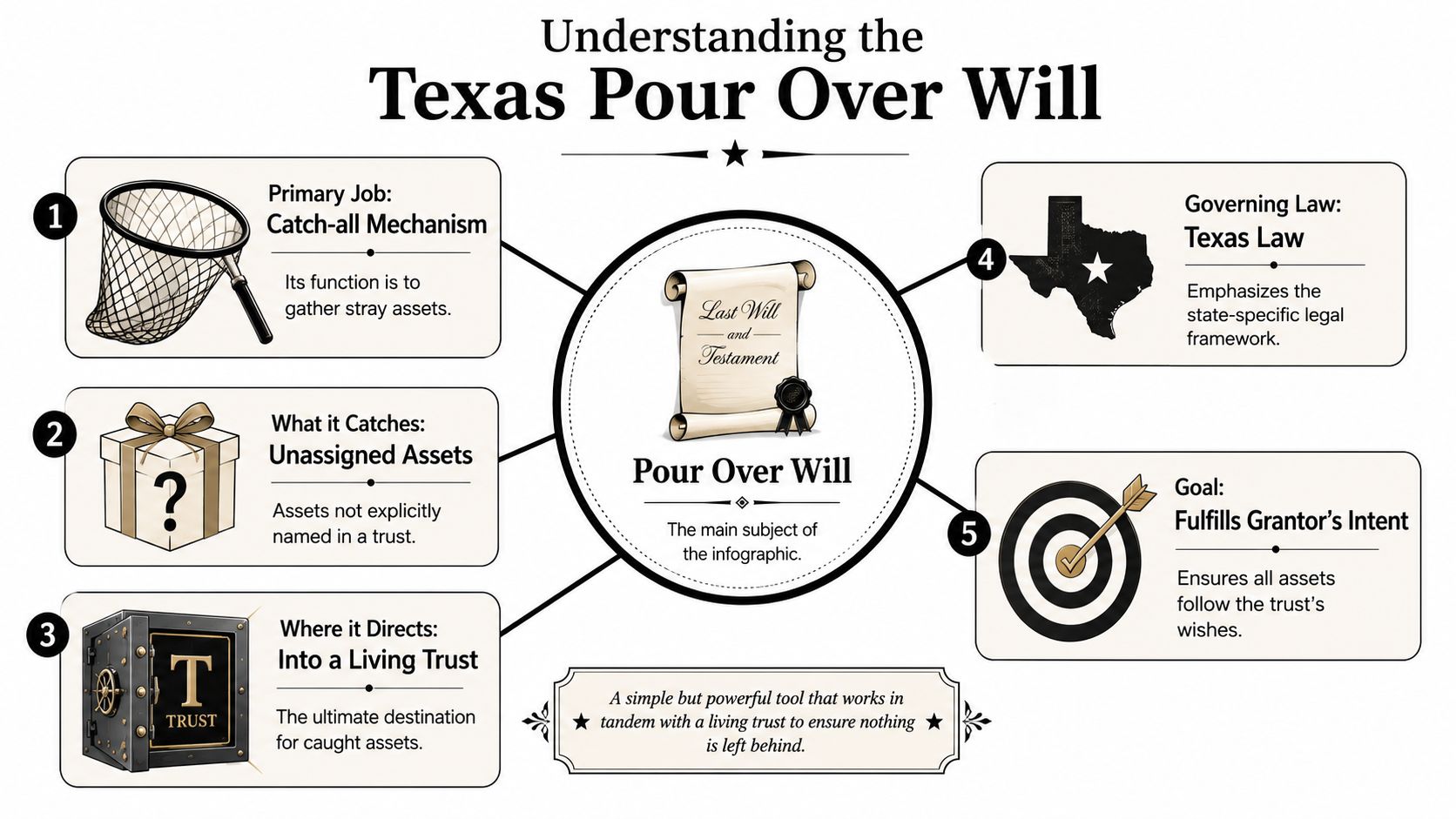
A pour over will in Texas is a will that sends probate assets into your existing revocable living trust instead of distributing them directly to individual beneficiaries. Its job is narrow, but very important.
Think of it as a catch-all document. If you die owning property in your own name that should have been in the trust, the pour over will tells the executor to gather that property and route it to the trust.
What makes it valid in Texas
In Texas, a pour-over will is a legally valid testamentary document only if it follows the execution rules in the Texas Estates Code. Under Texas Estates Code Section 251.051, the will must be signed by the testator and attested by two credible witnesses who are at least 14 years old, as described in this discussion of Texas pour-over wills and probate requirements.
That tells us two things.
- It's still a real will: It must be signed correctly and witnessed correctly.
- It's not just trust paperwork: If the will isn't properly executed, the backup may fail when your family needs it.
It only works with a trust
A pour over will isn't a standalone estate plan. In Texas, it functions exclusively as a safety net paired with a revocable living trust and is legally invalid if created without an existing trust to receive the assets, as explained in Grogan Law's overview of Texas pour-over wills.
That same source explains two practical points families often overlook:
| Issue | Why it matters |
|---|---|
| Trust timing | The trust should exist before or at the same time as the will |
| Plan review | Attorneys commonly recommend reviewing both documents every three to five years |
A pour over will doesn't replace a trust. It points back to one.
If you're searching for “pour over will texas,” that's the core answer. It's a backup will that only makes sense as part of a trust-based plan.
The Essential Partnership with a Revocable Living Trust
A pour over will and a revocable living trust should be viewed as one coordinated strategy, not two separate plans. The trust holds the detailed instructions. The will acts like a funnel, moving missed assets into that trust after death.
If you want a basic primer on how the trust itself works during life, this overview of what a revocable trust is in Texas is a useful starting point.
How the handoff works
The trust usually says who receives what, when they receive it, and under what conditions. That can be especially useful for blended families, beneficiaries who need staged distributions, or children who shouldn't inherit assets outright at a young age.
The pour over will supports that structure by naming the trust as the recipient of estate assets left outside the trust. Instead of creating a separate set of inheritance instructions in the will, the will pushes those assets back into the trust system.
Consider a simple example:
- Maria creates a revocable living trust.
- She transfers her home and brokerage account into it.
- She forgets to retitle a small ranch vehicle and one old savings account.
- At Maria's death, the trust controls the assets already inside it.
- The pour over will directs the forgotten property into the trust so the trustee can handle everything under one plan.
That kind of alignment prevents the estate from splitting into two separate distribution systems.
The trustee's role after assets reach the trust
Once assets arrive in the trust, the trustee takes over. Texas law gives trustees serious responsibilities. Under Texas Trust Code Section 111.0035, trustees have non-waivable core duties that include the duty of loyalty, the duty of prudence, and the duty to administer the trust strictly according to its terms, as outlined in this discussion of trustee responsibilities under Texas law.
Those duties matter in real life.
- Duty of loyalty: The trustee must put the trust's interests ahead of personal interests.
- Duty of prudence: The trustee must manage assets as an “ordinary prudent person” would.
- Follow the trust terms: The trustee can't rewrite the grantor's plan just because family members disagree.
If the trust says a beneficiary receives funds in stages, the trustee must honor that structure even when a family member asks for an exception.
Families often reach this stage with practical questions about timing, notice, distributions, and next steps after death. A focused resource such as Administering a Revocable Living Trust After Death in Texas explains how a revocable trust becomes irrevocable and is administered at death.
Why this partnership matters
The trust brings privacy and structure for assets properly titled into it during life. The pour over will catches the leftovers. Together, they help preserve a single distribution plan instead of leaving forgotten assets to be handled under default inheritance rules.
That's why a Texas estate planning attorney usually treats the pour over will as supporting trust administration, not as a substitute for it.
How Pour Over Wills Navigate the Texas Probate System
Many people hear “trust-based estate plan” and assume “no probate at all.” That's the part that causes confusion.
Property already owned by the trust can avoid probate. But property captured by a pour over will must go through the Texas probate process before it can move into the trust.
A court has to recognize the will, confirm the executor's authority, and allow the transfer. That isn't a flaw in the plan. It's the legal step that changes title from the deceased person's estate to the trust.
For a visual overview, this process chart helps:
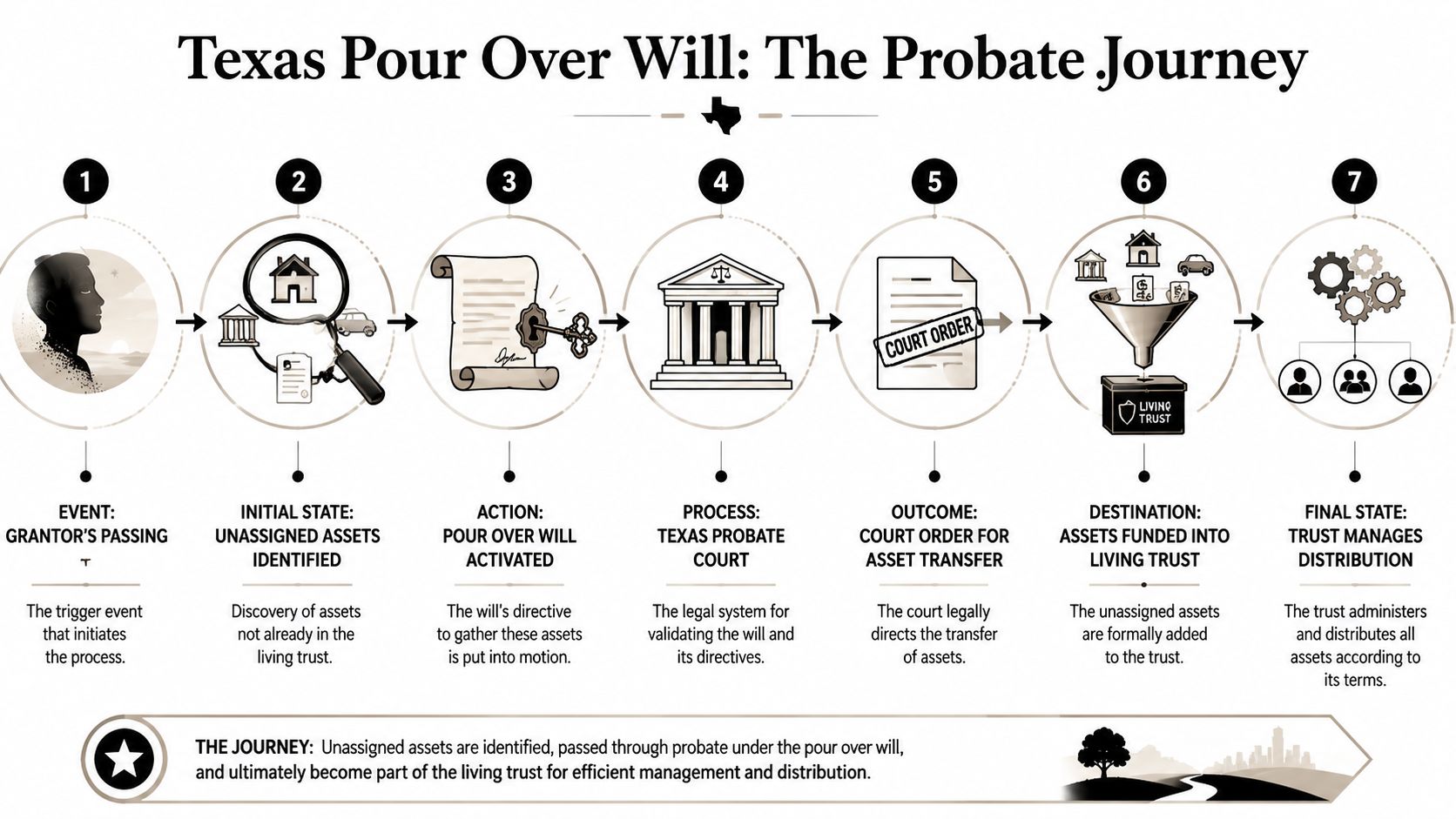
What probate looks like with a pour over will
Texas law requires assets captured by a pour-over will to go through formal probate. The probate court reviews the will to confirm validity and issues Letters Testamentary, which gives the executor authority to manage and transfer estate assets into the trust, as described in this explanation of Texas pour-over wills and the probate process.
That process is often more manageable than families fear because the will gives direction. The executor isn't guessing where the assets should go. The will points to the trust.
Here's the typical flow:
- The executor files the will with the probate court.
- The court reviews the document. The court is checking legal validity.
- The executor receives Letters Testamentary. This is the formal proof of authority.
- The executor collects the probate assets.
- Those assets transfer into the trust.
- The trustee administers them under the trust terms.
Why this still helps
A pour over will doesn't eliminate probate for stray assets, but it can simplify the direction of travel. Without that will, forgotten property may pass under Texas intestacy rules instead of under your trust instructions.
That difference matters if your trust contains careful planning for children, remarriages, asset management, or family business interests.
This short video also gives families a practical way to think about probate and trust planning in Texas.
A point executors should remember
The probate filing deadline also matters. A pour over will must be filed for probate within four years after death under the rule described earlier in the Grogan Law discussion. Waiting too long can create avoidable problems for the transfer into the trust.
Probate through a pour over will is usually best understood as controlled probate. The court process still exists, but the will tells the executor and the court exactly where the assets are supposed to end up.
For executors, trustees, and beneficiaries, that clarity can reduce conflict even when some court involvement is still required.
Advantages and Common Misconceptions of Pour Over Wills
A pour over will is helpful because it protects the trust-based plan from ordinary human error. It gives your family a way to pull missed assets back into the structure you already built.
That benefit is real. So are the limits.
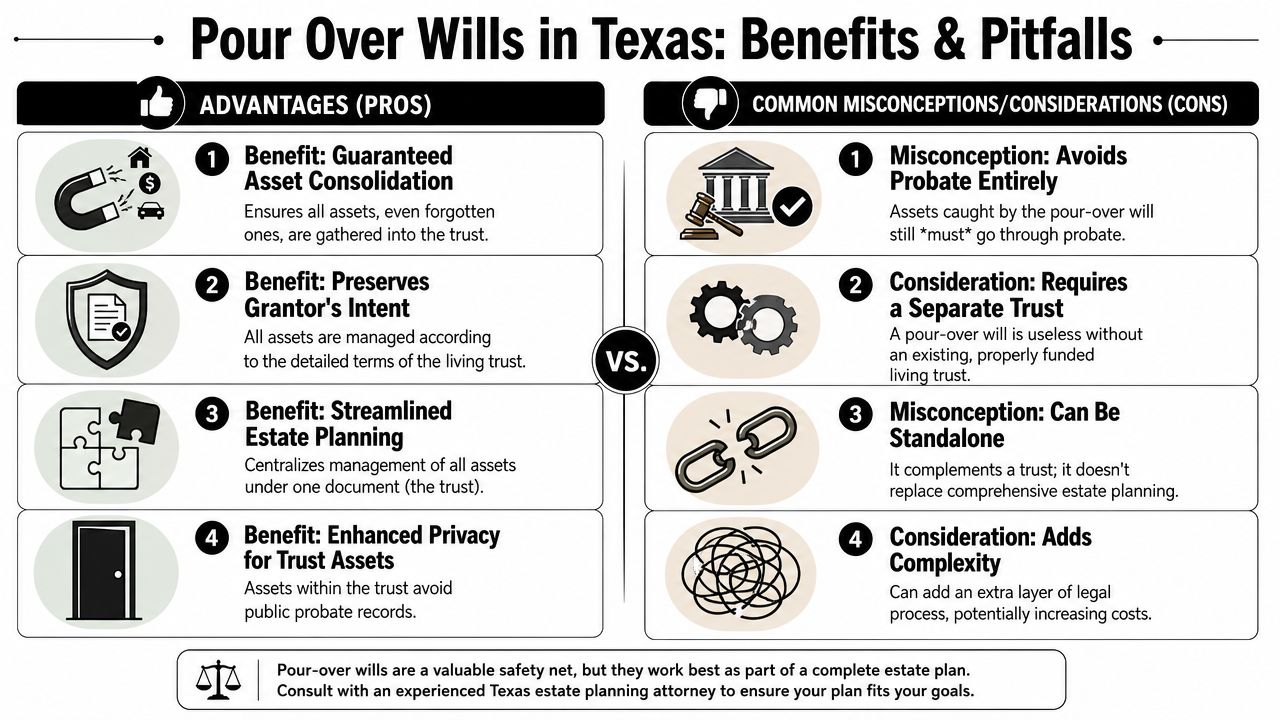
What a pour over will does well
The strongest advantage is consistency. If your trust contains detailed instructions, a pour over will helps bring stray property under those same instructions rather than letting it drift into a separate probate distribution.
That can help with situations such as:
| Situation | Why the pour over feature helps |
|---|---|
| Forgotten account | The asset can be redirected into the trust rather than distributed separately |
| Recently acquired property | New assets bought late in life often haven't been retitled yet |
| Complex family plans | The trust's timing and protection terms can still govern the missed asset |
It also helps reduce the risk that one overlooked item changes the balance of your entire plan.
What people get wrong
The biggest misconception is believing a pour over will can stand on its own. It can't. Texas law does not recognize it as valid without an associated trust. A source discussing this issue reports that a 2025 Texas Bar Association study found that 18% of probate cases involving “pour-over will only” documents were rejected by courts, causing delays for beneficiaries, according to Denton Legacy's review of pour-over will risks in Texas.
That's a serious warning sign for families trying to save money by skipping the trust. The shortcut can create a much larger problem later.
Other misunderstandings are more subtle:
- It doesn't avoid probate entirely: Assets caught by the will still pass through court.
- It doesn't create privacy for probate assets: A probated will becomes part of the court record.
- It doesn't excuse poor funding: The better your trust funding, the less your family has to clean up later.
Important distinction: A pour over will is insurance against mistakes. It isn't the main engine of the estate plan.
When families should pause and ask questions
You should get legal guidance if any of these apply:
- You created a trust years ago and aren't sure whether current assets were retitled.
- You signed a will but never signed a trust and thought the will was enough.
- You're an executor or beneficiary trying to sort out what belongs to the estate versus the trust.
- You expect conflict among children, a surviving spouse, or business successors.
This is where a Texas estate planning attorney or Texas trust administration lawyer adds value. The issue usually isn't just drafting. It's coordinating the will, trust, probate process, and fiduciary roles so they work together.
Drafting and Funding Best Practices for Your Estate Plan
The best pour over will is the one your family barely needs because your trust was funded carefully during your lifetime.
Funding means changing ownership so assets are held by the trust when appropriate. Signing the trust document alone doesn't complete that work.
A practical funding checklist
A strong estate plan often includes reviewing these categories one by one. Guidance on how to transfer property to a trust in Texas can help families and fiduciaries understand the transfer process.
Use a checklist like this:
- Real estate: Confirm the deed reflects the trust when that transfer fits your plan.
- Bank accounts: Check title and ownership language with the financial institution.
- Investment accounts: Make sure the account registration matches the trust arrangement.
- Vehicles: Review whether retitling is appropriate under your broader estate plan.
- Personal property: Keep assignment documents and clear records for valuable items.
- New assets: Revisit trust funding after major purchases, inheritance receipts, or refinancing.
What the will is trying to say
Most pour over wills contain language that, in plain English, works like this: any property still in my individual name at death should pass to my named trust and be distributed under that trust's terms.
The exact wording matters. So do the trust name and trust date. If the will points to the wrong trust, or to a trust that was changed without matching updates, confusion can follow.
A careful attorney will also help families think through related roles. The executor handles the probate estate. The trustee manages trust property. Sometimes that's the same person. Sometimes it shouldn't be.
Keep the plan current
Estate planning isn't one-and-done. As noted earlier from the Texas-specific source, attorneys commonly recommend reviewing trust-based plans every three to five years, and sooner after death, divorce, remarriage, or significant asset changes.
Beneficiaries and trustees should also know that trust administration carries ongoing disclosure duties. Under Texas Trust Code Section 113.152, trustees must provide certain accounting and disclosure items, including compensation records, updated beneficiary information, copies or relevant portions of the trust instrument, and a narrative of material facts affecting beneficiary rights, as explained in this summary of fiduciary duties and disclosures in Texas.
That administrative side matters after death. A cleanly drafted, well-funded plan is easier to carry out and easier to explain.
Get Trusted Guidance for Your Texas Estate Plan
A pour over will fills an important gap in a trust-based plan, but it only works when the foundation is sound. In Texas, that means a valid will, an existing revocable living trust, and a realistic understanding that stray assets may still need to pass through probate before they reach the trust.
Families often feel anxious because the documents seem technical. The good news is that the core ideas are manageable. Put the trust in place. Fund it carefully. Use the pour over will as backup. Choose fiduciaries who understand their duties. Review the plan as life changes.
If you're serving as an executor, trustee, or beneficiary, clarity matters just as much as drafting. Trustees in particular should remember that proper accountings can also create procedural protection. A trustee who fully complies with Texas Trust Code Section 113.152 generally gains the benefit under Section 113.151 that a beneficiary can't usually demand a second accounting for the same period until 12 months have passed, as discussed in Today's CPA on Texas trust accounting rules.
If you're managing a trust or planning your estate, contact The Law Office of Bryan Fagan, PLLC for a free consultation. Our attorneys provide trusted, Texas-based guidance for every step of the process.
If you need help with a pour over will, trust funding, probate, guardianship concerns, or asset protection planning, schedule a free consultation with Law Office of Bryan Fagan, PLLC. We help Texas families, trustees, executors, and beneficiaries understand their options and move forward with clear, practical legal guidance.