Managing a loved one's trust can feel overwhelming, especially when something seems off. You might be a beneficiary who asked for information and got silence. Or you might be a trustee doing your best and suddenly facing accusations from family members who think you made a bad call.
Both situations are stressful. Trust disputes often mix money, grief, old family tension, and legal rules that aren't easy to understand at first glance.
The good news is that Texas law gives both beneficiaries and trustees a clear framework. If you're worried about a trustee breach of fiduciary duty in Texas, the first step is understanding what the trustee was legally required to do, what counts as a real breach, what evidence matters, and how fast you need to act. With the right guidance, a confusing conflict can become a manageable legal problem with concrete next steps.
Navigating Trust Disputes with Confidence
A common starting point is this. A beneficiary receives an accounting that doesn't make sense, or doesn't receive one at all. There are withdrawals without clear explanations. A house owned by the trust has been neglected. Emails go unanswered. The trustee says, “Trust me, I'm handling it,” but won't show records.
That kind of uncertainty can make anyone anxious. Beneficiaries often wonder whether they're overreacting. Trustees often wonder whether every unhappy family member can turn a disagreement into a lawsuit.
Texas trust law doesn't expect you to guess. It gives you a structure for asking the right questions. Did the trustee follow the trust document? Did the trustee act in good faith? Did the trustee put the beneficiaries first? Did the trustee keep proper records and provide the information required by law?
Practical rule: Don't start with assumptions. Start with documents, timelines, and the exact language of the trust.
Many disputes can also be addressed before full litigation becomes necessary. In some families, a formal accounting, mediation, or a structured negotiation helps clarify what happened and what needs to change. If you're trying to understand those options, this overview of family trust disputes and mediation options in Texas is a useful starting point.
Trust cases also overlap with broader estate issues. A trustee may be dealing with probate questions, tax obligations, real estate, or the care of a vulnerable family member. That's why a calm, organized approach matters. The right strategy protects the trust, the beneficiaries, and in many cases the trustee who's trying to do the job correctly.
The Core Fiduciary Duties of a Texas Trustee
A fiduciary duty is a legal duty to act for someone else's benefit, not your own. In the trust context, that means the trustee must manage trust property for the beneficiaries and according to the trust's terms.
Texas law states that under Texas Property Code §111.004(25), a breach of trust is defined as “a violation by a trustee of any duty owed to a beneficiary,” including mandatory duties like acting in good faith and placing beneficiary interests first. Texas law also requires a fiduciary to administer the trust according to its terms and the beneficiaries' interests alone, excluding personal advantage, under Texas Property Code §113.051. That summary appears in this discussion of breach of trust under Texas law.
Loyalty comes first
The duty of loyalty is the foundation. A trustee can't use trust property as a personal piggy bank or steer trust opportunities toward friends, relatives, or personal business interests.
If a trustee sells trust land to themselves at a discount, that's an obvious problem. If a trustee hires their own company to perform services for the trust without proper authority and fair terms, that can raise the same concern. The trustee's role is to serve, not to benefit.
A helpful resource on these core principles is The Fiduciary Duties of a Texas Trustee, which outlines the core duties of loyalty, prudence, and impartiality under the Trust Code.
Prudence means careful judgment
The duty of prudence requires the trustee to act with care, caution, and sound judgment. A trustee doesn't have to make perfect decisions. But the trustee does have to make reasonable ones.
For example, a trustee who ignores unpaid property taxes, lets insurance lapse, or leaves a valuable asset unmanaged may be acting imprudently. So may a trustee who makes major decisions without reviewing records, obtaining advice when needed, or considering the trust's purpose.
Impartiality and transparency matter
When there's more than one beneficiary, the trustee must act with impartiality. That doesn't always mean equal distributions. It means the trustee must follow the trust terms fairly and not play favorites.
The trustee also has duties of disclosure and accounting. Beneficiaries usually need enough information to understand what the trustee is doing. Regular accountings, accurate records, and timely responses help prevent suspicion and reduce disputes.
A trustee who communicates clearly and keeps organized records is usually in a much stronger position if questions arise later.
These duties often connect with larger planning issues too. Families may need coordinated advice from a Texas estate planning attorney or support with probate, guardianship, and asset protection when a trust is part of a broader estate plan. A trustee may also need help from a Texas trust administration lawyer to make sure day-to-day decisions comply with the Texas Trust Code and related fiduciary principles.
Recognizing Common Breaches of Fiduciary Duty
Legal duties can sound abstract until you see how problems show up in daily life. Most trust disputes begin with patterns that beneficiaries notice over time.
One beneficiary notices the trustee won't explain why trust money was transferred. Another sees a family home falling into disrepair. A third learns that one sibling seems to get information and distributions while everyone else is left in the dark.
Red flags beneficiaries and trustees should recognize
Here are common examples of conduct that may lead to a claim:
| Common Breach Example | Fiduciary Duty Violated |
|---|---|
| Selling trust property to the trustee or a close relative on favorable terms | Duty of loyalty |
| Mixing trust money with personal funds | Duty to safeguard trust property and act in good faith |
| Refusing to provide a proper accounting | Duty to inform and account |
| Favoring one beneficiary without support in the trust terms | Duty of impartiality |
| Ignoring maintenance, taxes, or insurance on trust assets | Duty of prudence |
| Making unauthorized profit from trust business | Duty of loyalty and good faith |
| Failing to keep accurate records | Duty to account and administer the trust properly |
What these breaches can look like in real life
Consider a trustee who controls a trust-owned rental house. Rent is collected, but beneficiaries never receive clear records showing what came in, what was spent, or why repairs weren't made. Months later, the property has serious damage and lower value. That may point to poor administration, failure to protect property, and failure to account.
Another example is commingling. If the trustee deposits trust funds into a personal account “just to simplify things,” that creates confusion and risk immediately. Even if the trustee says no harm was intended, mixing funds makes tracking difficult and can expose trust assets to personal liabilities.
A third example is self-dealing. A trustee may decide to buy a trust vehicle, artwork, or piece of land for themselves. Even if they believe the price is fair, the transaction can violate the duty of loyalty if it benefits the trustee personally and wasn't properly authorized and handled transparently.
When beneficiaries say, “Something just doesn't feel right,” the next question should be, “Which specific fiduciary duty may have been violated?”
For trustees, these examples are warnings. Good intentions won't always fix poor process. Written records, clear accountings, and careful separation of trust assets from personal assets are essential. These same habits also support estate planning, probate administration, and asset protection goals because they preserve clarity about ownership and responsibility.
How to Legally Prove a Breach of Fiduciary Duty
Suspicion alone won't win a case. Texas courts need proof. That's why it helps to think of a breach claim as a checklist rather than a feeling.
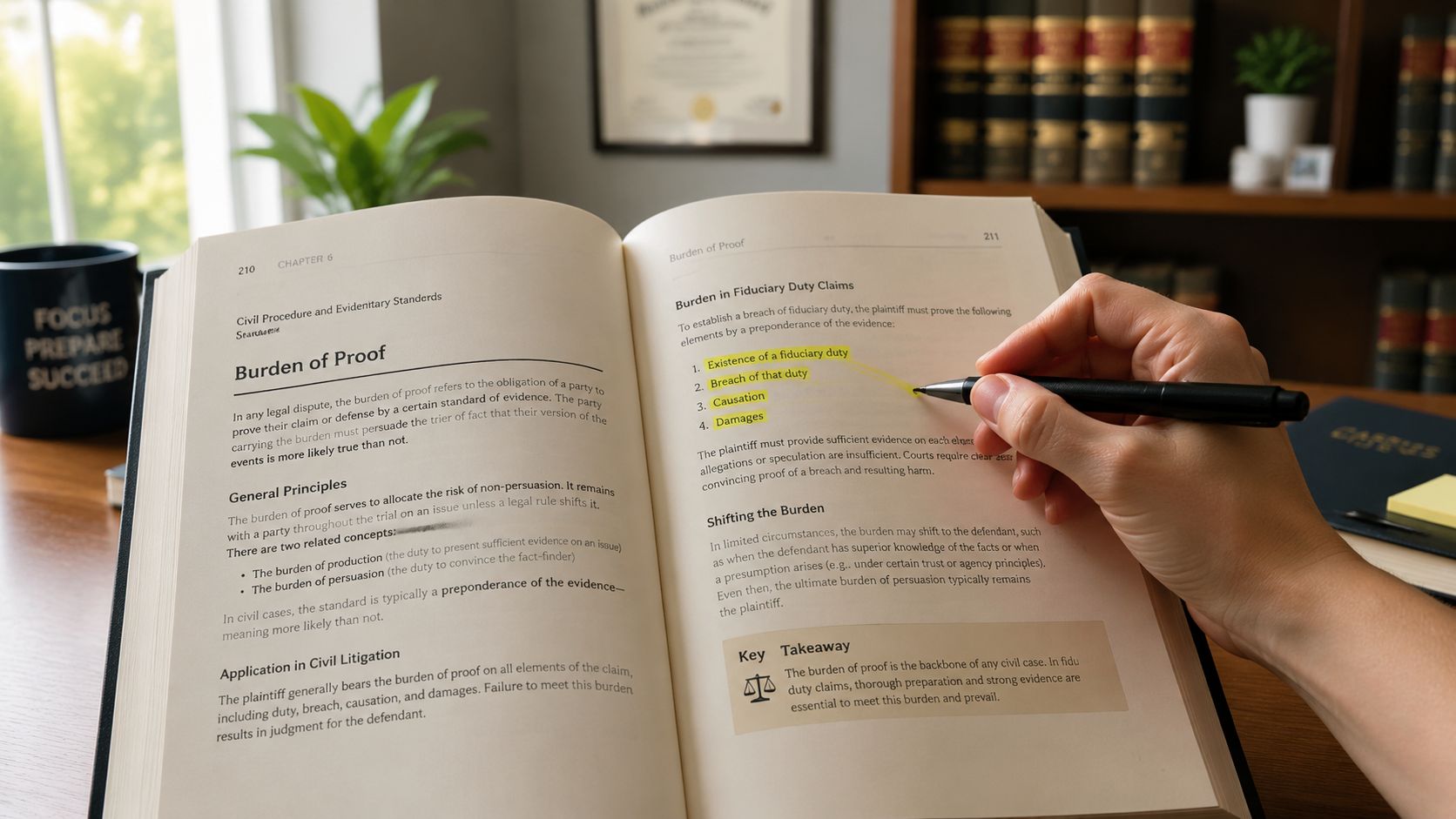
The four elements a beneficiary must prove
Under Texas law, a beneficiary must prove four key elements to establish a trustee breach of fiduciary duty: (1) the existence of a fiduciary relationship, (2) a breach of the trustee's duty, (3) that the breach was the proximate cause of harm, and (4) quantifiable damages. Intent is not always required; a pattern of neglect or failure to meet care standards can be sufficient for a breach, as explained in this discussion of Texas breach of fiduciary duty claims.
In plain English, that means:
- There must be a real fiduciary relationship. Trustee and beneficiary usually satisfies this.
- The trustee must have violated a duty. Not just made a choice someone disliked.
- The violation must have caused harm. The court will ask what changed because of the breach.
- The harm must be measurable. Courts need evidence of financial loss or another concrete injury.
What evidence usually matters most
A strong claim often depends on documents more than emotion. Useful evidence may include:
- The trust instrument: It shows what the trustee was supposed to do.
- Accountings and financial statements: These can reveal missing funds, unexplained transactions, or lack of disclosure.
- Emails and letters: Communications may show delay, refusal, inconsistency, or admissions.
- Property records and invoices: These help trace how assets were managed.
- A chronology: Dates matter. A timeline often exposes gaps and patterns.
A key point causes confusion for many families. Not every bad outcome is a legal breach. Investments can lose value. Real estate can become expensive to maintain. Markets can change. A court looks for a violated duty tied to actual damage, not just disappointment with the result.
Mistake versus actionable breach
A trustee may make an honest administrative mistake and correct it. That's different from repeated failures to keep records, respond to requests, or protect assets.
The strongest cases usually show a specific duty, a paper trail, and a clear connection between the conduct and the loss.
That distinction matters for everyone involved in trustee breach of fiduciary duty Texas cases. Beneficiaries need realistic expectations. Trustees need to understand that carelessness can create liability even without bad motives.
Remedies and Critical Deadlines for Filing a Claim
When a breach is proven, Texas courts can do more than criticize the trustee. Courts can order practical remedies designed to stop the problem and repair the harm.
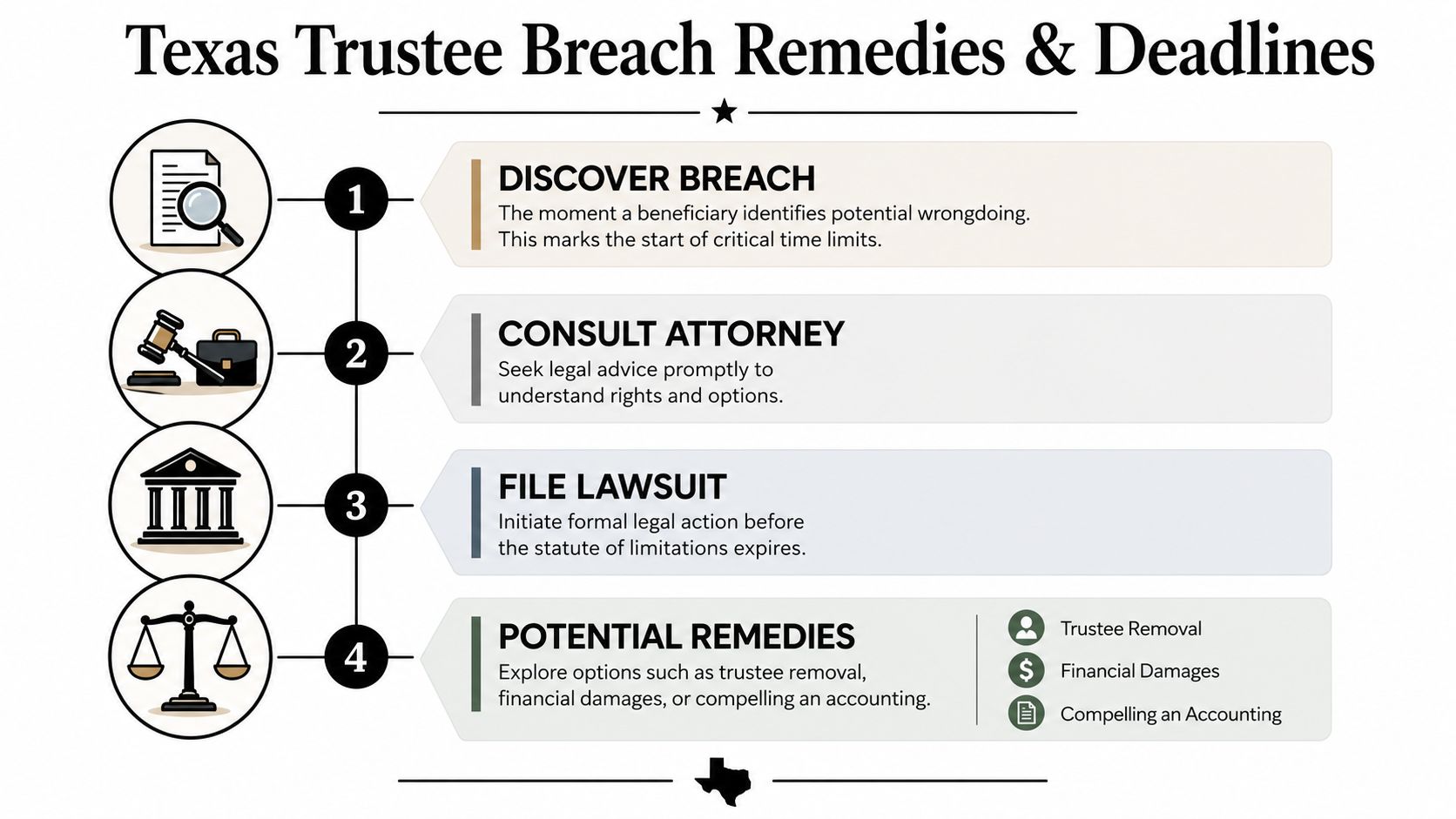
Remedies a court may order
Texas law may allow remedies such as:
- Trustee removal: If the trustee can't or won't perform properly, the court may remove them.
- Disgorgement of profits: A trustee may have to give up improper personal gains.
- Actual damages: The trust or beneficiaries may recover for financial loss.
- Accounting and court supervision: A court can require transparency and closer oversight.
- Exemplary damages in serious cases: If fraud or gross negligence is proven, exemplary damages may be available.
This can overlap with other legal needs. If a vulnerable adult is involved, guardianship issues may arise. If a successor needs to step in and preserve property, broader estate planning, probate, or asset protection strategies may also matter.
The clock matters more than most people realize
Texas imposes important filing deadlines. The statute of limitations for a breach of fiduciary duty claim is generally four years from when the breach occurred or was discovered. But if a trustee provides an adequate accounting that discloses the breach, beneficiaries may have only one year to object. Remedies can include trustee removal, disgorgement of profits, actual damages, and exemplary damages in cases of fraud or gross negligence, according to this explanation of breach of fiduciary duty in Texas.
That's why delay is dangerous. People often wait because they hope the trustee will “fix it,” or because family pressure discourages confrontation. But trust disputes have a ticking clock.
What to do quickly if you suspect wrongdoing
If you think a deadline may be running, practical steps include:
- Gather records early: Don't wait until statements disappear or memories fade.
- Review any accounting carefully: The one-year rule can become critical if the accounting adequately disclosed the issue.
- Consult counsel promptly: A lawyer can evaluate whether your claim is timely and what remedy makes sense.
- Act before positions harden: A prompt legal review may lead to correction, mediation, or suit before damage grows.
If you're weighing formal legal action, this guide on how to sue a trustee in Texas explains the litigation path in more detail.
A Practical Guide for Beneficiaries and Trustees
A daughter opens her mail and sees that trust property was sold without any warning. Across town, the trustee, who is also a brother, believes he acted reasonably and cannot understand why everyone is upset. That is how many Texas trust disputes begin. One side feels shut out. The other feels accused. Both need a clear process.
Many discussions of trustee breach stop at the definition. Real disputes require more than that. Beneficiaries need a practical way to gather proof without making assumptions too early. Trustees need a practical way to document decisions, correct mistakes, and defend conduct that was proper under the trust.
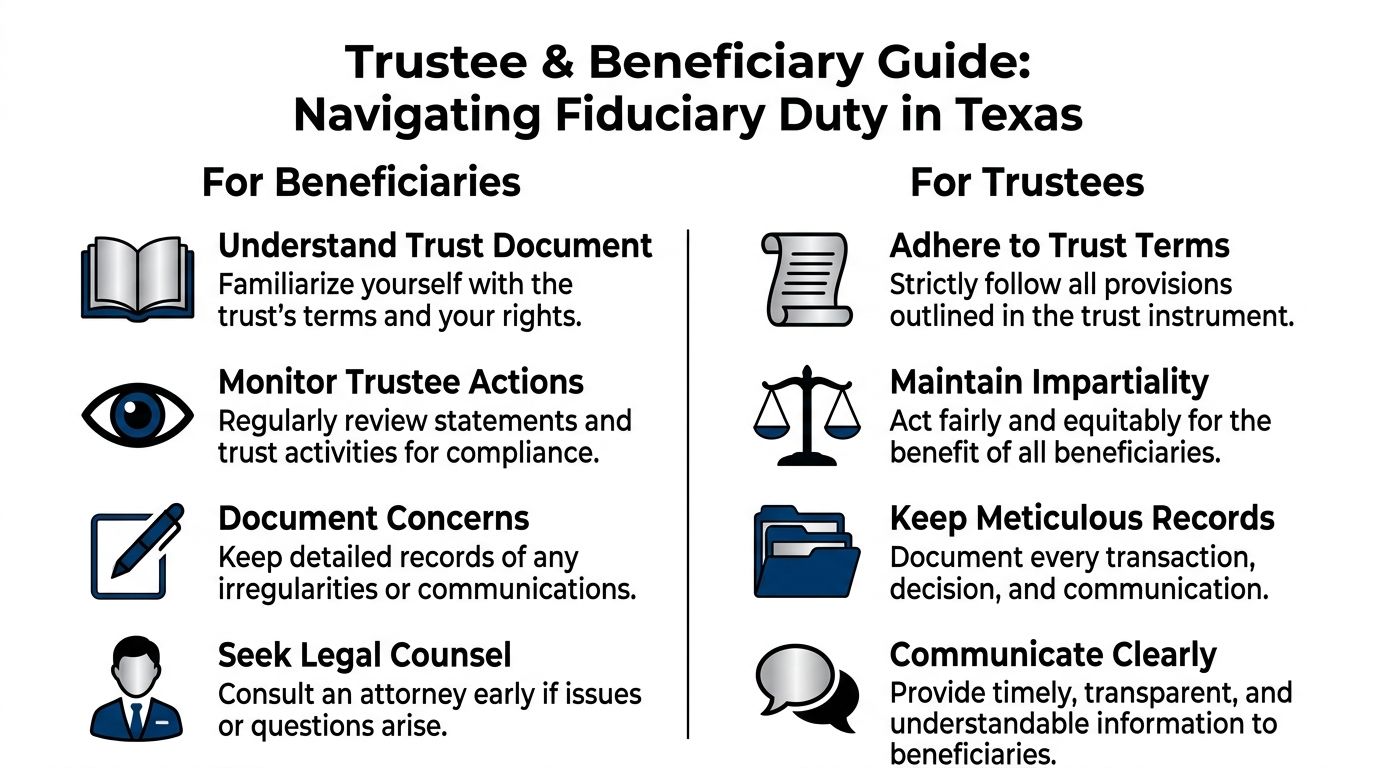
For beneficiaries
Start with facts, not conclusions.
A trust dispute works a lot like putting together a financial timeline after a car accident. You need to know what happened, in what order, who made the decision, and what loss followed. If you begin with accusations instead of records, it becomes harder to show a court exactly where the trustee crossed the line.
One useful first step is often a written request for information or a formal accounting. That can clarify whether you are dealing with poor communication, a misunderstanding, or conduct that may rise to an actionable breach, as discussed in this article on the elements of a fiduciary duty breach in Texas.
Build an evidence file
Gather the papers that tell the story:
- The trust agreement and any amendments: The trustee's authority begins here.
- Accountings, bank statements, and investment reports: Put them in date order so changes are easier to spot.
- Emails, letters, and text messages: Save them in one folder. After phone calls, write a short summary of what was said and when.
- Records tied to specific property or expenses: Deeds, sale documents, invoices, tax notices, insurance records, and repair bills often fill in missing pieces.
Then create a simple chronology. List each event, the date, what you learned, and why it concerns you. That timeline often helps beneficiaries see whether there is a true pattern or just a single unexplained transaction.
Ask focused questions
Broad accusations usually produce broad denials. Specific questions tend to produce better answers.
For example, instead of writing, “You are hiding trust money,” ask, “Please provide the closing statement for the sale of the Elm Street property, the appraisal relied on, and the account where the proceeds were deposited.” That approach does three things. It shows you are serious. It creates a paper trail. It gives your lawyer something concrete to evaluate.
If an older family member may be under pressure from outsiders, learn the warning signs early. Families dealing with trust administration and caregiving may benefit from reviewing proven strategies against senior scams, especially when suspicious transfers, new “helpers,” or unusual withdrawals appear in the background.
Here is a brief video that may help frame these issues in practical terms:
For trustees
Serving as trustee is part manager, part recordkeeper, and part messenger. Good intentions matter, but they do not replace process.
Many trustees are relatives who stepped in after a death or incapacity. They may know the family well but have never administered a trust before. That is where preventable mistakes happen. A distribution is made without written support. Trust funds are mixed with personal money for convenience. A beneficiary asks a fair question and hears nothing back for months. Each choice can make a defensible situation look suspicious.
Use habits that protect the trust and protect you
A careful trustee should:
- Follow the trust language closely: Tie each distribution or expense to the authority the document provides.
- Keep trust assets separate: Use dedicated trust accounts and avoid any personal use of trust property or funds.
- Document the reason for each major decision: Keep appraisals, receipts, advisor input, and notes showing the basis for your choice.
- Communicate in a steady, calm way: Regular updates often reduce conflict because beneficiaries are not left guessing.
- Ask for professional help when a decision has legal, tax, or valuation issues: Accountants, appraisers, and attorneys often prevent larger problems later.
The Law Office of Bryan Fagan, PLLC also handles matters involving trust administration, estate planning, probate, guardianship, and asset protection. For some trustees, getting legal advice early is part of doing the job carefully.
Understand how trustees defend a claim
A trustee's defense often comes down to showing the court a clean chain of reasoning. Was the action allowed by the trust? Was it taken in good faith? Was it disclosed? Is there paperwork showing where the money went and why the decision benefited the trust rather than the trustee personally?
Sometimes the dispute is really about judgment. A beneficiary may dislike an investment choice or timing decision that was still reasonable under the circumstances. Sometimes the trustee did make an error, but corrected it promptly and fully. Those details matter.
A helpful rule is this: if a stranger reviewed your file six months from now, would the documents explain your decision without your having to fill in the gaps from memory? If the answer is no, improve the file now.
Get Trusted Guidance for Your Texas Trust Matter
A daughter believes trust money is disappearing. A trustee believes every decision was allowed and documented. Both are losing sleep, and both are worried about what happens next.
That is often how Texas trust disputes begin. The legal questions matter, but so do timing, records, family dynamics, and the risk of making a bad situation worse by waiting too long or reacting too fast.
Clear advice helps each side for different reasons. A beneficiary may need help identifying whether the problem is suspicion or provable misconduct, then gathering account statements, communications, and trust records in a way that supports a claim. A trustee may need help showing that a decision followed the trust terms, was made in good faith, and was handled with proper disclosure and documentation. In other words, the same dispute can look very different depending on where you stand.
Trust matters also tend to overlap with other legal issues, including probate, estate planning, guardianship, taxes, and protection of trust property. Looking at only one piece of the problem can lead to costly mistakes.
Early legal guidance can help preserve evidence, clarify deadlines, and create a practical plan. Sometimes that plan involves formal action. Sometimes it involves correcting a problem before it grows into a lawsuit. Either way, informed action is usually safer than guessing.
The Law Office of Bryan Fagan, PLLC handles trust administration and related disputes in Texas. If you are facing concerns about a possible breach of fiduciary duty, or defending your conduct as a trustee, you can contact the firm for a free consultation to discuss the facts, the records you should gather, and the next step that fits your situation.