Managing a loved one's trust can feel overwhelming, especially when the person in charge doesn't seem to be handling things well. You may be seeing silence, delays, missing information, or decisions that just don't make sense. At that point, most families ask the same question: when can a trustee be removed in Texas?
Texas law gives beneficiaries real options, but the answer is rarely as simple as “only if the trustee stole money.” In many cases, the problem sits in a gray area. A trustee may be honest but disorganized. They may be loyal to the family but unable to keep up with records, taxes, distributions, or investment decisions. That distinction matters, because fiduciary duties in Texas are about competent, faithful administration, not just avoiding fraud.
Clear legal guidance proves helpful. The Texas Trust Code and related fiduciary principles set the rules trustees must follow. The Texas Estates Code often becomes relevant too, especially when incapacity, probate court procedure, or family disputes overlap with trust administration. Whether you're a beneficiary, trustee, executor, or family member trying to prevent further damage, understanding the legal standard is the first step toward a better outcome.
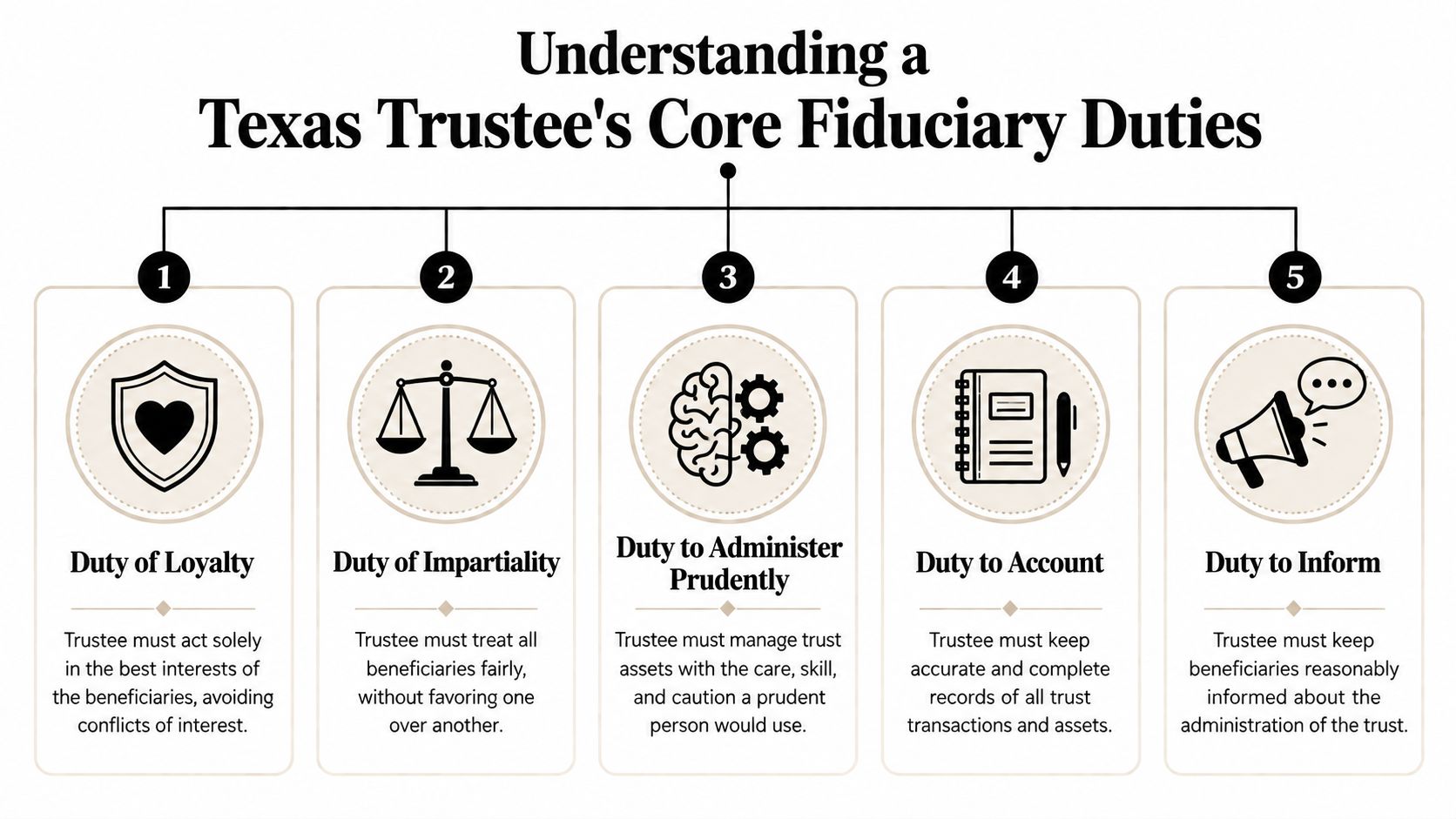
Understanding a Trustee's Core Fiduciary Duties
Before anyone can decide whether removal makes sense, it helps to know what a trustee is supposed to do in the first place. A trustee is not just a helper or a family representative. Under Texas law, a trustee is a fiduciary, which means they must manage the trust for the benefit of others and follow the terms of the trust document.
A simple way to think about it is this. A trustee is like a financial guardian with legal duties. They don't get to treat the trust as their own money, and they can't make casual decisions just because they mean well.
Loyalty prudence and accountability
The core duties usually start with loyalty, prudence, and accounting.
Loyalty means the trustee must act in the beneficiaries' best interests, not their own. If a trustee uses trust property for personal gain, that is often called self-dealing. Texas trust disputes commonly involve self-dealing, mismanagement causing significant financial loss, or hostility between co-trustees that blocks proper administration, as discussed by Dallas Probate and Trust on trustee removal grounds.
Prudence means the trustee must use care, skill, and caution when managing trust assets. They don't have to predict the future perfectly. But they do have to make decisions the way a careful fiduciary would, especially when investments, taxes, distributions, and recordkeeping are involved.
The duty to account means the trustee must keep clear financial records and provide the information the law requires. Beneficiaries can't protect themselves if they have no idea what money came in, what went out, or why.
Practical rule: If a trustee can't explain what they did with trust assets in a clear and documented way, that's often the first sign of a deeper fiduciary problem.
Other duties families often miss
Two other duties often get less attention but matter in everyday trust administration.
- Impartiality: A trustee must treat beneficiaries fairly and not play favorites without authority in the trust.
- Duty to inform: A trustee must keep beneficiaries reasonably informed about trust administration.
For a more detailed breakdown of these duties under the Trust Code, see Texas trustee duties under the Texas Trust Code. The same core concepts also appear in The Fiduciary Duties of a Texas Trustee, which discusses the duties of loyalty, prudence, and impartiality.
These rules matter well beyond litigation. They shape daily trust administration, affect estate planning choices, and often determine whether a family needs help from a Texas trust administration lawyer, a Texas estate planning attorney, or even guardianship counsel when incapacity becomes part of the story.
Legal Grounds for Trustee Removal Under the Texas Trust Code
A common family problem often develops gradually. The trustee is not stealing money. They may even be trying hard. But deadlines get missed, records are scattered, investments drift, and no one can get a straight answer about what is happening. At that point, many beneficiaries ask the same question. Does Texas law require outright fraud before a court will step in?
No.
Under Texas Property Code § 113.082, a court may remove a trustee for specific legal reasons. The statute sets guardrails. It gives beneficiaries a remedy, but it also prevents removal based only on tension, suspicion, or personality conflict.
The four main grounds
Texas courts can remove a trustee if one of these grounds is proved:
- The trustee materially violates or attempts to violate the trust, and the violation causes material financial loss to the trust.
- The trustee becomes incapacitated or insolvent.
- The trustee fails to make a required accounting.
- The court finds other cause for removal.
Those categories matter because they shift the question from "Are the beneficiaries upset?" to "What legally happened, and can it be shown with evidence?"
What these grounds mean in real life
A material violation of the trust usually means the trustee departed from the trust's written instructions in a meaningful way and the trust suffered financially. If the trust called for conservative management but the trustee made speculative investments, the issue is not just poor judgment. The issue is whether the decision broke the trust's rules and caused measurable harm.
Incapacity or insolvency reaches a different kind of problem. A trustee may become unable to manage the job because of illness, cognitive decline, addiction, or another condition that interferes with reliable decision-making. Insolvency can matter because a trustee under severe financial pressure may pose a risk to trust administration, even before anyone proves theft.
This is one of the gray areas families often miss.
A trustee does not have to be malicious to become unfit for the role. Sometimes removal is appropriate because the trustee cannot perform the job competently anymore, even if their intentions are good. In practice, those cases can be harder than the obvious misconduct cases because the family is often dealing with loyalty, denial, and embarrassment at the same time.
Failure to account is another major ground. If a trustee does not provide a required accounting, that is not a technical paperwork issue. It is often the point where beneficiaries realize they cannot verify what the trustee has done, what the trust owns, or whether distributions and expenses make sense.
A trustee's duty to account is a core fiduciary obligation, not a favor to the beneficiaries.
The broadest category is often the most important
The phrase "other cause" is broad, and that is often where the most practical disputes fall. Courts can look at patterns of behavior that may not fit neatly into a single dramatic event. Chronic delay, repeated confusion, failure to communicate, inability to manage assets, or ongoing conflict that disrupts administration can matter, depending on the facts.
That broad standard is important because trust problems do not always look like embezzlement. Sometimes the trustee is in over their head. A trustee role works like managing a small business for someone else's benefit. Good intentions alone are not enough if the books are not kept, deadlines are missed, and judgment is unreliable.
Why the Estates Code can still matter
Trustee removal usually arises under the Texas Trust Code, but the Texas Estates Code may still affect the larger dispute. That often happens when the same family is also dealing with a probate estate, guardianship concerns, or questions about a trustee's mental capacity.
For this reason, trustee removal is rarely just about one bad act. It often involves several overlapping issues at once. The trust document, the trustee's conduct, the available evidence, and the court's procedure all shape whether removal is realistic and what alternatives may exist outside a courtroom.
When Trustee Behavior Warrants Removal
A common Texas trust dispute begins subtly. The trustee is a family member. Nobody believes they are stealing. Yet bills are late, beneficiaries cannot get clear answers, tax papers are missing, and investment decisions do not match the trust's instructions. At some point, the issue stops being intent and becomes performance.

Misconduct is one path, but gray-area failures matter too
Clear misconduct still matters. A trustee may need to be removed for self-dealing, misuse of trust funds, favoritism, concealment, or refusal to follow the trust document. Those cases are easier for families to spot because the problem is obvious.
Many removal cases are less dramatic. The trustee may be disorganized, passive, overwhelmed, unable to keep records, or unable to make sound decisions. A trustee's job works like managing someone else's business and bank account under strict rules. Good intentions do not fix missed deadlines, unmanaged assets, or repeated communication failures.
That gray area is often overlooked.
A trustee can harm a trust without acting maliciously. An elderly parent may lose the ability to stay on top of investments. A sibling may accept the role out of loyalty, then realize too late that fiduciary accounting, tax filings, and distribution decisions are more technical than expected. In those situations, removal may still be the right solution because the law focuses on protecting the trust and its beneficiaries.
Conduct that often raises a serious removal question
Certain patterns tend to signal more than a simple personality conflict.
- Repeated failure to provide records or accountings. If beneficiaries ask reasonable questions and the trustee cannot produce organized information, that may suggest deeper administration problems.
- Missed tax filings, unpaid bills, or lapsed insurance. These are not minor clerical mistakes if they expose the trust to penalties, lawsuits, or preventable loss.
- Investment decisions that ignore the trust's purpose. A trustee managing a support trust for a surviving spouse should not treat the portfolio like a speculative trading account.
- Paralysis between co-trustees. If co-trustees cannot agree and the trust's business stalls, the deadlock itself can become harmful.
- Declining capacity or persistent confusion. A trustee does not have to be dishonest for beneficiaries to have a legitimate concern about competence.
One mistake usually does not decide the issue. A pattern does. Courts and lawyers often look for repetition, consequences, and whether the trustee improves after concerns are raised.
A few real-world examples
Consider three common situations.
A son takes over as trustee after his mother dies. He means well, but he misses filing deadlines, cannot explain prior distributions, and keeps trust records in scattered personal emails and paper folders. No one accuses him of theft. Still, the trust may be at risk because basic administration is breaking down.
Two sisters serve as co-trustees and stop speaking except through hostile text messages. One will not approve repairs to trust property. The other refuses to sign routine paperwork. The trust becomes stuck, and beneficiaries bear the cost of delay.
A trustee with no investment background moves trust assets into ventures they personally believe in, even though the trust calls for steady management and dependable distributions. The problem is not only the outcome. It is the mismatch between the trustee's decisions and the job they were given.
When concern should turn into action
Beneficiaries often hesitate because they feel they need proof of fraud before speaking up. Texas law is not that narrow. If the trustee's conduct shows inability, repeated neglect, harmful conflict, or poor judgment that puts the trust at risk, it may be time to act.
Start by documenting what you are seeing. Save emails, requests for information, account statements, tax notices, missed deadlines, and any written explanations that do not add up. Then review the trust itself. Some trusts allow removal without a full court fight through a named trust protector, a replacement procedure in the document, or coordinated action by beneficiaries. Others require a court petition.
At that point, a Texas trust administration lawyer can help evaluate whether the facts support removal and whether a court case is necessary. If you want a practical overview of that process, this guide on petitioning to remove a trustee in Texas explains how beneficiaries typically begin.
The Step-by-Step Process for Court-Ordered Removal
A common turning point looks like this. A beneficiary has asked for records more than once, distributions are delayed, and the trustee keeps saying everything is under control. No one has proof of theft, but the trust is drifting. In that situation, a court case may be less about exposing fraud and more about stopping ongoing mismanagement before the damage gets worse.
The process feels more manageable when you view it as a series of decisions rather than one dramatic courtroom event.
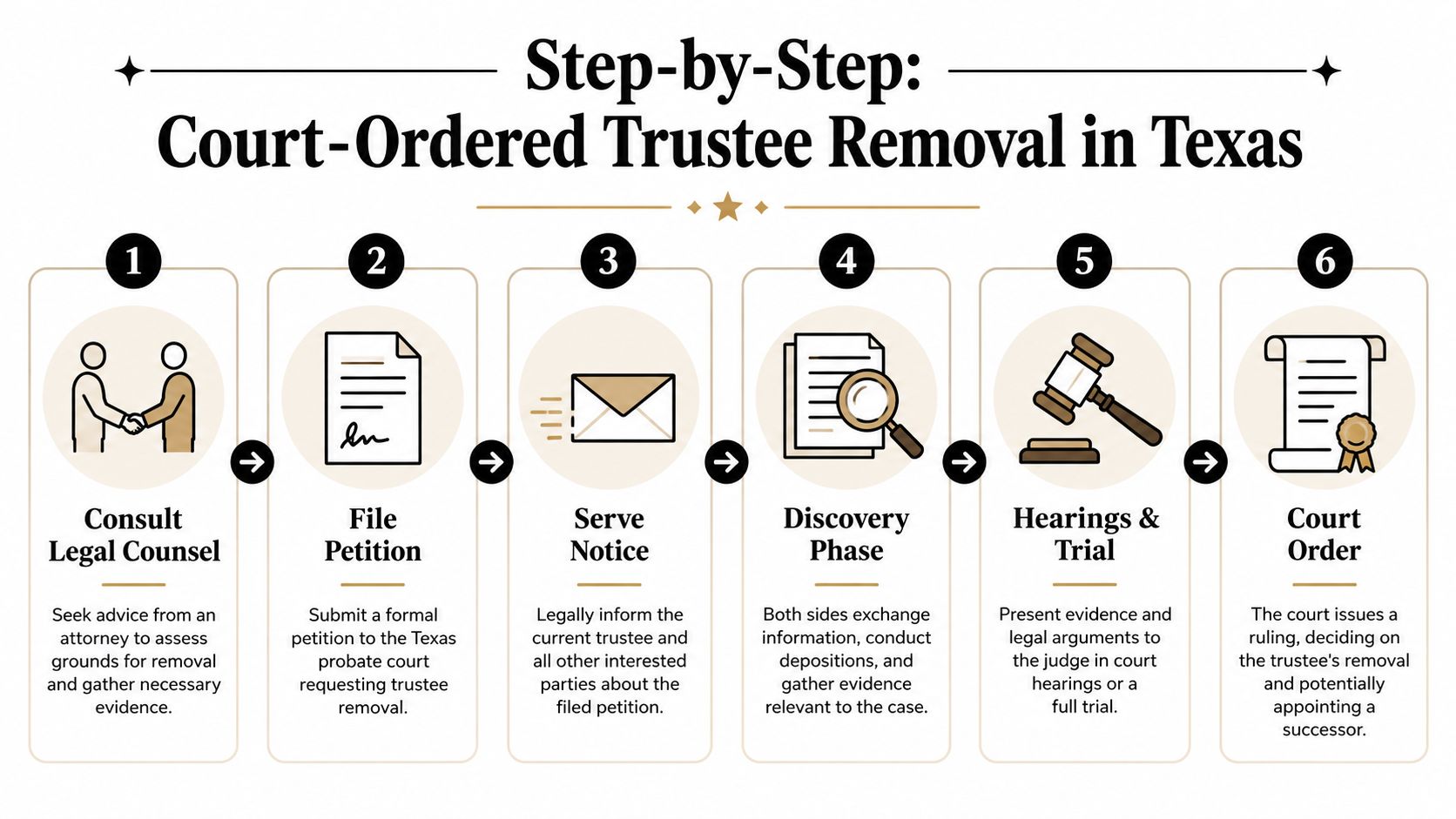
Step one review the trust and gather records
Start with the trust document. Read it closely. Some trusts set out their own method for replacing a trustee, naming a successor, or giving another person limited authority to step in. Even if you are preparing for court, those provisions matter because they can shape what relief to request and whether a judge sees removal as the cleanest solution.
Then collect the paper trail. Useful records often include account statements, formal accountings, emails, letters, tax notices, distribution requests, and written responses from the trustee. If the concern involves declining capacity rather than bad intent, medical information or evidence of repeated confusion may matter too. That gray area is easy to miss. Texas courts do not look only for dishonesty. They also look at whether the trustee can still perform the job.
For a practical overview of how families usually begin that case, review this guide on petitioning to remove a trustee in Texas.
Step two file the petition
The formal case begins when an interested person files a petition asking the court to remove the trustee. The petition should identify the legal basis for removal and tie that ground to specific facts.
Specifics carry weight. General statements such as "the trustee is doing a bad job" usually do not. Judges want a clear timeline, examples of missed duties, trust language that applies, and records showing how the trust or beneficiaries were affected.
This step also forces an important discipline on the case. It separates suspicions from provable facts. Sometimes that confirms a strong removal claim. Sometimes it reveals a narrower problem, such as the need for an accounting, instructions from the court, or temporary restrictions while the larger dispute is sorted out.
Step three expect notice discovery and hearing preparation
After filing, the trustee and other interested parties must receive notice. The case may then move into discovery, which is the information-gathering phase. Each side can request documents, written answers, and testimony.
The discovery phase often clarifies the case. A trustee who seemed evasive may finally produce records that explain the problem. Or the opposite may happen. Missing accountings, inconsistent statements, or unexplained transfers can confirm that removal is necessary. In many trust disputes, the central issue is competence, judgment, or conflict management rather than outright stealing. Discovery often brings those gray-area problems into focus.
To understand the kind of legal support trustees and beneficiaries often need before disputes deepen, many families also review related guidance on estate planning, probate, guardianship, and asset protection. One practical option is Law Office of Bryan Fagan, PLLC, which provides Texas-based trust administration, estate planning, and trust dispute services.
Here is a helpful video overview that many families find useful before speaking with counsel:
Step four present the case to the judge
At the hearing, the judge is usually asking a practical question. Will the trust be better protected if this trustee stays, or if someone else takes over?
That is why the strongest presentations are organized and concrete. The court will often focus on:
- What duty the trustee failed to carry out
- What trust term or legal requirement applies
- What harm has already occurred, or is likely to occur
- Why removal, rather than a lesser fix, is the appropriate remedy
A useful comparison is a business owner replacing a manager. The issue is not always misconduct. Sometimes the manager is no longer able to run the operation safely and reliably. Trustee removal can work the same way. A court may remove a trustee for repeated poor judgment, inability to cooperate, failure to account, or incapacity, even when the evidence does not show malicious intent.
What tends to persuade courts: organized records, a careful timeline, and a direct connection between the trustee's conduct and the need to protect the trust.
The judge may order removal, deny the request, require corrective action, or approve a transition to a successor trustee. In some cases, filing the petition leads to a negotiated resignation before the court has to decide the full dispute.
Exploring Alternatives to a Court Battle
Court isn't always the first or best option. In many trust disputes, the better question is not just when can a trustee be removed in Texas, but whether removal can happen without a courtroom fight.
That possibility often starts with the trust instrument. Some trusts include written procedures for replacing a trustee after certain events, such as incapacity, resignation, deadlock, or beneficiary action. Families sometimes miss these provisions because they focus only on litigation before closely reading the document.
Start with the trust document
The first practical step is simple. Read the trust closely, preferably with counsel. A clause naming a successor trustee, setting a resignation process, or authorizing removal by another person can change the entire path forward.
If you suspect the trust allows a private change, review changing trustees without court in Texas. That kind of review often saves time and can reduce family conflict.
The trust protector option
Many modern trusts include a Trust Protector, an independent third party who can “fire and hire trustees without needing a judge's approval,” creating a private removal mechanism that bypasses a court petition, as described in ElderLawAnswers on when to fire a trustee.
That's a major development in modern estate planning. If a trust protector has removal authority, a family may be able to solve the problem administratively instead of through litigation. This can be especially useful when the issue is poor performance, personality conflict, or fading capacity rather than active theft.
Other non-court paths
Not every non-judicial solution requires a trust protector. Depending on the trust's language and the facts, options may include:
- Voluntary resignation: A struggling trustee may step aside once concerns are addressed directly.
- Agreed transition: Beneficiaries and the trustee may agree on a handoff to a named successor.
- Targeted legal demand: A written demand for accounting or compliance sometimes leads to correction without a filed lawsuit.
- Preventive estate planning: New or amended trust structures can be drafted with clearer removal language for future protection. That's one reason families often speak with a Texas estate planning attorney when asking how to modify a trust in Texas.
A courtroom is one tool. It isn't the only tool.
The right strategy depends on the trust terms, the quality of the records, the level of family cooperation, and the urgency of the risk to trust assets.
What Happens After a Trustee Is Removed
A trustee's removal often feels like the end of the problem. In practice, it is the start of a transition period. The key question becomes simple: who is now in charge of protecting the trust, paying expenses, gathering records, and carrying out the trust's instructions?
Usually, the answer starts with the trust document. Many Texas trusts name a successor trustee in advance, much like naming a backup driver before the first driver ever needs to pull over. If the document clearly names the next person and that person is willing and able to serve, the handoff can be fairly direct. If no successor is named, or the named successor cannot serve, a court may need to appoint a replacement so the trust does not sit unattended.
That gap matters. A trust still has bills, investments, tax issues, and beneficiaries waiting for information.
The transition to a successor trustee
A proper transition is more than changing a title on paper. Control of bank and brokerage accounts has to shift. Trust records have to be delivered. Tax returns, property records, passwords, insurance information, and pending distribution questions all have to land with the new trustee.
If the former trustee was dishonest, the problem is obvious. The gray-area cases can be harder. A trustee may have meant well but kept poor records, missed deadlines, blended personal and trust information, or become unable to manage the job carefully. In those situations, the new trustee often has to rebuild the trust's history before making major decisions. That may mean tracing transactions, confirming asset titles, and checking whether beneficiaries received what the trust required.
Families are often surprised by this stage. Removal does not automatically clean up the books. It changes who has the authority to do the cleanup.
Can the trust recover losses
Sometimes, yes.
A removed trustee may lose some or all of the compensation they would otherwise have received. If the trustee's conduct caused harm to the trust, beneficiaries or the successor trustee may also pursue a breach-of-trust claim to recover losses, restore misused property, or correct improper transactions. Whether that makes sense depends on the size of the damage, the available proof, and whether recovery is realistically possible.
That does not mean every removal should turn into a second lawsuit. If the problem was incompetence rather than theft, the first priority is often stabilizing administration, securing assets, and getting accurate records in place. Recovery can be considered after the immediate risk is under control.
A practical checklist after removal
After a trustee is removed, families usually need to address five basic tasks:
- Confirm control of assets: Identify who has authority over trust accounts, real estate, business interests, and digital access.
- Gather the paper trail: Collect statements, tax filings, accountings, emails, deeds, and transaction records.
- Check for loose ends: Review unpaid bills, required notices, tax deadlines, and scheduled distributions.
- Evaluate possible harm: Look for penalties, unexplained withdrawals, neglected investments, or missed opportunities caused by delay or poor management.
- Set expectations with beneficiaries: The successor trustee should explain what is known, what still needs review, and when beneficiaries can expect updates.
That last point is easy to overlook. Clear communication can calm a family that has already spent months dealing with uncertainty.
The goal after removal is to restore competent administration and protect the trust's assets and purpose. Sometimes that means pursuing repayment from the former trustee. Sometimes it means recognizing that the proper solution is a clean handoff to someone who can do the job correctly from now on.
If you're managing a trust or planning your estate, contact The Law Office of Bryan Fagan, PLLC for a free consultation. Our attorneys provide Texas-based guidance on trust administration, fiduciary duties, probate, guardianship, asset protection, and long-term estate planning.