Managing a loved one's trust can feel overwhelming, especially when you're also dealing with grief, family questions, and a stack of unfamiliar paperwork. Many new trustees in Texas find themselves in the same spot. A parent has died, the family is looking to you for answers, and you're wondering what you're allowed to do, what you must do, and what can wait.
A common first-week scene looks like this. You have a copy of the trust somewhere in a file cabinet, one sibling is asking when distributions will happen, and the bank says it can't discuss the account yet. That doesn't mean you're doing anything wrong. It usually means you haven't assembled the documents that prove your authority.
The good news is that trust administration becomes much more manageable when you handle it in the right order. The first steps after becoming a trustee in Texas are less about rushing to move money and more about establishing authority, protecting assets, and setting up a clean paper trail. That approach protects both the beneficiaries and you.
Texas law places real fiduciary duties on trustees. In plain English, that means you must act carefully, ethically, and in the beneficiaries' best interests. The Texas Trust Code shapes many of those duties, and related estate issues can also intersect with the Texas Estates Code. If a trust owns assets that overlap with a probate estate, or if family members are unsure what passes through the trust versus through probate, that legal background matters. Still, your first month is usually about practical control: documents, accounts, notices, records, and communication.
A New Responsibility A Guide for Texas Trustees
You may have accepted this role because a spouse, parent, grandparent, or close friend trusted you to carry out their wishes. That's meaningful. It can also feel like you were handed a job description without training.
Take Maria, for example. Her father named her as successor trustee of his revocable living trust. After he died, her first instinct was to “take care of everything” as fast as possible. She wanted to pay bills, reassure her brother, and list a house for sale. But before any of that, she needed to confirm what the trust said, determine what property belonged to the trust, and gather the documents financial institutions would require.
That's where many trustees get tripped up. They assume being named in the document automatically lets them act everywhere immediately. In reality, institutions often need formal proof before they'll recognize a new trustee's authority. Beneficiaries may also assume the trustee can make instant distributions, even when the trust requires a slower and more careful process.
Being a trustee is not about doing everything quickly. It's about doing the right things in the right order.
If you're in your first month as trustee, focus on steady progress. You don't need to know every answer on day one. You do need a disciplined process.
A strong start usually means:
- Reading before acting: The trust document is your rulebook.
- Documenting every step: Keep copies of notices, statements, receipts, and decisions.
- Separating roles clearly: You may be a child, sibling, or spouse, but when you act as trustee, you're serving in a fiduciary role.
- Getting help when needed: A Texas trust administration lawyer, CPA, financial advisor, or appraiser may all play a role depending on the trust.
This same mindset helps in related areas such as estate planning services and probate matters when a family's assets don't all pass the same way.
Your First Legal Obligations as a Trustee
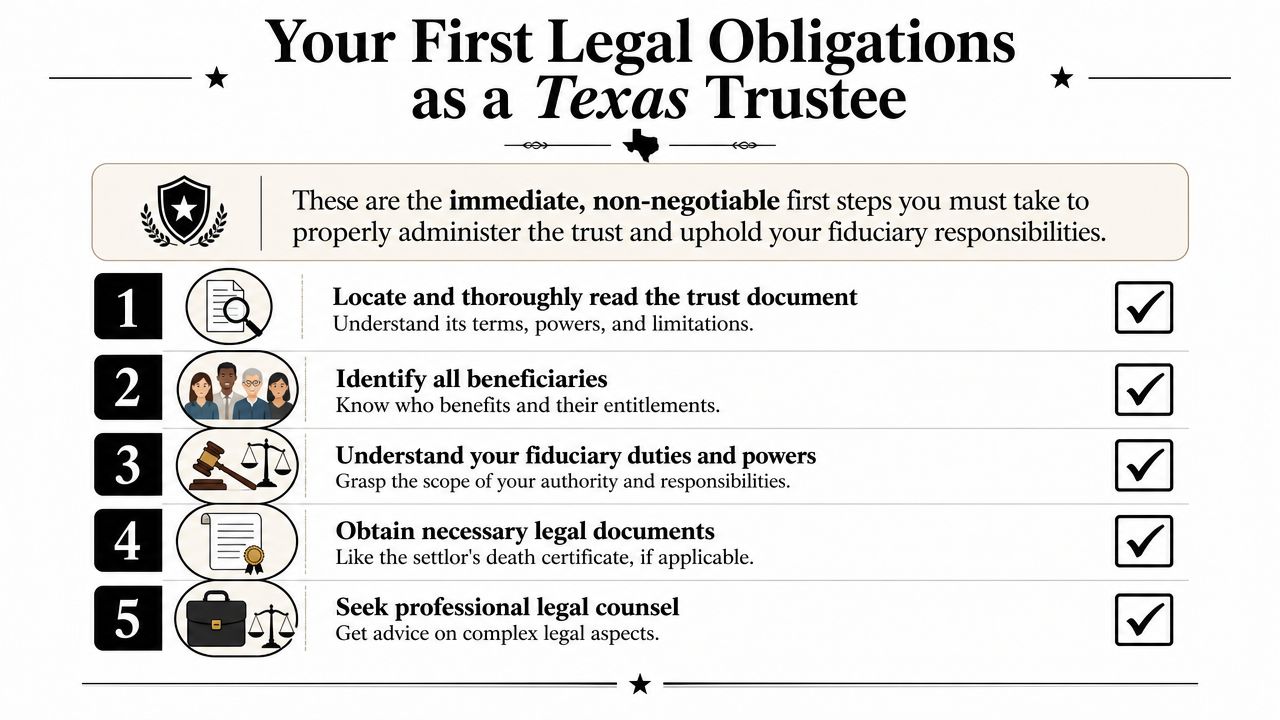
The first legal obligations are simple in concept, even if the paperwork feels tedious. Before taking control of assets, secure the trust instrument, obtain certified death certificates, identify beneficiaries, formally accept the role, and notify beneficiaries that administration has begun and the trust has become irrevocable at death, as described in Texas guidance on what happens when a trustee dies.
Read the trust before you touch anything
Start with the trust itself. Read the full document, not just the pages that name you as trustee. Look for who the beneficiaries are, what powers the trustee has, what property is supposed to be in the trust, and whether there are special instructions about distributions, taxes, business interests, or real estate.
Also check for practical details. Does the trust require a co-trustee? Does it limit when beneficiaries receive funds? Does it allow or require certain notices? These details shape everything that follows.
If you want a plain-English overview of the role, this guide on what a trustee does in Texas is a helpful companion to the trust document itself.
Gather the documents that prove your authority
A trustee's authority may seem obvious to the family, but banks and title companies usually need paperwork. One of the most important early steps is getting certified death certificates. Nolo specifically suggests 8 to 12 certified copies because institutions often require them before recognizing the successor trustee's authority, as noted in Nolo's discussion of a trustee's first six months.
Why so many? Because different institutions may want an original certified copy for their own file. If the trust owns multiple accounts, real estate, or investment assets, those copies can disappear quickly.
A practical early file often includes:
- The complete trust document and any amendments
- Certified death certificates
- Acceptance of Trusteeship if needed to show you've formally accepted the role
- A beneficiary list with current contact information
- A working asset list so you know what you're trying to locate and protect
Practical rule: If an institution won't talk to you yet, assume it needs more proof, not that something has gone terribly wrong.
Notify beneficiaries early and professionally
New trustees sometimes avoid beneficiary communication because they don't want to trigger conflict. Usually that makes things worse. Early notice doesn't mean you need every answer immediately. It means people should know the trust is now under administration and that you're beginning the process.
A simple, calm notice can reduce suspicion. It tells beneficiaries that you've accepted the role, that you're gathering records, and that you'll share information as the administration progresses. That kind of transparency is part of good fiduciary practice in Texas.
Slow down before moving assets
A lot of harm happens when a trustee acts too fast. For example, a daughter may transfer money from a trust account into her own account “just to pay bills more easily.” A son may start dividing personal property before confirming whether those items even belong to the trust. Those choices can create confusion, disputes, and personal liability.
The better path is slower and cleaner. Establish authority first. Then act.
Securing and Inventorying Trust Assets
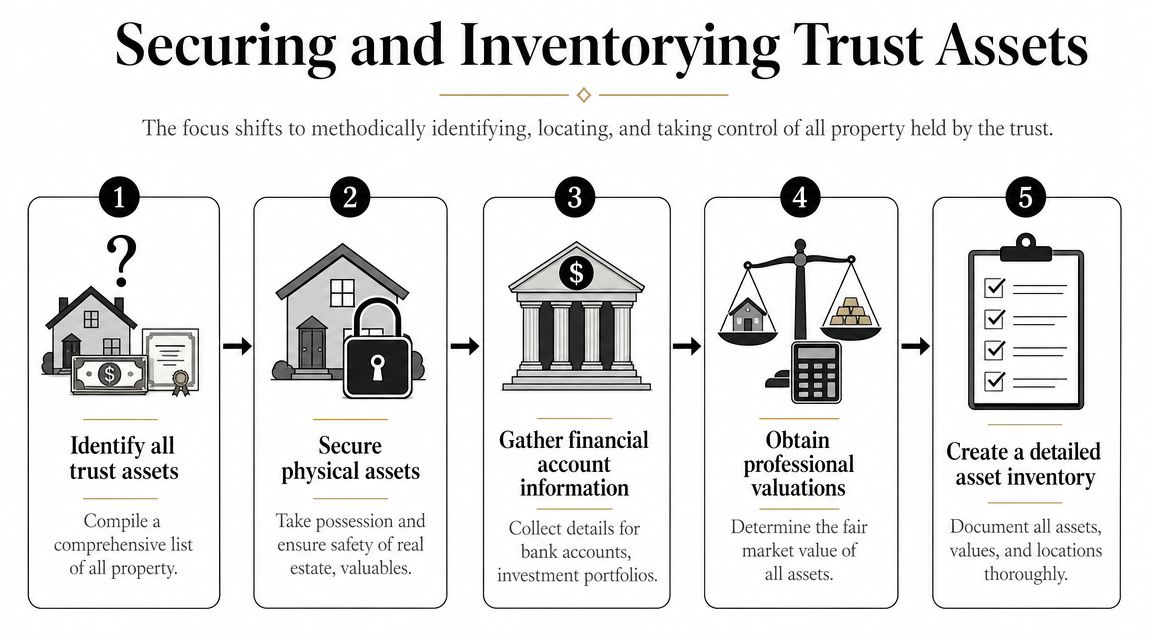
Once the legal foundation is in place, your attention shifts from documents to property. The key question becomes: what does the trust own, where is it, and how do you protect it?
Build an inventory before making decisions
Don't rely on memory or family assumptions. Create a written inventory. Include bank accounts, brokerage accounts, real estate, business interests, vehicles, life insurance payable to the trust if applicable, and significant personal property that may be titled in the trust.
Some trustees discover surprises only after a full search. A parent may have an old brokerage account, mineral interests, or a safe deposit box no one mentioned. Another family may assume a home belongs to the trust, only to learn title was never transferred into it. That distinction can affect whether the Texas Estates Code and probate process become relevant alongside trust administration.
Use a working list with columns like these:
| Asset | Institution or location | Titled in trust | Action needed |
|---|---|---|---|
| Checking account | Local bank | Confirm | Get statements and control access |
| Brokerage account | Investment firm | Confirm | Update trustee authority |
| Home | County records | Confirm | Secure property and review insurance |
| Personal valuables | Residence or storage | Unknown | Photograph and document |
| Business interest | Company records | Confirm | Review governing documents |
Secure first, value second
Physical assets need attention quickly. If the trust owns a home, make sure it's secure. Check locks, insurance, mail, utilities, and property condition. If there are vehicles, firearms, jewelry, or collectibles, document their location and condition. Take photos and keep notes.
Financial assets need a similar level of care. Contact banks and brokers only after your paperwork is ready. Institutions often require proof of death and your trustee acceptance before they'll let you access accounts or retitle property. That practical hurdle is one reason a detailed trust administration checklist can help keep the process organized.
Keep trust property separate from everything else
One of the easiest mistakes to make is mixing trust property with personal property. Don't deposit trust funds into your own account. Don't pay trust expenses from your personal card without careful documentation and a plan for reimbursement. Don't let family members remove items from a trust-owned house “just for safekeeping” without records.
This separation is central to fiduciary duties in Texas. It creates a clean accounting trail and protects you if someone later questions your actions.
A practical way to approach this:
- Trust money stays in trust accounts
- Trust bills are paid from trust funds when appropriate
- Trust property gets documented before anyone distributes, sells, donates, or discards it
If you can't show where an asset was, what happened to it, and why you acted, you're exposed to unnecessary risk.
Use professionals where the asset requires it
Not every asset needs a formal appraisal right away, but some do. Real estate may need a broker opinion or appraisal. A closely held business may require review by counsel and an accountant. Valuable personal property may need a specialty appraiser.
This is also where asset protection concerns can overlap with administration. The trustee's job isn't only to distribute property eventually. It's to preserve it first, especially when the trust includes vulnerable assets, creditor concerns, or family tension around ownership.
Fiduciary Duties and Communicating with Beneficiaries
The phrase fiduciary duties in Texas sounds abstract until you're the one answering beneficiary emails and signing checks. In practice, fiduciary duty means you must act for the beneficiaries, not for yourself, and you must manage the trust with care.
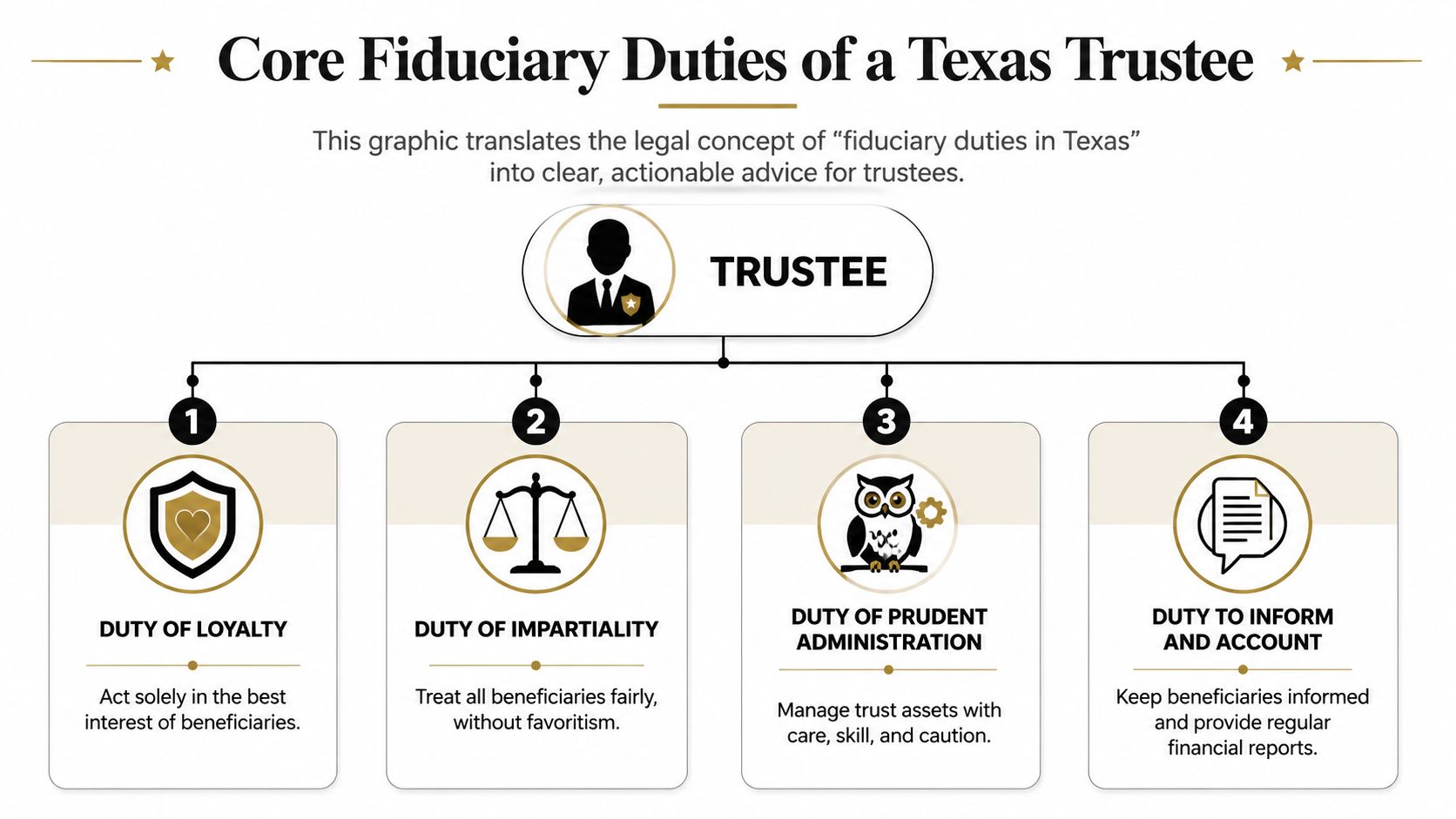
What those duties look like in real life
A trustee's core duties commonly include loyalty, impartiality, prudent administration, and the duty to inform and account. Those aren't just legal labels. They guide daily choices.
- Loyalty: You can't use trust property for your personal benefit unless the trust clearly allows it.
- Impartiality: If there are multiple beneficiaries, you can't favor one because they call more often or live closer.
- Prudent administration: You need to manage assets carefully, not casually.
- Informing and accounting: Beneficiaries are entitled to certain trust information.
This explainer may help if you prefer video guidance before handling those conversations.
Communication prevents many disputes
One sibling may want immediate cash. Another may care most about preserving the house. A third may distrust everyone because they live out of state and feel excluded. The trustee doesn't solve this by pleasing the loudest person. The trustee solves it by following the trust and communicating clearly.
A good communication system includes:
- An opening notice: Explain that you've begun administration and are assembling records.
- A document routine: Save emails, letters, statements, invoices, and notes of important calls.
- A consistent tone: Be neutral, factual, and polite, even if a beneficiary is upset.
- A repeatable process: If one beneficiary gets a material update, others entitled to that information should generally receive comparable treatment.
Here's a useful script for a tense situation: “I understand you want a timeline. I'm still confirming what assets are in the trust and what steps are required before any distributions can be made. I'll provide updates as the administration progresses.”
That answer is respectful and measured. It doesn't promise what you can't deliver.
Accounting starts on day one, not at the end
A Texas CPA publication summarizing the Texas Trust Code explains that trustees have duties to share certain trust information with beneficiaries and that, generally, a trustee is not required to account more than once every 12 months, as discussed in this Texas CPA analysis of trustee duties. That benchmark gives your administration an early rhythm.
What does that mean for the first month? It means you should build your bookkeeping system now, not later.
You might keep:
| Record type | Why it matters |
|---|---|
| Bank statements | Show money in and money out |
| Invoices and receipts | Support expenses paid by the trust |
| Distribution log | Tracks who received what and when |
| Property expense file | Helps document maintenance, insurance, and utilities |
| Beneficiary correspondence | Shows what information you provided |
A trustee who keeps careful records usually communicates with more confidence, because the file answers questions before arguments grow.
If the trust overlaps with wider family planning concerns, families often benefit from related guidance in estate planning and probate matters in Texas. Those areas can intersect when not all assets were properly funded into the trust.
Neutrality matters more than warmth
Many trustees are close relatives. That can make the role feel informal. But informal administration often creates formal disputes. If you're also a beneficiary, be especially disciplined. Document your decisions. Avoid side deals. Don't make “advance distributions” to yourself or another beneficiary unless the trust permits them and the decision is properly supported.
Transparency doesn't mean handing over every raw note or responding to every emotional accusation in detail. It means sharing required information, keeping sound records, and acting consistently.
Common Trustee Mistakes to Avoid in Texas
Most trustee mistakes don't start with bad intent. They start with pressure, assumptions, and shortcuts.
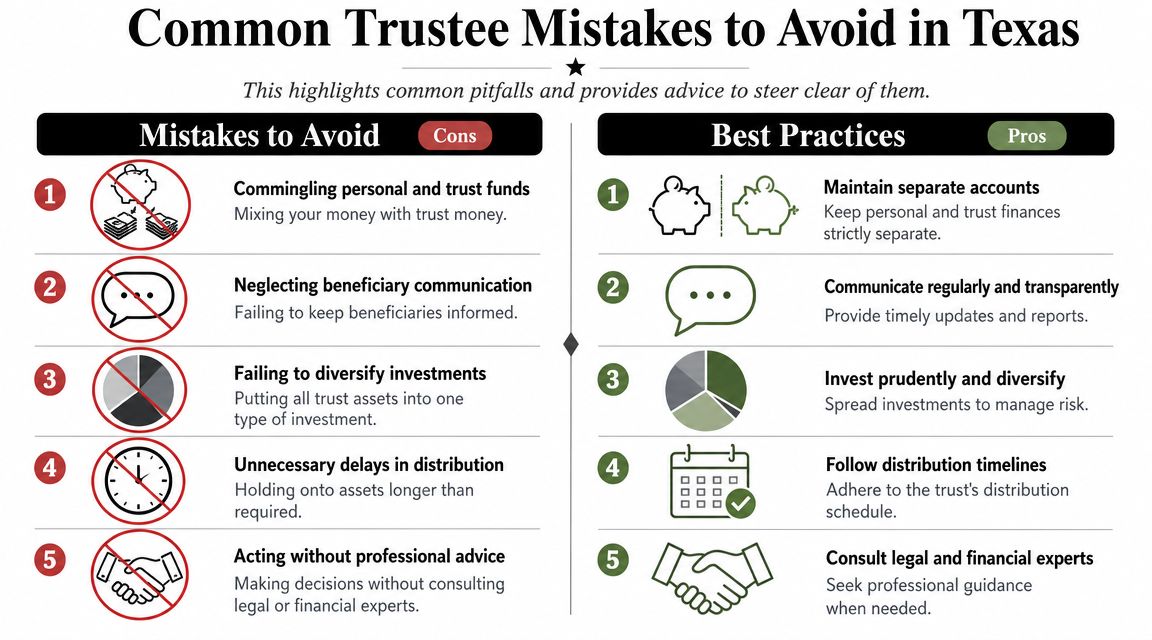
The shortcuts that create the biggest problems
A new trustee might think, “I'm family, so everyone knows I'm acting in good faith.” Good faith matters, but it doesn't replace process.
These are common trouble spots:
- Mixing funds: A trustee uses a personal account to hold trust money temporarily. Even if the motive is convenience, it blurs ownership and accounting.
- Making uneven distributions: One beneficiary gets money early because they asked first or have immediate needs. That can create impartiality problems.
- Ignoring paperwork: A trustee pays bills but doesn't save statements, receipts, or notes. Months later, no one can reconstruct what happened.
- Acting on assumptions: Family members say an item “was always meant” for a certain person, but the trust says something else.
- Delaying communication: Silence often causes more conflict than a cautious status update.
A few cautionary examples
Consider a trustee who “loans” money from the trust to a nephew after a job loss. The trustee believes the settlor would have wanted to help. But if the trust doesn't authorize that loan, or if other beneficiaries aren't treated fairly, the trustee may have breached fiduciary duties.
Or take a trustee who lets a vacant trust-owned home sit untouched for months. Mail piles up, insurance questions go unanswered, and valuables remain inside. No one intended harm, but lack of action can still damage the trust.
Another recurring issue involves trying to change trust terms informally after death. Once a revocable trust becomes irrevocable at death, the trustee usually must follow it as written. If your family is dealing with whether and how to modify a trust in Texas, that's a separate legal question, not something a trustee should improvise.
“I was only trying to help” is one of the most common explanations trustees give after preventable mistakes.
The safer approach
If you're unsure, pause and ask:
- Does the trust allow this?
- Will I be able to document this clearly later?
- Would I make the same decision if every beneficiary were watching?
That three-part check catches a surprising number of problems before they grow.
If you need practical support, a trustee may work with a lawyer, CPA, financial advisor, realtor, or appraiser depending on the issue. The Law Office of Bryan Fagan, PLLC is one Texas option that assists with trust administration, fiduciary guidance, and related estate matters.
Partnering with a Texas Trust Administration Lawyer
A careful trustee doesn't wait for a crisis before getting legal guidance. Hiring a lawyer is often part of prudent administration, especially when the trust is complex or family dynamics are strained.
Some situations call for help sooner rather than later. The trust language may be unclear. A beneficiary may be threatening legal action. The trust may own a business, unusual real estate, or assets that weren't clearly titled. You may be unsure whether an expense, sale, or distribution is permitted. Those are not signs you've failed. They're signs the role has reached a point where legal analysis matters.
A Texas trust administration attorney can help you interpret the trust, prepare notices, review your accounting system, respond to beneficiary demands, and coordinate with CPAs or financial professionals when needed. That support can also help when trust administration overlaps with probate, guardianship concerns, or broader asset protection planning.
Trustees often feel they should be able to “handle it themselves” because the settlor chose them personally. But being chosen usually means the settlor trusted your judgment, not that they expected you to work without guidance. In many cases, the most responsible decision is to get advice before making a difficult call.
A good legal partnership also helps you stay focused on your real job. Preserve assets. follow the trust. communicate appropriately. keep records. make thoughtful decisions. Those are the habits that reduce conflict and protect everyone involved.
If you're in the first month of administration, remember this: your role is manageable when you take it one step at a time. Start with authority. Move to inventory. Build your records. Communicate with care. Ask for help before uncertainty turns into a dispute.
If you're managing a trust or planning your estate, contact The Law Office of Bryan Fagan, PLLC for a free consultation. Our attorneys provide trusted, Texas-based guidance for every step of the process.