When a blended family sits down to plan an estate, the hardest part often isn't the paperwork. It's the fear of getting family wrong.
A stepparent may have helped raise a child for years, paid for school, shown up at every milestone, and treated that child as their own. Then estate planning enters the picture, and the family learns something painful. Love and daily life don't automatically create inheritance rights under Texas law. That gap surprises people, and it can create real conflict after a death.
If you're worried about whether a stepchild will be protected in a trust, that concern is justified. The good news is that Texas trust law gives families tools to close the gap. With careful drafting, thoughtful administration, and sometimes adoption, you can make the legal plan match the family you know you have.
Navigating Blended Family Legacies in Texas
A common Texas family scenario goes like this. A husband remarries. His new wife has a child from a prior relationship. Over time, he becomes the day-to-day father figure. He signs school forms, teaches the child to drive, and wants that child treated the same as everyone else when he dies.
Then someone asks a simple question: “Is the child included in the trust?”
That question can stop a family cold. Many people assume that if a child is part of the household, the law will treat that child as an heir. But blended family planning doesn't work on assumptions. It works on wording, legal status, and the instructions written into the estate plan.
That is why so many trust disputes in blended families start with surprise. One side says, “Of course he meant to include her.” Another side says, “The document doesn't say that.” At that point, the trustee is stuck in the middle, and grief quickly turns into conflict.
For families dealing with those tensions, our discussion of blended families and trust disputes in Texas can help frame the bigger picture.
The emotional problem and the legal problem
The emotional problem is easy to understand. A stepchild may feel like family in every way that matters.
The legal problem is narrower. Trusts, wills, beneficiary designations, and adoption status each carry legal weight. If those pieces don't line up, a child can be left out even when that result feels unfair.
Families usually don't run into trouble because they meant harm. They run into trouble because they thought everyone understood the plan.
Where families get confused
Readers often mix together three different ideas:
- Being family in daily life: This is emotional and social.
- Being an heir under Texas law: This is a legal status question.
- Being a beneficiary of a trust: This depends on the trust's written terms.
Those are not the same thing. Once you see that difference clearly, planning becomes much easier. You can then decide whether the right path is a trust amendment, a new trust, beneficiary updates, adoption, or a combination of those steps.
The Default Rule What Texas Law Says About Stepchildren
Texas has a default system for people who die without valid estate instructions controlling the asset. Lawyers call this intestate succession. The easiest way to think about it is as a preset wiring diagram. If you don't install custom instructions, the law follows its own built-in path.

Under that default rule, a stepchild has no default inheritance right from a stepparent unless the child was legally adopted or explicitly named in an estate document. Texas intestacy rules pass property to a spouse and then to biological or adopted descendants and blood relatives, but not to stepchildren as automatic heirs. The practical result is direct and serious. A stepchild can receive nothing by default unless the stepparent took affirmative planning steps, as explained in this discussion of Texas stepchild inheritance rights.
Why the word child can cause trouble
Many families think the phrase “my children” will naturally include everyone raised in the home. That can be a costly assumption.
In legal drafting, words matter because trustees and courts read them as instructions, not as family sentiment. If the trust uses a general class term and doesn't define it clearly, disputes can start over whether a stepchild fits inside that class. That's why blended families need more than good intentions. They need precise language.
A simple comparison
| Family relationship | Automatic heir under default Texas inheritance rules | Can be included by trust |
|---|---|---|
| Biological child | Yes | Yes |
| Adopted child | Yes | Yes |
| Stepchild not adopted | No | Yes, if expressly included |
The practical takeaway
If you remember one rule, remember this one. Stepchildren rights in a Texas trust come from express drafting, not assumption.
That means families need to ask focused questions:
- Was the child legally adopted
- Does the trust name the stepchild clearly
- Does the trust define terms like “children,” “descendants,” or “issue”
- Are related beneficiary designations coordinated with the trust
Practical rule: If you want a stepchild included, say so in writing with enough detail that a trustee can carry out the instruction without guessing.
Texas Estates Code concepts and trust planning work together. The Estates Code supplies the default rule. A trust can redirect trust property according to the grantor's written wishes. That is one reason trusts are so useful in blended families. They allow control over who receives property, when they receive it, and under what conditions.
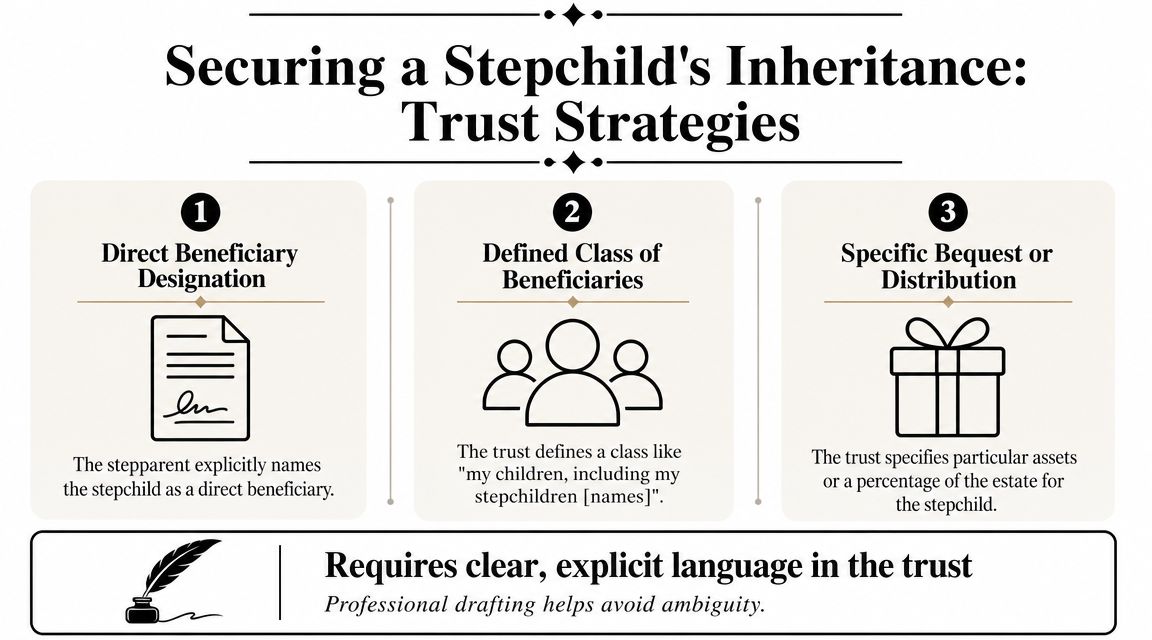
Three Ways to Secure a Stepchild's Inheritance with a Trust
Once a family understands the default rule, the next question is usually, “What do we do?” In most blended family plans, there are three practical paths. The right one depends on the family's goals, the ages of the children, the marriage history, and whether the stepparent wants equal treatment or a more customized plan.
Name the stepchild directly
The most reliable method is often the simplest. The trust can identify the stepchild by full legal name and state exactly what that child is to receive.
That may sound obvious, but many problems start because documents use broad labels instead of names. A sentence like “I leave a share to my children” can invite argument. A sentence that identifies “Jane Smith, my stepdaughter” gives the trustee something concrete to follow.
Here is the kind of idea lawyers often use for illustration, not for copy-and-paste use: a trust might state that a named stepchild receives a distribution at the grantor's death, or receives distributions for health, education, maintenance, and support under trustee supervision. The exact wording matters because it shapes the trustee's duties and the beneficiary's rights.
Define a beneficiary class carefully
Some families don't want to list everyone individually. They prefer a category, especially if the family may grow or if they want one rule to apply across multiple people.
In that case, the trust can define a class. For example, instead of relying on an undefined term like “children,” the document can create a custom class that includes biological children, adopted children, and specifically identified stepchildren. This can work well if the trust drafter takes the time to define terms with care.
A strong class definition reduces future confusion about who belongs in the group and who doesn't.
Here's a helpful visual summary of those options and how they compare.
Use the trust to control timing and purpose
A trust doesn't just answer who inherits. It also answers how and when. That matters in blended families where fairness may not mean identical treatment.
For example, a stepparent may want:
- Staggered distributions: A child receives trust assets in stages rather than all at once.
- Purpose-based support: The trustee may pay for education, housing, or medical needs under defined standards.
- Protection for a surviving spouse: One part of the trust may support the spouse during life, with the remainder later passing to named children and stepchildren.
The significance of fiduciary principles becomes apparent. Under the Texas Trust Code, the trustee's job is to administer the trust according to its written terms and in the interests of the beneficiaries named there. Clear drafting gives the trustee a workable roadmap.
Consider adoption when equal legal status is the goal
Trust drafting can include a stepchild without adoption. But adoption changes the legal relationship itself. For some families, that is the cleaner long-term answer because it changes status, not just one document.
Adoption may be worth discussing when the goal is full legal alignment across the family's planning, not just inclusion in one trust.
What to bring to the planning meeting
When you meet with a Texas estate planning attorney, it helps to gather:
- Current estate documents: Existing wills, trusts, and amendments.
- Family details: Marriage history, children from prior relationships, and adoption status.
- Asset information: Real property, business interests, retirement accounts, and life insurance.
- Intentions in plain language: Who you want included, whether treatment should be equal, and whether a surviving spouse needs lifetime support first.
If you need a practical planning option, the Law Office of Bryan Fagan, PLLC handles Texas estate planning, trust drafting, probate, guardianship, and asset protection matters that often intersect in blended family cases.
The more precise the trust language, the less room there is for a trustee, beneficiary, or court to guess what the grantor meant.
A Trustee's Duties When Stepchildren Are Involved
Trustees often inherit more than paperwork. They inherit pressure.
In a blended family, a trustee may hear competing stories from grieving relatives. One person says a stepchild should be treated equally because “that was Dad's intention.” Another says the trust doesn't list that child anywhere. The trustee may want to keep the peace, but personal fairness and legal duty are not always the same thing.
Fiduciary duty comes first
Under Texas trust law, a trustee owes fiduciary duties in Texas to the beneficiaries and to the trust itself. That includes a duty to follow the trust terms, act prudently, protect trust property, maintain records, and avoid self-dealing.
When stepchildren are involved, the core rule is especially important. A stepchild has no default inheritance right from a stepparent under intestate succession, and in trust administration the child must be expressly included in the governing instrument or legally adopted. Otherwise, the trustee must follow the trust's written terms rather than family expectations, as explained in this overview of Texas inheritance rights for stepchildren and heirs.
That means a trustee usually can't “fix” an omission by making an extra distribution to someone who isn't named.
A common trustee mistake
A trustee sees that a stepchild was raised in the home and decides to make an informal payment from trust funds because “it's only fair.”
That decision can create a breach of trust claim from the named beneficiaries. The trustee may have acted with good motives, but good motives don't override the document. This is one reason trustees should learn more about trustee duties in Texas.
When the wording is unclear
Ambiguity makes administration harder. If a trust uses terms like “my family” or “my children” without a definition, the trustee may need legal guidance before distributing assets.
A prudent trustee should consider steps like these:
- Read the entire trust: One section may define a term used elsewhere.
- Review amendments and related documents: Later changes can control.
- Document questions early: Written notes help show careful administration.
- Get legal advice before distributing: A Texas trust administration lawyer can help reduce liability.
A trustee's safest path is rarely the most popular one in the room. It's the one the trust actually authorizes.
Contesting a Trust Common Disputes and A Stepchild's Standing
Not every disappointed family member has the legal right to challenge a trust. That is where standing becomes the key issue.
Standing means the person has a recognized legal interest in the dispute. In trust cases, that often turns on whether the person is a named beneficiary, a person removed by a later amendment, or someone with another direct interest affected by the trust's validity or administration.
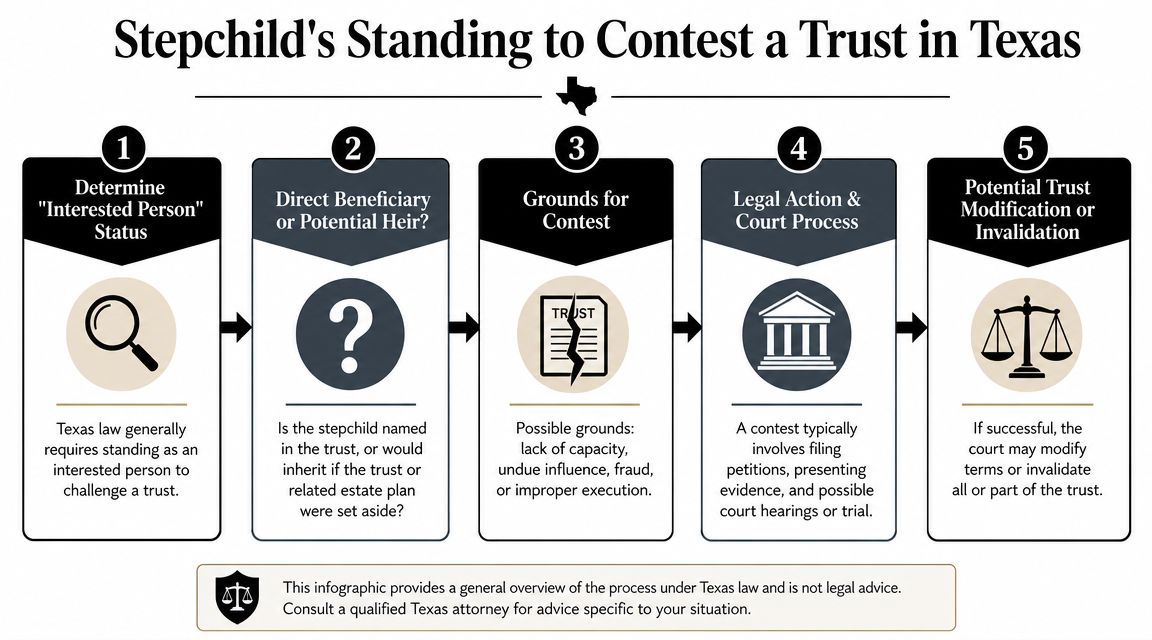
When a stepchild may have standing
A stepchild who was never named, never adopted, and has no legally recognized interest may have a difficult path. Feeling excluded is not the same as having a claim.
Still, some situations deserve close review:
- Prior inclusion in an earlier trust version: If a stepchild was named before and later removed, that may raise questions about capacity, undue influence, or fraud.
- Current beneficiary status: If the trust includes the stepchild, even in a limited way, that child may have rights to information and may challenge harmful trustee conduct.
- Future or contingent interest: A stepchild might not receive an immediate distribution but could still hold a meaningful interest under the trust terms.
Common dispute patterns
Trust contests involving blended families often center on misunderstanding and timing. A new marriage, a late-life amendment, a child from a prior relationship, and a trustee under pressure can create a volatile mix.
A few examples show how these conflicts arise:
| Dispute type | What the fight is really about |
|---|---|
| Removal from a later amendment | Whether the change was valid or improperly influenced |
| Vague beneficiary language | Whether the stepchild falls inside or outside a defined class |
| Trustee distribution decision | Whether the trustee followed the trust and fiduciary standards |
| Access to information | Whether the person asking has rights as a beneficiary or interested person |
Claims beyond a basic inheritance argument
Sometimes the issue isn't “I should have inherited automatically.” Sometimes it's “The trust was changed unfairly” or “The trustee mishandled the property.”
That distinction matters. A stepchild may not be able to rely on family status alone, but may still have a legal argument if the facts support one. For example, if a trustee ignores the trust's terms, hides information from a named beneficiary, or favors one beneficiary improperly, that can raise fiduciary issues separate from the family relationship.
If you're facing that kind of situation, it helps to review the process for how to contest a trust.
What a court will usually want to know
Courts generally focus on grounded legal questions, not broad appeals to fairness. Issues often include:
- Is this person a beneficiary or interested person
- What does the trust say
- Was there a valid amendment
- Did the trustee comply with fiduciary duties
- Is there evidence of incapacity, undue influence, or fraud
Courts don't rewrite trusts to match what family members assumed. They start with legal status, the document's wording, and admissible evidence.
This is why records matter. Copies of earlier trust versions, communications about amendments, financial records, and trustee accountings can all become important in a dispute.
An Action Plan for Your Blended Family's Estate
Families usually feel better once they have a checklist. Estate planning becomes more manageable when each person knows what to review and what questions to ask.
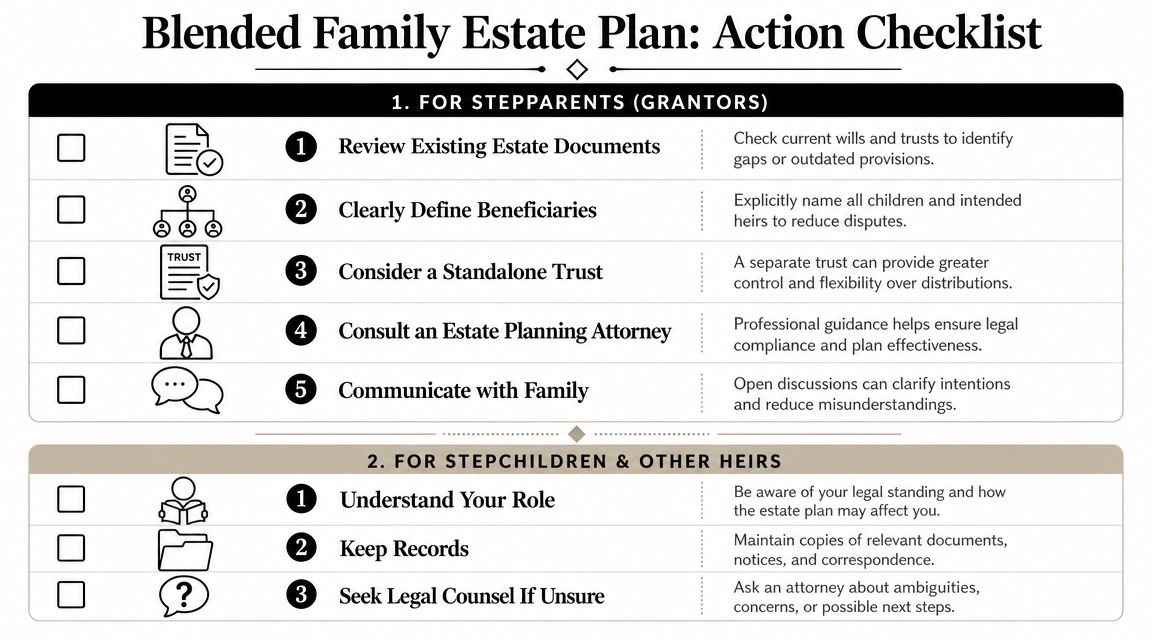
For stepparents and grantors
If you're creating or updating a trust, focus on clarity before anything else.
- Review old documents after remarriage: Wills, revocable trusts, powers of attorney, and beneficiary designations may not match your current family structure.
- Name people precisely: If a stepchild should inherit, use the person's full legal name and define the relationship where appropriate.
- Define class terms: If you use terms like “children” or “descendants,” make sure the trust explains exactly who is included.
- Coordinate non-trust assets: Retirement accounts, life insurance, and payable-on-death accounts need to align with the broader plan.
- Consider whether adoption fits your family: Some families want document-based inclusion. Others want equal legal status across the board.
- Communicate thoughtfully: In some families, a calm explanation during life can prevent bitter surprises later.
For stepchildren and other beneficiaries
If you're trying to understand your position, start with the documents, not assumptions.
- Request the governing instrument if you may be a beneficiary: You need to know what the trust says before drawing conclusions.
- Keep records: Save communications from the trustee, trust summaries, notices, and account statements.
- Watch for ambiguity: Terms like “family” or “children” may require closer legal review.
- Ask whether you have standing before filing anything: A dispute only works if the law recognizes your interest.
- Seek your own counsel when needed: The trustee's lawyer does not represent every family member.
A short planning worksheet
Use these questions at the kitchen table or in an attorney meeting:
- Who do we want included
- Should everyone receive the same thing, or different things for different reasons
- Does the trust language already say that clearly
- Are any stepchildren relying on assumptions rather than written rights
- Would a will, trust amendment, adoption, or asset retitling solve the problem better
This checklist also overlaps with related planning areas. A blended family estate may involve probate administration, guardianship concerns for minors or disabled adults, and asset protection planning for beneficiaries who need structured distributions.
Secure Your Family's Future with Confidence
Blended families need estate plans that are both legally sound and emotionally honest. In Texas, the law's default rules don't automatically track the relationships that matter most inside a household. That can feel harsh, but it also means careful planning gives you real control.
A trust can bridge the space between “this child is part of my family” and “this child has enforceable legal rights.” Clear drafting can name the right beneficiaries, define who belongs in a class, guide a trustee's decisions, and reduce the risk of future litigation. Adoption may also be part of the answer when a family wants a more complete legal change.
For trustees, the message is just as important. Follow the trust. Respect fiduciary duties. Don't try to solve drafting problems with informal distributions. When the language is unclear, get advice before acting.
For stepchildren and other relatives, the strongest next step is usually information. Get the trust, understand your role, and find out whether you have beneficiary rights or standing before conflict escalates.
Estate planning isn't only about property. It's also about preserving dignity, avoiding avoidable disputes, and making sure the people you love aren't left to argue over what you “must have meant.”
If you're managing a trust or planning your estate, contact Law Office of Bryan Fagan, PLLC for a free consultation. Our attorneys provide trusted, Texas-based guidance for every step of the process.