A second marriage often brings a simple goal and a complicated legal problem. You want your spouse to be secure. You also want your children, and sometimes stepchildren, to be treated fairly. Most families assume a trust will handle that balance automatically. In Texas, it usually won't unless the plan is built carefully, asset by asset, and administered with discipline.
That's why blended families and trust disputes in Texas can become so painful. The conflict usually isn't about greed alone. It's about unclear expectations, mismatched documents, beneficiary forms that were never updated, and family members who feel shut out after the first parent dies. A calm, well-drafted plan can reduce that risk. A generic plan often makes it worse.
Protecting Your Legacy in a Blended Family
A common situation looks like this. A husband remarries later in life. He owns a house he bought before the marriage, has retirement accounts from years of work, and wants his current wife to live comfortably if he dies first. He also wants his children from an earlier marriage to inherit what he built. Everyone agrees while he is living. After his death, the disagreements start.
This isn't rare. Over 35% of Americans are part of a blended family structure, and that same dynamic is tied to estate conflicts. In Texas, undue influence and questions about mental capacity are two of the most common grounds for challenging a will or trust, as noted in this blended-family estate planning discussion.
For many families, the legal issue is really two issues at once. First, the plan has to reflect the emotional reality of a second marriage. Second, the documents have to work under the Texas Estates Code, the Texas Trust Code, and ordinary fiduciary rules that govern how trustees and executors must act.
What families usually need
Most blended-family plans need more than a simple will. They often require coordinated decisions about:
- Who is protected first: A surviving spouse may need housing, income, or access to support.
- Who receives what later: Children from a prior relationship may need a protected remainder interest instead of a vague promise.
- Who controls the assets: The person serving as trustee or executor can either lower tension or intensify it.
- Which documents must match: A trust, a will, deeds, and beneficiary designations need to point in the same direction.
Practical rule: In a blended family, the biggest mistake is assuming your overall intent matters more than the exact wording on each account, deed, and trust provision.
Families looking for a more focused overview of these issues can also review estate planning for blended families in Texas. The core lesson is simple. If your family has more than one marital line, your plan needs more than good intentions.
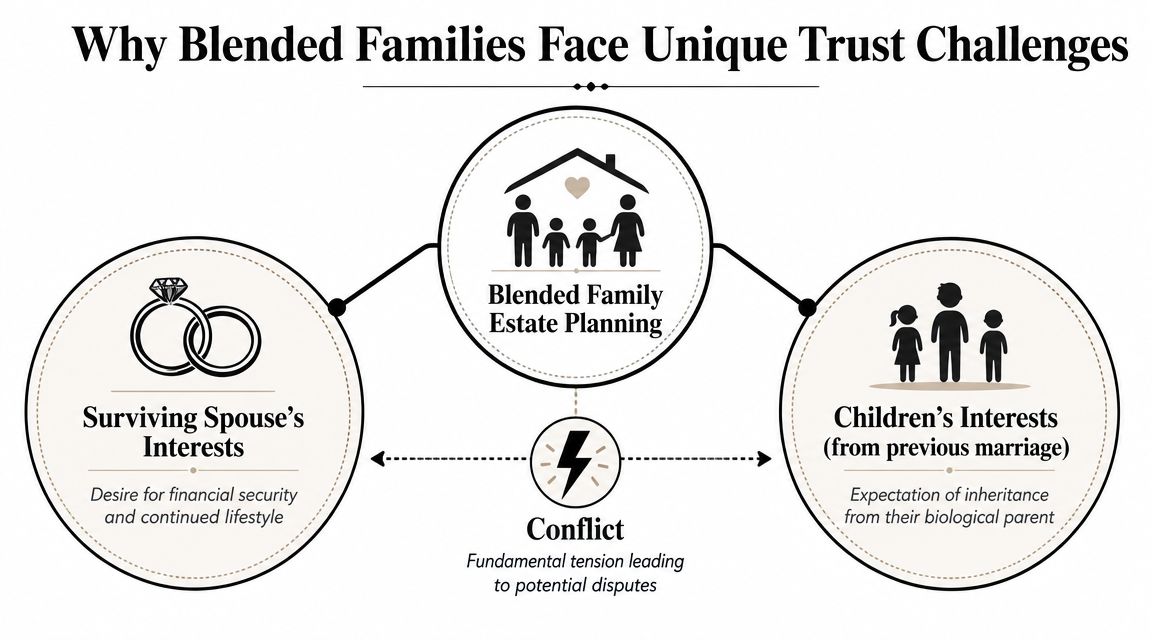
Why Blended Families Face Unique Trust Challenges
The tension in most blended-family cases is easy to describe. The surviving spouse wants stability and control. The children from the prior marriage want to know that their parent's assets won't disappear, be redirected, or be consumed without accountability. Both concerns are understandable. Texas law doesn't erase either one.
Separate property and community property matter
Texas is a community property state. That means property acquired during marriage may be treated differently from property owned before marriage, inherited individually, or received as a gift. In plain English, not everything belongs to the same bucket.
That matters in second marriages because people often bring assets into the marriage at different times and in different forms. A home purchased before remarriage may be one spouse's separate property. Income earned during the marriage may be community property. An inherited brokerage account may be separate property, but if the records are poor or funds are mixed together, proving that later can become harder than families expect.
The trust may not match the family's expectations
A lot of people think a trust solves the whole problem by itself. It doesn't. A trust only controls the assets that are owned by the trust or made payable to it. If one spouse says, “My trust leaves everything to my kids after my wife is taken care of,” but the retirement account still names someone else directly, the account may follow that form instead of the broader plan.
The emotional side of the dispute often commences with this contrast. One side says, “We know what Dad wanted.” The other side says, “The paperwork says something else.” Courts and trustees have to work with the paperwork.
The conflict is built into the roles
A blended-family estate plan creates overlapping roles that can be hard to manage:
- The spouse as beneficiary: The spouse may need income, housing, or principal distributions.
- The children as remainder beneficiaries: They may receive what is left later, which makes them sensitive to spending and administration decisions.
- The spouse as trustee: This can create immediate suspicion, even where no misconduct has happened.
- The stepchildren as outsiders to communication: They may not know what they're entitled to receive or what the trustee is doing.
A good blended-family plan doesn't try to eliminate human emotion. It gives those emotions a structure that Texas law can enforce.
Under the Texas Trust Code, trustees owe fiduciary duties such as loyalty, prudence, and compliance with the trust's terms. Under the Texas Estates Code, probate and inheritance rules still affect assets that weren't placed into the trust or coordinated properly. When families ignore those rules, disputes often follow.
Common Triggers for Trust Disputes in Texas
Most trust disputes don't begin with one dramatic event. They start with a series of smaller failures. A document was never updated. A beneficiary wasn't told what happened. A trustee made decisions without explaining them. In blended families, those failures are more likely to be interpreted through a personal lens.
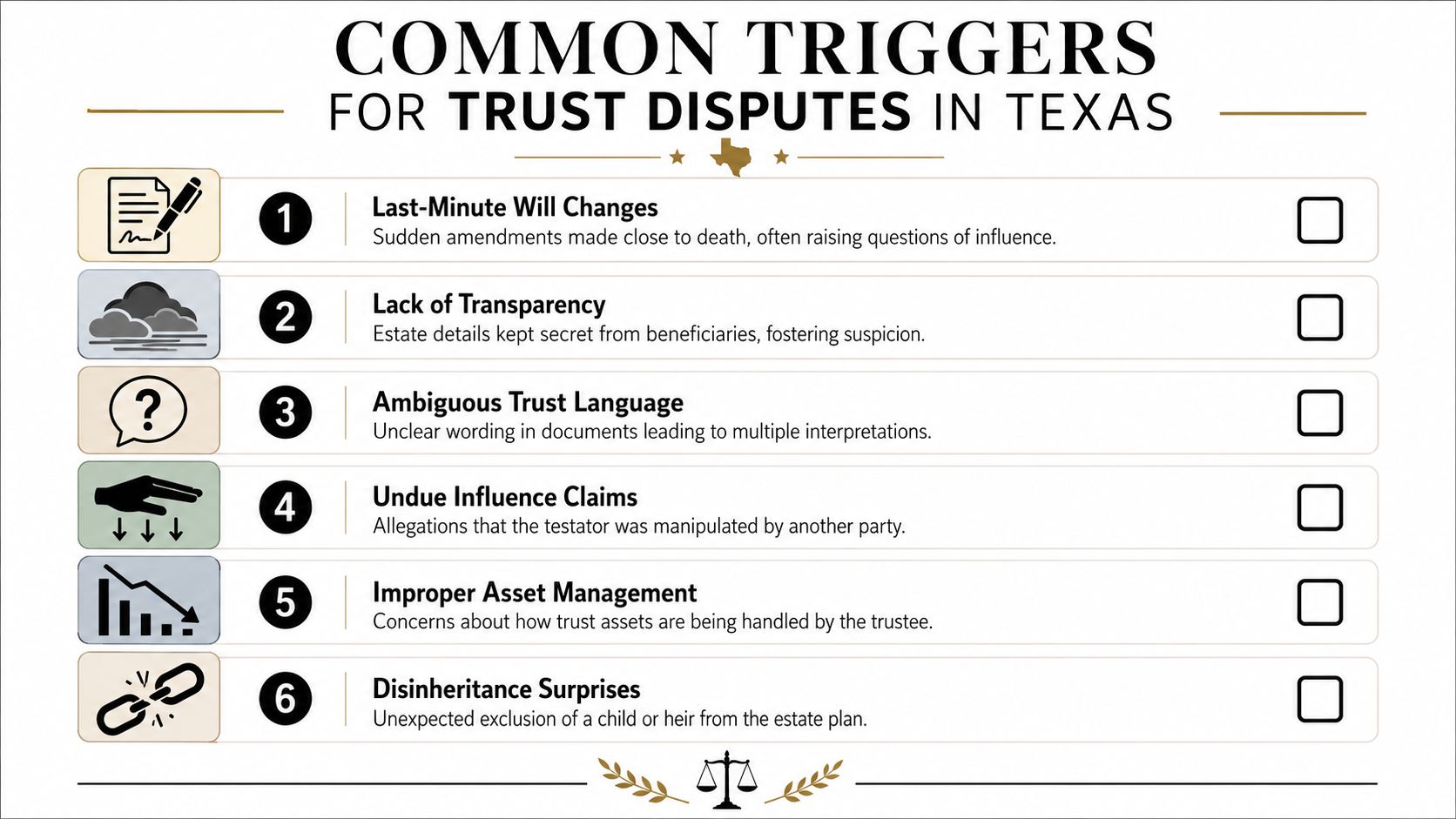
Texas practitioners regularly see disputes tied to inconsistent documents, poor communication, and unclear trustee authority, and advisers describe these contests as increasingly common when a plan must divide assets between a surviving spouse and children from an earlier marriage, as discussed in this analysis of blended-family dispute risks.
Capacity and undue influence
Two of the most serious triggers are claims that the person who signed the will or trust lacked capacity, or was pressured by someone else. In second-marriage situations, relatives may focus on last-minute changes that favor a new spouse, especially if the children were excluded from conversations or signing meetings.
That doesn't mean every updated plan is invalid. It does mean the surrounding facts matter. Medical history, timing, witness credibility, attorney involvement, and documentation all affect whether a challenge gains traction.
For a closer look at how these claims are evaluated, see undue influence in Texas trusts and how to prove it.
A short overview may also help if you're trying to spot warning signs early.
Administration mistakes that create distrust
Even a valid trust can lead to conflict if administration is sloppy. Common examples include:
- No accounting provided: Beneficiaries begin to assume the trustee is hiding something.
- Distributions that seem uneven: Stepchildren may believe the surviving spouse is favoring one side of the family.
- Unclear standards for support: If the trust says distributions can be made for support, but never defines how that discretion should be used, fights can start quickly.
- Delay: Beneficiaries often tolerate bad news better than silence.
Real-world patterns that lead to litigation
A few patterns show up again and again in blended families:
- A parent remarries and updates only part of the plan.
- The trust says one thing, title records or account forms say another.
- The surviving spouse begins acting as trustee without a clear reporting process.
- Adult children hear about asset transfers after the fact and suspect self-dealing.
- Each side hires counsel after trust has already broken down.
Silence is rarely neutral in trust administration. Beneficiaries often treat a lack of information as evidence of misconduct.
Under Texas fiduciary principles, trustees must act in good faith and in accordance with the trust instrument. Executors and trustees who fail to document decisions, preserve records, or communicate responsibly often make a manageable problem much worse.
Texas Law and Your Blended Family Estate Plan
A well-built plan for a blended family has to work on paper and in practice. That means understanding what a trust can control, what passes outside the trust, and how Texas default rules can override a family's assumptions.
A major source of conflict is the collision between a trust and Texas default property rules. Assets with beneficiary designations, such as 401(k)s and life insurance, pass outside the will or trust. If they aren't updated after a remarriage, they can unintentionally disinherit a new spouse or children and directly contradict the estate plan's intent, as explained in this Texas probate discussion for blended families.
What the Texas Estates Code affects
The Texas Estates Code matters whenever a person dies with assets that still pass through probate or under default inheritance rules. If a blended-family client assumes “my trust covers everything,” but never retitles certain property or updates account designations, the Estates Code may still shape the outcome.
That can affect:
- Community property interests
- Separate property that remains outside the trust
- Homestead-related rights
- Probate administration of assets not transferred into the trust
The lesson is practical. A trust document is only one part of the estate plan. Deeds, account forms, beneficiary designations, and ownership records must be reviewed together.
What the Texas Trust Code affects
The Texas Trust Code governs trust creation, administration, trustee powers, fiduciary duties, and disputes involving trust interpretation or trustee conduct. For blended families, the code becomes especially important after the first death, when the trustee must balance present needs against future remainder interests.
If the trust gives a surviving spouse lifetime benefits but preserves principal for children later, the trustee has to follow that design exactly. A trustee can't rewrite the settlor's intent through informal family agreements, selective disclosures, or broad spending choices that the instrument doesn't support.
Tools that often work better than a simple all-to-spouse plan
One common approach in blended-family planning is a QTIP trust or another separate-trust structure. The basic idea is straightforward. The surviving spouse can receive income or support during life, while the principal is preserved for children or other chosen beneficiaries later.
That structure often works better than an outright transfer because it separates use from final ownership. It can also reduce the risk that assets will be redirected after the first spouse dies.
A useful legal review usually covers at least these items:
- Trust funding. Which assets are in the trust now?
- Title review. How are the house, land, or business interests titled?
- Beneficiary forms. Who is listed on retirement accounts, insurance, and payable-on-death accounts?
- Fiduciary design. Who will administer the plan after incapacity or death?
The strongest blended-family plan is coordinated at the asset level. If one major account is left out, that account can become the center of the dispute.
Proactive Strategies to Prevent Trust Disputes
Dispute prevention starts long before anyone files a lawsuit. The best plans reduce ambiguity, reduce opportunities for suspicion, and reduce the chance that one family member controls too much with too little oversight.
A primary litigation risk in blended families is trustee bias, especially when a surviving spouse serves as trustee for stepchildren. Texas legal guidance points to safeguards such as independent accounting, clear distribution schedules, and professional trustees to reduce contests based on alleged self-dealing or undue influence, as discussed in this blended-family planning resource from UNT Dallas.
Draft for administration, not just for signing day
Many estate plans read well and administer poorly. A good blended-family trust should answer practical questions, not just broad ones.
Include instructions that address:
- Distribution standards: If the spouse can receive funds for health, education, maintenance, and support, define how that standard will be applied.
- Housing rules: If the surviving spouse may stay in the home, who pays taxes, insurance, repairs, and major improvements?
- Accounting cadence: State when beneficiaries receive reports and what those reports will include.
- Decision authority: Clarify whether the trustee has sole discretion, limited discretion, or must consult an independent party.
Choose the right trustee for the family you actually have
The wrong trustee can ruin a well-drafted trust. In blended families, naming a spouse as sole trustee may save money up front but create long-term mistrust. Naming one child may create a different kind of conflict. A neutral fiduciary, co-trustee structure, or trust protector arrangement can sometimes produce better results.
If you need a Texas trust administration lawyer to review fiduciary design, distribution provisions, and reporting duties, Law Office of Bryan Fagan, PLLC handles trust administration, beneficiary disputes, and estate planning matters under Texas law.
For readers who want a plain-English refresher on the distinction between these planning tools, Cremation.Green's family guide offers a helpful overview of wills versus trusts before you meet with counsel.
Comparing trust provisions for blended families
| Provision / Strategy | What It Does | Best For Preventing… |
|---|---|---|
| Separate trusts for each spouse | Keeps each spouse's assets and dispositive choices more clearly defined | Claims that one side of the family was never meant to share equally in all assets |
| QTIP or spouse-benefit trust | Supports a surviving spouse while preserving principal for later beneficiaries | Disinheritance of children from a prior relationship |
| Independent trustee | Places administration with a neutral decision-maker | Allegations of bias, favoritism, and self-dealing |
| Required accountings | Forces regular disclosure of trust activity | Suspicion caused by silence or incomplete information |
| Distribution schedule | Sets timing and standards for payments | Arguments over whether the trustee is delaying or over-distributing |
| Dispute-resolution clause | Encourages mediation or sets procedures before suit | Immediate escalation into expensive litigation |
Communication that actually helps
“Talk to your family” is incomplete advice. Productive communication is specific.
- Hold a focused planning meeting: Explain the broad structure, not every dollar if that would inflame conflict.
- Keep records of intent: Letters of instruction and attorney notes can help explain why the plan was structured a certain way.
- Use separate counsel when needed: In high-tension situations, independent advice can reduce later claims of pressure.
- Revisit the plan after major changes: Remarriage, sale of a home, retirement, incapacity, and beneficiary deaths all justify a review.
Navigating a Trust Dispute That Has Already Started
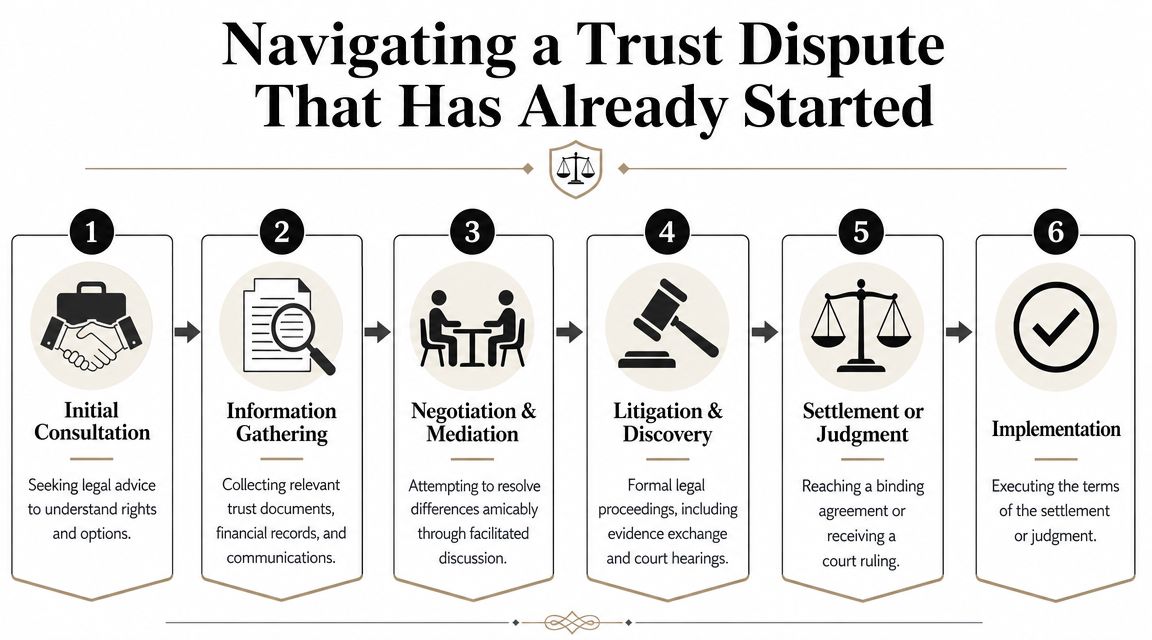
Once a dispute begins, families often make two mistakes. They wait too long, or they escalate too fast. A better approach is to gather facts quickly, protect records, and choose the least destructive path that still protects your rights.
Start with documents and deadlines
If you're a beneficiary, trustee, or executor, begin by collecting the trust instrument, amendments, account statements, deeds, correspondence, tax records, and any written explanation of the settlor's intent. If the dispute involves capacity or undue influence, preserve medical records and communications that may show timing and decision-making context.
A Texas trust administration lawyer can help evaluate claims for breach of fiduciary duty, requests for accounting, trust interpretation issues, and possible removal of a trustee. Early legal review matters because trust disputes can involve filing deadlines and procedural requirements that are easy to miss if you delay.
For a broader look at these case paths, review dispute resolution and litigation in Texas trusts.
Use negotiation and mediation when they can still work
Many blended-family cases are emotionally intense but legally fixable. If the core problem is distrust, a structured exchange of information may narrow the issues quickly. Mediation is often effective when the family needs help separating legal rights from personal history.
That said, mediation only works when both sides have enough information to negotiate intelligently. If the trustee refuses to provide records or explain decisions, a court proceeding may be necessary to force disclosure.
Know what courts can do
Texas courts can address serious trust administration problems. Depending on the facts, a court may:
- Order an accounting
- Interpret trust language
- Review disputed distributions
- Remove or restrain a trustee
- Address breaches of fiduciary duties in Texas
- Approve or reject settlement structures
When a beneficiary suspects misconduct, the first goal isn't to “win.” It's to secure the records, clarify the legal authority, and stop preventable damage.
A calm response is often the most effective one. Angry emails, public accusations, and rushed self-help usually make the record worse. Careful documentation, prompt legal advice, and disciplined communication usually make it better.
Questions to Ask Your Texas Trust Attorney
The right questions can save families from years of avoidable conflict. If you're meeting with a Texas estate planning attorney or trust litigation counsel, ask for direct answers in plain English.
Useful questions for blended-family planning
Can my trust protect my spouse and still preserve assets for my children?
Often yes, but the answer depends on the assets, the distribution terms, and who serves as trustee.What happens if a retirement account names the wrong beneficiary?
That account may pass outside the trust or will, even if the broader estate plan says something different.Can a surviving spouse also serve as trustee?
Sometimes, but the safer question is whether that choice will create avoidable claims of bias or self-dealing.What information is a trustee required to share?
That depends on the trust terms and Texas fiduciary rules, but trustees generally need to maintain records and provide appropriate information to qualified beneficiaries.How do I modify a trust in Texas if the family situation has changed?
The answer depends on whether the trust is revocable or irrevocable, the trust language, and whether court involvement is needed. If you're researching how to modify a trust in Texas, bring the full trust and all amendments to the consultation.
Bring these items to your consultation
A productive meeting usually includes:
- Current estate documents: Wills, trusts, amendments, powers of attorney
- Asset records: Deeds, account statements, business ownership records, insurance policies
- Beneficiary forms: Retirement, life insurance, transfer-on-death, payable-on-death accounts
- Family details: Marriage history, children, stepchildren, adoptions, prior divorces
- Dispute materials: Letters, emails, notices from trustees, court filings, accountings
If you're managing a trust or planning your estate, contact The Law Office of Bryan Fagan, PLLC for a free consultation. Our attorneys provide trusted, Texas-based guidance for every step of the process.