Discovering a no contest clause in a Texas trust often happens at the worst possible time. A parent has died, tensions are already high, and someone in the family finally reads the trust closely enough to find a sentence that seems to say, “If you challenge this, you lose everything.”
That can feel frightening. It can also feel unfair, especially if something about the trust's creation doesn't seem right.
A common situation looks like this: one child handled most of the parent's finances near the end of life, a new trust appears, and another beneficiary starts asking whether the parent really understood what they signed. Then the family sees the no-contest language and assumes the matter is over. It usually isn't that simple under Texas law.
Navigating a Loved One's Trust With Confidence
Managing a loved one's trust can feel overwhelming, but with the right legal guidance, it doesn't have to be. A no-contest clause is serious, but it is not a magic shield that blocks every question, every concern, or every court filing.

Families usually need three kinds of clarity at once. Beneficiaries want to know whether asking questions could cost them their inheritance. Trustees want to know how to administer the trust without making the conflict worse. Trust creators want to know how to reduce future litigation without overpromising what a clause can do.
Texas trust matters also involve more than one body of law. The Texas Trust Code governs many trust administration issues, including trustee powers, duties, and beneficiary rights. The Texas Estates Code matters because Texas law addresses the enforceability of no-contest clauses and probate-related disputes. On top of that, fiduciary principles require trustees and executors to act carefully, loyally, and in line with the governing document and Texas law.
A no-contest clause should never stop a family from getting clear advice before taking action.
If you're a trustee, your first job is often practical. Secure records, identify trust property, communicate carefully, and avoid emotional decisions. If you're a beneficiary, your first job is also practical. Read the trust, gather facts, and separate suspicion from proof.
That steady approach is what keeps a difficult trust matter from turning into a preventable legal fight.
Understanding the No-Contest Clause in Simple Terms
A no-contest clause, sometimes called an in terrorem clause, is a provision in a will or trust that tries to discourage challenges. In plain English, it says that if a beneficiary contests the document, that beneficiary may lose what they were supposed to receive.
What the clause is trying to do
The trust creator usually includes this clause to protect their plan from disruption. Many families use it like a peace treaty for the estate. The message is simple: respect the document, follow the instructions, and don't file a lawsuit just because you're unhappy with the distribution.
That doesn't mean every complaint is forbidden. It means the clause is aimed at stopping baseless attacks on the trust itself.
Who it usually affects
In practice, a no-contest clause matters most to beneficiaries named in the trust. Those are the people who have something to lose. If a person is receiving a meaningful gift under the trust, the clause may deter them from filing a weak claim.
For trustees, the issue is different. A trustee doesn't get to ignore fiduciary duties in Texas just because the trust contains strong no-contest language. Trustees still must administer the trust in good faith, keep proper records, follow the trust terms, and respond appropriately when a beneficiary has a lawful request for information.
A newly acting trustee who needs a practical checklist may find First Steps for a Successor Trustee in Texas helpful because it focuses on what to do immediately after stepping into the trustee role.
What readers often misunderstand
People often confuse a challenge to the validity of the trust with questions about administration of the trust. Those are not always the same thing.
Here is the simple distinction:
| Action | General purpose |
|---|---|
| Contesting the trust | Claims the trust should not stand as written |
| Trust administration request | Seeks information, accounting, or proper trustee conduct |
That distinction matters because Texas courts and lawyers often examine the exact wording of the clause and the exact conduct at issue.
Are No-Contest Clauses Enforceable Under Texas Law
Yes, but not absolutely.
In Texas, no-contest clauses are generally enforceable under the Texas Estates Code, but they explicitly fail to penalize a beneficiary who contests a will or trust in good faith and with probable cause. This statutory safeguard ensures that a beneficiary retains their inheritance even if the challenge is ultimately unsuccessful, provided the court finds the challenger had a reasonable basis for questioning the document's validity (Texas no-contest clause overview).
What good faith and probable cause mean
These two ideas do most of the work.
Good faith means the beneficiary is acting with integrity, not using the lawsuit as a weapon out of spite or delay. Probable cause means there is a reasonable basis for the challenge. The beneficiary doesn't need a guaranteed win. The beneficiary needs real facts that justify asking the court to look closer.
A Texas court may consider concerns such as:
- Possible fraud: A signature or document history raises serious questions.
- Possible undue influence: One person may have pressured the trust creator into changing the plan.
- Possible lack of capacity: The trust creator may not have understood what they signed.
If you want a closer look at when a trust challenge may be viable, this discussion of whether a trust can be contested in Texas provides helpful context.
A practical example
Suppose your mother signed an amended trust late in life. A sibling drove her to the lawyer, controlled access to her, and suddenly became the primary beneficiary. You also have medical records and witness observations suggesting confusion around that time.
That does not mean you will automatically win. It does mean you may have a serious basis to ask whether the trust amendment is valid.
Practical rule: If your concern is grounded in documents, witness accounts, or specific events, the no-contest clause may not be the brick wall it first appears to be.
Families dealing with multi-state trust disputes sometimes compare how other states handle similar issues. For readers who need that perspective, this resource on how parties navigate Hawaii trust challenges shows how trust litigation analysis can differ outside Texas.
Why this matters for trustees and families
This rule protects both sides. It discourages frivolous lawsuits, but it also preserves judicial review when a trust may be invalid. That balance is important in Texas estate planning, probate, and trust administration.
It also means trustees should be careful before accusing a beneficiary of violating the clause. The facts matter. The motive matters. The evidence matters.
How Texas Courts Decide to Uphold Forfeiture
Texas judges do not usually rush to strip a beneficiary of an inheritance. Courts apply no-contest clauses narrowly.
Texas courts strictly construe no-contest clauses to avoid forfeiture whenever possible. The Texas Supreme Court, in Badouh v. Hale (22 S.W.3d 392, 397), established that a breach is found only when the parties' acts come within the clause's express terms, emphasizing that courts should not enforce forfeiture when the suit's purpose is not to thwart the grantor's intent (discussion of Badouh v. Hale and strict construction).
Strict construction in everyday language
“Strict construction” means the court reads the clause carefully and does not expand it beyond its actual words. If the trust says one thing, the court does not casually treat it as saying something broader.
That matters because forfeiture is harsh. Courts know that taking away a beneficiary's inheritance is a serious result, so they examine whether the beneficiary's conduct clearly falls within the clause's language.
What judges look at
A court often asks practical questions such as these:
- What exactly did the beneficiary file? A direct attack on validity is different from an administrative complaint.
- What did the clause say? Broad assumptions don't control. The text does.
- Why was the lawsuit filed? Courts pay attention to whether the filing was made to investigate a legitimate issue or to disrupt the trust.
- Was there a reasonable basis? A beneficiary with evidence stands differently from a beneficiary acting on rumor.
Here is a useful side-by-side view:
| Court concern | More likely to support forfeiture | Less likely to support forfeiture |
|---|---|---|
| Purpose of suit | Delay or obstruction | Legitimate inquiry |
| Evidence | Little or none | Specific supporting facts |
| Clause language | Expressly covers the conduct | Ambiguous or limited wording |
| Overall context | Attempt to defeat intent | Attempt to test validity fairly |
Why trustees should proceed carefully
A trustee may feel pressure from one side of the family to “enforce the clause.” But trustees have fiduciary duties in Texas. They must act prudently, remain neutral where required, and avoid turning a family disagreement into a larger breach of duty.
A trustee who threatens forfeiture too quickly can create new problems. A beneficiary who overreacts can do the same.
For readers comparing trust dispute frameworks in other states, this article on Trust and estate litigation in Utah offers another example of how courts analyze family conflicts in estate cases.
Courts tend to focus less on family anger and more on wording, evidence, and purpose.
That's why these cases are rarely resolved well through guesswork. They turn on the document, the facts, and the way the case is presented.
Actions That May or May Not Trigger the Clause
In this situation, many beneficiaries feel stuck. They want answers, but they don't want to trigger the clause by accident.
The safest way to think about it is to separate attacking the trust's validity from asking the trustee to do the job properly.
Actions more likely to trigger concern
The following actions may raise no-contest issues, depending on the trust's wording and the surrounding facts:
- Direct validity challenge: Filing suit to claim the trust or an amendment is invalid because of incapacity, fraud, or similar defects.
- Demand for a larger share through invalidation: Asking the court to set aside the trust so distribution changes in your favor.
- Bad-faith litigation: Using court filings mainly to delay administration or pressure a settlement without meaningful evidence.
A claim based on undue influence can be serious and legitimate, but it needs proof. Beneficiaries evaluating that issue often start by learning how to prove undue influence in a Texas trust.
Actions that often stand on different footing
Other actions are often different because they deal with administration rather than invalidity:
- Requesting an accounting: A beneficiary may need records showing what the trustee received, spent, or distributed.
- Seeking interpretation: If trust language is unclear, a court may be asked to clarify meaning.
- Enforcing fiduciary duties: A beneficiary may question whether the trustee followed the Texas Trust Code and basic fiduciary principles.
- Addressing mismanagement: If a trustee mishandles trust property, that issue may concern administration rather than a contest to the trust itself.
A practical comparison
| If you are doing this | It often looks like |
|---|---|
| “This trust should be thrown out” | A contest |
| “Show me the trust records” | An administration request |
| “What did this paragraph mean?” | A construction or interpretation issue |
| “The trustee used trust assets improperly” | A fiduciary-duty dispute |
The exact trust language still matters. Some clauses are drafted broadly. Others are not. That's why beneficiaries and trustees should avoid relying on assumptions or family lore about what “always” triggers forfeiture.
A Beneficiary's Guide to Responding to a No-Contest Clause
You open the trust, read the no-contest clause, and your stomach drops. You may be wondering whether asking questions could cost you your inheritance, or whether staying quiet could let a real problem go unaddressed.
That moment calls for calm, not speed.
A no-contest clause often feels like a warning sign posted on a closed gate. The hard part is figuring out whether you are about to start a true legal challenge or ask for information you are entitled to receive. Before you do anything public, give yourself room to sort those two paths apart.
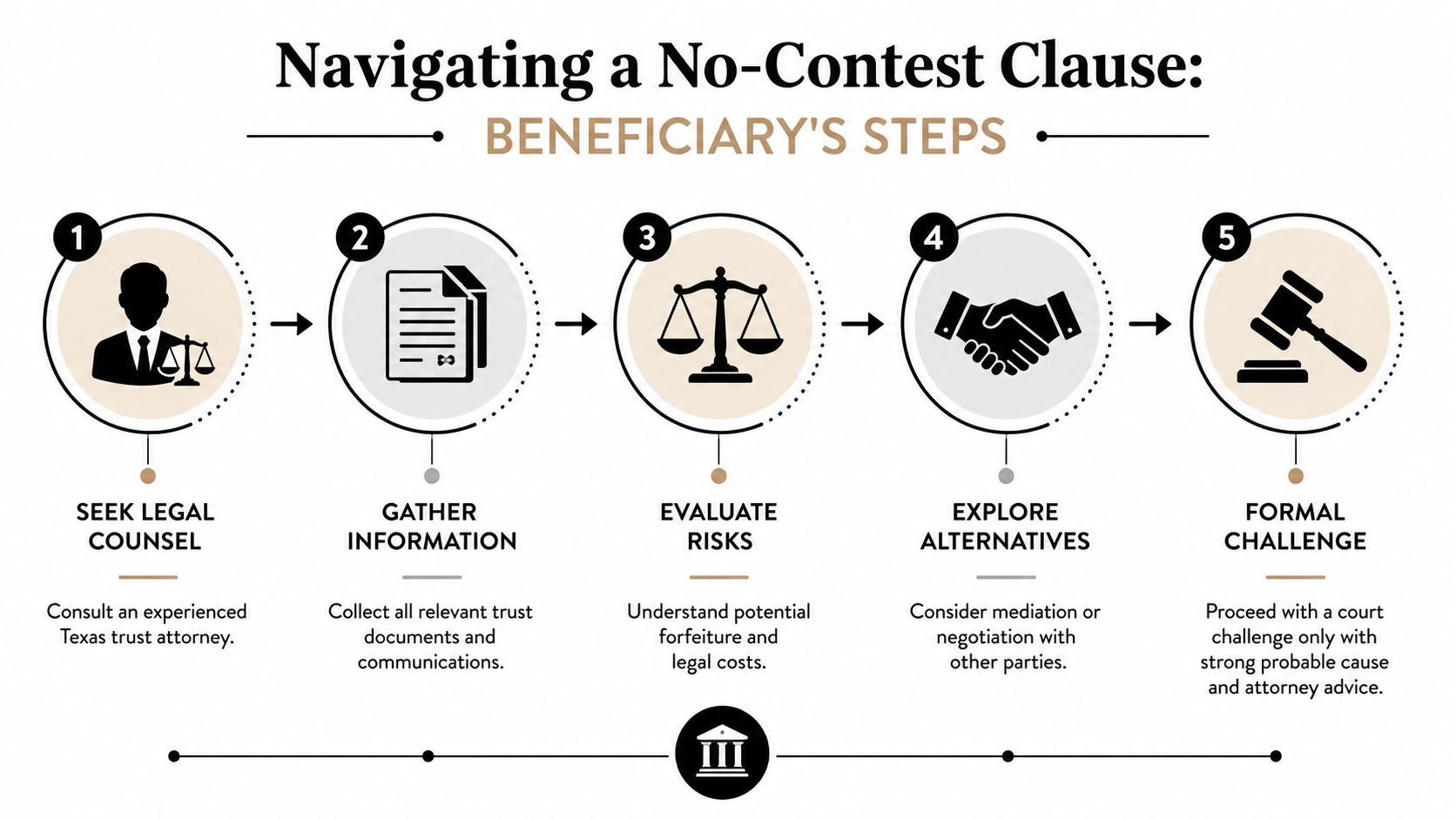
Start with a five-step approach
Pause before making accusations
Early emails, family texts, and threats to sue can create problems fast. They may harden positions before you know what the documents say.Gather the paperwork
Collect the trust, any amendments, related estate planning documents, letters, emails, texts, and records showing who was involved in later changes. If capacity is part of your concern, make note of medical providers and people who saw the trust creator around the time of signing.Build a simple timeline
Put key events in order. When was the trust created? When was it changed? Who met with the trust creator, and when? A timeline helps separate a specific concern from general family frustration.Ask what problem you are really trying to solve
Are you saying the trust should be invalid? Are you trying to get records? Are you concerned that the trustee mishandled property? Those are different problems, and they do not carry the same risk under a no-contest clause.Get legal advice before filing anything
Speaking with a lawyer is usually a planning step, not a contest. If you are weighing a formal challenge, this guide on how to contest a trust in Texas can help you understand what that process may involve.
Questions to ask before you decide
A beneficiary often benefits from slowing the decision down and asking a few direct questions:
- What evidence do I have? Suspicion feels powerful, especially after a death. Courts usually need more than a feeling.
- What am I at risk of losing? If the trust leaves you a meaningful share, forfeiture risk deserves careful attention.
- Is there a narrower solution? Mediation, a request for records, or a limited court action may address the issue without directly attacking the trust.
- Am I upset about the document or the trustee's conduct? Those are not the same. A bad administration problem does not always require a trust contest.
One practical way to view it is this: if your goal is to overturn the trust, the clause may come into play much more directly. If your goal is to understand what the trustee did, compel an accounting, or address misuse of trust assets, the analysis may look very different.
Organize the facts first. Then decide whether you are dealing with a contest, an administration dispute, or a misunderstanding that can be resolved more quietly.
Why the full family picture matters
No-contest clause disputes rarely exist by themselves. The trust may sit in the middle of a larger family story involving declining health, sharp changes to an estate plan, probate questions, or concerns about who controlled information.
That broader view is important because a no-contest clause problem often overlaps with other issues. A beneficiary may suspect undue influence but also need records from the trustee. A family may be arguing about fairness when the primary legal issue is whether the trustee followed fiduciary duties. Clear advice helps sort those threads out before someone takes a step that cannot be undone.
In some situations, families need coordinated advice on trust administration, probate, guardianship concerns, or estate planning. One available Texas-based option is the Law Office of Bryan Fagan, PLLC, which handles trust administration, estate planning, probate matters, and related disputes.
Beneficiaries also sometimes find it helpful to understand the planning side of the equation, especially if they may one day create their own trust. This guide to Texas living trusts gives useful background on how these documents are structured and why careful drafting can reduce family conflict later.
Drafting Tips for Texas Trust Creators
Trust creators often ask the same question in a different form: “How do I reduce the chance of a family fight?” A no-contest clause can help, but only when it is part of a thoughtful estate plan.
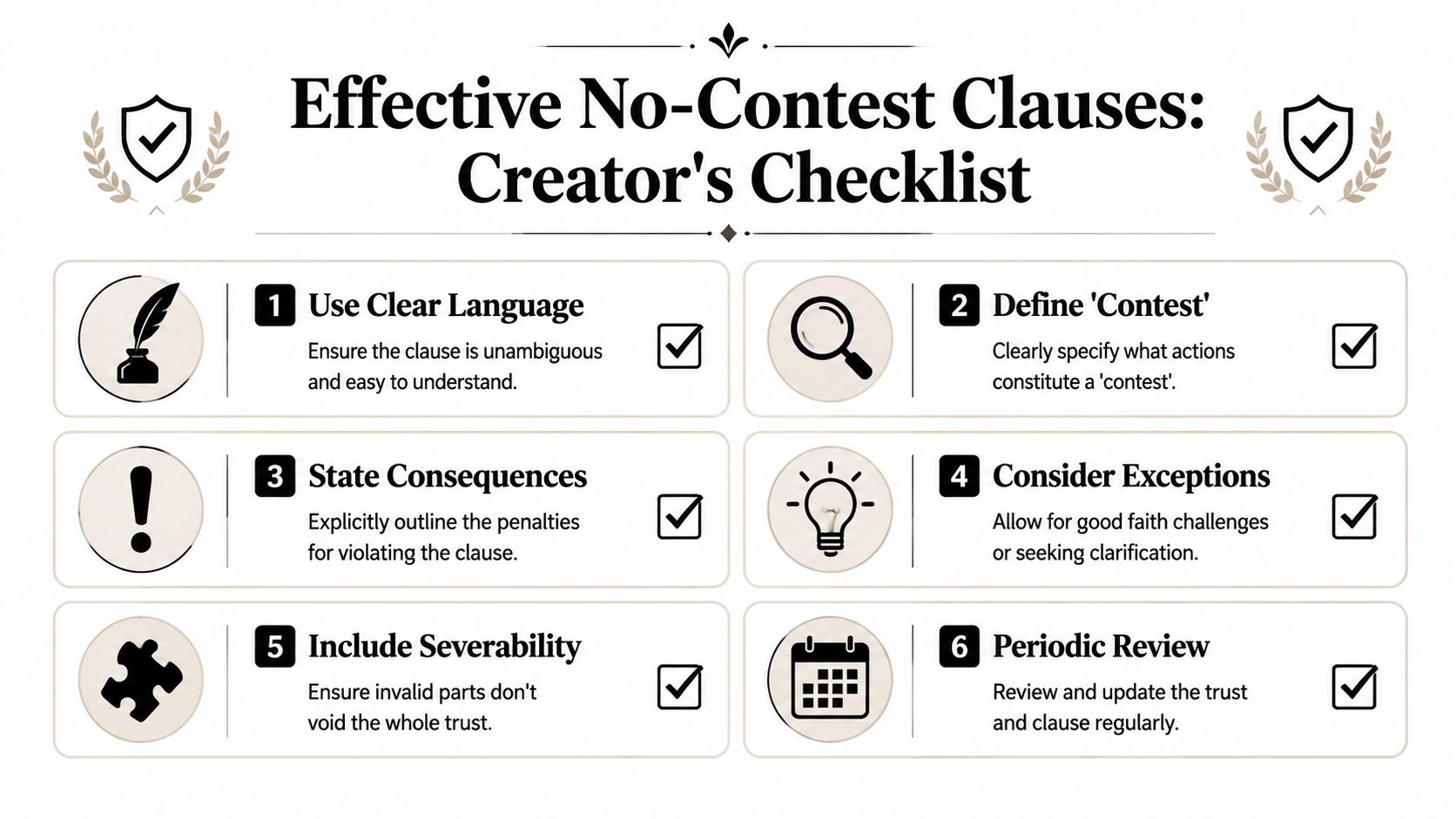
Draft with precision
A Texas estate planning attorney will usually focus first on clarity. If you want a no-contest clause in a Texas trust to have practical value, the clause should be easy to read and tied to the trust's overall plan.
Consider these drafting points:
- Use clear language: Define what conduct counts as a contest.
- Match the clause to the specific risk: If your concern is a challenge to an amendment, the trust should say so clearly.
- Support the clause with sound administration planning: Choose a capable trustee, create consistent documents, and reduce ambiguity.
- Review the plan regularly: Updates matter when family relationships, health, or assets change.
A useful broader resource for planning issues is this guide to Texas living trusts, especially for families deciding whether a trust fits their goals.
Don't overestimate what the clause can do
This is one of the most important drafting realities: Texas law allows any 'interested party' to challenge the validity of a trust, and no-contest clauses may be ineffective against non-beneficiaries like omitted heirs. Families often assume a trust clause offers absolute protection, unaware of this nuance, which has led to increased litigation by omitted heirs exploiting this ambiguity in recent years (discussion of omitted heirs and Texas trust challenges).
That means the clause may have less force against someone who is not receiving under the trust. If a person has nothing to lose, the deterrent effect may be limited.
A practical drafting checklist
For trust creators and families, the strongest planning usually includes more than one protective step:
- Give careful thought to distributions: A clause tends to matter more when a beneficiary has something meaningful to lose.
- Document intent clearly: Ambiguity invites litigation.
- Coordinate related documents: Trusts, wills, powers of attorney, and beneficiary designations should work together.
- Prepare for administration: The best drafting can still fail if the trustee handles communication poorly.
- Think beyond the clause: Tax planning, asset protection, guardianship planning, and succession issues often affect how stable the plan will be after death or incapacity.
Trust creators also benefit from discussing how to modify a trust in Texas if family circumstances change. Updating a trust before a crisis is often easier than defending it after one.
Get Trusted Guidance for Your Texas Trust Matters
A no-contest clause can discourage weak challenges, but it does not erase beneficiary rights, trustee duties, or the court's role in reviewing serious concerns. For beneficiaries, the right question is often not “Can I challenge this?” but “Do I have enough facts to proceed safely and in good faith?” For trust creators, the better question is not “Will this clause prevent every dispute?” but “How do I build a stronger plan that holds up under stress?”
If you're managing a trust or planning your estate, contact The Law Office of Bryan Fagan, PLLC for a free consultation. Our attorneys provide trusted, Texas-based guidance for every step of the process.
If you need help with a no contest clause in a Texas trust, probate administration, estate planning, guardianship concerns, or asset protection planning, schedule a free consultation with Law Office of Bryan Fagan, PLLC. Our team works with trustees, executors, beneficiaries, and families across Texas to provide clear, practical guidance grounded in the Texas Trust Code, the Texas Estates Code, and fiduciary law.