Managing the future of your family's property can feel overwhelming, especially when you're trying to protect a spouse without losing sight of your children, your home, and the values behind everything you've built. Many Texas couples reach the same hard question: how do you make sure a surviving spouse is cared for, while also making sure the remaining assets go where you want them to go later?
That's where many people start searching for what is a marital trust in Texas. The answer is more practical than most online definitions suggest. A marital trust can help with taxes in the right situation, but for many Texas families, its real value is control, protection, and keeping loved ones out of unnecessary probate problems.
Planning Your Legacy Together
A common Texas planning problem looks like this. A husband and wife own a home, have investment accounts, maybe a family business, and want the surviving spouse to be financially secure for life. At the same time, they want children or grandchildren to receive what's left after the second spouse passes away.
A simple outright inheritance doesn't always accomplish both goals. If everything passes directly to the surviving spouse, that spouse has full ownership. They can spend it, gift it, retitle it, or leave it to someone else later. That may be perfectly fine in some marriages, but in others, especially second marriages or blended families, that creates real risk.
A marital trust gives families a middle path. It lets one spouse provide ongoing support for the survivor while also setting legal guardrails around what happens next. It operates by placing family assets into a carefully written set of instructions. The surviving spouse benefits from the property, but the trust terms control how the principal is managed and who ultimately receives it.
Why families use this structure
Texas families often want three things at once:
- Security for a spouse: The surviving spouse needs income, stability, and access to support.
- Protection for children: Children from the marriage, or from a prior marriage, should not be accidentally disinherited.
- Clarity under Texas law: A written trust can reduce uncertainty, guide the trustee, and limit later conflict.
Texas estate planning also works within a larger legal framework. The Texas Trust Code governs how trusts are created and administered. The Texas Estates Code affects probate, wills, and what happens when assets aren't planned properly. Running through both is a basic fiduciary principle: the person in charge of trust property must act loyally, carefully, and in the interest of the beneficiaries.
A good estate plan doesn't just transfer wealth. It reduces confusion at a time when your family is grieving.
For many couples, the conversation isn't really about death. It's about care, fairness, and making sure the law supports the family plan instead of disrupting it.
What Is a Marital Trust in Simple Terms
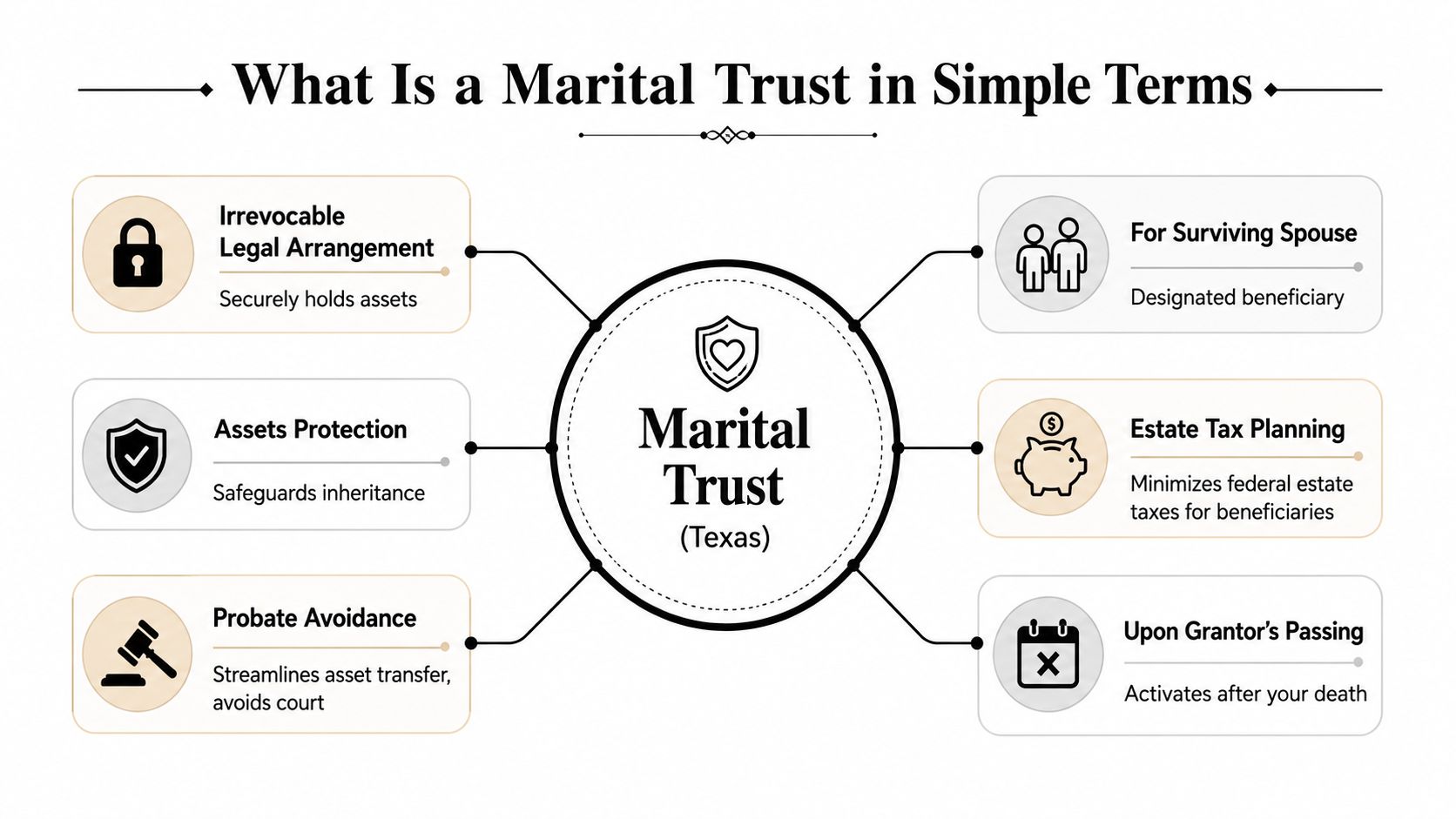
A marital trust is an irrevocable trust created to hold property for a surviving spouse. In Texas, it is often called an A Trust. The basic idea is simple: after one spouse dies, selected assets go into the trust, the surviving spouse benefits from those assets, and the remaining property later passes to the final beneficiaries named in the trust.
The easiest way to picture it
Think of a marital trust like a protected family fund.
The trust holds the assets. The surviving spouse has the right to benefit from them under the terms of the trust. The trustee manages the fund and follows the instructions in the trust document. After the surviving spouse dies, the remaining assets go to the people the first spouse named, often children or grandchildren.
That structure matters because the surviving spouse doesn't automatically receive everything free of restrictions. The trust separates beneficial use from ultimate ownership.
The key people in the trust
Every marital trust has a few moving parts:
- Grantor or settlor: The person who creates the trust.
- Trustee: The person or institution that manages the trust property and carries out fiduciary duties in Texas.
- Surviving spouse: The lifetime beneficiary.
- Remainder beneficiaries: The heirs who receive what remains after the surviving spouse dies.
Texas law also requires formality. A marital trust is established under the Texas Trust Code through a written agreement that identifies the grantor, trustee, and surviving spouse as the sole beneficiary for life, and because it is irrevocable, changes usually aren't simple.
Why the tax treatment matters
One core feature is its use of the unlimited marital deduction. In Texas, a marital trust is designed so that no federal estate taxes are due at the first spouse's death, and the tax obligation is deferred until the surviving spouse passes, so long as the surviving spouse is the sole beneficiary and receives all income generated by the trust assets at least annually, as explained in this discussion of marital trusts for married couples in Texas.
That tax rule is important, but it's only part of the story.
If you're asking practical questions about administration, one issue people overlook is trustee succession. If the acting trustee dies or becomes unable to serve, What Happens When a Trustee Dies in Texas? explains how successor trustees take over when the acting trustee dies or is incapacitated.
Practical rule: A marital trust works best when the document is precise, the trustee is well chosen, and the assets are actually transferred into the trust structure.
Common Types of Marital Trusts in Texas
Not all marital trusts work the same way. The biggest difference usually comes down to control. How much freedom should the surviving spouse have over the remaining property?
That question matters most in second marriages, blended families, and situations where one spouse wants to provide support but still protect children from a prior relationship.
General Power of Appointment and QTIP trusts
A General Power of Appointment (GPA) Trust gives the surviving spouse broader authority. In many plans, that can include the ability to redirect where the remaining assets go at death.
A Qualified Terminable Interest Property (QTIP) Trust is more restrictive. It still provides for the surviving spouse, but it allows the first spouse to keep control over who receives the trust remainder later. That's often the better fit when the family wants certainty.
Here's a side-by-side comparison.
| Feature | General Power of Appointment (GPA) Trust | Qualified Terminable Interest Property (QTIP) Trust |
|---|---|---|
| Surviving spouse's control | Broader control over final disposition | More limited control |
| Final beneficiaries | May be changed by surviving spouse, depending on terms | Usually fixed by the first spouse to die |
| Common use | Couples comfortable giving the survivor wide discretion | Blended families and asset-preservation planning |
| Flexibility | High for the surviving spouse | Higher control for the original grantor's plan |
| Main concern addressed | Simplicity and spousal authority | Protecting children or chosen heirs |
Why QTIP causes confusion
Many readers assume a QTIP trust only comes into existence after death. That's one of the most common misunderstandings.
There is a well-recognized gap in public explanations because many guides discuss QTIP trusts only as testamentary trusts created at death, even though Texas grantors can also create an inter vivos QTIP during life to lock in asset ownership for children while the grantor spouse remains alive, as noted in this explanation of Texas QTIP trusts.
That distinction matters because lifetime planning can be useful when a couple wants asset protection before death, not just after it.
When each type makes sense
A GPA trust may fit when:
- The marriage is straightforward: Both spouses share the same beneficiaries and trust each other to make later decisions.
- Flexibility matters more than control: The surviving spouse may need discretion to respond to changing family circumstances.
A QTIP trust may fit when:
- Children from a prior marriage are involved: The first spouse wants to lock in who inherits later.
- There's concern about remarriage or pressure from others: The trust can reduce the risk that assets drift away from the intended family line.
- The plan needs structure: The trustee follows written instructions instead of relying on informal promises.
For readers comparing trust options more closely, this overview of what a QTIP trust is in Texas is a useful companion to the broader marital trust discussion.
How Marital Trusts Interact with Texas Law
A marital trust only works well if it fits the Texas legal rules around ownership, administration, and fiduciary responsibility. Families often focus on the trust document and overlook the larger legal framework around it.
The Texas Trust Code and valid trust creation
Under the Texas Trust Code, a valid trust requires clear intent, a trustee with legal capacity, identifiable property, and enforceable terms. Verified guidance tied to Section 112.002 of the Texas Trust Code explains that a valid marital trust in Texas requires a written trust agreement clearly establishing the settlor's intent, the trustee's legal capacity, and the terms for managing and distributing assets.
That written agreement is not just paperwork. It is the operating manual for the trustee and the enforcement tool for beneficiaries.
A marital trust is also generally irrevocable. That means it isn't something either spouse can casually rewrite later. In many cases, changes require beneficiary consent or court involvement.
Community property and separate property issues
Texas is a community property state. That affects what a spouse can place into the trust planning structure.
In simple terms, each spouse needs to know which assets are community property and which are separate property. A house owned before marriage may be separate property. Income earned during marriage may be community property. If those lines aren't clear, funding the trust can become messy and disputes can follow.
If title, beneficiary designations, and trust language don't match, families often discover the problem only after a death, when fixing it is harder and more expensive.
Fiduciary duties in Texas
Once the trust is active, the trustee doesn't get to “do what feels fair.” The trustee owes fiduciary duties in Texas. That usually includes duties of loyalty, prudent management, accounting, following trust terms, and communicating appropriately with beneficiaries.
Practical problems arise when a trustee:
- Blends trust property with personal assets: That can expose the trustee to claims.
- Makes uneven or undocumented distributions: Beneficiaries may challenge those decisions.
- Ignores the written standard for support: The trustee must follow the trust, not family pressure.
The Texas Estates Code also matters because assets left outside the trust may still go through probate. That creates the very split result many families hoped to avoid, with some assets in a protected trust plan and others stuck in a court process.
This is one reason a Texas estate planning attorney usually looks at the whole picture, not just the trust language.
Funding Administration and Tax Implications
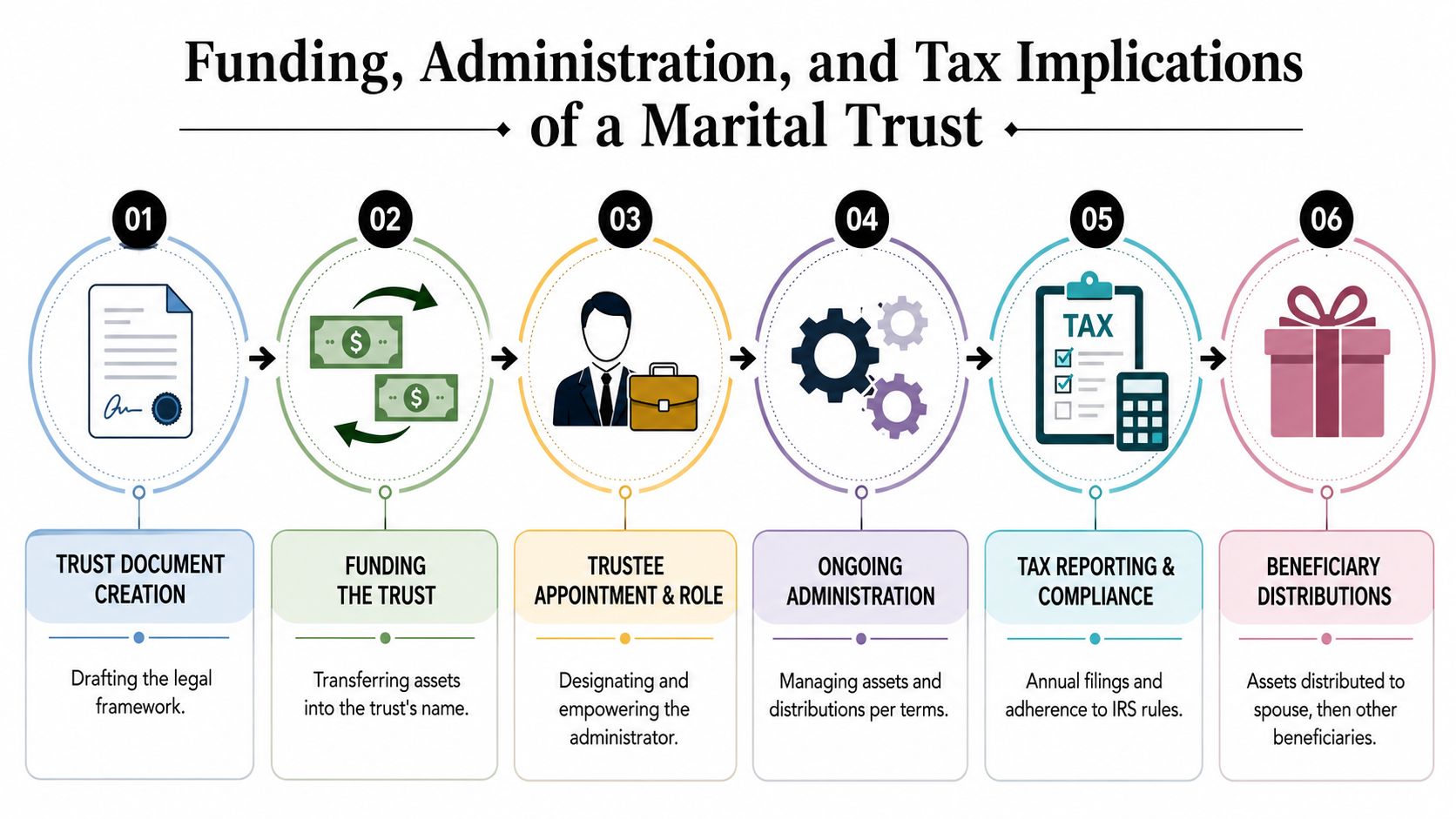
Signing a trust is only the beginning. A marital trust that never receives assets is like a safe with nothing inside. For the plan to work, someone has to fund it correctly, administer it properly, and handle tax reporting with care.
Funding the trust
Funding means changing ownership or beneficiary designations so the intended assets move into the trust arrangement.
That may include:
- Real estate by deed preparation and recording.
- Bank and brokerage accounts by retitling or trust registration.
- Business interests by assignment or transfer documents.
- Personal property through schedules or transfer instruments attached to the trust plan.
Families often believe the signed document handles all of this automatically. It usually doesn't. If the asset never gets transferred, the trust may not control it.
What the trustee actually does
A trustee's job is active, not ceremonial. After the first spouse dies, the trustee may need to gather assets, obtain tax information, manage investments, make required distributions to the surviving spouse, keep records, and communicate with beneficiaries.
A careful trustee will usually follow a process like this:
- Review the trust terms first: The trustee needs to know what income must be distributed and what standards apply to principal.
- Separate trust assets immediately: Trust property should be titled and tracked apart from anyone's personal accounts.
- Create a recordkeeping system: Account statements, receipts, valuations, and distribution records matter if questions arise later.
- Coordinate with professionals: A Texas trust administration lawyer, CPA, and financial advisor often help with compliance and practical management.
For readers dealing with reporting and filing issues, Texas trust taxation guidance can help explain the tax side of ongoing administration.
Estate tax planning and basis adjustment
Marital trusts are often discussed as tax tools, and they can be. Verified legal guidance explains that for high-net-worth couples expecting assets exceeding the federal applicable exclusion amount, approximately $27.22 million in 2024, pairing a marital trust with a bypass trust may allow both spouses to use their exclusion amounts and potentially shelter up to $54.44 million from federal estate tax, according to Baylor Law estate planning materials.
Just as important, those same materials note that the assets in the marital trust are included in the surviving spouse's gross estate for tax purposes, but they receive a federal income tax basis adjustment at the surviving spouse's death. That step-up in basis can significantly reduce future capital gains liability for heirs.
That point surprises many families. Inclusion in the surviving spouse's estate sounds negative at first. In the right situation, though, it can produce an important income tax benefit for the next generation.
Who Really Needs a Marital Trust in Texas
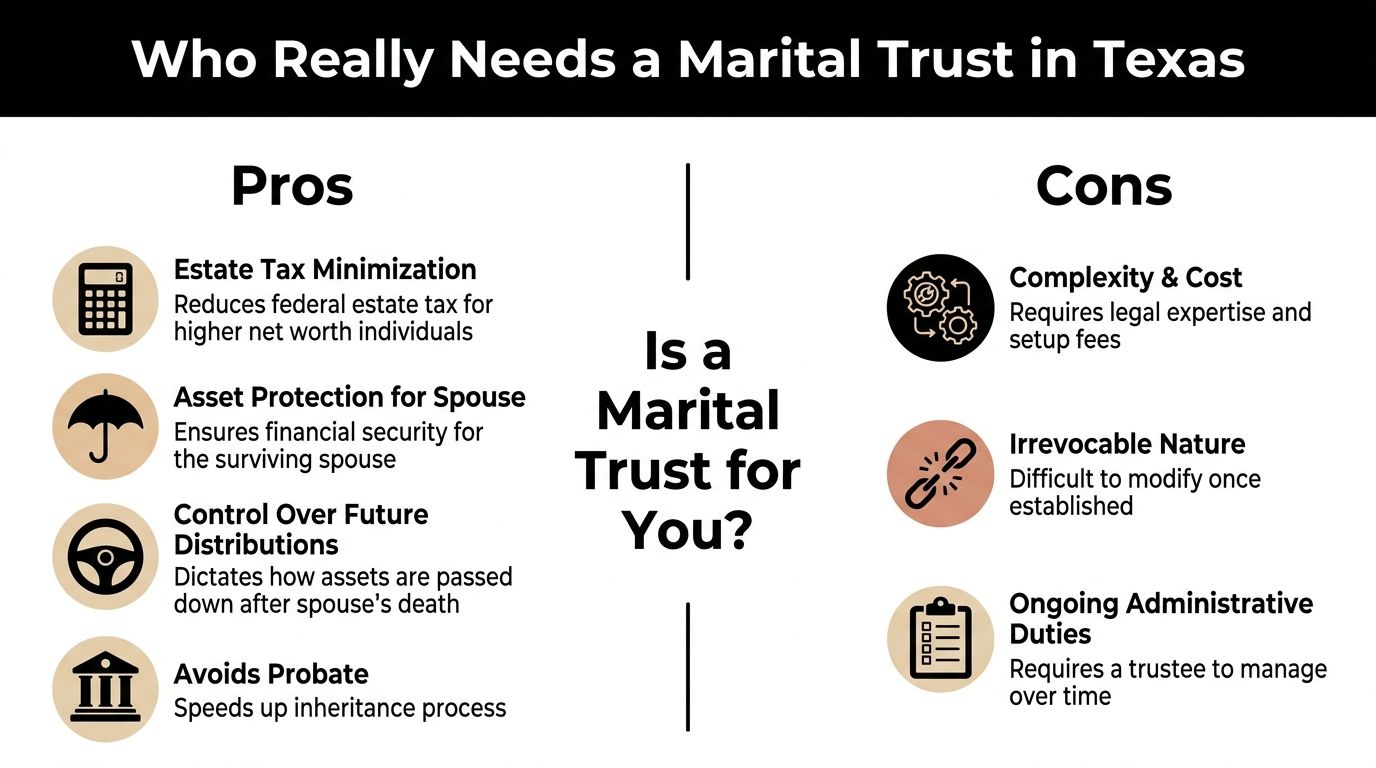
Many people assume marital trusts are only for ultra-wealthy families trying to avoid federal estate tax. In Texas, that view is far too narrow.
For many households, the stronger reasons are probate avoidance, asset protection, and preserving a clear inheritance plan when life gets complicated.
Families who benefit most
A marital trust often deserves serious consideration if any of these are true:
- You're in a blended family: You want your spouse cared for, but you also want children from a prior relationship to inherit later.
- You're worried about remarriage or future influence: An outright inheritance can be redirected. A trust can keep the original plan intact.
- Your spouse may need help managing assets: A trustee can provide oversight, structure, and continuity.
- You want to reduce probate exposure: Proper trust planning can keep assets out of the court-supervised probate process.
One overlooked Texas-specific point is that marital trusts aren't only about estate tax planning. Verified material states that for Texas families with estates between $5M and $15M, a marital trust is frequently the better tool not because federal estate tax will be due, but because it can help avoid the Texas probate bottleneck and protect assets from a surviving spouse's potential future divorce or incapacity. The same source states that 60% of Texas testators with estates under $15M still face complex probate disputes that marital trusts can bypass, according to this discussion of marital trusts as probate shields in Texas.
That's the practical angle many families miss.
Here's a helpful video that addresses trust planning concerns many Texas families have when deciding whether a trust is necessary.
A real-world style example
A couple in a second marriage may own a home, retirement savings, and a taxable investment account. The husband wants his wife to have income and housing security for life. He also wants whatever remains to go to his children from his first marriage.
If he leaves everything outright to his wife, there's no legal guarantee the children receive anything later. If he uses a marital trust, the trust can support the wife during her lifetime while preserving the remainder for the children under defined terms.
Families often use marital trusts to solve a fairness problem, not just a tax problem.
This is also where practical legal help matters. A Texas estate planning attorney or Texas trust administration lawyer can help decide whether a marital trust, a QTIP trust, a probate-focused plan, or an asset protection structure fits your goals. For people weighing the broader question, do I need a trust is often the right starting point. The Law Office of Bryan Fagan, PLLC handles trust creation, administration, fiduciary compliance, probate-related issues, guardianship matters, and asset protection planning for Texas families and fiduciaries.
Your Consultation Checklist and Next Steps
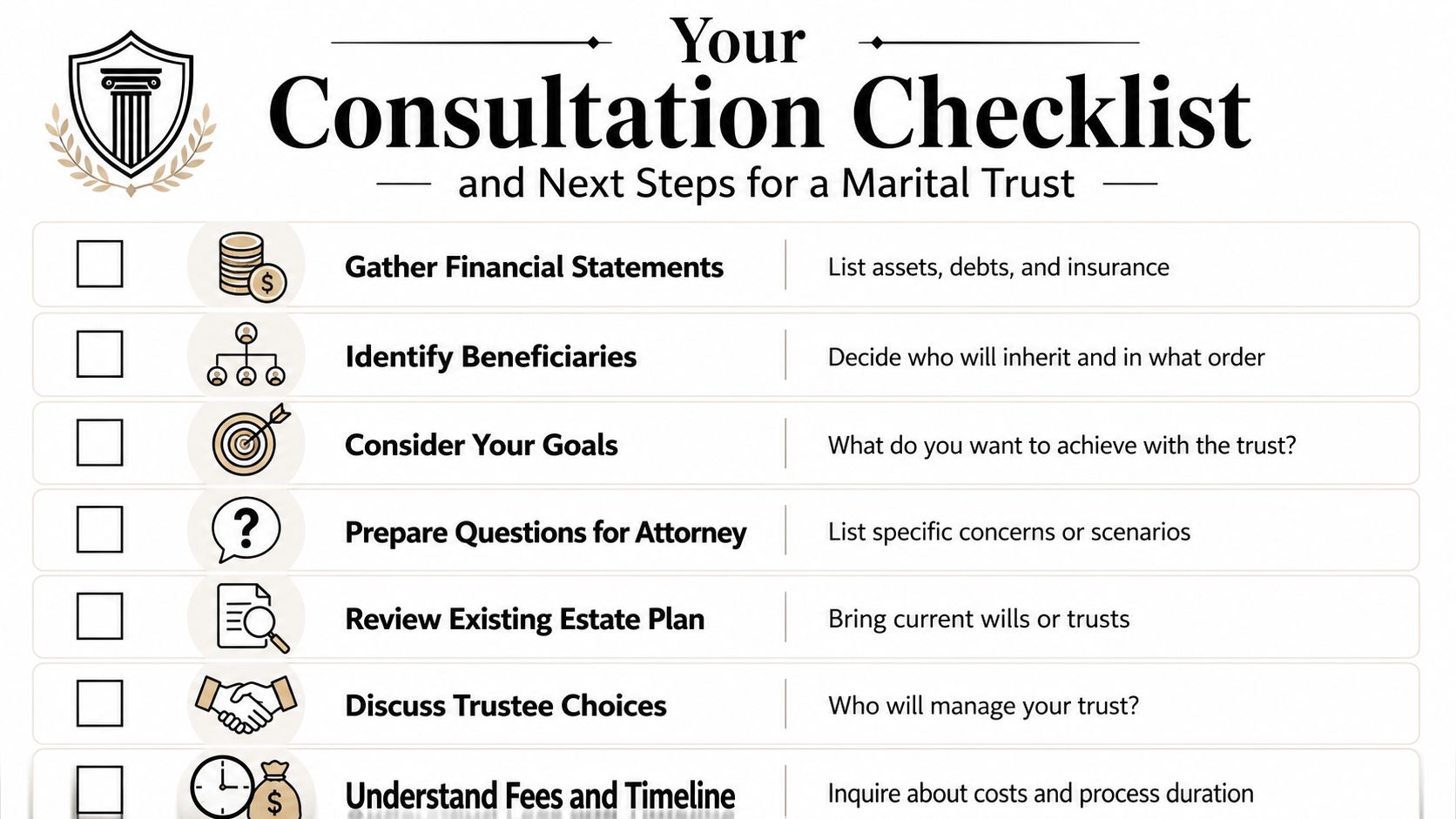
By the time most couples seek legal advice, they already know what they want in broad terms. They want peace at home now and fewer problems later. A productive consultation turns that general goal into a workable legal plan.
What to bring to the meeting
Bring enough information for the attorney to see both the legal structure and the family dynamics.
- Existing estate documents: Wills, trusts, powers of attorney, and prior amendments.
- Asset information: Deeds, account statements, business ownership records, insurance details, and beneficiary designations.
- Family information: Marriage history, children from current or prior relationships, and anyone with special support needs.
- Questions about fiduciaries: Your preferred trustee, backup trustee, executor, and agents under powers of attorney.
If probate, incapacity, or guardianship concerns are part of the picture, say so early. Those issues often affect the trust design.
Questions worth asking
A strong consultation usually includes questions like these:
- How would a marital trust work with our specific mix of community and separate property?
- Would a QTIP trust make more sense than a broader marital trust structure?
- Who should serve as trustee, and who should be the backup?
- What steps are needed to fund the trust after signing?
- How are distributions handled if the surviving spouse later becomes incapacitated?
- What's the process for dispute resolution if beneficiaries and trustees disagree?
- If changes are needed later, how to modify a trust in Texas under the trust terms or court procedures?
Bring your concerns, not just your documents. A good planning meeting should address family pressure points, not just legal forms.
A thoughtful estate plan should also coordinate with related areas such as probate administration, guardianship planning, and asset protection. Those topics often overlap more than families expect.
If you're managing a trust or planning your estate, contact The Law Office of Bryan Fagan, PLLC for a free consultation. Our attorneys provide trusted, Texas-based guidance for every step of the process.