Yes, a trustee can withhold money from a beneficiary in Texas, but only when the trust document or Texas law allows it. If a trustee withholds funds for no valid reason, that is a breach of fiduciary duty.
Managing a loved one's trust can feel overwhelming, but with the right legal guidance, it doesn't have to be. A lot of families land in the same stressful place. A parent dies, a trust is supposed to help the children, and then the checks don't come. Weeks pass. Then months. The trustee says, “I'm still working on it,” but nobody explains what that means.
That delay can feel personal, even when the legal issue is more complicated than it first appears. Sometimes the trustee is doing exactly what the trust and Texas law require. Sometimes the trustee is crossing a line. The hard part is knowing which is which.
As a Texas trust administration lawyer would tell you over a cup of sweet tea, the answer usually comes down to three things. First, what the trust says. Second, what the Texas Trust Code and Texas Estates Code require. Third, whether the trustee is honoring the fiduciary duties of loyalty, good faith, prudence, and fair dealing.
Waiting on a Promise Understanding Distribution Delays
Sarah thought the process would be simple. Her father's trust named her and her brother as beneficiaries. The trustee, an uncle, told them both that distributions would happen after “some paperwork.” At first, that sounded reasonable.
Then the silence started.
Sarah sent a polite email. No answer. She called. Voicemail. When she finally reached her uncle, he said he was “not ready” to send her share. He didn't point to any trust language. He didn't explain whether taxes were pending, whether debts had to be paid, or whether the trust gave him discretion to wait. He just kept delaying.
That's where many Texas families get stuck. The legal question, can a trustee withhold money from a beneficiary, becomes acutely personal very fast. People count on those funds for housing, school, medical needs, or just closure after a loss.
Sometimes a delay is proper. Trust administration can take time. A trustee may need to gather assets, deal with estate obligations, review tax issues, or confirm that a beneficiary has met conditions written into the trust. But if the trustee is delaying without a valid reason, the beneficiary may have the right to push back.
Practical rule: A trustee doesn't get to withhold money just because it's easier, less awkward, or more convenient.
Texas families often ask whether a trustee can delay distributions forever. The short answer is no. The answer is still no even when the trustee is also a relative. Family status doesn't erase legal duties. If you want a closer look at that issue, this discussion of whether a trustee can delay distributions indefinitely in Texas is a useful companion.
A trust is supposed to serve the beneficiary, not trap them in uncertainty.
The Trustee's Authority Under the Texas Trust Code
A trustee's power starts with the trust instrument. It doesn't start with personal opinion, family politics, or fear of making someone upset. In Texas, a trustee's authority to withhold distributions is strictly tied to the terms of the trust instrument and fiduciary obligations, which require acting in the best interests of beneficiaries. Withholding funds without just cause violates this duty and can lead to trustee removal and court orders mandating distribution, as explained in this discussion of Texas trustee withholding authority and fiduciary obligations.
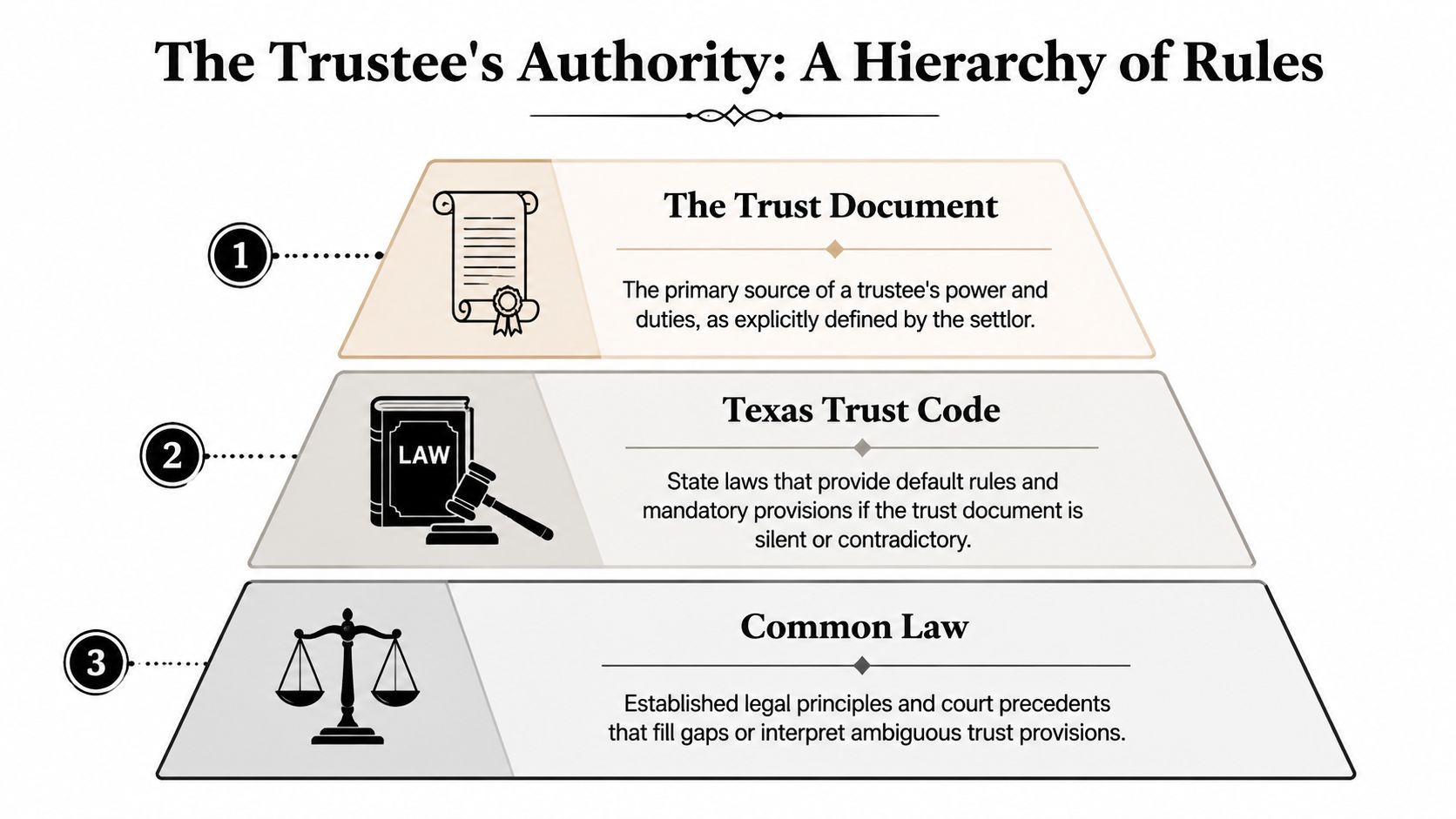
The three layers that control a trustee
Think of a trustee's authority as a stack of rules.
First comes the trust document. If the trust says a beneficiary receives money at a certain age, after a specific event, or only at the trustee's discretion, that language usually controls.
Second comes the Texas Trust Code. It supplies governing rules for trust administration, beneficiary rights, accountings, and trustee conduct. It also sets limits. A trustee can't rely on broad power language in a way that violates mandatory legal duties.
Third comes general fiduciary law and court guidance. That body of law helps courts interpret the trustee's conduct when trust language is unclear or when someone claims the trustee acted unfairly.
What fiduciary duty means in plain English
A fiduciary duty is a legal obligation to put the interests of the trust and its beneficiaries ahead of the trustee's own interests. In everyday terms, it means the trustee must act carefully, with integrity, and loyally.
Here's what that usually looks like in practice:
- Loyalty: The trustee can't use trust decisions to reward friends, punish a beneficiary, or benefit personally.
- Prudence: The trustee must act with care, keep records, and make informed decisions.
- Impartiality: If there are multiple beneficiaries, the trustee must treat them fairly under the trust terms.
- Good faith: The trustee must exercise discretion for the purpose the trust was created, not for hidden motives.
The Texas Estates Code often enters the picture too, especially when a death triggers related probate issues, debt payment, or estate administration questions before trust assets are fully distributed. That overlap is one reason trust administration sometimes feels slower than families expect.
A trustee has authority, but not ownership. The money may be under the trustee's control, but it is not the trustee's money to hold back on a whim.
Mandatory distributions and discretionary distributions
Many readers find this confusing.
A mandatory distribution means the trust says the trustee must pay a beneficiary when certain conditions are met. If the beneficiary satisfies those conditions, the trustee usually doesn't have a choice.
A discretionary distribution means the trust gives the trustee judgment. The trustee may decide whether to distribute funds, when to distribute them, or how much to distribute, depending on the trust language. But even then, discretion is not unlimited. The trustee still must act in good faith and in line with the trust's purpose.
For someone newly stepping into the role, First Steps for a Successor Trustee in Texas covers what to do immediately after stepping into the trustee role. That kind of early review often prevents avoidable conflicts later.
When Withholding a Distribution Is Legally Justified
Not every delay is wrongful. In Texas, a trustee may withhold funds when the trust authorizes it or when a legal reason supports it. The key is that the reason must connect to trust administration, beneficiary protection, or a specific legal duty.
Common situations where withholding may be lawful
One common example is an unmet condition in the trust. If a trust says a beneficiary receives principal at age 25, the trustee can withhold that distribution until the beneficiary reaches that age. If the trust ties payment to graduation, the trustee may wait until that event occurs.
Another common example is outstanding taxes, debts, or administrative expenses. A trustee may need to hold assets long enough to pay obligations tied to the trust or related estate matters. Distributing too early can expose the trustee to problems if bills remain unpaid.
A third example is a discretionary trust provision. Some trusts allow the trustee to delay or limit distributions based on a beneficiary's needs, health, support, education, or welfare. If the trust gives that kind of discretion, the trustee may have room to pause distributions. But the trustee still must act in good faith and consistently with the trust's purpose.
A fourth example involves active disputes or litigation. If there's a real disagreement over what the trust means, who is entitled to what, or whether a claim affects a beneficiary's share, the trustee may need to wait until the dispute is resolved.
Special Texas issue involving beneficiary liability
Texas law also recognizes a specific offset right. The Texas Trust Code gives a trustee the statutory authority to offset a beneficiary's liability to the trust, such as from an unpaid loan or misappropriation of funds, against that beneficiary's interest, even if the trust has a spendthrift provision, under Texas Property Code section 114.031.
That means if a beneficiary owes money back to the trust, the trustee may be able to reduce that beneficiary's distribution accordingly.
Valid vs. Invalid Reasons for a Trustee to Withhold Funds
| Valid Reason (Potentially Lawful) | Invalid Reason (Potential Breach of Duty) |
|---|---|
| The beneficiary hasn't met a clear condition in the trust, such as reaching a required age | The trustee doesn't like the beneficiary's lifestyle |
| The trust still needs to pay taxes, debts, or administration costs | The trustee wants to keep control of the assets longer |
| The trust gives the trustee discretion, and the decision is made in good faith | The trustee gives shifting excuses with no trust-based reason |
| A real legal dispute affects interpretation or distribution | The trustee is too busy and keeps putting it off |
| The beneficiary owes money to the trust and offset is allowed by law | The trustee wants to pressure the beneficiary into a family agreement |
Good faith matters. Even a trustee with discretion must connect the delay to the trust's purpose and document the reason.
A Beneficiary's Guide to Taking Action
A common Texas trust dispute frequently commences with little fanfare. A beneficiary expects a distribution after a parent or grandparent dies. Weeks pass, then months. The trustee says, "I'm working on it," but nothing arrives, and the explanation keeps shifting.
If that sounds familiar, treat it like any other serious paper trail problem. Stay calm, get organized, and separate the issue into three parts: what the trust requires, what information you can ask for, and what steps make sense if the trustee still refuses to act.
Under Texas law, beneficiaries are not stuck waiting in the dark. They have rights to information, and courts can require a trustee to account, explain, or carry out duties when the trustee is not doing the job properly, as discussed in this overview of Texas trust beneficiary rights and court enforcement.
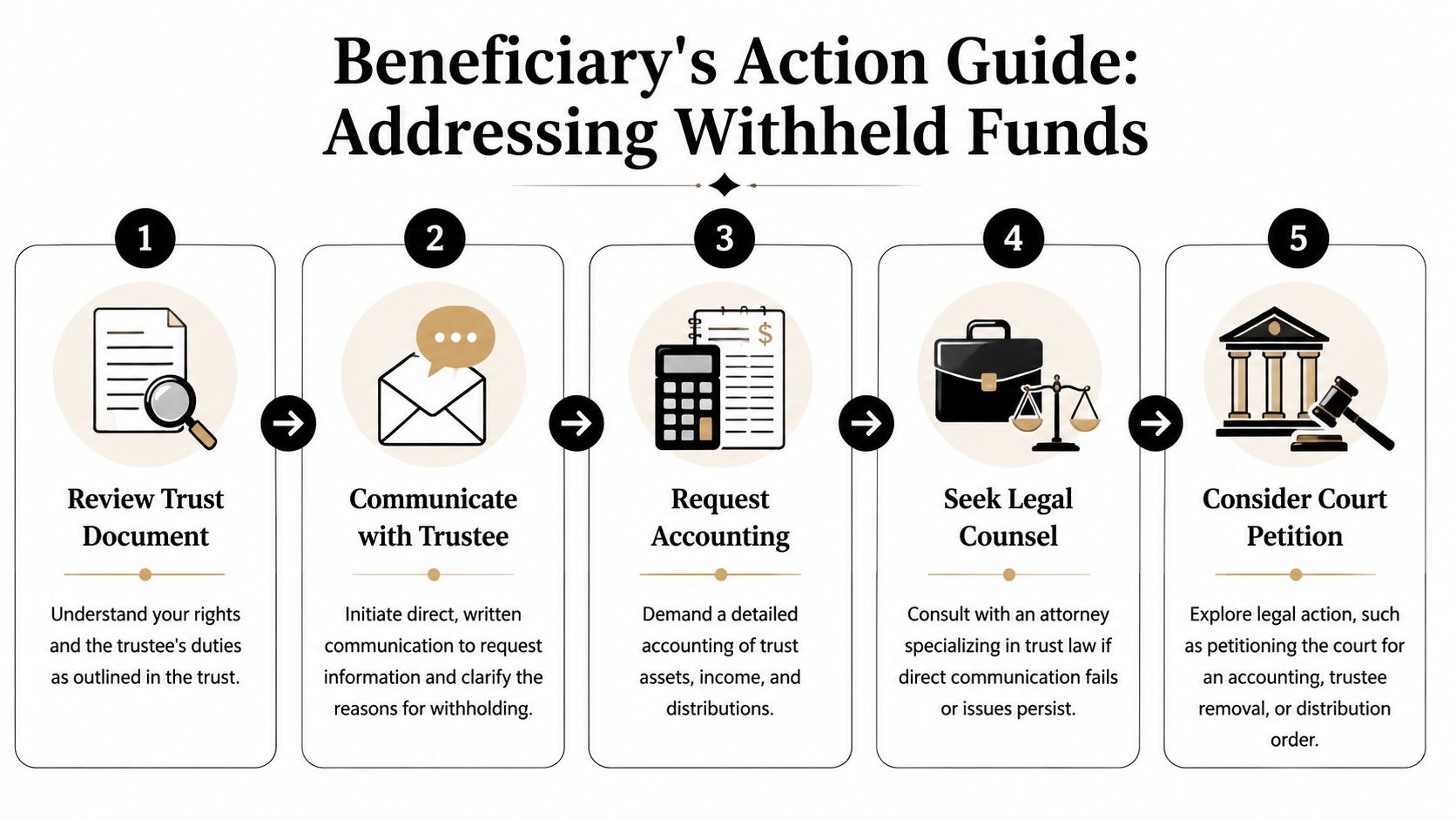
Start with the trust and a written request
Before you accuse the trustee of wrongdoing, confirm what kind of distribution you are expecting. Some trusts require payment at a certain age or on a certain date. Others give the trustee discretion. Others delay payment until expenses, taxes, or administration tasks are handled. The trust works like a rulebook. You need to know which page applies to your situation.
Then send a formal written request. Ask the trustee to explain:
- Why the distribution has not been made: Request the exact trust provision or legal reason.
- What still needs to happen: Ask whether the issue is taxes, debts, asset sales, a dispute, or something else.
- When you should expect an answer or payment: A clear timeline matters.
- What records support the delay: Ask for enough information to evaluate whether the explanation fits the trust.
Keep the tone professional. Emails and letters are usually more helpful than phone calls because they create a dated record of what was asked and how the trustee responded.
Ask for an accounting if the answers stay fuzzy
If the trustee responds with broad statements but no details, an accounting is often the next step. An accounting can show what property is in the trust, what bills have been paid, what distributions have already been made, and whether the trustee's explanation matches the numbers.
If you want to understand that process, this guide to a petition for accounting in a Texas trust explains how beneficiaries often ask the court to require real transparency.
When a trustee stops communicating, documentation becomes your most important tool.
Save the trust document, your letters, emails, text messages, account statements, and any deadlines the trustee mentioned. If this later turns into a court dispute, those records help show whether the delay was reasonable or whether the trustee avoided basic duties.
Get legal advice before the problem gets bigger
Sometimes a focused letter from a Texas trust lawyer gets results because it shows the beneficiary understands both the trust terms and the trustee's legal duties. In family cases, that can lower the temperature and bring everyone back to the actual issue.
Other times, the facts point to a more serious problem. A trustee may be refusing to provide information, favoring one beneficiary over another, ignoring mandatory distributions, or using trust property carelessly. At that stage, a lawyer can help you decide whether to seek an accounting, ask the court for instructions, request trustee removal, or pursue another remedy that fits the trust and the facts.
Pay attention to timing
Delay can hurt a beneficiary in two ways. First, the money stays tied up. Second, legal claims can become harder to pursue if you wait too long.
Texas limitation questions in trust cases can be technical and fact specific. The safer approach is simple: act early, ask in writing, and speak with counsel if the trustee is silent or evasive. A beneficiary who moves promptly is in a much better position than one who waits and hopes the problem will clear up on its own.
A Trustee's Guide to Proper Trust Administration
A lot of trustees get the job the same way people get handed the keys to an old family ranch. Someone trusted them. Someone believed they would take care of things. Then the actual work starts. There are bills to pay, records to gather, tax questions to sort out, and beneficiaries asking when money will be distributed.
That is why proper trust administration starts with one simple idea. A trustee should be able to explain every important decision by pointing to the trust document, Texas law, or both.
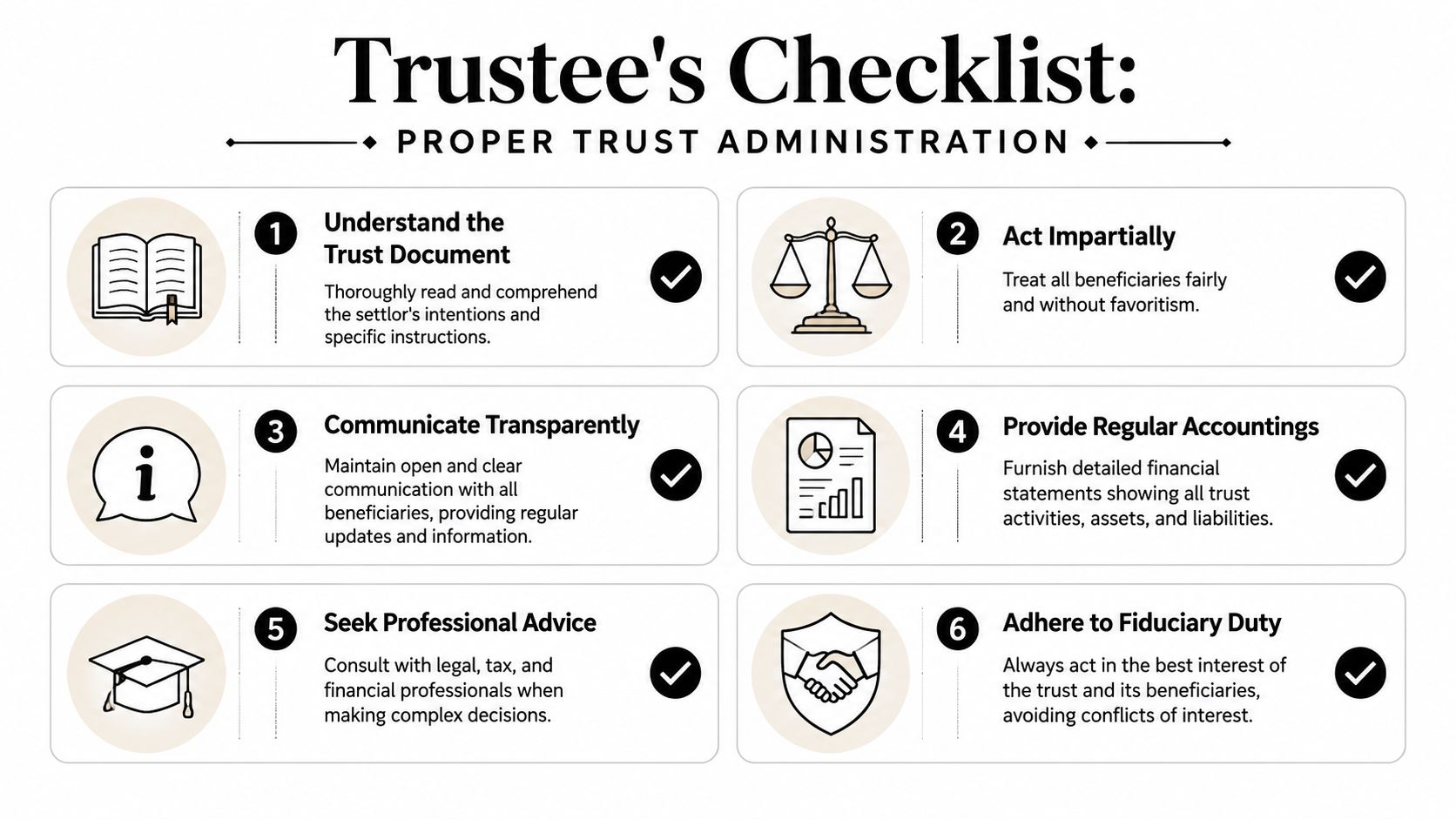
A good way to understand this section is to keep three perspectives in mind. First, the trust and Texas law set the rules. Second, beneficiaries will judge the trustee's actions by what they can see and understand. Third, the trustee's own habits, records, and communication often decide whether a delay looks reasonable or looks like a breach of duty.
What careful trustees do differently
Careful trustees begin with the document itself. They read it line by line, identify the beneficiaries, sort out mandatory distributions from discretionary ones, and note any conditions that must be satisfied before money goes out.
Then they do the less glamorous work that keeps them out of trouble. They gather account statements, confirm asset values, track expenses, protect trust property, and keep trust assets separate from personal assets. A trust works a lot like a fenced pasture in Texas. If the fence line is not clear, problems spread fast.
Communication matters too. A trustee does not have to answer every angry email with a lengthy legal explanation. But silence creates suspicion. Beneficiaries should receive timely updates, a plain-English explanation of delays, and enough information to understand whether the trustee is following the trust.
A sound administration routine usually includes:
- Reading the trust carefully: The trustee's authority comes from the written terms, not memory, family pressure, or personal opinions.
- Keeping organized records: Save statements, receipts, tax returns, correspondence, valuations, and logs showing what was paid and why.
- Applying the same standards fairly: Beneficiaries in similar positions should receive similar treatment unless the trust says otherwise.
- Writing down reasons for delay: If a distribution is paused, note the trust provision involved, the specific problem, and what must happen before funds can be released.
- Getting professional advice when needed: Legal, tax, or accounting guidance often prevents a small mistake from becoming a personal liability claim.
Avoiding personal liability
Trustees often get into trouble when they substitute personal judgment for actual authority. Good motives do not fix that problem.
For example, a trustee may believe a beneficiary is bad with money. If the trust does not give discretion to withhold funds for that reason, the trustee cannot create that power out of thin air. On the other hand, if there is a legitimate issue involving trust administration, such as unresolved taxes, debts tied to the trust, competing claims, or a permitted offset recognized under the trust or Texas law, a temporary hold may be proper.
The practical question is straightforward. Can the trustee show the legal basis for the decision?
If the answer is no, the decision needs another look.
Trustees also need to pay attention to related estate and probate issues. Death-related expenses, creditor matters, tax filings, and coordination with the estate can affect timing. Those issues do not automatically excuse delay, but they often explain why a careful trustee slows down before releasing funds.
The Law Office of Bryan Fagan, PLLC works with Texas families and fiduciaries on trust administration, estate planning, probate, guardianship, and asset protection questions, including trustee compliance and beneficiary communication.
Practical steps before you release funds
Before making or withholding a distribution, a trustee should pause and work through a short checklist.
- What does the trust require or permit here?
- What Texas legal rule affects this decision, if any?
- Are taxes, debts, valuations, or disputes still unresolved?
- Am I treating this beneficiary consistently with others under the trust terms?
- Have I explained the decision clearly in writing?
- Would a judge reviewing this file understand why I acted this way?
That last question helps more than people expect. Judges often see the paper trail long after the family arguments have gotten loud. A trustee with clear records, consistent procedures, and written explanations is usually in a much stronger position than a trustee who relied on unwritten assumptions.
If conflict is already building, trustees should understand what claims beneficiaries may bring and how those claims are framed under Texas law. This guide on suing a trustee in Texas can help a trustee see the problem from the beneficiary's side and avoid mistakes that lead to litigation.
Navigating Trust Disputes With Confidence
Most trust disputes don't begin with a dramatic courtroom moment. They begin with silence, confusion, and unanswered questions. A beneficiary expects a distribution. A trustee hesitates. Nobody explains the legal reason clearly enough, and suspicion grows.
The law gives both sides a path forward. The trust terms matter. The Texas Trust Code matters. Fiduciary duties matter. A trustee can withhold money in limited situations, but not as a matter of personal preference. A beneficiary can demand information, ask for an accounting, and seek court help when necessary. Trustees who stay organized, communicate, and follow the trust carefully are far less likely to face claims.
Families also need to remember that trust disputes often overlap with probate, tax planning, guardianship concerns, and broader estate planning choices. That's one reason these cases can feel heavier than a simple payment dispute.
If you're worried that a trustee is acting unfairly, or you're a trustee trying to handle the job correctly, timely legal advice can make the next step much clearer. For readers facing serious conflict, this resource on how to sue a trustee in Texas may help frame the issues before you speak with counsel.
If you're managing a trust or planning your estate, contact Law Office of Bryan Fagan, PLLC for a free consultation. Our attorneys provide trusted, Texas-based guidance for every step of the process.