Managing a loved one's estate can feel overwhelming, especially when you're grieving and someone hands you a stack of legal documents full of unfamiliar terms. Many Texas families worry they'll make a permanent decision too quickly, accept property the wrong way, or miss a chance to protect children and grandchildren later.
That's one reason disclaimer trusts exist. They give a surviving spouse room to pause, review the family's finances, and decide what makes sense after the first spouse dies. Instead of forcing every decision years in advance, this tool can preserve flexibility when the facts are finally clear.
If you've been searching for what is a disclaimer trust Texas, the short answer is this. It's an estate planning arrangement that lets a surviving spouse refuse, or “disclaim,” some inherited property so that property passes into a trust under the deceased spouse's plan. When it's structured and handled correctly, it can help with tax planning, long-term control, and protection for the next generation.
An Introduction to Flexible Estate Planning
A lot can change between the day a couple signs estate documents and the day one spouse passes away. Asset values shift. Family dynamics change. A child may need more protection than expected. A surviving spouse may be financially secure in one scenario and insecure in another.
That's why a disclaimer trust can be such a compassionate planning tool. It acts like a second chance to make a careful decision after loss, instead of locking a family into one rigid outcome before anyone knows what the future will look like.
Why flexibility matters after a death
A traditional plan often assumes the surviving spouse should inherit everything outright. Sometimes that works well. Sometimes it creates problems. Property inherited outright may become part of the survivor's estate, and it may also be harder to preserve for children from a prior marriage or shield in a later dispute.
A disclaimer trust offers another path. The deceased spouse's will or revocable trust includes language that allows the surviving spouse to decide, after death, whether to keep certain assets directly or let them pass into a trust instead.
Practical rule: Good estate planning doesn't just transfer wealth. It gives families options when life becomes complicated.
Where Texas law fits in
Texas families also need to understand that estate planning here isn't just about one document. Texas Estates Code governs many of the rules around disclaimers and probate procedure. The Texas Trust Code shapes how trusts are administered and how fiduciaries must behave. Fiduciary principles matter because executors, trustees, and even surviving spouses must handle property carefully and loyally.
If you're a spouse, executor, or beneficiary, the key is simple. Don't treat inherited property casually until you know whether a disclaimer is part of the plan. One early move can affect tax treatment, trust funding, and later administration.
What Is a Disclaimer Trust
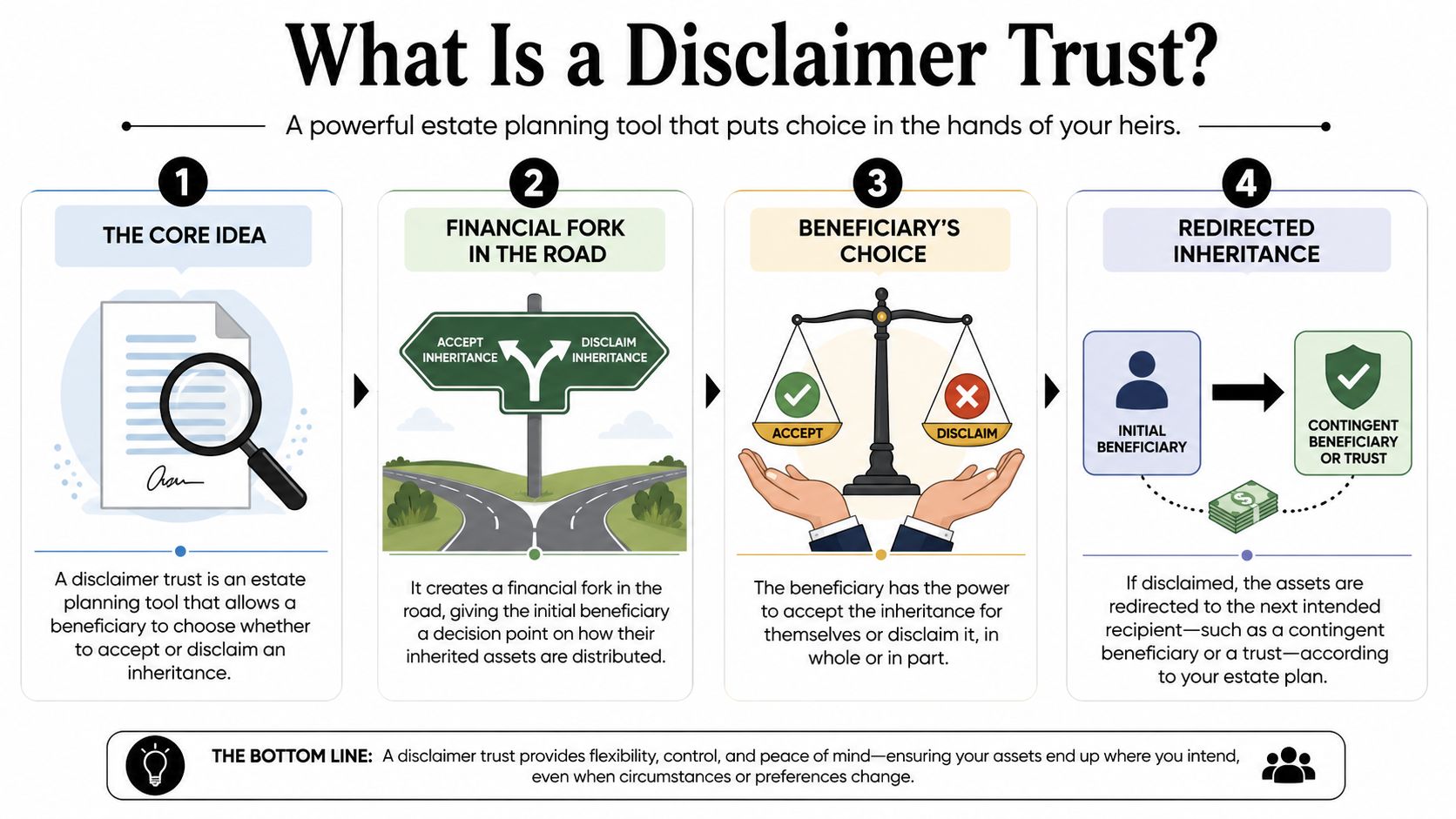
A disclaimer trust is easiest to understand as a financial fork in the road.
When the first spouse dies, the surviving spouse stands at that fork. One road leads to accepting inherited property outright. The other road leads to formally refusing some or all of that property so it goes into a trust created under the deceased spouse's estate plan.
The core idea in plain English
The word “disclaimer” can sound negative, but in this setting it's often strategic. The surviving spouse isn't rejecting the family's wealth. The spouse is deciding that certain assets should follow a different legal path.
A disclaimer trust in Texas functions as a strategic “wait-and-see” provision that allows a surviving spouse to elect, within nine months of the first spouse's death, whether to accept an inheritance outright or disclaim a portion into the trust to minimize federal estate taxes under IRC §2056(b). This ensures the disclaimed assets are excluded from their taxable estate upon their subsequent death, preventing double estate taxation while providing the spouse with beneficial trust income and principal access, as explained in this discussion of how a disclaimer trust plan works.
That flexibility is a significant value. A couple can prepare one plan now, then let the surviving spouse decide later based on actual family needs.
It doesn't have to be all or nothing
Many readers assume a spouse must either accept everything or disclaim everything. That isn't how these plans usually work. Depending on the estate documents and the assets involved, a spouse may disclaim some property, all of it, or none of it.
For example, a surviving spouse might keep enough cash directly for peace of mind while disclaiming investment assets or land into the trust. That can preserve access to benefits under the trust while keeping those assets on a separate track.
Here's a simple comparison:
| Choice | What happens |
|---|---|
| Accept outright | The spouse owns the asset personally |
| Disclaim to trust | The asset passes under the estate plan into the disclaimer trust |
| Disclaim nothing | No disclaimer trust funding occurs |
Families who want more background on trust structures often start with an overview of types of trusts in Texas. A broader reference like Texas Trust Administration: A Trustee's Guide can also help clarify what trust administration involves and how it differs from probate.
A disclaimer trust is less about saying “no” to an inheritance and more about saying “yes” to a more careful plan.
How Disclaimer Trusts Work Under Texas Law
A disclaimer trust only works if the legal mechanics are right. Many families struggle with this aspect. The trust may sound simple in conversation, but its effectiveness depends on both federal tax rules and Texas law.
The documents must allow it
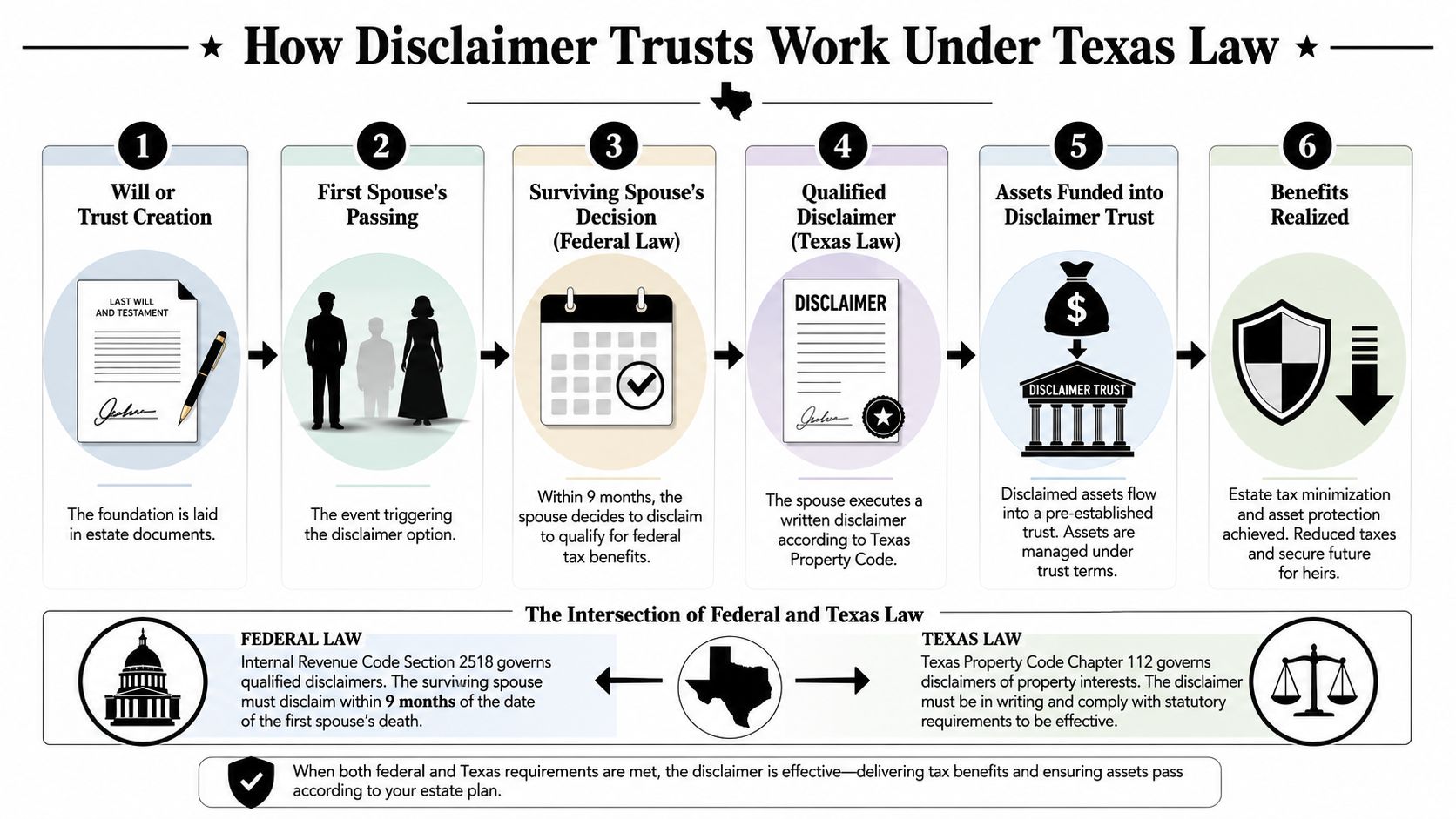
In Texas, a disclaimer trust is typically irrevocable once funded. The deceased spouse's will or trust must include specific language enabling the disclaimer, and the surviving spouse may serve as trustee but cannot have power to direct beneficial enjoyment unless limited by an “ascertainable standard,” a key requirement to satisfy IRC Sec. 2518(b), as described in this article on using a disclaimer trust to transfer land.
That last point matters. The trust can be designed so the surviving spouse still benefits from it, but not with unlimited control. If the spouse has too much power, the tax result can change, and other legal problems may follow.
The role of Texas Estates Code
Texas law also controls how a disclaimer is made and recognized. Texas Estates Code Chapter 122 codifies the requirements for a qualified disclaimer, including written delivery within the required timing rules after the interest is finally ascertained and vested. In practical terms, families need to treat the disclaimer as a formal legal act, not an informal family understanding. You can review a general statutory overview in the Texas Estates Code resource.
This often involves several people with different jobs:
- Executor or administrator handles the estate and receives required paperwork.
- Trustee manages trust assets after funding and follows fiduciary duties in Texas.
- Surviving spouse may be a beneficiary and, in some plans, also serve as trustee.
- Beneficiaries have rights to information and to proper administration.
Why fiduciary principles matter
Trust administration in Texas isn't just paperwork. A trustee must act in good faith, follow the trust terms, protect trust assets, and avoid using trust property for improper personal purposes. An executor has similar obligations while administering the estate.
If the surviving spouse serves as trustee, that spouse has to wear two hats carefully. One hat is beneficiary. The other is fiduciary. Texas fiduciary law expects the trustee to respect both the trust's language and the interests of remainder beneficiaries, such as children.
Important point: Tax qualification and proper fiduciary administration are related, but they aren't the same thing. A trust can be tax-efficient and still create administration problems if the terms are loose or the fiduciary acts carelessly.
Primary Uses and Benefits for Texas Families
For many families, a disclaimer trust is appealing because it combines flexibility with structure. It gives a surviving spouse options without requiring a rushed choice at a painful time.

Tax planning without locking in one outcome
A disclaimer trust is often used by married couples as a flexible estate planning tool to minimize estate taxes by using the deceased spouse's unified credit, while still allowing the surviving spouse to benefit from the property without it being taxed at the survivor's later death. That's one reason lawyers sometimes call it a post-death planning tool. The family can evaluate the estate after the first death instead of guessing years earlier.
Think of a couple who own a family ranch, investment accounts, and business interests. On paper, leaving everything to the survivor may seem simplest. But after one spouse dies, the survivor may realize that placing part of those assets into a disclaimer trust would better preserve the family legacy.
Asset separation can help in real life
Once funded, a disclaimer trust is typically irrevocable. That means the property in the trust is no longer part of the surviving spouse's personal ownership in the ordinary sense. That separation can support tax planning and may also create practical discipline around how assets are used and distributed.
Families often appreciate this when they want to:
- Preserve property for children from the first marriage
- Maintain investment oversight through a trustee structure
- Create rules for distributions instead of relying on informal promises
- Support asset protection planning as part of a broader estate strategy
For readers comparing planning tools, a Texas estate planning attorney often discusses how disclaimer trusts differ from direct inheritances, marital trusts, and probate transfers.
A trust can create order during administration
A funded trust also gives a clear framework for administration after death. That can reduce confusion over who manages assets, who receives income, and what standards govern distributions.
This short video gives a practical overview of trust planning concepts many Texas families find useful before making those decisions.
A trust can also keep some property administration outside the full probate process, depending on how the overall estate plan is structured. That's one reason trustees and executors often need coordinated advice on probate, trust administration, and asset protection, rather than looking at each issue in isolation.
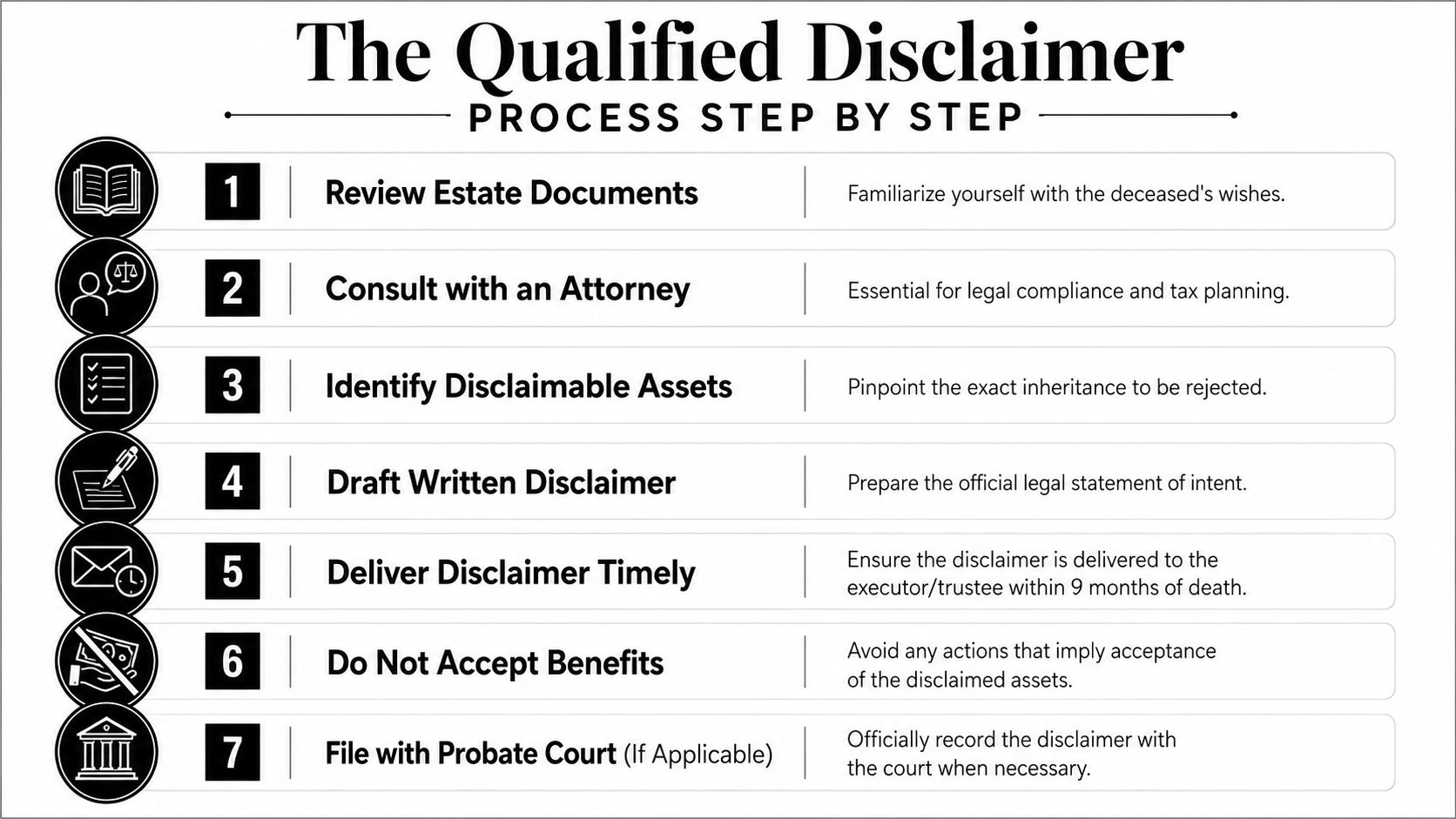
The Qualified Disclaimer Process Step by Step
The process for creating a valid disclaimer isn't casual. A missed deadline or a small misstep can ruin the intended result.
The deadline comes first
A marital disclaimer trust in Texas must be funded within nine months of the deceased spouse's date of death to be a qualified disclaimer under IRC Section 2518. The surviving spouse must provide the disclaimer in writing and can't have accepted any benefits from the property before disclaiming it. Once funded, the trust becomes irrevocable, as outlined in this explanation of whether a disclaimer trust is right for you.
That means the clock starts running quickly. Families who delay because they're still sorting through grief can lose the option.
A practical checklist
The process usually looks something like this:
- Review the estate documents. Confirm that the deceased spouse's will or revocable trust includes the disclaimer trust language.
- Identify the assets carefully. The spouse must know exactly what property or share is being disclaimed.
- Avoid accepting benefits. If the spouse takes benefits from the property first, the disclaimer may fail.
- Prepare a written disclaimer. It must meet legal requirements and clearly state the refusal.
- Deliver it properly. The writing must go to the executor or other appropriate fiduciary.
- Fund the trust correctly. Titles, accounts, or deed records must reflect the transfer into the trust.
- Administer the trust as a trust. After funding, the trustee follows the trust terms and fiduciary duties in Texas.
For families trying to reduce court involvement generally, it also helps to understand broader planning tools for how to avoid probate in Texas.
What counts as “accepting a benefit”
This is one of the biggest points of confusion. A spouse may think, “I haven't signed anything yet, so I'm fine.” But actions matter. If the spouse has already taken a benefit from the property, the qualified disclaimer may be invalid.
Examples may include using income from the asset, taking distributions, or otherwise exercising ownership before disclaiming. That's why executors and families should pause before moving money, retitling accounts informally, or treating the property as already accepted.
Don't assume a disclaimer can be fixed later. The safest approach is to get legal advice before touching the asset you may want to disclaim.
Hidden Risks and Advanced Considerations
Most articles stop after discussing tax benefits. That's where many families get a false sense of security. A disclaimer trust can be powerful, but it can also produce disappointing results if the drafting is too generic or the administration is too casual.
Second marriages and blended family concerns
A common concern arises when the surviving spouse later remarries. The original couple may have intended trust assets to support the surviving spouse during life and then pass to children from the first marriage. But if the trust language is broad, conflict can arise over how trust resources are used during that surviving spouse's lifetime.
The practical concern is straightforward. If distributions are allowed under a broad HEMS standard for health, education, maintenance, and support, the surviving spouse's personal spending choices can indirectly benefit a new spouse or a new household. That doesn't automatically mean wrongdoing. It does mean families should think carefully about whether the trust needs stronger limits, a spendthrift provision, or more detailed instructions for distributions in the event of remarriage.
A well-drafted trust can address questions such as:
- Who receives the remainder after the surviving spouse dies
- Whether an independent trustee should step in after remarriage
- How support distributions are defined
- Whether trust property can be used in ways that materially benefit a later spouse
This issue matters in many probate and trust disputes because family expectations often differ from the trust's actual wording. If the document is vague, litigation risk rises.
Creditor protection isn't automatic
Another overlooked issue is the gap between tax planning and creditor protection. Families often assume that because the surviving spouse disclaimed ownership, the trust assets are fully shielded from that spouse's personal creditors.
That assumption can be dangerous.
A critical risk is the “Fiduciary Discretion vs. Creditor Immunity” misconception. If a surviving spouse in Texas has any discretionary power as trustee, even limited by HEMS, courts may treat the trust as a self-settled asset under Texas fraudulent transfer statutes, potentially exposing it to the spouse's personal creditors. This blind spot is discussed in this analysis of Texas disclaimers and related legal concerns.
So what does that mean in plain English? It means a trust can be excellent for estate tax planning and still fall short as a creditor shield if the surviving spouse has too much practical control.
Watch this closely: A disclaimer trust may separate assets for transfer-tax purposes, but that doesn't always mean the spouse's creditors will be kept out.
Better drafting usually means better protection
A Texas trust administration lawyer and careful drafting become important. Families may need to consider whether the surviving spouse should serve as sole trustee, whether an independent co-trustee is wiser, and how distribution powers should be written.
A few practical questions often help:
| Question | Why it matters |
|---|---|
| Can the spouse act alone as trustee? | Too much control may create risk |
| Are distributions tightly defined? | Clear standards reduce later disputes |
| Is remarriage addressed directly? | Blended families often need extra guardrails |
| Are beneficiary rights clear? | Better communication can prevent conflict |
These issues also overlap with broader concerns in probate, guardianship planning, and asset protection. Families dealing with aging parents, vulnerable beneficiaries, or disputed inheritances often need one coordinated strategy instead of isolated documents.
Secure Your Family's Future with Confidence
A disclaimer trust can be one of the most useful flexible planning tools available to Texas families. It gives a surviving spouse time to make a thoughtful choice, allows assets to pass into a trust when that serves the family better, and can support tax planning and long-term control when handled properly.
The details matter. The estate documents must authorize the trust. The disclaimer has to be timely and in writing. The surviving spouse can't accept benefits from the property first. After funding, the trust must be administered according to Texas fiduciary principles, not treated like an informal family account.
Families should also look beyond the usual talking points. Second marriages can create beneficiary tension. Trustee powers can affect creditor exposure. And the difference between good drafting and generic drafting often becomes obvious only after a death, when changing course is harder.
If you're trying to answer what is a disclaimer trust in Texas, the best next step is usually a document review with a lawyer who handles estate planning, probate, trust administration, and related disputes together. That kind of review can help you decide whether a disclaimer trust fits your family, how to modify a trust in Texas when appropriate, and what fiduciary duties in Texas will apply after death.
If you're managing a trust or planning your estate, contact Law Office of Bryan Fagan, PLLC for a free consultation. Our attorneys provide trusted, Texas-based guidance for every step of the process.