A lot of Texas families sit at the same kitchen table with the same worry.
You want your spouse to be secure if you die first. You also want to know that your children, especially children from a prior marriage, won't be unintentionally disinherited later. That tension is common in blended families. It's not about distrust. It's about protecting everyone you love in a way that's clear, fair, and legally enforceable.
A QTIP trust can help solve that problem. It gives a surviving spouse ongoing financial support while preserving the right to decide who receives the remaining assets later. For many families, that balance brings peace of mind.
If you've been searching for what is a QTIP trust Texas, the answer starts with people, not paperwork. It starts with a husband who wants his wife to be comfortable in the family home, and a father who also wants his children to receive what he intended. It starts with a second marriage, adult children, community property questions, and the hope of avoiding future conflict. With careful drafting under the Texas Trust Code, coordination with the Texas Estates Code, and attention to trustee fiduciary duties in Texas, families can build a plan that reflects both compassion and control.
An Introduction to QTIP Trusts for Texas Families
Maria and David have been married for years. It's a second marriage for both. They share a life in Texas, but they don't share the same family tree. David wants Maria protected if he dies first. He also wants the assets he brings into the marriage to pass to his children later.
That's where families often get stuck.
If David leaves everything outright to Maria, she may later change her estate plan, remarry, or face pressures David never expected. If he leaves too little to her, he risks creating hardship for the person he loves most. The challenge isn't legal first. It's human.
A QTIP trust is often the answer for families in that exact position. It can support a current spouse without giving up control over who inherits the remaining property later. For trustees, executors, and beneficiaries trying to understand the moving parts, support resources such as HireParalegals trusts estates can also help clarify the roles professionals often play around trust and estate work.
Why blended families need more than a simple will
In Texas, estate planning often involves more than deciding who gets what. Families also need to think about community property, separate property, probate exposure, trust administration, and the practical question of who will manage assets after death.
A simple will can leave too much to chance in a blended family. A marital trust can add structure, and if you want a broader primer on that category, this overview of what a marital trust is is a useful starting point.
Families usually aren't trying to “control from the grave.” They're trying to reduce confusion, protect relationships, and make sure the right people are cared for in the right order.
What families usually want
Most clients considering this kind of planning want three things at once:
- Care for a spouse: They want the surviving spouse to have reliable financial support.
- Protection for children: They want children from a prior marriage to inherit what was intended for them.
- Less room for conflict: They want fewer surprises, fewer disputes, and clearer instructions for the people left behind.
That's the heart of a QTIP trust.
What Is a QTIP Trust in Plain English
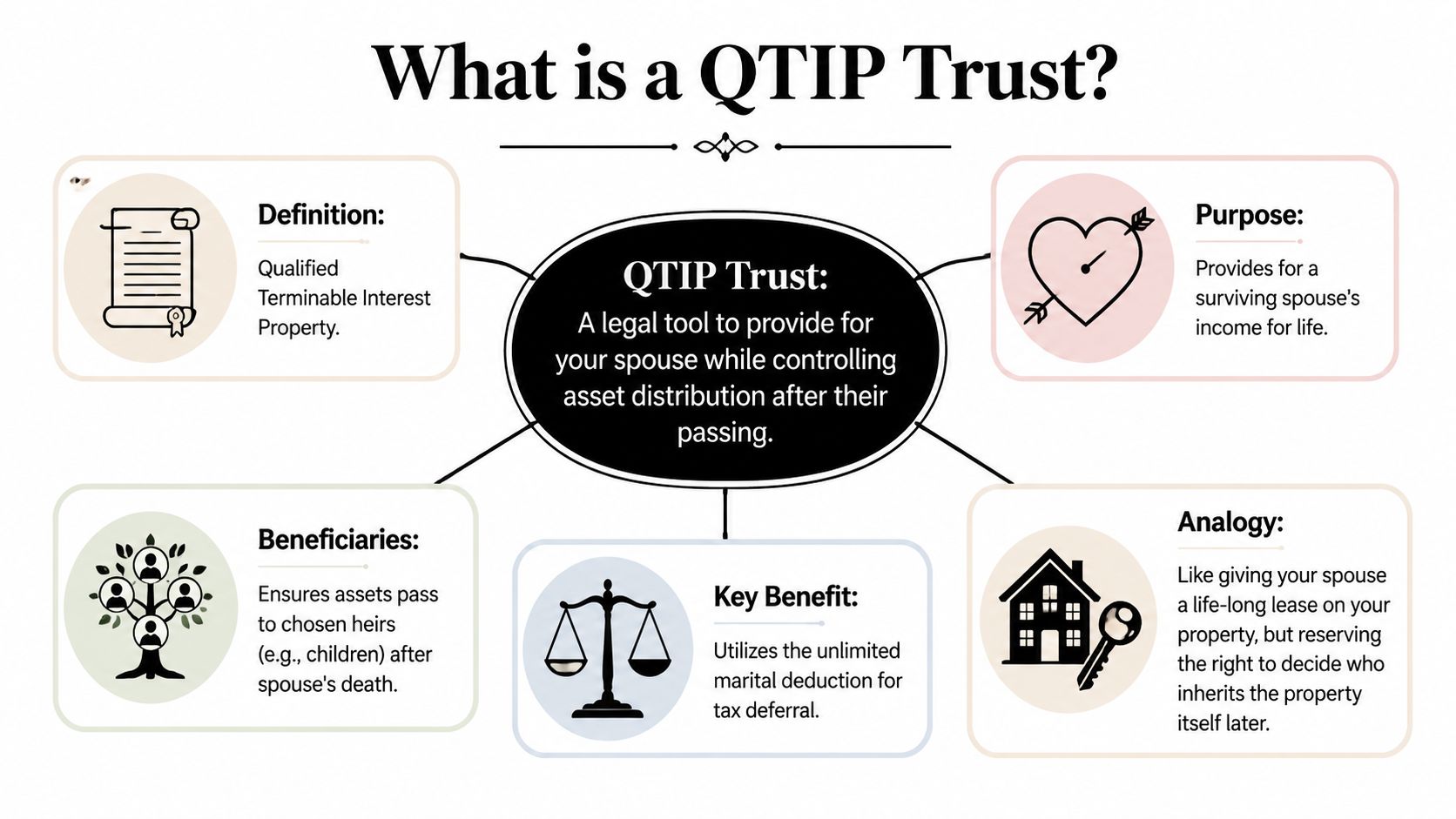
A QTIP trust is a trust that lets you provide for your surviving spouse during that spouse's lifetime while keeping control over who receives the trust property after your spouse dies.
In plain English, think of it this way. You can let your spouse benefit from the property without giving your spouse the power to rewrite the final destination of that property.
A simple family home analogy
Suppose you own a home and investment assets. You want your wife to have income and security for the rest of her life. But you also want your children to receive those assets after she passes away.
A QTIP trust works a lot like giving your spouse a lifetime right to benefit from the property while reserving the right to name the final heirs yourself. Your spouse is protected. Your children are not forgotten.
Legally, a QTIP Trust is an irrevocable estate planning instrument specifically designed to qualify for the federal estate tax unlimited marital deduction, allowing assets to pass to a surviving spouse without triggering federal estate taxes at the grantor's death. It's especially important for blended families because it can provide for the spouse while preventing those assets from being diverted away from the grantor's chosen heirs, as explained by Texas Tax & Estate Law on QTIP trusts.
The three people who matter most
A QTIP trust becomes easier to understand once you know the roles.
- Grantor: This is the person creating the trust plan and deciding who should benefit now and who should inherit later.
- Surviving spouse: This spouse is usually the lifetime income beneficiary.
- Remainder beneficiaries: These are the people who receive what remains after the surviving spouse dies. In many Texas families, these are children from a prior marriage.
Why this differs from probate and a direct inheritance
If assets pass outright to a spouse, that spouse usually controls them fully. That can be perfectly fine in some families, but it doesn't preserve the first spouse's wishes about final distribution.
A trust changes that. Trust administration also differs from probate in important ways. For readers comparing those systems, Texas Trust Administration: A Trustee's Guide explains what trust administration involves and how it differs from probate.
A QTIP trust is less about restricting love and more about preserving intent.
How a QTIP Trust Works for Tax Planning in Texas
For many families, the emotional reason for a QTIP trust comes first. The tax rules are what make the structure legally effective.
The marital deduction in everyday language
Federal estate tax law allows certain transfers to a surviving spouse to qualify for the unlimited marital deduction. In practical terms, that means assets placed into a properly structured QTIP trust can pass at the first spouse's death without triggering federal estate taxes at that time.
That doesn't erase tax forever. It defers it. The tax issue is pushed to a later point, typically after the surviving spouse's death. For families trying to balance support, control, and tax timing, that can be very useful. If you're also reviewing broader strategies, this guide on how to minimize estate taxes gives related context.
Why the law normally dislikes “terminable interests”
Federal law generally doesn't allow the marital deduction for an interest that ends at death and then passes to someone else. That's the so-called terminable interest rule.
A QTIP trust is a carefully designed exception.
A compliant QTIP trust requires that the surviving spouse hold a “qualifying income interest for life” and have the right to demand that the trustee make the assets productive. That structure qualifies as an exception to the terminable interest rule and allows the executor to make a QTIP election on the federal estate tax return, as described by Estate Plan ATX on QTIP trusts.
What the trust must do
To work properly, the trust has to follow specific rules. The surviving spouse must receive all of the trust's net income at least annually for life, and that right can't be subject to conditions. The trust also needs to be drafted so the spouse can enforce the right to income from productive assets.
Here is the practical effect:
- The first spouse dies. Assets move into the QTIP trust.
- The surviving spouse receives income. The spouse benefits during life under the trust's terms.
- The executor makes the election. Proper tax reporting is essential.
- The remainder stays protected. The final beneficiaries remain the people named by the grantor.
That's why drafting matters so much. If the trust language misses a required feature, the intended tax treatment can be lost.
A short explainer can help if you want to hear these ideas discussed in a different format.
Where Texas law fits in
Texas doesn't create the federal marital deduction, but Texas law still matters significantly. The Texas Trust Code governs trust creation, administration, trustee powers, accounting, and beneficiary rights. The Texas Estates Code affects probate, executor duties, nonprobate transfers, and estate administration procedures surrounding the trust plan.
For married couples in Texas, careful planning is also important because families often hold a mix of community and separate property. A tax-smart trust still has to be funded correctly and administered correctly under Texas law.
Practical rule: A QTIP trust only works as intended when the family plan, the trust language, and the post-death administration all match.
The Trustee Role and Fiduciary Duties Under Texas Law
A QTIP trust doesn't run itself. A trustee has to manage it, follow the trust terms, communicate appropriately, and make decisions that hold up under Texas law.
That job can be harder than families expect.
The trustee's balancing act
In many QTIP trusts, the trustee stands between two groups with different interests. The surviving spouse wants reliable income and sensible support. The remainder beneficiaries, often children, want the trustee to preserve principal and avoid unnecessary depletion.
Under the Texas Trust Code, trustees owe core fiduciary obligations. These fiduciary duties in Texas include loyalty, prudence, good faith administration, and careful compliance with the trust instrument. A trustee also has to act impartially when multiple beneficiaries have legitimate but competing interests. For a closer look, review this discussion of fiduciary duties of trustees.
What that means in real life
A trustee of a QTIP trust often needs to decide questions like these:
- Investment choices: Should the trustee prioritize current income for the spouse or long-term growth for the children?
- Asset management: If trust property isn't producing income, does the trustee need to take steps to make it productive?
- Communication: How much information should go to the spouse, the children, and the executor?
- Recordkeeping: Are accountings, tax records, and distributions documented clearly enough to prevent later disputes?
The trustee's job isn't to “pick a side.” The trustee must honor the trust and treat each beneficiary according to the legal rights that beneficiary actually has.
Guidance for trustees and families
If you've been named trustee, slow down before making early decisions. Read the trust, identify all beneficiaries, gather title documents, and confirm what the spouse is entitled to receive. A trustee who moves too fast can create avoidable conflict.
Families also need to understand that trust administration is ongoing work. It may involve investment review, tax filings, beneficiary communication, and coordination with probate or nonprobate assets. Questions often arise about successor trustees, incapacity, and what happens if the named trustee can't serve. Those are issues a Texas trust administration lawyer can help resolve before small misunderstandings turn into bigger disputes.
Weighing the Pros and Cons of a QTIP Trust
A QTIP trust can be a powerful tool, but it isn't the right fit for every family. The best decision depends on your relationships, the nature of your assets, and how much control you want to keep over the final distribution.
Where a QTIP trust shines
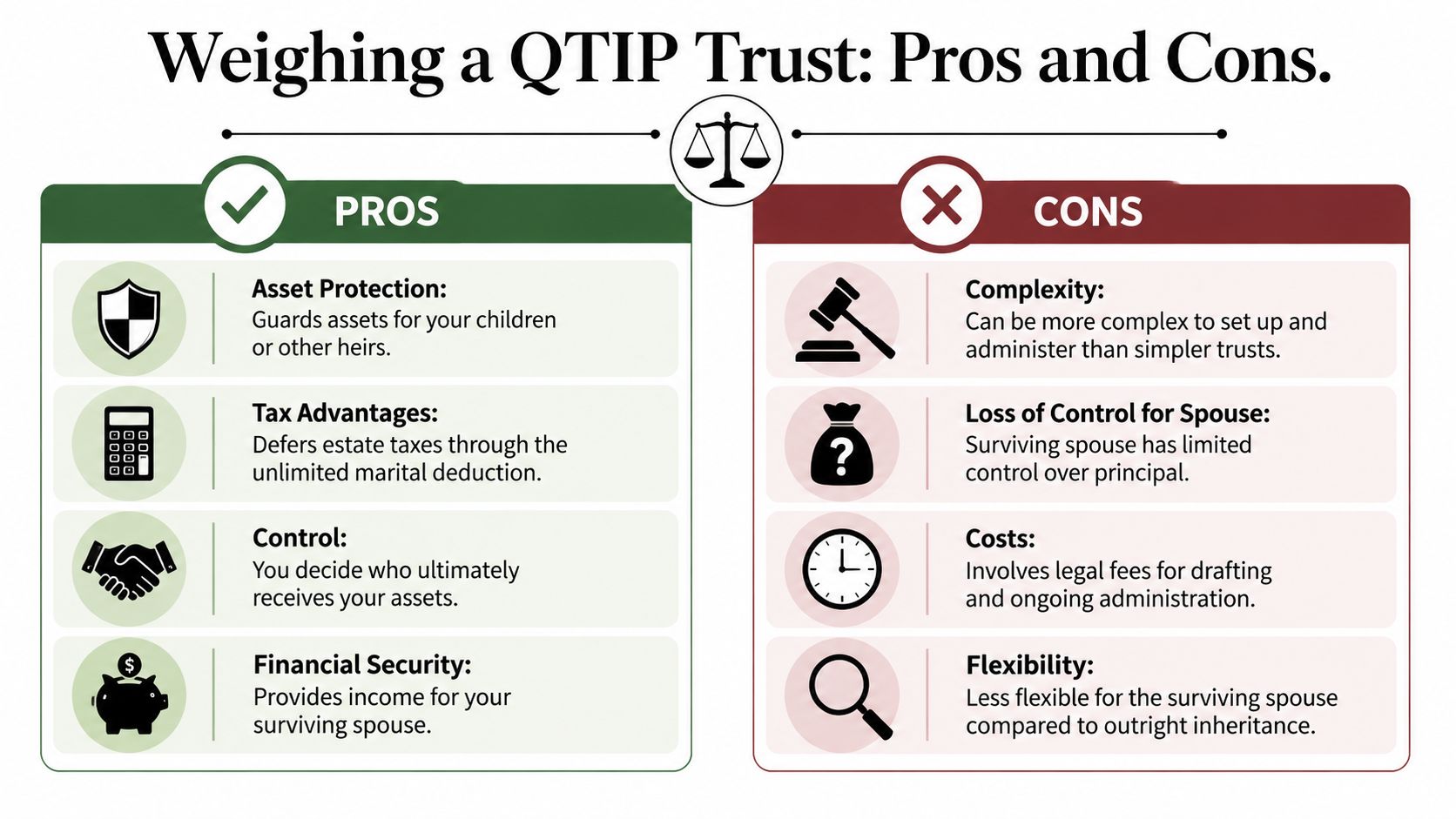
For blended families, the biggest strength is clarity. The trust can support a spouse now and protect the inheritance path later.
Some of the main advantages include:
- Control over final beneficiaries: The grantor decides who receives the remaining trust property after the surviving spouse's death.
- Support for the spouse: The surviving spouse has a protected right to trust income for life under the trust terms.
- Tax deferral: A properly structured QTIP can qualify for favorable federal estate tax treatment.
- Asset protection structure: Because the spouse doesn't receive everything outright, the assets are less exposed to redirection through a later estate plan.
- Useful in second marriages: This is often the cleanest solution when the family wants to avoid conflict between a current spouse and children from an earlier relationship.
Where families need to be cautious
A QTIP trust also has tradeoffs.
- Less flexibility for the spouse: The surviving spouse does not receive unrestricted control over principal.
- More administration: The trustee must manage the trust, maintain records, and follow tax and fiduciary requirements.
- Potential friction: Tension can develop if the spouse wants more distributions and the remainder beneficiaries want preservation.
- Drafting precision matters: Ambiguous language can lead to disputes or tax problems.
A narrow but important flexibility feature
Although a QTIP trust restricts a surviving spouse from withdrawing principal, it can be drafted to allow the greater of $5,000 or 5% of the trust's total asset value annually to the spouse, offering a limited floor of flexibility while preserving the principal for the remainder beneficiaries, as noted by Wilmington Trust's discussion of QTIP trust benefits.
That feature won't fit every plan, but it shows that QTIP trusts aren't always rigid. They can be customized within legal limits.
A quick decision lens
| Question | If your answer is yes |
|---|---|
| Do you want to support a current spouse and protect children from a prior marriage? | A QTIP trust may fit well |
| Do you want your spouse to control all assets freely after your death? | An outright gift may fit better |
| Are you willing to accept trustee administration and formal legal structure? | A QTIP becomes more practical |
| Is reducing future family conflict a major goal? | Clear trust terms become especially valuable |
Comparing QTIP Trusts to Other Estate Planning Tools
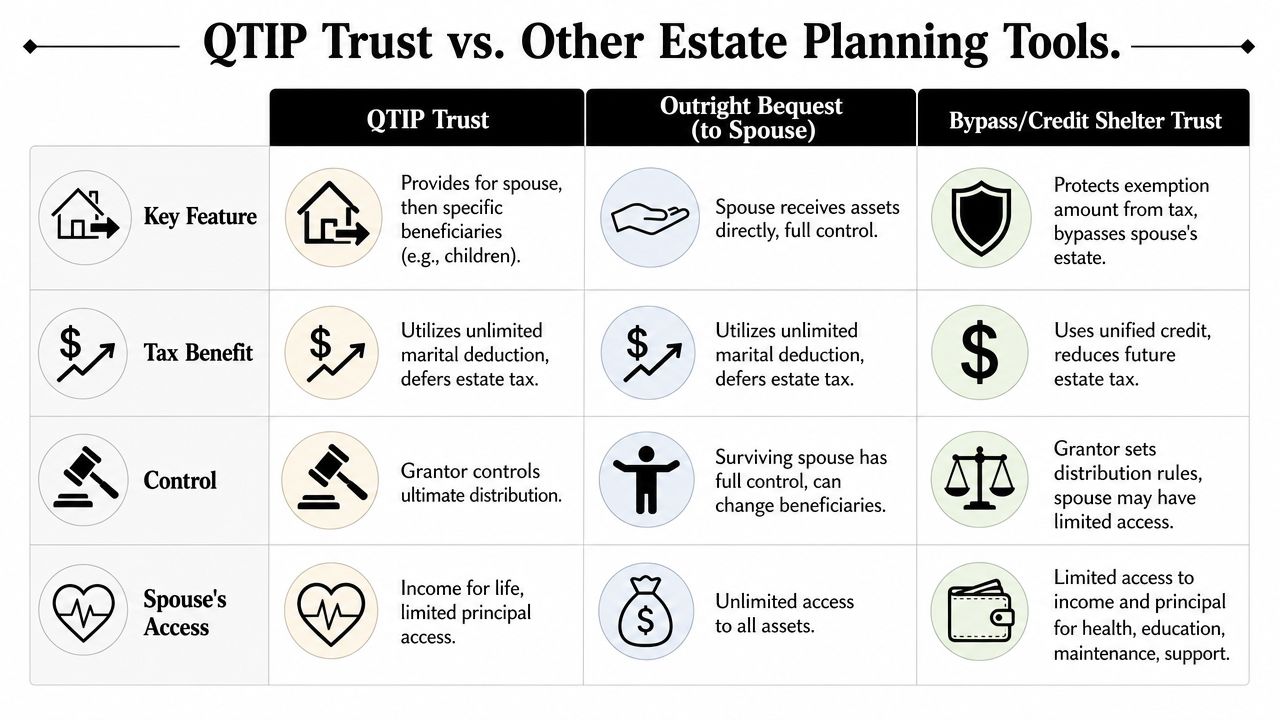
A QTIP trust makes the most sense when you compare it to the alternatives. Most families aren't choosing between a QTIP and nothing. They're choosing between a QTIP and other ways of providing for a spouse.
QTIP trust versus outright bequest
If you leave assets outright to your spouse, that spouse has broad freedom. They can use the assets, sell them, gift them, or leave them to someone else later.
That simplicity has a cost. You lose control over the final destination of the property.
A QTIP trust gives less freedom to the surviving spouse, but more certainty to the grantor and the children.
QTIP trust versus bypass trust
A bypass trust, sometimes called a credit shelter trust, serves a different planning purpose. It's often used in tax-oriented planning to keep certain assets outside the surviving spouse's taxable estate while allowing limited benefit to the spouse.
A QTIP trust is different. Its defining feature is that it supports the spouse while still qualifying for the marital deduction and preserving the grantor's control over remainder beneficiaries.
Side-by-side practical comparison
QTIP trust
- Best for: Blended families that need both spouse support and final-control protection
- Spouse access: Income for life, limited principal access under the trust terms
- Final control: Stays with the grantor's plan
Outright bequest to spouse
- Best for: Families with complete comfort giving the surviving spouse total control
- Spouse access: Full access to all assets
- Final control: Belongs to the surviving spouse
Bypass trust
- Best for: Families focused on a different estate tax and asset-preservation structure
- Spouse access: Often limited and defined by trust standards
- Final control: Set by the original plan, but with a different tax design than a QTIP
Why the right choice depends on family dynamics
If the central concern is, “I want my spouse cared for, but I also need to protect my children's inheritance,” a QTIP trust is often the most direct answer.
If the central concern is, “I want my spouse to have complete control because our family goals are fully aligned,” then a simpler plan may work. A Texas estate planning attorney can help compare these options in light of your property character, beneficiary relationships, and long-term intentions.
Navigating QTIP Trust Creation and Administration in Texas
A blended Texas family often reaches the same hard question after the first spouse dies. How do you make sure a surviving husband or wife is secure, while also making sure children from an earlier marriage still receive what their parent meant for them to have?
A QTIP trust can carry out that plan, but only if the setup and follow-through are done carefully. The document has to say the right things, the right assets have to be directed into the trust, and the people handling the estate have to understand both the family's wishes and the legal rules that apply.
The path families usually follow
The process usually starts with a careful conversation about goals. A family and a Texas estate planning attorney sort through questions such as: Which assets should be reserved to support the surviving spouse? Which beneficiaries should receive what remains later? Who is levelheaded enough to serve as trustee? How do community property and separate property affect the plan?
Drafting comes next. This stage is more than paperwork. The trust language needs to clearly give the surviving spouse the rights required for QTIP treatment, while also preserving the instruction that the remaining assets pass to the children or other chosen beneficiaries after that spouse's death. A good draft reduces the chance that family members will later argue about what the deceased person intended.
After death, attention shifts to administration. The executor and trustee need to identify the assets tied to the plan, gather values and account records, decide what qualifies for the election, and carry out the trust terms in a way that matches Texas law. That work can involve probate, trust accounting, tax filings, and coordination with guardianship planning, probate administration, and asset protection strategies.
Where problems usually begin
Mistakes tend to happen in a few predictable places:
- Unclear drafting: If the spouse's required rights are described poorly, the trust may not qualify or may invite disputes.
- Weak administration: Poor records, late distributions, or uneven communication can strain an already sensitive blended-family relationship.
- Missed tax handling: The QTIP election and related return preparation must be handled correctly and on time.
- Wrong trustee choice: A trustee who is disorganized, biased, or uncomfortable managing conflict can make a sound plan much harder to carry out.
Trust modification can add another layer of complexity. For families asking about how to modify a trust in Texas, the answer depends on the trust terms, the interests of the beneficiaries, and Texas law. Some changes are simple. Others require court approval or consent from the people affected.
The best time to prevent conflict is before conflict has a chance to start.
That is why a QTIP trust works best when the family is honest about its real concern. In many Texas blended families, the challenge is not a lack of love. It is the fear that caring for a current spouse and protecting children from a prior marriage may pull in opposite directions. A properly created and well-administered QTIP trust helps hold those two commitments together.
If you're managing a trust or planning your estate, contact Law Office of Bryan Fagan, PLLC for a free consultation. Our attorneys provide Texas-based guidance for each step of the process.