Managing a loved one’s estate can feel overwhelming, especially when you’re navigating a legal system that can feel like a maze. But with the right legal guidance, it doesn’t have to be. A key part of that guidance involves understanding non probatable assets. Think of them as a powerful tool in your estate planning toolkit, a way to ensure your legacy goes directly to your family without the delays and public nature of the court system.
This approach helps you avoid the time, expense, and public exposure of the Texas probate process, offering peace of mind for both you and your loved ones.
Your Guide to Non Probatable Assets in Texas
When someone passes away, their property must be legally transferred to their heirs. The traditional path for this is a court-supervised process called probate. While probate is necessary in many situations, it's not always quick, inexpensive, or private. In fact, it's governed by the Texas Estates Code and can become a lengthy public affair.
The good news is that Texas law gives families smarter, more strategic options. A significant part of modern estate planning is structuring certain assets to bypass the formal court process entirely. These are your non probatable assets.
How These Assets Streamline Estate Administration
Imagine an asset with its own pre-written instructions for transfer. That’s a non probatable asset. Instead of relying on a will—which must be validated by a probate court—the transfer is handled directly through a legal contract or a beneficiary designation you established during your lifetime.
This direct-transfer shortcut offers practical, real-world advantages for your family:
- Speed: Beneficiaries can often access funds or property much faster—often in days or weeks, not the months it can take waiting for a court order.
- Privacy: Because the transfer happens outside the courtroom, the details—what the asset is, how much it's worth, and who receives it—remain private. Probate, on the other hand, is a public record.
- Reduced Costs: By avoiding court fees, probate-related attorney's bills, and other administrative expenses, more of your hard-earned wealth stays with the people you intended it for.
The Texas Estates Code fully supports using non probatable assets as a core strategy for efficient wealth transfer. It’s all about creating a direct, contract-based handoff that honors your wishes without getting bogged down in court supervision. This brings peace of mind for both you and your loved ones.
Learning how to use these tools correctly is the first step toward building a legacy that’s both secure and seamless. A well-thought-out plan ensures your wishes are followed precisely, reducing the administrative burden on your family and providing critical asset protection when they need it most.
Understanding Probate vs. Non-Probate Transfers
To truly grasp the power of non-probatable assets, it helps to visualize the two different paths an estate’s property can take. The traditional route is probate, a formal, court-supervised process outlined in the Texas Estates Code. Think of it as a public proceeding where a judge must approve every step: validating the will, paying debts, and finally, authorizing the distribution of assets.
Every action requires judicial approval, which can drag out the process, increase costs, and expose your family's financial details. Any asset owned solely in the deceased's name without a designated beneficiary is typically forced down this path.
In contrast, a non-probate transfer is like a direct pass for your legacy. It bypasses the courthouse entirely because you have already set up the transfer instructions during your lifetime through a legal contract—like a beneficiary form on a life insurance policy or the clear terms of a trust. The asset moves directly to its intended recipient without needing court approval.
The Core Differences: Speed, Cost, and Privacy
The distinction between these two methods has significant real-world consequences for your family. Understanding this is a foundational step in smart estate planning in Texas.
- Transfer Speed: Probate in Texas can take months, sometimes even years, to conclude. Non-probate transfers can often be completed in just a few days or weeks once a death certificate is provided.
- Associated Costs: The probate process involves court filing fees, attorney's fees, and other administrative costs that can diminish the estate's value. Non-probate transfers avoid nearly all of these court-related expenses.
- Level of Privacy: Probate is a public record, meaning anyone can access details about the deceased’s assets and debts. Non-probate transfers are private transactions between the financial institution and your beneficiary.
To help you see the difference quickly, here’s a straightforward comparison.
Probate Assets vs. Non-Probatable Assets at a Glance
This table breaks down the key distinctions between assets that go through the Texas court system and those that bypass it, giving you a clear snapshot of how they're handled.
| Characteristic | Probate Assets | Non-Probatable Assets |
|---|---|---|
| Transfer Method | Court-supervised process (probate) | Direct transfer via contract (e.g., beneficiary form) |
| Ownership | Titled solely in the decedent’s name | Jointly owned or has a designated beneficiary/TOD/POD |
| Speed of Transfer | Slow (months to years) | Fast (days to weeks) |
| Cost | Higher (court fees, legal expenses) | Lower (minimal administrative costs) |
| Privacy | Public record | Private transaction |
| Control | Controlled by will and court orders | Controlled by pre-set beneficiary designations |
Ultimately, a key goal of a Texas estate planning attorney is to shift as much of the estate as possible into the right-hand column, giving your family a much smoother, faster, and more private experience.
This flowchart visually splits an estate into these two categories, showing the separate journeys each type of asset will take.
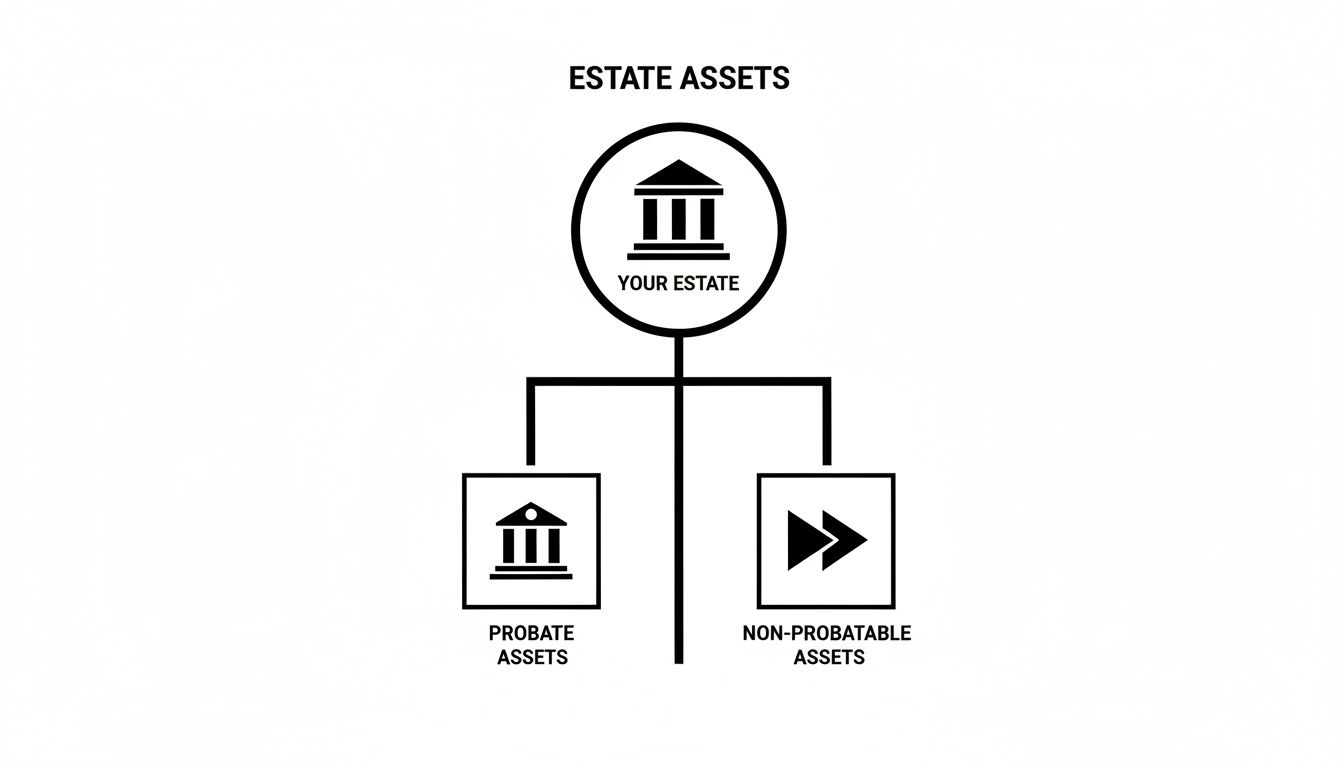
This picture really drives home how much control you can have. With a little planning, you can steer assets away from the courthouse and directly into the hands of your loved ones.
Why This Matters for Your Estate Plan
Failing to plan is one of the biggest hurdles families face. It’s shocking, but as many as two-thirds of Americans don't have any estate plan at all. This isn't just a statistic; it's a gap that leaves the courts in charge of how assets are managed. The problem is so common that even one in four financial advisors—the very people who manage wealth for a living—don't have personal estate plans, which just highlights how critical proactive legal guidance is for Texas families. You can read more about these findings on estate planning preparedness.
Without clear instructions using non-probate tools, your assets are thrown into the default system: the courts. This can create unnecessary stress and conflict for your family during an already difficult time. For a modern take on how asset transfers are evolving, understanding the principles of custodial and non-custodial asset control can offer some interesting parallels to the traditional probate discussion, especially as digital assets become more common.
A key goal of a Texas estate planning attorney is to structure as much of your estate as possible to pass through these more efficient non-probate channels. This isn't about avoiding legal obligations but about choosing a smarter, more direct path for your legacy.
By taking the time to carefully title your assets and name beneficiaries, you’re creating a clear, legally binding roadmap for your estate. This ensures your wishes are honored quickly and privately, giving your family the security and support they need when they need it most. It’s all about empowering you to keep control, even after you’re gone.
Key Types of Non-Probatable Assets in Texas

Knowing what tools are available is the first step toward building an estate plan that works for your family here in Texas. Several types of non-probatable assets are designed for a direct, private transfer of wealth, and each one serves a specific purpose under Texas law.
By properly structuring your assets, you can create a clear path for your legacy that neatly bypasses the potential delays and public scrutiny of probate court. These are not legal loopholes; they are well-established strategies rooted in the Texas Estates Code. Let's walk through some of the most common and effective options.
Revocable Living Trusts
A Revocable Living Trust is one of the most powerful tools in a modern estate plan. Think of it as a private entity you create to hold your most valuable assets. You transfer ownership of your property—like your home, investments, and certain bank accounts—into this trust. You then name yourself the trustee, allowing you to maintain full control during your lifetime.
When you pass away, the successor trustee you hand-picked steps in to manage and distribute the assets exactly as you outlined in the trust document. Since the trust owns the assets, not you personally, there is nothing for the probate court to oversee. The entire process is handled privately and according to your terms.
Real-World Scenario: Imagine a Houston couple wants to ensure their home and investment portfolio pass directly to their three children without court involvement. A Texas trust administration lawyer helps them establish a revocable living trust and retitle their property into it. When they pass away, their eldest daughter, as successor trustee, follows their instructions to distribute the property—without ever needing to go to probate court.
Life Insurance and Retirement Accounts
Life insurance policies, 401(k)s, IRAs, and other retirement accounts are classic examples of non-probatable assets. At their core, these are contracts between you and a financial institution. A critical part of that contract is the beneficiary designation form, where you name who receives the proceeds upon your death.
That designation acts as a direct order that legally bypasses your will. After you pass away, your beneficiary simply needs to provide a death certificate to the company to claim the funds. The process is typically quick, private, and straightforward.
Payable-on-Death (POD) and Transfer-on-Death (TOD) Accounts
Texas law provides a simple way to convert bank and investment accounts into non-probatable assets by filling out a form.
- Payable-on-Death (POD): This is for bank accounts, such as checking, savings, and CDs. You name a beneficiary who will automatically receive the funds in the account upon your death.
- Transfer-on-Death (TOD): This functions similarly but applies to brokerage or investment accounts holding stocks, bonds, and mutual funds. The assets transfer directly to your named beneficiary, avoiding probate.
During your lifetime, the beneficiary has no access to or control over these funds, and you can change your designation at any time. It's a simple strategy that can prevent significant assets from getting tied up in the court system.
Joint Tenancy with Right of Survivorship
When two or more people own property as "joint tenants with right of survivorship," it includes a powerful, built-in succession feature. If one owner passes away, their share automatically transfers to the surviving owner(s). The deceased’s share does not become part of their probate estate; instead, the other owner takes full ownership immediately by operation of law.
This is a common way for married couples in Texas to own their home. However, it's important to understand that this legal arrangement is powerful and will override any conflicting instructions in your will.
Real-World Scenario: Two sisters in Dallas purchase a vacation home together, titling it as joint tenants with right of survivorship. If one sister passes away, the other automatically becomes the sole owner of the entire property, regardless of what the deceased sister’s will might state.
Texas Transfer-on-Death Deed (TODD)
A Transfer-on-Death Deed (TODD) is a specific tool for Texas real estate that allows a property owner to name a beneficiary who will inherit the property directly, completely avoiding probate. The owner signs and records the deed in the county property records during their lifetime.
Crucially, the TODD only becomes effective upon death. The owner retains complete control—they can sell the property, mortgage it, or revoke the TODD at any point before they pass away. It is a simple, clean way to transfer real estate.
If you want to dig deeper into these distinctions, check out our guide on probate and non-probate assets in Texas. Each of these tools gives you a clear, legally solid way to make sure your assets get to your loved ones efficiently and privately.
Why Bother With Non-Probatable Assets? It's About Strategy.
Viewing non probatable assets as a simple checkbox on your estate plan misses the bigger picture. This isn't just about convenience; it is a strategic decision that provides your loved ones with security and invaluable peace of mind when they need it most. Understanding these benefits helps you make informed choices to protect your family and your legacy.
The primary benefit is bypassing the Texas probate process. Probate is the court's slow, expensive, and very public method of validating a will and settling an estate. It is rarely quick, often dragging on for months—sometimes years—while legal and court fees diminish the inheritance intended for your family.
Keep Your Family's Business Private
One aspect of probate that people often overlook is its public nature. Once an estate enters probate, the will, a detailed inventory of assets, and a list of all debts become public record. This means anyone, from a curious neighbor to a predatory salesperson, can access your family's financial information.
Non-probate transfers, in contrast, are completely private. When a life insurance policy pays out or a TOD account transfers to a beneficiary, it is a direct, confidential transaction between the financial institution and your loved one. This privacy acts as a shield, protecting your family from unwanted attention during a difficult time.
By its very nature, probate throws open the doors to your family’s financial life. Structuring your estate with non probatable assets ensures the transfer of your wealth remains a private family matter, shielded from public prying.
Make Sure Your Family Has Money When They Need It
The last thing a grieving family needs is to be locked out of funds required for daily living. During probate, bank accounts and other assets are often frozen until the court officially grants an executor the authority to act—a delay that can last for weeks or even months.
This is where non probatable assets truly shine. Beneficiaries of life insurance policies or Payable-on-Death (POD) bank accounts can often access funds almost immediately, usually with just a death certificate and proper identification. This quick access to cash can be a lifeline, covering immediate needs like funeral costs, mortgage payments, and daily expenses, providing stability when everything else feels uncertain.
Why Getting Professional Help is More Important Than Ever
Smart estate planning is no longer just for the ultra-wealthy; it is a fundamental part of responsible family wealth management. The U.S. Trusts & Estates industry grew to an incredible $290.1 billion in revenue in 2025, a figure driven by an aging population and a growing recognition of the need for professional guidance. For Texas families, this underscores the value of working with a skilled attorney to navigate this complex field. You can read more about this industry trend on IBISWorld.com.
Using these tools correctly creates a direct, seamless transfer of your assets—a cornerstone of effective estate planning. It’s how you make sure your hard-earned wealth goes where you want it to, efficiently and privately. To dig deeper into this strategy, check out our guide on how to avoid probate in Texas. At the end of the day, these tools don't just move assets around; they safeguard your family’s future.
Common Mistakes to Avoid with Your Beneficiaries
While they are incredibly effective, non-probatable assets can lead to painful and unexpected outcomes if not managed carefully. These are powerful legal instruments that operate on strict, contractual rules. A simple oversight can steer your legacy in a direction you never intended.
Knowing the common pitfalls is the first step to ensuring your plan functions exactly as you envision.
One of the most frequent and heartbreaking errors is failing to update beneficiary designations. Life changes. People get married, divorced, have children, or a beneficiary may pass away. Many people mistakenly believe their will can override an old beneficiary form, but that is a dangerous assumption. The designation on a life insurance policy or retirement account is a binding contract, and under Texas law, it almost always supersedes what is written in your will.
The Dangers of "Set It and Forget It" Planning
An outdated beneficiary form can easily send your hard-earned assets to an ex-spouse or a deceased relative’s estate, creating family conflict and costly legal disputes. This is precisely why a "set it and forget it" mindset is so hazardous in estate planning. Your plan must be a living document that evolves with your life.
Another critical mistake is improperly funding a living trust. Simply signing the trust document is only half the battle. If you do not legally transfer ownership of your assets—your home, bank accounts, and investments—into the name of the trust, it remains an empty shell. Any assets left outside the trust will be subject to the public, time-consuming probate process, defeating the very purpose of establishing it.
A will and a beneficiary designation are two separate legal instructions. Under Texas law, the beneficiary form almost always wins. Regularly reviewing these documents with a Texas estate planning attorney is essential to prevent your legacy from going to the wrong person.
Overlooking Contingent Beneficiaries and Joint Accounts
It's also crucial to name contingent (or backup) beneficiaries. If your primary beneficiary passes away before you and you have not named a secondary beneficiary, that asset could default to your estate and end up in probate court.
Relying solely on joint accounts without understanding the full implications can also cause issues. While it avoids probate for that specific account, it gives the joint owner immediate and total control upon your death, which may not align with your overall estate distribution goals.
These are not minor administrative slip-ups; they can have profound emotional and financial consequences for your family. To protect your legacy, you must be proactive.
- Review Beneficiary Forms Annually: Make it a yearly habit to check every single account that has a named beneficiary.
- Confirm Your Trust is Funded: Work with your lawyer to get a clear inventory and confirm that every intended asset has been correctly retitled into the trust's name.
- Coordinate All Your Documents: Ensure your will, trust, and beneficiary designations are all aligned and working together as a cohesive plan.
A periodic check-in with a skilled attorney ensures your plan remains true to your wishes, preventing costly and heartbreaking mistakes down the road.
How a Texas Estate Planning Lawyer Can Help
Knowing about non probatable assets is one thing; turning that knowledge into a sound legal strategy that works when your family needs it most is another. This is where professional guidance becomes indispensable.
An experienced Texas estate planning lawyer provides the legal precision needed to transform your intentions into an effective plan. It’s not just about drafting documents; it’s about crafting a comprehensive strategy that stands up to real-world challenges.
At The Law Office of Bryan Fagan, PLLC, our first step is always a thorough review of your assets. This process helps us identify which properties can and should be structured to bypass the probate process, saving your family significant time, money, and stress.
Building a Cohesive and Modern Estate Plan
From there, our legal team provides step-by-step guidance. We’ll help you title accounts correctly, update beneficiary designations to reflect your current wishes, and draft and fund trusts according to the strict requirements of the Texas Trust Code. The goal is to ensure every component of your plan works in harmony, preventing conflicts between your will and non-probate instructions. If you want to get into the nuts and bolts of our role, you can learn more about what estate planning lawyers do in Texas.
We also stay ahead of modern challenges. For instance, digital assets like cryptocurrency have become a significant factor in estate planning, with transactions soaring past $27 trillion last year. Too often, these assets become inaccessible after death due to poor planning—a critical gap we help our clients address.
An estate plan is more than a will. It is a coordinated system of legal tools, including trusts and beneficiary designations, designed to protect your legacy and provide for your loved ones with maximum efficiency and privacy.
We ensure your plan is robust enough to handle everything from the family home to your digital wallet, providing a clear, unambiguous roadmap for your executor and beneficiaries. This proactive approach reduces confusion and the potential for disputes, paving the way for a smoother administration process.
If you’re ready to secure your family's future and gain the peace of mind that a well-crafted plan provides, our team is here to help.
If you’re managing a trust or planning your estate, contact The Law Office of Bryan Fagan, PLLC for a free consultation. Our attorneys provide trusted, Texas-based guidance for every step of the process.
A Few Common Questions About Non-Probatable Assets in Texas
When Texas families begin to explore the details of non-probatable assets, a few key questions often arise. Getting clear answers is the best way to feel confident in your estate plan, so let's address some of the most common concerns.
Do Non-Probatable Assets Help Me Avoid Estate Taxes?
This is a critical question, and the answer often surprises people. While using non-probatable assets is an excellent strategy for avoiding the probate court process, they do not automatically help you avoid estate taxes.
For federal estate tax purposes, the value of these assets is still included as part of your total taxable estate. Tax planning is a separate and complex area that requires its own specialized strategies.
What Happens If a Named Beneficiary Passes Away Before I Do?
This scenario can create a significant problem. If your primary beneficiary on an account dies before you do and you have not named a contingent (or backup) beneficiary, that asset often defaults back to your estate.
When that occurs, it gets pulled into the court system and must go through probate—completely defeating the purpose of its non-probate designation. This is precisely why it is so important to review and update your beneficiary forms regularly.
Can My Will Override a Beneficiary Designation?
In short: no. A beneficiary designation on a life insurance policy, retirement account, or Transfer-on-Death (TOD) account is a binding legal contract. The Texas Estates Code is very clear that this contract takes priority over instructions in your will.
Your will governs your probate assets, but the beneficiary form controls the specific non-probate asset to which it is attached.
Key Takeaway: A beneficiary designation is a powerful legal tool that operates completely independently of your will. Never make the mistake of assuming your will can "fix" an outdated beneficiary form—it almost certainly can't.
Are Assets in a Revocable Living Trust Protected from Creditors?
During your lifetime, the answer is generally no. Assets held in a revocable living trust are not shielded from your personal creditors. Because you retain full control over the assets and can dissolve the trust at any time, the law views those assets as still belonging to you.
True asset protection from creditors typically involves more advanced legal tools, such as certain types of irrevocable trusts. The best way to determine which strategies fit your financial situation is to discuss them with a Texas estate planning attorney.
If you’re managing a trust or planning your estate, contact The Law Office of Bryan Fagan, PLLC for a free consultation. Our attorneys provide trusted, Texas-based guidance for every step of the process.
Find out more at https://texastrustadministration.com.