Managing a loved one's trust can feel overwhelming, especially when you realize the job is not just about following wishes. It's also about following Texas law, keeping good records, handling property correctly, and communicating with beneficiaries in a way that protects everyone involved.
Many trustees wait too long to get legal help because they assume hiring a lawyer is only necessary after a dispute begins. In many Texas trust matters, the better time to get help is earlier, when the first serious decisions have to be made. That's usually when mistakes are still preventable.
If you're searching for guidance on when to hire a trust administration attorney in Texas, the most useful answer is this: hire counsel when the trust stops being simple. That could happen the day the settlor dies, when real estate has to be retitled, when a beneficiary starts asking hard questions, or when you're not sure what the document requires.
Understanding Your Responsibilities as a Trustee in Texas
You may be named trustee on paper one day and, the next, find yourself dealing with a rent house that needs insurance, an account that has to be retitled, or siblings who want answers right away. That shift can happen fast in Texas. The job is not merely honoring someone's wishes. It is carrying out legal duties in a way that protects the trust, the beneficiaries, and you.
At the core, a trustee is a fiduciary. In plain English, that means Texas law expects you to put the interests of the trust and its beneficiaries ahead of your own convenience, preferences, or financial interests.
Texas trustees work within a detailed legal framework. The main rules appear in the Texas Property Code, Subtitle B, Trusts, and related questions can also arise under the Texas Estates Code when a death or incapacity sets events in motion. For many trustees, the hard part is not finding out that rules exist. The hard part is applying those rules to real decisions, such as whether to sell property, how to handle a business interest, or what to say when one beneficiary asks for more information than another.
A useful way to understand the role is this: a trustee works much like a manager following written instructions for property that belongs to others in a practical sense. You are in charge of the administration, but you do not have free rein. If the trust limits distributions, requires certain conditions, or gives you discretion with guardrails, those limits matter.
What fiduciary duties mean in daily life
These duties sound abstract until they show up in a real decision.
Duty of loyalty
You must act for the beneficiaries' benefit, not your own. If the trust owns a house and you want to buy it, or if you are also a beneficiary and want an early distribution, that is the kind of situation that deserves careful review.Duty of prudence
You must handle trust assets with care. That can include keeping insurance in place, monitoring investments, preserving records, and avoiding delays that put assets at risk.Duty of impartiality
If there are multiple beneficiaries, you usually cannot favor one unfairly over another unless the trust clearly allows it. This issue often shows up when one child is living in trust property, one wants cash quickly, and another wants to hold assets for long-term growth.Duty to follow the trust document
The trust instrument is your operating manual. If the language is specific, you follow it. If the language is unclear, guessing can create expensive problems later.
The practical work is often where new trustees feel the pressure first. You may need to identify assets, secure real estate, gather statements, review deeds, coordinate with tax professionals, respond to beneficiary questions, and document every important decision. A family business, mineral interests, or property in more than one county can turn a manageable job into one that needs legal guidance early.
One simple rule helps. If a decision affects someone's inheritance, creates a paper trail, or could be questioned later, document what you did and why you did it.
That habit saves money. It also reduces the chance of the common errors discussed in these mistakes new trustees make in Texas.
Trust administration also overlaps with other legal areas. A trust may hold a homestead, rental property, closely held business interests, protected assets, or accounts connected to a larger estate plan. If incapacity is part of the story, guardianship or agent authority questions may also surface. Those are recognizable trigger points. They are often the moments when getting legal advice early costs far less than fixing a misstep later.
Clear Signals It Is Time to Hire a Trust Administration Attorney
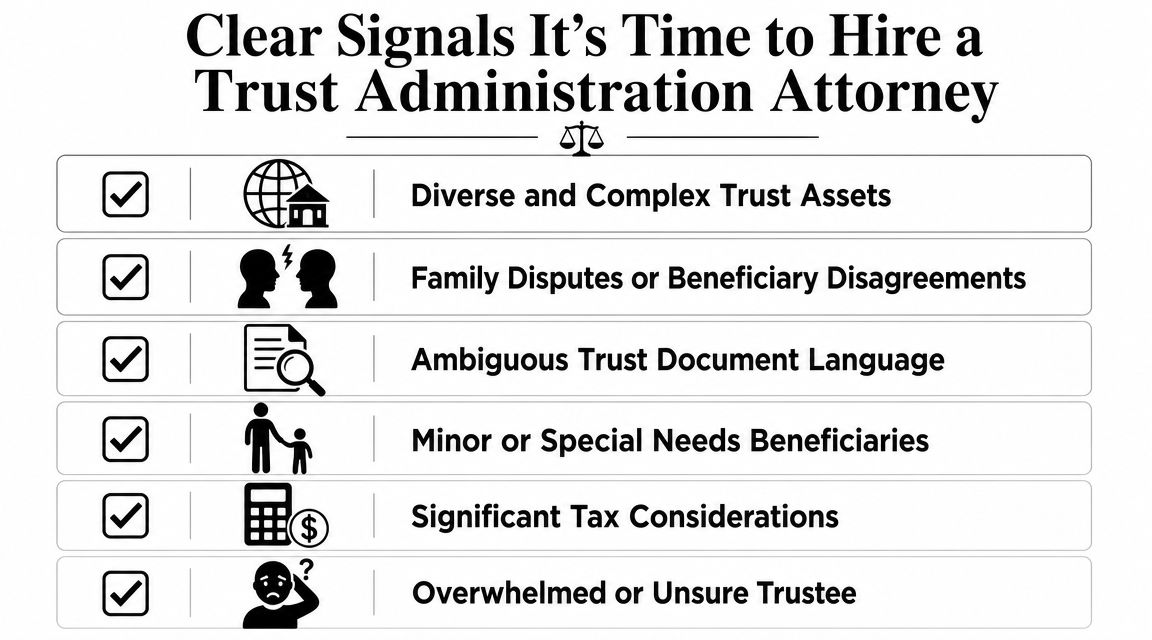
You open the mail and find a stack of trust documents, a deed to the family home, and questions from relatives who assume you already know what to do next. That is a common Texas trustee moment. The right time to call a trust administration attorney is often not after a dispute. It is when a recognizable trigger appears and one wrong step could cost time, money, or family trust.
A good rule is simple. If the trust has moved from quiet planning to active administration, legal guidance often saves more than it costs.
The most recognizable trigger events
Some events are clear signals because they change your job overnight. Before that point, the trust may have been little more than part of an estate plan. After it, you may need to protect property, interpret instructions, answer beneficiaries, and create a record that will hold up later.
Here are the situations that usually justify calling a Texas trust administration lawyer early.
The settlor has died or become incapacitated
This is often the starting line for real administration. You may need to confirm who has authority, identify trust assets, secure property, and determine what notices or next steps are required.The trust holds real estate, a business, mineral interests, or other unusual assets
A checking account is one thing. A rent house with tenants, an oil and gas interest, or shares in a closely held company is another. These assets often need transfers, valuations, operating decisions, or coordination with other professionals. Early legal review can prevent title problems, missed deadlines, and disputes over value.The trust language is hard to interpret
If one paragraph seems to say “distribute now” and another suggests “hold for health, education, maintenance, and support,” guessing is dangerous. Trust language works like an instruction manual. If two pages appear to point in different directions, you stop and clarify before turning the machine on.The trust gives you discretion over distributions
Discretion sounds broad, but it still has limits. If you are deciding whether one beneficiary receives funds for a home purchase, tuition, addiction treatment, or monthly support, the decision should be tied to the trust terms and documented carefully.
A short delay can also become expensive. If a house sits uninsured, a business account remains in the wrong name, or a beneficiary gets no response for weeks, the problem often grows on its own.
For a visual overview of trustee risk points, this short video may help clarify what early legal guidance can prevent.
Red flags that usually mean don't wait
Other warning signs are quieter, but they matter just as much because they usually involve paperwork, deadlines, or rising tension.
You need to retitle assets or prepare legal paperwork
Deeds, account transfers, certifications of trust, and related documents need to match the trust terms and the asset involved. Small paperwork errors can create title issues that are much harder to fix later.A beneficiary is questioning your decisions or asking for documents
Sometimes this starts with a reasonable question. Sometimes it is an early sign that expectations are already drifting apart. Getting legal advice early can help you respond consistently and avoid creating a record that makes conflict worse.You are managing property with practical problems attached to it
The home may be vacant. The rental property may need repairs. The family business may need someone to sign contracts or review payroll. These are legal issues and management issues at the same time, which is why trustees often benefit from counsel before a crisis develops.You are preparing an accounting
An accounting is where informal decisions become visible. Income, expenses, reimbursements, distributions, and asset values all need to be organized in a way that is accurate and defensible.Family members are already in conflict
If one beneficiary wants a quick sale, another wants to keep the property, and a third distrusts everyone involved, the trustee can get caught in the middle fast. Early counsel helps set process before positions harden.You feel unsure about your next step
That feeling is not weakness. It is often your best warning sign. Trustees are frequently dealing with grief, urgency, and family pressure at the same time.
Many trustees wait because they assume hiring a lawyer means a fight is coming. In practice, early advice often does the opposite. It helps you set up the administration correctly, avoid avoidable mistakes, and reduce the chance that a business asset, property transfer, or family disagreement turns into litigation.
If you want a practical picture of where trustees often slip, review these common mistakes new trustees make in Texas.
The Role of a Texas Trust Administration Lawyer
A trustee often reaches a practical moment. The trust owns a house that needs insurance renewed, an investment account that cannot be accessed until paperwork is accepted, or a family business that still has bills and employees. At that point, a Texas trust administration lawyer serves as both a legal guide and a process manager, helping the trustee act correctly before small problems become expensive ones.
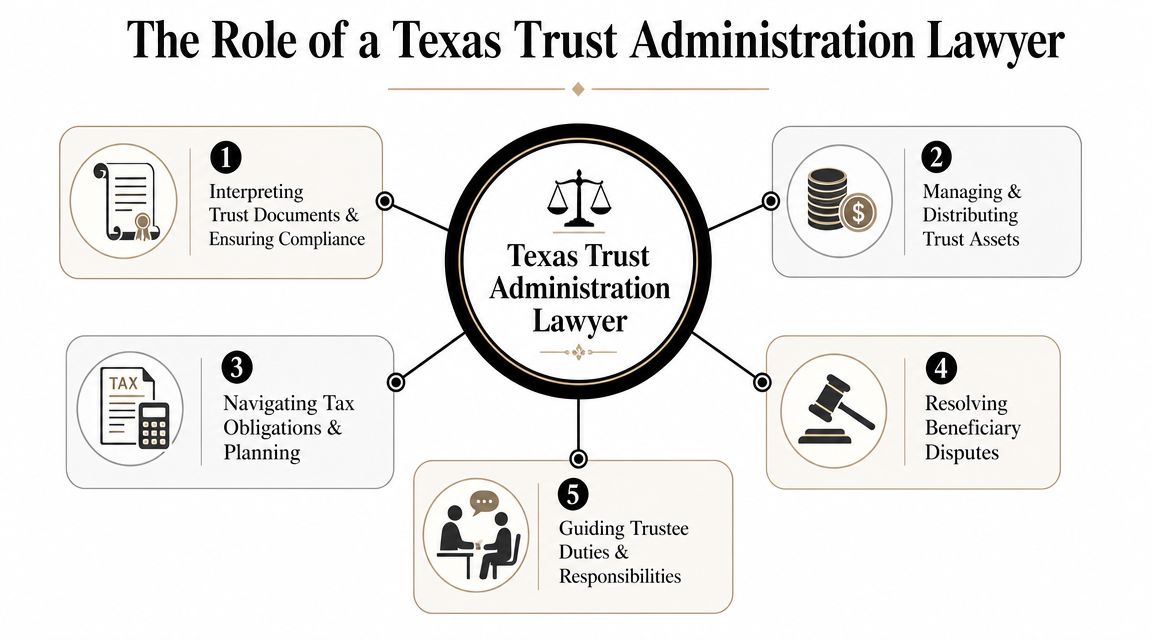
Texas trustees operate under detailed rules in the Texas Property Code. Those rules affect how a trustee handles notice, recordkeeping, investments, distributions, and communication with beneficiaries. A lawyer helps translate those rules into daily decisions, much like a set of operating instructions for assets, deadlines, and family expectations.
The lawyer also helps the trustee separate two questions that often get blurred together. What does the trust allow? And what does Texas law require? A trustee may feel pressure to act quickly, especially when beneficiaries want answers, but speed is only helpful if the process is correct.
What that help looks like in practice
A trust administration lawyer usually helps in several specific ways.
| Service area | What the attorney helps with |
|---|---|
| Document review | Reading the trust carefully, identifying mandatory duties, and explaining unclear provisions |
| Compliance | Notices, timelines, recordkeeping, and decisions that must match the trust terms and Texas law |
| Asset administration | Coordinating transfer of accounts, property interests, business holdings, and related paperwork |
| Communication | Helping the trustee respond appropriately to beneficiaries and reduce misunderstandings |
| Distribution and closing | Guiding final distributions, receipts, releases, and trust termination steps when appropriate |
That table may sound abstract, so it helps to translate it into ordinary situations.
If the trust owns rental property, the lawyer can help confirm who has authority to sign leases, approve repairs, and deal with insurance or tax questions. If the trust holds an LLC interest or shares in a closely held company, the lawyer can review governing documents, check transfer restrictions, and coordinate with business counsel or accountants. If beneficiaries are asking for information, the lawyer can help the trustee respond in a way that is accurate, timely, and less likely to create new conflict.
In other words, the lawyer helps build a reliable system. Records are organized. Notices go out properly. Decisions are tied back to the trust document and the trustee's duties. That kind of structure often saves money because it reduces rework, disputes, and avoidable mistakes.
Some trustees also need one professional to coordinate the moving parts. Accountants, financial advisors, property managers, title companies, and probate counsel may all be involved at once. A good attorney can serve as the legal hub so the trustee is not left stitching together advice from five different directions.
Why this role matters early
Early legal help often costs less than cleaning up a preventable problem later. A deed signed in the wrong capacity, a distribution made before the trustee confirms authority, or a poorly worded email to beneficiaries can create delays that are far more expensive to fix than to avoid.
That is why trustees often benefit from getting guidance at the front end, especially after recognizable trigger events such as a vacant property, a business interest that needs active oversight, or rising tension among family members. A lawyer helps the trustee create a defensible process before every decision starts feeling urgent.
If you want a clearer picture of the services involved, this overview of a Texas trust administration lawyer and trustee support explains the day-to-day legal work in more detail. This type of steady guidance is a core service for firms that handle these matters, such as the Law Office of Bryan Fagan, PLLC, which assists families with trust administration, estate planning, and related legal needs across Texas.
Navigating Complex Assets and Family Disputes
Some trusts become difficult not because the trustee is careless, but because the assets themselves create legal pressure.
Real estate is a strong example. A key trigger to hire a trust attorney in Texas is when the trust owns real estate. Trustees must often transfer or retitle property, and Texas title and recording issues can create delays or defects, sharply increasing the risk of liability and litigation if not handled by knowledgeable counsel, according to this discussion of Texas trust administration and real estate title issues.

When the trust owns a house or land
Suppose the trust owns a home in Houston, a ranch in Central Texas, or mineral interests in West Texas. A trustee may need to determine who has authority to sign, whether a deed should be prepared, how insurance should be handled, and whether debts tied to the property must be addressed before any transfer.
Trustees often make understandable mistakes. They may assume they can sign the same way the deceased settlor once signed, or they may rely on a title company to “figure it out.” But title companies don't represent the trustee. Their role is different.
A useful question to ask yourself: If I sign this deed, listing agreement, lease, or payoff document today, can I explain exactly why I had authority to do so?
If the answer is no, call counsel before signing.
Business assets and blended family pressure
Family businesses raise a different set of problems. Imagine the trust owns an interest in a closely held company. One beneficiary works in the business. Another doesn't. One wants immediate cash. The other wants to keep the company intact.
The trustee may need to review governing documents, valuation issues, management rights, and distribution limits before doing anything. A rushed decision can trigger claims of favoritism or breach of fiduciary duty.
Blended families can create similar tension. A surviving spouse may need income, while children from a prior marriage are focused on preserving principal. Neither side necessarily sees the full legal picture. The trustee is stuck in the middle.
Why legal counsel helps preserve both assets and relationships
In these settings, a lawyer often serves two roles at once. The lawyer gives the trustee legal direction, and the lawyer also helps create a communication structure that reduces suspicion.
That can include written explanations of process, carefully timed updates, review of proposed distributions, and guidance on when formal dispute resolution is needed. Good process won't eliminate every disagreement, but it often keeps a hard situation from becoming a lawsuit.
How to Choose the Right Trust Attorney in Texas
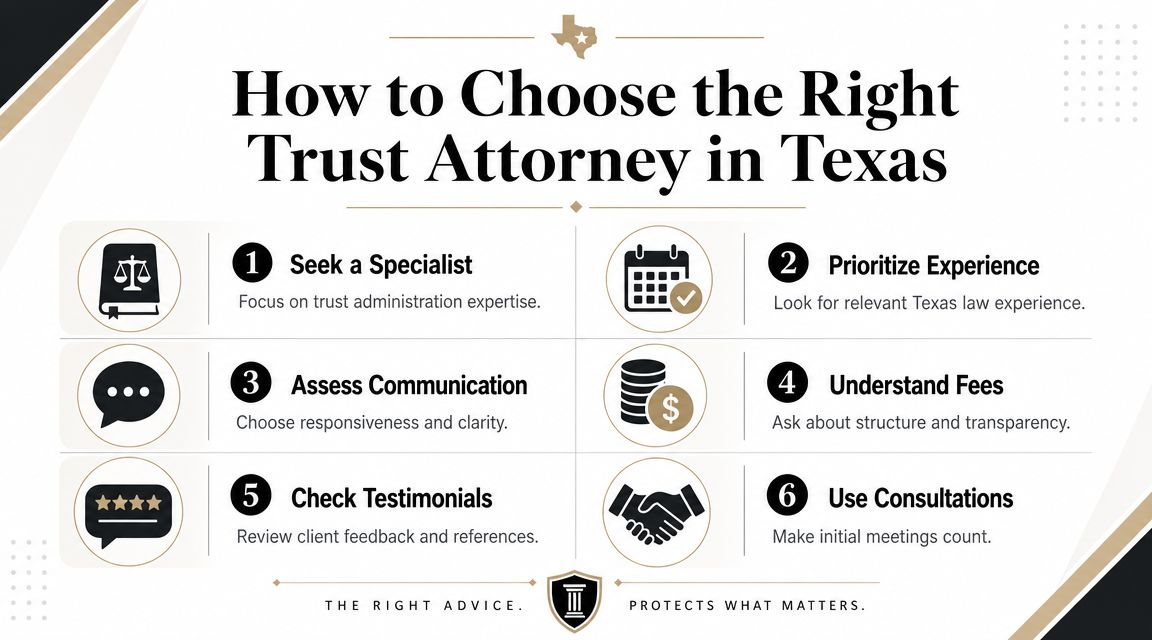
Hiring a lawyer should feel like gaining a steady guide, not adding more confusion. The best approach is to treat the consultation like an informed interview.
What to gather before the first meeting
Start with the documents that tell the story of the trust and the current problem.
Bring or organize:
The trust agreement and amendments
If you don't have every version, bring what you do have and explain what may be missing.Death certificate or incapacity-related paperwork
If the trustee transition happened because of death or incapacity, that context matters.Asset information
Recent statements, deeds, business records, insurance papers, and lists of known trust property are all useful.Communications from beneficiaries
Emails, letters, and text summaries can help an attorney spot conflict early.
You don't need a perfect binder. You do need enough information for the lawyer to understand what decisions are pending.
Questions worth asking the attorney
Not every estate planning attorney handles active trust administration in the same way. Ask focused questions.
How much of your practice involves trust administration under Texas law?
You want someone who regularly works with trustees, fiduciary duties in Texas, and post-death administration issues.How do you handle beneficiary communication issues?
This tells you whether the attorney thinks only in technical legal terms or also understands the human side of the job.What does your fee structure look like for this type of matter?
Ask whether work is billed hourly, what tasks are commonly included, and how staffing works.What should I do first, and what should I avoid doing right now?
The answer will tell you whether the lawyer can quickly identify practical priorities.
A strong fit should leave you feeling clearer, not more intimidated. The lawyer doesn't need to promise a perfect outcome. The lawyer should be able to explain the path forward in plain English.
For additional guidance, this article on how to choose an estate planning attorney is a good starting point.
Signs you've found the right fit
A helpful attorney usually does three things well. They explain the law clearly, they ask organized questions about the assets and family dynamics, and they tell you what steps can wait versus what needs attention now.
If you're looking for a Texas estate planning attorney or trying to compare lawyers for trust administration, pay attention to responsiveness and clarity. In this area of law, communication style matters almost as much as technical knowledge.
Frequently Asked Questions About Texas Trust Administration
Can a trustee use trust funds to pay an attorney
Often, yes, but it depends on the trust terms, the nature of the legal work, and whether the expense is properly tied to trust administration. A trustee should be careful to keep clear records showing why the legal fees were incurred and how they benefited the trust or helped fulfill fiduciary duties in Texas.
What if beneficiaries disagree with my decisions
Disagreement doesn't automatically mean you've done anything wrong. It does mean you should slow down, document your reasoning, preserve records, and get legal advice before taking another contested step. If the conflict centers on distributions, accountings, or access to information, counsel can help you respond in a way that is consistent and defensible.
Beneficiary frustration often grows when the trustee is silent, inconsistent, or informal. A clear process usually helps more than a quick explanation.
As a beneficiary, when should I talk to my own lawyer
A beneficiary should consider independent legal advice when the trustee refuses to provide basic information, delays administration without explanation, appears to favor one beneficiary over another, or handles trust property in a way that seems careless. A beneficiary lawyer can help evaluate rights to information, accounting requests, and possible remedies without escalating unnecessarily.
Can a trust be changed after it becomes active
Sometimes, but the answer depends on the trust language, the circumstances, and Texas law. Some changes may require agreement among interested parties, while others may require court involvement. If you're asking how to modify a trust in Texas, that's a sign the matter deserves legal review before anyone assumes a change is allowed.
Do I need both a probate lawyer and a trust lawyer
Sometimes you do. If some assets were not placed into the trust before death, probate issues may still exist alongside trust administration. Families are often surprised to learn that a trust does not automatically remove every court-related issue after a loved one dies.
If you're managing a trust or planning your estate, contact Law Office of Bryan Fagan, PLLC for a free consultation. Our attorneys provide trusted, Texas-based guidance for every step of the process, including trust administration, probate, estate planning, guardianship, and asset protection. Whether you're a trustee who needs direction or a beneficiary who needs clarity, you don't have to sort through Texas trust law alone.