You may be reading this because you've put it off for months, or years. Maybe you have children at home, aging parents, a family business, a second marriage, or a house that took decades to pay for. You know you need a plan, but every article seems to assume you already speak fluent legalese.
You don't need to.
A family trust is a legal arrangement that lets you set rules for how property is managed and passed to the people or causes you care about. In Texas, that can be a powerful part of an estate plan when it's drafted carefully, signed correctly, and funded so it controls the assets you intend it to control.
A lot of families think the hard part is signing the paperwork. Often, the actual work starts right after that. That's where confusion creeps in, especially for people trying to learn how to create a family trust without clear guidance. The good news is that the process is manageable when you break it into decisions, documents, and asset transfers.
Planning Your Legacy A Guide for Texas Families
Estate planning can feel heavy because it asks you to think about loss, conflict, and uncertainty. Most Texas families aren't trying to do anything fancy. They want to make life easier for the people they love. They want bills paid, property protected, and clear instructions in place if illness, incapacity, or death happens unexpectedly.
That's why a family trust helps many households. It creates a structure for managing property during life, after death, or both, depending on how the trust is designed. It can also give families a private framework for decision-making instead of leaving everything to a public court process.
For many people, one of the biggest emotional hurdles is wondering whether trust planning is too complicated or too expensive to be practical. In reality, families often use attorneys because trust planning involves both legal drafting and long-term administration. Kubera notes that professional trust creation typically costs between $1,000 and $3,500 depending on complexity, and professional trustees often spend 15 to 20 hours per month managing a typical family trust, which reflects the ongoing work involved after creation, including administration and recordkeeping (Kubera on setting up a family trust).
What a family trust really does
A trust answers a few basic questions:
- Who is in charge if you can't manage things yourself
- Who benefits from the property
- What rules apply to distributions and use of funds
- When transfers happen and under what conditions
That can mean very practical instructions. A parent may want money held for a child's education. A married couple may want a surviving spouse supported first, with the rest later passing to children. A grandparent may want to leave funds in a controlled way instead of handing over a lump sum.
A trust works best when it reflects family realities, not just legal theory.
Many families also want their planning to preserve stories and values, not just assets. If that matters to you, a thoughtful guide to creating a family legacy can complement the legal side of planning by helping you organize family history, relationships, and personal context that legal documents alone can't fully capture.
Why Texas families often choose a trust
Texas law gives families several estate-planning tools, and a trust is only one of them. But when people want continuity, clarity, and a structured way to manage assets, a trust often becomes central to the plan.
If you're still getting familiar with the concept, this plain-English explanation of what a family trust is can help connect the big picture before you dive into the legal details.
Under the Texas Trust Code and Texas Estates Code, the legal framework matters. So do fiduciary principles. A trustee isn't free to do whatever feels fair in the moment. The trustee must follow the trust's terms and act in line with legal duties owed to beneficiaries. That's one reason trust planning should feel deliberate, not rushed.
Laying the Foundation for Your Texas Family Trust
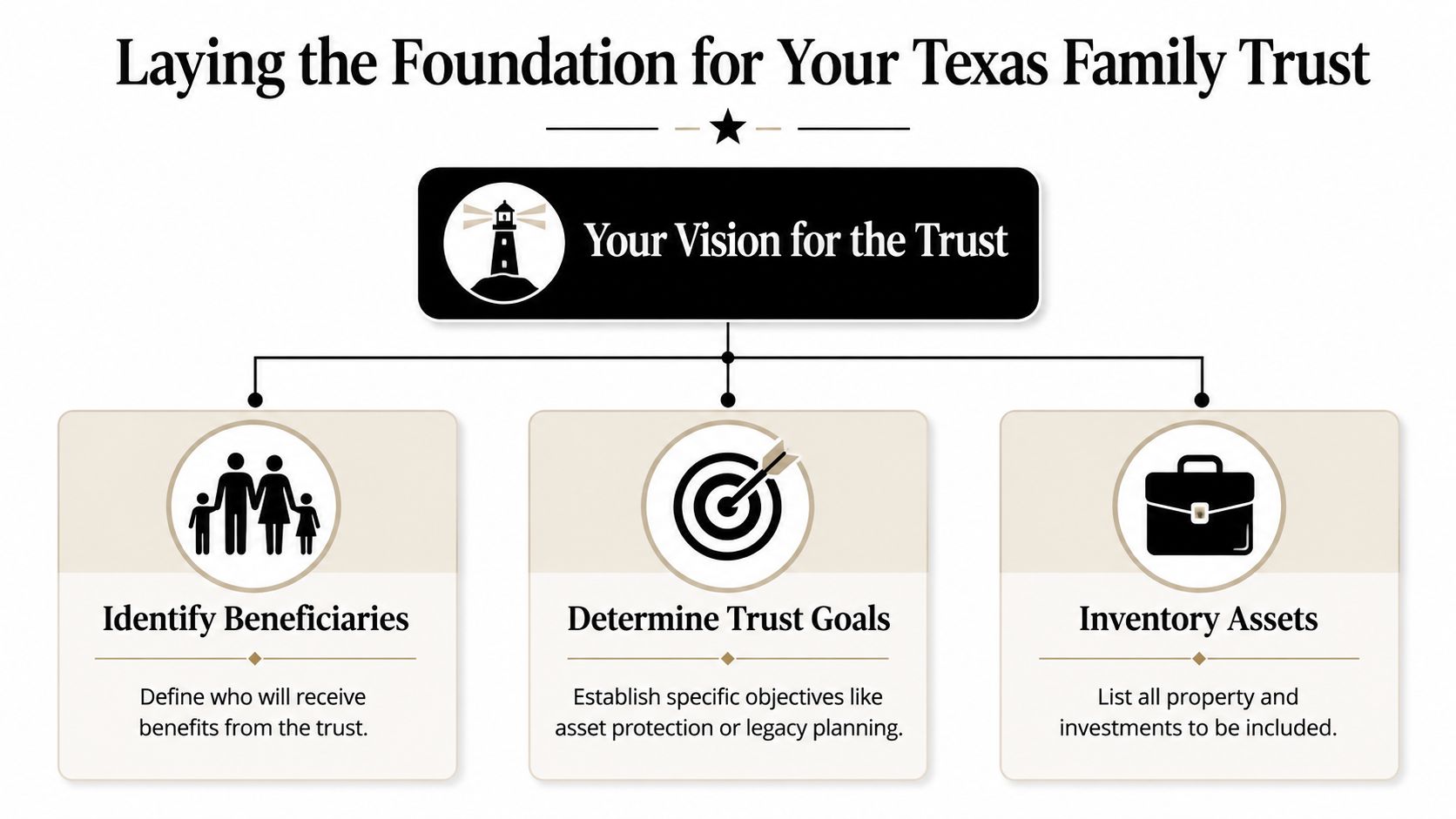
Before anyone drafts a trust agreement, the family has to decide what the trust is supposed to accomplish. That sounds obvious, but it's where many plans go off track. People start by asking what form they need, when they should first ask what problem they're trying to solve.
For one family, the issue may be caring for minor children. For another, it may be protecting a surviving spouse while preserving assets for children from a prior marriage. A business owner may care most about continuity and control. A parent of an adult child who struggles with spending may want guardrails instead of outright distributions.
Start with the purpose, not the paperwork
A useful way to think about a trust is to picture it as a set of instructions attached to a container. The instructions matter. The people matter. The property matters. If any one of those is unclear, the trust becomes harder to administer.
Families usually begin with questions like these:
Protection goals
Do you want to reduce the chance of probate, create continuity during incapacity, or provide oversight for inherited assets?Beneficiary needs
Are your beneficiaries young, financially inexperienced, in a blended family, or likely to need staggered distributions?Asset mix
Do you own a home, brokerage accounts, business interests, or property that may require extra transfer steps?
U.S. Bank notes that a trust can be created to benefit any number of beneficiaries, including children, a spouse, a foundation, or a charity, which makes beneficiary design one of the earliest structural choices in the process (U.S. Bank on setting up a trust).
The three roles every family should understand
Every trust has human roles behind the legal language. In plain English:
| Role | What this person does |
|---|---|
| Grantor | Creates the trust and decides its terms |
| Trustee | Manages the trust property and follows the rules |
| Beneficiary | Receives benefits from the trust |
A simple example helps. Suppose grandparents want to leave money for a granddaughter's education. The grandparents are the grantors. They appoint a trustee to manage the money. The granddaughter is the beneficiary. The trust might allow tuition payments directly to a school, but delay broader access until she reaches an age or milestone the grantors choose.
That structure is why planning comes before drafting. You're not filling in blanks. You're building a governance system for family property.
Why this stage matters under Texas law
Texas trust planning isn't just about who gets what. It's also about whether the trust can function smoothly when real life intervenes. Illness, remarriage, disability, conflict among siblings, and changing financial circumstances all put pressure on vague documents.
That's why many trustees and families benefit from learning what administration involves. Texas Trust Administration: A Trustee's Guide gives a general overview of trust administration and how it differs from probate, which is often helpful when a family is deciding whether a trust fits their planning goals.
Practical rule: If you can't explain the trust's purpose in two or three clear sentences, it probably isn't ready to be drafted.
The Texas Trust Code supplies the legal framework for creation, administration, and fiduciary conduct. The Texas Estates Code often intersects with trust planning when probate, incapacity planning, and related estate issues arise. Families don't need to memorize either code. They do need a plan that respects both.
Drafting the Trust Agreement Under Texas Law
Once the goals are clear, the legal drafting begins, translating broad intentions into enforceable instructions. A strong trust agreement doesn't just name people and list wishes. It translates family decisions into language that can hold up when the trustee, beneficiaries, banks, title companies, and courts all need to understand what the document means.
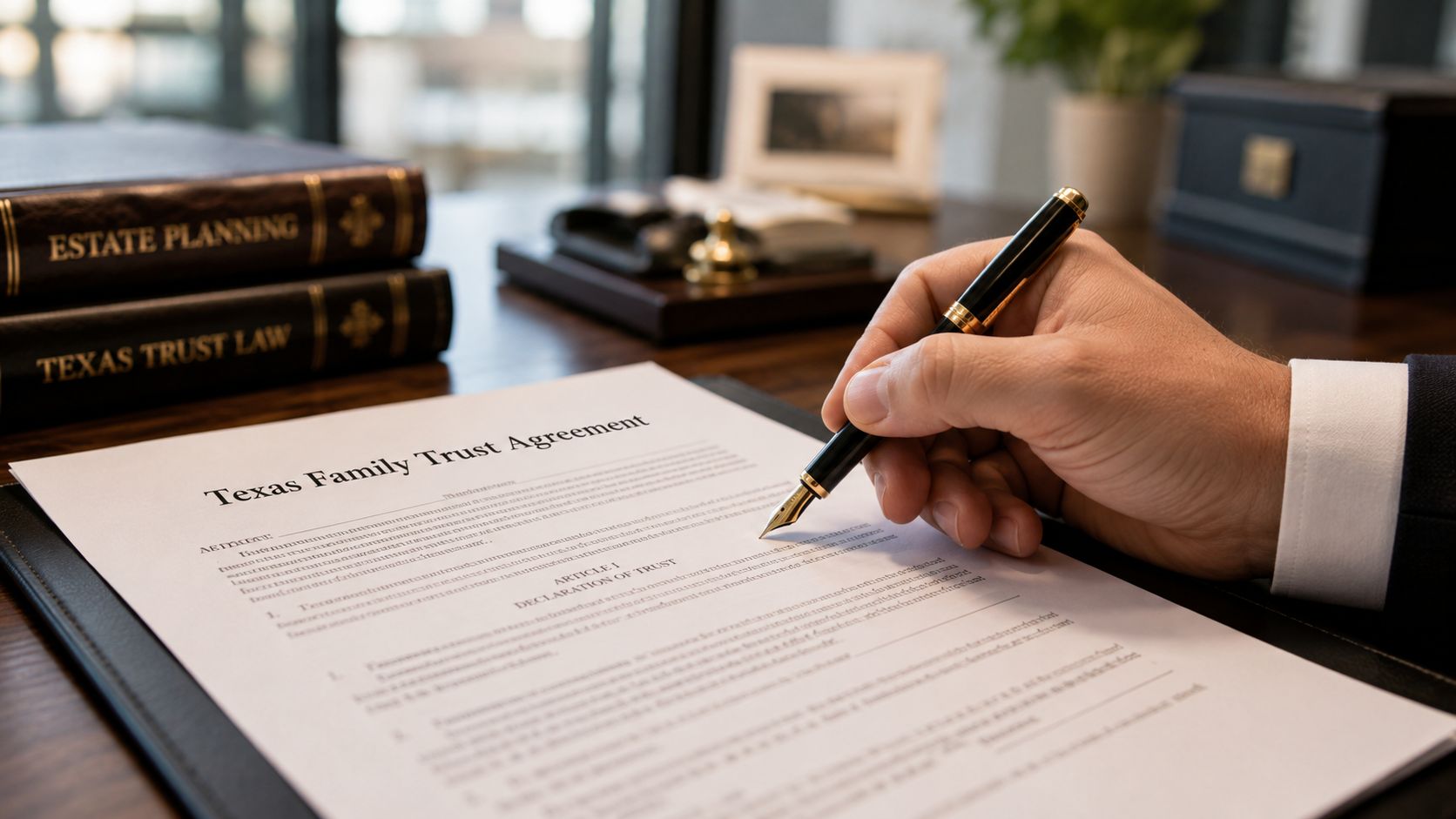
LegalShield describes a sound family trust setup as a six-step workflow: define the trust type, select a trustee, identify beneficiaries and rules, draft a state-compliant agreement, execute it with proper legal formalities, and then fund it by retitling assets (LegalShield on family trust setup).
What goes into the trust agreement
A Texas trust agreement usually needs to address several core subjects in clear language:
Identity of the parties
The document should clearly identify the grantor, trustee, successor trustee, and beneficiaries.Trust property
The agreement should describe the property intended for the trust, even though the separate transfer work often happens afterward.Distribution standards
The document should explain when and how the trustee may distribute money or property.Trustee powers and limits
The trustee needs authority to manage assets, but the document should also set guardrails consistent with fiduciary duties in Texas.Successor management
If the original trustee resigns, becomes incapacitated, or dies, the document should explain who steps in next.
Revocable and irrevocable trusts
One of the first drafting choices is whether the trust will be revocable or irrevocable.
A revocable trust usually gives the person creating it more flexibility during life. An irrevocable trust generally involves giving up more control in exchange for different planning benefits, depending on the family's goals. Which one fits depends on the facts, not on a one-size-fits-all rule.
For many Texas families, the right question isn't “Which trust is better?” It's “What level of control, flexibility, and structure do we need?”
Texas execution formalities matter
The trust's language can be excellent and still create problems if the signing process is sloppy. Texas law governs how trusts are created and interpreted, and execution details matter. In practice, families should treat signing as a legal event, not an informal paperwork session at the kitchen table.
That means paying attention to:
- State-compliant drafting so the terms fit Texas law
- Proper signatures from the required parties
- Notarization or other formalities when needed for related transfer documents
- Consistency across documents so the trust, deed work, beneficiary forms, and estate plan don't conflict
When families fight over trusts, the dispute often starts with ambiguity. Good drafting reduces the room for later conflict.
The Texas Trust Code provides the core legal framework for trust formation and administration. The Texas Estates Code often affects surrounding estate documents, probate strategy, and incapacity planning. A Texas estate planning attorney helps make sure these pieces fit together rather than pulling in different directions.
A plain-language example
Suppose a couple wants their home, investment account, and a portion of business interests managed for the surviving spouse, then divided among children later. A bare-bones document might say the spouse receives support and the children inherit the rest. A well-drafted Texas trust would go further.
It would define who serves as trustee if the spouse can't. It would explain whether the spouse can access principal or only income. It would address what happens if one child dies first, becomes disabled, or has creditor issues. It would coordinate with related estate documents so the plan works as a whole.
That level of detail doesn't make the plan harsh. It makes it usable.
Choosing the Right People for the Right Roles
Families often spend more time debating who should receive property than who should manage it. That's backwards. The trustee is the person who carries the trust from paper into daily reality. In many trust disputes, the trouble isn't the concept of the trust. It's the person chosen to run it.
A trustee has real legal responsibilities under fiduciary principles. In Texas, that means the trustee must act with loyalty, prudence, and care, follow the trust terms, keep proper records, and treat beneficiaries according to the law and the document. This is why “fiduciary duties in Texas” isn't just a phrase for lawyers. It's the standard that protects families from careless or self-interested management.
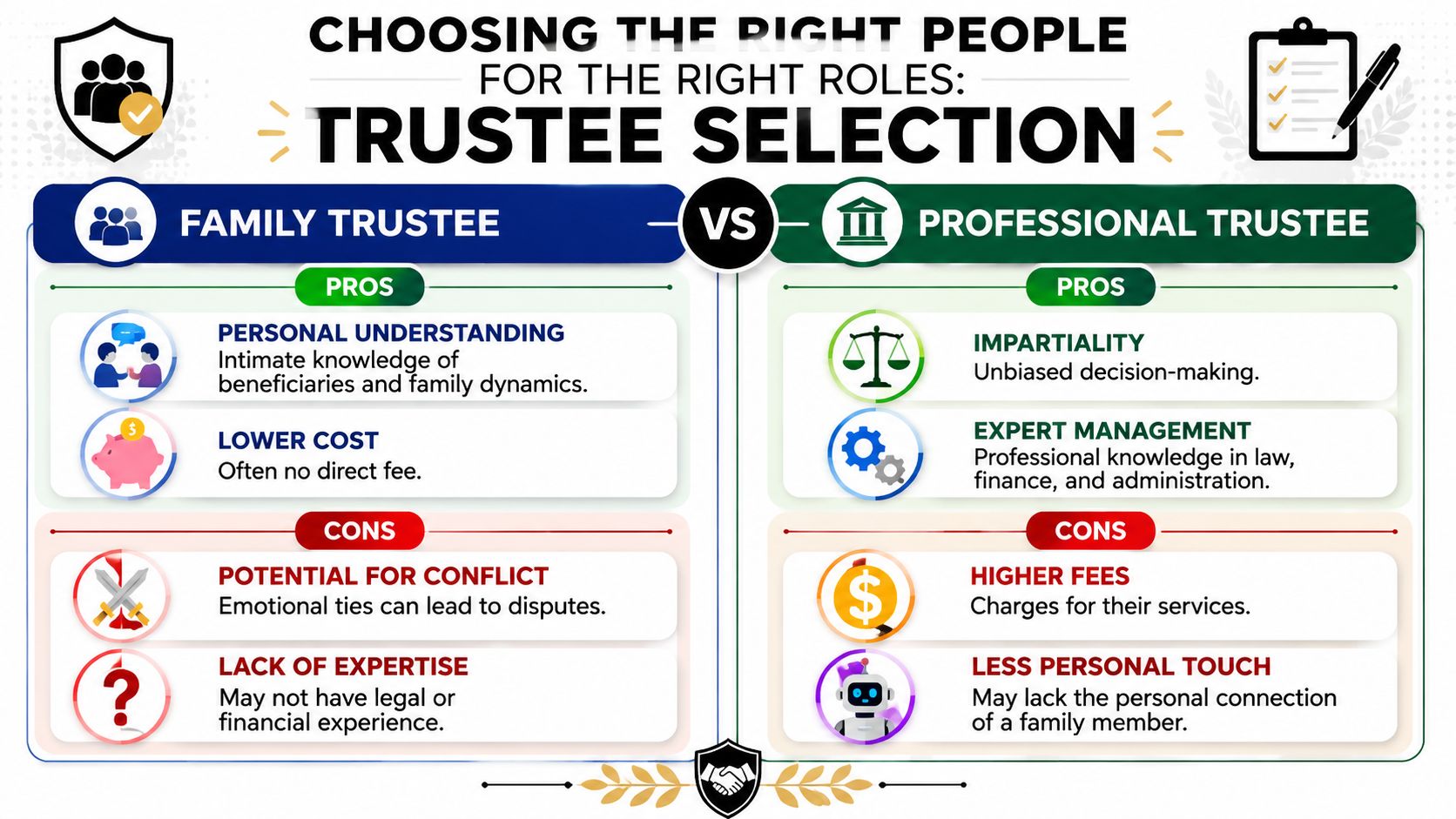
Family trustee or professional trustee
Many people instinctively choose an adult child, sibling, or close friend. Sometimes that works well. Sometimes it creates friction that lasts for years.
Here's the practical comparison:
| Option | Often works well when | Risks to think through |
|---|---|---|
| Family trustee | The person is organized, fair, and respected by the family | Personal history can complicate neutral decision-making |
| Professional trustee | The trust is complex or family conflict is likely | The relationship may feel less personal |
A family trustee may understand the beneficiaries well. A professional trustee may bring more distance and administrative experience. Neither option is automatically right. The better choice is the person or institution that can effectively perform the job.
What trustees owe beneficiaries in Texas
Trustees don't just hold title. They manage obligations. Under the Texas Trust Code and broader fiduciary principles, a trustee should approach the role as a position of duty, not privilege.
A trustee generally needs to:
- Follow the written terms of the trust rather than personal preference
- Protect trust property and avoid careless handling of assets
- Keep records so transactions and decisions can be explained
- Communicate appropriately with beneficiaries
- Seek legal or tax guidance when an issue goes beyond ordinary judgment
If you're evaluating whether someone is ready for that role, this overview of what a trustee does in Texas is a useful starting point.
Communication is part of the plan
A trust doesn't operate in a vacuum. It lives inside a family system. Wells Fargo Advisors notes that frank family conversations about a trust can be as important as the trust terms themselves, and that discussing inheritance early can help educate heirs about responsible money management, especially in families facing blended-family issues or longer lifespans (Wells Fargo Advisors on trust conversations and heirs).
That's an important point. Silence can reduce conflict sometimes, but secrecy can also create suspicion. If beneficiaries have no idea why a trustee has discretion, or why distributions are structured a certain way, they may assume unfairness when the trustee is following instructions.
A trustee who communicates clearly is often less likely to face avoidable disputes.
A thoughtful trustee also protects themselves by documenting decisions, staying within the trust's authority, and asking for professional guidance when needed. That's especially important when the trust holds real estate, business interests, or assets that trigger tax or valuation questions.
The Critical Step of Funding Your Family Trust
This is the part families skip most often. It's also the part that decides whether the trust will work.
A signed trust document is not the finish line. It is the instruction manual. The assets still have to be moved into the trust, or otherwise coordinated with it, before the trust can control them. Arden Trust explains that the most common beginner mistake is treating the trust as complete once it is signed. The trust must be funded by retitling assets, because the document alone does not move them, and assets left outside the trust may still end up in probate (Arden Trust on common family trust mistakes).
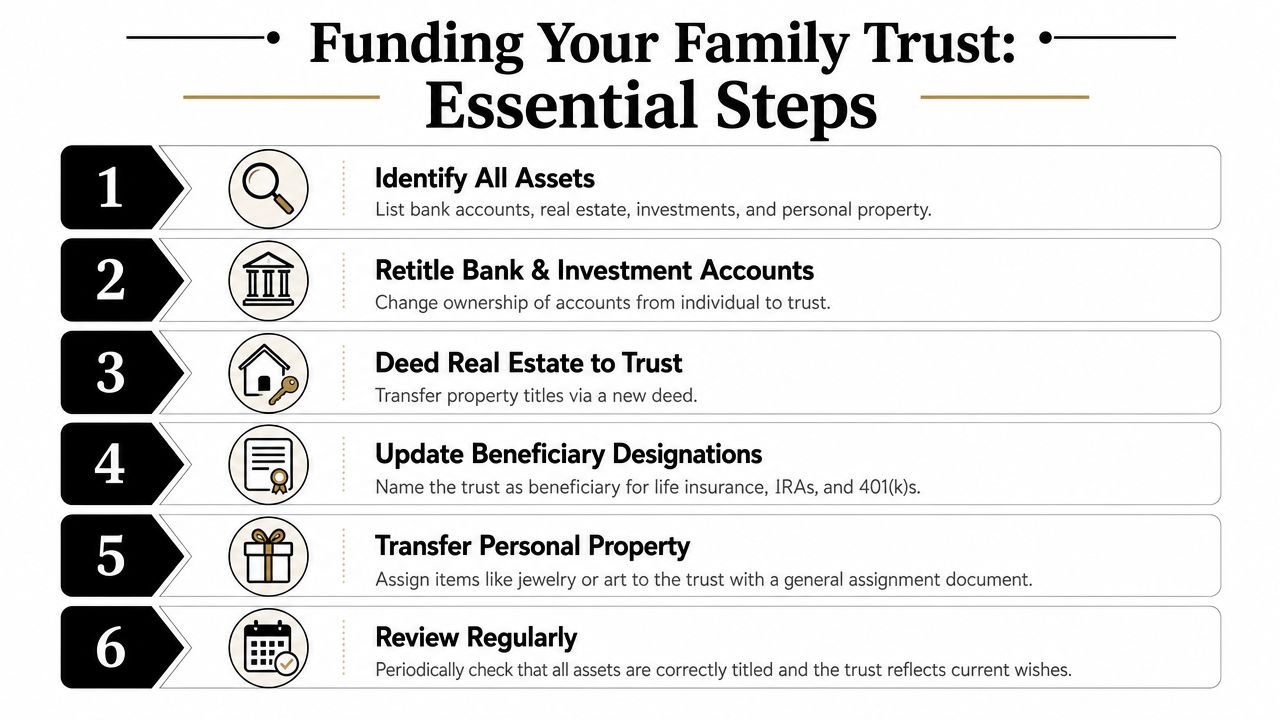
What funding means in real life
Funding means changing ownership or title so the trust, not you individually, holds the asset when appropriate. U.S. Bank puts it plainly in its trust guidance: a trust controls only the assets that are transferred into it. That principle is why a trust can look perfect on paper and still fail in practice if the titles and registrations never change.
The highest-risk point in the process is often this one. If deeds, account titles, or related designations aren't updated, the trust may not control the property at death or incapacity. In Texas, that can force a family back into court when they thought they had planned to avoid that result.
Asset-by-asset funding checklist
Different assets require different steps. There isn't one master form that moves everything.
Real estate
A deed usually must be prepared and recorded so title reflects the trust where appropriate. Texas real property transfers need careful handling because recording, legal description errors, lender issues, and title chain problems can all create headaches later.Bank and investment accounts
The account ownership often needs to be changed with the institution. Each bank or brokerage has its own paperwork, and families are often surprised by how much follow-up this takes.Business interests
Membership interests, shares, or partnership interests may need assignments and review of governing documents. Business succession planning often requires coordination beyond the trust itself.Personal property
Tangible items may be assigned through transfer documents if the trust is meant to hold them.Beneficiary-driven assets
Some assets require extra planning rather than immediate transfer. The key is coordinated review, not assumption.
For a practical overview of deed and transfer issues, this guide on how to transfer property to a trust is a helpful companion.
A short explainer can also help make the process feel less abstract:
Why DIY plans often break here
Most do-it-yourself trust failures don't happen because someone forgot to name beneficiaries. They happen because the family assumed signing the trust changed ownership automatically.
It usually doesn't.
A common Texas example is a couple who signs a trust and believes their home is covered, but the deed is never changed. Another is a parent who intends an account to flow through the trust but never completes the bank's retitling process. When death or incapacity happens, the successor trustee discovers the trust exists, but the asset doesn't belong to it.
If the trust isn't connected to the asset, the trustee may have no authority over that asset.
A better way to approach funding
The safest approach is to create an asset-by-asset checklist and work through it methodically with legal and financial guidance as needed.
Use questions like these:
What do we own right now
List real estate, accounts, business interests, and valuable personal property.How is each asset titled today
Don't rely on memory. Pull statements, deeds, and ownership documents.Should this asset be transferred now
Some assets can be retitled promptly. Others need extra analysis.What institution-specific forms apply
Banks, brokers, and transfer agents often require their own internal paperwork.How will we confirm completion
Keep copies of recorded deeds, updated statements, and acceptance forms.
A Texas trust administration lawyer or Texas estate planning attorney adds practical value. The legal document may be complete, but the trust is only effective in practice when the funding work is done correctly.
Life After Creation Trust Administration and Maintenance
Families often feel a wave of relief after the trust is signed and funded. That relief is well-earned, but a trust still needs attention over time. It isn't a document you create, drop in a binder, and forget. It's an ongoing legal relationship governed by the trust terms, the Texas Trust Code, fiduciary duties, and changing family circumstances.
That ongoing work is called trust administration. It includes asset management, recordkeeping, communication, tax coordination, and distribution decisions when the trust calls for them. In some families, administration remains simple for years. In others, it becomes more active after incapacity, death, or a major life event.
What administration looks like after setup
A trustee's daily job depends on the trust assets and the trust terms, but common tasks include:
Managing accounts and property
The trustee may need to maintain real estate, oversee investments, safeguard records, or deal with appraisals and insurance issues.Making distributions
The trustee must follow the document's rules and apply discretion carefully if the trust gives discretionary authority.Communicating with beneficiaries
Good administration usually includes timely, respectful communication so beneficiaries understand what is happening and why.Working with professionals
Accountants, financial advisors, appraisers, and attorneys often help trustees carry out duties correctly.
If you're trying to understand the timing side of this process, First Steps for a Successor Trustee in Texas offers a factual overview of what someone may need to do after stepping into the role.
When to review or modify a trust in Texas
Life changes. A trust should keep pace.
Families often review a trust after:
- Marriage or divorce
- Birth or adoption of a child
- Death of a trustee or beneficiary
- A major change in finances
- A move, sale of property, or business transition
- Shifts in family dynamics or care needs
For a revocable trust, amendment may be possible during the grantor's lifetime if the person has the legal capacity and the trust terms allow it. For other trust structures, modification may require more analysis under Texas law. As a result, the phrase how to modify a trust in Texas progresses beyond a mere internet search term. It transforms into a real legal question that depends on the trust's wording, the type of trust, and the interests of the people involved.
Texas trust administration lawyers look at both the Texas Trust Code and the Texas Estates Code when advising on changes, disputes, and administration strategy. Beneficiaries also need to understand that not every desired change is legally available just because the family agrees informally.
Review your trust after major life events, not just when a crisis forces the issue.
Keep the plan human
A trust should reduce chaos, not create distance. Families do best when the legal structure and the human conversations support each other. That means telling the right people where documents are kept, making sure trustees know they've been chosen, and giving beneficiaries enough context to understand the purpose of the plan.
It also means asking for help before a small issue becomes a dispute. Questions about fiduciary duties in Texas, trustee accounting, beneficiary rights, probate overlap, guardianship concerns, or asset protection should be addressed early. That's especially true when a trust intersects with complex family or medical realities.
If you're managing a trust or planning your estate, contact Law Office of Bryan Fagan, PLLC for a free consultation. Our attorneys provide trusted, Texas-based guidance for every step of the process, including estate planning, probate, guardianship, asset protection, trust creation, administration, and dispute resolution.