Managing a loved one's trust can feel overwhelming, especially when the current trustee isn't the right fit anymore. Many families assume they have to file a lawsuit or go to court to make a change. In Texas, that isn't always true.
A lot depends on the trust document itself. If the trust already includes a way to remove one trustee and appoint another, the change may be handled privately through careful paperwork instead of a judge's order. That's why the changing trustees without court Texas process is often less about courtroom procedure and more about reading the document closely, following the right formalities, and avoiding preventable mistakes.
Families also get tripped up because “changing a trustee” can mean different things. Sometimes it's a simple successor taking over after a resignation. Other times it involves a grantor amending a revocable trust, or beneficiaries trying to work together on an irrevocable trust. And if the trust owns land or mineral interests, the process often extends beyond the trust file and into county records.
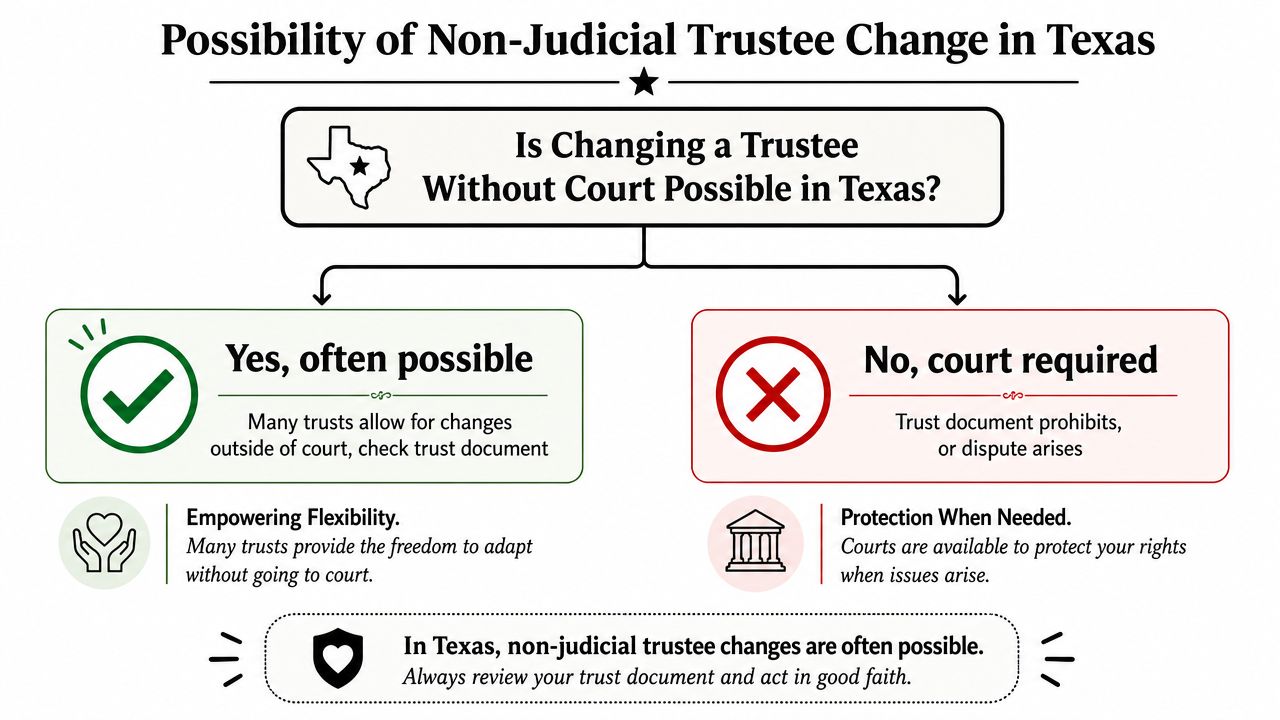
Is Changing a Trustee Without Court Possible in Texas
In many cases, yes.
Texas law separates court-based trustee removal from a nonjudicial trustee change. Under Texas Property Code § 113.082, a court may remove a trustee for certain reasons, but if the trust document itself provides a method for removal and replacement, that method can be followed without court intervention. The key point is simple: the governing instrument controls first, as discussed in this Texas trustee removal and replacement overview.
That means your first job isn't to draft a complaint or threaten litigation. It's to pull the trust agreement and read the trustee provisions line by line.
What to look for in the trust document
Start with the parts of the trust that address trustees directly. Different trusts label these sections differently, so the language may appear under “Trustee,” “Successor Trustee,” “Removal,” “Resignation,” or “Administration.”
Look for questions like these:
- Who has removal power: Does the trust let the settlor, a co-trustee, a trust protector, or beneficiaries remove the trustee?
- Who appoints the replacement: Does the same person name the successor, or does the trust already name one?
- What formalities apply: Does the trust require written notice, notarization, or acceptance by the incoming trustee?
- Are there limits: Does the trust block certain changes after the settlor dies or after the trust becomes irrevocable?
Practical rule: If the trust gives a clear method for changing the trustee, follow that method exactly. If the trust is silent, contradictory, or restrictive, the non-court path gets much harder.
A common example helps. A mother creates a revocable living trust and names herself as trustee, with her brother as successor trustee. Later, while she still has capacity, she decides her daughter would be a better choice. If the trust allows amendment, she may be able to update that trustee provision privately rather than asking a court to intervene.
If you're trying to understand how amendments are usually completed, this guide on how to complete an amendment to a trust in Texas gives a useful document-level overview.
When court is still part of the picture
Not every trustee change can stay private. If the trustee refuses to cooperate, if the trust doesn't authorize the change, or if there are allegations of misconduct, incapacity, insolvency, or failure to account, the dispute may shift into a court-supervised removal process.
That distinction matters because families often use the phrase “remove the trustee” when they really mean “replace the trustee under the trust's own terms.” Those are not always the same thing. One is administrative. The other can become litigation.
A good starting mindset is this: read first, act second. The trust usually tells you whether a nonjudicial change is available, who can do it, and what the paperwork should look like.
Three Pathways for a Non-Judicial Trustee Change
Once the trust allows a private change, there are usually three paths families consider. Which one works depends on whether the trust is revocable or irrevocable, who still has authority, and whether everyone agrees.
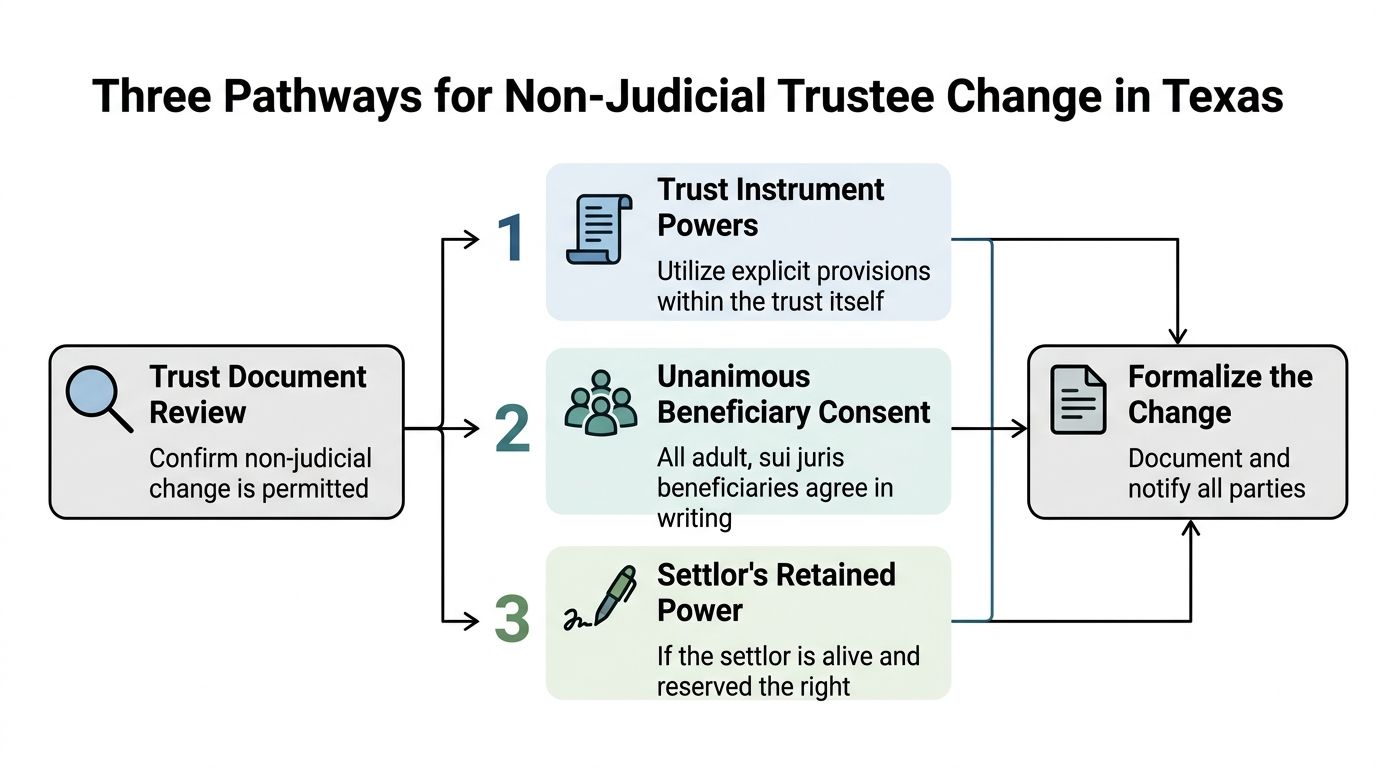
Texas practice recognizes that a trustee can often be changed without court if the trust document provides a mechanism, the grantor of a revocable trust amends it, or all beneficiaries agree through a Non-Judicial Settlement Agreement, so long as the change doesn't impair a material purpose of the trust. Once a trust becomes irrevocable, beneficiary rights increase and formal consent matters more, as explained in this discussion of important steps involved in changing a trustee in Texas.
Path one through the trust's own removal and appointment language
Some trusts make this straightforward. They say who may remove the trustee, how notice must be given, and who names the replacement.
This is often the cleanest route when the trust already names a successor or gives a specific person the power to make the switch. In those cases, the family isn't changing the trust's terms. They're carrying out the terms already written.
For example, a trust may say that after the settlor's death, a majority of adult beneficiaries may remove the acting trustee and appoint a successor by signed written notice. If that language exists, the work becomes procedural rather than argumentative.
Path two through amendment of a revocable trust
If the trust is revocable and the settlor still has capacity, amendment is often the most direct solution. The settlor can update the trustee provisions as long as the amendment follows the trust's required formalities.
This approach is common when no one has done anything wrong. The current trustee may still be trustworthy, but the settlor wants someone else with better availability, financial skills, or family proximity.
Here's a short comparison:
| Path | Best fit | Main requirement |
|---|---|---|
| Trust instrument power | Trust already gives removal authority | Follow the exact written method |
| Revocable trust amendment | Settlor is alive and has capacity | Amendment must match trust formalities |
| NJSA | Irrevocable trust and full beneficiary agreement | All beneficiaries consent and no material purpose is impaired |
Families weighing broader trust changes sometimes also look at decanting a trust in Texas explained, although decanting is a different tool from replacing a trustee.
After one substantive review of the options, some people find a visual walkthrough helpful:
Path three through a Non-Judicial Settlement Agreement
An NJSA is the most collaborative route. It can work when the trust is irrevocable, the issue is administrative, and all beneficiaries consent. The agreement can't impair a material purpose of the trust, which is where legal judgment becomes important.
This is also where families need a clear view of Beneficiary Rights in a Texas Trust, especially the rights beneficiaries have to information and proper administration. Those rights often affect how discussions unfold, what must be disclosed, and whether an agreement is likely to hold.
A workable NJSA usually depends less on legal theory and more on whether everyone understands the same facts and trusts the paperwork.
The biggest source of confusion is assuming unanimous agreement means casual agreement. It doesn't. The consent needs to be formal, informed, and tied to terms the trust and Texas law will support.
Executing the Change Paperwork and Protocol
A non-court trustee change succeeds or fails on documentation. Families often focus on the decision to replace the trustee, but the legal risk usually shows up later, when a bank, title company, brokerage, or beneficiary asks, “Where is the paper proving this person has authority?”
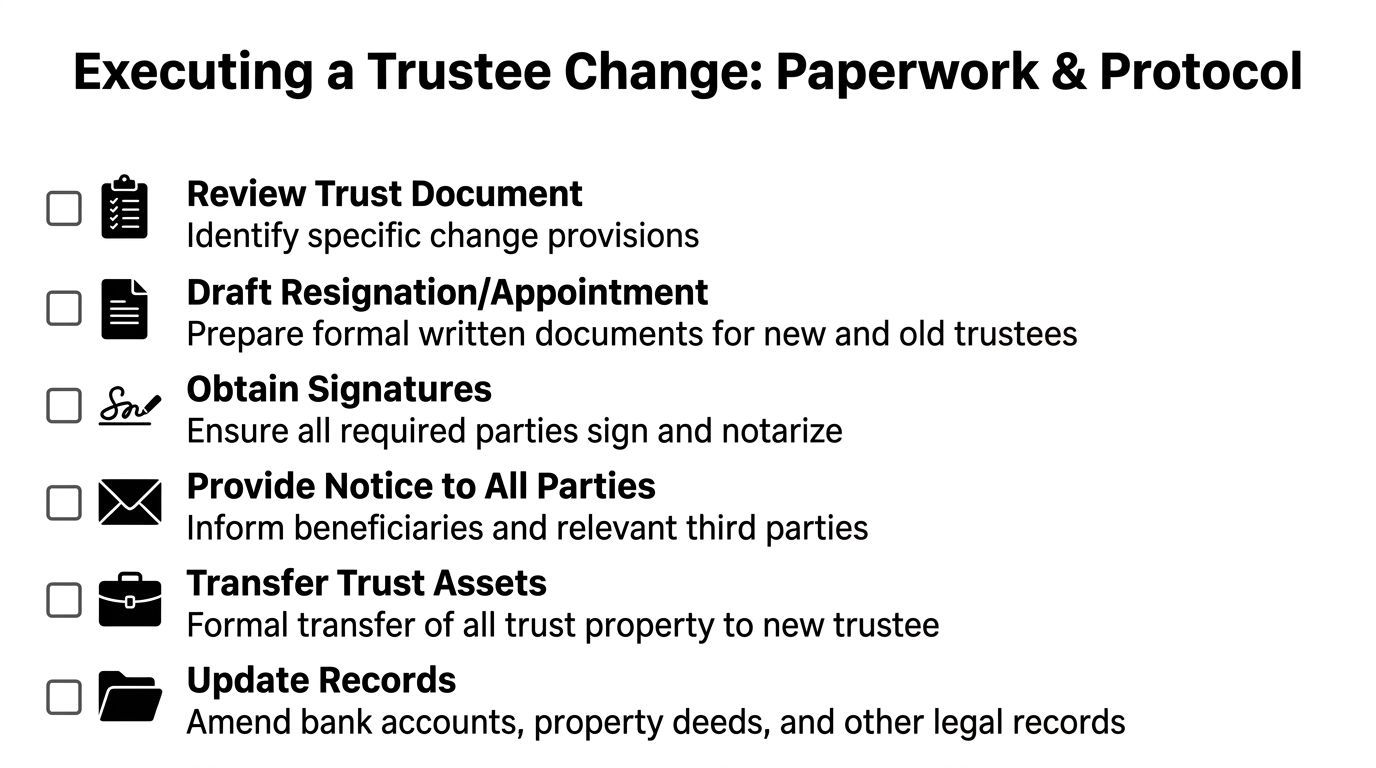
For a non-court trustee change to be effective, the documents must identify the trust, specify the change, and be executed with the same formalities as the original instrument. For a successor-trustee transition, written resignation and acceptance, followed by notice to third parties, helps establish clear authority over trust assets and reduces later disputes, as noted in this discussion of amending a trust and documenting trustee changes.
The core documents most families need
The exact packet depends on the trust, but many nonjudicial trustee changes include some version of the following:
- Written amendment or removal document if the trust is being amended or if someone is exercising a written removal power.
- Resignation of Trustee signed by the outgoing trustee, when the change is voluntary.
- Acceptance of Appointment signed by the incoming trustee.
- Certification or summary of trust authority for banks and other institutions, if needed.
- Notice letters to beneficiaries, custodians, advisors, and recordholders.
The language needs to be precise. The paperwork should identify the trust by its exact name and date, describe the old and new trustee language clearly, and preserve the rest of the trust through a reaffirmation clause if only one provision is changing.
A practical checklist for the transition
A smooth handoff usually follows an orderly sequence.
- Confirm the legal authority: Match the planned change to the trust language. Don't rely on assumptions or family consensus alone.
- Use matching formalities: If the trust required signing and notarization, use those same formalities for the change documents.
- Set an effective date: Make it obvious when the old trustee's authority ends and the new trustee's authority begins.
- Collect governing records: Gather the trust agreement, amendments, prior resignations, tax identification details, and asset lists in one file.
- Notify institutions carefully: Banks, investment firms, and insurance carriers often have their own forms in addition to your trust documents.
- Document asset transfer control: The incoming trustee should have practical access to accounts, records, passwords, statements, and contact information.
If the incoming trustee can't prove authority to a third party, the change may be valid on paper but ineffective in practice.
Where people make avoidable mistakes
Most errors aren't dramatic. They're small drafting problems that create big administrative headaches later.
A family may say, “We changed the trustee,” but the document never states which paragraph was replaced. Or the outgoing trustee resigns, but the incoming trustee never signs an acceptance. Or everyone signs correctly, but no one tells the bank, so the former trustee remains the only person with account access.
Communication matters too. In some situations, legal notice obligations differ depending on whether the trust is revocable or irrevocable and who has current rights to information. If you're sorting out what must be shared and when, a separate guide on notifying beneficiaries during Texas trust administration can help frame that issue.
The larger principle is simple. A trustee change should create a clean paper trail from authority, to signature, to notice, to control of assets.
Special Rules for Texas Real Estate and Mineral Rights
A trustee change becomes more technical when the trust owns a house, ranch, commercial tract, or mineral interests. In those situations, private paperwork inside the family file usually isn't enough.
Consider a common Texas scenario. A family trust owns a ranch in one county and mineral interests in several others. The acting trustee resigns, and the successor signs an acceptance. Everyone in the family believes the job is done. Then royalty payments stop, or a title company questions who has authority to sign a lease or deed.
That happens because county-recorded assets involve public title records, not just internal trust administration.
Why recorded assets need extra steps
When a Texas trust holds county-recorded real property or oil-and-gas interests, changing the trustee often requires preparing and recording an affidavit of trustee change in each county where the trust owns an interest, plus notice to operators and working-interest owners so title remains clear and payments are directed correctly, as described in this Texas-focused discussion of notifying parties about a trustee change for mineral interests.
That means the same trustee change can have two layers:
- Internal authority layer: the resignation, amendment, appointment, or acceptance inside the trust file.
- External record layer: the filings and notices needed so the outside world recognizes the new trustee.
A ranch and royalty example
Suppose a trust owns a family ranch and receives checks from oil and gas production. The old trustee retires, and the daughter becomes successor trustee under the trust terms.
She may need to do more than keep the signed trust papers in a binder. She may also need to:
- Record proof of trustee change: File the appropriate affidavit or supporting document in each county where the trust holds recorded property.
- Notify operators and payors: Send the change documents to the companies responsible for royalty or lease payments.
- Update title-related contacts: Make sure landmen, title companies, and property managers know who now has signing authority.
For families handling these assets, this overview of mineral rights in trust in Texas can be a useful starting point.
With land and minerals, the trustee change isn't finished until the records and payment channels reflect the new trustee.
This is one reason generic advice often falls short. A trustee replacement may be simple in principle but recordation-heavy in execution, especially when assets sit in multiple counties.
Navigating Disputes and Common Roadblocks
A family often starts this process expecting a paperwork update. Then one person will not sign, one bank asks for different proof, or one beneficiary raises concerns about the trustee's conduct. At that point, the question changes from "What form do we need?" to "Do we still have a valid non-court path?"
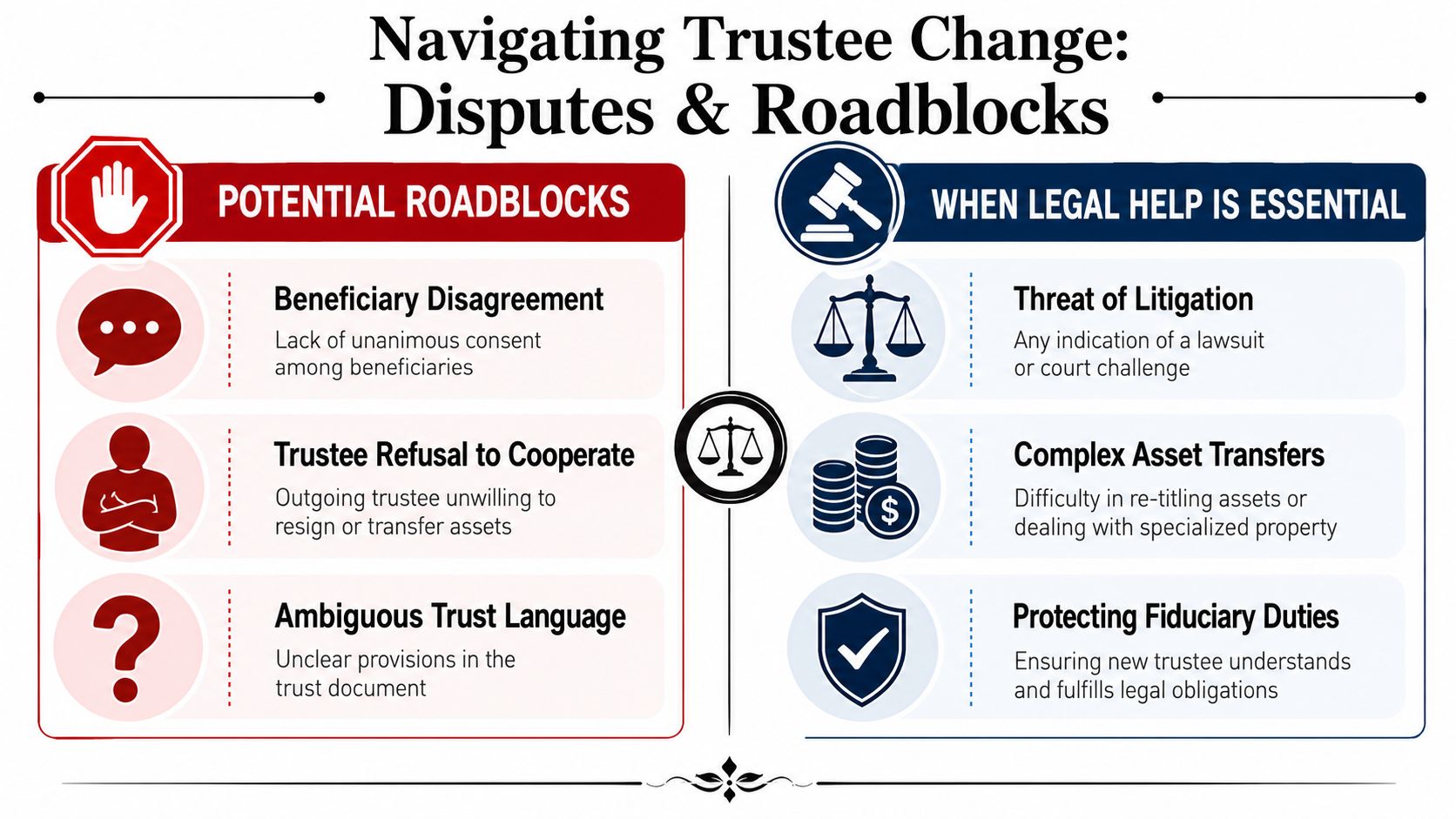
The answer usually turns on three things. First, what the trust says. Second, whether the people with authority will cooperate. Third, whether outside institutions will accept the change documents. A non-judicial trustee change in Texas works best when all three line up.
Three roadblocks that show up often
The first roadblock is unclear trust language. Some trusts name successor trustees but do not clearly explain how to remove a currently serving trustee before death, incapacity, or resignation. That gap matters. Families sometimes assume a successor clause automatically creates a removal power, but those are different tools.
The second is trustee resistance. An outgoing trustee may refuse to resign, delay turning over records, or continue using trust accounts after a replacement has been named. The legal issue then becomes practical as well as technical. Authority on paper does not help much if the old trustee still controls the files, passwords, deeds, or communication with the bank.
The third is beneficiary conflict. One beneficiary may see a trustee change as routine. Another may see it as a power shift and question the motive. That disagreement can block a nonjudicial settlement agreement, especially with an irrevocable trust where broad consent is often needed for a document-driven solution.
Signs the matter may no longer fit a non-judicial process
Watch for these red flags:
- Missing records: The trustee will not provide statements, accountings, deeds, lease files, or basic asset information.
- Misconduct allegations: Family members claim self-dealing, mismanagement, or failure to follow fiduciary duties.
- Consent problems: The proposed agreement depends on signatures that are not coming.
- Third-party rejection: A bank, title company, transfer agent, or mineral payor refuses to recognize the new trustee.
- Capacity questions: The person who would amend a revocable trust may no longer be able to act legally.
- Property control issues: The trust owns land or minerals, and no one can confirm who has current authority to sign division orders, leases, or sale documents.
A useful rule of thumb is this: document problems can often be fixed with better drafting, better proof, or better follow-through. Conduct problems usually require a different response.
How to respond without making the dispute worse
Start by building a clean file. Save the trust agreement, amendments, resignation letters, appointment documents, acceptance documents, notices, account statements, emails, text messages, and notes of conversations. The file should tell the story in order, like a chain of title for authority.
Then sort the problem into the right category. If a bank says the certificate of trust is incomplete, that is an administrative issue. If a trustee refuses to account for trust money or transfer control of trust property, that points to a possible breach of duty. Those problems should not be handled the same way.
At this stage, related planning areas can overlap. A trustee dispute may connect to probate administration, guardianship concerns if capacity is in question, or asset protection planning for a beneficiary who needs added safeguards. Families often benefit from having a Texas trust administration lawyer identify the exact issue before anyone sends accusations, records a flawed property filing, or signs an agreement that creates a larger problem.
Real estate and mineral interests deserve extra caution here. If the trust owns a ranch, rental house, or royalty-producing property, a disagreement about the trustee can freeze more than internal administration. It can interrupt closings, delay lease negotiations, stall division order updates, and create title questions in county records. Many articles stop at "replace the trustee." In practice, families also need outside recognition of that change.
If you are unsure whether the process is still on a document-driven track, get legal review early. Law Office of Bryan Fagan, PLLC offers Texas-based guidance for trustee transitions, fiduciary duty issues, probate, guardianship, and related trust administration questions.