Texas homeowners now have a mandatory school district homestead exemption of $140,000 under recently passed legislation, and if voters approve it in November 2025, a $300,000 home would be taxed for school purposes as if it were worth $160,000. That kind of reduction can make a meaningful difference for a family budget, especially when property values keep climbing.
Opening an appraisal notice can put a knot in your stomach. For many families, it feels like the tax bill rises faster than everything else, and it's not always clear what protection Texas law gives you.
The good news is that Texas does give homeowners a powerful tool. The homestead exemption can lower taxable value, preserve cash flow, and support a broader estate plan when a home is part of a trust, probate estate, or long-term family wealth strategy. The hard part isn't usually the idea. It's the paperwork, the timing, and the compliance traps that most short guides skip.
That's where families, executors, trustees, and beneficiaries often need calm, practical guidance. Texas property tax rules intersect with fiduciary duties, the Texas Estates Code, and trust administration in ways that matter in real life, especially when someone has died, a home has been inherited, or a trustee is trying to protect trust assets without missing a filing deadline.
Your Guide to Lowering Texas Property Taxes
A lot of people first start looking into the homestead exemption after a stressful moment at the kitchen table. The appraisal arrives. The taxable value looks high. Someone asks, “Are we missing something?”
That's a fair question.
For many Texas homeowners, the answer is yes. Some families never file their initial homestead paperwork. Others qualify for added exemptions because of age, disability, or military service in the family but don't realize those protections exist. Still others had the exemption in place for years and assume it takes care of itself forever, only to run into a verification problem later.
Why this matters beyond one tax bill
A homestead exemption isn't just a line item on a county record. It affects how much cash a household keeps each year, how a surviving spouse manages expenses, and how a trustee or executor carries out fiduciary duties in Texas. Under core fiduciary principles, the person managing property for someone else must act carefully, keep up with deadlines, and protect value where the law allows.
That matters in both trust and probate administration. A trustee working under the Texas Trust Code has a duty to administer trust property prudently. An executor working under the Texas Estates Code has to preserve estate assets and address ongoing property obligations. If a residence qualifies for a tax benefit and no one takes the right steps, the family may pay more than necessary.
Practical rule: If a house is part of an estate, trust, or transition after a death, don't treat the homestead exemption as “just a tax office issue.” It's often part of good fiduciary administration.
A simple way to think about it
Think of the Texas homestead exemption as a legal reduction applied to the taxable value of your primary residence. If the home qualifies, taxes are calculated on a lower number than the full appraised value.
That sounds simple, but the details matter. Eligibility, filing dates, ownership structure, and follow-up notices can all change the result. Families often need a step-by-step approach, especially when the home is held in trust, inherited by children, or occupied by a surviving spouse.
What Is the Texas Homestead Exemption
The Texas homestead exemption is a property tax benefit for your primary residence. It doesn't erase all property taxes. Instead, it lowers the value used to calculate certain taxes, which can reduce what you owe.
For school district taxes, that reduction is especially significant. The Texas Legislature passed legislation increasing the mandatory school district homestead exemption from $100,000 to $140,000, and if voters approve it in November 2025, a home valued at $300,000 would have a taxable value of $160,000 for school taxes under the new rule, as described by Texas Policy Research's summary of the legislation.
What the exemption does in plain English
If your home qualifies, the law tells the taxing authority to subtract a set amount before calculating school taxes. That means the tax bill is based on a smaller number.
For many homeowners, that's the key idea. The exemption doesn't change what your house is worth on the market. It changes the value used for tax purposes.
Here's the practical example tied to the pending increase:
- Home value: $300,000
- School tax exemption: $140,000
- Taxable value for school taxes: $160,000
That's why this isn't a minor paperwork exercise. It can directly affect what a family owes.
Why estate planners pay attention to it
The exemption also matters in trust and estate work because homes don't always stay titled in one person's individual name forever. A house may move into a revocable trust. It may pass through probate under the Texas Estates Code. A surviving spouse may continue living there after a death. In each of those situations, someone has to confirm whether the exemption still applies and whether any update is needed.
If you've stepped into a fiduciary role, First Steps for a Successor Trustee in Texas gives a factual overview of what to do immediately after taking over trustee responsibilities. One of those early practical questions is whether the trust's residence is properly documented for property tax purposes.
The best time to check homestead status is when ownership changes, not when the tax bill arrives.
A Guide to All Available Homestead Exemption Types
Not every homeowner gets the same benefit. Texas law includes a general residence homestead exemption, added protections for older homeowners and people with disabilities, optional local exemptions, and special rules for some surviving spouses.
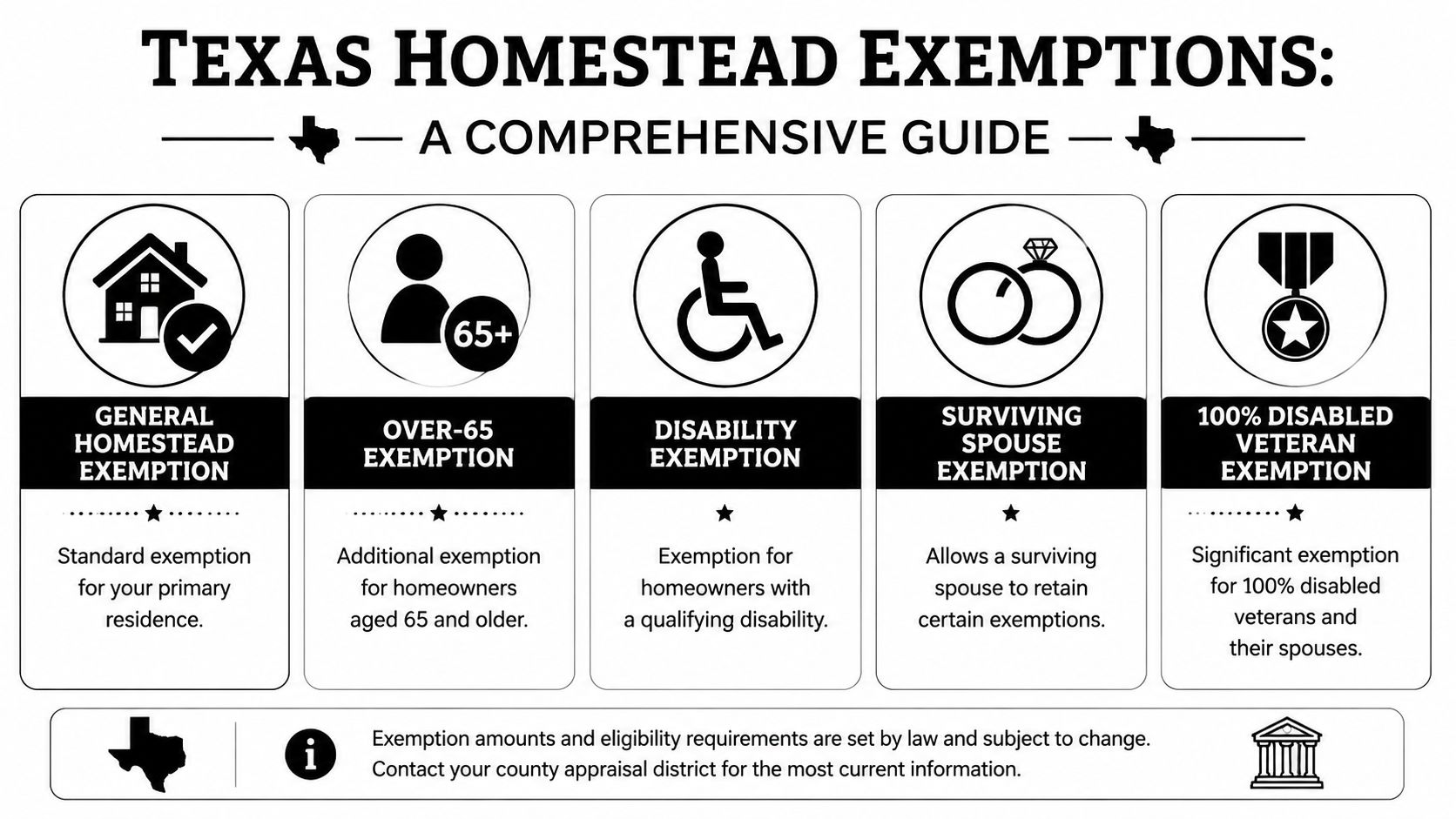
Under Texas Tax Code Section 11.13(b), school districts must provide a $140,000 general homestead exemption. Section 11.13(n) also allows counties, cities, and other taxing units to offer an optional local exemption of up to 20% of appraised value, but not less than $5,000, according to the Texas Comptroller's property tax exemption guidance.
Texas Homestead Exemption Comparison
| Exemption Type | Mandatory Benefit (for School Taxes) | Key Eligibility |
|---|---|---|
| General Homestead Exemption | $140,000 | Property must be your principal residence and you must have an ownership interest |
| Over-65 Exemption | Additional $60,000 | Homeowner is age 65 or older and qualifies for homestead status |
| Disability Exemption | Additional $60,000 | Homeowner qualifies as disabled and has homestead status |
| Surviving Spouse Exemption | Varies by underlying exemption | Depends on the specific exemption involved and continued eligibility |
| Surviving Spouse of Certain Veterans | 100% exemption | Surviving spouse of a veteran who died from qualifying service-connected conditions and has not remarried |
How these categories work together
The general homestead exemption is the starting point for most families. If the property is your principal residence, this is the standard benefit many people think of first.
For homeowners who are 65 or older or who qualify as disabled, Texas law adds more relief for school taxes. The verified guidance also notes that school districts must provide an additional $60,000 exemption for these groups, and separate rules may apply for related school tax protections.
Local taxing units can add another layer. A county or city may adopt an optional local exemption, which can increase the total reduction beyond the mandatory school exemption.
Where families often get confused
Some people assume all property taxes are reduced by the same fixed amount. That's not how it works. The mandatory school tax exemption is one piece. Optional exemptions from counties or cities are another. The result depends on which taxing units are involved and whether they've adopted local relief.
For fiduciaries, this is more than a technical detail. A trustee or executor should review the tax treatment of a residence just as carefully as they review account titles, insurance, and creditor notices. That's part of responsible administration under fiduciary duties in Texas.
Your Step-by-Step Guide to Applying in Texas
The application process is manageable once you break it into steps. Most delays happen because people file too late, send incomplete documents, or assume they had to wait after buying the home.
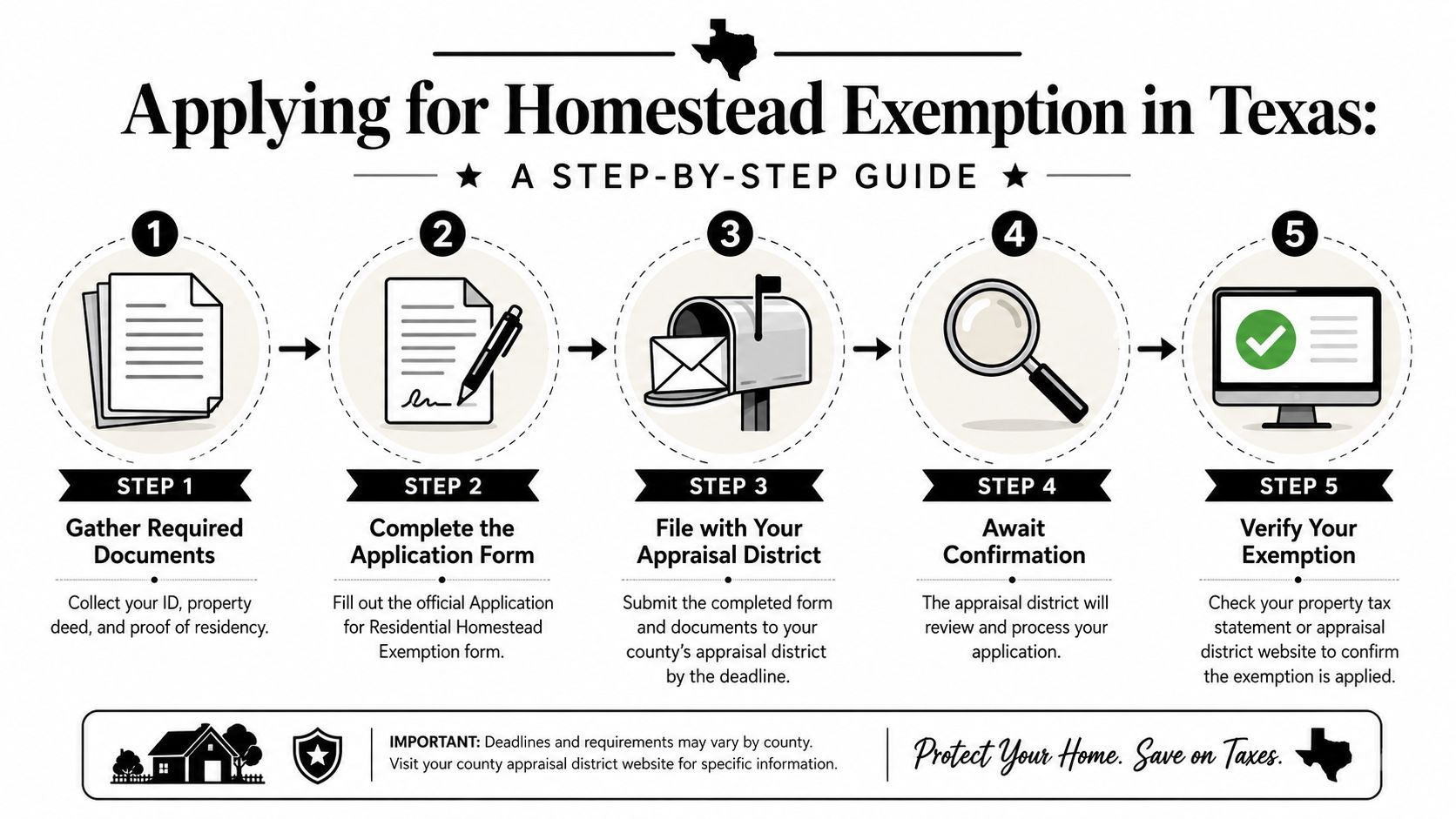
As of a rule effective January 1, 2022, new Texas homeowners can apply for a residence homestead exemption in the same year they buy the property, without waiting a full year, and applications are due by April 30 to be processed for that year's tax bill, as explained in Old Republic Title's Texas homestead update.
Step 1 through Step 3
Confirm that the property is your principal residence
The home must be the place where you live most of the time. You also need an ownership interest in the property.Gather supporting documents
Verified guidance from Harris County Tax Assessor-Collector materials explains that owners should provide proof of identity, such as a Texas driver's license, and proof of residency, such as a utility bill showing the same address as the property.Complete the proper form
The general application is Form 50-114. If a disabled veteran or qualifying survivor exemption applies, different forms may be required.
Step 4 and Step 5
File with the county appraisal district
Timeliness is key. Filing by April 30 gives you the best chance of having the exemption reflected on that year's bill.Verify that the exemption was applied
Don't assume the process finished correctly. Check the appraisal district record or your tax statement.
Here's a practical overview in video form:
The compliance issue many owners miss
Texas also has a newer verification rule that can affect long-term homeowners. Verified county guidance explains that once approved, the exemption generally renews automatically, but property owners must verify eligibility every five years if required, and failure to respond to a verification request can put the exemption at risk.
That matters for families using trusts as part of an estate plan. If you're reviewing title planning, putting your house into a trust in Texas step by step can help frame the ownership side of the discussion. The tax side should be reviewed at the same time so the homestead benefit isn't overlooked after a deed change.
Homestead Exemptions for Trusts and Inherited Property
Homes rarely stay in a simple ownership pattern forever. A parent creates a revocable trust. A spouse dies. Children inherit a house but one child continues living there. An executor has to decide what paperwork to handle first. That's where homestead questions become legal and practical at the same time.

When a home is held in trust
A common concern is whether moving a home into a trust destroys the exemption. Often, families are worried because the legal title changes, but the person living there hasn't changed.
In many estate plans, a revocable living trust holds the residence while the grantor continues to live in the home as a principal residence. The trust structure may help with management, incapacity planning, and smoother post-death administration, but the tax treatment still needs attention. A trustee should confirm how the county appraisal district wants the ownership and occupancy documented.
Under fiduciary duties in Texas, a trustee must protect trust property and administer it prudently. That includes attention to taxes, notices, and qualification requirements. If the trustee ignores a homestead issue, the trust may pay more than it should, which can affect beneficiaries directly.
When a home passes through probate or inheritance
Now consider a different family.
A mother dies owning a house in her name alone. Her will names her son as executor, and her daughter has been living in the home as her principal residence. The son focuses on opening probate under the Texas Estates Code, gathering accounts, and dealing with funeral expenses. Months later, the family learns the property tax records still reflect outdated information, and no one has checked whether the exemption status needs to be updated.
That's a common real-world problem.
Executors and beneficiaries need to understand that probate administration is not only about transferring title. It also includes preserving value while the estate is open. If a residence remains occupied by a qualifying person, someone should review whether the homestead benefit continues, whether a filing is needed, and whether the county has sent any verification notice.
A missed property tax issue during probate can quietly become an estate administration issue.
Special rules for surviving spouses
Some exemptions are especially important after a death. For surviving spouses of veterans who died from qualifying service-connected conditions, Texas Tax Code Section 11.136 provides a 100% property tax exemption on the residence homestead if the surviving spouse does not remarry, according to the Texas Comptroller form and guidance for surviving spouses of qualifying veterans.
That's not just a reduction in taxable value. It's a total exemption for the qualifying homestead.
Families should treat this as a major estate administration issue. If the surviving spouse is eligible, the filing should be handled carefully and promptly. The emotional weight after a death can make paperwork hard to prioritize, but this is exactly the kind of benefit that protects a household's financial stability.
Asset protection and title planning
Trust planning often overlaps with tax and creditor planning. For some families, asset protection trusts in Texas and whether they work is part of the broader conversation when deciding how to hold real estate and preserve family wealth.
The legal answer depends on the trust terms, the owner's rights, occupancy, and the family's larger estate plan. A Texas estate planning attorney or Texas trust administration lawyer should review those details together rather than treating the tax exemption as a separate afterthought.
Protecting Your Future with Tax Ceilings and Deferrals
For many older Texans, the primary concern isn't only today's bill. It's whether they'll be able to stay in the home long term if values keep rising. That's where related protections become part of estate planning, not just tax planning.
Verified guidance states that seniors who qualify can receive the general exemption plus added school tax relief, and in practice that can significantly reduce the tax burden on a home. For families on fixed income, that stability matters.
Why this belongs in an estate plan
A home is often the largest asset in a family estate. Under the Texas Estates Code, it may be central to a surviving spouse's housing, a probate administration, or a future inheritance strategy. Under the Texas Trust Code, it may also be trust property that a trustee must manage for current and remainder beneficiaries.
That means homestead planning connects to:
- Cash flow protection for a surviving spouse or disabled homeowner
- Administrative planning for trustees and executors handling ongoing expenses
- Wealth preservation for beneficiaries who may eventually receive the property
- Transfer strategy when families consider options such as a Lady Bird deed in Texas
Deferrals and careful decision-making
Some homeowners may also explore tax deferral options. A deferral doesn't work the same way as an exemption, and it shouldn't be treated as a casual filing decision. It can affect timing, payment obligations, and estate administration after death.
Estate planning insight: The right question isn't only “How do we lower this year's taxes?” It's also “How do we keep this home manageable for the person who lives there now and for the people who may inherit it later?”
That's where a coordinated review helps. A Texas estate planning attorney can look at title, occupancy, beneficiary design, trust terms, and fiduciary duties in Texas as one connected plan instead of a stack of unrelated forms.
Avoiding Common Pitfalls and Answering Your Questions
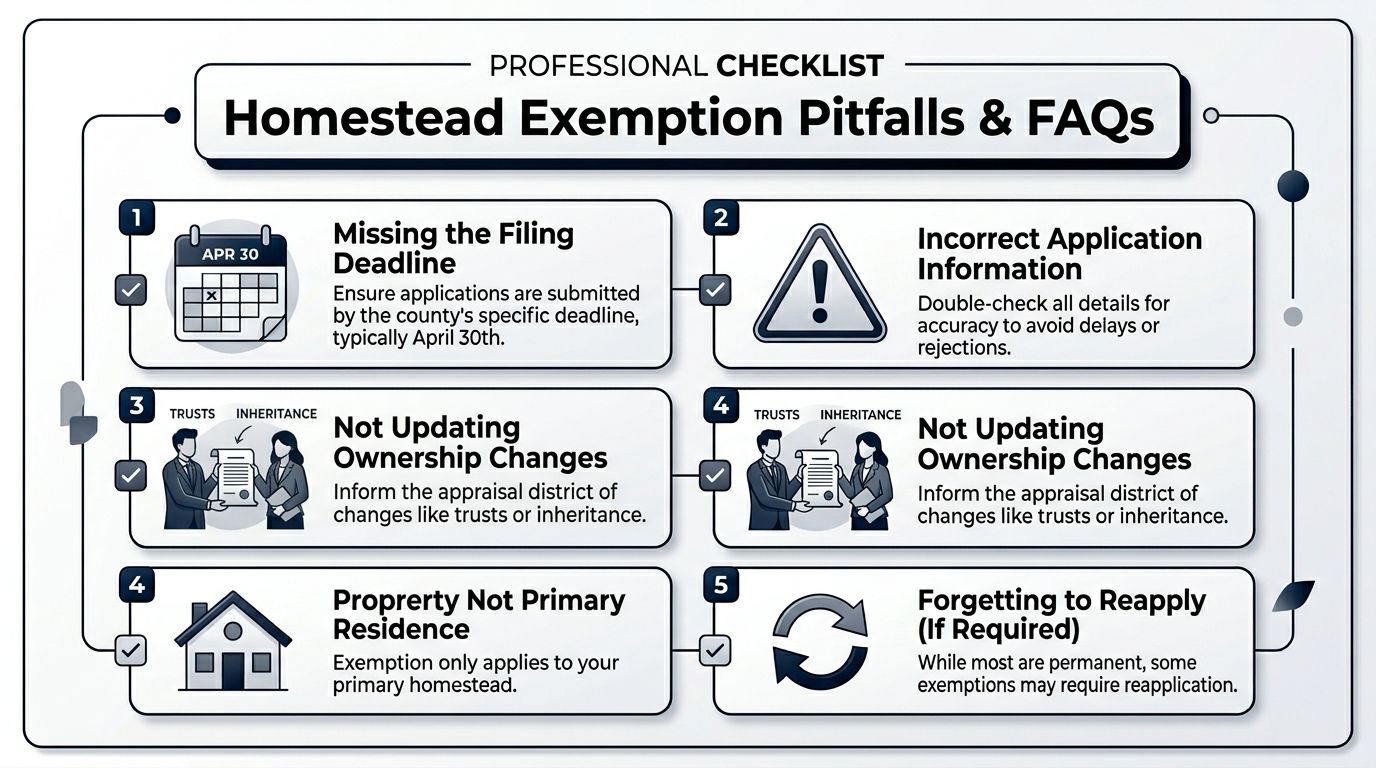
The biggest mistakes usually come from assumptions. People assume the exemption follows the house automatically forever. They assume a trustee will somehow be notified of every deadline. They assume a surviving spouse can wait until later.
Texas law now includes a mandatory five-year audit cycle in which appraisal districts may require homeowners to re-verify eligibility for the homestead exemption, and failure to respond can lead to removal of the exemption and a higher tax bill, according to the Harris County Tax Assessor-Collector explanation of Texas homestead verification rules.
Common questions families ask
Do I have to reapply every year?
Usually no. Once approved, the exemption generally renews automatically unless the chief appraiser asks for a new application or verification.
Can I claim it on more than one property?
No. A residence homestead exemption applies to your principal residence, not a second home or investment property.
What if I move or title changes after death or trust planning?
That's when problems often start. Ownership changes, occupancy changes, and mailing address issues can all trigger review.
Why are seniors and fiduciaries at higher risk?
Because notices may go to the wrong address, sit unopened, or be misunderstood. Executors, trustees, and caregivers should monitor county correspondence closely and keep records current.
A short checklist that prevents expensive errors
- Watch your mail carefully because appraisal district verification letters can affect an existing exemption.
- Match your records so your identification, residency documents, and property information line up.
- Review after any life event such as death, incapacity, trust funding, remarriage, or inheritance.
- Treat deadlines seriously because delay can mean losing a tax benefit for a period that matters to your family budget.
If you're managing a trust or planning your estate, contact Law Office of Bryan Fagan, PLLC for a free consultation. Our attorneys provide trusted, Texas-based guidance for every step of the process. Whether you need help as a trustee, executor, beneficiary, caregiver, or homeowner, we can help you evaluate homestead exemption questions alongside probate, guardianship, estate planning, and asset protection so you can move forward with clarity and confidence.