Losing a loved one is a deeply emotional experience, and navigating the legal complexities that follow can feel overwhelming. For many Texas families, a Small Estate Affidavit (SEA) offers a beacon of hope—a simpler, faster way to transfer property when a person passes away without a will. This legal tool can help you avoid the time and expense of a full probate court process, but understanding if it's the right path for your family is crucial. With the right guidance, this process doesn't have to be a burden.
Is a Small Estate Affidavit Right for Your Family?
When someone passes away without a will, they are said to have died "intestate." In these situations, the Texas Estates Code provides a default plan for how their property is divided, which typically involves a court process called probate. Before considering an SEA, it's helpful to understand what is probate and how it works.
The Small Estate Affidavit acts as a legal shortcut, created specifically to help families with modest, straightforward estates bypass the delays and costs of formal probate. For many, this translates into saving thousands of dollars in legal fees and avoiding months of waiting for a judge's approval, allowing families to grieve without added financial strain.
Core Requirements Under the Texas Estates Code
So, how do you determine if your loved one's estate qualifies? The Texas Estates Code sets clear, specific rules. The estate must meet these key conditions to be eligible for an SEA:
- The decedent passed away without a valid will. If a will exists, an SEA is not an option. However, other streamlined probate procedures may be available, such as probating the will as a Muniment of Title in Texas.
- The estate's value is $75,000 or less. This is a critical threshold, but it importantly excludes the value of the decedent's homestead (primary residence) and certain other exempt property, like one vehicle per family member.
- Assets must exceed debts. The total value of the non-exempt property must be greater than the estate's known debts. This calculation does not include mortgages or other loans secured by the homestead or other exempt assets.
A Real-World Scenario: How the SEA Works
Let’s illustrate with a practical example. Imagine a mother in Houston passes away without a will. Her only assets are her home (which was her homestead), a car valued at $10,000, and a checking account with a $15,000 balance.
Since her home is exempt, we only consider the car and the bank account. Their combined value is $25,000, which is well under the $75,000 limit. In this scenario, her children could likely use a Small Estate Affidavit to legally transfer the car title and access the funds from her bank account without the stress and expense of a full court proceeding.
The Small Estate Affidavit is a compassionate provision in Texas law, recognizing that not every estate requires the complexity of full probate. It empowers families to settle affairs with dignity and efficiency during a difficult time.
This tool is a testament to providing practical legal solutions. However, success depends on carefully calculating the estate's value and understanding precisely which assets count toward that $75,000 limit. An experienced Texas trust administration lawyer can be invaluable, ensuring you are on the right legal footing from the very beginning.
If you’re managing an estate or planning your own, contact The Law Office of Bryan Fagan, PLLC for a free consultation. Our attorneys provide trusted, Texas-based guidance for every step of the process.
Calculating the Estate Value for Texas SEA Eligibility
Determining if a Small Estate Affidavit (SEA) is the correct tool for your family hinges on one critical number: $75,000. The Texas Estates Code is unequivocal on this point: the total value of the decedent's assets, minus some significant exceptions, cannot exceed this limit.
An incorrect calculation is one of the most common reasons an affidavit is rejected by the court. It is absolutely essential to get this step right to ensure a smooth process.
The key is understanding what to include and what to exclude. Many families we assist are relieved to learn that not every asset contributes to the $75,000 threshold. This is what makes the SEA an accessible option for many Texans, even for those who owned significant property. The law is designed to evaluate the probate estate, which is often much smaller than a person's total net worth.
What Assets Are Excluded From the Calculation
The single largest exclusion is the decedent's homestead—the primary residence where the person lived. Its market value, regardless of how high, does not count toward the $75,000 limit.
Additionally, Texas law designates certain "exempt personal property" that is also excluded from the calculation. This property is considered necessary for the family's well-being and typically includes:
- One vehicle for each family member with a driver's license.
- Home furnishings, including family heirlooms.
- Tools and equipment used for a trade or profession.
- Certain livestock and the food on hand for their consumption.
This flowchart provides a quick visual to help you determine if your loved one's estate might qualify for this simplified process.
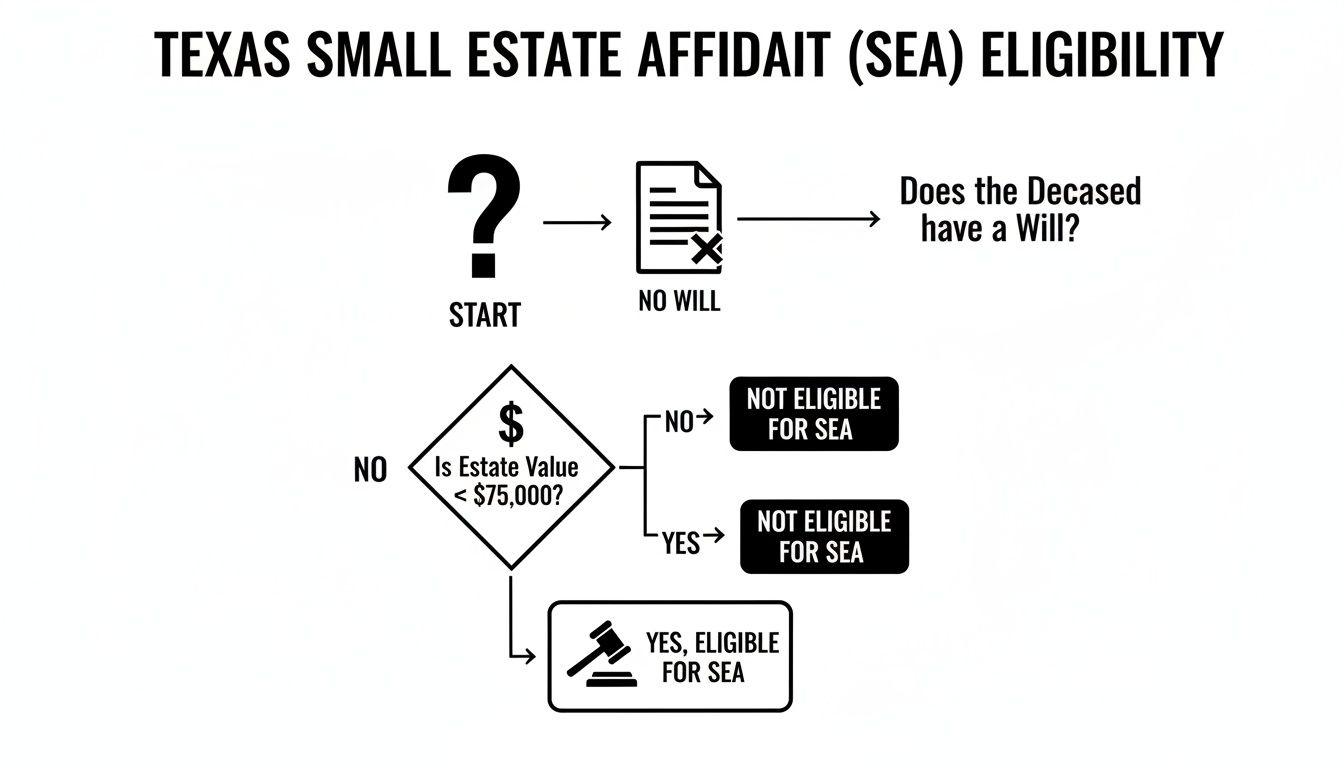
As you can see, the two main criteria for SEA eligibility are dying without a will and having a non-exempt estate valued below the legal threshold.
How to Calculate the Total Estate Value
To arrive at an accurate figure, you must first compile a complete inventory of everything the decedent owned. Properly categorizing each asset is crucial. If you need a refresher, our firm has a detailed guide on understanding probate and non-probate assets that can provide clarity.
Once you have a comprehensive list, subtract the value of the homestead and any exempt personal property.
The remaining assets are what count toward the limit. These typically include:
- Bank accounts (checking, savings, CDs).
- Stocks, bonds, and other investment accounts.
- Second homes or rental properties (any real estate that is not the homestead).
- Vehicles that do not qualify as exempt property.
- Cash, valuable jewelry, and other personal items.
The $75,000 asset limit is a firm legal boundary. When someone dies intestate—meaning without a will—Texas law permits their heirs to use this streamlined affidavit process, but only if the non-exempt total is under $75,000.
For example, an estate could include a primary home worth $500,000 and still qualify for the SEA process, as long as the bank accounts, extra cars, and other non-exempt assets total less than $75,000.
One final, crucial check: the estate's assets must be greater than its known debts. However, just as with assets, debts secured by the homestead (like a mortgage) or by exempt property (like a car loan) are not counted in this part of the calculation.
Getting these numbers right isn't just a formality; it's a legal requirement. An experienced Texas estate planning attorney can provide invaluable assistance, ensuring every asset is identified and valued correctly according to the Texas Estates Code.
Nailing the Details: How to Fill Out the Affidavit Form Correctly
Once you've confirmed that a Small Estate Affidavit (SEA) is the appropriate course of action, the next step is completing the official form. This document is more than just paperwork; it is a sworn statement to the court, and every detail matters. Approaching it with patience and precision is the best way to avoid having it rejected by the county clerk.
The form may appear daunting at first, as it requests specific information about the decedent, their family history, all property they owned, and any debts they left behind. The purpose is to provide the court with a clear, honest snapshot of the estate for approval.
Doing Your Homework: Gathering the Essential Information
Before writing anything on the form, gather all necessary information to make the process smoother.
Here's what you'll need:
- Decedent’s Information: Full legal name, exact date of death, the county of residence at the time of death, and their last known address.
- A Full List of Assets: A detailed list of every non-exempt asset with its fair market value on the date of death. This includes everything from bank account balances to the penny to the Kelley Blue Book value of their car.
- A Full List of Liabilities: A comprehensive list of every known debt, such as credit card bills and final medical expenses. You do not need to include mortgages on the homestead or loans against other exempt property.
This initial preparation is the foundation of your affidavit. A single mistake here could jeopardize the entire filing.
Getting the Family Tree Right: Identifying and Listing All Heirs
This is arguably the most critical part of the form. Since the decedent died intestate, the affidavit must strictly follow the inheritance laws outlined in the Texas Estates Code. This means you must correctly identify every individual with a legal claim to the estate.
For each heir, you must list their:
- Full legal name
- Current physical address
- Relationship to the decedent
- The exact share of the estate they are legally entitled to receive
For instance, if the decedent was a widower with three children, each child is an heir and is entitled to a one-third (1/3) share. Matters can become complicated if the family tree is more complex, such as with half-siblings or grandchildren from a predeceased child. Determining the correct shares in these situations can be challenging. Missing an heir or miscalculating shares is a significant error that will cause the court to reject the affidavit. For more complex family situations, some may also consider an Affidavit of Heirship, which serves a different legal purpose but involves similar principles of identifying heirs.
A common misconception is that you only need to list the family members actively involved in the filing. This is incorrect. Under Texas law, every single legal heir must be identified and listed, regardless of their involvement or location.
Finding Your Witnesses: The Role of Disinterested Parties
The Texas Estates Code includes a safeguard to ensure the affidavit's accuracy: it must be signed by two disinterested witnesses.
A "disinterested witness" must meet two strict criteria:
- They cannot be an heir to the estate.
- They cannot have any financial interest in the estate.
This means they have nothing to gain financially from the affidavit's approval. Suitable candidates are often neighbors, coworkers, or long-time family friends who knew the decedent but are not related and will not inherit anything. Their role is to swear under oath that, to the best of their knowledge, all facts in the affidavit are true.
Finally, every signature on the document—from the heirs and both witnesses—must be notarized. This is a mandatory requirement. You will all need to sign in the presence of a notary public, who will verify your identities and officially stamp the document, making it a legally binding affidavit ready for court filing.
Filing the Affidavit and What Happens After Approval
You have diligently completed the small estate affidavit form for Texas, a significant accomplishment. However, the process is not yet finished. The next phase involves filing it correctly and understanding the steps to take after the court grants approval. This is where your careful preparation culminates, transforming the paperwork into a legal tool to settle your loved one's affairs.
First, the affidavit must be filed with the probate court in the county where the decedent resided. This detail is non-negotiable. Filing in the wrong county is a common mistake that results in an automatic rejection, forcing you to start over. Furthermore, each Texas county may have its own local rules for submitting these documents, which can be a stumbling block for families navigating this process alone.
Navigating County-Specific Filing Rules
Counties like Harris, Dallas, and Travis often have their own specific requirements or supplementary forms that must be filed along with the standard affidavit. Before heading to the courthouse, it is absolutely essential to check the county clerk’s website or call their office directly.
Here is a quick checklist of what to look for:
- Local Forms: Does the county require a special cover sheet or an additional information form?
- Filing Method: Can you file online, or must you appear in person?
- Filing Fees: The filing cost can vary by county. Confirm the exact fee and acceptable payment methods.
Taking a few minutes to verify these local rules can save you weeks of frustrating delays. Once filed, the affidavit is reviewed by a judge. There is no formal court hearing. Instead, the judge will meticulously examine your document for accuracy, completeness, and compliance with the Texas Estates Code. This review process can take anywhere from a few weeks to a couple of months, depending on the court's caseload.
Life After Approval: Using the Court Order
Receiving notification that a judge has signed the order approving your Small Estate Affidavit is a moment of significant relief. This signed order is the legal key needed to access the decedent’s assets. However, the original order is not enough; you will need certified copies to provide to banks, the DMV, and other asset holders.
You can obtain these certified copies from the county clerk's office, typically for a small fee per copy. Our advice is to get more copies than you think you need—at least one for each asset you must collect.
A certified copy of the approved order serves as your proof of legal authority. When you present it to a bank manager or a clerk at the DMV, they are legally obligated to release the property to the heirs listed in the affidavit.
For instance, to close a bank account, you will present a certified copy to the bank. They will verify the order and then release the funds as specified. Similarly, the Texas DMV will require a certified copy to transfer a vehicle title into an heir’s name. This final phase demonstrates the true power of the SEA process, allowing families to finalize an estate with dignity and without the prolonged stress and expense of full probate.
If you’re managing a trust or planning your estate, contact The Law Office of Bryan Fagan, PLLC for a free consultation. Our attorneys provide trusted, Texas-based guidance for every step of the process.
Common Mistakes to Avoid With a Small Estate Affidavit
Navigating the Texas Small Estate Affidavit (SEA) may seem straightforward, but several common missteps can lead to frustrating delays or even an outright rejection from the court. Understanding these potential pitfalls ahead of time is the best way to ensure a smooth process for your family during an already difficult time.
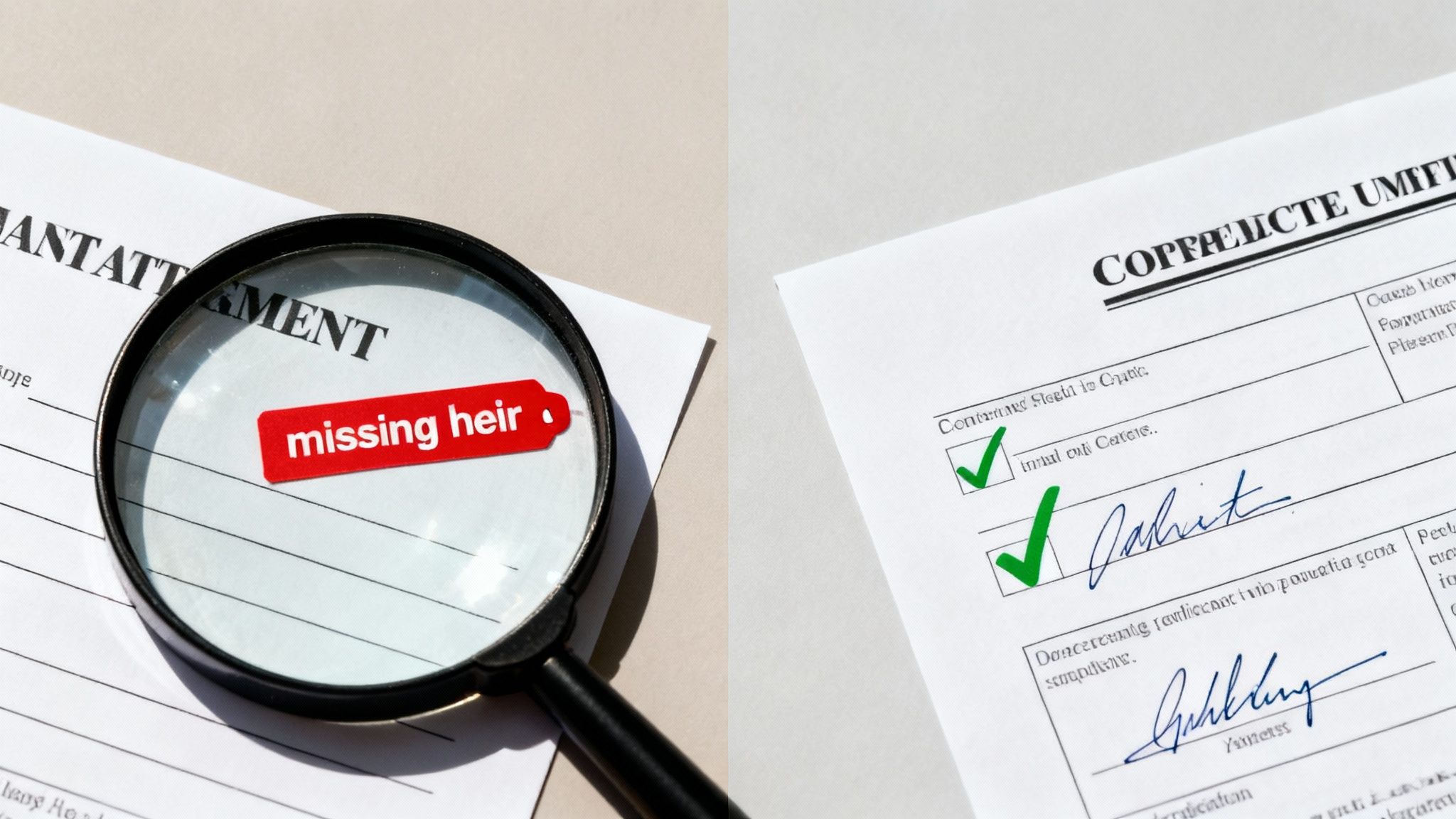
Even with the best intentions, a simple error on the small estate affidavit form texas can escalate into a major headache. Let's review the most common mistakes so you can avoid them entirely.
Miscalculating the Estate's True Value
This is perhaps the most frequent error we encounter. Families sometimes mistakenly include the value of the decedent's homestead or other exempt property when calculating the total estate value.
Remember, the $75,000 limit established by the Texas Estates Code is a strict threshold that applies only to non-exempt assets. Including the home's value can make an otherwise eligible estate appear too large, leading you to believe an SEA is not an option. This single mathematical error can unnecessarily push a family towards a more complex and costly probate process.
Failing to Identify Every Single Heir
Texas law is unequivocal on this point: every single legal heir under intestacy statutes must be identified and listed on the affidavit. This is not a mere suggestion; it is a strict legal requirement designed to protect the inheritance rights of every entitled individual.
We have seen this issue arise in real-world cases with unfortunate consequences.
A son filed an SEA for his father. He was close with his two full siblings and listed them correctly. However, he completely, though unintentionally, forgot about a half-sibling from his father's first marriage who lived out of state. That single omission rendered the affidavit legally invalid. The estranged half-sibling eventually discovered the filing and contested it, dragging the family into a lengthy, expensive, and emotionally draining court battle that a more thorough search could have easily prevented.
This story underscores the importance of due diligence. Common oversights often include:
- Children from previous marriages who may have lost contact over the years.
- Grandchildren who become heirs because their parent (the decedent's child) has already passed away.
- The decedent's parents or siblings if there is no surviving spouse or children.
A diligent search for all heirs is absolutely critical. Missing just one rightful heir invalidates the entire affidavit and can trigger serious legal disputes, fracturing families and depleting the very assets you are trying to protect.
Using Witnesses Who Are Not Disinterested
Another common pitfall is selecting inappropriate witnesses. The law is very specific, requiring two disinterested witnesses. This means they must be individuals with no financial stake in the estate—they cannot be an heir, a beneficiary, or a creditor.
It may be tempting to ask a close family friend who is also an heir to sign, but this is strictly prohibited. The purpose of this rule is to have neutral, third-party observers confirm the facts presented in the affidavit. Using an "interested" witness will cause the court to reject the form without consideration. Your best options are typically neighbors, colleagues, or family friends who are not in line to inherit anything.
Overlooking Debts and Liabilities
Finally, it is easy to become so focused on assets that you forget to list all of the decedent’s known debts. The affidavit requires a complete and honest accounting of both sides of the ledger—what was owned and what was owed.
Forgetting to include a significant credit card balance or a final hospital bill can render the affidavit inaccurate. If the estate's liabilities (excluding those secured by the homestead) actually outweigh its assets, it will not qualify for the SEA process. Total honesty and thoroughness are non-negotiable for a successful filing. Avoiding these common blunders is your best strategy for making the Small Estate Affidavit work as intended.
Your Top Questions About the Texas SEA, Answered
Navigating any legal process naturally raises questions, and the Small Estate Affidavit (SEA) is no exception. Even when the path seems clear, it is completely normal to have concerns about "what if" scenarios.
This section provides direct, clear answers to the most common questions we hear from Texas families about the SEA. Our goal is to offer additional clarity, reinforce what you've learned, and help you feel confident in your next steps.
What Happens if We Find a Debt After We've Already Filed?
It's a common fear: you've filed the small estate affidavit form texas, it has been approved, and you have begun distributing assets. Then, a previously unknown bill arrives in the mail. What should you do?
First, remain calm. If a legitimate debt is discovered after the fact, the heirs who received property may be responsible for it. However—and this is a critical point—their liability is limited to the value of the non-exempt property they received. This is an important protection under the Texas Estates Code.
For example, if an heir received $5,000 from their parent's bank account and a surprise medical bill for $8,000 later appears, that heir is only liable for up to the $5,000 they received, not the full amount. This is precisely why conducting a thorough search for all possible debts before filing is so important. It prevents future complications for everyone involved.
Can We Use a Small Estate Affidavit for Real Estate?
This is a major point of confusion for many families. In Texas, a Small Estate Affidavit can only be used to transfer the title to one specific type of real estate: the decedent's homestead. This is their primary residence, the place they called home.
It absolutely cannot be used for any other kind of real property, such as:
- Rental properties or a vacation home
- Undeveloped lots or tracts of land
- Commercial buildings
If your loved one owned any real estate besides their homestead, the SEA is not the appropriate legal tool. You will need to explore other probate options, such as a formal administration or a proceeding to determine heirship. An experienced Texas estate planning attorney can guide you to the correct procedure for your specific situation.
Who Exactly Counts as a "Disinterested Witness"?
The requirement for two "disinterested witnesses" is a legal safeguard to ensure the affidavit's integrity. So, what does "disinterested" truly mean? The criteria are strict. A person qualifies only if they meet two firm conditions:
- They have zero financial stake in the estate. They cannot be inheriting property, be a named beneficiary, or be a creditor of the estate.
- They are not related to any of the decedent's heirs. This includes relatives by blood (like an heir's child or sibling) or by marriage (like an heir's spouse or in-law).
These witnesses are neutral third parties who swear under oath that, to the best of their knowledge, the family relationships and other facts in the affidavit are true. Good choices often include trusted neighbors, colleagues, or long-time family friends who meet these legal criteria.
A classic mistake is asking an heir's spouse to sign as a witness. While well-intentioned, their marriage to an heir makes them an "interested" party in the eyes of the law. This signature would invalidate the affidavit, forcing you to start the process over.
How Long Does the Texas SEA Process Actually Take?
One of the greatest benefits of the SEA is its speed compared to formal probate. That said, the exact timeline can vary depending on the county and the court's current docket.
As a general guideline, once a complete and correct affidavit is filed, you can expect a judge to review it within a few weeks to a couple of months. Once the judge signs the order approving the SEA, the court process is complete. This is significantly faster than a formal probate, which can easily take six months to a year, or even longer if complications arise.
For the most accurate timeline, it is best to contact the local county clerk’s office where you plan to file and inquire about their current processing times.
If you’re managing an estate or planning for your own future, contact The Law Office of Bryan Fagan, PLLC for a free consultation. Our attorneys provide trusted, Texas-based guidance for every step of the process. Visit us at https://texastrustadministration.com.