Skip to content
Managing a loved one’s estate after they pass away without a will can feel overwhelming, but with the right legal guidance, it doesn’t have to be. A Letter of Administration is the official document from a Texas court that grants a specific person the authority to manage the deceased's affairs. Think of it as the legal key that unlocks the ability to pay debts, access bank accounts, and ensure property is distributed to the rightful heirs according to Texas law.
What Happens When a Loved One Dies Without a Will?

Sorting through a loved one's affairs is emotionally taxing. When there is no will to serve as a roadmap, the challenge can feel monumental. This situation is known legally as dying "intestate," and it is a reality for many Texas families.
When a person dies without a will, their wishes are unknown, so Texas law provides a clear framework for how the estate must be handled. This involves a court-supervised process called probate to ensure every step is managed correctly and fairly.
The primary tool for this process is the Letter of Administration. This court order officially appoints an administrator to take control of the estate.
The Role of a Letter of Administration
The administrator acts as the estate's temporary manager, responsible for wrapping up the deceased's financial life in an orderly and legal manner. A Letter of Administration is critical because it serves as legal proof of their authority to banks, mortgage lenders, government agencies, and other third parties.
Without this official document, you are effectively locked out. You cannot:
- Access your loved one’s bank accounts or investments.
- Sell property, such as a house or car, to pay off debts.
- Settle claims from creditors.
- Legally transfer assets to the heirs.
This scenario is far from rare. Studies show that a significant percentage of adults die without a will, leaving their families to navigate the court system. In Texas, our state laws establish a clear line of succession for a spouse, children, or parents. The best way to avoid this uncertainty is with proactive estate planning. Planning ahead gives you control over how your legacy is managed.
Navigating probate without a will can feel overwhelming, but the process is designed to bring order and clarity. A Letter of Administration ensures a loved one’s legacy is managed with the care and integrity it deserves.
Here at The Law Office of Bryan Fagan, PLLC, we provide the steady, compassionate guidance Texas families need to walk this path with confidence.
When Does Texas Require a Letter of Administration?
Determining if a letter of administration for an estate is necessary is the first step toward bringing clarity to a difficult time. The Texas Estates Code outlines a clear path for these situations, ensuring a loved one's assets are protected and handled correctly. The primary reason this process is initiated is when someone passes away intestate—the legal term for dying without a valid will.
For example, imagine a Texas resident passes away, leaving behind a family home, a car, and several bank accounts. If they never created a will naming an executor and specifying who inherits their property, the family cannot legally access or distribute any of those assets. This is precisely when a letter of administration becomes essential. It grants a court-appointed individual the legal authority to step in and manage the estate.
Dying Without a Will in Texas
When someone dies intestate in Texas, family members cannot simply divide the property on their own, even if they all agree. Instead, a probate court must oversee a fair and lawful distribution according to the Texas Estates Code. The court's primary tool to facilitate this is the letter of administration.
This official document gives an "administrator" the authority to act on behalf of the estate. Without it, banks, the DMV, and other institutions will not recognize anyone’s right to manage the deceased's assets, and everything remains frozen.
Other Times an Administrator is Needed
While dying without a will is the most common reason, a letter of administration may also be required in other scenarios, even when a will exists.
Consider these possibilities:
- The Will is Invalidated: A court might rule that a will is invalid. This can happen if it was signed under duress, the person was not of sound mind, or it fails to meet Texas's legal requirements. In this case, the will is set aside, and the estate is treated as if no will ever existed.
- The Named Executor Cannot Serve: The person named as executor in the will might have passed away, become incapacitated, or be legally unable to serve (for instance, due to a felony conviction).
- No Executor Was Named: Sometimes a valid will overlooks one crucial detail: naming an executor to carry out its instructions. The court must then appoint an administrator to manage the estate according to the will's terms.
A letter of administration is the court's solution when there is a leadership vacuum in an estate. Whether due to the absence of a will or the unavailability of a named executor, this document provides the legal authority needed to move forward.
This process differs from cases where a valid will exists with a ready and willing executor. In that scenario, the court issues Letters Testamentary. They serve a similar purpose but are based on the instructions provided in the will. Knowing which path your family needs to follow is key.
For very small estates, there may be simpler alternatives. You can learn more by reviewing the requirements for a small estate affidavit form. Identifying your family's specific legal situation with a knowledgeable Texas estate planning attorney is the best way to navigate the probate process with confidence.
Who Can Serve as an Estate Administrator in Texas?
When a loved one passes away without a will, the court appoints an estate administrator to handle their final affairs—a role with significant responsibility. But who gets this important job? The Texas Estates Code provides a clear order of priority to determine who has the right to serve.
This legal hierarchy is designed with a commonsense goal: to give the person most closely related to the deceased the first opportunity to manage the estate. The court follows this priority list to make a fair and logical appointment.
The Legal Order of Priority in Texas
Texas law is very specific about the sequence for appointing an administrator. The court will move down the list until it finds a qualified and willing candidate.
Generally, the priority is as follows:
- The surviving spouse.
- The principal beneficiary named in a will (if the named executor cannot serve).
- Any other beneficiary named in the will.
- The next of kin, beginning with the closest relative.
This structure creates a predictable and orderly process. For example, the surviving spouse has the primary right to serve. If they are unable or choose not to, the court then looks to the children, followed by other close relatives like parents or siblings. Understanding this priority is key for families determining who should apply for the letter of administration for the estate.
According to the Texas Estates Code, the order of priority for appointing an administrator is designed to protect the estate by granting authority to the person with the strongest legal connection to the deceased.
To clarify the priority for intestate estates (when there is no will), the court follows this specific order.
Priority Order for Administrator Appointment in Texas
The table below outlines the legal order of preference for individuals seeking to be appointed as the administrator of an intestate estate under the Texas Estates Code.
| Priority Level | Eligible Person(s) |
|---|---|
| 1 | Surviving Spouse |
| 2 | Next of Kin (Closest degree) |
| 3 | A Creditor of the Estate |
| 4 | Any Other Qualified Person |
This clear hierarchy helps prevent disputes by providing a straightforward path for the court to follow.
Essential Qualifications for an Administrator
Being first in line is not enough. The Texas Estates Code also lists non-negotiable qualifications that any potential administrator must meet. These rules are in place to protect the estate’s assets and ensure the person in charge is both capable and trustworthy.
An individual may be disqualified from serving if they:
- Are incapacitated (e.g., not of sound mind).
- Have been convicted of a felony.
- Have a conflict of interest that makes them unsuitable.
- Are a non-resident of Texas who has not appointed a resident agent to accept legal service.
The court carefully vets each applicant to ensure they meet these standards. For instance, someone with a felony conviction is automatically disqualified, as the law considers them a potential risk in a position of trust.
How a Judge Makes the Decision
Let's consider a real-world scenario. A man in Houston passes away without a will, leaving behind his wife and two adult children from a previous marriage. Both his wife and his eldest child wish to be appointed administrator.
The judge will first look to the surviving spouse, who is at the top of the priority list. Assuming she meets all legal qualifications—she is of sound mind and has a clean record—the court would almost certainly appoint her. Her legal right to serve supersedes that of the children. This example shows how the priority rules can resolve potential family disagreements and provide a clear answer.
It is also crucial to understand the difference between an administrator and an executor. For a more detailed explanation, our guide comparing an executor vs. administrator is an excellent resource. Understanding this distinction is fundamental to navigating the Texas probate process.
Your Step-by-Step Guide to Getting a Letter of Administration
Losing a loved one is difficult enough without the added stress of navigating the court system. Obtaining a letter of administration for an estate in Texas is a structured, manageable process, especially when you understand the steps involved.
We've broken down the journey into clear, practical guidance to demystify the process and give you the confidence to move forward.
Step 1: Filing the Initial Application
The first step is to file an "Application for Letters of Administration and Determination of Heirship." This formal legal document initiates the process with the probate court in the county where the deceased resided.
The application must include essential details: the date of death, the last known address, and a complete list of all known heirs and their relationship to the decedent. Precision is critical. Even minor errors or omissions can cause significant delays, which is why working with an experienced Texas trust administration lawyer is invaluable. They ensure the paperwork is filed correctly from the start.
Step 2: Posting Public Notice and the Waiting Period
Once the application is filed, Texas law requires a public notice to be posted at the courthouse. This serves as an official announcement of the probate proceedings, giving anyone with an interest in the estate—such as creditors or other potential heirs—a fair opportunity to come forward.
After the notice is posted, there is a mandatory waiting period, typically about two weeks, before a court hearing can be scheduled. This pause ensures the process adheres to the principles of due process and transparency required by the Texas Estates Code.
This infographic shows the legal order of priority for heirs in Texas, which is central to the court's decisions.
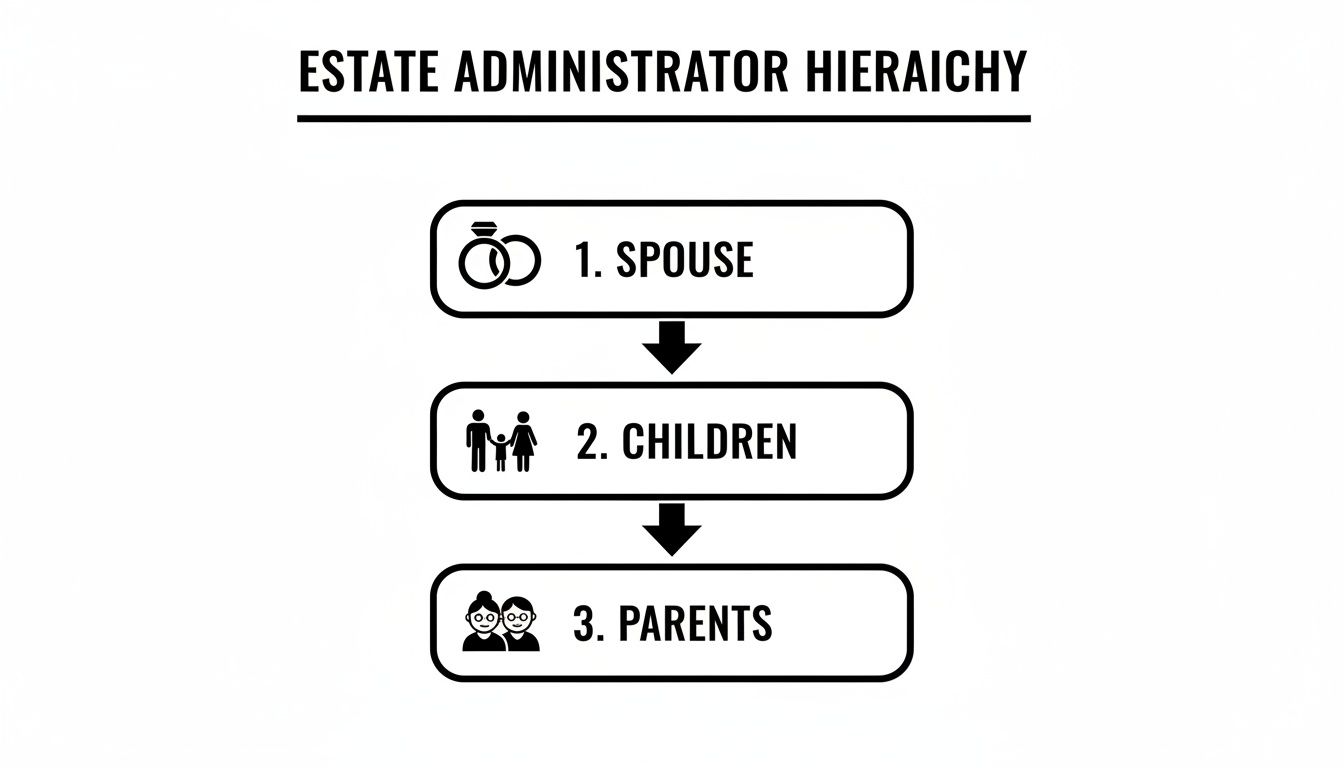
As you can see, the court looks first to a surviving spouse, then to children, and then to other relatives when determining who inherits the estate.
Step 3: Attending the Court Hearing
At the court hearing, a judge will legally determine the deceased's heirs in a process called "proving heirship." You will need to bring two "disinterested witnesses" to the hearing. These are individuals who knew the deceased well but have no financial stake in the estate—they will not inherit anything.
These witnesses will testify under oath about the deceased’s family history, including marriages, divorces, and children. After reviewing the testimony and evidence, the judge will sign an "Order Determining Heirship." This document legally establishes the heirs and their respective shares of the estate under Texas law. The judge will also approve the applicant to serve as the administrator. For a deeper understanding of how this fits into the overall process, explore our guide to the probate process in Texas.
Step 4: Taking an Oath and Securing a Bond
Once the judge approves the application, two final steps are required. First, you must take an oath of office, a solemn promise to faithfully carry out your duties as administrator according to the law. This is a commitment to act with integrity and always in the estate's best interest.
Second, the court will almost always require you to post a probate bond. This bond acts as an insurance policy for the estate, protecting the heirs and creditors from potential mistakes or financial mismanagement by the administrator.
The bond amount is typically based on the estimated value of the estate's assets (excluding real estate). It provides a critical layer of asset protection and ensures the administrator’s responsibilities are backed by a financial guarantee.
After you have taken the oath and filed the bond, the judge will sign the final order. The court clerk will then issue the official Letter of Administration. With this document in hand, you have the full legal authority to manage the estate—from accessing bank accounts to paying debts and distributing property to the rightful heirs.
Figuring Out Your Legal Path for Settling an Estate
When settling an estate in Texas, a Letter of Administration is not the only option. Different legal tools are available, and choosing the right one for your situation is crucial. Selecting the wrong path can lead to frustrating delays and unnecessary costs.
We will break down the most common options to help you understand which path makes the most sense for your family.
Letters of Administration vs. Letters Testamentary
This is one of the most common questions families ask. The difference between Letters of Administration and Letters Testamentary comes down to one critical factor: whether a valid will exists.
Letters of Administration: The court grants these when a person dies without a will (intestate). With no instructions from the deceased, the court appoints an administrator to follow Texas state law to settle the estate.
Letters Testamentary: These are issued when the deceased left a valid will naming an executor. The court is officially recognizing the executor's authority to follow the instructions in the will.
In short, a Letter Testamentary is about carrying out the deceased's personal wishes, while a Letter of Administration is about following the state's rules. Both grant legal authority, but the source of that authority is different. Understanding this distinction is a critical first step in the probate process.
Are There Simpler Routes Than Formal Probate?
Yes. For many Texas families, a full, court-supervised administration is not necessary. The Texas Estates Code offers streamlined, more affordable alternatives for smaller or less complex estates that can save significant time, money, and stress.
The two most common alternatives are the Small Estate Affidavit and the Affidavit of Heirship. These tools are particularly useful when the estate is modest and there are no outstanding debts.
Small Estate Affidavit (SEA)
A Small Estate Affidavit is a sworn legal document filed with the court that allows heirs to collect property without formal probate. While incredibly useful, it is only available under very specific circumstances.
To qualify for an SEA in Texas, the estate must meet these requirements:
- The total value of the assets (excluding the homestead and other exempt property) is $75,000 or less.
- The decedent died without a will.
- The estate’s assets are worth more than its known debts.
- All heirs agree on how to divide the property.
If these conditions are met, an SEA can be a quick and efficient way to transfer title to bank accounts, vehicles, and other personal property, completely bypassing the need for a court-appointed administrator.
Affidavit of Heirship
An Affidavit of Heirship is used almost exclusively to transfer title to real estate when the owner dies without a will. It is a formal document that identifies the deceased's legal heirs and is filed in the public property records of the county where the property is located.
It is important to note that this affidavit does not transfer title in the same way a court order does. Instead, it serves as evidence of ownership that title companies and banks can rely on. It works best when all heirs are in agreement and there are no creditors seeking payment from the estate.
Key Takeaway: Both the Small Estate Affidavit and the Affidavit of Heirship can be excellent shortcuts to avoid formal probate, but they are not suitable for every situation. It is best to consult with an experienced Texas estate planning attorney who can assess your family's circumstances and determine if you qualify for one of these simpler paths.
Comparing Texas Estate Administration Options
Choosing the right legal path depends on specific factors—the existence of a will, the size of the estate, and the complexity of the finances. This table provides a clear, side-by-side comparison of each option.
| Procedure/Document | Requires a Will? | Court Involvement | Best For |
|---|---|---|---|
| Letters of Administration | No | High (Formal Administration) | Larger estates without a will or with complex debt or asset issues. |
| Letters Testamentary | Yes | High (Formal Administration) | Estates with a valid will where an executor is named and ready to serve. |
| Small Estate Affidavit | No | Minimal (Filing Only) | Estates valued at $75,000 or less with no debts and cooperative heirs. |
| Affidavit of Heirship | No | None (Public Record Filing) | Primarily for transferring real estate title when there is no will and no debts. |
This comparison should help you identify which option best fits your situation. Understanding the purpose of each is the first step toward a smoother, less stressful estate settlement process.
What Does an Administrator Actually Do?

Once the court grants you the letter of administration for estate, you step into a role of immense trust and legal responsibility. Under the Texas Estates Code, you are now a fiduciary.
A fiduciary has a sworn duty to act with complete good faith and loyalty, always putting the interests of the estate and its heirs above their own. This role is not just about managing assets—it is about protecting a legacy with integrity and care. Your responsibilities are clearly defined, and following them precisely is the best way to avoid personal liability and ensure a smooth process.
Your Core Duties Under Texas Law
Serving as an administrator is a methodical job that requires careful attention to detail. While every estate is unique, the fundamental tasks are consistent and held to strict legal standards. Your primary mission is to gather, manage, and distribute the deceased's assets according to Texas law.
Here is a breakdown of your foundational responsibilities:
- Marshalling the Estate’s Assets: Your first task is to locate and secure all property, including bank accounts, real estate, vehicles, investments, and personal belongings.
- Notifying Creditors: You must formally notify potential creditors of the death, typically by publishing a notice in a local newspaper. This starts a timeline for them to submit claims for any debts owed by the estate.
- Paying Valid Debts and Expenses: You will carefully review all claims. Using the estate's funds, you must pay all legitimate debts, taxes, and administration costs.
- Filing an Inventory: Within 90 days of your appointment, you must file a detailed report with the court called an "Inventory, Appraisement, and List of Claims." This document provides a transparent accounting of all estate assets and their values.
- Distributing Remaining Assets: After all debts and expenses are paid, your final major task is to distribute the remaining assets to the legal heirs, as identified by the court in the Order Determining Heirship.
Navigating Practical Challenges and Fiduciary Duties
The role of an administrator often involves unexpected challenges that test your fiduciary duties in Texas. For example, while reviewing your parent's records, you might discover a promissory note for a large personal loan they made to a friend that was never repaid.
As a fiduciary, you cannot ignore it. That unpaid loan is an estate asset, and you have a legal obligation to attempt to collect the funds on behalf of the heirs. This might require difficult conversations or even legal action, but your primary loyalty is to the estate. This is why maintaining meticulous records of every action you take is crucial—it protects you against any claims of mismanagement.
These complexities can be magnified when assets are located internationally. It is not uncommon to deal with a vacation home in another country or foreign stocks, which can turn the administration into a logistical puzzle. At The Law Office of Bryan Fagan, PLLC, our team helps clients navigate these intricate issues, providing the expert guidance needed for both local and international asset protection.
An administrator's role is a profound commitment. It demands not only diligence and organization but also unwavering integrity. Every decision must be documented and made with the sole purpose of benefiting the estate and its rightful heirs.
Why You Need an Experienced Texas Probate Attorney
While Texas law provides a roadmap for the probate process, navigating it alone can lead to costly errors, frustrating delays, and unnecessary family stress. Professional legal guidance is not just a good idea—it is often essential to protect the estate and ensure a smooth process.
An experienced probate attorney is your personal guide through the legal complexities. They are invaluable when dealing with challenging heirship determinations, creditor claims, managing a family business, or mediating disagreements among heirs. A skilled lawyer ensures every legal requirement is met with precision.
Gaining Peace of Mind
The compassionate attorneys at The Law Office of Bryan Fagan, PLLC can lift this legal burden from your shoulders, allowing you to focus on your family. Our mission is to ensure the administration of your loved one's estate is handled correctly and efficiently, from start to finish.
Seeking professional help to obtain a letter of administration for estate is a proactive step toward preventing legal complications and honoring your loved one’s legacy without turmoil. It provides clarity and confidence during a difficult time.
If you’re managing an estate or planning your own, contact The Law Office of Bryan Fagan, PLLC for a free consultation. Our attorneys provide trusted, Texas-based guidance for every step of the probate process.