Skip to content
Managing a loved one’s trust can feel overwhelming — but with the right legal guidance, it doesn’t have to be. Being named a trustee is a profound vote of confidence, but it often comes with a pile of legal documents and complex responsibilities. In Texas, a trustee is the legal steward of assets held for others, and their duties are defined by the Texas Trust Code. This guide is designed to explain these complex legal matters in plain English, giving you a clear path to honor that trust with confidence.
Your Introduction to Being a Trustee in Texas
Your new role is that of a fiduciary. It’s a legal term, but the concept is simple: you must always put the beneficiaries' interests ahead of your own. Think of yourself as the loyal guardian of assets meant for others, a promise you are legally bound to keep under Texas law.
These fiduciary duties aren't just suggestions; they are serious legal obligations spelled out in the Texas Trust Code and Texas Estates Code. This set of laws is your rulebook, detailing exactly how you must manage, invest, and distribute the trust's property. Misunderstanding these rules, even by accident, can lead to personal liability and family disputes.
Understanding Your Core Responsibilities
The moment you accept the trustee role, several key duties immediately come into play. These principles are designed to protect the trust's assets and ensure the person who created the trust (the grantor) has their wishes carried out precisely. Your primary jobs include:
- Duty of Loyalty: You must act exclusively for the beneficiaries. This means no self-dealing or even the appearance of a conflict of interest.
- Duty of Prudence: You are expected to manage the trust's assets as a reasonably cautious person would, which often means seeking professional financial advice.
- Duty to Administer Per Terms: You must follow the instructions in the trust document exactly. There’s no room for personal interpretation.
- Duty to Inform and Account: You have a legal responsibility to keep beneficiaries informed about the trust’s administration and provide formal financial accountings.
Navigating the Path Forward
We will walk through each of these duties, step by step, providing practical advice for everything from making an inventory of assets and handling taxes to communicating effectively with beneficiaries. The goal is to demystify the process of trust administration, empowering you to serve as trustee with integrity and peace of mind.
For example, imagine a trust holds a family vacation home in Galveston. Your duties could involve everything from paying property taxes and insurance to managing repairs and eventually distributing or selling the property as the trust directs. Juggling these tasks while keeping transparent records is critical. In situations like this, an experienced Texas estate planning attorney can be your most valuable partner, ensuring every decision complies with state law and protects you from disputes.
Understanding Your Core Fiduciary Duties

When you agree to be a trustee, you step into a role with significant legal weight. At the heart of this role are your fiduciary duties. This is a legal way of saying you are held to the highest standard of care and must act entirely in the best interests of the trust's beneficiaries.
Think of it like being the captain of a ship. The trust assets are the precious cargo, the beneficiaries are waiting at the destination, and the trust document is the map the grantor drew for you. The laws of the sea, in this case, are the Texas Trust Code. Your job is to navigate safely, following both the map and the law.
This isn't just a friendly suggestion; it's a binding legal mandate. Understanding your fiduciary duties in Texas from day one is the most critical part of the job. In Texas, your full legal duties begin the instant you accept the role, with no grace period. This catches many new trustees by surprise and is a common source of trust disputes.
The Unwavering Duty of Loyalty
Your first and most important job is the duty of loyalty. Plain and simple, this means every decision you make must be solely for the benefit of the beneficiaries. You cannot use your position as trustee to benefit yourself, your business, or your family in any way.
This duty prohibits any form of "self-dealing." For example, you cannot sell a trust asset to yourself, even if you offer a fair market price, without obtaining specific court approval. You also cannot borrow from the trust or use trust property, like a vacation home, for your personal enjoyment.
Key Takeaway: The duty of loyalty is absolute. Even an action that merely looks like a conflict of interest can land you in legal trouble. Always ask yourself: "Is this action 100% for the beneficiaries' benefit?"
The Duty of Prudence and the Prudent Investor Rule
Next is the duty of prudence. This legal principle requires you to manage the trust’s assets with the same care and skill a reasonably cautious person would use for their own finances. You don’t have to be a Wall Street expert, but you do have to be diligent and make sensible choices.
In Texas, this duty is defined by the Uniform Prudent Investor Act. This modern standard means you are judged on your overall investment strategy—your entire portfolio—not on the performance of a single investment. The focus is on balancing risk and return for the trust as a whole. A key part of being prudent is knowing when to delegate. Handing off investment management to a qualified financial advisor or tax preparation to a CPA is often the smartest and safest thing to do. A skilled Texas trust administration lawyer can help you properly document this delegation to ensure everything is clear and compliant.
The Duty to Follow the Trust's Instructions
Finally, you have a non-negotiable duty to administer the trust according to its specific terms. The trust document is your playbook. The grantor created it to achieve specific goals, and your job is to follow those instructions precisely.
- Distribution Schedules: If the trust says a beneficiary receives their share at age 30, that's when you must distribute it. You don't have the authority to decide they aren't ready and withhold the funds.
- Asset Management: If the trust directs you to retain a family business or ranch, you must make a reasonable effort to do so, unless selling is the only way to prevent a major loss to the trust.
- Beneficiary Designations: You must treat every beneficiary impartially as laid out in the document. You cannot play favorites or give one beneficiary preferential treatment over another.
Deviating from the trust's instructions, even with good intentions, is a breach of your duty. If a provision is unclear, impossible to carry out, or seems to violate the law, your only recourse is to petition the court for guidance. Never make that decision on your own.
How to Inform and Account to Beneficiaries
As a trustee in Texas, clear and consistent communication is your most powerful tool for preventing disputes and building trust with beneficiaries. This isn’t just good manners—it’s a legal duty that ensures transparency and accountability.
You are the custodian of assets that belong to others. The beneficiaries have a right to know what's happening with their property. Proactive updates about investments, expenses, and distributions can transform suspicion into confidence.
The Legal Duty to Inform
Under the Texas Trust Code, you have an affirmative responsibility to provide beneficiaries with complete and accurate information about the trust’s property. This is not a passive, "wait-for-them-to-ask" duty. You must be proactive.
This means you must respond promptly to reasonable requests for information. Ignoring a beneficiary’s email or phone call not only creates frustration but can be viewed as a breach of your fiduciary duty. Regular, clear updates are your best defense against misunderstandings escalating into legal conflicts.
The Formal Duty to Account
Beyond general updates, Texas law requires you to deliver a formal accounting to beneficiaries. An accounting is a detailed financial report showing every transaction—all income received and all expenses paid—over a specific period.
While this duty is absolute, the Texas Trust Code offers some protection. It generally prevents beneficiaries from demanding a formal accounting more than once every 12 months. This rule shields you from overly frequent requests while still guaranteeing transparency. With trust litigation in Texas probate courts rising, often due to accounting failures, getting this right is non-negotiable. The requirements are detailed in Section 113.152 of the Texas Trust Code. For a deeper look, see our guide on the essentials of trust accounting in Texas. Properly managing clients' trust accounts demands meticulous records and strict adherence to these rules.
Texas Trustee Accounting Requirements Checklist
A formal accounting must provide a complete and transparent financial picture of the trust. This table breaks down the components required by Texas law.
| Required Component | Description | Practical Tip |
|---|---|---|
| Beginning Balance | Lists all trust property at the start of the accounting period, including assets, their values, and any liabilities. | To ensure continuity, always use the ending balance from your last accounting as the starting point for the new one. |
| All Transactions | Provides a detailed log of all receipts, disbursements, and distributions that occurred during the period. | Categorize your entries clearly (e.g., "Income – Stock Dividends," "Expense – Property Maintenance") to make it easy for beneficiaries to follow. |
| Changes in Assets | Shows any assets that were bought, sold, or otherwise changed, including any resulting gains or losses. | If you sold a piece of real estate, make sure to show the sale price, its original cost basis, and the resulting capital gain or loss. |
| Ending Balance | A complete inventory of all property being managed at the end of the period, with current market values. | For assets that are hard to value, like a private business interest, you will likely need a professional appraisal to get an accurate figure. |
| Trustee Compensation | A clear statement showing any compensation paid to you, the trustee, during the accounting period. | Keep detailed time logs of your work. This documentation is your best defense if a beneficiary ever questions your fee. |
Ensuring each of these components is accurate and clearly presented is the best way to fulfill your duty and protect yourself from future claims.
A Note on Transparency: Never attempt to hide or obscure a transaction. A complete, honest, and easy-to-understand accounting is your ultimate protection against accusations of mismanagement and serves as proof that you have honored your trustee duties in Texas.
Managing Trust Assets, Distributions, and Tax Reporting
Beyond communication, your most hands-on job as a trustee is managing the trust’s financial life. This involves gathering assets, making smart investments, handling distributions, and ensuring all tax obligations are met. This work requires organization, diligence, and a keen eye for detail.
Your first step is to create a complete inventory of every asset the trust holds—bank accounts, real estate, stocks, bonds, business interests, and personal property. Once you have a full picture, you must manage these assets according to the Prudent Investor Rule from the Texas Trust Code, which requires a sensible balance between risk and return.
Navigating Tax Obligations
A major part of your financial responsibility is handling taxes. Errors can lead to serious penalties and even personal liability, so this duty must be taken seriously.
For most non-grantor irrevocable trusts, you will need to file IRS Form 1041 if the trust has any taxable income, earns over $600 in gross income for the year, or has a non-resident alien as a beneficiary. As the trustee, you are responsible for reporting all income and deductions. You must also send Schedule K-1s to the beneficiaries, which informs them of the income they need to report on their personal tax returns. This is a standard part of how irrevocable trust administration works in Texas.
Fortunately, Texas has no state-level income tax on trusts. This simplifies your duties and helps preserve more of the trust's assets for the beneficiaries.
Making Distributions Correctly
Distributing assets is where your duties come to life. The trust document is your strict instruction manual, not a set of suggestions. You must follow its directions precisely, whether it calls for a lump-sum payment, staggered distributions at certain ages, or discretionary payments for needs like education and healthcare.
Paying the wrong amount, at the wrong time, or to the wrong person is a serious breach of duty. Even a well-intentioned decision, like giving a beneficiary an advance for an emergency, can create legal problems if the trust does not explicitly allow for it. The proper step-by-step process is to inform the beneficiaries, document every action, and provide a formal accounting.
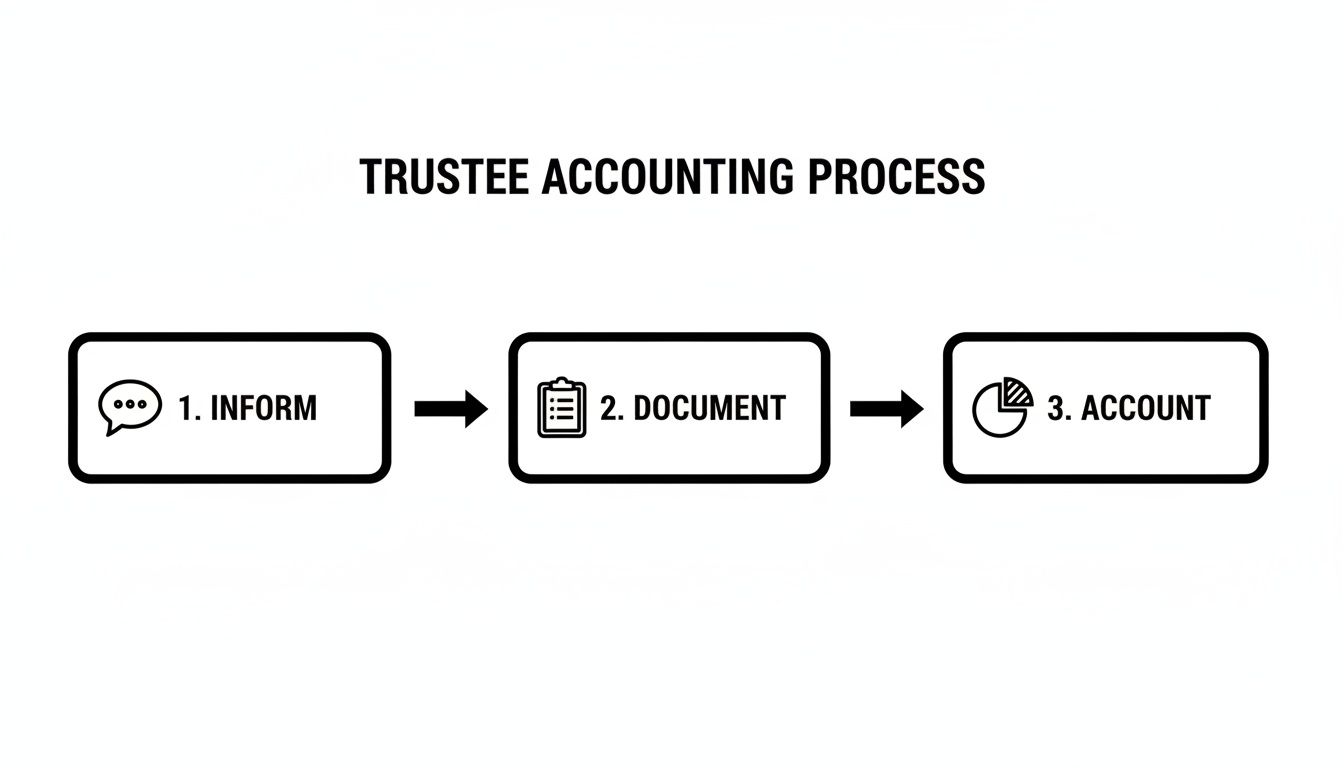
This simple workflow highlights a core truth: transparent communication and detailed records are the foundation of proper financial management and distributions.
Strategies for Asset Protection
Managing trust property also means protecting it from potential threats. This extends beyond investment choices to actively shielding assets from creditors or legal claims—both against the trust and its beneficiaries.
For example, if the trust owns a rental property, your duty includes ensuring it is properly insured and potentially holding it within an LLC to limit liability. A well-structured and properly administered trust is one of the most powerful tools for asset protection, safeguarding a grantor’s legacy for future generations.
A Critical Reminder: The trust document dictates everything. When it comes to distributions, your personal judgment is secondary to the grantor's written instructions. If the terms are unclear, seek legal advice before acting. This proactive step can save you from significant personal liability.
Common Mistakes and How to Avoid Trust Disputes

Most trust disputes arise not from bad intentions, but from simple, preventable mistakes. Knowing the common pitfalls is the best way to steer clear of family conflict and costly legal battles.
By understanding these common errors, you can proactively avoid trouble and keep the peace. Identifying warning signs early allows you to correct course before issues escalate.
Ignoring Conflicts of Interest and Self-Dealing
One of the clearest prohibitions in trust administration is self-dealing. This is a direct violation of your duty of loyalty. The Texas Trust Code is unequivocal: you cannot use the trust to benefit yourself personally.
Scenario: A trustee decides to borrow money from the trust to fund a personal business venture, intending to pay it back with interest. This is considered self-dealing and is a clear breach of fiduciary duty, regardless of the trustee's good intentions. Even hiring your own company to perform services for the trust, such as real estate repairs, creates a conflict of interest that can lead to legal challenges.
Playing Favorites Among Beneficiaries
Trusts often have multiple beneficiaries, and your duty is to treat them all impartially according to the terms of the trust document. Showing favoritism, whether intentional or not, is a guaranteed way to stir resentment and legal challenges.
This often occurs when a trustee has a closer personal relationship with one beneficiary. For instance, if a trust allows for distributions for "health and education," a trustee might quickly approve funds for a niece they see regularly while scrutinizing every request from a nephew who lives out of state. This unequal treatment can be considered a breach of duty.
The Dangers of Poor Record-Keeping
A disorganized paper trail is a breeding ground for suspicion. If you cannot provide a clear, documented answer when a beneficiary asks for information, they may assume the worst. As discussed, providing a formal accounting is one of your core trustee duties in Texas.
Without meticulous records of every transaction, preparing an accurate accounting is impossible. This not only violates the Texas Trust Code but also leaves you personally liable if you cannot prove you managed the assets responsibly. It is crucial to understand what constitutes a breach of fiduciary duty for a trustee to avoid these pitfalls.
Failing to Delegate to Professionals
Many trustees try to do everything themselves to save the trust money. While noble, this can backfire significantly. Managing a complex investment portfolio, filing specialized tax returns like Form 1041, or appraising unique assets are not DIY tasks.
Under the "Prudent Investor Rule," part of your duty is recognizing when to seek expert help. A trustee who attempts to day-trade with trust funds and loses money has almost certainly breached their duty. Hiring a qualified financial advisor, CPA, or attorney is a sign of a responsible trustee. These professional fees are a legitimate administrative expense paid by the trust.
When You Should Seek an Estate Planning Attorney
Taking on the role of a trustee is a serious commitment, but you don't have to do it alone. The most successful trustees are not those who know everything, but those who know when to ask for help. Trying to navigate every complex legal or financial issue yourself is a significant risk—for both the trust and for you personally.
Hiring a Texas trust administration lawyer is not an admission of failure; it is a mark of prudence. It shows you are taking your duties seriously and acting to protect the assets you are in charge of. While some trustees hesitate due to cost, legal fees are almost always considered a standard administrative expense paid directly from the trust's funds.
When Legal Guidance Is Essential
Certain situations carry higher stakes and require a legal professional to ensure you fulfill your fiduciary duties. Navigating these scenarios without an attorney is like sailing through a storm without a compass.
You should contact an attorney immediately if you encounter:
- Unclear Trust Language: If the trust document is ambiguous about distributions, investments, or beneficiary rights, never guess. An attorney can interpret the grantor's intent and, if necessary, seek clarification from a court to protect you from liability.
- Disagreements with Beneficiaries: When beneficiaries question your decisions, make unreasonable demands, or threaten legal action, a lawyer becomes your first line of defense. They can facilitate communication and mediate disputes before they escalate.
- Complex Asset Transactions: Selling a business, managing a large portfolio, or selling real estate involves complex contracts and tax implications. A lawyer ensures the transaction is compliant with both the trust’s terms and Texas law.
- The Need to Modify a Trust: Circumstances can change, making a trust's terms outdated or impractical. Petitioning a court for how to modify a trust in Texas is a formal legal process that requires an attorney’s guidance.
Protecting Yourself and the Trust
Attempting to handle these complex issues alone can lead to costly mistakes that expose you to personal liability. Even an unintentional error can be deemed a breach of duty if it resulted from a failure to seek necessary expert advice.
An experienced attorney is more than just a lawyer; they are your strategic partner. They ensure every move is compliant, well-documented, and in the best interest of the beneficiaries. This guidance reduces your risk and provides peace of mind.
The Law Office of Bryan Fagan, PLLC offers the clear, Texas-specific guidance you need. If you're facing any of these challenges, you can learn more about how a Texas trust administration attorney can help.
Common Questions We Hear from Texas Trustees
Stepping into the role of a trustee is a big responsibility, and it’s only natural for questions to pop up along the way. Think of this as a quick, no-nonsense chat where we tackle some of the most common questions we get from trustees right here in Texas.
Can I Get Paid for Serving as a Trustee in Texas?
Yes, you can and you should. The Texas Trust Code is clear that serving as a trustee is real work, and you're entitled to "reasonable compensation" for your efforts. What's considered reasonable? It really depends on the trust itself—how complex it is, how much time it demands, and the skills needed to manage its assets properly.
The key is to keep meticulous records of your time and every task you handle. To head off any potential disputes with beneficiaries down the road, the best-case scenario is having the compensation spelled out in the trust document. If it’s not, your safest bet is to get the beneficiaries to agree on your fee or talk to an attorney to make sure it’s in line with Texas standards.
What Happens If I Make a Mistake as a Trustee?
Making a mistake can put your personal assets on the line. If an error causes the trust to lose money, a court could order you to pay the trust back out of your own pocket—this is called a "surcharge." For more serious missteps, you could even be removed from your role as trustee.
But don't panic. Not every mistake is a breach of your duties. The law in Texas understands that people aren't perfect. If you can show you were acting in good faith, with reasonable care, and didn't personally gain from the error, you may have a solid defense. If you even have a hunch you’ve made a mistake, the first thing you should do is call a Texas trust administration lawyer. They can help you figure out your options and minimize any potential fallout.
How Long Do I Have to Serve as a Trustee?
Your job as trustee lasts until the trust officially ends based on its own terms. That could be when a beneficiary hits a certain age, or perhaps once all the assets have finally been handed out. You can also choose to resign, but you have to do it by the book, following the rules laid out in both the trust agreement and the Texas Trust Code.
Resigning isn’t as simple as just walking away. It usually means preparing a final accounting for the beneficiaries, giving them proper notice, and making sure there’s a smooth handover to the next trustee. And remember, your duties—and your potential liability for your actions—stick with you until you are formally released from your responsibilities.
If you’re managing a trust or planning your estate, contact The Law Office of Bryan Fagan, PLLC for a free consultation. Our attorneys provide trusted, Texas-based guidance for every step of the process.