Skip to content
When you suspect money is missing from a family trust, the emotional hit is immediate. You may be grieving, trying to help siblings or parents, and suddenly facing bank records that don't make sense. A trustee may be vague, defensive, or silent. That combination often leaves beneficiaries wondering whether the problem is a simple paperwork issue or something more serious.
Texas law gives beneficiaries and fiduciaries tools to get answers, but the right response is rarely a rushed accusation. The better approach is structured, documented, and patient. Tracking how to track missing trust money Texas often involves more than a name search in a state database. In many cases, the harder question is whether the money was mishandled, transferred, or never properly accounted for by the person in charge.
Trust administration in Texas is built on fiduciary duties. That means a trustee is expected to act loyally, carefully, and in the interest of the beneficiaries. When those duties break down, the problem becomes legal as well as financial. The Texas Trust Code and, in related estate matters, the Texas Estates Code provide the framework for demanding records, forcing an accounting, and asking a court to step in when necessary.
A calm process usually works better than an emotional one. Preserve documents. Identify what is missing. Separate trust assets from probate assets and personal property. Then decide whether the issue can be resolved with a formal request or whether litigation is needed.
Discovering a Loved One's Trust Is a Sacred Duty Not a Financial Burden
Individuals in this position never expected to become an investigator. They expected the trustee to handle things properly, keep records, and communicate transparently. When that doesn't happen, families often swing between denial and confrontation. Neither helps much.
What helps is treating the problem as a fiduciary administration issue first. A trust exists to carry out someone's wishes. Protecting that trust is not greed. It is part of protecting a loved one's legacy and making sure the right people receive what the trust was meant to hold.
What usually goes wrong
In practice, missing trust money often falls into a few broad categories:
- Poor bookkeeping that makes assets look missing when the trustee failed to organize records
- Dormant or closed accounts that were never followed after a death, resignation, or trustee change
- Improper transfers to the trustee, a related person, or an outside account
- Mixed ownership problems where no one clearly separated trust assets from individually owned property
- Unclaimed funds issues tied to old checks, bank accounts, dividends, insurance proceeds, or mineral interests
Some of these problems involve bad administration. Some involve a breach of fiduciary duty in Texas. A few involve both.
Practical rule: Don't assume theft, and don't assume innocence. Assume you need proof.
Why a methodical response matters
Beneficiaries sometimes make the mistake of sending a furious email before they understand the records. That can alert a dishonest trustee without improving your position. It can also make settlement harder if the problem turns out to be sloppiness rather than misconduct.
A better first move is to build a file. Gather the trust agreement, amendments, past statements, tax records, distribution records, and prior communications. Identify the trustee's powers and duties. Look for signs of delay, inconsistency, or missing support.
In such situations, a Texas trust administration lawyer can help frame the problem correctly. The question isn't only “Where did the money go?” It's also “What was the trustee required to do, when, and what records should exist if the trustee did it properly?”
That shift in mindset matters. It turns panic into a workable plan.
Your First Steps When Suspecting Missing Trust Funds
Before you call the trustee, build your paper trail. Most successful recovery efforts begin with organization, not confrontation.
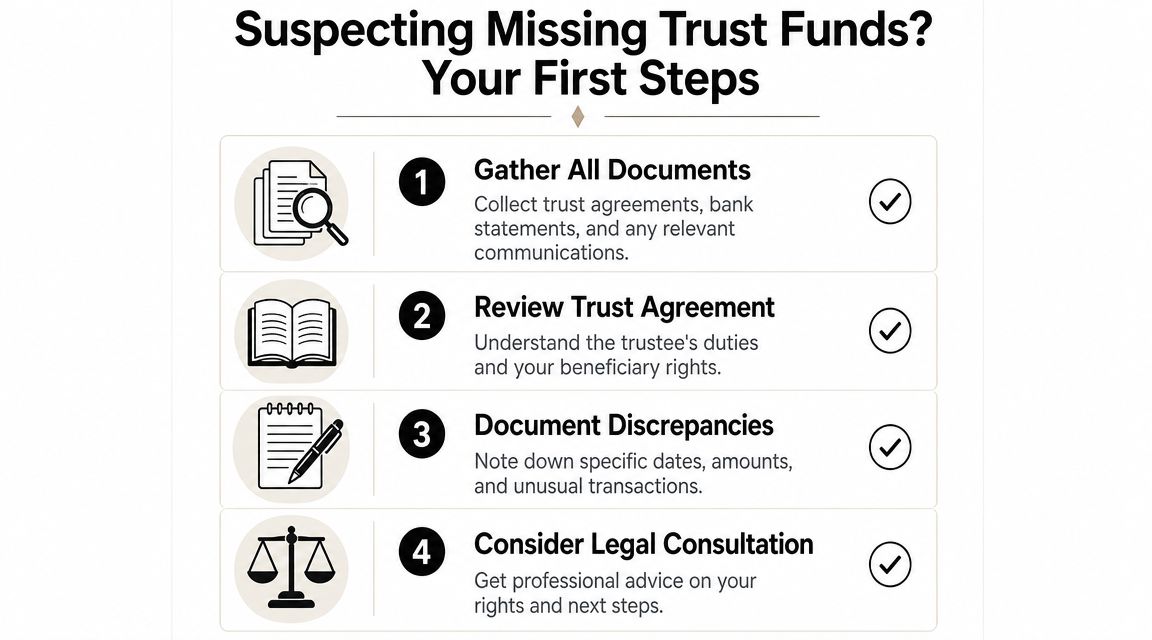
Start with the documents you already control
Look for originals and copies. Family members often have more than they realize. A prior trustee may have emailed statements. An accountant may have sent tax schedules. A parent may have left paper files in a safe, office, or digital folder.
Gather these first:
- The trust instrument and amendments so you can confirm who served as trustee, who the beneficiaries are, and what powers exist.
- Bank and brokerage statements for any account that might have held trust funds.
- Canceled checks and wire confirmations if available.
- Distribution logs or informal summaries sent to beneficiaries.
- Tax returns and K-1s that may show income from accounts not listed elsewhere.
- Letters, emails, and text messages discussing trust assets, distributions, or account changes.
If the trust is connected to a probate estate, include letters testamentary, letters of administration, inventories, and any court filings. Trust disputes often overlap with probate, which is why families frequently need coordinated help with estate planning, probate, guardianship, and asset protection issues rather than a narrow one-document review.
Build a discrepancy log
A simple timeline is more useful than a stack of unsorted records.
Create a working log with:
- Dates of major events, including death, trustee appointment, resignation, property sale, and distributions
- Accounts or assets believed to exist
- Last known balance or value
- What support exists
- What is missing
- Who may have relevant records
This record becomes your roadmap. It also helps your lawyer or forensic accountant avoid wasting time recreating basic facts.
The strongest early cases usually come from dated records, not suspicions.
Check whether the funds are dormant rather than gone
Texas maintains an official unclaimed property system that can sometimes surface trust-adjacent assets. The Texas Comptroller says the state has returned more than $5 billion in unclaimed property, and the program includes abandoned bank accounts, uncashed checks, overpayments, payroll and vendor checks, unredeemed gift cards, insurance proceeds, dividends, and mineral interests through Texas ClaimIt.
That matters because some “missing” trust money was never stolen. It may have become dormant after a trustee changed addresses, a beneficiary moved, a check went stale, or a financial institution lost contact.
Still, many online guides often conclude their instructions prematurely. Public guidance often focuses on simple owner searches, but it doesn't clearly walk fiduciaries through the proof chain needed to show authority or distinguish trust assets from personal property, as reflected in the Texas comptroller's unclaimed property guidance for fiduciaries and owners.
For a beneficiary trying to force transparency, a database search is only one small step. If you need to understand what a proper accounting demand looks like, this guide on getting a trust accounting in Texas is often the next practical step.
What not to do yet
Avoid these common mistakes:
- Don't accuse before reviewing records. A weak accusation can harden positions.
- Don't accept verbal explanations. If it matters, it needs documentation.
- Don't mix trust issues with family grievances. Courts care about records and duties.
- Don't rely on one website search. Trust money may sit in a bank, brokerage, county record system, or litigation-related account.
If you start here, you'll know whether you're dealing with delay, confusion, or a real breach of fiduciary duties in Texas.
How to Formally Request an Accounting from a Trustee
Once you have a baseline, the next move is formal. A trustee who is acting properly should not fear transparency. A trustee who avoids it often reveals the problem by the way they respond.

Why formality matters
An informal email may be ignored or answered with half-information. A formal written demand creates a clearer record. It shows that the beneficiary asked for specific information, identified their interest, and gave the trustee a chance to respond.
A proper accounting should do more than offer broad assurances. It should let a beneficiary follow the movement of trust property. If a trustee says, “Everything was used for trust purposes,” that's not enough by itself. The records should show what came in, what went out, when it happened, and why.
The Texas Trust Code is important in practical terms. Beneficiaries generally have rights to information, and trustees carry ongoing fiduciary obligations of loyalty, prudence, and disclosure. Those duties are not optional because a trustee finds questions inconvenient.
What to ask for
A formal accounting request usually seeks:
- Asset identification for all trust accounts, investments, real property interests, and business interests
- Receipts and deposits into the trust
- Disbursements and distributions with dates and supporting backup
- Fees or compensation paid to the trustee or professionals
- Closing records for any account that no longer exists
- Tax reporting documents tied to trust income and deductions
It also helps to request supporting documents, not just summaries. A spreadsheet created after the fact is less persuasive than monthly statements, canceled checks, wire records, and tax filings.
A clean accounting answers questions before they become disputes. A vague accounting usually creates more questions.
A useful tone for the demand
The best demand letters are direct, not theatrical. They identify the trust, the beneficiary's interest, the documents requested, and a deadline for response. They also preserve the option of court intervention if the trustee refuses.
A letter often works better when it avoids personal attacks. The point is not to “win” the letter. The point is to create a record that a reasonable request was made and not properly met.
A common pattern looks like this:
| Part of the request | What it should do |
|---|---|
| Identify the trust | Name the trust and relevant dates |
| State your status | Explain that you are a beneficiary or successor fiduciary |
| Request accounting | Ask for a full written accounting and source documents |
| Set scope | List accounts, transfers, fees, taxes, and distributions |
| Preserve remedies | State that failure to comply may require court relief |
If the trustee still stalls, a court petition may be necessary. This overview of a petition for accounting in a Texas trust matter helps beneficiaries understand what that formal step looks like.
What a refusal may mean
A refusal does not prove theft. But it does change the posture of the case.
It may mean:
- the trustee has poor records,
- the trustee has legal exposure,
- the trustee used informal practices that can't withstand scrutiny, or
- the trustee is trying to delay until records become harder to obtain.
At that point, you usually stop asking for voluntary cooperation and start preparing for compulsory disclosure.
Investigative Tools to Uncover the Truth
When an accounting is incomplete, inconsistent, or obviously curated, the case moves from administrative concern to investigation. At this stage, experienced counsel and financial experts make a real difference.
Follow patterns, not isolated transactions
A technical trace-the-money approach should combine forensic accounting with outside record checks. Practitioner guidance on missing-asset investigations notes that the highest-yield evidence often comes from pattern recognition, such as recurring transfers to the same counterparty or income on tax returns that points to accounts missing from the trust's own books, as described in this discussion of tracking hidden estate and trust-related assets.
That point matters. Beneficiaries often fixate on one suspicious withdrawal. But a stronger case may come from seeing a monthly pattern, a repeated transfer to a related entity, or investment income reported for an account the trustee never disclosed.
The main investigative tools
Some tools are financial. Others come from litigation.
Forensic accounting
A forensic accountant reconstructs the money trail from incomplete records. That can include:
- tracing wires between institutions,
- matching distributions against trust terms,
- comparing tax return entries to missing accounts,
- identifying self-dealing patterns, and
- quantifying losses for a surcharge claim.
In a serious dispute, the accountant's role is not only to find money. It's to convert messy records into evidence a judge can follow.
Discovery requests and subpoenas
If litigation begins, your legal team can seek records directly from the trustee and, when appropriate, from third parties. Banks, brokerages, accountants, and business entities may hold better records than the trustee does.
A subpoena can be especially important when the trustee claims documents were lost or destroyed. Third-party statements, signature cards, wire logs, and tax reporting records often survive long after informal family files disappear.
Depositions
Depositions place the trustee and other witnesses under oath. They are useful when the paper record raises obvious contradictions.
A trustee may say a transfer was for trust expenses. A deposition tests whether the trustee can identify the payee, purpose, approval, and supporting document. Vague testimony can become as important as the bank record itself.
Asset tracing beyond bank accounts
A bank review alone is often too narrow. Missing trust assets can be converted into other forms. That includes real property, business interests, brokerage positions, or successor entities. In some matters, trust-related money may also intersect with bankruptcy or litigation proceeds.
For federal money tied to Texas trust and estate matters, the Southern District of Texas maintains a separate unclaimed-funds process. The court instructs claimants to review its ledger and submit specific documents, including an original application, a certificate of service, a proposed order, and a completed W-9, with service on the U.S. Attorney, the U.S. Trustee, and other interested parties through the Southern District of Texas federal unclaimed funds process. That process exists outside the state unclaimed-property database and is easy to miss if your search stays too narrow.
If the money truly disappeared, the records usually show movement before they show absence.
Choosing the right help
Not every case needs full litigation on day one. Some need a demand letter and accountant review. Others need immediate court action because the trustee is still controlling assets.
One option families sometimes use is a firm that handles trust administration and trust disputes in the same practice. For example, Law Office of Bryan Fagan, PLLC trust administration resources address issues involving trustee conduct, accounting, and related fiduciary disputes. The right fit depends on whether your matter is primarily administrative, investigative, or headed toward trial.
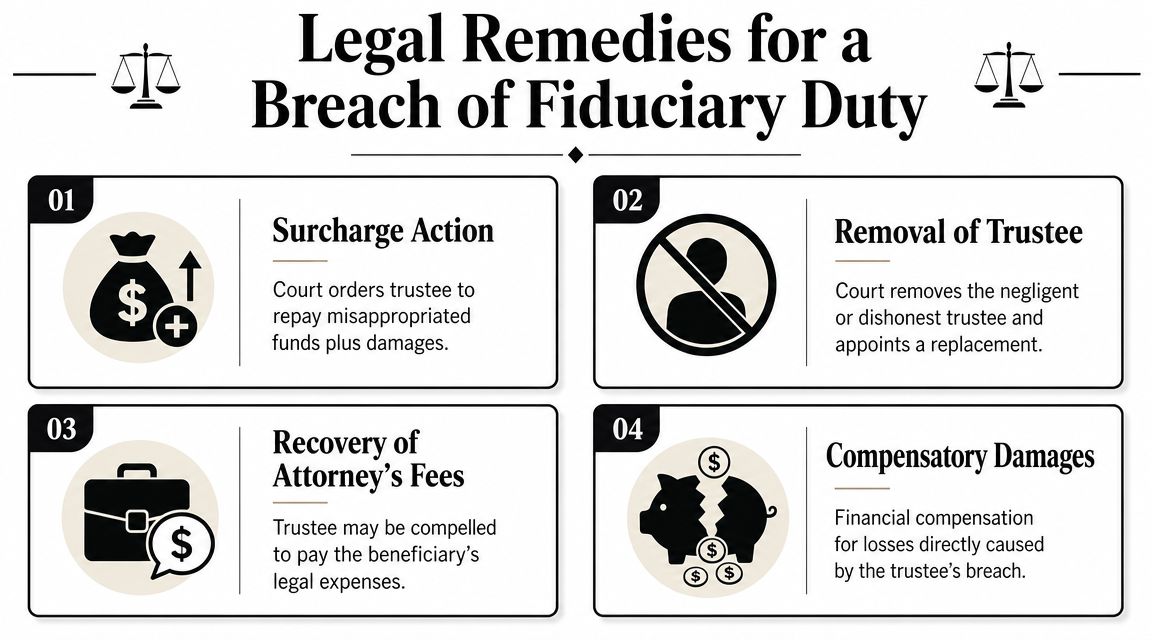
Your Legal Remedies for a Breach of Fiduciary Duty
Once you have evidence, the focus shifts from discovery to remedy. The purpose of a trust lawsuit is not merely to complain about unfairness. It is to protect the trust, recover losses, and stop ongoing harm.
The core claim
The central claim in many of these cases is breach of fiduciary duty. In plain English, that means the trustee failed to act with the loyalty, honesty, prudence, and care required by Texas trust law.
That can involve:
- self-dealing,
- unauthorized distributions,
- failure to keep records,
- failure to disclose material information,
- improper commingling of assets, or
- negligent investment or administration decisions.
Texas trust litigation often also intersects with the Texas Estates Code when the same family dispute includes probate administration, death-related transfers, or authority questions involving an executor or administrator.
The main remedies and what they do
Different remedies solve different problems. They are tools, not labels.
Surcharge
A surcharge action asks the court to hold the trustee personally responsible for losses caused by misconduct or mismanagement. If the trust suffered financial harm because of the trustee's breach, surcharge is often the direct path to making the trust whole.
Removal of trustee
If the current trustee cannot be trusted to continue, removal may be necessary. Courts look closely at whether the trustee's conduct threatens the trust, frustrates administration, or destroys confidence to the point that continued service is not workable.
Recovery of property or turnover-style relief
Sometimes the issue is not abstract loss but specific property. The goal then is to compel return of the account, funds, or asset that should still be in trust hands.
Attorney's fees and related relief
In the right case, a court may award attorney's fees or other relief connected to the fiduciary breach and the litigation required to address it.
A practical comparison
| Remedy | Best used when | Main purpose |
|---|---|---|
| Surcharge | Money was lost through breach | Repay the trust |
| Removal | Trustee can't continue safely | Protect future administration |
| Return of property | Specific asset was diverted | Restore trust ownership |
| Fee recovery | Litigation was necessary | Shift some financial burden |
Civil remedies usually matter more than outrage. Courts want proof, losses, and a clear request for relief.
Expectations after filing
Families often want to know how long a claim or recovery process will take. For state unclaimed property, Texas offers an online status check, but public-facing material gives little detail about turnaround times, denial reasons, or appeals, especially when trust-related records are incomplete, as shown on the Texas claim status page. That same uncertainty appears in trust disputes. Cases involving old records, deceased settlors, or informal administration usually take longer and require more documentation than straightforward owner claims.
This is why early evidence work matters so much. A beneficiary with organized records, a clean request history, and a coherent damages theory usually has a stronger standing than one relying on suspicion alone.
Why early legal action is often better than waiting
Some beneficiaries delay because they hope the trustee will “eventually explain.” That can be expensive. Records get harder to locate. Witness memories fade. Assets may be moved again. Delay also encourages a resistant trustee to believe no one will push back.
If the facts point to mismanagement, prompt civil action is usually more effective than threatening criminal charges. Most trust disputes are resolved through the civil court system because the immediate need is to obtain records, freeze the problem, remove the trustee if necessary, and recover money for the trust.
Navigating Deadlines and Deciding on Your Next Steps
Timing matters in trust disputes. Waiting too long can weaken a claim, make tracing harder, or in some situations jeopardize your ability to recover at all. The exact deadline depends on the claim, the trust language, the facts, and when the beneficiary knew or should have known enough to act. That is one reason generalized internet advice is dangerous here.
What to do if you are near the edge
If you already have strong concerns, take these steps quickly:
- Preserve records now. Save paper files, screenshots, emails, and statements.
- Stop relying on oral updates. Ask that future explanations be given in writing.
- Identify the legal role of each person involved. Trustee, co-trustee, executor, agent, and beneficiary are not interchangeable roles.
- Get the trust reviewed promptly. The terms of the instrument shape the remedies.
- Separate civil strategy from criminal frustration. Even where conduct feels dishonest, the first useful path is often a civil petition for records, removal, or repayment.
Civil court is usually the working forum
Families often ask whether the trustee can be “charged.” Sometimes law enforcement becomes part of a case, but that is not where most trust disputes begin or end. Criminal cases have a high threshold and a different purpose. Civil court is where beneficiaries usually obtain accountings, subpoenas, depositions, surcharge relief, trustee removal, and orders that restore the trust.
That's also why working with a Texas estate planning attorney or trust litigator matters. The legal issue is not just bad behavior. It is whether the conduct violated fiduciary duties in Texas and what remedy the court can realistically enforce.
If you're dealing with uncertainty, don't wait for the problem to fix itself. Missing trust money cases become manageable when you narrow the facts, request the right records, and act before the trail goes cold.
If you're managing a trust, planning your estate, or worried that trust funds have gone missing, Law Office of Bryan Fagan, PLLC offers a free consultation. Our attorneys assist trustees, beneficiaries, executors, and families with Texas trust administration, probate, guardianship, asset protection, and dispute resolution, providing clear, practical guidance specific to the facts of your case.