A lot of families expect conflict over money. They don't expect someone to say, “I don't want it.”
That moment can stop an estate or trust administration in its tracks. A child may feel overwhelmed by inherited property. A surviving spouse may worry about taxes or future planning. A beneficiary with health-related benefits may fear that receiving assets could create problems. A trustee may wonder whether to hold the distribution, redirect it, or ask the beneficiary to sign something.
In Texas, this situation is unusual, but it isn't a dead end. What happens if a beneficiary refuses a distribution depends on what exactly is being refused, how the refusal is handled, and whether the trust or will requires a formal legal disclaimer. It also matters whether the issue is a beneficiary declining property, a trustee withholding a required payout, or a beneficiary refusing to sign a release after an accounting.
Families often think a verbal refusal is enough. It usually isn't. Estate and trust administration runs on written authority, deadlines, and fiduciary duties. If you are a beneficiary, trustee, or executor, the safest approach is to slow down, document everything, and follow the governing document and Texas law carefully.
Navigating an Unexpected Decision in Estate Administration
A common Texas scenario looks like this. A father dies, and his revocable trust becomes irrevocable. His daughter is supposed to receive a share of trust assets. Instead of accepting it, she tells the trustee, “Please let it go to my kids.”
That sounds simple. In practice, it raises several legal questions right away.
Can she just step aside? Does the trustee have to get something in writing? Do the assets pass to her children automatically? Could she change her mind later? If she already used trust funds, even in a small way, has she lost the ability to refuse the inheritance properly?
Those questions matter because trustees and executors in Texas don't have authority to improvise. They owe fiduciary duties in Texas, which means they must act carefully, loyally, and according to the trust instrument, will, and applicable law. They cannot treat a casual conversation as final legal direction.
Practical rule: If a beneficiary wants to refuse property, nobody should assume the next step. The refusal should be evaluated before any distribution moves forward.
Texas families also get tripped up by terminology. People use phrases like “waive it,” “turn it down,” or “give it to someone else.” Legally, those are not all the same thing. In many situations, the formal tool is a qualified disclaimer. That is a legal refusal with specific consequences. If done correctly, the law generally treats the beneficiary as though that person died before the person who created the estate plan.
That legal fiction may feel strange, but it serves an important purpose. It tells the trustee or executor where to look next for the proper recipient.
Understanding the Qualified Disclaimer in Texas
A qualified disclaimer is not just saying “no thanks.” It is a formal refusal of property. In Texas estate administration, that distinction is critical.
It's akin to forfeiting a prize under official contest rules. You are not handing the prize to a friend. You are stepping out of line completely, and the rules decide who stands next in line. That is why a disclaimer is different from gifting inherited property after you receive it. A gift means you accepted the property first. A disclaimer means you never accepted it in the first place.

What a disclaimer does
When a beneficiary properly disclaims an inheritance, the estate or trust generally treats that beneficiary as having predeceased the decedent for distribution purposes. That means the trustee or executor must go back to the will or trust and follow the next instruction in the document.
People often get confused because a disclaiming beneficiary usually cannot direct where the property goes next. The governing instrument controls that result.
If you want a broader explanation of the concept, this overview of what a disclaimer means in trust administration is a helpful starting point.
What a disclaimer does not do
A disclaimer is not the same as refusing to sign a receipt, release, or waiver. Those are separate issues.
One verified source explains that refusal can lead to very different consequences depending on the situation. If a trustee is withholding a mandatory distribution, a beneficiary may petition a probate court to compel distribution, and the court may order relief that can include specific performance, deadlines, damages, trustee removal, and sometimes attorney's fees, as described in this discussion of trustee refusal to distribute assets. By contrast, when a beneficiary refuses a release or waiver after receiving an accounting, that refusal may preserve the claim period instead of closing it out.
That distinction matters in real life. A beneficiary who says, “I'm not signing this release,” may be protecting legal rights. A beneficiary who says, “I don't want the inherited property,” may need a qualified disclaimer instead.
Why trustees need to pause here
A trustee's first job is not speed. It is accuracy.
Under the Texas Trust Code and fiduciary principles, a trustee should identify the nature of the refusal before acting. If the beneficiary is disclaiming property, the trustee needs to verify that the refusal is legally effective. If the beneficiary is rejecting a release, that is a dispute-management issue, not a redistribution issue.
A trustee who guesses wrong can expose the trust, and possibly themselves, to avoidable litigation.
The Step-by-Step Process for Disclaiming an Inheritance
A valid disclaimer depends on careful procedure, as small mistakes can create major problems.
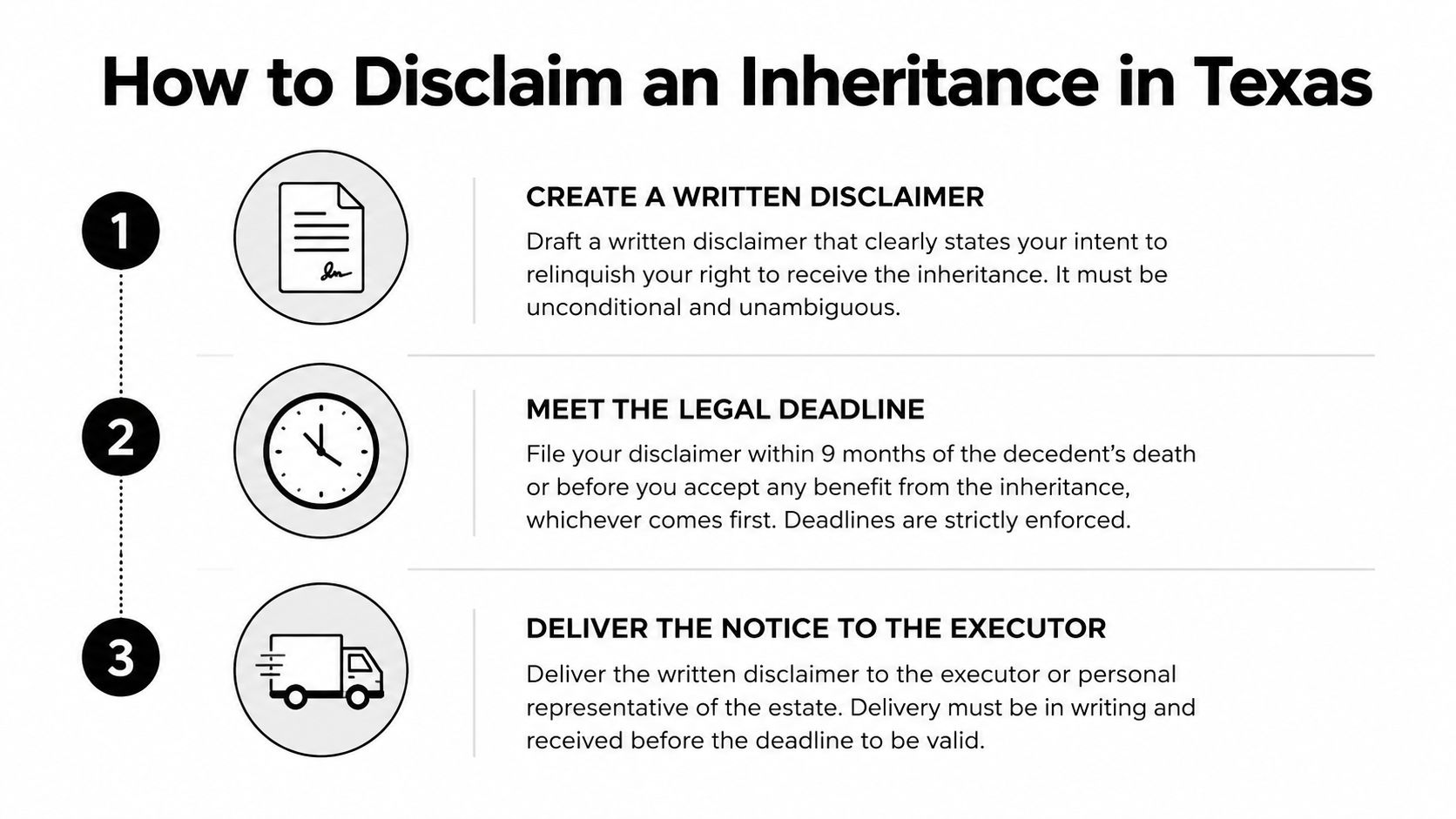
Verified guidance cited by estate-planning practitioners states that a qualified disclaimer must be delivered in writing within 9 months of the decedent's death, or if the beneficiary is under 21, within 9 months after turning 21, as explained in this discussion of refusing a trust distribution. The same source states that the beneficiary must not have accepted the property or any benefits from it, cannot direct where it goes next, and cannot receive it indirectly after disclaiming. Once validly made, the disclaimer is generally irrevocable, and the property is excluded from the beneficiary's estate for tax purposes.
Step one and step two
Two early parts of the process tend to matter most.
Put it in writing
A disclaimer should clearly identify the interest being refused. In plain English, it should say what property or share the beneficiary is disclaiming.Act before the deadline
The timing rule is strict. If the deadline passes, the beneficiary may lose the option to make a qualified disclaimer with the intended legal effect.
A vague email or family text chain usually isn't enough. Trustees and executors need a proper written document that can be kept in the administration file.
Step three and step four
The next parts are where beneficiaries often make accidental mistakes.
| Issue | Why it matters |
|---|---|
| Acceptance of benefits | If the beneficiary has already accepted the property or a benefit from it, the disclaimer may fail. |
| Control over destination | A beneficiary generally cannot disclaim and then choose the next recipient. |
| Indirect benefit | A beneficiary cannot refuse the property and still receive it through the back door. |
Here is a simple example. Suppose a beneficiary is entitled to receive rental income from inherited real estate. If that beneficiary takes the rent payments first and then tries to disclaim the property interest, there may be a serious problem. The same concern can arise if the person moves into inherited property, uses inherited funds, or otherwise acts like an owner.
Delivery matters too
The disclaimer also needs to be delivered to the right person, usually the executor or trustee handling the administration.
That point sounds minor, but it isn't. A signed document sitting in a desk drawer doesn't help anyone. The fiduciary must receive it so the administration can proceed correctly and the file can show who knew what, and when.
Client advice: If you think you may disclaim, don't deposit checks, transfer title, use the asset, or make side agreements with relatives before speaking with counsel.
Why legal review is worth it
Under the Texas Estates Code and Texas trust administration practice, disclaimers interact with distribution clauses, contingent beneficiaries, tax planning, and family dynamics. The legal effect may be very different depending on whether the inheritance comes through a will, a trust, or a non-probate asset.
A Texas estate planning attorney or Texas trust administration lawyer can help the beneficiary prepare the disclaimer and help the fiduciary decide whether it should be honored as presented. That review is especially important when the trust has layered beneficiaries, special instructions, or disputed family relationships.
Common Reasons for Refusing an Inheritance
People don't refuse an inheritance because they are careless. Most of the time, they are trying to solve a problem.

Family planning and next-generation goals
A parent may decide that the assets would do more good in the hands of children or grandchildren. In that situation, the emotional goal is often simple. The parent doesn't need the property and would rather let it pass down the line under the estate plan's terms.
That doesn't mean the parent can rewrite the trust. It means the parent may consider stepping aside so the document controls the next transfer.
Concerns about taxes and estate size
Some beneficiaries worry that accepting additional assets could complicate their own estate planning. The exact impact depends on the asset, the person's existing estate plan, and the broader tax picture.
Legal advice is especially useful. A disclaimer can be part of thoughtful planning, but only if the document and the timing line up correctly.
Creditor and liability concerns
Another common reason is exposure to creditors or financial instability. A beneficiary dealing with debt, lawsuits, or business risk may hesitate to accept inherited property.
Families often think this is a simple asset-protection move. Sometimes it may help with planning goals. Sometimes it may not. The trustee should not assume the reason makes the disclaimer valid. The beneficiary should not assume the strategy will work without careful review.
Government benefit eligibility
A beneficiary who receives needs-based benefits may worry that a direct inheritance could interfere with eligibility. That concern comes up often when a family member has long-term care needs, a disability, or limited income.
This is a sensitive area because one wrong move can create expensive consequences. The legal form of the inheritance, and the way the refusal is handled, can matter a great deal.
A short video can help explain why these choices should be made carefully and early in the process.
Sometimes the asset is simply a burden
Not every inheritance feels like a blessing. A beneficiary may inherit a house that needs major repairs, mineral interests that require administration, or a business interest that brings responsibilities the beneficiary doesn't want.
That kind of refusal is often emotional as much as legal. The beneficiary may feel guilt for saying no. The trustee may feel pressure to persuade the person otherwise. In most cases, the better approach is calm documentation and legal clarity.
What Happens to the Disclaimed Property
Once a disclaimer is accepted as valid, the next question is immediate and practical. Who gets the property now?
The answer usually comes from the governing instrument. The trust or will should be read as though the disclaiming beneficiary had died before the person whose estate is being administered. That legal assumption tells the trustee or executor where to look next.

The trustee's roadmap
A trustee should move carefully and in order.
Confirm the disclaimer is valid
Review the writing, timing, delivery, and surrounding facts. If there is doubt, get legal advice before distributing anything.Read the trust or will for contingent beneficiaries
Many estate plans name backup beneficiaries. If the primary beneficiary is treated as predeceased, the trustee follows the backup provision.Document the decision trail
Keep the disclaimer, correspondence, notes, and distribution records together. Good records protect both the fiduciary and the beneficiaries.Make the new distribution properly
Transfer the property only after the trustee is satisfied that the legal basis for the new recipient is clear.
For trustees handling this process, this overview of the distribution of trust assets in administration gives a useful framework for the larger distribution stage.
A short example
Suppose a Texas trust says: “My son receives the lake house. If he does not survive me, then the lake house passes to his children, in equal shares.”
If the son makes a valid disclaimer, the trustee will generally read that clause as if the son died first. The children become the next likely recipients under the trust language.
That doesn't happen because the son chose them after the fact. It happens because the trust already did.
Fiduciary duties still control
Under the Texas Trust Code and general fiduciary principles, trustees must act in good faith, remain loyal to the beneficiaries, and administer the trust according to its terms. Executors handling estate property face similar obligations under the Texas Estates Code.
Trustees should never treat a disclaimer as a family convenience form. It changes legal rights, so the file should show careful review and precise follow-through.
This is also a good place to learn from broad trust-administration comparisons. While Texas law governs Texas estates and trusts, readers sometimes find it helpful to see how administration issues are framed elsewhere, such as this resource on understanding trusts after someone dies in Hawaii. The details differ by state, but the practical lesson is the same. The governing document controls, and the fiduciary must follow it.
When things become contested
Sometimes the hardest part is not identifying the next beneficiary. It is handling disagreement.
A family member may argue the disclaimer was too late. Another may claim the beneficiary already accepted benefits. A trustee may worry that making the wrong distribution could create personal liability. In those cases, a Texas trust administration lawyer can help the fiduciary evaluate options, preserve neutrality, and decide whether court involvement is necessary.
Your Next Steps A Guide for Beneficiaries and Trustees
When families ask what happens if a beneficiary refuses a distribution, they usually need a checklist, not a lecture. Here is the practical version.
If you are the beneficiary
Start by stopping. Don't use the asset, don't take income from it, and don't make side promises about who should receive it instead.
Then gather the key documents. That usually includes the trust, the will, any notice from the executor or trustee, and any proposed receipt or release. A lawyer can review whether you are considering a disclaimer, or whether you are dealing with a different issue entirely.
If you want a broader consumer-friendly explanation of inheritance investigation and related administration issues, this BDJ Express Law inheritance guide may help you think through the practical side of the process.
Beneficiaries should also understand their rights during administration. This guide to beneficiary rights in Texas trust administration is useful if you are trying to understand what information you can request and how to protect your position.
If you are the trustee or executor
Your role is different. You are not there to coach the beneficiary into one outcome or another. You are there to administer the estate or trust correctly.
That means you should verify the refusal, review the governing document, and avoid distributing the property until the path is clear. If the beneficiary is refusing a release after an accounting, treat that as a legal-rights issue. If the beneficiary is disclaiming the inheritance itself, treat that as a distribution issue with tax and fiduciary consequences.
This is also the point where legal help can prevent expensive mistakes. A Texas trust administration lawyer can review the disclaimer, identify the next beneficiary, and help document the file. For families who need that kind of support, the Law Office of Bryan Fagan, PLLC handles Texas trust administration, probate, estate planning, guardianship, and asset protection matters.
Why independent advice matters
Beneficiaries and fiduciaries often assume one lawyer can casually “explain it to everyone.” Sometimes that works for basic administration. In a disclaimer situation, interests can diverge quickly.
The beneficiary may want personal advice about tax planning, family planning, or benefits. The trustee may need separate advice about fiduciary duties in Texas and how to avoid misdistribution. Independent counsel isn't an extra layer of drama. It is often the cleanest way to protect everyone involved.
If you're managing a trust or planning your estate, contact Law Office of Bryan Fagan, PLLC for a free consultation. Our attorneys provide trusted, Texas-based guidance for every step of the process.