Owning rental property in Texas often starts as a practical investment decision. Then life gets more complicated. You add another house, refinance one property, sign leases, update insurance, and eventually realize your estate plan hasn't kept pace with what you've built.
That's usually when the question comes up: should you move your rentals into a trust?
For many Texas landlords, the answer is yes. But transferring rental properties into a trust in Texas only works well when the trust is created correctly, the deed is drafted and recorded properly, and the lender, insurer, and tax offices are updated afterward. The two mistakes I see most often are simple but costly. Owners assume a trust gives liability protection it may not give, and they treat the mortgage due-on-sale issue as something to ignore rather than address directly.
Texas law gives property owners useful planning tools through the Texas Trust Code, the Texas Estates Code, and long-standing fiduciary principles that govern how trustees manage trust assets for beneficiaries. Used correctly, a trust can make succession smoother and reduce court involvement later. Used casually, it can leave title problems, loan issues, and insurance gaps behind.
Why Texas Landlords Consider a Trust for Rental Properties
A common Texas landlord scenario looks like this: one spouse handles the rentals, knows every tenant by name, and keeps the repair history in a phone note or filing cabinet. The other spouse knows the properties exist, but not the details. If the managing spouse dies or becomes incapacitated, the family suddenly has rent coming in, vendors calling, and real property titled in an individual name.
That's where a trust often becomes part of the solution.

A key reason rental owners use trusts is probate avoidance. Assets placed in a revocable trust can pass to beneficiaries without going through probate, which is often described as a lengthy and costly court process, as explained in this discussion of probate avoidance for rental property owners. For landlords with more than one property, that can mean a more orderly transition when a successor trustee needs to step in and manage the portfolio.
What a trust solves well
A trust is usually strongest as a succession and management tool. It can help with:
- Continuity during incapacity so a successor trustee can act if the original owner can't
- Private administration because trust administration is generally different from a public probate file
- Clear instructions for who manages, who benefits, and how the property should be handled
- Portfolio coordination when several rentals need to pass under one plan
For landlords thinking long term, this is often a key advantage. If your children or other beneficiaries aren't experienced landlords, a trust can give the trustee authority to manage the assets under written terms rather than leaving everyone to sort things out after a death.
Practical rule: A trust is usually about control, transition, and administration. It isn't automatically a lawsuit shield.
Where owners get confused
Texas landlords often hear “put the property in a trust” and assume that means the property is protected from tenant claims. That's where planning can go off track. A trust may help the property pass outside probate, but it does not automatically replace liability planning.
That's why many investors compare a trust with an LLC, or use both in a coordinated plan. If you want a deeper look at structure options, this guide on how to structure a trust for real estate investors in Texas is a useful next read.
Under Texas fiduciary principles, a trustee also has real duties once the property is in trust. The trustee must follow the trust terms, act for the beneficiaries' benefit, keep records, and manage the asset responsibly. In plain English, creating the trust is only the beginning. Someone has to administer it correctly.
The Essential First Step Creating and Funding Your Texas Trust
Before a rental property can go into a trust, the trust has to exist. That sounds obvious, but many owners focus on the deed and skip the legal foundation underneath it.
In Texas, the trust starts with the trust instrument, the written document that sets the rules. Under the Texas Trust Code, the document identifies the parties, the powers, and the management terms. For most landlords using a living trust, the same person starts out wearing several hats. They are the person creating the trust, the initial trustee managing it, and one of the current beneficiaries.
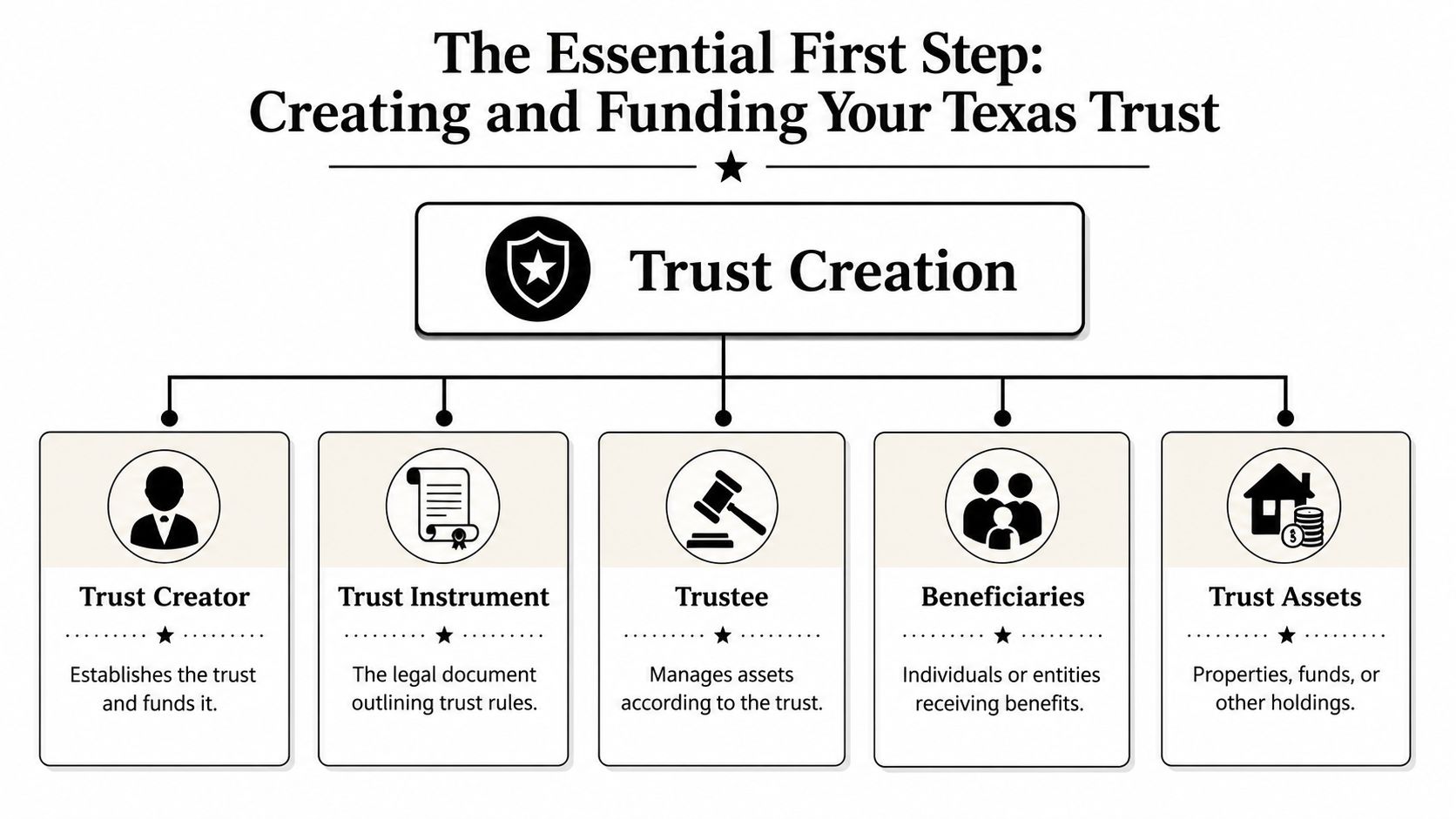
The basic roles in plain English
A Texas trust usually includes these core roles:
| Role | What the role does |
|---|---|
| Grantor | Creates the trust and transfers assets into it |
| Trustee | Manages trust property under the trust terms and fiduciary duties in Texas |
| Beneficiary | Receives the benefit of the trust property now or later |
| Successor trustee | Steps in if the initial trustee dies, resigns, or becomes unable to serve |
Rental property involves active management. Rent has to be collected. Repairs have to be approved. Leases have to be enforced. If the trust names the wrong trustee, or a trustee who won't handle those responsibilities, the plan looks good on paper but fails in real life.
Revocable and irrevocable trusts are not interchangeable
Most Texas landlords asking about rental properties are considering a revocable trust. That usually means the creator can amend it, revoke it, and continue controlling the asset during life. It's flexible, and it fits many estate planning goals.
An irrevocable trust is a different tool. It usually involves giving up some control, and whether it makes sense depends on the broader legal and tax planning picture. Owners sometimes assume “irrevocable” automatically means stronger protection in every setting. It's not that straightforward. The trust has to match the goal.
One of the most overlooked planning points is the trust-versus-LLC question. Texas practitioners distinguish ownership form from liability insulation, emphasizing that trust transfers are usually about estate administration rather than asset-protection design, as discussed in this article on whether a trust should hold Texas residential real estate.
A trust answers “who manages and inherits this property?” An LLC more directly addresses “what happens if someone sues over this property?”
Funding is what makes the trust real in practice
Clients often say, “I already have a trust,” when what they really have is a signed trust document with assets still titled in their individual names.
That gap matters.
Funding the trust means changing title or ownership so the trust holds the asset. For real estate, that usually means preparing and recording a new deed. Without funding, the trust may exist, but the rental property may still sit outside the plan you thought you created.
A few useful checkpoints before funding a rental property into a trust:
- Choose the trustee carefully. Pick someone who can handle records, tenants, repairs, and beneficiary communication.
- Coordinate with your will. A pour-over will and trust usually work together under a broader Texas estate planning attorney strategy.
- Review management language. Rental property trusts should address powers to lease, repair, insure, and sell.
- Think through incapacity. The best trust plans don't just transfer wealth at death. They also provide continuity if you can't manage the rentals yourself.
If you want to see the mechanics of moving title after the trust is in place, this article on how to transfer property to a trust covers the transfer concept in more detail.
The Transfer Process Preparing and Recording the New Deed
A lot of Texas landlords get to this stage thinking the hard part was setting up the trust. Then the deed transfer exposes the primary risk. A deed with the wrong grantor name, an incomplete legal description, or the wrong trustee language can create title problems that do not show up until a refinance, sale, or insurance claim.
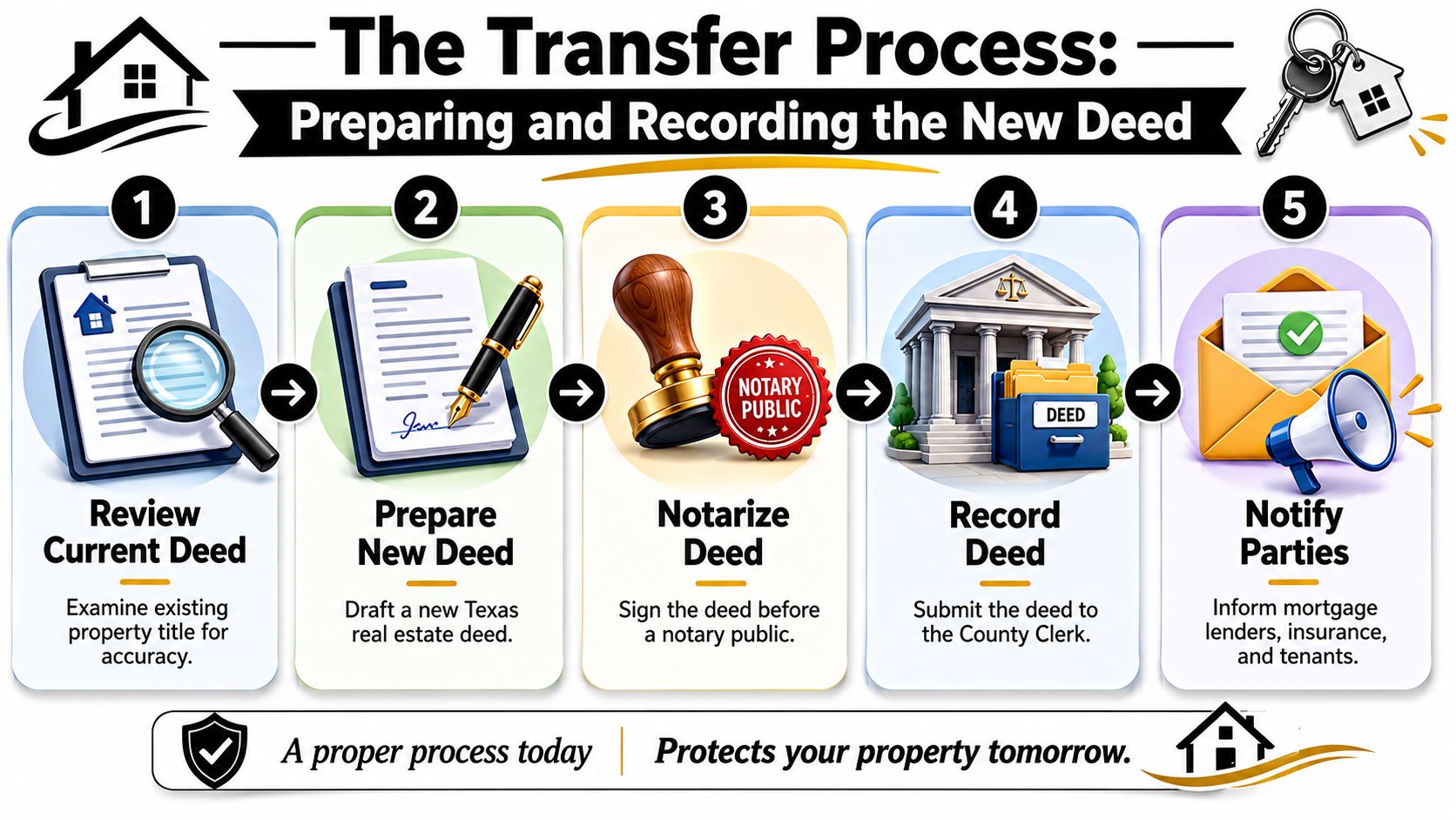
For a Texas rental property transfer into a trust, the usual sequence is straightforward. Confirm the trust is already signed and funded enough to receive title, prepare a new deed from the current owner to the trustee, sign before a notary, and record the deed in the official property records of the county where the property sits. If you want a broader overview of that title-change process, this guide on transferring property into a trust in Texas is a useful reference.
Step one: confirm exactly who owns the property and exactly how the trust will take title
Start with the current recorded deed, not your memory and not the county appraisal district website.
The new deed should track the current owner name exactly as it appears in the deed already on file. If title is vested in "John A. Smith and Mary B. Smith," the transfer deed needs to reflect that ownership accurately, including marital capacity if it affects title. I also check whether the property is owned individually, with a spouse, through an LLC, or by inherited interests that were never formally cleaned up. Those details change the deed.
The trust side has to be just as precise. In Texas, title is usually conveyed to the trustee, in the trustee's fiduciary capacity, rather than to the trust name alone. That wording matters because title companies and lenders often reject shortcuts.
Step two: use the correct legal description and deed form
The legal description controls. The street address does not.
For that reason, the description should come from the last recorded deed or another reliable title document, not from a tax bill summary or online property search. A lot and block description copied incorrectly by one line can create a title defect. On acreage, the metes-and-bounds description has to be exact, including attached exhibits.
A careful deed review usually includes:
- Current vesting exactly as shown in the county records
- Legal description copied from the prior recorded instrument
- Trustee name and capacity stated the same way the trust documents state it
- Grantor signatures from every current owner who must sign
- Spousal or entity issues that could affect enforceability or later title review
If there is an existing loan, I also want the deed language reviewed with the financing in mind. A trust transfer and a future refinance often intersect, and this discussion of refinancing property held in a Texas trust explains why lenders sometimes ask for follow-up documentation after title changes.
Step three: sign the final deed, not a draft, and sign in the right capacity
This part sounds routine. It is also where many avoidable mistakes happen.
Owners sometimes sign an old version of the deed, miss an attached exhibit, or sign only individually when the deed requires a trustee or entity capacity. A Texas county clerk may still accept a document for recording that later creates questions for a title company. Recording alone does not cure bad drafting.
The practical fix is simple. Before signing, confirm the deed is final, every exhibit is attached, names match the trust and prior deed, and the notary acknowledgment fits the person signing.
Step four: record it in the correct county
The transfer is not complete because the deed was signed and placed in a binder.
Recording puts the deed into the county's official real property records and gives the public chain of title a clear path from you, individually, to you or another person as trustee. If the deed never gets recorded, the trust may exist on paper while title still appears in your individual name. That disconnect causes problems later with title companies, casualty claims, and probate avoidance planning.
Step five: keep a clean transfer file after recording
Texas landlords should keep more than the stamped deed. Keep a copy of the recorded deed, the trust's relevant signature and trustee pages, and any certificate or abstract of trust your bank, insurer, or title company may ask for later. The Texas State Law Library's materials on wills and directives, including trust-related estate planning resources are a good public reference point for organizing estate planning records.
That file serves a practical purpose. A trust can help with management continuity and probate avoidance, but it does not replace good records, and it does not create liability protection by itself for tenant claims. If you treat the deed transfer as both a title step and a recordkeeping step, the trust is much more likely to work the way you intended.
Navigating Mortgages and the Due-on-Sale Clause
For many landlords, this is the section that matters most. They can accept the paperwork. They can handle the deed. What worries them is the mortgage.
Most loan documents contain a due-on-sale clause. In plain English, it gives the lender rights if the property is transferred without the lender's consent. The problem is that many general trust articles stop at “put it in your revocable trust” and don't explain the rental-property complication.
Federal guidance is nuanced. Transfers into a revocable trust may avoid due-on-sale enforcement only if the borrower remains a beneficiary and the transfer is not for transfer of occupancy rights, as discussed in this article on using trusts to manage real estate in Texas. That is helpful, but it isn't a blanket pass for every Texas rental transfer.
Why rental property owners need a closer review
A landlord should not assume that every deed into every trust is automatically exempt from lender review. The details matter:
| Issue | Why it matters |
|---|---|
| Type of trust | Revocable and irrevocable trusts raise different questions |
| Borrower status | The borrower generally needs to remain a beneficiary for the common federal protection discussion |
| Occupancy rights | Transfers involving occupancy changes may create added concern |
| Loan language | The promissory note and deed of trust still need to be reviewed |
Rental property owners face a practical issue that owner-occupants don't always face. The property is already leased or intended for lease. That makes clean lender communication more important, not less.
What works better than hoping the lender ignores it
The right approach is usually proactive and documented.
After the deed is recorded, notify the mortgage servicer and provide the information they request. In many cases, that means sending a copy of the recorded deed and limited trust documentation. Owners who stay silent sometimes create unnecessary anxiety later when escrow, insurance, or title records no longer match the loan file.
A useful checklist includes:
- Review the loan documents first
- Confirm the trust structure before transfer
- Keep the borrower aligned with the trust terms where required
- Notify the servicer after recording
- Save written communications and acknowledgments
Lenders don't like surprises. Most mortgage problems in this setting start with inconsistent records, not with the trust itself.
If refinancing is part of your plan, the timing matters too. Some owners should transfer after a refinance closes rather than during the loan process. For related issues, this article on refinancing a home in a trust in Texas is worth reviewing.
This is one place where legal review pays for itself. A Texas trust administration lawyer or Texas estate planning attorney can compare the trust terms, title documents, and loan language before the deed is filed, rather than trying to fix the file after the lender raises a concern.
Post-Transfer Responsibilities for Texas Landlords
The deed is recorded. Rent is still coming in. Tenants may not notice any change at all.
That is usually the point where Texas landlords assume the hard part is over. In practice, this is the stage where small administrative mistakes can undermine the plan. A trust can help with succession and management authority, but it does not excuse mismatched insurance, confused tenant notices, sloppy bookkeeping, or poor trustee records. It also does not replace liability planning. Holding title in a trust is different from shielding personal assets from a tenant claim.
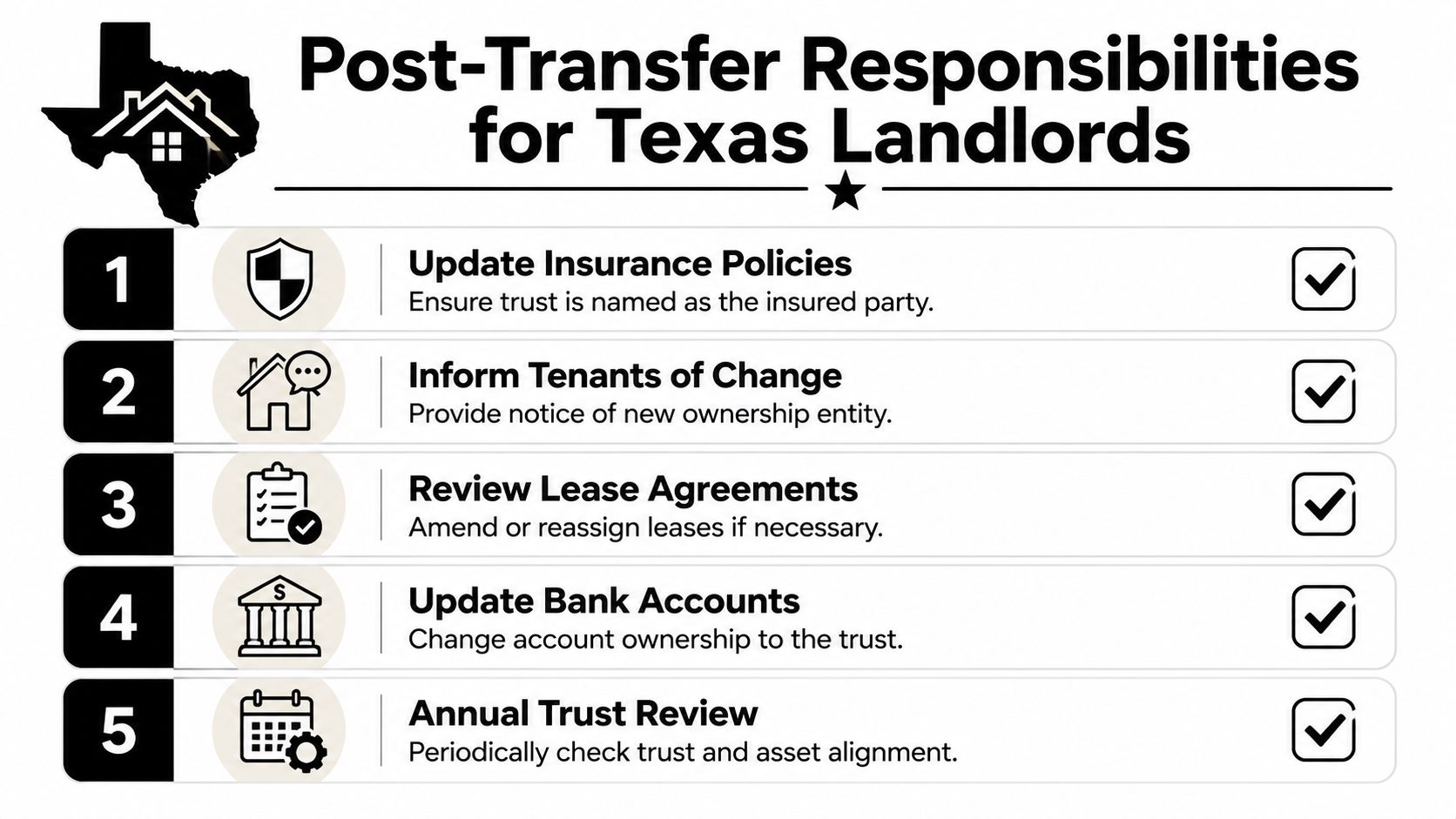
Start by cleaning up every record that still shows the old owner name. If title is now held by the trustee, the insurance carrier, county appraisal district, property tax mailing address, lease file, rent collection system, and repair vendors should all reflect that change where appropriate. The goal is consistency. In my experience, many post-transfer problems start because one file says the trust owns the property, another says the individual owner does, and a third still lists an outdated mailing address.
The follow-up checklist that protects the plan
A recorded deed by itself is not enough. Texas landlords should handle these items promptly:
- Update the landlord insurance policy. The named insured and any additional insured designations should match the new ownership and management structure. If a fire, liability claim, or vacancy loss occurs, the carrier will review the policy language closely.
- Confirm property tax and appraisal records. Make sure tax bills and exemption-related notices, if any apply, go to the correct party at the correct address.
- Review leases, notices, and management agreements. Tenants need clear instructions on who collects rent, where notices should be sent, and who has authority to approve repairs or renewals.
- Align rent collection and bank handling. The trustee should not casually mix trust income with personal funds. Use account titles and bookkeeping that make the paper trail clear.
- Keep a trustee file. Save the deed, trust certificate or other trust documentation used for third parties, insurance updates, tax correspondence, leases, invoices, and major repair decisions.
What a trust does for liability, and what it does not do
This point deserves blunt treatment because landlords are often told that a trust "protects" rental property without enough explanation.
A revocable living trust is usually an estate planning and management tool. It helps avoid probate delays, allows a successor trustee to step in during incapacity, and keeps title organized across multiple properties. It is not the same thing as an LLC, and it does not automatically block personal liability for premises claims, contractor disputes, or fair housing allegations. Liability protection usually depends on the full structure. That can include entity planning, insurance limits, lease practices, and how the property is operated.
Trustees also have real duties under Texas law. The trustee should act prudently, keep accurate records, follow the trust terms, and be ready to account to beneficiaries when required. That matters even more after a death or incapacity, when family members want practical answers and quick access to information.
For many landlords, the best results come from treating the trust as one part of the plan instead of the whole plan. The Law Office of Bryan Fagan, PLLC handles Texas trust and estate matters, including planning and administration issues that come up when real estate is held in trust.
Secure Your Legacy with Trusted Texas Legal Guidance
A trust can be an excellent tool for Texas landlords. It can simplify succession, reduce court involvement, and give a successor trustee a clear legal path to manage property when life changes suddenly. For many families, that alone makes the planning worthwhile.
But the process only works when the details line up.
The trust must be validly created. The deed must be drafted with the right names and legal description. The deed must be notarized and recorded. The lender issue has to be reviewed instead of guessed at. Insurance, tax records, and lease administration must all be updated so the trust operates the way it was intended to operate.
What a good legal plan should accomplish
A well-built plan for transferring rental properties into a trust in Texas should do more than move title. It should answer practical questions such as:
- Who manages the property if the owner becomes incapacitated?
- How are beneficiaries protected and informed?
- What fiduciary duties in Texas will the trustee have?
- Does the mortgage require notice or further review?
- Is liability planning being handled somewhere other than the trust?
Those are not side issues. They are the core of whether the plan helps your family.
When legal advice is especially important
You should get personalized advice if any of these apply:
- You have more than one rental property
- One or more rentals has a mortgage
- You're deciding between a trust, an LLC, or a combined structure
- You want clear trustee powers under the Texas Trust Code
- You need a broader estate plan under the Texas Estates Code
- You expect family disagreement about management or distribution
A trust should create order, not leave your family sorting through title records and lender letters after a crisis. If the goal is peace of mind, precision matters.
If you're managing a trust or planning your estate, contact Law Office of Bryan Fagan, PLLC for a free consultation. Our attorneys provide trusted, Texas-based guidance for every step of the process.