
Managing a trust can feel overwhelming, especially when a bank says your refinance is “complicated” the moment it sees the home isn't titled in your individual name. That frustration is common. It's also usually solvable.
For Texas families, refinancing a home in a trust is rarely about whether the trust exists at all. The core issue is whether the lender can document clean title, confirm who has authority to sign, and fit the file inside its underwriting rules. Once you understand those pressure points, the process becomes far less mysterious.
Most online articles stop at “yes, you can refinance a house in a trust.” That answer is too shallow to help at the closing table. The actual decision usually comes later, when the lender says it wants either an attorney opinion letter or a temporary transfer of title out of the trust and back in. Knowing how to evaluate those two paths can save time, reduce risk, and protect the estate plan you built in the first place.
Understanding Why Refinancing in a Trust is Complicated
When a lender underwrites a standard refinance, it wants a straightforward borrower, a straightforward title chain, and loan documents that match exactly. A trust changes that picture. The home may be owned by a trustee, governed by a separate written instrument, and subject to powers that aren't obvious from the deed alone.
That doesn't make a refinance impossible. It means the lender has more legal questions to answer before it will approve the file.
Why lenders slow down when they see a trust
A lender's concern is practical. It wants to know who owns the property, who can pledge it as collateral, and whether the security instrument will be enforceable after closing. If the trust document is incomplete, unclear, or inconsistent with title records, the lender may pause even when the borrower has strong credit and income.
The biggest dividing line is whether the trust is revocable or irrevocable. Mortgage and legal guidance consistently treats a revocable living trust as the easier structure for refinancing, while an irrevocable trust often causes lender hesitation or blocks the transaction unless extra steps are taken, as discussed in this guidance on refinancing property in a trust.
Practical rule: If the property is in a revocable living trust and the borrower still controls the trust, the conversation is usually about documentation. If the property is in an irrevocable trust, the conversation often shifts to whether the refinance can happen at all without restructuring.
The bank isn't rejecting your estate plan
Many clients take a lender's hesitation personally. They think the trust itself has created a fatal problem. Usually, that isn't what's happening.
The bank is trying to fit a non-standard ownership structure into a standardized mortgage process. Underwriters work from checklists. Trust-owned property falls outside the most routine file type, so the lender asks for more paper, more review, and sometimes a different title path.
That's why you should expect questions like these:
- Who is the current trustee and has that trustee accepted the role?
- Does the trust authorize borrowing or mortgaging real property?
- Is the trust revocable and borrower-controlled?
- Do title records match the trust name exactly?
- Will the lender close in the trust's name, or does it require temporary retitling?
The risk most borrowers don't see
The refinance itself usually isn't the biggest danger. The danger is losing the trust's protection by mishandling title after the closing.
If the lender requires a temporary deed out of the trust, and the property never gets deeded back in, the house may sit in the individual owner's name. That can defeat the probate-avoidance purpose of the trust. It can also create cleanup work later, especially after death or incapacity.
That's why the process should be treated as a legal and title project, not just a mortgage project.
First Steps Reviewing Your Trust and Trustee Powers
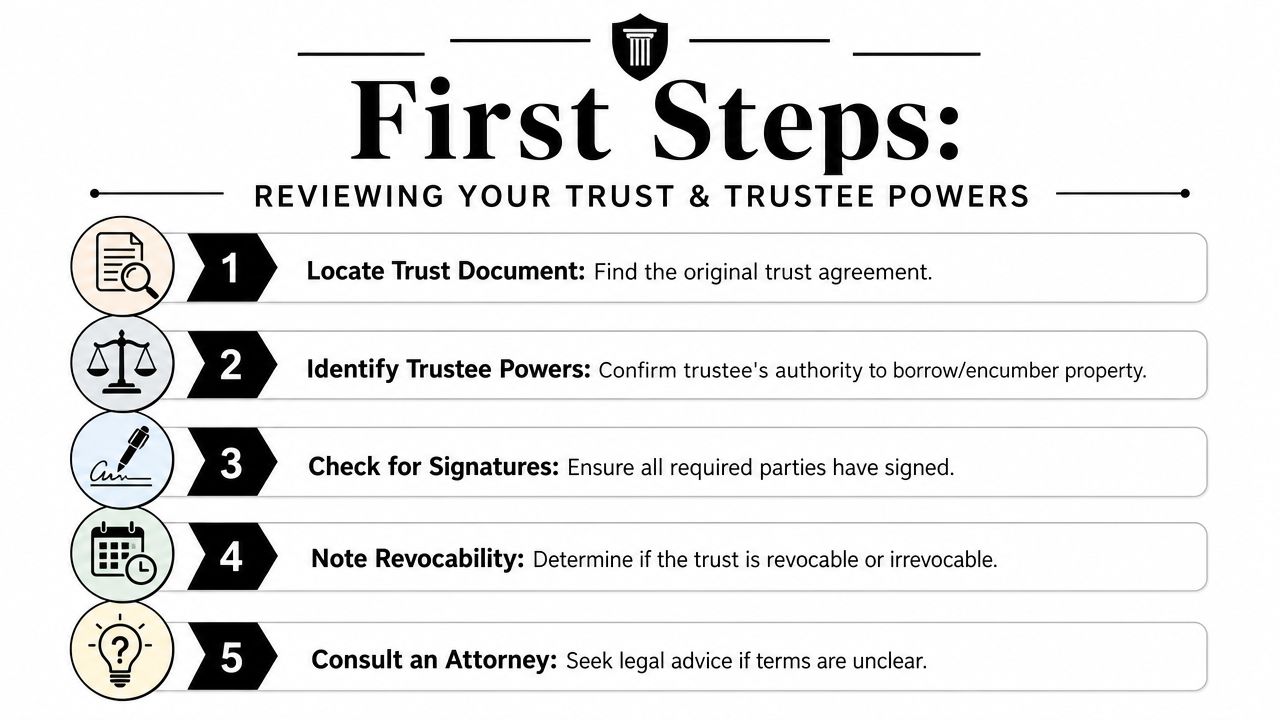
Before you send a single document to the lender, pull out the trust agreement and read it with one question in mind. Does this trust clearly let the trustee borrow against the house?
That question often determines whether the lender will consider lending directly to the trust, or whether it will insist on retitling the property before underwriting.
What to look for in the trust document
You do not need to memorize the full trust. Start with the sections on trustee powers, management powers, or administrative powers. You are looking for language that gives the trustee authority to do things such as borrow money, mortgage real property, encumber trust assets, sign loan documents, or pledge property as collateral.
A key technical gate is whether the trust instrument authorizes the trustee to encumber the property and use it as collateral. If it does, the trustee may be able to sign the note and mortgage without a temporary title pull-out. If it does not, lenders commonly require retitling before underwriting, as explained in this discussion of refinancing a home owned by a living trust.
A simple self-audit before calling the lender
Use a short checklist before you start the refinance application:
- Find the signed trust agreement. Make sure you have the complete document, not just a summary or draft.
- Confirm the trustee's authority. Search for words like “borrow,” “mortgage,” “encumber,” or “pledge.”
- Check who serves as trustee now. If there has been a resignation, death, or successor appointment, gather that paperwork too.
- Verify whether the trust is revocable or irrevocable. Lenders care about that distinction immediately.
- Compare the deed to the trust name. The legal name on title should match the trust records cleanly.
If you want a clearer understanding of what a trustee is expected to do under Texas law, this guide on what a trustee does in Texas is a useful starting point.
Why this review matters under Texas fiduciary principles
Under Texas trust practice, a trustee must act within the authority granted by the trust instrument and carry out fiduciary duties carefully. That matters in refinancing because the trustee isn't just signing bank forms. The trustee is making a decision that affects trust property, debt obligations, and the long-term administration of the estate plan.
If the trust terms are vague, a lender may still try to push the file forward in some fashion. That doesn't mean the trustee should proceed casually. A trustee has to be able to show that the action is authorized and consistent with the trust's administration.
The cleaner the trust language, the more likely the refinance stays a document problem instead of becoming a title problem.
When the trust lacks clear borrowing authority, that doesn't always end the transaction. It does mean you should stop guessing. At that point, legal review becomes the efficient move, not an extra one.
Navigating Lender Requirements for Trust-Owned Homes
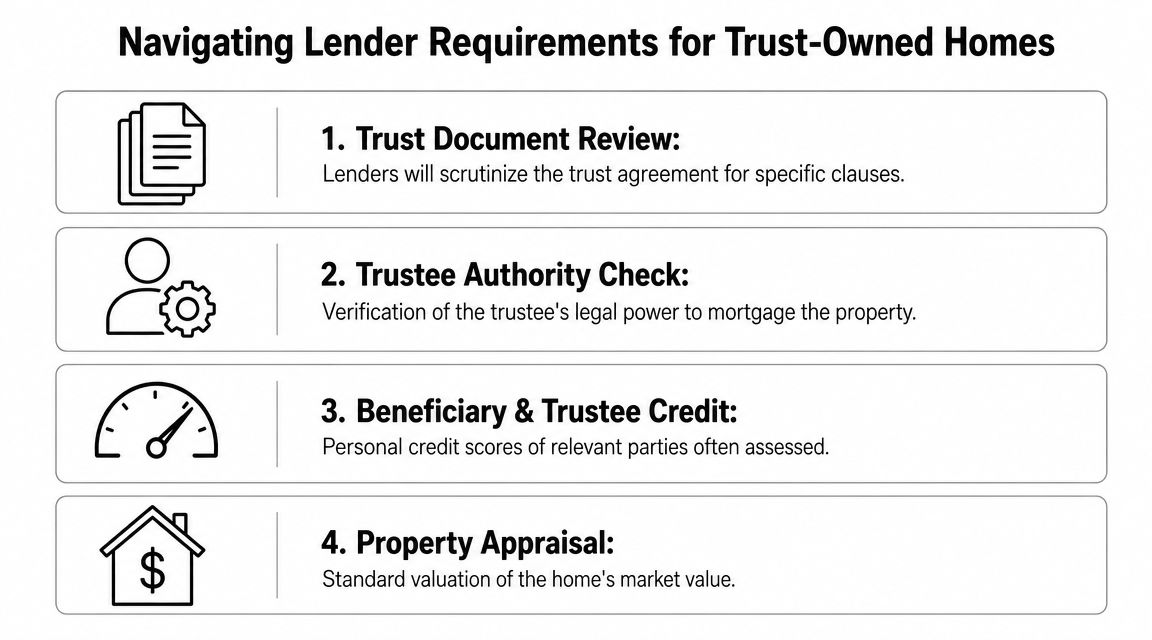
Once the trust document checks out, the next issue is underwriting. Lenders don't evaluate trust-owned homes by instinct. They evaluate them by policy, overlays, and whether the file can be sold or held under their own standards.
That's why two lenders can look at the same Texas property and reach different answers.
What underwriters usually want to see
Expect requests for the trust agreement, a certificate of trust if available, identification for trustees, existing vesting information, and title records. The lender may also ask whether the borrower occupies the property, whether the trust is revocable, and whether the borrower is the beneficiary.
Those aren't random questions. They help the lender decide whether the trust fits within its refinance rules or whether it will require one of the workarounds discussed later.
A practical way to prepare is to assemble the file before underwriting asks for it. This resource on how to organize trust records and documents in Texas can help you put the trust, deed, and related records in one place before the lender starts issuing conditions.
A concrete underwriting example
For cash-out refinances, Fannie Mae's Selling Guide provides a useful benchmark that many borrowers and lenders recognize. Under that guide, the existing first mortgage must be at least 12 months old at the note date of the new loan, and at least one borrower must have been on title for at least six months before disbursement. Fannie Mae also states that when the property is owned by an inter vivos revocable trust, the time held by the trust can count toward the borrower's six-month ownership requirement if the borrower is the primary beneficiary, according to the Fannie Mae cash-out refinance rules.
That doesn't mean every lender will say yes. It does show that trust ownership, by itself, doesn't automatically disqualify the loan.
Where credit and trust issues intersect
Even when the trust structure works, the borrower still has to qualify financially. If the lender raises concerns about score, payment history, or overall profile, it helps to address that side of the file separately instead of assuming the trust is the only obstacle. Borrowers trying to strengthen eligibility before applying may find guidance on how to rebuild credit for Texas home loans useful as part of the broader preparation process.
A trust-friendly file still has to be a lendable file.
| Lender question | Why it matters |
|---|---|
| Is the trust revocable | Revocable trusts are usually easier for underwriting to accept |
| Is the borrower the beneficiary | Helps align occupancy, control, and ownership questions |
| Does title match the trust exactly | Reduces closing and recording problems |
| Does the trustee have borrowing power | Determines whether direct trust signing is even possible |
When borrowers understand these requirements early, conversations with the bank become more productive. You're no longer asking “Can I refinance?” You're asking “What specific condition is preventing approval?”
The Two Paths Forward Attorney Letter or Title Transfer
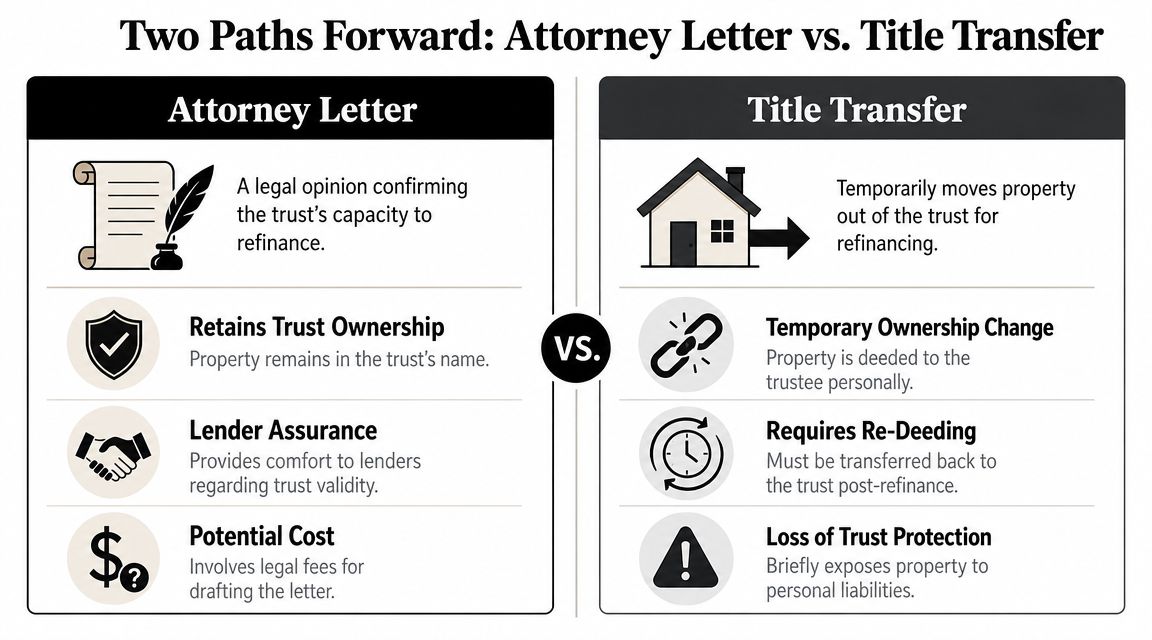
This is a decision point often not anticipated. The lender reviews the trust, gets uncomfortable, and then asks for a workaround. In practice, that workaround is usually one of two options. The lender either accepts an attorney opinion letter, or it requires the property to come out of the trust for closing and go back in afterward.
Both paths can work. They do not carry the same risk.
Some borrowers find it helpful to hear the issue explained visually before deciding between the two methods.
Path one with an attorney opinion letter
An attorney opinion letter is a formal letter from counsel to the lender. It typically confirms that the trust exists, the trustee is acting under valid authority, and the trust terms permit the transaction the lender wants to close.
This route is cleaner because the property can often remain titled in the trust. That preserves continuity and avoids extra deeds. It is often the better path when the trust language is solid, the title record is clean, and the lender is willing to let its legal department rely on outside counsel.
The limitation is simple. Not every lender accepts these letters.
Path two with a deed out and deed back
If the lender will not underwrite directly to the trust, it may require temporary retitling. The property is deeded out of the trust into the borrower's individual name, the refinance closes, and then the property is deeded back into the trust.
Lenders commonly use one of these two workarounds, either an attorney letter confirming the trust's validity or a temporary retitling out of and back into the trust. Which path works best often depends on the lender's internal underwriting policies, as outlined in this overview of refinancing a house in a trust.
If you're dealing with the title-transfer route, this primer on how to transfer property to a trust helps explain the mechanics involved after closing.
Which path is more likely by lender type and trust terms
Practical judgment matters.
- If the trust is revocable, clearly drafted, and the lender has in-house flexibility, an attorney opinion letter is often worth trying first.
- If the lender is highly standardized or sells loans through rigid channels, title transfer is often the path it knows how to process fastest.
- If the trust language on borrowing is weak or incomplete, the lender is more likely to insist on retitling.
- If title history is messy, lenders usually become more conservative, not less.
A good question for the loan officer is this: “If your legal department reviews an attorney opinion letter confirming trustee authority, will you keep title in the trust, or are you going to require a deed-out no matter what?”
That one question saves time. It tells you whether the attorney letter is a real option or just an expensive detour.
A side-by-side view
| Path | Usually works best when | Main advantage | Main concern |
|---|---|---|---|
| Attorney opinion letter | Trust terms are strong and lender accepts legal review | Title may stay in trust | Some lenders refuse the format outright |
| Deed out and deed back | Lender wants a conventional borrower/title structure | Familiar process for many lenders | The property must be reconveyed correctly after closing |
The mistake I see most often is not choosing the “wrong” path. It's failing to manage the chosen path all the way through recording.
Texas-Specific Rules Homestead and Community Property
A refinance in Texas isn't just a trust issue. It is also a homestead and marital rights issue. Even when the house is in a revocable trust, Texas title companies and lenders still look hard at occupancy, marital status, and whether both spouses must sign closing documents.
That surprises many families, especially when only one spouse is the trustee or only one spouse appears to be the borrower.

Why Texas law changes the practical workflow
Texas has strong homestead protections. A lender and title company closing a refinance on a Texas residence want to make sure the lien documents are enforceable and properly executed. That often means they care about more than the trust certificate. They want to know who lives there, who is married to whom, and whether any spouse has rights that require signatures.
Community property principles can matter too. Even if separate property issues exist, title professionals don't like assumptions. They prefer documents that resolve those questions before closing day.
What spouses should expect at closing
For a Texas homestead, expect the possibility that both spouses will need to sign certain documents, even if the trust lists only one trustee or the loan application focuses on one borrower. That isn't always a sign of a problem. It is often the lender and title company trying to account for homestead and marital rights under Texas practice.
A calm way to prepare is to ask the lender and title company these questions early:
- Is this property being treated as a Texas homestead
- Will my spouse need to sign any deed of trust, occupancy, or title documents
- Are you requiring vesting changes before closing
- What exact name should appear on every deed and loan document
Texas closings go smoother when the trustee, borrower, spouse, lender, and title company are all using the same legal description and the same vesting language.
Texas Trust Code and Estates Code concerns
The trust side of the analysis still matters. Under Texas fiduciary principles, the trustee must act within the powers granted by the trust and in the proper administration of the trust estate. If a refinance affects future administration, beneficiary expectations, or the condition of trust assets, the trustee should document the basis for the decision.
Texas Estates Code issues can also surface later if the property accidentally remains outside the trust and the owner dies. At that point, a family that expected a smooth non-probate transition may suddenly face a probate proceeding or title correction process that could have been avoided.
A practical Texas closing checklist
Use this short pre-closing review:
- Confirm the property's current vesting with the title company.
- Verify homestead status and ask whether that changes required signatures.
- Check marital status disclosures for consistency across the loan file.
- Review all deeds before recording if a temporary transfer is involved.
- Make sure post-closing instructions are written down if the property must return to the trust.
That approach keeps the legal, title, and mortgage pieces aligned. In Texas, that alignment is what prevents last-minute signing delays and post-closing title defects.
Common Pitfalls and When to Consult a Texas Trust Attorney
A refinance can look finished on closing day and still leave the trust plan damaged.
I see the same pattern in troubled files. The note is signed, funds are disbursed, and everyone assumes the legal work is complete. Then a later sale, death, or incapacity review shows the title never matched the intended plan.
The failure that causes the most damage
The highest-risk mistake usually happens in the deed-out/deed-back path. The property is transferred out of the trust to satisfy the lender, the refinance closes, and the deed returning the home to the trust is never recorded. That leaves title in an individual name and can force the family into the very probate or title-curative process the trust was supposed to avoid, as discussed in this discussion of refinancing a home held in a trust.
This is why the two-path decision matters. An attorney opinion letter can reduce title movement risk if the lender will accept it and the trust terms support it. The deed-out/deed-back method can still work, but only if post-closing recording responsibility is assigned clearly and then verified.
Do not rely on assumptions. Get confirmation that the final deed was signed, delivered, and recorded.
Other mistakes that show up in real files
Some problems begin before closing and stay hidden until much later.
- Using the wrong trust name or date. Even a small mismatch between the deed, loan package, and certification of trust can create a title objection.
- Skipping proof of trustee authority. If a successor trustee is acting, the file may need resignation documents, death certificates, or other records showing the change in authority.
- Choosing the wrong refinance path. A local bank or portfolio lender may be open to an attorney letter. A large conventional lender often defaults to a deed-out requirement. Asking that question early saves time.
- Treating the file as only a lending issue. It is also a title, trust-administration, and estate-planning issue.
- Letting a side issue control the closing. If the property also has a tax lien or another title problem, address that directly. Homeowners dealing with that issue may also want to read about how to sell home with IRS lien.
The practical question is not just whether the loan can close. The question is whether the house will still be titled the right way after closing.
When legal help stops being optional
A Texas trust attorney should review the file before closing when any of these facts are present:
- The trust is irrevocable
- The trustee's authority to mortgage or encumber property is unclear
- The lender asks for an attorney opinion letter
- The lender insists on a deed-out and deed-back
- The property is homestead and spouse signature questions have surfaced
- The trust has multiple beneficiaries or a history of family conflict
- No one has clear written responsibility for the post-closing deed back into trust
In those cases, the legal work is not paperwork cleanup. It is risk control.
A good lawyer helps decide which of the two paths is more realistic, based on the lender, the trust language, title requirements, and the family's estate-planning goals. That advice can prevent a failed attorney-letter request on the front end and a broken trust title chain on the back end.
For guidance on refinancing a home in a trust in Texas, or for help evaluating trustee authority, fiduciary duties, probate avoidance, or asset protection, contact Law Office of Bryan Fagan, PLLC for a free consultation. Our attorneys provide trusted, Texas-based guidance for every step of the process, whether you need help with trust administration, estate planning, probate, guardianship, or understanding how to modify a trust in Texas.