Skip to content
You may be reading this because something feels off.
A parent or grandparent created a trust. The trustee promised to “handle everything.” But now the updates are vague, the numbers don't make sense, or your questions are met with silence. Maybe distributions keep getting delayed. Maybe assets were sold and nobody explained why. Maybe you're the trustee, trying to do the right thing, and you're worried that an unhappy beneficiary will call every mistake “malpractice.”
That uncertainty is exhausting. It also creates a lot of confusion, because people use the phrase trustee malpractice loosely. In Texas, the actual legal question is usually whether the trustee committed a breach of trust or breached a fiduciary duty.
Feeling Lost in a Loved One's Trust? You're Not Alone
Many families come to trust disputes slowly, not all at once. At first, it looks like a communication problem. A beneficiary asks for records and gets partial answers. A trustee says, “I'm working on it.” Months pass. The paperwork still feels incomplete. Tension builds, and people start wondering whether the trustee is overwhelmed, careless, or doing something improper.
That matters because trust problems rarely begin with one dramatic event. More often, families see a pattern. Missing explanations. Poor recordkeeping. Conflicted choices. Assets being used in ways that don't match the trust's purpose. In Texas, that pattern can matter just as much as one obvious act of theft or self-dealing.
If you feel confused, that doesn't mean you're overreacting. Trust administration is technical, and beneficiaries often receive information in pieces.
A trust is supposed to create order. When the trustee stops being transparent, the trust can start feeling like a locked box. That's where people get stuck. They don't know whether they're seeing ordinary delays, bad judgment, or conduct a court would treat as serious misconduct.
The good news is that Texas law gives you a framework. It doesn't expect beneficiaries to guess. It also doesn't punish trustees just because investments underperform or a family member disagrees with every choice. The law looks at duties, authority, records, and conduct.
If you're searching for what is trustee malpractice in Texas, you're really trying to answer a practical question. Was this a frustrating decision, or was it a legal breach? Once you understand that dividing line, the next steps become much clearer.
Understanding Trustee Malpractice as Breach of Trust in Texas
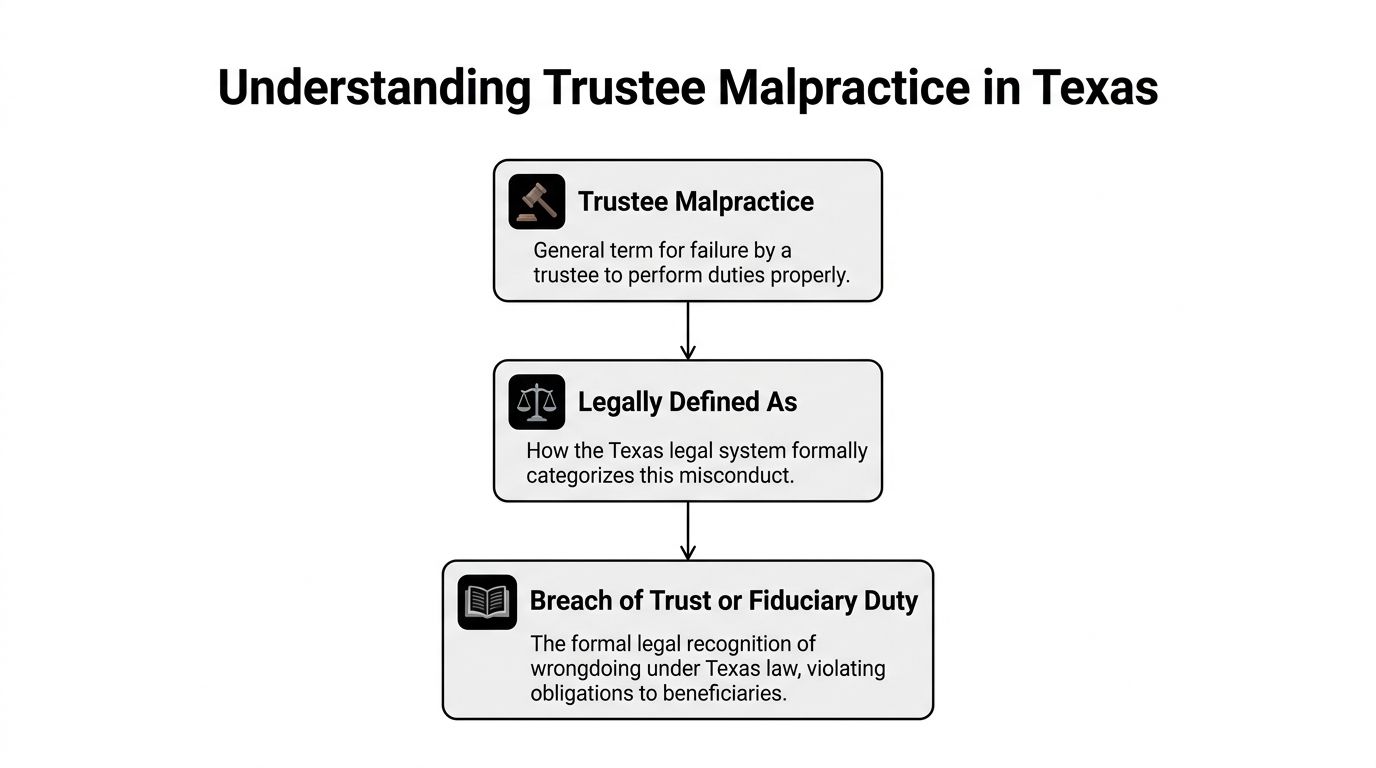
In Texas, what people often call trustee malpractice is usually a breach of trust. That means the trustee failed to carry out a legal duty owed to the beneficiaries. The label matters less than the question a court asks: Did the trustee violate a fiduciary duty, or did the trustee make a decision that turned out badly?
A trustee holds power, but only for a limited purpose
A trustee controls trust property, sometimes with broad discretion. Even so, that control is not personal ownership. The trustee is allowed to make choices only within the rules set by the trust and Texas law, and only for the beneficiaries' benefit.
A simple comparison helps here. A trustee works much like a person given the keys to someone else's house for safekeeping. That person may pay the bills, arrange repairs, and protect the property. The keys do not permit weekend use for personal convenience, gifts to friends, or silence when the owner asks for an update.
That is the practical dividing line. Poor judgment can be legal. Disloyalty, concealment, and action outside the trustee's authority often are not.
The duties Texas law expects a trustee to follow
These duties sound technical, but each one answers a very practical question:
- Duty of loyalty: Did the trustee put the beneficiaries first, or was the trustee helping himself?
- Duty to follow the trust: Did the trustee act within the powers the trust document grants?
- Duty of prudence: Did the trustee use reasonable care, attention, and judgment with trust property?
- Duty of impartiality: Did the trustee treat multiple beneficiaries fairly, unless the trust allows a different approach?
- Duty to inform and account: Did the trustee keep records and provide the information Texas law and the trust require?
If you keep those five duties in mind, trust disputes become easier to sort. A disappointing result by itself usually does not prove malpractice. A broken duty might.
The line between a bad call and a breach
Families often get stuck here, and for good reason. A trustee may choose an investment that loses value, sell property at the wrong time, or move too slowly. Those facts can point to bad judgment, inexperience, or even ordinary market risk. They do not automatically mean the trustee committed a legal wrong.
Texas courts usually look closer at process, authority, motive, and disclosure. Did the trustee read and follow the trust? Did the trustee gather information before acting? Was there a conflict of interest? Were records kept? Were beneficiaries told what they were entitled to know?
For example, a trustee who picks a conservative investment that later underperforms may still be acting prudently. A trustee who puts trust money into the trustee's own business, without clear authority and full fairness, raises a very different concern.
As explained in this Texas trust liability discussion, exculpatory clauses do not protect trustees who act in bad faith, with reckless indifference, or through intentional misconduct.
Practical test: Ask three questions. Did the trustee have authority? Did the trustee act for the beneficiaries rather than for personal advantage? Did the trustee keep records and provide honest information? If the answer to any of those questions is no, the problem may be more than poor judgment.
Why the word "malpractice" can confuse people
"Malpractice" sounds like a professional negligence case against a doctor or lawyer. In trust disputes, the stronger legal question is usually whether the trustee breached a fiduciary duty. That breach can happen through an act, such as self-dealing, or through inaction, such as failing to account, ignoring the trust's instructions, or refusing to share required information.
For that reason, a careful review matters. The primary issue is not merely whether the outcome was frustrating. The issue is whether the trustee stayed within the trust's rules, acted loyally, used reasonable care, and handled the job with the transparency Texas law requires.
Red Flags vs Bad Judgment Examples of Trustee Misconduct
The hardest part of these cases is often this question: Was the trustee wrong, or just unsuccessful?
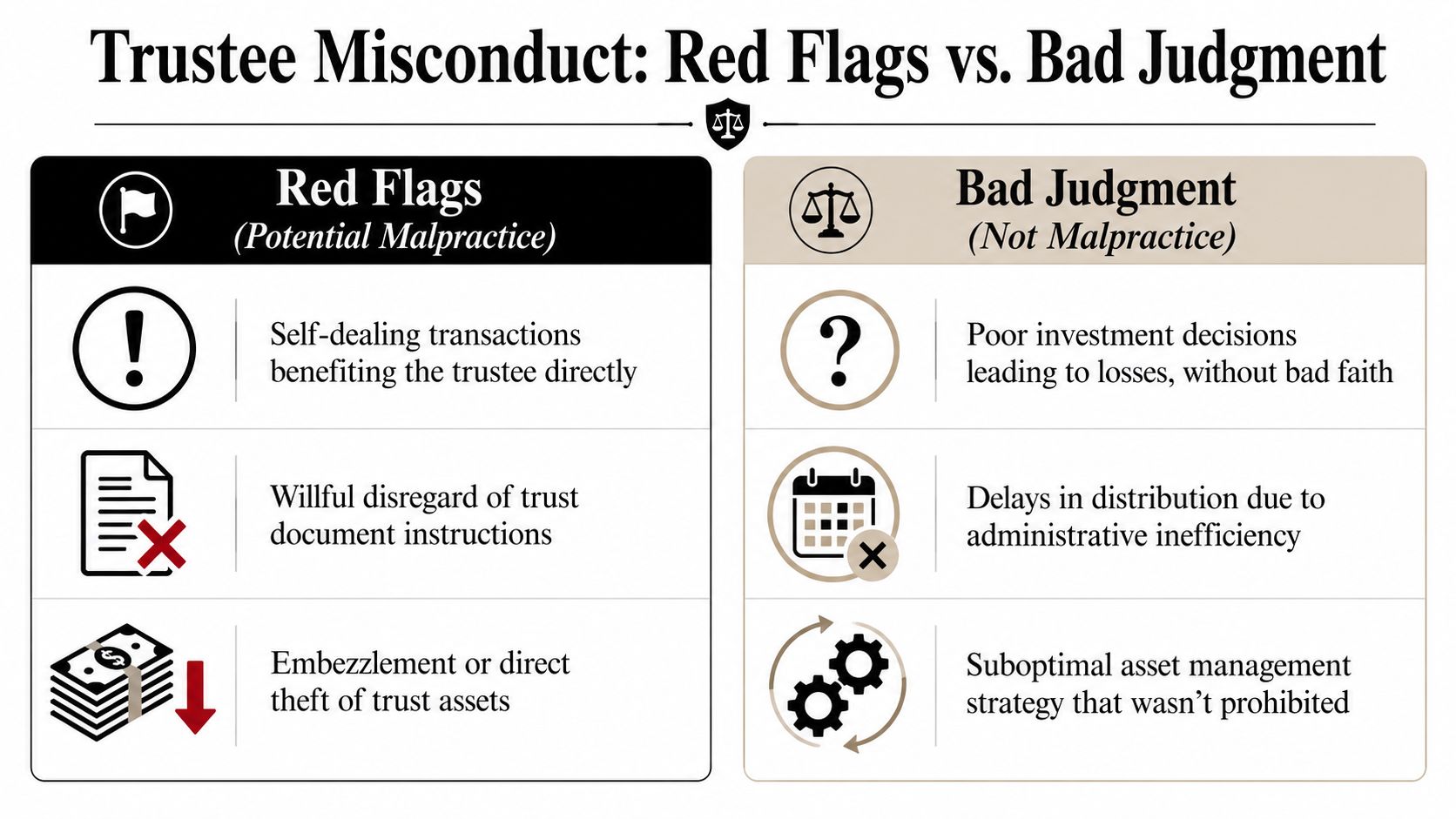
Texas law does not make trustees guarantors of perfect results. It does, however, hold them accountable for disloyalty, bad faith, and conduct outside their authority. The dividing line often comes down to motive, process, and whether the trust document allowed the decision.
Conduct that should raise concern
Some patterns deserve immediate attention because they often point to a legal breach rather than ordinary human error.
| Situation | More likely bad judgment or red flag | Why it matters |
|---|---|---|
| A trustee chose a conservative investment that earned less than expected | Bad judgment, possibly | Underperformance alone doesn't prove disloyalty |
| A trustee invested trust money into the trustee's own company | Red flag | That suggests self-dealing and conflict |
| A trustee is slow and disorganized but eventually provides records | Maybe poor administration | Frustrating, but not always actionable by itself |
| A trustee ignores repeated requests and key records remain missing | Red flag | Non-disclosure can signal deeper problems |
| One beneficiary dislikes a distribution decision allowed by the trust | Often not malpractice | Discretion may protect the trustee |
| The trustee favors one beneficiary for personal reasons, contrary to trust terms | Red flag | That can violate impartiality and loyalty |
A useful boundary test
Ask these questions in order:
What did the trust document authorize?
If the trust gave broad discretion, a court may allow a range of choices even if beneficiaries disagree.Did the trustee benefit personally?
Personal gain is one of the clearest warning signs.Were records kept and explanations given?
Honest trustees usually leave a paper trail.Was there bad faith or intentional disregard?
Courts look closely at mindset when the conduct goes beyond a simple mistake.
Texas law also recognizes that some trusts use advisors. Under Texas law on trustee reliance on a trust advisor, a trustee who follows a trust advisor's direction is generally not liable except for wilful misconduct or bad faith. That means the analysis often turns on the trust's own language, the trustee's authority, and proof of bad faith, not just disappointment with the result.
Real-world examples that often confuse families
A trustee sells stock before a market rise. Beneficiaries later say the trustee “blew it.” That may be painful, but it isn't automatically malpractice if the trustee acted within authority and used a reasonable process.
A trustee uses trust money to renovate a property the trustee personally owns. That's different. The issue isn't just whether the renovation was a smart financial move. The problem is that the trustee may have used trust assets for personal benefit.
A trustee delays a distribution because tax questions need to be resolved. That may be prudent.
A trustee delays a distribution because the trustee wants an advantage over a beneficiary in a family dispute. That can look much more like misconduct.
If you're worried about conflicts, this guide on trustee self-dealing in Texas can help you spot one of the clearest breach patterns.
A bad outcome is not always a breach. A hidden conflict often is.
How to Prove a Breach of Trust in a Texas Court
Once suspicion turns into concern, the next question is proof. Courts don't decide these cases based on family frustration alone. They look for documents, timelines, and evidence showing that the trustee owed a duty, violated it, and caused harm to the trust or beneficiaries.

The three building blocks of a claim
Most breach of trust claims are built from three parts.
First, you identify the duty. The trust instrument, Texas Trust Code rules, and the trustee's role establish what the trustee was supposed to do.
Second, you show the breach. This might be a prohibited transaction, failure to follow trust terms, poor recordkeeping, concealment, or misuse of assets.
Third, you connect that breach to harm. If the trustee's conduct caused losses, improper fees, missing assets, or delayed distributions, that link matters.
The evidence courts care about
Trust cases are often won or lost on paperwork. Helpful evidence may include:
- The trust document itself: This shows powers, limits, and distribution instructions.
- Accountings and bank records: These help trace where money went.
- Emails, texts, and letters: Communications can show what the trustee knew and when.
- Transaction support: Deeds, sale records, invoices, and business documents can reveal conflicts or unauthorized activity.
- Beneficiary requests in writing: A paper trail often becomes important if the trustee was evasive.
If records are missing, that may not end the case. Sometimes the absence of ordinary trust records becomes part of the story. If you need to force financial transparency, a petition for accounting in a Texas trust matter is one tool beneficiaries often discuss with counsel.
Why timing and organization matter
A calm, organized file helps more than an emotional accusation. Courts want specifics. Dates. Documents. Transactions. Written requests. Clear explanations of what happened.
This short video gives a helpful overview of how trust disputes can unfold in practice:
Keep originals, download statements, and preserve messages before relationships get worse. In trust litigation, memory fades faster than documents.
For trustees, this same principle is protective. Good records can defeat a weak claim. For beneficiaries, records can turn a vague worry into a provable case.
Legal Remedies and Trustee Liabilities for Misconduct
A trust case does not end with, "The trustee messed up." The court still has to answer a practical question. What will fix the problem?
That is where the line between poor judgment and actionable misconduct matters most. If a trustee made a reasonable decision that turned out badly, a court may leave that decision alone. If the trustee crossed a legal duty, such as using trust property for personal benefit, hiding records, ignoring the trust's terms, or causing avoidable loss through disloyal or careless conduct, the court can step in and impose real consequences.
What Texas courts can order
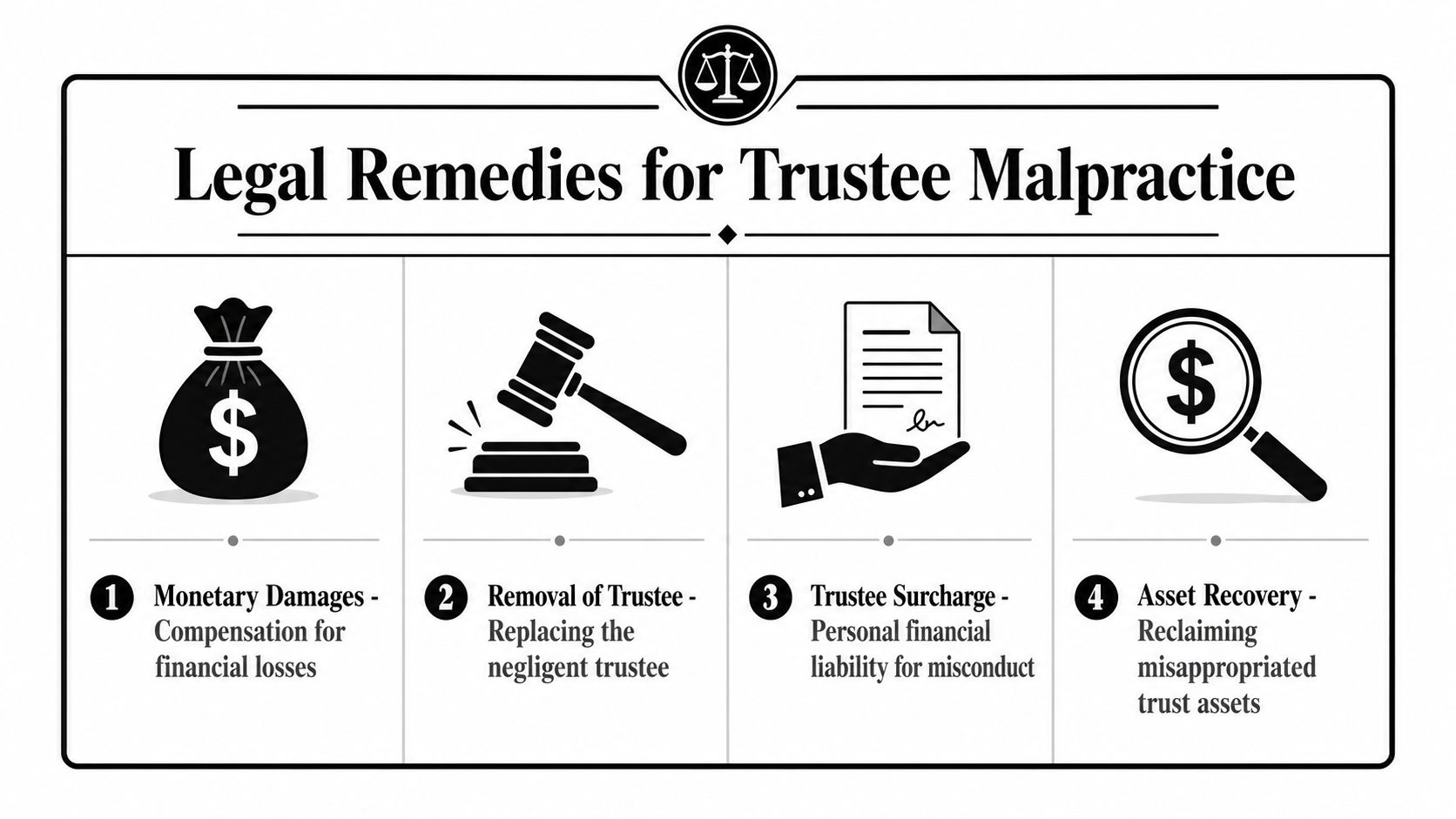
Texas courts have several tools, and each one fits a different kind of problem.
A court may order the trustee to repay losses to the trust. Lawyers often call this a surcharge. In plain English, it means the trustee may have to put money back if the trust was harmed by a breach.
A court may also require the trustee to give up profits gained from misconduct. If the trustee benefited personally from a trust transaction that should have benefited the beneficiaries, the court can order that profit returned.
Sometimes money is not the main issue. Control is. If the trustee has shown that he or she cannot be trusted to follow the rules, the court may remove that person and appoint someone else to serve.
Courts can also reduce or deny trustee compensation. A trustee who violated fiduciary duties may not get paid as if the job was handled properly.
In some cases, the court can block future harm too. That may include orders directing the trustee to take a certain action, stop a certain action, turn over records, or return specific property to the trust.
How the remedy usually matches the red flag
A simple way to understand remedies is to match the court's response to the type of breach.
- Trust funds are missing: the court may order repayment, tracing, or return of property.
- The trustee engaged in self-dealing: the court may unwind the transaction, require the trustee to give up any profit, and cut compensation.
- The trustee refuses to follow the trust's terms: the court may issue instructions or remove the trustee.
- The trustee's conduct creates an ongoing risk: the court may step in quickly to prevent more damage, not just compensate for past loss.
This is why two trust disputes can look similar emotionally but end very differently in court. A beneficiary may feel equally upset by a bad investment decision and by a trustee secretly transferring trust assets to a family business. Texas courts usually treat those situations very differently. One may be a judgment call. The other may be a breach that triggers removal, repayment, and personal liability.
Personal liability is real
Many trustees are surprised by this point. Serving as trustee does not automatically protect someone from personal responsibility.
If the trustee breaches a duty and the trust loses value, the trustee may be personally liable for that loss. If the trustee gained a benefit that should never have been taken, personal repayment may also be on the table. In serious cases, the cost of "just trying to handle it informally" becomes much higher than getting advice early.
If you are trying to assess whether the facts justify litigation, this guide on how to sue a trustee in Texas and protect your inheritance explains the dispute process families often consider.
A practical warning for trustees and beneficiaries
For beneficiaries, the goal is usually not punishment for its own sake. The goal is to protect the trust, recover what can be recovered, and stop further harm.
For trustees, the lesson is just as clear. Courts do not punish honest decisions for the sole reason that they turned out poorly. They focus on duties. Was the trustee loyal? Careful? Honest? Did the trustee follow the trust document and keep proper boundaries?
For families needing help with trust disputes, probate issues, or connected planning concerns such as estate planning, probate, guardianship, and asset protection, the Law Office of Bryan Fagan, PLLC is one Texas-based option that handles trust administration and fiduciary conflict matters.
The Clock Is Ticking Your First Steps and Statute of Limitations
Even a strong claim can be lost by waiting too long.
In Texas, breach-of-trust claims are generally subject to a 4-year filing window that begins when the breach was discovered or reasonably should have been discovered, according to this discussion of Texas trustee disputes and timing. That's why delay is risky. A beneficiary may not know everything at once, but the law still asks when the problem should reasonably have been recognized.
Why this catches families off guard
Trustees don't always announce wrongdoing. Sometimes beneficiaries learn piece by piece. A missing statement here. An unexplained sale there. A refusal to answer basic questions. The danger is assuming you can “wait and see” indefinitely.
Texas law also limits repeated accounting demands. Under Texas Trust Code §113.151, a trustee is generally not required to provide more than one accounting every 12 months, which means a missed or incomplete accounting can become an important warning sign rather than something to casually overlook.
For many families, trust and probate issues overlap. If you're trying to understand how estate administration timelines can affect practical decision-making, Property Nation's probate insights offer a useful general comparison point, even though Texas procedure has its own rules.
A calm action plan
If you suspect trustee malpractice, start here:
Gather the paper trail
Pull together the trust agreement, statements, tax documents, emails, letters, and notes of conversations.Move questions into writing
Verbal complaints are easy to deny later. Written requests create a record.Ask specific questions
Don't send a vague message saying you want “everything.” Ask about transactions, distributions, missing records, or asset sales.Review the trust language closely
Many disputes turn on whether the trustee had discretion that beneficiaries didn't realize existed.Speak with a Texas estate planning attorney or Texas trust administration lawyer
Early review can help you distinguish a weak suspicion from a claim worth pursuing.
The first goal isn't to file a lawsuit. It's to preserve facts, protect deadlines, and stop the situation from getting murkier.
Prompt action also helps trustees. If a beneficiary raises a concern, respond clearly, provide records when required, and correct avoidable problems before mistrust hardens into litigation.
Frequently Asked Questions About Texas Trustee Disputes
Can a trustee be removed without going to court
Sometimes, yes. The trust document may give a named person, co-trustee, or trust protector the power to remove and replace the trustee without filing a lawsuit.
If the trust does not provide that path, court involvement is often required. Texas courts usually want a clear reason for removal, such as a serious conflict of interest, refusal to provide required information, self-dealing, inability to manage the trust, or repeated violations of the trust terms. Frustration alone usually is not enough.
What if the trustee is also a beneficiary
That setup is common in Texas families. A son, daughter, or sibling may wear both hats.
The legal question is not whether the trustee benefits at all. The question is whether the trustee is still following the trust rules and treating other beneficiaries fairly. A trustee crosses the line into misconduct when personal benefit starts driving decisions that should be made for the trust as a whole. For example, delaying someone else's distribution to preserve more cash for the trustee's own future share can raise concern.
If the trustee made a bad investment, is that automatically malpractice
No. Texas law does not treat every loss as proof of wrongdoing.
A trustee is judged more by the decision-making process than by the final result. A court will often ask questions like these: Did the trustee review the trust's instructions, consider the needs of the beneficiaries, spread out risk appropriately, avoid obvious conflicts, and keep records showing why the decision made sense at the time? A reasonable decision can still turn out badly. An uninformed or self-interested decision is where liability becomes more likely.
A simple way to separate bad luck from breach is this. If the trustee used care, loyalty, and honest judgment, the decision may be protected. If the trustee guessed, ignored warnings, favored personal interests, or acted outside the trust's authority, the problem is much more serious.
How can trustees protect themselves from false accusations
Good habits matter. Clear records, written communications, timely accountings, and careful attention to the trust language can protect a trustee far better than vague assurances after a dispute starts.
It also helps to pause before unusual transactions. Selling trust property to a relative, making unequal distributions, or holding a concentrated investment position without a documented reason can create red flags, even if the trustee believed the choice was sensible. A short written explanation made at the time is often far more persuasive than a later defense.
Do trust disputes always end in a trial
No. Many cases settle before trial through informal negotiation, mediation, an agreed accounting, or a voluntary trustee resignation.
Trial usually becomes more likely when one side will not produce records, the trust language is disputed, money is missing, or family conflict has hardened into mistrust. In that sense, a trust dispute often works like a bookkeeping problem mixed with a family problem. If the paper trail becomes clear early, resolution is usually easier.
If you need guidance about a trustee dispute or trust administration issue, Law Office of Bryan Fagan, PLLC offers consultations to discuss the facts, the trust language, and whether the problem looks like poor judgment or a true breach of trust under Texas law.