Yes, a trustee can be personally sued in Texas, but personal liability usually arises only when the trustee personally commits wrongful conduct, such as breaching fiduciary duties or committing a tort. If the trustee is handling a trust matter in a proper representative role, Texas law has long treated the trust property, not the trustee's own assets, as the usual source for a judgment.
You may be reading this because you were just named trustee for a parent's trust, or because you're a beneficiary who has started to worry that something isn't right. Both situations carry a lot of stress. Trustees often feel honored to serve, then quickly realize they're responsible for money, records, family expectations, and legal duties all at once.
That anxiety is understandable. A trustee isn't just helping informally. A trustee is stepping into a role that Texas law takes seriously. A common early question is simple: Can a trustee be personally sued in Texas? The honest answer is yes, but that doesn't mean every disagreement or every trust problem puts the trustee's personal bank account at risk.
A careful trustee acting in good faith is not in the same position as a trustee who uses trust funds for personal purposes, hides records, or puts beneficiaries at a loss through disloyal or reckless conduct. That line matters. It affects how lawsuits are filed, what remedies a court may order, and whether trust assets or personal assets are exposed.
The good news is that this area of Texas trust law is easier to understand once you separate two ideas. First, a trustee often acts as trustee, meaning on behalf of the trust. Second, a trustee can also act personally, meaning in a way that creates direct exposure for the trustee as an individual. Once you see that distinction, a lot of the confusion falls away.
Introduction Understanding the Weight of a Trustee's Role
A daughter learns that her late father named her trustee of the family trust. She assumes that means she'll pay a few bills, keep the house insured, and distribute property when the time comes. Then the questions start. One sibling wants money now. Another wants copies of records. The financial advisor asks for instructions. The tax preparer needs documents. Suddenly, the role feels far bigger than she expected.
That's how trust administration begins for many Texas families. Serving as trustee often comes from love, loyalty, or a sense of duty. It can also feel like stepping into a job with real legal exposure and no instruction manual.
For beneficiaries, the fear runs in the other direction. You may suspect the trustee is avoiding questions, favoring one family member, or using trust assets in ways that don't make sense. You don't want to overreact, but you also don't want to wait too long if the trust is being mishandled.
A trustee's title doesn't automatically protect the trustee from personal responsibility. It depends on what the trustee actually did.
That's the heart of the issue. Texas law recognizes that trustees sometimes get sued because they entered a contract, managed trust property, or made decisions within the scope of the trust. In those situations, the lawsuit may be against the trustee in a representative role. But if the trustee personally breaches duties owed to the beneficiaries or commits wrongful acts, the trustee may face personal exposure.
Why this question causes so much confusion
People often use the word “trust” as if it were a person or business. It isn't. A trust operates through its trustee. So when something goes wrong, the practical question becomes: is the complaint really about the administration of the trust, or is it about the trustee's own misconduct?
That difference shapes everything from pleadings to settlement strategy.
What readers usually need to know first
Most trustees don't need panic. They need direction. Most beneficiaries don't need assumptions. They need facts, records, and a legal review of what the trustee did. If you understand the trustee's duties and the line between representative action and personal wrongdoing, you're already in a better position to protect yourself.
The Foundation of Trustee Responsibility Fiduciary Duties in Texas
A trustee is a fiduciary. In plain English, that means the trustee must handle someone else's property with a high level of honesty, care, and loyalty. The trustee doesn't get to treat trust assets like personal property, and doesn't get to make decisions based on convenience, family pressure, or self-interest.
A useful way to think about it is stewardship. If a friend handed you the keys to their most valuable property and told you to protect it for their children, you'd understand that you must be careful, keep records, avoid conflicts, and follow instructions. Texas trust law applies that same kind of responsibility, but with enforceable legal duties.
The core duties that matter most
Texas materials explain that trustees owe a duty of care, must avoid self-dealing, and may be personally liable when they breach fiduciary duties. One Texas legislative analysis notes that beneficiaries can obtain money judgments against trustees personally when the trustee's conduct causes losses without reimbursement from the trust estate, as discussed in the Texas fiduciary duty analysis for trustees.
Here are the duties that usually drive disputes:
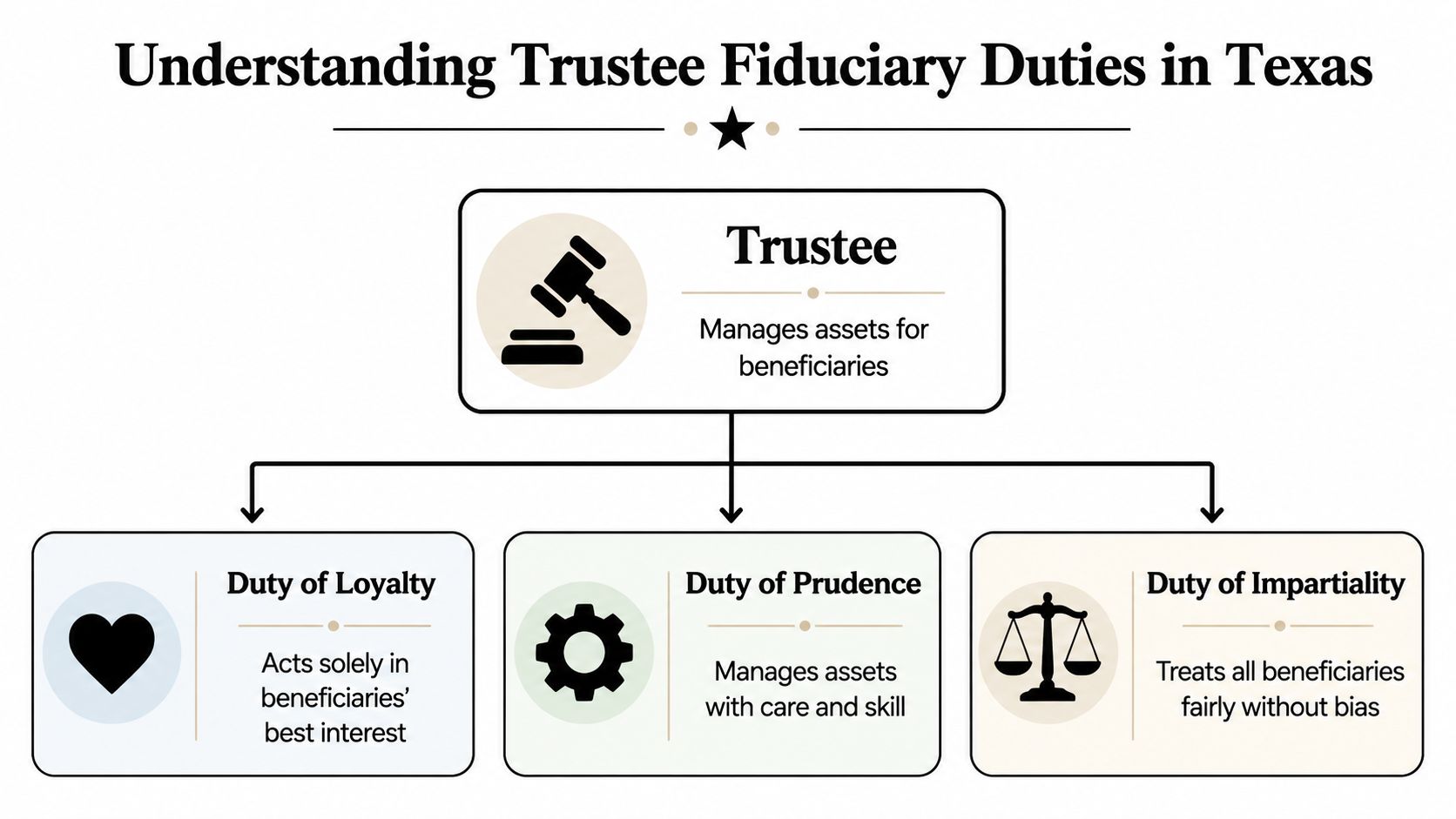
Duty of loyalty: The trustee must act in the beneficiaries' interest, not the trustee's own. If a trustee sells trust property to a business the trustee owns, that raises an immediate loyalty problem.
Duty of prudence: The trustee must manage assets with care and sound judgment. If a trustee ignores risk, fails to investigate decisions, or handles trust property casually, beneficiaries may claim the trustee acted imprudently.
Duty of impartiality: When there are multiple beneficiaries, the trustee must treat them fairly according to the trust's terms. A trustee can't favor the loudest sibling or the beneficiary the trustee likes best.
Duty to account and communicate: Trustees must keep clear records and provide information when required. Poor communication often turns a manageable issue into a lawsuit because beneficiaries begin to suspect concealment.
For a fuller discussion of these obligations, this guide on fiduciary duties of trustees in Texas is a helpful starting point.
Why fiduciary duty claims turn personal
Not every trustee mistake creates personal liability. But once a trustee crosses into self-dealing, disloyalty, or conduct that causes a loss, the case often stops being a simple administration dispute. It becomes a breach of fiduciary duty claim against the individual trustee.
Practical rule: If the trustee benefits personally from the transaction, a court will look much harder at whether the trustee crossed the line.
That basic principle shows up in many states, not just Texas. If you want a broader plain-English comparison of how these claims are analyzed, this discussion of Florida breach of fiduciary duty offers a useful outside-state perspective on the same core concept.
Drawing the Line When Can a Trustee Be Personally Sued
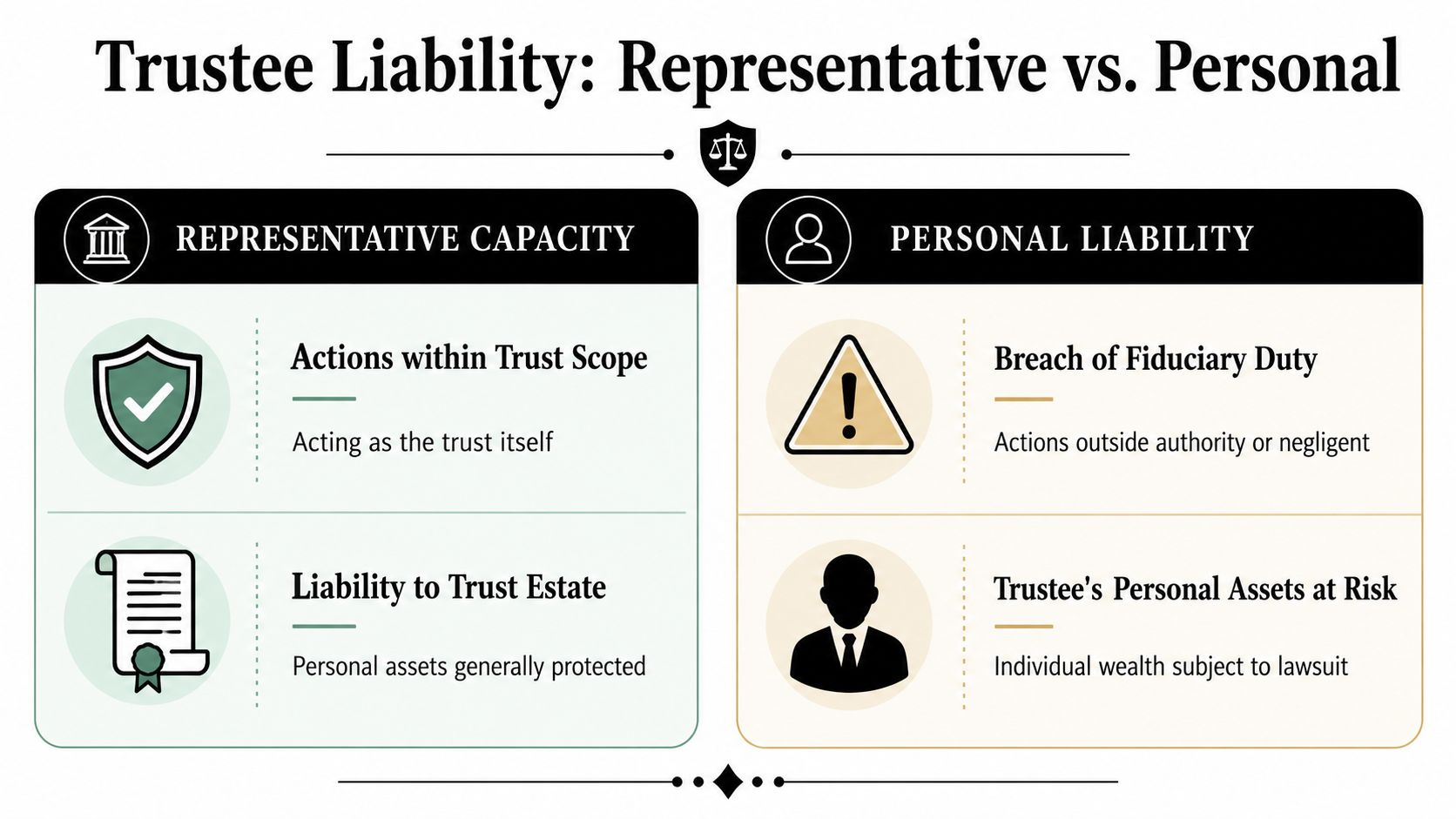
The central distinction is this: a trustee can be sued in a representative capacity or in a personal capacity. Those are not just technical labels. They often determine where a judgment may be collected and whether the trustee's own assets are exposed.
Texas law has long recognized that a trustee may be sued in a representative capacity, and the SMU Law Review explains that Section 19A of the Texas Trust Act permits suit against a trustee in that role and states that a judgment “shall be collectible by execution out of the trust property.” The same source notes that Texas law also preserved personal liability for a trustee's own torts, which is why wrongful personal conduct can still expose the trustee individually, as described in this SMU Law Review discussion of Texas trustee liability.
Representative capacity versus personal capacity
A short comparison helps:
| Capacity | What it usually means | Typical source of payment |
|---|---|---|
| Representative capacity | The trustee is being sued for an act taken on behalf of the trust | Usually trust property |
| Personal capacity | The trustee is being sued for the trustee's own wrongful conduct | The trustee's personal assets may be at risk |
This is why the same trustee may be named in two ways in the same case. One set of claims may involve trust administration. Another may allege personal breach of duty.
A simple example on the protected side
Suppose a trustee hires a property maintenance contractor to maintain trust-owned property. A billing dispute follows, and the contractor sues over the contract. If the trustee acted within authority and on behalf of the trust, that claim generally fits the representative-capacity model.
The complaint is really about a trust obligation, not personal wrongdoing by the trustee.
A beneficiary considering litigation over trustee conduct can compare these issues with this overview of a beneficiary suing a trustee in Texas.
Later in the dispute process, many people find it useful to hear the issue explained out loud:
A simple example on the dangerous side
Now change the facts. The trustee takes money from the trust and pays for a personal vacation, then records it vaguely as “administrative expenses.” That isn't representative action. That's personal conduct that can support a personal claim against the trustee.
The same is true if the trustee lies to beneficiaries, diverts trust opportunities, or personally commits a tort while managing trust affairs. A trustee doesn't avoid personal exposure just by saying, “I was acting as trustee.”
The title matters less than the conduct. Courts look at what the trustee actually did, not just how the trustee signed a document.
That's a critical distinction to grasp. Trustees are not insurers against every trust problem, but they are accountable for their own misconduct.
Common Scenarios Leading to Personal Lawsuits
Most trustee lawsuits don't start with dramatic fraud. They begin with conduct that feels explainable at first, then grows more serious when records are reviewed. These examples show how ordinary trust administration can turn into personal exposure.
Self-dealing with trust property
A trustee manages a trust that owns rental land. The trustee also owns an LLC. Instead of listing the land openly and negotiating at arm's length, the trustee arranges for the LLC to buy the property on favorable terms.
That situation raises a direct loyalty problem. Even if the trustee says the price was “fair enough,” the conflict itself is serious. Beneficiaries may claim the trustee put personal interests ahead of the trust and should repay losses personally or undo the transaction.
Reckless investment choices
Another trustee receives cash and marketable assets, then places nearly everything into one speculative investment because the trustee believes it will “take off.” The investment falls sharply, and the trust suffers a major loss.
A trustee does not have to guarantee positive returns. Markets move. Values change. But the trustee must act prudently, investigate decisions, and manage risk responsibly. Concentrating trust assets in an obviously risky way can lead to a claim that the trustee personally caused avoidable harm.
Beneficiaries usually understand bad luck. What they often challenge is bad process.
Silence, delay, and missing records
A third trustee may not steal anything at all. Instead, the trustee stops answering questions, delays distributions without explanation, and never provides a clear accounting. Bank statements are incomplete. Expenses aren't categorized. Family members receive inconsistent answers.
That pattern creates suspicion fast. Even when the underlying transactions are defensible, the failure to account can trigger litigation. Once a suit is filed, missing records often make everything worse for the trustee because the trustee may struggle to prove that decisions were proper.
Why these cases escalate
The common thread is not just loss. It is breach of duty tied to the trustee's own conduct.
- Conflict-driven decisions: The trustee benefits personally, directly or indirectly.
- Careless management: The trustee acts without the caution the role requires.
- Broken transparency: The trustee fails to document and explain actions.
In real life, these issues often overlap. A trustee who self-deals also tends to keep poor records. A trustee who makes reckless decisions may avoid communication after losses occur. That's why early legal advice matters for both sides. The sooner the conduct is evaluated, the easier it is to separate a misunderstanding from an actionable breach.
Defenses and Protections for a Texas Trustee
A trustee is not automatically on the hook in every dispute. Texas law draws an important line between actions taken in the trustee's representative role and conduct that is personal, disloyal, or outside the trustee's authority. That distinction matters because the same lawsuit can involve both kinds of claims.
A simple example helps. If a trustee hires a CPA for trust tax work and a disagreement later arises over the bill, that usually points to trust administration. If the trustee uses trust money to pay the CPA for the trustee's personal taxes, the issue shifts toward personal liability. The question is always the same: was the trustee acting for the trust, or for himself or herself?
The trust document may reduce exposure
Some trusts include an exculpatory clause. That language may protect a trustee from liability for certain mistakes made in good-faith administration. It does not usually protect intentional wrongdoing, bad faith, self-dealing, or reckless disregard of fiduciary duties.
The exact wording matters. So does how the problem arose. A trustee should read that clause as a guardrail, not a blanket shield.
Reimbursement and indemnification depend on the trustee's role
Texas trustees may have the right to reimbursement or indemnification for expenses properly incurred while administering the trust. In plain terms, if the trustee spends money carrying out trust duties in a proper way, the trust may repay those costs.
That protection usually weakens fast when the trustee is defending personal misconduct. A trustee accused of acting outside authority, taking a personal benefit, or breaching the duty of loyalty may have trouble asking the trust to cover the bill. The line stays the same here too. Costs tied to trustee work may be reimbursable. Costs tied to personal wrongdoing often are not.
Good process is one of the strongest protections
Courts often examine process as closely as outcome. A trustee who gathers information, gets advice, follows the trust terms, and keeps records is in a much stronger position than a trustee who makes major decisions by instinct and leaves no paper trail.
Professional advice matters for another reason. It helps show the trustee was trying to act as a careful fiduciary, not as an individual making casual personal choices. That can be especially helpful with property sales, valuation questions, tax reporting, discretionary distributions, and conflicts between beneficiaries.
Helpful protective steps include:
- Document the reason for major decisions: Keep appraisals, meeting notes, emails, written recommendations, and beneficiary communications.
- Keep trust property separate from personal property: Separate accounts and clear bookkeeping help show the trustee was acting in a representative capacity.
- Get advice before unusual transactions: Sales to relatives, uneven distributions, loans, and high-risk investments deserve legal and financial review.
- Communicate consistently: Clear responses and timely accountings can prevent suspicion from turning into a personal claim.
A trustee who treats the role like a formal job usually has better defenses than one who treats it like informal family help. That is often where cases are won or lost.
For trustees facing a difficult decision, early review by a Texas trust administration lawyer, CPA, valuation professional, or other advisor can help identify whether the proposed act belongs safely within the trustee's authority or risks crossing into personal exposure.
Remedies and the Statute of Limitations for Beneficiaries
When beneficiaries suspect wrongdoing, they usually want to know two things. What can a court do, and how long do they have to act? Both questions matter because waiting too long can make a strong claim harder to pursue.
Remedies a court may order
A Texas court has several tools available in a trustee dispute. The right remedy depends on the conduct and the harm involved.
Common remedies may include:
- Compelling an accounting: The trustee may be ordered to produce records and explain transactions.
- Removal of the trustee: If the trustee can't or won't serve properly, the court may replace the trustee.
- Repayment of losses: If the trustee's conduct harmed the trust, the court may order the trustee to restore what was lost personally.
- Reversal of improper transactions: A court may unwind a transfer if trust property was sold or transferred improperly.
These remedies are practical, not theoretical. In many cases, the first real turning point is getting the documents. Once records are produced, the dispute usually becomes much clearer.
If you're a beneficiary, your first goal is often information, not accusation.
The limitations issue that catches families off guard
Texas fiduciary-duty claims are often discussed with a four-year limitations period in mind. But beneficiaries should not treat that as a simple calendar exercise. Timing can become complicated when the trustee controlled the records or the beneficiary did not know, and could not reasonably have known, about the wrongful conduct.
That's where the discovery rule may matter. In plain language, the clock may not start when the wrongful act happened if the problem was hidden and the beneficiary could not reasonably discover it earlier. This issue is heavily fact-dependent, and it often becomes one of the first arguments in trust litigation.
A practical approach for beneficiaries
If something feels wrong, don't rely on family assumptions or verbal explanations alone. Start by gathering documents and making a written request for information. Preserve emails, texts, account statements, notices, and anything else showing what you were told and when.
Then get legal advice promptly. Waiting can weaken your position, especially if assets are moving, records are incomplete, or the trustee is becoming harder to reach. A beneficiary doesn't need proof of every detail before consulting counsel. The goal is to understand rights, possible remedies, and timing before options narrow.
Next Steps for Trustees and Beneficiaries
A trustee can go from managing routine paperwork to facing a personal lawsuit faster than many families expect. The turning point is often simple. Did the trustee act in the trustee role, within the trust's authority, or step outside that role and act personally?
For trustees, that line should shape every decision. Use the trust's name and your trustee title on contracts, keep trust property separate from your own, and create a paper trail that shows why you made each major choice. A trustee who signs clearly as trustee and follows the trust terms is in a very different position from one who mixes funds, makes side deals, or acts without authority.
Real estate disputes show this clearly. A family home held in trust may need to be sold after a death, but conflict starts when no one is sure who can sign, who must be notified, or whether the trustee is selling on proper terms. Practical outside reading such as this guide with actionable advice for trust sellers can help families spot the procedural issues that often lead to larger trust disputes.
For beneficiaries, the same line matters for a different reason. If the complaint is really about a trustee's decision made in the course of administration, the claim may focus on the trustee in that fiduciary capacity. If the trustee used trust property for personal benefit, hid transactions, or exceeded authority, personal liability becomes a much more realistic issue.
A simple checklist helps keep that distinction clear.
For trustees:
- Sign in the correct capacity: Use your full trustee title on agreements, letters, and closing documents.
- Keep accounts separate: Trust money should never pass through a personal account.
- Document judgment calls: Keep records showing the facts you reviewed, the advice you received, and the reason for the decision.
- Get advice early: Legal, tax, or valuation advice often helps prevent personal exposure later.
For beneficiaries:
- Ask targeted questions: Request the document, transaction, or accounting entry you want explained.
- Build a timeline: Note when requests were made, what responses came back, and what remains missing.
- Look for capacity clues: Contracts, checks, deeds, and emails often show whether the trustee acted as trustee or acted personally.
- Seek a case assessment: A lawyer can help sort out whether the problem is poor administration, a breach of duty, or conduct that may support personal claims.
If litigation may be necessary, the earlier discussion of how to sue a trustee in Texas explains the basic path. The main point here is practical. The closer everyone stays focused on capacity, authority, and documentation, the easier it becomes to see whether the dispute belongs against the trustee in that role, against the trustee personally, or both.
If you're managing a trust or planning your estate, contact Law Office of Bryan Fagan, PLLC for a free consultation. Our attorneys provide Texas-based guidance on estate planning, probate, guardianship, asset protection, trust administration, and trustee dispute resolution.